
So, you're thinking about a new concrete project—maybe a patio for those summer cookouts, a solid foundation for a new garage, or a driveway that actually adds to your curb appeal. The first question on everyone's mind is always the same: "What's this going to cost me?"
In the Atlanta area, a good rule of thumb for a standard concrete slab installation is somewhere between $6 and $12 per square foot. This ballpark figure typically covers the concrete itself, the labor to pour and finish it, and basic site prep. For a typical 400-square-foot project, like a two-car garage floor, this translates to a total cost of $2,400 to $4,800.
Your Quick Guide to Atlanta Concrete Slab Costs
Getting a handle on the numbers is the first real step toward turning your idea into reality. While that $6 to $12 per square foot range is a fantastic starting point, the final price really depends on the specifics of your job.
Think of it like buying a car. The base model has a set price, but as you add features like a sunroof, leather seats, or a better engine, the cost goes up. Concrete is no different. A simple, broom-finished patio won't cost the same as a thick, reinforced slab engineered to hold two SUVs. For instance, a 4-inch-thick slab for a patio might cost $8 per square foot, while a 6-inch-thick driveway slab with rebar reinforcement could be $11 per square foot for the same yard.
For a bit of context, these Atlanta-area prices are right in line with what you'd see across the country. Nationally, most standard 4- to 6-inch thick slabs run from $6 to $10 per square foot. So, for a common 30×30 foot slab (900 sq ft) for a garage or a large patio, you could be looking at a total between $5,400 and $9,000.
Estimated Concrete Slab Costs in Atlanta at a Glance
To make budgeting a little easier, it helps to see how these per-square-foot numbers play out in real-world projects. Here’s a quick table to give you a clearer picture of what to expect for some of the most common jobs we handle at Atlanta Concrete Solutions.
| Project Type | Common Size (sq ft) | Average Cost per Square Foot | Estimated Total Cost |
|---|---|---|---|
| Small Patio | 100 sq ft | $8 – $12 | $800 – $1,200 |
| Shed Foundation | 200 sq ft | $7 – $11 | $1,400 – $2,200 |
| Two-Car Garage Slab | 400 sq ft | $6 – $10 | $2,400 – $4,000 |
| Two-Car Driveway | 576 sq ft | $7 – $12 | $4,032 – $6,912 |
This chart is a great starting point, but remember, every property is different. Things like tricky access for our trucks, needing extra grading work, or choosing a decorative stamped finish will all nudge the final price. For example, if a backyard is fenced with no gate, requiring a concrete pump to move the material from the truck, it could add $500 to $1,000 to the total cost.
The most important thing to remember is that an accurate price comes from a detailed, on-site evaluation. A professional quote accounts for all the little variables an online calculator can't see, ensuring you get a firm price with no surprises.
Next, we'll dig into the specific factors that make these prices go up or down. Understanding what goes into a quote will give you the confidence to move forward with your project, whether it's a simple walkway or a complex foundation. Feel free to also review the full range of our professional concrete services to see what's possible for your home.
The 6 Key Factors That Drive Your Concrete Slab Price
Getting an average cost for a concrete slab is a good starting point, but it doesn't tell the whole story. What makes one project's final bill different from another? It’s a lot like ordering a custom piece of furniture—the final price isn't based on one thing, but on a handful of specific choices and site conditions.
Think of your quote as a recipe. Each ingredient contributes to the final product and its cost. Once you understand these "ingredients," you'll see exactly where your money is going and can make smart decisions for your Atlanta home. Let's dig into the six biggest factors that will shape your concrete slab estimate.
1. Slab Thickness and Volume
This one is the most straightforward. The final cost is directly tied to the sheer volume of concrete we need to pour, which all comes down to the slab's thickness. For a simple patio that will only see foot traffic, a 4-inch thick slab is usually plenty.
But what about a driveway that has to hold up a heavy SUV day after day? That requires a much beefier 6-inch foundation. That little 2-inch difference might not sound like a lot, but it means we have to order and pour 50% more concrete, which has a major impact on material costs. For a 500 sq. ft. area, a 4-inch slab requires about 6.2 cubic yards of concrete, while a 6-inch slab needs 9.3 cubic yards. At an average price of $150 per cubic yard, that's a material cost difference of nearly $500 before labor is even considered.
2. Site Preparation and Grading
Long before the concrete truck ever shows up, the ground has to be perfectly prepared. This phase is basically building the foundation for your foundation—it has to be done right. If you have a flat, clear, and level yard, the prep work is minimal and might only add $1 to $2 per square foot to the cost.
Unfortunately, many properties around Atlanta have slopes, pesky tree roots, or poor soil that we need to deal with first. This often involves:
- Excavation: Digging out soil to create a stable, level base for the slab.
- Grading: Carefully reshaping the land to ensure rainwater flows away from your home, not toward it.
- Hauling: Getting rid of all the excess dirt, rocks, and debris.
A sloped backyard that needs a lot of grading and dirt removal will naturally cost more in labor and equipment than a site that's already flat and ready to go. A challenging site could increase prep costs to $3 to $5 per square foot.
A project’s success is often decided before a single drop of concrete is poured. Proper site prep prevents future headaches like cracking, shifting, and water damage, making it one of the most critical parts of your investment.
3. Reinforcement Materials
Here's a fact about concrete: it's incredibly strong when you push down on it (compression), but not so great when you pull on it (tension). To fix that weakness, we add reinforcement. It acts like a hidden steel skeleton inside the slab, holding everything together and helping to distribute heavy loads evenly.
The two most common types of reinforcement are:
- Wire Mesh: A grid of steel wires that’s great for preventing small surface cracks from spreading. This is a budget-friendly option, adding about $0.50 per square foot to the project cost, making it ideal for patios and walkways.
- Rebar: Thick steel rods that provide serious structural strength. This is absolutely essential for driveways, garage floors, and building foundations. Rebar is more expensive, typically adding $1.00 to $2.00 per square foot, but it's the only choice for load-bearing slabs.
Using rebar costs more than wire mesh, but it's completely non-negotiable for any slab that will be holding up a vehicle or a structure. Skimping on reinforcement is one of the fastest ways to guarantee a cracked, failed slab down the road.
4. Concrete Strength (PSI)
Not all concrete is the same. Its strength is measured in Pounds per Square Inch (PSI), which tells you how much pressure it can handle before cracking. Think of it like a recipe for a cake—you can use different ingredients to make a light, fluffy sponge cake or a dense, heavy fruitcake.
Concrete is a specific mix of cement, sand, gravel, and water, and by tweaking those ratios, we can create mixes for different jobs.
- A simple sidewalk might only need a 2,500 PSI mix, which is the most affordable option.
- A standard driveway, on the other hand, needs at least a 4,000 PSI mix to handle the weight of cars and stand up to the weather. Upgrading from 2,500 to 4,000 PSI can increase the material cost by 10-15%.
Higher PSI mixes cost more, but they provide the durability needed for more demanding projects.
5. Finishes and Customization
The finish is the part you actually see and walk on, and it can range from simple and functional to beautifully decorative. Your choice of finish has a big impact on both the labor time and the final cost.
- Broom Finish: This is the most common and budget-friendly option, typically included in the base $6-$12 per sq. ft. price. We just drag a special broom over the wet concrete to create a non-slip texture.
- Trowel Finish: This creates a very smooth, hard surface that's easy to clean, often adding $1 to $2 per square foot. It's ideal for garage floors and basements.
- Stamped Concrete: This is where things get creative. We press patterns into the concrete to make it look like expensive stone, brick, or even wood. The added labor and materials can increase the total cost to $15 to $20+ per square foot.
- Stained or Colored Concrete: We can add special dyes and stains to the mix to create unique colors and visual effects. An integral color (mixed in) might add $1 per sq. ft., while a more complex acid stain finish could add $2 to $4 per sq. ft.
6. Labor and Site Accessibility
Finally, labor costs and how easy it is to get to your worksite play a huge role. If our concrete truck can pull right up to the area where we're pouring, the job is fast and efficient. This direct access is the baseline for a standard quote.
However, if the project is in a fenced-in backyard with no direct access, things get trickier. We might have to use wheelbarrows or a special concrete pump to get the material where it needs to go. A pump truck rental, for example, can add $500 to $1,000 to the total project cost. That extra time and equipment will be reflected in the labor portion of your quote. The global concrete slab market is always growing, and you can learn more about how US costs of $6–$12 per square foot compare to global trends in this 2025 concrete pricing guide.
Real-World Costs for Common Concrete Projects
Knowing the individual cost factors is a great start, but seeing how they all come together on a real-world job is what truly helps with budgeting. Let's walk through three of the most common residential concrete projects we handle right here in Atlanta to see how the numbers stack up.
These examples really highlight how different needs—like supporting a heavy SUV versus creating a beautiful outdoor hangout spot—dramatically change the final investment. By looking at these scenarios, you'll get a much clearer picture of what your own project might cost.
A New Concrete Driveway
A driveway is much more than a place to park your car. It's a heavy-duty workhorse that has to bear thousands of pounds of pressure day in and day out. This is where getting the thickness and reinforcement right isn't just a good idea—it's absolutely essential for a slab that lasts.
Let's break down a standard two-car driveway, measuring 24×24 feet, which gives us a total of 576 square feet.
- Thickness is a Must: To prevent ugly cracks and premature failure under the weight of vehicles, a driveway needs to be poured at a minimum of 6 inches thick. A 4-inch slab just won’t cut it for this job.
- Heavy-Duty Reinforcement: You need a strong rebar grid to properly distribute all that weight and resist cracking. Lighter wire mesh is meant for foot traffic, not vehicles. It costs more, but it’s the only way to ensure your driveway stands the test of time.
- A Practical Finish: A simple, non-slip broom finish is the go-to for driveways. It’s the most cost-effective option and provides fantastic traction, rain or shine.
For a driveway project like this, you can expect the cost to land somewhere in the $7 to $12 per square foot range. That puts the total estimate for a 576 sq ft driveway between $4,032 and $6,912, which accounts for that thicker pour, the robust rebar, and all the necessary site prep.
A Backyard Concrete Patio
Unlike a tough-as-nails driveway, a backyard patio is all about creating a beautiful and functional outdoor living space. The focus here shifts from raw structural strength to aesthetics, which means your choice of finish can play a huge role in the final cost.
Let’s imagine a popular patio size of 12×16 feet, which is 192 square feet.
- Standard Thickness: A patio only has to support people and outdoor furniture, so a 4-inch thick slab is more than enough. This uses quite a bit less concrete than a driveway.
- Basic Reinforcement: Simple wire mesh is usually all you need to prevent minor surface cracks and keep the slab stable for years of cookouts and gatherings.
- The Finish Makes the Difference: This is where your budget can really flex. A basic broom finish keeps costs down, but if you want a decorative stamped pattern that mimics slate or cobblestone, the added labor and materials will increase the price.
A simple, straightforward patio will typically run $8 to $12 per square foot. But if you go for a high-end stamped or stained finish, that price can easily jump to $15 to $20+ per square foot.
So, a simple 192 sq ft patio might cost between $1,536 and $2,304. That same patio with an intricate stamped design could quickly climb to $2,880 to $3,840 or even more. It's a perfect example of how much the finish can influence the bottom line.
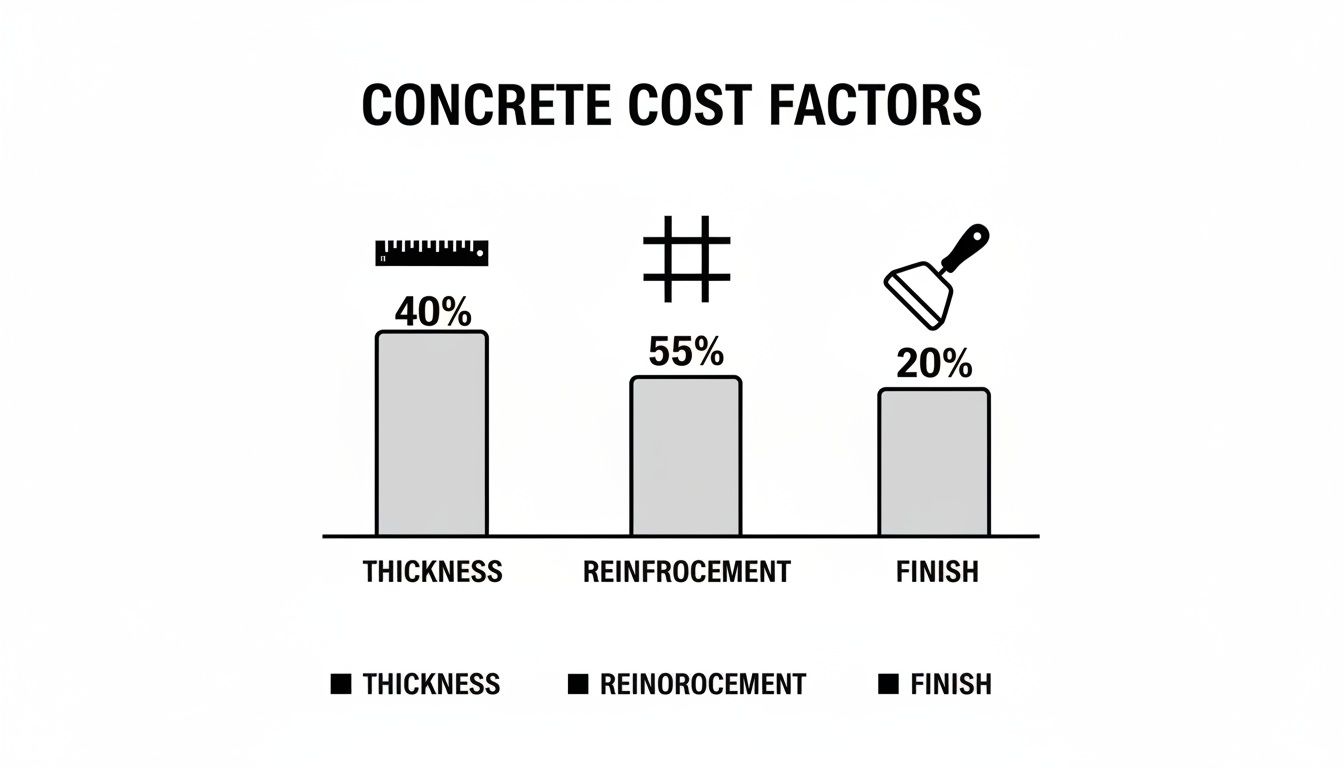
This chart helps visualize how the structural elements—thickness and reinforcement—form the cost foundation, while the finish is a variable you can adjust to match your style and budget.
A Garage or Shed Foundation
A foundation for a garage or a large shed has one critical job: to provide a perfectly level, stable, and strong base for the building above it. This kind of project is all about precision and structural integrity, borrowing elements from both driveways and patios.
Let's use a 20×20 foot garage foundation (400 square feet) as our example.
- Engineered Thickness: The required thickness depends on the building's weight and local codes, but it’s usually between 4 to 6 inches. A standard garage often gets a 4-inch slab with thickened edges, known as footings, to support the load-bearing walls.
- Structural Reinforcement: Rebar is non-negotiable here. It’s used around the perimeter and often throughout the slab to handle the weight of the structure and any cars parked inside.
- A Smooth, Functional Finish: The goal is a perfectly flat and smooth surface. A hard trowel finish is the industry standard—it’s durable, easy to sweep, and ready for any floor coatings you might want to add later.
The cost for a garage foundation generally falls between $6 and $10 per square foot. For our 400 sq ft example, you’d be looking at a total project cost ranging from $2,400 to $4,000. This covers the concrete, rebar, and the skilled labor needed to get that foundation perfectly right.
If a foundation is on your project list, you can learn more about our expertise with all types of residential poured concrete and see how we guarantee a solid build from the ground up.
Sample Project Cost Scenarios in Atlanta
To bring it all together, let’s compare these three common projects side-by-side. This table really illustrates how the specific requirements of each job—from thickness to finish—directly impact the final price tag.
| Cost Factor | Backyard Patio (12×16 ft) | Standard Driveway (24×24 ft) | Garage Foundation (20×20 ft) |
|---|---|---|---|
| Primary Use | Foot traffic, furniture | Vehicle weight, daily use | Structural support, vehicle storage |
| Slab Thickness | 4 inches (Standard) | 6 inches (Heavy-Duty) | 4 inches (with thickened edges) |
| Reinforcement | Wire Mesh | Rebar Grid | Rebar Grid & Footings |
| Common Finish | Broom or Stamped | Broom Finish (Non-slip) | Trowel Finish (Smooth) |
| Est. Sq Ft Cost | $8 – $20+ | $7 – $12 | $6 – $10 |
| Total Est. Cost | $1,536 – $3,840+ | $4,032 – $6,912 | $2,400 – $4,000 |
As you can see, there's no single answer to "how much does a concrete slab cost?" It always comes down to what you're building and what you need it to do. A patio and a garage foundation might have the same thickness in the middle, but the need for structural footings on the garage changes the entire scope and cost of the job.
How to Shave Costs on Your Concrete Slab (Without Cutting Corners)
Everyone loves a good deal, but when it comes to concrete, the cheapest option isn't always the best value. A poorly installed slab will cost you far more in repairs and headaches down the road. The real secret to saving money is being a smart, informed customer.
Fortunately, there are several practical ways to manage your budget and bring down the total cost of a concrete slab without sacrificing the quality that ensures it lasts a lifetime. It’s all about making strategic choices that focus on long-term value, not just a lower number on the initial quote.
Roll Up Your Sleeves and Prep the Site
A big chunk of any concrete bid is labor, and site preparation is where a lot of those hours get spent. If you've got the time and are willing to put in a little sweat equity, you can tackle some of the prep work yourself and see a noticeable difference in your quote.
Before our crew arrives, consider doing the following:
- Clear the space: Get rid of any grass, weeds, small shrubs, rocks, or old mulch in the area where the slab will go.
- Do some light demolition: If you're replacing a small, cracked walkway or a few old pavers, breaking them up and hauling them away can cut down on our team's labor time.
- Create easy access: Make sure there's a clear, wide path for our equipment and crew. That might mean moving a woodpile, trimming a few low-hanging branches, or just clearing a path from the street to your backyard.
Stick with a Simple, Functional Finish
Stamped, stained, and decorative finishes look incredible, but they also require extra materials, specialized tools, and a lot more time. All that adds up. The single easiest way to control your costs is to go with a classic, high-quality finish that gets the job done right.
A standard broom finish is by far the most budget-friendly choice. It creates a clean, non-slip texture that’s perfect for just about any application, from driveways and garage floors to patios and walkways. You get fantastic durability and function without the premium price tag.
Choosing a standard broom finish over a decorative stamped pattern can often reduce the per-square-foot cost by $5 to $10 or more. For a 200-square-foot patio, that's a potential savings of $1,000 to $2,000.
Be Flexible with Your Project’s Timing
Just like any other construction trade, concrete contractors have peak seasons and slower periods. Spring and summer are prime time, when everyone wants their outdoor projects done. If your timeline is flexible, scheduling your project during the off-season—like late fall or even a mild week in the winter—can work in your favor.
When our schedule isn't completely packed, we sometimes have more flexibility on pricing to keep our crews working. A little bit of patience on your end can sometimes lead to savings of 5-15% on the total job.
Always Get Multiple, Detailed Quotes
This is the golden rule of any home improvement project. Don't just get one price; get at least three detailed, itemized quotes from reputable local contractors (and we hope you'll include us!). A professional quote won't just have a single number at the bottom—it will break down the costs for materials, labor, site prep, reinforcement, and finishing.
This lets you compare "apples to apples" so you know exactly what you're paying for. It also helps you spot any outliers, like a bid that seems way too high or, even more concerning, one that seems too good to be true. We believe in being transparent with our pricing because a well-informed decision is always the best one.
From Dirt to Done: The Concrete Slab Installation Process
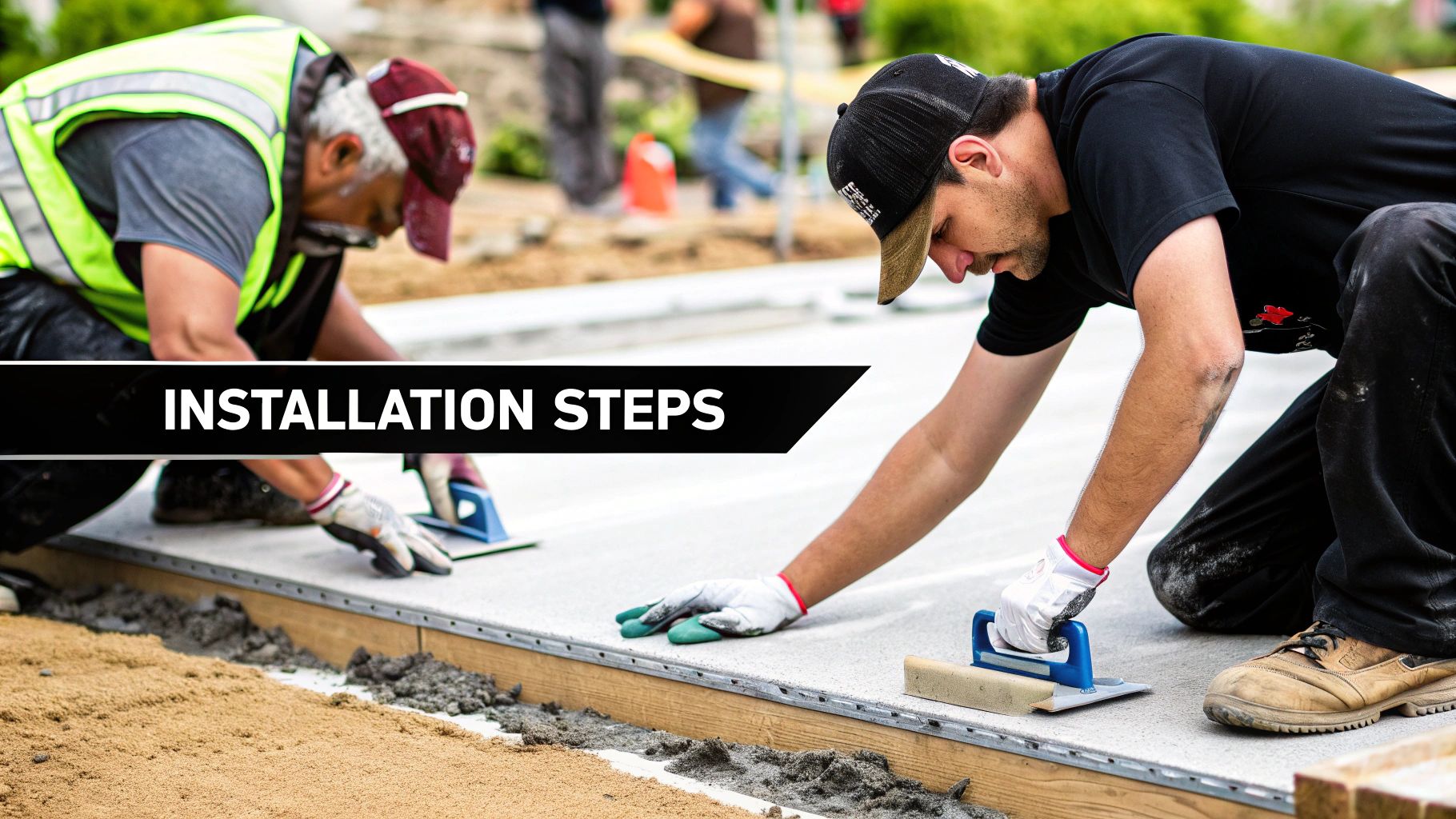
It helps to understand the factors behind the average cost for a concrete slab, but seeing how it all comes together really provides peace of mind. Knowing what to expect demystifies the whole project, transforming a big undertaking into an exciting improvement. A professional job is like a well-choreographed dance, where every single step is critical for the strength and look of your final slab.
The journey from a patch of grass to a perfect concrete surface is a straight line. Once you give us the green light on our detailed quote, the Atlanta Concrete Solutions team gets to work planning every detail to make sure the project runs like clockwork. Let's walk through what a professional concrete installation looks like.
Phase 1: The Foundation of a Good Slab – Site Prep
Everything officially kicks off with a thorough site visit and consultation. This is our chance to lock in the final dimensions, confirm your choice of finish, and answer any lingering questions you might have. With the plan set, the real work begins with site preparation—and honestly, this is the most important part of the entire process.
This first phase involves a few key steps:
- Excavation: Our crew clears the area, digging out grass, soil, and any debris to the exact depth needed for your new slab.
- Grading: We then carefully level and compact the earth beneath. This creates a solid, stable base that's essential for supporting the concrete and preventing it from shifting or cracking down the road.
- Formwork: Next, we build a temporary wooden frame, called "formwork," around the perimeter. Think of it as a mold for the concrete; it holds the wet mix in place and guarantees your slab has those clean, precise edges you want.
Phase 2: The Main Event – Pouring and Finishing
With the groundwork perfectly laid, it's time for the pour. The arrival of the concrete truck is the big moment—your project is about to take its final shape. This is where skill, precision, and teamwork are absolutely non-negotiable.
Our experienced finishers have to move fast. They work methodically to spread the concrete mix evenly throughout the forms, making sure to eliminate any air pockets. Using specialized tools like screeds and floats, they level the surface to a perfectly smooth plane. This is also when we apply the final texture, whether it's a practical non-slip broom finish for a walkway or a sleek trowel finish for a garage.
A professional concrete pour is a race against the clock. The material has to be placed, leveled, and finished before it starts to set. It takes a highly coordinated and experienced crew to pull it off flawlessly every time.
Phase 3: The Waiting Game – Curing
After the last finishing touches are done, we enter the most overlooked—yet vital—phase: curing. Fresh concrete doesn’t just "dry" like paint. It goes through a chemical reaction called hydration, where water and cement particles bond to create an incredibly hard, crystalline structure.
This is where concrete gets its legendary strength. To make sure it cures properly, we often apply a curing compound or cover the slab to manage moisture and temperature. Rushing this step is a surefire way to end up with a weak, brittle slab that’s prone to cracking.
While you can usually walk on a new slab within 24-48 hours, it needs a full 28 days to reach its maximum design strength. This is especially important for driveways that have to bear the weight of vehicles. That patient wait is the best insurance you can get for a slab that will stand strong for decades.
Why Choose a Professional Atlanta Concrete Contractor
Getting a handle on the factors that drive the average cost for a concrete slab is a great start. But the next, and arguably most important, step is finding the right team to bring your project to life—without any headaches or surprise costs down the road.
At Atlanta Concrete Solutions, we’ve built our entire business on being upfront and honest. It’s easy for a less experienced crew to throw out a lowball number that looks good on paper. What they often leave out are crucial details like proper site prep or using the right strength of concrete mix, which almost always leads to cracks, settling, and expensive fixes later. We just don't work that way.
Your Partner for Quality and Transparency
We believe you deserve to know exactly what you're paying for. That's why our quotes are detailed and itemized, breaking down everything from the specific thickness and rebar needed for your slab to the exact finish you've picked out. We don’t take shortcuts, and we never compromise on quality.
Our goal is simple: to deliver a finished product that you'll be happy with for decades to come.
Choosing a contractor is about more than just a price; it’s about ensuring the job is done right the first time. Our satisfaction guarantee is our promise that your project receives the expert craftsmanship it deserves.
We're proud of the work we do, and we think it speaks for itself. You can see the level of quality and care we bring to every job by taking a look at some of our completed driveways, patios, and foundations when you view our recent projects.
Ready for a clear, reliable estimate for your project? Reach out to Atlanta Concrete Solutions today. We’d be happy to provide a free, no-obligation consultation and show you how we can build lasting value for your home.
Still Have Questions About Concrete Slab Costs?
Even with all the numbers laid out, you probably still have a few questions floating around. That’s perfectly normal. Let's tackle some of the most common ones we hear from homeowners right here in Atlanta.
How Much More Does a 6-Inch Slab Cost Than a 4-Inch Slab?
This is a great question. A 6-inch slab uses 50% more concrete than a 4-inch slab for the exact same area, which bumps up the total project cost by about 20-30%.
It might be tempting to save a few bucks by going thinner, but for anything that needs to handle serious weight, those extra two inches are absolutely critical. Driveways, garage floors, or foundations for sheds need that added thickness to prevent cracking and stand up to years of use.
Think of it like this: paying a bit more for the right thickness is your best insurance policy against a future of cracks, crumbling, and costly repairs. It’s about doing the job right the first time.
Do I Need a Permit for a Concrete Slab in Atlanta?
This one is a classic "it depends." The need for a permit really boils down to the size and scope of your project.
- Small Patios: A simple, ground-level patio that isn't changing how water drains off your property? You're often in the clear and won't need a permit. For example, a 10×10 foot patio in the middle of a backyard typically requires no permit.
- Driveways & Foundations: Pouring a new driveway, a foundation for a garage, or any slab that’s part of a new structure? You'll almost certainly need to get a permit from your local building department. Altering a driveway curb cut or building a foundation for a 20×20 garage will always require a permit to ensure it meets safety and zoning codes.
The rules can vary slightly between Atlanta, Marietta, and other local municipalities. The easiest way to navigate this is to work with a team like us at Atlanta Concrete Solutions. We know the local codes inside and out and can handle the entire permitting process for you.
How Long Until I Can Walk on My New Concrete Slab?
I know you'll be eager to use your new space, but patience is a virtue when it comes to concrete curing. The slab needs time to build up its strength.
You can usually walk on the fresh slab within 24 to 48 hours. But hold off on placing heavy patio furniture or your grill for at least 7 days. If it’s a driveway, you absolutely must wait the full 28 days for the concrete to reach its maximum compressive strength before you even think about parking a car on it.
Tired of guessing what your project will cost? Let's get you a real number. The team at Atlanta Concrete Solutions can give you a clear, detailed estimate with no strings attached. Reach out today, and let's get your project started on solid ground.