
The going rate for a new concrete slab in Atlanta usually lands somewhere between $6 and $12 per square foot. That price generally covers the concrete itself, the labor to install it, and the basic prep work for a standard 4-inch thick slab. For most folks, this is the magic number to start with when you're budgeting for a new patio or driveway. For example, a simple 10×10 foot (100 sq ft) patio might cost between $600 and $1,200, giving you a tangible starting point for your budget.
Your Guide to Atlanta Concrete Slab Costs
When you're planning a concrete project here in Atlanta, you have to look beyond the national averages. They're a decent starting point, sure, but the final price tag is really shaped by what's happening right here in our own backyard.
Think of it like buying peaches. You'd expect a different price for a Georgia peach in Atlanta than you would in, say, Seattle. That’s because of local supply, labor, and getting it from the farm to the market. Concrete works the exact same way.
A few local factors that will nudge your final quote up or down include:
- Where the Materials Come From: The distance to haul heavy stuff like cement, sand, and gravel from local quarries and plants definitely plays a role in the cost. For instance, a project in south Fulton County might have slightly lower material transport costs than one in northern Gwinnett if the quarry is closer.
- Atlanta's Labor Market: We have a busy construction scene in the metro area, and that competition influences what skilled crews charge for a top-notch installation. A skilled concrete finisher's hourly rate can fluctuate based on demand, directly impacting your total cost.
- How Busy Everyone Is: When demand for construction is high, like during the spring and summer building seasons, it can sometimes affect scheduling and pricing across the board. For example, booking a project in April might come with a higher price tag than booking it in a slower month like November.
Breaking Down the Numbers
The national average for a standard 4-inch reinforced concrete slab is currently running between $6 to $12 per square foot. That number bundles in materials, labor, basic reinforcement, and site prep.
Let's put that into a real-world example. For a typical 24×24-foot garage slab (576 sq ft)—a really common size for homeowners around Atlanta—you’re looking at a total project cost between $3,456 and $6,912 using that national average.
Luckily for us, in competitive southern markets like Georgia, prices can sometimes dip as low as $5.50 per square foot. That makes it a great time for Atlanta homeowners and businesses to invest in a solid slab for a driveway, sidewalk, or commercial pad. You can dig into more national concrete pricing trends over at BhumiCalculator.com.
The only way to get the real cost for your project is with a detailed local quote. An expert on the ground can see everything a national average can't—from your specific soil conditions to how easily a truck can access your property. For instance, a quote for a home in a hilly Roswell neighborhood will be different than one for a flat lot in Peachtree City due to grading needs.
Consider this guide your first step. It gives you a solid baseline to work from as we get into the nitty-gritty details. When you're ready to see exactly what your project will cost, the best move is always to talk with local pros who know the ins and outs of working with Atlanta concrete.
Breaking Down Your Concrete Slab Estimate
Ever get two quotes for the same job and wonder why they're worlds apart? A concrete slab estimate isn't just a single number; it's the story of your specific project, from the ground up. Knowing how to read that story lets you understand exactly where your money is going and compare quotes with confidence.
Instead of just a boring list of cost factors, let's peel back the layers and get into the "why" behind each line item on your bid. The average cost of a concrete slab is a direct result of these moving parts, and each one plays a crucial role in the final price.
This infographic gives a great visual of how national averages, local Atlanta realities, and your project's unique details all come together.
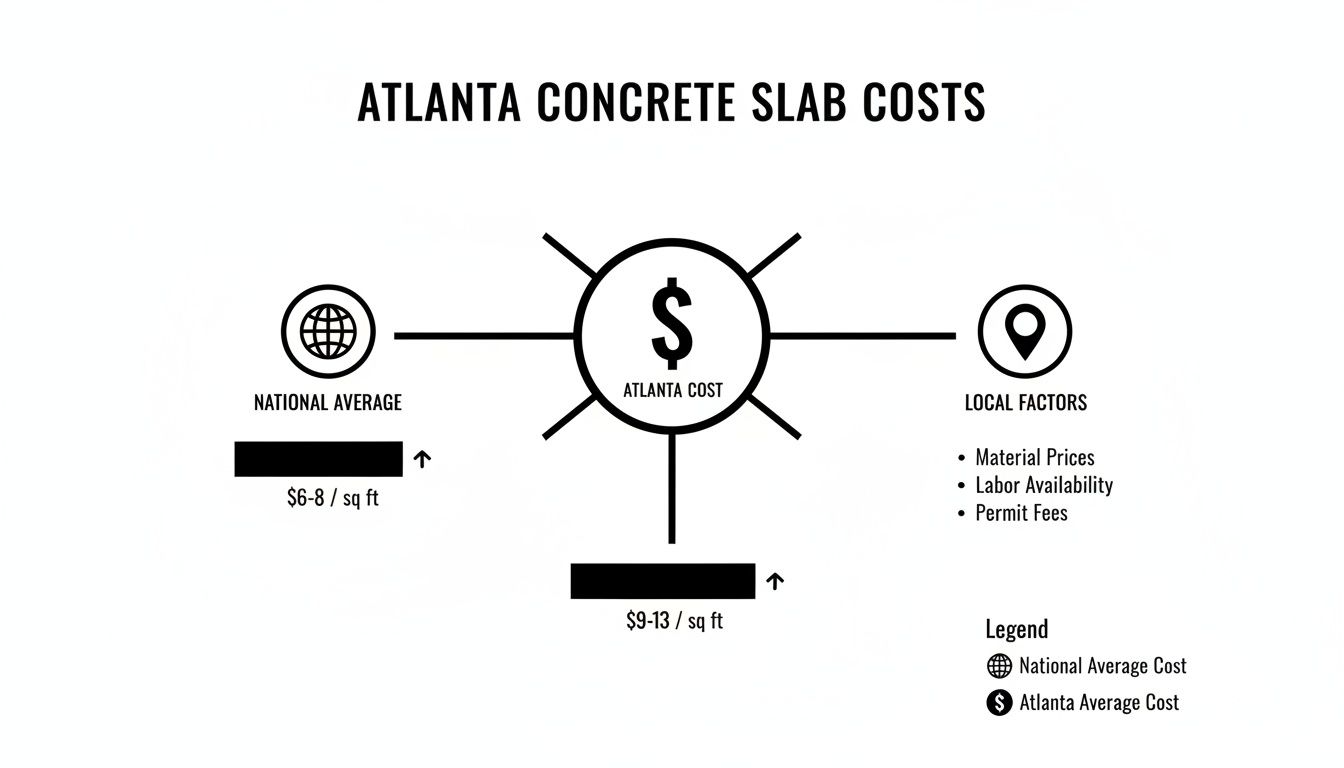
As you can see, the final price tag for your Atlanta-area project is a mix of big-picture market trends and the hyper-local factors a contractor can only assess by seeing your property firsthand.
Slab Thickness: The Foundation of Your Cost
One of the biggest levers on your final cost is, unsurprisingly, the thickness of the slab. A four-inch slab is pretty standard for things like patios or sidewalks, but anything that needs to support serious weight requires more concrete. And it's not just about the cost of the extra material; a thicker slab creates a ripple effect across the entire budget.
For example, pouring a six-inch slab for a driveway that will hold an RV or a heavy-duty workshop floor doesn't just use 50% more concrete than a four-inch slab. It also means we have to dig deeper, bring in more gravel for the sub-base, and often use beefier reinforcement to handle all that extra stress.
- Patio Example: A typical 15×15 foot patio (225 sq ft) at a standard 4-inch thickness needs about 2.8 cubic yards of concrete.
- Workshop Example: That same 225 sq ft slab, but at 6 inches thick for heavy equipment, now needs around 4.2 cubic yards. That’s a big jump in material costs before a single hour of labor is factored in.
Reinforcement: Giving the Slab Its Skeleton
Plain concrete is incredibly strong under compression (squishing forces) but weak under tension (pulling forces). Reinforcement is what gives it the tensile strength to resist cracking under load. Your project will likely use one of two options: wire mesh or steel rebar.
Think of it this way: wire mesh is like the ligaments in a joint, holding everything together for general stability. Rebar is like the bones—a rigid, structural skeleton built for heavy lifting.
Wire mesh is the more affordable option and it works just fine for light-duty surfaces like a simple walkway. For example, a walkway slab with wire mesh might add $0.50-$1.00 per square foot to the cost. Rebar, which means building a grid of thick steel rods, is more expensive and labor-intensive, potentially adding $2.00-$3.00 per square foot. But it's absolutely essential for foundations, garage floors, and driveways that have to support thousands of pounds day in and day out. Your estimate will reflect not only the cost of the steel itself but also the skilled labor needed to lay out and tie this "skeleton" together before a drop of concrete is poured.
Site Prep and Access: The Hidden Game-Changers
This is where you can see two seemingly identical projects have wildly different price tags. The current state of your property and how easily we can get to it are huge variables that directly impact the amount of prep work required.
Site Preparation:
A perfectly flat, clear, and level patch of dirt is a contractor's dream. In reality, most Atlanta-area yards have a few quirks we need to address.
- Grading: If your yard slopes, we'll need to do some serious earth-moving to create a level base. This is critical for ensuring proper drainage so water runs away from your home's foundation, not toward it. For example, grading a 1-foot slope over a 20-foot patio area could add several hundred dollars to the prep cost.
- Obstacle Removal: That old, cracked patio, big tree stump, or collection of buried rocks all have to go. This often requires heavy machinery and includes fees for hauling and disposal. Removing a 200 sq ft concrete patio might cost $500-$1,000 alone.
- Soil Quality: Georgia's famous red clay can be tricky. If the soil is too soft or unstable, we may need to dig it out and replace it with a more stable engineered fill to keep your new slab from sinking and cracking down the road. This remediation step could add $1-$2 per square foot to the project.
Site Access:
How easily can a 40,000-pound concrete truck get to the pour site? The answer dramatically affects labor costs.
- Tight Squeeze: If the truck can't back right up to the forms, we have two choices: run the concrete back and forth with wheelbarrows or bring in a specialized concrete pump truck. Both options add significant labor hours and equipment rental fees to the job. A pump truck, for example, can add $500 to $1,000 to the day's cost.
- Real-World Difference: A backyard patio project with only a narrow fence gate for access will almost always cost more than a front-yard driveway replacement where the truck can pull right up and pour directly.
Once you get a handle on these core components, you're no longer just looking at a price. You're reading the blueprint of your project, ready to ask the right questions and feel confident you're making a smart investment.
How Your Project Type Shapes the Final Bill
It’s a common misconception that all concrete slabs are pretty much the same. In reality, a simple slab for a backyard shed and the engineered foundation holding up your entire house are worlds apart. The specific job your concrete needs to do is probably the single biggest factor driving the average cost of a concrete slab, because each project demands a different recipe for thickness, reinforcement, and finishing.
Getting a handle on these differences is the first step to setting a realistic budget. A basic patio might land on the lower end of the cost spectrum, while a structural foundation will, quite naturally, be at the top. Let's walk through the most common residential projects we see here in the Atlanta area to get a feel for how their costs stack up.
Concrete Driveway Slabs
Think of your driveway as the unsung hero of your property. It takes a beating every single day, bearing the weight of cars, SUVs, and delivery trucks. Because of that constant stress, a driveway slab has to be poured thicker and stronger than a simple walkway.
Here in Atlanta, a standard concrete driveway typically runs between $8 and $14 per square foot. That price gets you a robust slab, usually 5 to 6 inches thick, fortified with essential steel rebar to keep it from cracking under heavy loads. For a typical 2-car driveway of 600 sq ft, this means a budget range of approximately $4,800 to $8,400.
Concrete Patios and Walkways
Patios and walkways are all about creating inviting, usable outdoor living spaces. Since their main job is to support people and patio furniture, they don’t need the same heavy-duty engineering as a driveway.
This translates to a friendlier price point, generally ranging from $9 to $18 per square foot in the local market. Why the wider range? It all comes down to the finish. A standard broom-finished patio will be on the lower end, but a decorative stamped and colored patio in a place like Marietta—designed to look like natural slate or classic cobblestone—will cost more because of the extra materials and skilled craftsmanship required. For example, a 300 sq ft basic patio might cost $3,000, while the same size with a complex stamped pattern could be closer to $5,400.
Concrete slab pricing varies significantly by type and enhancements. Standard options start around $6 per square foot, rebar-reinforced at $7, and high-strength mixes at $8. Decorative stamped concrete, perfect for boosting curb appeal, can escalate to $10-$18 per square foot.
Garage Floor Slabs
A garage floor slab is a bit of a hybrid. On one hand, it needs to be tough enough to hold up thousands of pounds of vehicle, just like a driveway. On the other hand, it needs a smooth, sealed surface that can handle oil drips, chemical spills, and constant foot traffic.
For a new garage floor slab in the Atlanta area, you can expect to pay somewhere between $7 and $15 per square foot. This typically covers a 4- to 5-inch thick slab with wire mesh or rebar, plus a smooth, hard-troweled finish. A standard 24×24 ft (576 sq ft) garage slab could range from $4,032 to $8,640. If you're planning a new build, it helps to see a full breakdown of the different costs for garage concrete slabs to understand the complete investment.
Concrete Foundation Slabs
This is the big one. The foundation is the most critical piece of concrete on your property, period. It supports the entire weight of your home. These are complex, engineered structures that have to meet strict building codes, which means significant excavation, precise grading, and a heavy-duty grid of reinforcement.
Because of their complexity and importance, foundation slabs are the most expensive type of residential project. In Atlanta, costs typically start around $9 to $18 per square foot and can go up from there. This price reflects a much thicker slab (6 inches or more), extensive rebar, vapor barriers, and often thickened edges or footings, all dictated by the home's architectural plans. A 1,500 sq ft home foundation, for example, could easily cost between $13,500 and $27,000.
Here’s a quick side-by-side look at what you can expect for these common projects.
| Project Type | Common Thickness | Primary Use | Atlanta Cost / Sq. Ft. | Example Project Cost (Approx.) |
|---|---|---|---|---|
| Driveway | 5-6 inches | Vehicle Support | $8 – $14 | A 600 sq ft driveway: $4,800 – $8,400 |
| Patio | 4 inches | Foot Traffic | $9 – $18 | A 300 sq ft stamped patio: $3,600 – $5,400 |
| Garage Floor | 4-5 inches | Vehicle & Foot Traffic | $7 – $15 | A 576 sq ft garage: $4,000 – $8,600 |
| Foundation | 6+ inches | Structural Support | $9 – $18+ | A 1,500 sq ft foundation: $13,500+ |
By figuring out which category your project fits into, you can start to zero in on a realistic cost and build a budget with confidence. To learn more about the specifics of different home projects, take a look at our guide on residential poured concrete applications.
Real Atlanta Concrete Project Cost Scenarios
Those per-square-foot numbers are a great starting point, but let's be honest—nothing beats seeing how the costs stack up on a real job. To give you a better feel for how a project estimate comes together, we'll walk through two common projects we handle right here in the Atlanta area.
By looking at the actual line items, you'll see exactly how different goals, site challenges, and finishing touches can lead to very different final price tags.
Think of these scenarios as an insider's look at how a contractor builds your quote from the ground up. It’s how we move from a ballpark guess to a detailed, reliable plan.
Project A: Driveway Replacement In Alpharetta
First up is a classic two-car driveway replacement, about 600 square feet, that has seen better days. The old concrete is a mess of cracks and uneven sections, which isn't just an eyesore—it's a safety hazard. The homeowner wants a complete tear-out and a new, durable slab that will last for decades.
For this job, the big-ticket items are the demolition, hauling away the old material, and pouring a thicker, reinforced slab strong enough to handle cars day in and day out.
- Demolition & Removal: The first order of business is breaking up the old driveway and getting it off the property. This is tough, labor-intensive work that requires heavy machinery, making it a major cost. For this project, demo and disposal run about $1,500.
- Site Preparation: With the old slab gone, the crew has to regrade the soil and lay down a fresh gravel sub-base. This step is critical for preventing the new driveway from sinking and costs around $700.
- Materials & Reinforcement: A driveway needs to be at least 6 inches thick to support vehicle weight. This job takes about 11 cubic yards of concrete and a grid of steel rebar for added strength. All in, the materials cost is roughly $2,400.
- Labor & Finishing: The skilled labor to set the forms, pour the concrete, and apply a standard broom finish is the largest part of the budget, coming in at about $2,800.
This brings the total estimated cost for the Alpharetta driveway replacement to $7,400. That breaks down to about $12.33 per square foot.
Project B: New Stamped Concrete Patio In Duluth
Now for a different kind of project. A Duluth homeowner wants to add a brand-new 400-square-foot patio to create an outdoor living space. They're not just looking for a simple grey slab; they want a decorative stamped and colored patio that looks like natural flagstone to match their backyard aesthetic.
Here, the cost drivers are completely different. Instead of demolition and thickness, the price is shaped by the specialized materials and artisan-level labor needed for a high-end decorative finish.
- Site Preparation: Since this is a new installation on a clear patch of lawn, there's no demolition cost. The team still needs to excavate, grade the area, and put in a solid gravel base. This prep work costs about $900.
- Materials & Reinforcement: A standard 4-inch slab is perfect for a patio. This requires about 5 cubic yards of concrete, integral color additives, and wire mesh for reinforcement. The materials total around $1,400.
- Labor & Finishing: This is where the two projects really diverge. While the initial pour is straightforward, the process of stamping, applying secondary colors, and sealing the surface is highly detailed and time-consuming. This decorative finish requires true craftsmanship and accounts for $3,500 of the cost.
The final estimate for this beautiful Duluth stamped patio comes to $5,800, which works out to a higher rate of $14.50 per square foot.
To make the comparison even clearer, here's a side-by-side look at the cost breakdown for both projects.
Sample Project Cost Breakdown: Atlanta Area
| Cost Component | Project A: Driveway (Approx. 600 sq ft) | Project B: Patio (Approx. 400 sq ft, Stamped) |
|---|---|---|
| Demolition & Haul-Away | $1,500 | $0 (New Installation) |
| Site Prep & Grading | $700 | $900 (Excavation Required) |
| Concrete & Materials | $2,400 (6" thick, rebar) | $1,400 (4" thick, color, mesh) |
| Labor & Finishing | $2,800 (Broom Finish) | $3,500 (Stamped & Sealed) |
| Total Estimated Cost | $7,400 | $5,800 |
| Cost Per Square Foot | ~$12.33 | ~$14.50 |
Notice how the "cheaper" project in total dollars actually had a higher per-square-foot cost. That's all because of the detailed, cosmetic finishing work involved.
You can get a better sense of how different finishes and scopes impact the final look and price by checking out our gallery of completed Atlanta concrete projects. Seeing these real-world examples is the best way to set a realistic budget and decide what’s most important for your own home.
Smart Strategies for Budgeting Your Concrete Project
Getting a handle on the average cost of a concrete slab is about more than just shopping for the lowest price—it's about making a smart investment that lasts. Of course, getting multiple quotes is the right first step, but a savvy homeowner knows how to dig a little deeper. Think of this as your playbook for building a solid budget and hiring a contractor you can trust.
It’s a lot like buying a car. You wouldn't just compare sticker prices. You’d look at reliability, maintenance costs, and safety ratings to figure out the real value. That cheap car on the lot might nickel-and-dime you with repairs later, and the exact same thing happens with concrete work.
Reading Between the Lines of an Estimate
A professional contractor will give you a detailed estimate. If you get a vague, one-line quote—for example, "Concrete Patio – $4,000"—that's a red flag. It opens the door for surprise charges and leaves you guessing about what you're actually paying for. A quality bid breaks everything down.
When you're looking over a quote, make sure it spells out these key details:
- Slab Thickness: Is it a 4-inch, 5-inch, or 6-inch slab? This is a huge factor in the final cost.
- Reinforcement Type: Does it specify wire mesh or steel rebar? This choice directly affects the slab's strength and price.
- Concrete Strength: The bid should list the concrete’s PSI (pounds per square inch). For most residential projects, this will be in the 3,000 to 4,000 PSI range. A driveway needs a higher PSI than a simple walkway.
- Site Prep: Does the price include demolition, grading, and preparing the sub-base? These are often the biggest variables in any project.
If you don't see these items listed, ask. Any contractor worth their salt will be happy to give you a transparent, itemized breakdown.
Why the Cheapest Bid Is Often the Most Expensive
It's always tempting to go with the lowest number, but this is often a recipe for disaster. A bid that seems too good to be true usually means corners are being cut somewhere, leading to problems like premature cracking, spalling, and settling down the road.
The real cost of a concrete slab isn't just the price you pay today; it's the price you pay over its entire lifespan. A poorly installed slab might need expensive repairs or a complete replacement in just a few years, erasing any initial savings. For example, saving $500 on a job that used a weak concrete mix could lead to a $2,000 repair bill for surface spalling after a few winters.
A suspiciously low price might mean the contractor is using a weaker concrete mix, skimping on crucial sub-base prep, or using flimsy reinforcement. These shortcuts undermine the entire structure, turning what looked like a good deal into a major headache. Investing in quality materials and expert workmanship from the get-go is always the smartest financial move.
Smart Questions to Ask Your Contractor
Beyond just clarifying the numbers on the estimate, asking the right questions helps you vet contractors and avoid any nasty surprises. It shows you've done your homework and helps make sure the project goes smoothly.
Before you sign on the dotted line, make sure you ask:
- Is your quote all-inclusive? This simple question can uncover hidden fees for things like permit applications, material delivery, or final cleanup. For example, ask, "Does this price include the cost to haul away all debris and leave the site clean?"
- How do you handle unexpected site issues? What’s the plan if they find poor soil or run into buried utility lines? A professional will have a clear process for creating a change order. Ask, "If you find unstable soil, what is your process and what are the potential costs for remediation?"
- What is the project timeline and payment schedule? This gets everyone on the same page about how long the job will take and when payments are expected. A typical schedule might be 30% down, 30% after the pour, and 40% upon completion.
By taking these steps, you're doing more than just comparing prices. You're evaluating true, long-term value, ensuring your new concrete is a durable and worthwhile addition to your home.
Why Do Concrete Prices in Atlanta Keep Changing?
Ever get a quote for a concrete project and wonder why it seems so different from what your neighbor paid a few years back? You're not imagining things. The price for a concrete slab isn't just pulled out of a hat; it's tied to a whole network of economic factors happening right here in Atlanta and even across the globe.
Think of it like the price of lumber or gasoline—it moves with the market. Getting a handle on these trends helps you understand that your quote isn't random. It’s a real-time reflection of the current supply, demand, and costs in our booming construction scene.
The Foundation: Raw Material Costs
At its core, concrete is just a mix of cement, sand, gravel, and water. But when the price of those basic ingredients goes up, so does the cost of every single project. Lately, kinks in the supply chain have made it more expensive to get raw materials like cement and aggregates to the mixing plant and then to your job site.
This directly affects the average cost of a concrete slab. A local contractor is paying more for a truck of ready-mix today than they did a couple of years ago, and that cost naturally finds its way into your final quote. For instance, if the price of cement increases by 10%, the cost of ready-mix concrete delivered to a job site might increase by 3-5%.
The global concrete slab market is massive, currently valued at $150 billion and expected to hit $250 billion by 2033. This boom is driven by construction worldwide. The U.S. alone accounts for 25% of that market, so even small shifts in supply or demand can cause price ripples from coast to coast. You can dive deeper into these global market dynamics on MarketReportAnalytics.com.
Atlanta's Hot Market: Labor and Local Demand
Let's be honest: Atlanta is growing fast. All the new construction, from commercial buildings to residential subdivisions, creates a huge demand for skilled labor. The folks who prep the ground, build the forms, and perfectly finish the surface are in high demand.
This competition for experienced crews can push labor rates up, which is a big piece of your project's total cost.
On top of that, the sheer amount of building happening around the metro area puts a strain on the supply of ready-mix concrete. Your new driveway is essentially competing for the same materials as that new high-rise going up downtown. When demand is this high, prices naturally climb for everyone, creating a pricing environment that’s uniquely competitive to our region. For example, during a construction boom, a concrete plant might prioritize large commercial orders, making it harder (and more expensive) for residential contractors to schedule smaller loads.
Frequently Asked Questions About Concrete Slabs
Even with all the numbers laid out, you probably still have a few questions rolling around in your head. That's completely normal. Think of this as the part where we tackle all the "what ifs" and "how longs" that come up when Atlanta homeowners start planning a real concrete project.
We've heard just about every question in the book, so we’ve put together the most common ones right here. The goal is to give you clear, straight-up answers so you can feel confident moving forward.
Practical Project Questions
The first thing people usually want to know is about timing. You're excited to use your new patio or get your car back in the garage, and we get it.
-
How long until I can walk or park on my new concrete?
You can usually walk on a new slab within 24 to 48 hours. But hold off on parking your car on that new driveway for at least 7 to 10 days. Concrete needs about 28 days to reach its full design strength, and giving it that initial week or so to cure properly is key to making it last for decades. For example, parking a heavy SUV on a 3-day-old slab can cause permanent tire depressions. -
Do I need a permit for a concrete patio in the Atlanta area?
This is a classic "it depends." For a simple, small patio that's level with the ground, you often don't. But if you're planning something larger, or if it involves significant grading or a retaining wall, you probably will. The rules can vary between Fulton, Gwinnett, and Cobb counties, so the safest bet is always a quick call to your local city or county planning office. For instance, the City of Atlanta often requires a permit for any new impervious surface over a certain square footage to manage stormwater runoff.
Long-Term Care and Concerns
Once the concrete is poured, what comes next? A lot of questions are about keeping that investment looking good and performing well for years to come. Thinking ahead about things like whether your homeowners insurance cover foundation repair can also offer serious peace of mind.
Proper maintenance is less about heavy-duty work and more about consistent, simple care. A little effort every year can prevent major headaches and expensive repairs down the road.
Here are the basics you need to know:
-
What maintenance does a concrete slab really need?
The single most important thing you can do is have it professionally cleaned and sealed every 2 to 3 years. A good sealer is like a shield—it protects the surface from moisture, oil stains, and the damage that Georgia's freeze-thaw cycles can cause. For example, an unsealed driveway is more likely to develop small pits and scaling (spalling) after a harsh winter. -
Can small cracks in my concrete be repaired?
Absolutely, and you should! Tiny hairline cracks are pretty common. The trick is to fill them early with a flexible concrete caulk. This keeps water from seeping in, freezing, and turning a tiny crack into a big problem. A $10 tube of caulk can prevent a future repair that might cost hundreds of dollars.
Answering these questions upfront helps you see the whole picture—not just the initial cost, but what to expect for the entire life of your new slab.
Ready to turn your plans into a reality with a team that knows Atlanta concrete? The experts at Atlanta Concrete Solutions are here to provide a clear, detailed, and no-obligation quote for your project. Visit us at https://atlantaconcretesolutions.com to get started today.