
Thinking about turning your backyard into a personal pickleball haven? It's a fantastic idea, but the first question on everyone's mind is usually, "What's this going to cost me?"
For a professional, turnkey installation in the Atlanta area, you can generally expect the backyard pickleball court cost to fall somewhere between $25,000 and $50,000. This range typically covers the whole nine yards—from excavating your yard and pouring a concrete foundation all the way to installing fencing and applying the final playing surface.
Of course, if you're handy and planning a simpler DIY approach, your starting costs could be much lower. For example, if you already have a level concrete patio, you could potentially get by with a DIY surfacing kit and a portable net for under $2,000. The final price tag really depends on how grand your vision is.
Your Quick Guide to Atlanta Pickleball Court Costs
Let's break down the numbers a bit more. Building a pickleball court is a lot like planning an outdoor kitchen—you can go for a basic grill and countertop, or you can opt for a high-end setup with a stone patio, built-in refrigerator, and ambient lighting. Each decision you make will shape the final investment.
To give you a clearer picture, here’s a quick look at what you can expect at different budget levels.
Pickleball Court Cost At a Glance
This table breaks down the typical costs and features for different tiers of backyard pickleball courts.
| Court Tier | Estimated Cost Range | Key Features |
|---|---|---|
| Basic (DIY-Friendly) | $8,000 – $15,000 | A simple 4-inch concrete slab with basic acrylic paint lines. Assumes minimal site prep and DIY labor. An example would be clearing a flat, grassy area yourself and hiring a small crew just for the concrete pour. |
| Standard Pro Install | $25,000 – $40,000 | Professional excavation, concrete slab, multi-layer acrylic surface, basic chain-link fencing, and a quality net system. This is the most common choice for homeowners who want a durable, long-lasting court without premium add-ons. |
| Premium Custom Court | $45,000 – $65,000+ | All features of a standard court plus premium cushioned surface, upgraded fencing (like black vinyl-coated chain-link), professional LED lighting for night play, and landscaping to integrate the court into your yard. |
As you can see, the features you choose have a major impact on the budget, but one element is crucial no matter what tier you're aiming for: the foundation.
Why the Foundation Is Everything
You can upgrade your net or add lights later, but the one thing you can't compromise on is the court's base. It’s the literal foundation of your investment.
Here in the Atlanta area, we deal with a lot of red clay and hilly terrain. That means a professionally poured concrete slab isn't just a good idea—it's the only way to ensure you get a durable, crack-free playing surface that lasts for years. A perfect example is a yard in Roswell with a significant slope; without proper grading and a reinforced slab, water would constantly wash out the base and crack the surface.
Skimping on site preparation or the concrete base is a recipe for disaster. It leads to pooling water, an uneven playing surface, and expensive repairs down the road that will ruin the integrity of the game.
A high-quality concrete foundation isn't just an expense; it's an investment in the court's longevity and playability. Starting with a solid, level base prevents drainage issues, surface cracking, and the need for expensive fixes down the line.
At Atlanta Concrete Solutions, creating that perfect foundation is what we do best. We understand that a tournament-quality bounce and decades of fun depend on a slab that's expertly graded, reinforced, and cured.
Investing in a professional concrete installation from day one protects your entire project. Check out our specialized concrete services to see how we build foundations that last. A flawless playing surface always starts with what’s underneath, and getting that part right is the key.
Deconstructing the Costs: What Are You Really Paying For?
Figuring out the total backyard pickleball court cost is a lot less intimidating when you break the project down piece by piece. Think of it like a custom home build; the final price isn't one giant number, but a combination of the foundation, framing, roofing, and all the finishes. Each part has its own price tag and directly impacts the court's quality and how it plays.
From the first scoop of dirt to stringing the final net, every stage is crucial. If you're starting from scratch, building a regulation-size backyard pickleball court can run anywhere from $25,000 to $80,000. Key line items include excavation ($2,000-$10,000), a premium post-tension concrete surface at about $5 per square foot, the acrylic surfacing and striping ($10,000), permanent net posts ($750), and perimeter fencing (starting around $2,000).
This chart helps visualize the three biggest cost pillars: digging out the space, pouring the concrete slab, and applying the final playing surface.
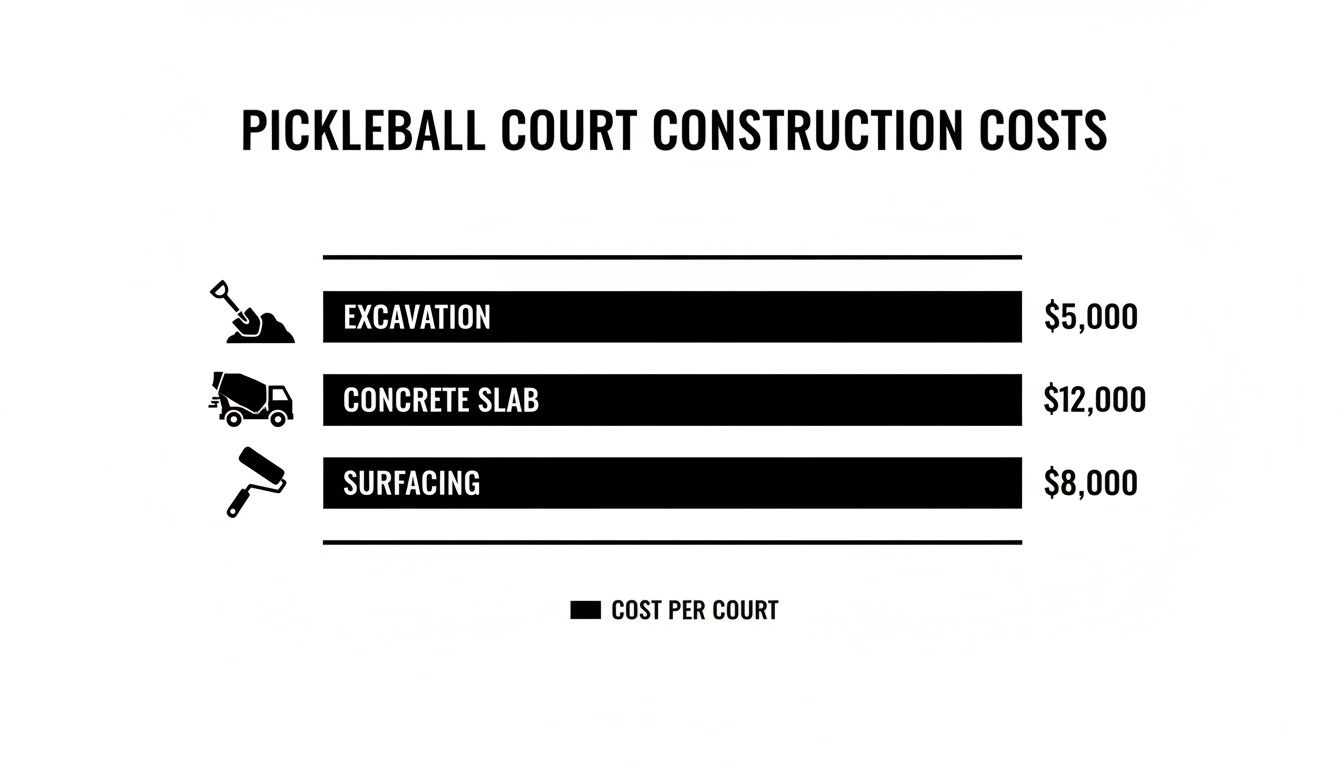
As you can see, the real heavy lifting—both literally and financially—happens with the site prep and the concrete base. These foundational steps make up the bulk of your initial investment.
Let's dig into each component.
Critical Site Preparation and Grading
Before a single bag of concrete is opened, the ground itself has to be made perfect. Honestly, this is the most important stage of the entire build, especially here in the hilly terrain of North Georgia. I've seen it time and again: improper site prep is the #1 reason slabs crack and turn into drainage nightmares.
This goes way beyond just clearing a patch of grass. A professional crew will handle:
- Excavation: They'll remove all the topsoil, rocks, roots, and any other debris to give you a clean slate. This can cost between $2,000 and $7,000, mostly depending on how much dirt they have to move and how easy it is to get equipment into your yard. For example, a tight backyard with limited access for a Bobcat will cost more than an open, flat lot.
- Grading: This is where the artistry comes in. The land is carefully shaped to create a precise, uniform slope—usually 1% from side-to-side or center-to-end—so water sheds off it correctly. Bad grading creates "bird baths," those annoying puddles that sit on your court and slowly destroy the surface.
- Drainage: Sometimes, you need more than just a slope. Installing systems like French drains might be necessary to actively channel water away from the court. It's an extra $1,500 to $5,000, but it’s cheap insurance against massive foundation problems later, especially for properties at the bottom of a hill.
The Concrete Slab: The Heart of Your Court
The concrete base is the literal foundation of your game. It determines how the ball bounces, keeps players safe, and has to be tough enough to handle Atlanta's unpredictable weather. For a court that’s built to last, a 4-inch reinforced concrete slab is the gold standard.
This isn't your average patio pour. It takes real expertise to prevent cracking and ensure the finished product is perfectly flat. A good example of what goes into this is the use of a vapor barrier beneath the slab to stop ground moisture from wicking up and compromising the acrylic surface over time.
A professionally poured concrete slab, reinforced with rebar and allowed to cure for a full 28 days, is absolutely non-negotiable for a high-performance court. This is what provides the structural integrity to support the acrylic surface and last for decades without shifting or cracking.
Here in the Atlanta market, a professionally installed, 4-inch reinforced slab for a standard 34×64 foot court area will typically cost between $9,000 and $15,000. That price reflects the skill, materials, and labor required to create a flawless foundation that protects your entire investment.
Surfacing, Fencing, and Finishing Touches
Once the concrete has fully cured, it’s time for the fun part—turning that gray slab into a proper court. These costs can vary quite a bit, depending on the look you want and the performance you need.
Court Surfacing: This is the multi-layered acrylic color coating system that provides grip, a true ball bounce, and protection for the concrete underneath. The process involves a primer, multiple color coats, and line paint. This usually runs between $5,000 to $10,000.
Fencing: You’ve got to keep the ball in play, and fencing is a significant part of the budget. Standard 10-foot chain-link is the most common and budget-friendly option. While the price of a wood fence or vinyl might be higher, they offer a different aesthetic. For a full court, expect professional fencing installation to cost anywhere from $7,000 to $15,000.
Lighting and Accessories: Want to play after sunset? You'll need lights. Modern LED systems are the way to go for their bright, even light and energy efficiency, typically costing $5,000 to $12,000 installed. And don't forget the net! A quality in-ground post system will run from $500 to $2,000.
Choosing Your Playing Surface: Concrete Vs. Asphalt
Once you’ve picked the perfect spot and prepped the site, you’ll hit the most critical decision of your entire project: the playing surface. This choice is the single biggest factor influencing your backyard pickleball court cost, how long the court will last, and even how the ball bounces. Think of it like paving a driveway—asphalt is a common route, but a properly installed concrete slab gives you a foundation that’s built to last.
The two main contenders for your court’s base are post-tensioned concrete and good old asphalt. Each has its place, but they perform very differently, especially here in Atlanta where the weather can be so unpredictable.
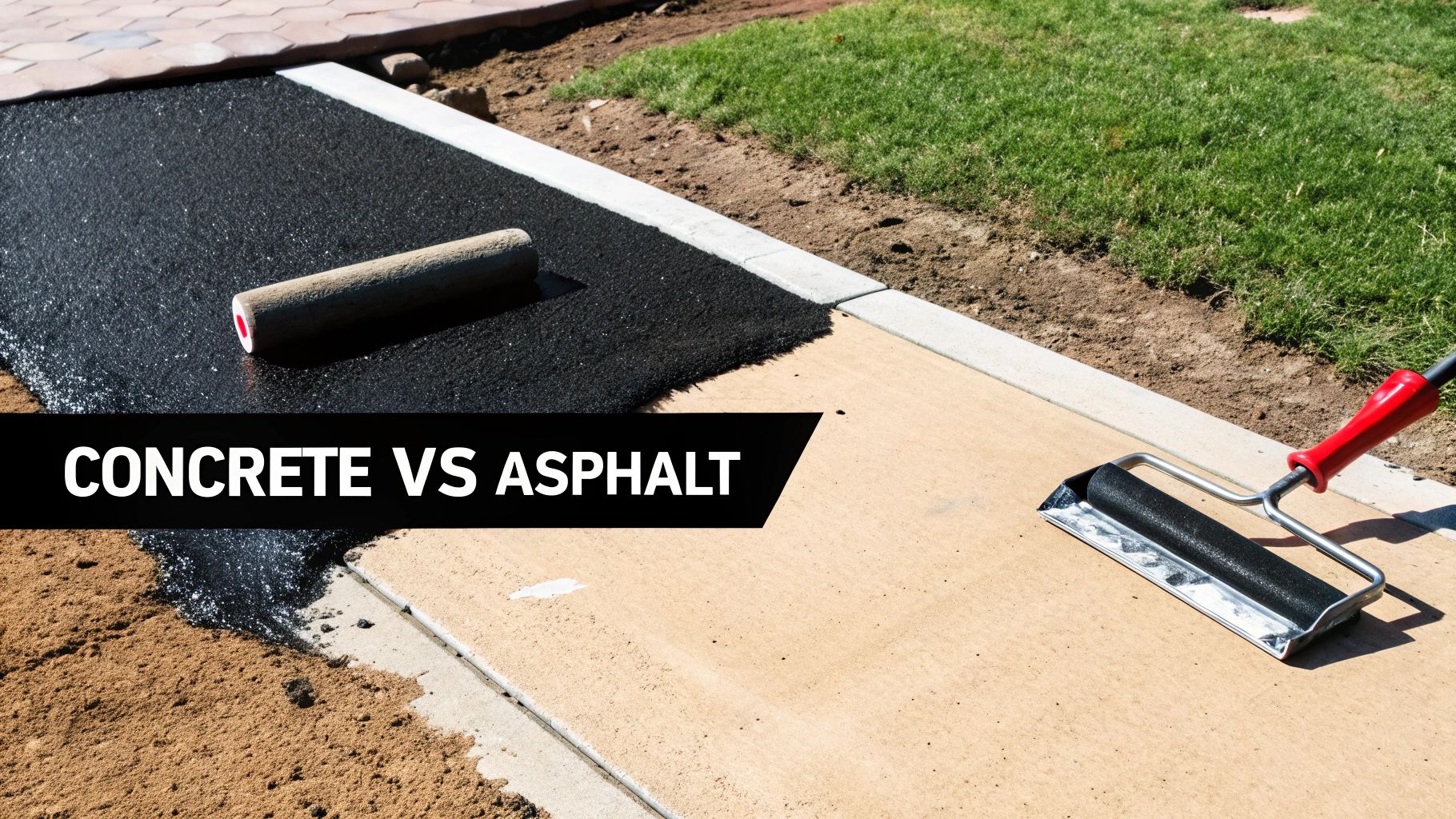
At the end of the day, your court is only as good as its foundation. A fancy acrylic topcoat won't do you any good if the base underneath is failing, which is why getting this part right from the very beginning is non-negotiable.
The Case for Asphalt Courts
For years, asphalt has been a popular choice for sports courts, mostly because it often comes with a lower price tag upfront. It’s a simple mix of sand, gravel, and petroleum, which gives it a bit of flexibility.
But that flexibility is also its Achilles' heel. Asphalt is porous, meaning it soaks up water, and it’s very sensitive to temperature changes. That’s a huge red flag for anyone living in Atlanta. Our sweltering summers can make the surface soften and expand, while the inevitable winter freeze-thaw cycles cause it to heave and crack. A prime example is a small crack that fills with water in December, freezes overnight expanding the crack, and then thaws, leaving a larger gap for the cycle to repeat.
Those cracks are more than just an eyesore. They create a dangerously uneven playing surface and act as tiny channels for water to seep in, destroying the base from below. This means you’ll be spending a lot more time and money on maintenance, from filling cracks to completely resurfacing the court every few years.
Why Post-Tensioned Concrete Is the Gold Standard
If you're looking for a permanent, pro-level court in your backyard, post-tensioned concrete is the undisputed champion. This isn't the same concrete used for your sidewalk. The process involves laying a grid of high-strength steel cables inside the framework before any concrete is poured. Once it hardens, those cables are tightened with hydraulic jacks, creating powerful internal compression.
This tension makes the slab incredibly strong and almost immune to cracking. Picture a tightly strung guitar string—that constant tension holds everything together, keeping the surface perfectly flat and stable for decades, no matter what the ground does underneath it. This technology is the same used for building foundations in areas with expansive clay soils, proving its durability.
A post-tensioned concrete slab is an engineered system designed to resist soil movement and extreme weather. This structural integrity guarantees a consistent, professional-grade ball bounce and virtually eliminates the cracks that plague asphalt courts, saving homeowners thousands in long-term repair costs.
In Atlanta's climate, this is a total game-changer. The slab can handle our humid summers and chilly winters without shifting or cracking, giving you a tournament-quality playing surface year after year.
To help you visualize the differences, here's a quick breakdown of the most common surface options.
Comparing Pickleball Court Surface Options
| Surface Type | Initial Cost per Sq. Ft. | Durability & Lifpan | Maintenance Needs | Best For |
|---|---|---|---|---|
| Post-Tensioned Concrete | $7 – $15 | 25-30+ years | Low; acrylic repaint every 5-8 years. | Homeowners seeking the highest quality, longest-lasting court with minimal upkeep. The gold standard for performance. |
| Asphalt | $5 – $12 | 10-15 years | High; requires frequent crack filling and resurfacing every 3-5 years, especially in shifting climates. | Budget-conscious projects where lower upfront cost is the primary driver, and regular maintenance is feasible. |
| Modular Tiles | $4 – $8 | 15-20 years | Moderate; individual tiles can be replaced. Needs occasional cleaning to remove debris from underneath. | DIY enthusiasts or those needing a less permanent solution that can be installed over an existing concrete pad, like a little-used basketball court. |
Ultimately, the surface you choose sets the stage for years of play. While modular tiles and asphalt have their uses, a concrete foundation provides a level of permanence and quality that other options just can't match.
Thinking About Long-Term Value and Customization
Sure, the initial backyard pickleball court cost for concrete can be a bit more than asphalt, but its long-term value is off the charts. An asphalt court might be begging for major repairs or a full resurfacing in just 5-7 years. A professionally installed concrete court, however, can easily last 20-30 years with nothing more than an occasional new acrylic color coat.
That durability translates to less money spent on fixes and more time spent actually playing. Better yet, concrete gives you a blank canvas for customization. With a team of experts, you aren’t stuck with the classic green or blue. You can choose from a huge range of colors and finishes to perfectly match your home and landscaping. For example, some homeowners in modern homes opt for a sleek gray court with white lines. You can learn more about the possibilities of residential poured concrete to see just how tailored it can be.
Choosing your court surface is a true investment in quality, performance, and your own peace of mind. For a court that will stand the test of time and deliver a perfect game every time, concrete is the clear winner.
Finishing Your Court: Fencing, Lighting, and Accessories
Once the foundation is poured and the playing surface is down, it’s time for the finishing touches. These are the details that take your project from a concrete slab to a true, ready-to-play pickleball court. Think of it like buying a car—the engine and frame are critical, but it's the sound system, comfortable seats, and safety features that really make you love the drive.
Fencing, lighting, and accessories aren't just optional extras. They're core components that affect gameplay, safety, and how often you can actually get out there and play. Budgeting for them from the get-go is the best way to avoid surprise costs and make sure your court is ready for action, day or night.
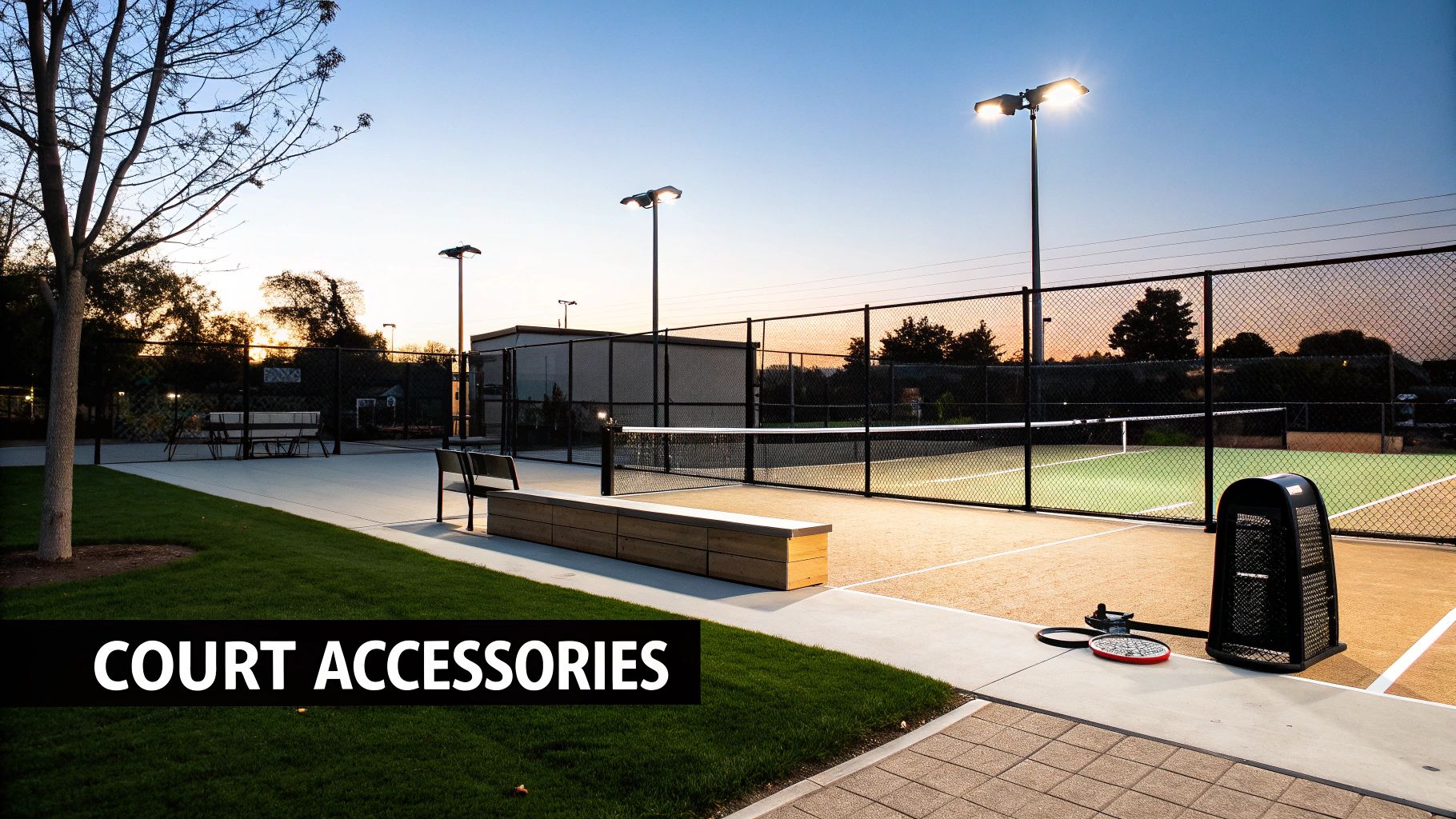
Securing Your Space With Proper Fencing
Pickleball is a game of quick movements and fast rallies. Nothing kills the momentum more than having to chase a stray ball across the lawn after every other point. Fencing is a non-negotiable for containment and safety, and it’s a pretty significant part of the overall backyard pickleball court cost.
The industry standard is 10-foot-high fencing. That height is enough to stop nearly all lobs and high-arcing shots. You could go shorter to save a few bucks, but you’ll probably regret it when an intense rally sends a ball sailing into your neighbor’s prize-winning roses.
Here’s a breakdown of the most common fencing options:
- Chain-Link: This is the go-to for a reason. It's durable, budget-friendly, and offers great visibility, typically running $15 to $30 per linear foot installed. A black vinyl-coated version is a popular upgrade that looks more modern.
- Vinyl or PVC: If you're after a more polished, modern look, vinyl is a great choice. It costs more, around $25 to $50 per linear foot, but it looks clean and comes in different colors.
- Wood or Composite: These materials give you a high-end, private feel but come with the highest price tag. For a really unique and durable aesthetic, you might even consider options like Charred Fencing.
For a standard court, you can expect the total fencing cost to land somewhere between $7,000 and $15,000, depending on the material you choose and the total length you need.
Lighting Up the Night for Extended Play
Adding lights is one of the single best upgrades you can make to your court. It instantly doubles your playing time, letting you host games on weeknights after work or enjoy a match on a warm summer evening.
Forget the old, buzzing halogen lights. Modern LED systems are the clear winner today. They cast a bright, even light that feels a lot like natural daylight, and they do it without creating harsh glares. While they cost more upfront, LEDs use far less energy and last for years, saving you a lot of money in the long run. A typical four-pole LED system for a pickleball court will provide tournament-level brightness (often called foot-candles) so you never lose the ball in the shadows.
A professional LED lighting system is a true game-changer. It transforms your court from a daytime-only space into a 24/7 amenity. This investment not only lets you play more but also adds significant value and appeal to your entire property.
A full, professional-grade LED lighting system, which includes the poles, fixtures, and all the electrical work, will typically cost between $6,000 and $12,000. It's a serious investment, but one that ensures your court is safe, playable, and fun long after the sun goes down.
Essential Accessories to Finish Your Court
With the big-ticket items handled, a few final accessories will get your court game-ready. These are the essentials that make playing comfortable and convenient.
The Net System: You can’t play pickleball without a net. A permanent, in-ground system with a hand-crank for tensioning is the way to go for a professional feel and long-term durability.
- Cost: $500 to $2,000 installed. Examples of top brands include Douglas and Edwards.
Player Amenities: Little comforts go a long way. Adding benches for players to rest between games, a shade structure for hot days, and a spot to put drinks makes the whole experience better.
- Benches: A simple park-style bench usually runs $200 to $500.
- Shade: A pergola or a large cantilever umbrella can range from $500 to over $5,000.
When you pull it all together, a complete court project with all the bells and whistles can average between $20,000 and $50,000 in a market like Atlanta. Big-ticket items like fencing ($5,000-$15,000) and optional upgrades like $6,000 for spectator seating or $12,500 for tournament-grade lighting really drive the final number. By accounting for these finishing touches from the start, your budget will reflect the true, all-in cost of your dream court.
Navigating Atlanta Permits and Finding the Right Contractor
Before you can break ground on your dream court, there are a few bureaucratic hoops to jump through. The final backyard pickleball court cost always includes the time and money spent dealing with local rules, and this is where an experienced guide becomes invaluable, especially in metro Atlanta areas like Alpharetta or Roswell.
Make no mistake, building a court is a significant construction project in the eyes of your local government. That means you will almost certainly need to pull building permits. This involves submitting detailed plans to your city or county to prove your court meets all the local zoning laws, setback requirements, and safety codes.
Understanding Local Atlanta Regulations
For most homeowners, navigating the red tape of permitting is the biggest headache of the entire project. Every municipality has its own unique set of rules. They’ll have specific limits on impervious surfaces (how much of your property can be covered by materials like concrete) and strict requirements for drainage plans and how far the court must sit from your property lines. For instance, Fulton County may require a 10-foot setback from the rear property line, while Cobb County might require 15 feet.
A seasoned local contractor takes this entire burden off your shoulders. They already know the specific documents needed in cities from Marietta to Johns Creek, which helps you avoid frustrating delays and ensures your project is 100% compliant from the very start.
How to Vet and Choose the Right Contractor
Picking the right team to build your court is easily the most critical decision you will make. Any general contractor can pour a patio, but a sport court is a different beast altogether. Hiring the wrong person can lead to a terrible playing surface and years of regret.
Think about it this way: one Atlanta homeowner tried to save a few bucks by hiring a general landscaper. What they got was a poorly graded slab that turned into a birdbath every time it rained, making the court useless. Another family hired a concrete specialist who handled the permits, engineered the drainage perfectly, and delivered a flawless court. The difference wasn't cost; it was expertise.
When hiring for a specialized project like a pickleball court, don't just look for a contractor—look for a specialist. A team that specializes in concrete sport courts will understand the unique requirements for slope, reinforcement, and finishing that generalists often miss.
To make sure you’re protecting your investment, you need to ask every potential contractor these questions:
- Do you specialize in concrete sport courts? Ask to see a portfolio filled with similar projects, not just patios and driveways.
- Are you licensed and fully insured in Georgia? Never, ever hire a contractor who can't provide these credentials. Ask for a copy of their Certificate of Insurance.
- Can you give me at least three local references for recent court projects? There's no substitute for talking to past clients.
- How do you handle site prep and drainage for Atlanta's clay soil? This question will quickly separate the pros from the amateurs. A good answer will involve discussing soil compaction tests and the use of a crushed stone sub-base.
- Will you manage the entire permitting process for me? You want a full-service partner, not someone who leaves the paperwork to you.
This is exactly where a dedicated expert like Atlanta Concrete Solutions becomes your greatest asset. With years of experience pouring concrete foundations and slabs all over the region, we know the local building codes and soil conditions inside and out. Our team manages every single detail—from the initial design and permitting to the final pour—giving you a seamless process and a perfect result.
You can check out some of our successful past concrete projects to see the level of quality and precision we bring to every job.
Protecting Your Investment With Smart Maintenance
Putting in a backyard pickleball court is a big deal—it’s a real investment in your home and your family's fun. But just like a new car or a beautiful deck, it needs some regular TLC to stay in great shape and protect that investment. A little proactive care goes a long way in stopping tiny, cheap-to-fix problems from snowballing into major repair bills that drive up your long-term backyard pickleball court cost.
Think of it this way: a simple maintenance routine can easily add years to your court's life, keeping it safe, playable, and looking sharp. This isn't just about looks; it’s about protecting the acrylic surface and the crucial concrete slab underneath.
Routine and Seasonal Court Care
Keeping your court in top condition doesn't have to be a major chore. A bit of consistent effort makes all the difference, much like washing your car regularly to keep the grime from setting in.
Here’s a simple checklist to follow:
- Weekly Sweep or Blow: Grab a leaf blower or a soft-bristle broom and clear off any leaves, twigs, and dirt. This simple step prevents organic stuff from staining the court and stops sand or grit from scuffing up the acrylic finish like sandpaper.
- Monthly Rinse: Give the court a gentle wash with a regular garden hose to get rid of fine dust and pollen. Steer clear of high-pressure washers—they're too aggressive and can easily strip or damage the surface coating.
- Seasonal Inspections: Twice a year, maybe at the start of spring and the end of fall, take a slow walk around the court. Keep an eye out for small cracks, any low spots where puddles form (we call them "bird baths"), or any mold trying to grow in shady corners. Catching these things early is the secret to a long-lasting court.
Knowing When to Call for Professional Resurfacing
No matter how well you care for it, every court surface eventually shows its age. The sun and countless games will gradually fade the color and wear down the gritty texture that gives you traction. This is totally normal and just part of the court's natural lifecycle. For example, you might notice the area around the baseline is much lighter than the corners, or that the surface feels slippery after a light rain. These are clear signs it's time for a refresh.
You should plan on resurfacing your court every 5 to 8 years. This is the single most important thing you can do for long-term protection. A pro will fill any minor cracks, apply fresh coats of acrylic color, and paint crisp new lines, making your court look and play like new for a fraction of the original price.
Enhancing Your Property Value
Beyond all the fun and games, a well-maintained pickleball court is a serious asset that can give your home’s value and curb appeal a major boost. In neighborhoods where people value an active, outdoor lifestyle, a pristine, ready-to-play court is a huge selling point that makes a property stand out from the crowd. For instance, a home in a community like Peachtree City with a pickleball court will likely be more attractive to active retirees and families than a similar home without one.
It sends a clear signal to potential buyers that the home is well-cared-for and offers a unique perk they won't find next door. This turns your court from just a fun feature into a tangible asset that builds your home's equity and delivers a fantastic return on your investment.
Got Questions? We’ve Got Answers.
When you're planning a project this big, it's natural to have a few questions. Let's tackle some of the most common ones we hear from homeowners thinking about adding a pickleball court to their backyard.
How Long Does It Take to Build a Backyard Pickleball Court?
Building a court right is a process that can't be rushed. From the day the first shovel hits the ground to the final net being tightened, you should plan on a timeline of about 4 to 8 weeks. This buffer accounts for unpredictable weather and, crucially, the local permitting process. For example, a week of heavy spring rain can pause excavation, and getting permit approval from the city of Atlanta can sometimes take a few weeks on its own.
The biggest test of patience? Letting the concrete cure. After the slab is poured, it needs to sit for about 28 days to gain the strength it needs to last for decades. Cutting this corner is a surefire way to end up with a weak, crack-prone court. Any good contractor will walk you through their schedule so you know what to expect.
Can I Finance My Pickleball Court Project?
Absolutely. A high-quality court is a real home improvement, and just like a kitchen remodel, many homeowners finance the cost instead of paying for it all at once. Spreading the investment out into manageable monthly payments makes it much more accessible. Common financing options include a Home Equity Line of Credit (HELOC) or a personal home improvement loan from a bank or credit union.
Most experienced court builders and concrete specialists have financing plans available, either in-house or through lending partners. It's always smart to bring this up during your first chat with a contractor. They can help you find a payment plan that works for your budget.
Financing lets you build the court you really want today. You won't have to skimp on the important stuff—like a proper concrete base or good lighting—just to save a few bucks upfront. It’s about getting it done right, right now.
Is It Cheaper to Convert an Existing Tennis Court?
Without a doubt, yes. If you already have a tennis or basketball court, you’ve got a massive head start. The most expensive and labor-intensive part—the excavation, grading, and the concrete or asphalt slab—is already paid for.
The conversion is mostly about surface work. This usually involves patching up any cracks, power washing the old surface clean, applying fresh acrylic color, and then painting the official pickleball lines. Better yet, a standard tennis court has enough room for two, sometimes even four, regulation pickleball courts. It's a fantastic value. For example, a full conversion might cost $8,000-$15,000, a fraction of the cost of building from scratch.
How Much Space Do I Really Need for a Court?
The actual playing area is 20 feet by 44 feet, but that's only part of the story. You need plenty of out-of-bounds space for players to safely chase down shots without running into a fence or a stray garden gnome.
For a brand-new court, we recommend a total footprint of 34 feet by 64 feet. If your yard is on the tighter side, an experienced builder can usually make a 30-foot by 60-foot area work. Anything smaller than that starts to feel cramped and can become a safety issue. To visualize this, a standard two-car garage is about 20×20 feet, so a full court footprint is more than three times that size.
Ready to turn your backyard into the ultimate pickleball destination? The team at Atlanta Concrete Solutions has the expertise to build a durable, high-performance concrete court that will provide years of enjoyment. Get your free, no-obligation quote today!