
When people ask for the "best" concrete mix for a foundation, they're often looking for a simple answer. The truth is, there isn't one. The right mix is a carefully calculated recipe, tailored specifically to your project. For most home foundations in the Atlanta area, a concrete mix delivering a compressive strength between 3000 to 4000 PSI (Pounds per Square Inch) hits the sweet spot between performance and cost. For example, a 3000 PSI mix might cost around $130 per cubic yard, while a 4000 PSI mix could be closer to $145. This relatively small price jump buys a significant boost in strength. The final formula hinges on the type of foundation, our local soil, and the weight of the structure it has to hold up for decades.
Choosing the Right Concrete Mix for Your Foundation
Getting the concrete mix right is the most critical decision you'll make for the long-term health of your foundation. Think of it as the literal bedrock of your entire building. Nailing this step from the start is what prevents those nightmare scenarios of cracks and costly repairs down the road.
At its core, concrete is a blend of cement, sand, aggregate (like gravel), and water. But the magic is in the proportions. We fine-tune this blend, often adding chemical admixtures, to hit a target compressive strength, which we measure in PSI. That number tells you exactly how much pressure the concrete can take before it fails. A standard home might be perfectly fine with a 3000 PSI mix, but a larger custom home with heavy stone features or a site with tricky soil conditions might demand a jump to 4000 PSI or even more.
Key Factors Influencing Your Mix Design
We don't just guess at the right mix. Several critical factors guide the recipe for every foundation pour. If you misjudge any one of these, you risk the integrity of the entire structure.
- Foundation Type: The demands on the concrete are completely different for a simple slab-on-grade garage floor versus deep footings holding up a two-story house. For instance, a garage slab needs high surface durability, while footings need pure compressive strength.
- Structural Load: We have to account for the total weight of the building—from the lumber and drywall right down to potential snow loads. A standard wood-frame house might exert a load of 2,000 pounds per linear foot on its footings, whereas a two-story brick home could easily exceed 4,000 pounds per linear foot, directly dictating the required PSI.
- Soil Conditions: This is a big one here in Georgia. The expansive clay soils common around Atlanta can put immense pressure on a foundation, demanding a stronger, more resilient mix designed to handle that movement. A geotechnical report might show a soil bearing capacity of only 1,500 pounds per square foot (psf), requiring wider footings and stronger concrete than a site with a 3,000 psf capacity.
- Climate and Exposure: Our humid summers and occasional freeze-thaw cycles can degrade concrete over time. This is where special additives, known as admixtures, come in to protect the foundation from environmental stress.
Expert Insight: There’s no such thing as a one-size-fits-all "best concrete mix for foundations." The optimal choice is always a custom solution born from a careful analysis of your project's specific structural needs and the ground it’s being built on.
Understanding these variables is key. For a deeper dive into the specs for different home projects, our guide on residential foundation concrete is a great resource.
Quick Guide to Foundation Concrete Mixes
To help visualize how this all comes together, here’s a quick reference for the concrete mixes we typically use for different foundation applications. Think of this as a starting point; we always recommend consulting with a structural engineer or a concrete pro to lock in the final specifications for your job.
Quick Guide to Foundation Concrete Mixes
| Foundation Type | Recommended PSI | Common Mix Ratio (Cement:Sand:Aggregate) | Key Considerations |
|---|---|---|---|
| Footings | 3000 PSI | 1:2:3 | Must support concentrated loads from walls and columns; needs solid strength and proper reinforcement. |
| Slab-on-Grade | 3500 – 4000 PSI | 1:2:3 | Needs high durability for vehicle and foot traffic and resistance to abrasion and moisture. |
| Basement Walls | 3000 – 4000 PSI | 1:2.5:3.5 | Requires strength to resist the constant lateral pressure from surrounding soil, which can exceed 500 pounds per square foot. |
| Commercial | 4000+ PSI | Custom Engineered | Designed for heavy structural loads; often requires specialized admixtures for performance and durability. |
As you can see, the requirements shift based on the job. A footing's primary role is to bear a direct load, while a slab has to stand up to surface wear and tear. Getting these details right is what separates a good foundation from a great one.
The Real Story Behind Concrete Strength and Mix Ratios
When we talk about a foundation's performance, it all boils down to the concrete mix itself. Getting a handle on a few key terms will help you have a much more productive conversation with your contractor, so you know exactly what you’re getting when that ready-mix truck pulls up. The single most important number to know is the concrete’s compressive strength, measured in Pounds per Square Inch (PSI).
Think of PSI as the power rating for your foundation. It tells you exactly how much force the cured concrete can take before it fails. For a standard single-family home here in Atlanta, a 3000 PSI mix is typically the go-to. It gives you plenty of strength for the structural load without going overboard on cost.
But when the building gets bigger or heavier, the PSI has to climb, too. A sprawling commercial structure or even a high-end custom home with heavy stone facades puts immense pressure on a foundation. In those cases, we'd be looking at a mix designed for 4000 PSI or even higher to guarantee that long-term stability and safety.
What Goes Into the Mix? Understanding the Ratios
That PSI rating comes directly from the concrete's recipe—what we call the mix ratio. This is just the proportion of the main ingredients: cement, sand (the fine aggregate), and gravel (the coarse aggregate). Even a small tweak to this recipe can make a huge difference in the final strength and how easy the concrete is to work with.
You'll often see this written as a simple three-number ratio, like 1:2:3. It's a straightforward recipe:
- One part cement
- Two parts sand
- Three parts gravel
That 1:2:3 mix is a real workhorse, perfect for residential footings and slabs where you need solid, reliable strength. Another classic you see around the world is the 1:2:4 ratio. This one generally cures out to around 2900 PSI after 28 days, making it more than enough for a huge range of residential and light commercial projects. In fact, over the last 50 years, it's estimated that something like 60% of small to mid-sized foundations have been built with this trusted formula. You can learn more about common concrete ratios and where they work best.
That concrete delivery ticket isn't just a receipt—it's the DNA of your foundation. It details the mix ratio, target PSI, water content, slump, and any admixtures, giving you a complete blueprint of what's going into the ground.
The Water-to-Cement Ratio: Where It All Goes Right (or Wrong)
While the cement and aggregates are the muscle, water is what brings it all to life. The water-to-cement ratio is, without a doubt, the most critical factor in determining the final strength of your foundation. It's a simple bit of math: the weight of the water divided by the weight of the cement.
For instance, if your mix calls for 30 pounds of water for every 60 pounds of cement, your water-to-cement ratio is 0.50. This isn't an arbitrary number; it’s carefully calculated to provide just enough water for hydration—the chemical reaction that makes concrete hard.
It’s always tempting on a job site to add a little extra water to make the concrete flow better, but that's a cardinal sin in the concrete world. All that extra water does is create a weaker, more porous product once it cures.
A Real-World Example
Let's say we have two identical foundation pours. The crew on Pour A sticks to the plan, using a 0.50 water-to-cement ratio. The result is a dense, rock-solid 3500 PSI foundation. Over on Pour B, the crew gets sloppy and adds extra water to make spreading it easier, pushing the ratio up to 0.60. That tiny change can slash the final compressive strength by up to 40%, dropping it to a measly 2100 PSI and seriously compromising the integrity of the whole structure.
Getting these fundamentals right—PSI, mix ratios, and the all-important water-to-cement balance—is the first and most important step to making sure your foundation is built on solid ground.
Comparing Mixes for Different Foundation Types
Not all foundations are created equal, and neither is the concrete that goes into them. The mix you’d use for a simple garage slab is worlds apart from what’s needed for the footings of a two-story home. Getting this choice right isn't just a matter of following a recipe; it’s about engineering a foundation that will stand strong for decades.
The specific job a foundation element has to do—whether it's bearing a direct load, resisting ground pressure, or serving as a finished floor—dictates the perfect concrete mix. Let's break down the go-to specifications for the most common foundation types you'll encounter, especially when dealing with Atlanta's unique soil conditions.
This simple decision tree shows how the type of project is the first and most important fork in the road when choosing your concrete strength.
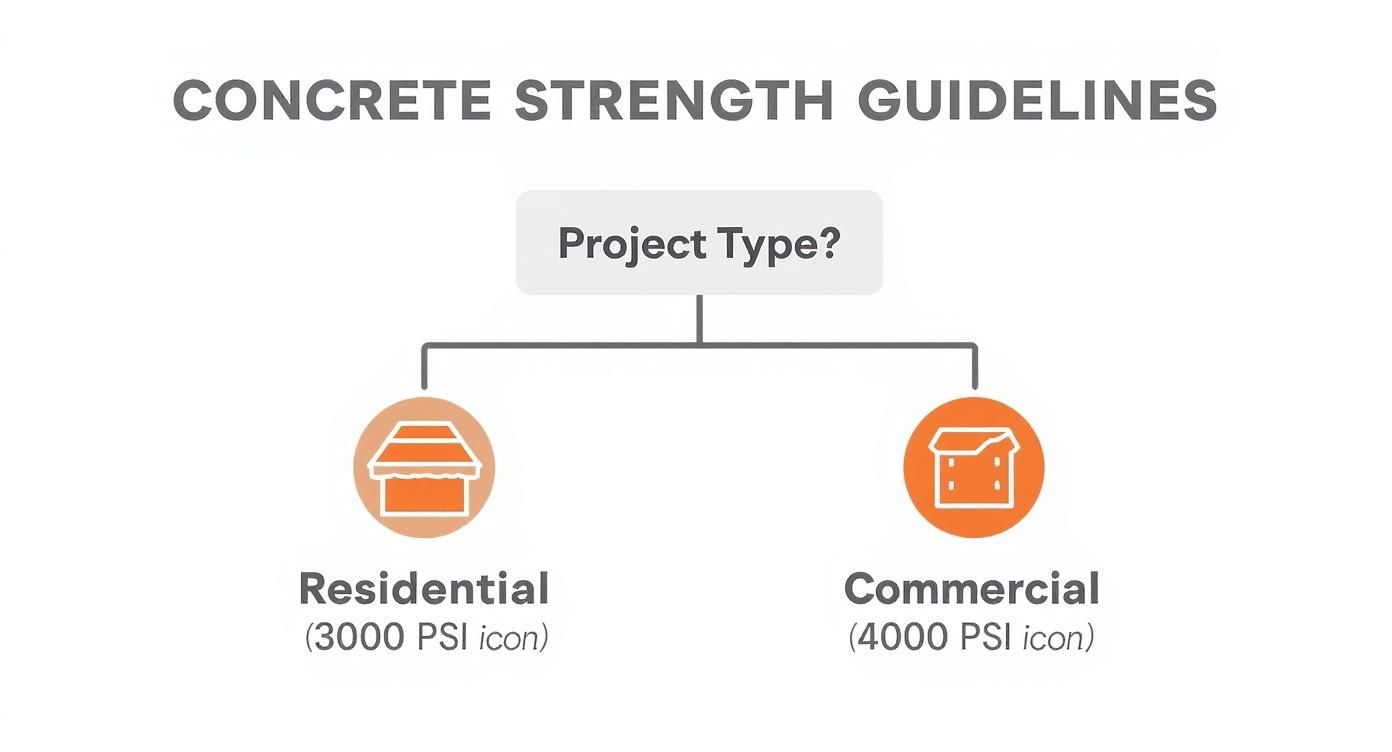
As you can see, the game changes significantly between residential and commercial work. While a 3000 PSI mix is a common starting point for a house, commercial projects immediately jump to 4000 PSI or more to handle the much heavier structural loads.
Footings Concrete Mixes
Footings are the unsung heroes of your foundation. Their one and only job is to take the entire weight of your building and transfer it safely into the ground. Because they are under constant, concentrated pressure, the name of the game is compressive strength.
For most residential builds—think single-family homes or an addition—a 3000 PSI mix is the industry standard and gets the job done perfectly. But if you're building a larger two-story home, especially one with heavy exterior finishes like brick, bumping that up to a 3500 PSI mix is a smart move. For example, a standard 16-inch wide footing with 3000 PSI concrete can support about 2,250 pounds per linear foot, while the same footing with 3500 PSI concrete can handle over 2,600 pounds per linear foot.
A footing mix doesn't need to look good. Its purpose is pure, brute strength. It needs to be a solid, immovable rock that can handle immense pressure day in and day out without a hint of failure.
And of course, reinforcement is a must. All footings need steel rebar to give them tensile strength—the ability to resist bending or pulling forces. The concrete has to be workable enough to completely envelop that rebar, leaving no gaps or voids that could weaken the structure.
Poured Slabs and Slab-on-Grade Foundations
A slab-on-grade foundation is a different beast entirely. It’s not hidden underground like a footing; it often serves as the finished floor for a garage or basement. This means the concrete has to be more than just strong—it has to be durable and able to resist surface damage.
We almost always recommend a 3500 to 4000 PSI mix for slabs. That extra strength is crucial for withstanding everything from foot traffic to the weight of parked cars and heavy equipment. A stronger mix also does a better job of fighting moisture that can try to creep up from the ground.
Key factors for a great slab mix include:
- Durability: The concrete has to be tough. Using a slightly smaller aggregate, like a 3/4-inch stone, helps create a denser surface that stands up better to daily wear and tear.
- Reinforcement: While structural slabs get a rebar grid, adding fiber mesh to the mix is a fantastic way to control hairline shrinkage cracks that can pop up as the surface dries.
- Finishability: The mix has to be workable so the finishing crew can get that perfectly smooth, level surface. A water-reducing admixture is perfect for this, as it improves flow without adding too much water and weakening the final product.
Crawlspace and Basement Foundation Walls
Poured concrete walls for a crawlspace or basement have a unique challenge: they’re constantly being pushed on from the side by the surrounding soil. This lateral pressure means the concrete mix has to be strong enough to function as a retaining wall, resisting any bowing or cracking over the years.
A 3000 to 4000 PSI mix is the typical range here. The final decision often comes down to the height of the wall and the soil conditions. Here in Atlanta, our expansive clay soils are notorious for swelling with moisture and putting huge pressure on foundation walls. In these situations, going with a 4000 PSI mix is a wise investment in the building's future. For an 8-foot high basement wall, expansive soil can exert over 40,000 pounds of force on a 10-foot section.
Proper rebar installation—a grid of both vertical and horizontal steel—is non-negotiable. The concrete mix must be fluid enough to flow down into the forms and surround all that steel without leaving any air pockets or "honeycomb" spots, which can become weak points and pathways for water.
High-Load Commercial Foundations
When you step into the world of commercial construction, you're playing in a different league. These foundations have to support enormous structures like warehouses, office towers, or retail centers. The loads are exponentially greater, and the concrete mix has to be engineered to match.
The conversation for commercial foundations starts at 4000 PSI and often goes up to 5000 PSI or even higher, especially for things like heavily loaded columns or pads for massive machinery. These aren't just standard mixes from the plant; they are precisely engineered formulas designed to meet the project's structural drawings. You can see just how demanding these projects are by learning more about the specifics of commercial foundation concrete.
These high-performance mixes almost always rely on special admixtures, like high-range water reducers (superplasticizers), to make the concrete flowable enough for placement while still achieving incredible strength. They also undergo strict quality control testing to ensure every single batch meets the engineer's exact specifications before it ever leaves the truck.
To make these choices easier to visualize, here's a direct comparison of the recommended specifications for each foundation type.
Foundation Type vs. Concrete Mix Specification Comparison
| Foundation Application | Target PSI Range | Recommended Admixtures | Reinforcement Notes | Best Use Case |
|---|---|---|---|---|
| Residential Footings | 3000 – 3500 PSI | None typically needed | Steel rebar is mandatory (e.g., two continuous runs of #4 bar) | Standard home foundations, additions, and detached garages |
| Slab-on-Grade | 3500 – 4000 PSI | Water reducer, fiber mesh | Fiber mesh for crack control, rebar grid for structural loads | Garage floors, basement slabs, sheds, and workshops |
| Crawlspace/Basement Walls | 3000 – 4000 PSI | Water reducer for flowability | Vertical & horizontal rebar grid is critical (e.g., #4 bar at 16" on center) | Below-grade walls supporting backfill and structural loads |
| High-Load Commercial | 4000 – 5000+ PSI | Superplasticizer, air entrainment | Engineered rebar schedule per structural plans | Warehouses, multi-story buildings, heavy equipment pads |
Ultimately, the right mix balances project requirements, site conditions, and budget. While the table provides a great starting point, every project is unique and benefits from an expert evaluation to ensure the foundation is built to last.
How Admixtures and Reinforcement Build a Rock-Solid Foundation
A well-proportioned mix is the heart of a good foundation, but that's just the starting point. To build something that can truly stand up to heavy loads and Atlanta’s unique climate, we have to go beyond the basic recipe. This is where chemical admixtures and physical reinforcement come into play, working together to turn a good mix into the right mix for your foundation.
Think of admixtures as specialized ingredients added at the plant. These chemicals are measured with precision to alter the concrete's behavior, boosting everything from its workability and strength to its long-term resilience. They’re the secret sauce that lets us tailor a mix for specific job site conditions.
Chemical Admixtures That Make a Difference
You won't need every admixture for every job, but knowing what they do—and when to use them—is what separates a standard pour from a professional one. Each one is a problem-solver, whether you're fighting freeze-thaw cycles or just trying to make a high-strength mix easier to place.
-
Water-Reducing Admixtures: These are our go-to for creating high-strength concrete that’s still workable. They let us dial down the water-to-cement ratio (which is the key to strength) without turning the mix into a stiff, unworkable mess. This is critical for getting a dense, high-PSI foundation that flows easily around rebar.
-
Air-Entraining Agents: These clever chemicals create billions of microscopic air bubbles throughout the concrete. When water inevitably gets in and freezes, it expands into these tiny pockets instead of cracking the concrete from the inside out. For a climate like ours with its share of freeze-thaw cycles, this is non-negotiable for long-term durability.
-
Accelerators and Retarders: These are all about controlling the clock. Accelerators, like calcium chloride, speed up the curing process, a lifesaver for cold-weather pours. Retarders do the opposite, slowing things down to give crews more time to finish massive slabs on a blazing hot Atlanta summer day.
A perfect example is using a water reducer on a commercial slab. It lets us specify a tough 4000 PSI mix with a low water-to-cement ratio for maximum strength, but the concrete stays fluid enough for the crew to get that perfect, smooth finish across a huge surface.
By using these additives strategically, we can fine-tune a concrete mix to perform perfectly in just about any environment. It’s this level of customization that ensures your foundation isn't just strong, but also perfectly suited to its surroundings.
The Critical Roles of Rebar and Fiber Mesh
Here’s the thing about concrete: it has phenomenal compressive strength, meaning it’s incredibly hard to crush. But its tensile strength—its ability to resist being pulled apart—is terrible. That's why we add physical reinforcement. Steel rebar and fiber mesh are the two main tools we use to give concrete the pulling strength it lacks.
It’s a huge mistake to think they're interchangeable. They each serve a distinct purpose, and choosing the right one for the job is absolutely critical.
Steel Rebar: The Structural Backbone
When it comes to handling serious weight, rebar is the heavy lifter. Its entire job is to provide the muscle—the tensile strength—to manage major structural loads and prevent big, catastrophic cracks. When the ground settles or a heavy column bears down, the rebar grid inside is what holds the foundation together.
- Where It Excels: It is non-negotiable for any load-bearing element. Think footings, foundation walls, and grade beams.
- Real-World Example: In a footing that supports a main house column, that rebar grid is what stops the footing from literally bending and snapping under the focused weight. Without rebar, the footing would crack right down the middle.
Fiber Mesh: The Surface Protector
Fiber mesh is a bit different. It’s made of thousands of tiny synthetic fibers that get mixed right into the concrete. These fibers don't add primary structural strength like rebar. Instead, they are masters at preventing plastic shrinkage cracks—those ugly little hairline fractures that pop up on the surface as a new slab dries.
- Where It Excels: It’s ideal for large, flat surfaces that don't carry primary structural loads, like garage floors, basement slabs, and patios.
- Real-World Example: As a garage slab cures and the water evaporates, the fiber mesh helps distribute the internal stresses, preventing a network of surface cracks from forming and keeping the finish looking good for years.
By combining the right admixtures with a properly engineered reinforcement plan, we build a foundation that’s strong all the way from its structural core to its finished surface.
Choosing a Concrete Mix for Atlanta's Unique Climate
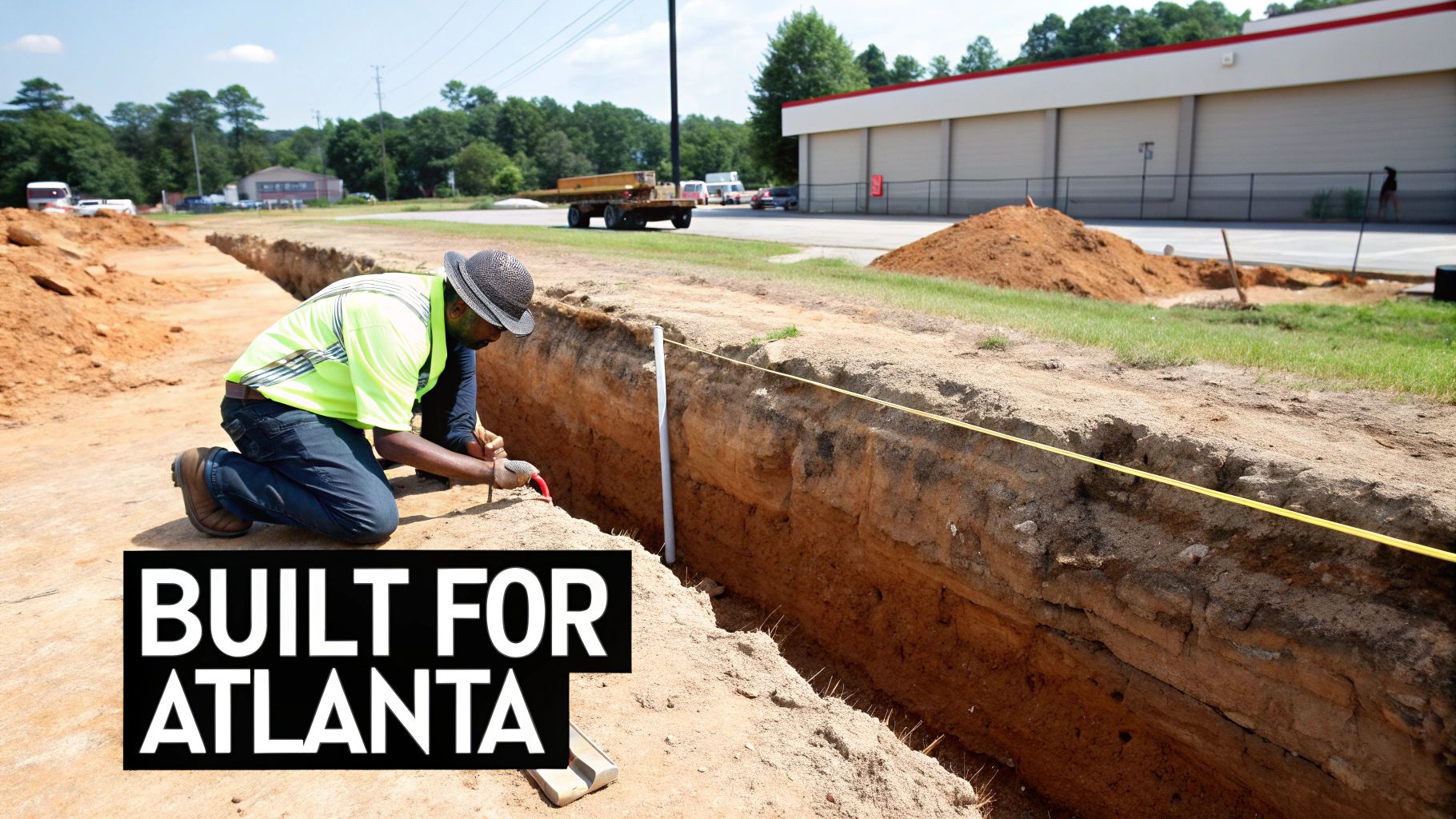
Building in the Atlanta area isn't like building anywhere else. You're up against a unique set of challenges that can make or break a foundation's lifespan. Our region is famous for its thick red clay and a climate that swings from punishingly humid summers to surprisingly sharp winters. Choosing the best concrete mix for foundations here means thinking strategically, not just picking a number off a spec sheet.
The ground itself is the first thing you have to account for. Georgia's red clay is notorious for being "expansive." When it gets wet, it swells up, and when it dries out, it shrinks back down. This constant cycle of movement puts tremendous, uneven stress on foundation walls and footings, which is a perfect recipe for cracks and structural problems down the road.
Battling Georgia's Expansive Clay Soil
To stand up to the force of this shifting clay, a standard 3000 PSI mix often just doesn't cut it. Your concrete mix is the first line of defense. For most foundations around here, we start the conversation at a minimum of 3500 PSI. For basements or larger commercial structures, we'll often spec 4000 PSI to build in a critical margin of safety.
That higher compressive strength gives the foundation the muscle it needs to resist the pressure from the soil. But strength is only half the battle. You also need a smart reinforcement plan with steel rebar to provide the tensile strength—the ability to hold itself together as the ground beneath it moves.
In Atlanta, the ground is an active variable, not a passive one. Your foundation mix can't just be strong enough to hold up the house; it must be strong enough to fight back against the soil that’s constantly trying to push it apart.
Managing Humidity and Freeze-Thaw Cycles
Atlanta’s climate adds another wrinkle. Our hot, humid summers can mess with the curing process, while winter brings just enough freeze-thaw cycles to be incredibly destructive to the wrong kind of concrete.
When water soaks into concrete and then freezes, it expands by about 9%. That expansion creates immense internal pressure that can cause the surface to flake (spall), scale, and crack the foundation from the inside out. To stop this from happening, we rely on specific admixtures.
-
Air-Entraining Admixtures: This is a non-negotiable for any exterior concrete exposed to our weather. It creates billions of microscopic air bubbles in the mix. These tiny pockets give freezing water room to expand without blowing the concrete apart, dramatically improving its durability. A typical specification for our climate is a mix with 4% to 6% entrained air.
-
Water-Reducing Admixtures: In our humidity, keeping the water-to-cement ratio low is absolutely key to getting strong concrete. A water reducer, or plasticizer, makes the concrete flow easily without having to add extra water that would just weaken the final product. It helps ensure you actually hit your target PSI.
By selecting a stronger mix and using the right admixtures, you can engineer a foundation that's truly built for our local conditions. Understanding the nuances of Atlanta concrete work is how you build something that will last for generations. It’s about being proactive with the mix design to make sure your investment is built on a solid base, ready for whatever Georgia's environment throws at it.
Why Expert Guidance on Your Concrete Mix Is Essential
While it's great to understand the basics of concrete, knowing the theory is a world away from applying it on a real job site. There's a big difference between reading about 3000 and 4000 PSI concrete and actually knowing which one will stand up to Atlanta's tricky soil conditions. When the stakes are high and the project is complex, nothing replaces the eye of a seasoned professional.
Partnering with an expert contractor like Atlanta Concrete Solutions becomes non-negotiable in certain situations. These are the scenarios where a standard, off-the-shelf mix just won't cut it and could seriously compromise the integrity of your foundation. It takes a much deeper level of experience to get it right.
When to Call in a Professional
Some site conditions are immediate red flags, signaling the need for an expert-designed concrete mix. Trying to tackle these with a DIY approach or a generic mix is a recipe for disaster and expensive repairs down the road.
- Poor Soil Reports: If your geotechnical report comes back showing expansive clay, low load-bearing capacity, or other unstable soil types, you absolutely need a professional to design a mix that can handle those specific ground issues. For instance, a report indicating a high Plasticity Index (PI) above 25 is a major warning sign for expansive soil.
- Heavy or Complex Structural Loads: Think about custom homes with unique architectural designs or commercial buildings that need to support heavy equipment. These projects demand an engineered foundation with a precisely formulated mix to match. A point load from a steel column might require a 5000 PSI mix in that specific footing.
- Challenging Terrain: Building on a steep hill? That introduces some serious lateral pressure from soil and water. An expert knows how to design a foundation mix that can resist those forces and prevent shifting or failure.
An experienced concrete contractor does more than just pour concrete; they interpret engineering plans, analyze soil conditions, and account for local climate to select the best concrete mix for foundations that are built to last.
A true professional manages the entire process, making sure every single detail is handled correctly. They're the ones who verify the custom mix is ordered properly from the plant, coordinate the complex logistics of a large pour, and oversee the all-important curing phase. This kind of oversight is your best defense against common—and costly—mistakes like a bad water-to-cement ratio or incorrectly placed rebar.
Ultimately, this partnership ensures your foundation isn't just built for performance but also meets all local Atlanta building codes. Investing in professional guidance from the start means your project is built on a genuinely solid footing, protecting your investment for decades to come.
Answering Your Questions About Foundation Concrete
When you're laying the groundwork for a new structure, you're bound to have questions about the concrete itself. Getting the right answers is the first step toward a foundation that lasts a lifetime. Here’s what we hear most often from our clients here in the Atlanta area.
What’s the Minimum PSI for a House Foundation?
For most residential projects, like a slab-on-grade floor or a standard footing, the bare minimum compressive strength you'll see specified is 2500 PSI. That said, modern construction almost always calls for 3000 PSI as the standard. It hits the sweet spot between long-term durability for typical home loads and overall cost.
However, you can't ignore local conditions. The expansive clay soils common around Atlanta can put a lot of stress on a foundation, which is why you'll often see engineers spec out 3500 PSI or even 4000 PSI mixes. This added strength gives the foundation the muscle it needs to resist soil movement and prevent cracks. Ultimately, your local building codes will have the final say.
Should I Mix Concrete Myself or Order Ready-Mix?
For a tiny project, like setting a fence post, mixing a few bags yourself is perfectly fine. For example, a single 80-pound bag will yield about 0.6 cubic feet of concrete. But for a house foundation? It's not even a question. A small 20×20 foot garage slab that is 4 inches thick requires almost 5 cubic yards of concrete—that's over 180 of those 80-pound bags! Any structural element—whether it's for a home, a garage, or an addition—absolutely requires professionally batched ready-mix concrete.
A ready-mix plant delivers a product that is perfectly proportioned and guaranteed to meet a specific PSI strength, a level of precision you simply can't achieve with a portable mixer and a hose. You'd risk creating weak spots from "cold joints" and inconsistent batches, putting the entire structure at risk.
How Does Aggregate Size Affect My Foundation Mix?
The size of the gravel or crushed stone in the mix—the coarse aggregate—is a big deal for both strength and workability. For most foundation pours, a standard 3/4-inch aggregate is the go-to choice. It's widely available and creates a strong, dense concrete.
The most important rule for aggregate is that it must be small enough to flow easily around all the steel rebar. If you have a complex design with tightly spaced reinforcement, your engineer might specify a smaller 3/8-inch aggregate to make sure you don't get voids or "honeycombing," which are serious weak spots.
The aggregate size has to be matched to the thickness of the foundation and the rebar layout to ensure you end up with a solid, uncompromised final product.
What Happens If the Water-to-Cement Ratio Is Too High?
Adding extra water to a concrete truck on-site is probably the single worst thing you can do. Sure, it makes the concrete flow easier for a few minutes, but it permanently cripples its final strength and durability.
That extra water has to go somewhere as the concrete cures, and it leaves behind a network of tiny pores. This makes the finished foundation much weaker and leaves it vulnerable to cracking, freeze-thaw cycles, and water damage. For example, increasing the water-to-cement ratio from 0.45 to 0.55 can reduce the 28-day compressive strength by nearly 1,500 PSI. Sticking to the specified water-to-cement ratio is non-negotiable if you want to hit your target PSI and build a foundation that will stand the test of time.
Choosing the right concrete mix is about more than just numbers; it's about understanding how the materials will perform under your specific site conditions. If you're planning a project and want to make sure you get it right, the team at Atlanta Concrete Solutions has the expertise you need. Reach out to us for a professional consultation and a free quote by visiting us at atlantaconcretesolutions.com.