
The secret to getting paint off concrete isn't just about elbow grease—it's about strategy. The best method always starts with figuring out what kind of paint you're up against and then choosing the right tool for the job. While simple latex paint from a weekend deck-staining project might come up with just a pressure washer, stubborn oil-based or epoxy paints used on a garage floor will make you work for it, often demanding chemical strippers or even mechanical grinding.
Matching the Method to Your Paint Problem
Before you grab a scraper or rent a pressure washer, take a moment to plan your attack. Trust me, jumping in without a game plan is a recipe for frustration. You could end up wasting hours, damaging your concrete, or making an even bigger mess than you started with.
The entire project boils down to two key things: the type of paint you need to remove and the condition of the concrete itself.
Think about it: tackling a small latex paint spill on a smooth basement floor is a world away from removing layers of old, baked-on oil-based paint from a rough, porous patio. One requires a gentle touch and perhaps a simple scraper; the other needs some serious muscle and a powerful chemical solvent. Using the wrong approach won't just be ineffective—it could permanently scar your concrete. For example, using a high-PSI pressure washer on old, crumbling concrete can blast away chunks of the surface itself.
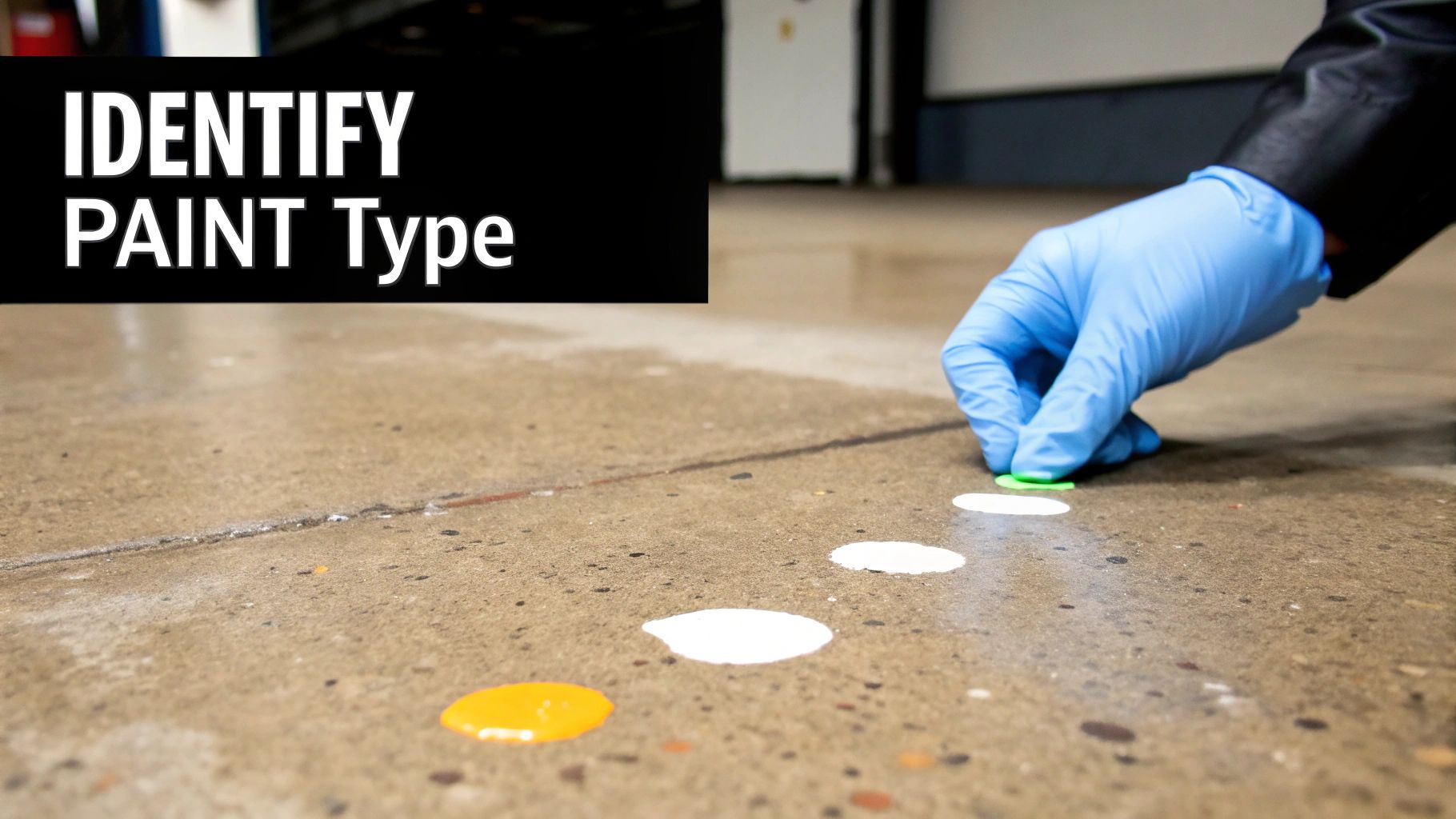
Identifying the Paint Type
First things first, you need to play detective. What kind of paint are you dealing with? Most of the time, it’s going to be one of three culprits: latex, oil-based, or an epoxy coating. Each has a completely different chemical makeup, which means they respond to different removal tactics.
- Latex (Water-Based) Paint: This is your standard-issue paint for most home projects, like painting walls or trim. It's usually the easiest to remove, especially if it’s already peeling. A quick way to check is to put some denatured alcohol on a rag and rub a small, inconspicuous area. If the paint gets gummy and starts to lift, you're likely dealing with latex.
- Oil-Based (Alkyd) Paint: Known for its toughness, oil-based paint bonds tightly to concrete. It was often used for porch floors or steps for its durability. It laughs at water and requires some heavy-duty solvents or serious mechanical effort to break it down.
- Epoxy or Two-Part Coatings: If you see this on a garage floor, get ready for a fight. These coatings form a super-hard, chemical-resistant shell. For instance, a two-part epoxy floor coating is designed to resist hot tire pickup and chemical spills. Removing them almost always calls for aggressive grinding or specially formulated chemical strippers designed for industrial-strength coatings.
This chart can help you quickly narrow down what you're looking at.
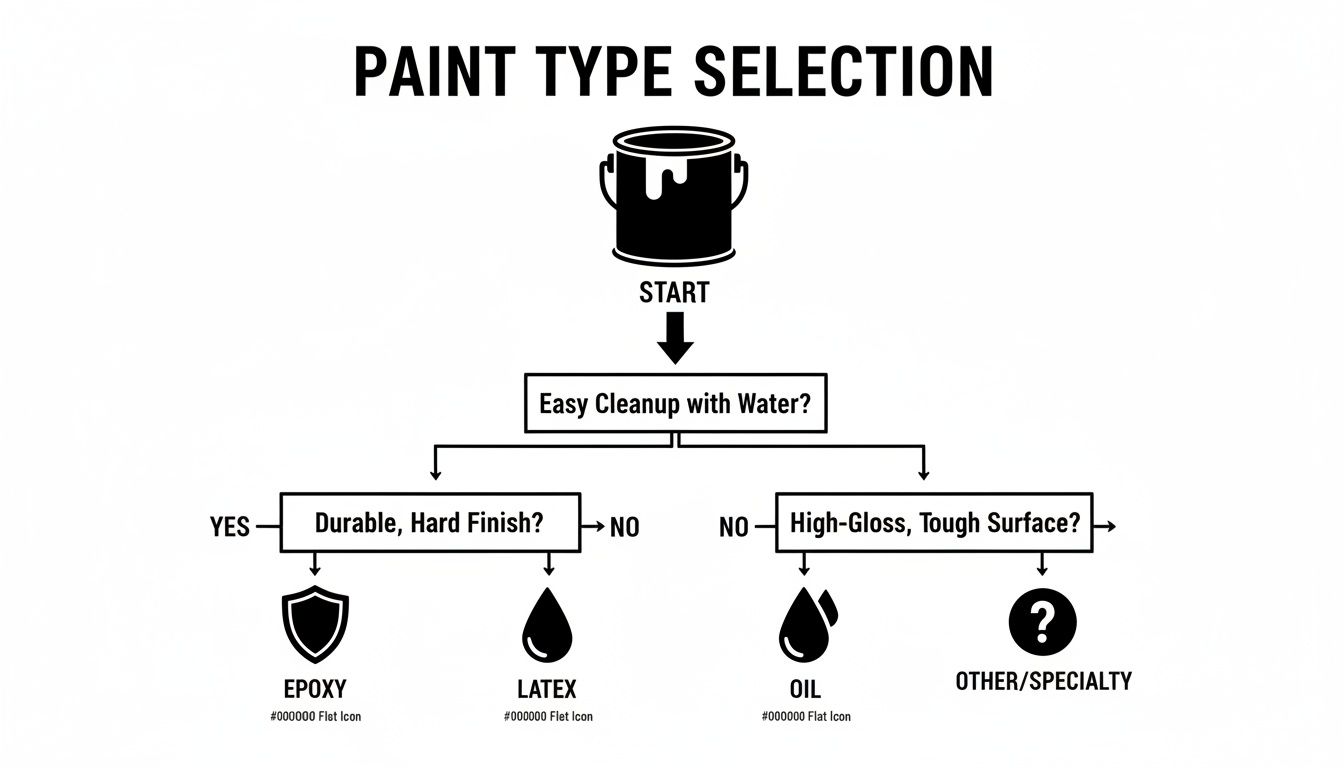
Understanding the properties of various types of paint and paint-related materials is crucial for picking a removal method that will actually work.
To make this even simpler, here’s a quick reference table to help you match your situation with the right solution.
Quick Guide to Concrete Paint Removal
| Paint Type | Concrete Surface | Recommended Method | Key Considerations |
|---|---|---|---|
| Latex (Water-Based) | Smooth, Sealed (e.g., Basement) | Pressure Washing or Scraper | Often comes off easily, especially if fresh. Example: Spilled wall paint. |
| Latex (Water-Based) | Porous, Unsealed (e.g., Driveway) | Chemical Stripper + Pressure Washing | Paint soaks into pores; stripper is needed to lift it. Example: Overspray from painting siding. |
| Oil-Based (Alkyd) | Any Surface | Strong Chemical Stripper or Grinding | Requires potent solvents. Good ventilation is critical. Example: Old porch paint. |
| Epoxy/2-Part Coating | Smooth, Sealed (e.g., Garage) | Mechanical Grinding or Shot Blasting | Extremely tough bond. Strippers may work but grinding is more reliable. Example: A failed DIY garage floor kit. |
This table should give you a solid starting point, but always remember to test your chosen method on a small, hidden spot first.
Assessing the Concrete Surface
Once you have a good idea about the paint, take a hard look at the concrete. Its condition is just as important. A smooth, sealed garage floor is non-porous, meaning the paint is just sitting on top and will be much easier to convince to let go.
The real headache is porous, unsealed concrete—think driveways, sidewalks, or patios with a broom-finish. Paint doesn't just sit on top; it seeps down into all those tiny nooks and crannies. This makes it incredibly tough to lift out completely without the right technique.
Be especially careful with older, spalling, or cracked concrete. For example, if your driveway has visible cracks or areas where the top layer is flaking off (spalling), hitting it with an aggressive method like high-pressure washing or grinding can cause more harm than good, chipping away the surface and leaving you with a bigger repair job. By taking the time to properly assess both the paint and the concrete, you can choose a method that gets the job done right without creating new problems.
Preparing Your Workspace for a Safe and Clean Project
I’ve seen it a hundred times: a project goes sideways not because the method was wrong, but because the prep work was rushed. Before you even crack open a can of stripper or plug in a grinder, getting your workspace set up properly is the single most important thing you can do.
Getting this part right isn't just about a cleaner finish. It's about safety. Trying to strip a basement floor without proper ventilation is a recipe for disaster. Pressure washing a patio and accidentally blasting your prize-winning roses? Also not a great outcome. A few minutes of thoughtful preparation can save you hours of cleanup and a whole lot of regret.
Your Essential Safety Gear
This is non-negotiable. Your Personal Protective Equipment (PPE) is what stands between you and some seriously nasty stuff. While the exact gear depends on whether you're grinding, stripping, or pressure washing, a few items are always on my list.
Here’s the absolute minimum you should have on hand:
- Safety Goggles: Not glasses. Goggles. They protect you from splashes, flying debris, and dust getting in from the sides. For example, when scraping, a paint chip can easily fly up and into your eye.
- Chemical-Resistant Gloves: Forget the basic work gloves. You need nitrile or butyl rubber gloves that can stand up to harsh solvents without melting. A solvent can soak through leather gloves in minutes.
- Respirator with Organic Vapor Cartridges: If you're using chemical strippers, this is absolutely mandatory. A simple dust mask does nothing to protect your lungs from chemical fumes. For instance, strippers containing NMP (N-Methyl-2-pyrrolidone) require this level of protection.
A pro always puts safety first. The best way to get paint off concrete is the safe way, period. You're dealing with materials that can cause real harm if you don't respect them.
Setting Up a Clean and Contained Workspace
With your safety gear sorted, it's time to prep the area itself. A well-prepared space makes the actual job easier and keeps the mess contained.
First, clear everything out. Get all the furniture, tools, planters, and cars out of the way. You need a completely open field to work in.
Next, protect what you can't move. I use heavy-duty plastic sheeting and good quality painter’s tape to cover everything nearby—walls, doors, siding, and especially landscaping. If I'm working on a concrete porch, you can bet that front door and any nearby windows are completely sealed off. You don't want chemical overspray or high-pressure water getting where it shouldn't. For instance, lay plastic down at least six feet around your work area and use tape to secure the edges to prevent runoff.
Finally, manage your environment. Working indoors? Open every window and door you can. I’ll even set up a box fan in a doorway, pointing it outward to actively pull fumes out of the space. If you're outside, pick a cool, overcast day if possible. Direct sun is your enemy; it makes chemical strippers dry out way too fast, forcing you to use more product for a worse result. A little bit of planning makes all the difference.
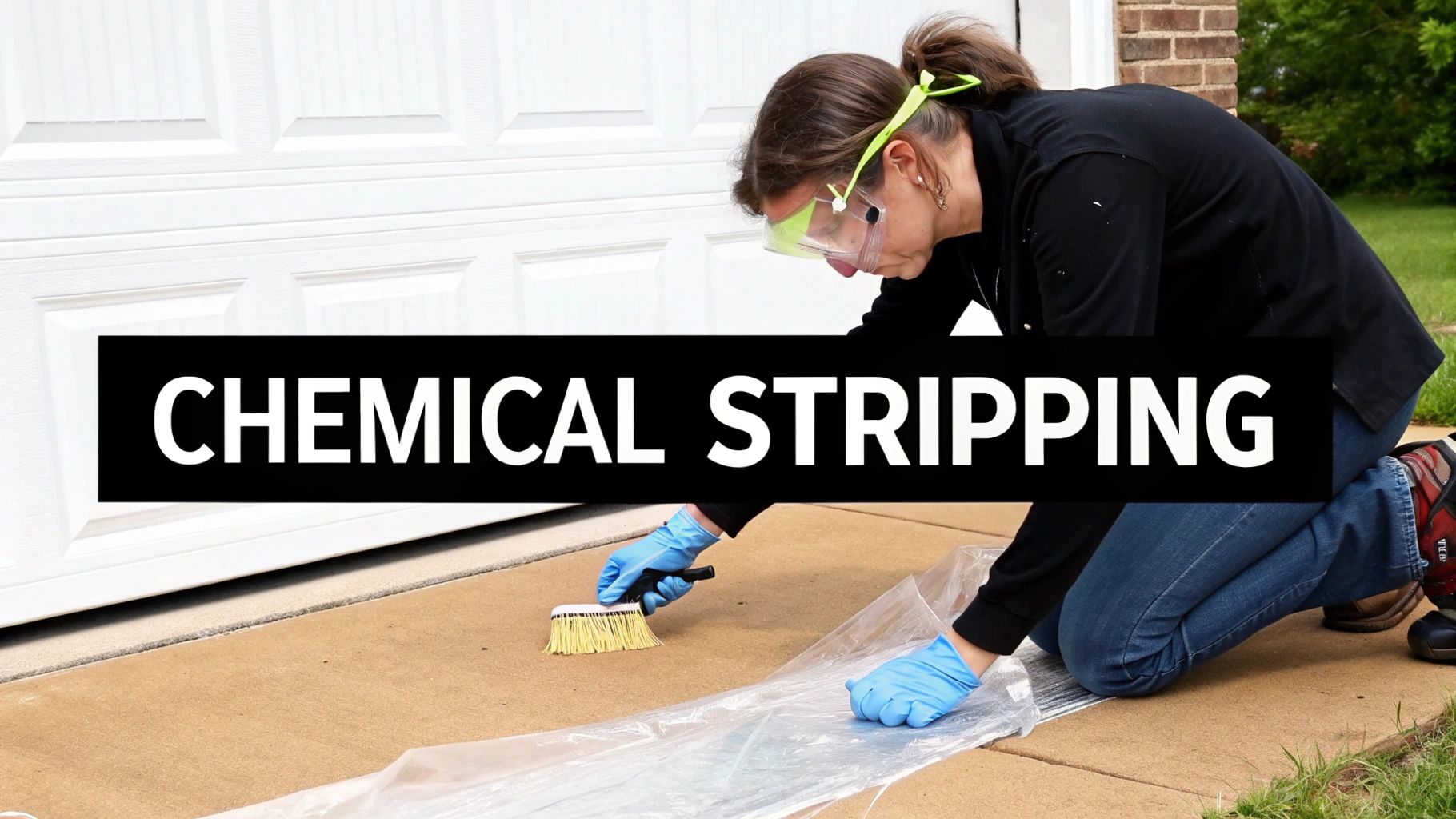
Tackling Stubborn Paint with Chemical Strippers
When you’re up against years of caked-on paint or a resilient epoxy coating, a pressure washer or sander just isn't going to get the job done. This is exactly when you need to bring in the big guns: chemical strippers. They don't just blast the surface; they get underneath the paint, dissolving its bond with the concrete and turning a nightmare job into a manageable one.
But walking into the hardware store can be overwhelming. You'll see a whole wall of different products, and grabbing the wrong one is a recipe for wasted time and frustration. Picking the right stripper is the most critical first step.
Choosing Your Chemical Weapon
Think of this like a doctor prescribing medicine—you need the right formula for the specific ailment. The type of paint you're trying to remove dictates the type of stripper you need.
-
Solvent-Based Strippers: These are the heavy-duty powerhouses, often containing chemicals like benzyl alcohol. If you're dealing with tough stuff like old oil-based paints or epoxy floor coatings, this is what you need. They work fast, but that power comes with a trade-off: intense fumes. You absolutely must have excellent ventilation and wear a respirator. No excuses.
-
Caustic Strippers: These products use a high-pH chemical, like lye (sodium hydroxide), to essentially turn the paint into a soapy mush that’s easy to scrape away. They're pretty good for thick layers of oil-based and latex paints, but they are slow. They're also incredibly corrosive, so gloves and goggles are a must.
-
Biochemical Strippers: These are your "green" or eco-friendly options, often made from plant-derived solvents like soy esters. They have a very low odor and are much safer to handle, but they are by far the slowest of the three. They can work for a single layer of latex paint, but you need to have a lot of patience.
Let's say you're trying to get a thick, glossy epoxy coating off your garage floor. Reaching for a biochemical stripper would be a complete waste of time. It would barely scratch the surface. You'd need a strong, solvent-based product designed specifically for that kind of industrial coating, like a gel formula that clings to the surface to prevent evaporation.
The market backs this up. It's projected that solvent-based removers will make up nearly 48.8% of the market by 2025, simply because they are so effective on stubborn paint. Even after the EPA banned methylene chloride, manufacturers created new, safer formulas that still pack a punch.
Here at Atlanta Concrete Solutions, we rely on these newer, professional-grade solvents. Our process is dialed in: we apply the stripper, let it sit for about 15-30 minutes, and then neutralize the surface. From our own experience in the field, this method is a solid 40% more efficient than trying to blast the same paint off with just water. The industry is always changing, and you can learn more about the evolution of paint remover products to see how things have improved.
The Stripping and Scraping Process
Once you've got the right stripper and all your safety gear on, the actual process is pretty straightforward. It just takes a bit of patience.
First, apply a generous, thick layer of the stripper. I can't stress "thick" enough. Use a cheap natural-bristle brush or a roller, and don't be shy with the product. A thin coat will just dry out before it has a chance to work. For example, you should aim for a layer about 1/8-inch thick, so it looks like a coat of frosting.
Now comes the most important part: dwell time. This is where you let the chemicals do the hard work for you. Walk away and let it sit. The time can range from 20 minutes to a full day, so always read the manufacturer's directions. Some products recommend covering the stripper with plastic sheeting to keep it wet and active for longer.
You'll know it's ready when the paint starts to look wrinkled and bubbly. That's your cue to grab a stiff metal paint scraper or, for larger floors, a long-handled scraper. Keep the blade at a low angle to the ground—you want to lift the paint off, not gouge the concrete underneath.
Finally, you have to clean up properly. After all the gunk is scraped away, you’ll need to neutralize the concrete to stop the chemical reaction. The product label will tell you what to use, but it's often just a simple solution of water and mild soap. For some caustic strippers, you might need a specific acid-based neutralizer. This final rinse is crucial for making sure the concrete is ready for a new sealer or coating.
For really big or tricky jobs, seeing how professionals approach the entire process—from prep to final finish—can make all the difference. Understanding the full range of professional concrete services can give you a better picture of what it takes to get that perfect, clean surface.
Mechanical Removal: Pressure Washing And Grinding
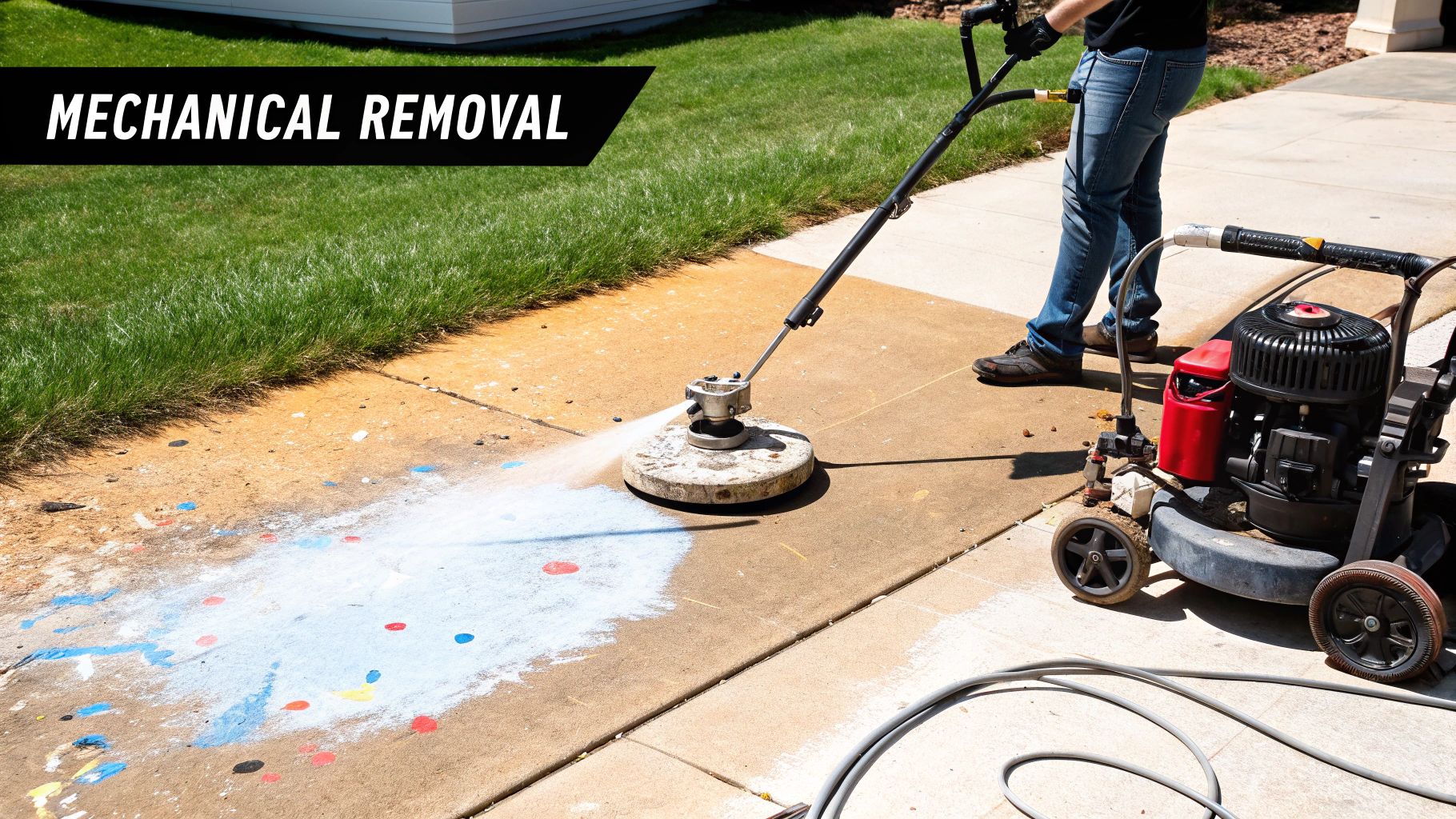
Sometimes, the best way to get paint off concrete is with good old-fashioned brute force. Instead of relying on chemical reactions, mechanical methods like pressure washing and grinding use physical abrasion to literally blast or grind the paint away. These are powerful techniques, and they’re particularly effective for large, open areas or when you're up against old, flaky paint that’s already losing its battle with the elements.
If you're staring at a peeling, sun-beaten latex paint job on your driveway, a high-powered pressure washer is often your best friend. But I'm not talking about the kind you screw onto your garden hose. To really strip paint, you need a serious machine that can push out at least 3,000 PSI (pounds per square inch). That's enough force to get under the paint and peel it right off without needing any harsh chemicals.
Pressure Washing Best Practices
Success with a pressure washer really comes down to the nozzle. Stay away from the red, zero-degree nozzle—it creates a concentrated jet that's powerful enough to etch permanent lines into your concrete. Trust me, you don't want to trade a paint problem for a permanent damage problem.
Instead, start with a wider fan tip, like a yellow (15-degree) or green (25-degree), and always test it on a hidden spot first.
- Keep your distance: Hold the wand about 12-18 inches from the concrete. Getting too close, for instance within 6 inches, dramatically increases the force and risk of damage.
- Sweep smoothly: Use steady, overlapping back-and-forth motions to avoid creating ugly stripes or "tiger lines." Imagine you are spray painting, not writing with a pencil.
- Come in at an angle: Hitting the paint from the side helps the water jet get underneath the edges and lift it off cleanly. An angle of about 45 degrees is often most effective.
If you're curious about what a professional job looks like, you can explore examples of pressure washing success.
When To Bring In a Concrete Grinder
For the really stubborn stuff, like a thick epoxy coating on a garage floor, a pressure washer just isn't going to have enough muscle. This is where you have to bring out the heavy machinery: a concrete grinder. These tools use rotating discs embedded with diamond abrasives to physically shave off the very top layer of the concrete, taking the paint right along with it.
It's an incredibly effective method, but it's also not for the faint of heart. One wrong move can gouge the concrete, so a steady hand is essential. Grinding is usually the go-to method when you're prepping a floor for a brand-new finish, like a stain or a polish. The biggest challenge? Dust. It gets everywhere. Always rent or buy a grinder that has a proper vacuum shroud attachment. This kind of aggressive prep work is often the first step toward achieving a high-end finish, like the ones you see in our guide to https://www.atlantaconcretesolutions.com/residential-polished-concrete.
While mechanical methods are powerful, they aren’t always the most efficient. Chemical removers can strip 95% of paints in a single pass compared to just 60-70% for media blasting, reducing project downtime by as much as 50%.
This efficiency is a big reason why professionals often lean toward chemical solutions. With the North American concrete floor coatings market reaching USD 434.06 million in 2023, finding the most cost-effective method is a huge priority. For contractors, using a good solvent can be 20-30% less expensive over the life of a project compared to repeatedly using aggressive mechanical systems.
When to Call a Professional for Concrete Paint Removal
There’s a real sense of accomplishment that comes with a weekend warrior project. But let's be honest—some jobs are just better left to the pros, and removing paint from concrete can definitely be one of them. Knowing when to put down the scraper and pick up the phone can save you from a world of headache, potential damage, and even serious safety risks.
Sometimes the best method is simply knowing your limits. Recognizing the signs that a project is over your head is crucial for protecting both your property and your well-being.
Spotting the Red Flags for a DIY Job
Certain situations can turn a seemingly straightforward paint removal project into a nightmare. If you run into any of these, it’s a strong signal that calling in an expert is the smartest move.
Think about hiring a professional crew if you're dealing with:
- Potential Lead-Based Paint: This is a big one. If your property was built before 1978, there's a good chance the paint contains lead. Scraping, sanding, or blasting it can release toxic dust into the air, creating a major health hazard. Professionals are trained and certified in lead-safe removal practices. For example, they use specialized vacuums with HEPA filters and follow strict containment protocols.
- Delicate or Decorative Surfaces: Is your concrete stamped, stained, or polished? Aggressive chemicals and high-pressure washing can quickly ruin these finishes, causing permanent etching, discoloration, or chipping. It takes a skilled hand to strip the paint without destroying the surface underneath. A professional, for example, might use a gentler soda-blasting technique instead of a harsh grinder.
- Massive Surface Areas: Stripping an entire two-car garage floor or a sprawling patio is a huge undertaking. A pro team brings in industrial-grade grinders and large-scale equipment to get the job done efficiently and, just as importantly, uniformly. Imagine trying to get a consistent finish across 500 square feet with a hand scraper—it’s nearly impossible.
The Real Value of Bringing in an Expert
Hiring a professional team isn't just about saving yourself a weekend of back-breaking labor. You're paying for their experience, specialized tools, and in-depth knowledge of how to get the job done right without costly mistakes.
A professional service doesn’t just bring the right equipment; they manage the entire process from start to finish. This includes the often-overlooked but critical step of proper waste disposal, ensuring everything is handled according to local environmental regulations.
There's a reason the global market for concrete paint removers reached USD 1.56 billion in 2023. Getting paint off concrete correctly is essential for the long-term health of the surface. Here in Atlanta, professional removal helps prevent issues like cracking and delamination, allowing concrete to stand up to decades of hot Georgia sun.
At the end of the day, a professional ensures the job is done right the first time. If you’re looking at a complicated paint removal project in the Atlanta area, getting an expert opinion is the best place to start. You can easily request a free quote from Atlanta Concrete Solutions to see what your options are.
Got Questions? We've Got Answers
Even the best-laid plans can hit a snag. When you're staring at a paint-stained slab of concrete, questions are bound to pop up. Here are some of the most common things people ask us, with straight-up answers from our experience in the field.
Can I Just Use Vinegar or Something from My Kitchen to Get This Paint Off?
It's a tempting thought, for sure. If only it were that easy! But the reality is, household products like vinegar or baking soda just don't have the muscle to break down cured paint on concrete. They can't touch the chemical binders in modern paints, especially not tough stuff like oil-based or epoxy coatings.
Now, if you catch a tiny latex paint drip the second it happens, you might make a small dent with some serious elbow grease and soapy water. But for any paint that has actually dried and set, you're going to need a real paint stripper or a method with some force, like pressure washing. Trust me, starting with the right tool will save you hours of scrubbing and frustration.
Will Trying to Remove Paint Wreck My Stamped Concrete?
Yes, it absolutely can, and this is a big one to watch out for. Stamped and decorative concrete isn't just plain concrete; it often has delicate sealants and colors mixed in that can be easily damaged by the wrong approach.
If you use a harsh chemical stripper, you could end up with permanent discoloration. And blasting it with a high-pressure washer is a great way to chip or wear away the beautiful pattern you paid for. With these surfaces, we always recommend getting a professional opinion. We use specific pH-neutral strippers and techniques like low-pressure, high-volume washing to lift the paint without harming the design.
Damaging decorative concrete is a real risk. A DIY mistake can quickly turn into a repair bill that costs thousands, while bringing in a pro protects your investment.
How Do I Get Rid of All This Chemical Sludge and Old Paint Safely?
This is a critical final step, so don't cut corners here. Never, ever wash chemical gunk and paint flakes down a storm drain. That stuff goes straight into local waterways and causes serious pollution.
Here’s the right way to handle it: gather all the scraped-up paint chips and sludge onto a big plastic sheet. Let it all dry out completely until it's solid. Once it's hardened, bag it up securely in a heavy-duty trash bag. The final step is to check with your local waste management office for their rules on disposing of household hazardous waste—every town can be a little different. For example, some municipalities have specific drop-off days or locations for this type of material.
Realistically, How Long Will It Take to Strip My Driveway?
The timeline for a project like this is all over the map. It really depends on a few key things:
- Driveway Size: Obviously, a small single-car spot is a much quicker job than a sweeping circular drive. For instance, a 200 sq. ft. patio is a one-day job, while a 1,000 sq. ft. driveway is not.
- Paint Type: A single, thin coat of latex paint might be gone in an afternoon. Multiple layers of old, thick epoxy? That’s a different beast entirely. We’ve seen jobs with 3-4 layers of old porch paint take days.
- Your Method: Using a chemical stripper means you have to factor in "dwell time"—the hours the chemical needs to sit and work. This alone can turn a one-day job into a multi-day project.
To put it in perspective, a DIY job on a standard two-car driveway with tough old paint could easily eat up your entire weekend. With our industrial-grade grinders and pressure washers, we can typically get the same job done 50-70% faster.
When you're past the point of guesswork and just want a perfect, clean slate, Atlanta Concrete Solutions has the tools and know-how to tackle any paint removal job. If you're in the Atlanta area with a stubborn paint problem, visit us online to get a free, no-obligation quote and let our team bring your concrete back to life.