
When you spot those tell-tale stair-step cracks running through your foundation or notice a wall starting to bow inward, you’re seeing signs of serious structural stress. For homes with cinder block foundations, these issues are often a direct result of immense pressure from the surrounding soil, and they almost always require a professional to stabilize the wall and prevent things from getting worse. Acting fast is the best way to protect your home’s integrity and value.
Understanding Cinder Block Foundation Issues
Few things cause a homeowner’s stomach to drop like finding a crack in their foundation. Here in the Atlanta area, many homes are built on cinder blocks, so it’s crucial to know the difference between a simple cosmetic issue and a genuine structural threat. Unlike a solid poured concrete wall, a cinder block foundation is a system of individual blocks and mortar joints.
This method of construction has its own unique set of vulnerabilities. While the blocks themselves are great at handling weight from above (compressive loads), they don't do as well against pressure from the side—that constant push from soil and water.
The Role of Atlanta's Clay Soil
In Georgia, the number one enemy of a cinder block foundation is our expansive clay soil. Think of it like a giant sponge. When it rains, the clay soaks up a massive amount of water and swells. During a drought, it shrinks and hardens. This endless cycle of expansion and contraction puts incredible hydrostatic pressure on your foundation walls.
When the ground is saturated, that heavy, waterlogged clay pushes relentlessly inward. Over the years, that constant force can make walls bow, lean, and eventually crack. For example, a heavy spring rainstorm after a dry winter can cause the soil to expand so rapidly that it exerts thousands of pounds of force against your basement wall, which can be the final straw that causes a horizontal crack to appear.
Key Takeaway: The damage from expansive soil isn't usually from one big event. It’s the slow, repetitive stress cycle that wears down the mortar joints and eventually causes the cinder block wall to fail.
Common Vulnerabilities of Block Foundations
Because of how they’re built, cinder block foundations tend to show very specific types of damage. Learning to spot them early can save you a lot of trouble down the road.
- Bowing or Bulging Walls: This is when the middle of the wall pushes inward, creating a visible curve. It’s a dead giveaway that the wall is under more stress than it can handle.
- Horizontal Cracks: These cracks typically run right along the mortar joints in the middle of a wall. This is a clear signal that the wall is failing from the lateral pressure.
- Stair-Step Cracks: You’ll see these zigzag cracks following the mortar lines. They often mean one part of your foundation is sinking or settling unevenly.
And this isn’t just an Atlanta problem. With an aging housing stock and more extreme weather, foundation repair is a massive industry. The market in the U.S. and Canada is expected to grow from USD 11.8 billion in 2025 to nearly USD 20 billion by 2035. The kind of work needed for block foundations—wall repair and settlement solutions—accounts for about 60% of that market. You can explore more about these trends in residential foundation concrete services.
The goal isn't to scare you, but to empower you with knowledge. While any foundation problem is serious, professional cinder block foundation repair can restore your home’s safety and give you back your peace of mind.
How to Spot Cinder Block Foundation Problems
Stepping into your basement or crawlspace to check on the foundation can feel a little intimidating. But you don't need to be an engineer to be a detective for your own home. Knowing what to look for helps you catch issues early, which can save you a lot of headaches and money down the road.
First things first, grab a good flashlight and walk the entire perimeter of your foundation, both inside and out. Don't just glance at it—really look. Shine the light sideways along the walls to highlight any subtle bulges or hairline cracks that are easy to miss. Pay extra attention to the corners and anywhere pipes or utility lines come through the wall, as these are common weak spots.
What Do the Cracks in Your Walls Mean?
Not all cracks are a four-alarm fire. Some are harmless, but others are screaming for help. The shape and direction of a crack tell a story about the forces pushing and pulling on your foundation.
You’ll generally run into three types in a cinder block wall:
- Vertical Cracks: These run straight up and down. They often show up as a house settles naturally over time. While you'll want to seal them to keep water out, they aren't usually a sign of a major structural emergency. For example, a thin crack less than 1/16th of an inch wide in the middle of a long wall is often due to normal concrete shrinkage.
- Horizontal Cracks: If you see a crack running horizontally across the middle of a wall, that's a huge red flag. This is the classic sign that immense pressure from soil and water outside is pushing your wall inward. This is a serious problem that needs to be addressed quickly.
- Stair-Step Cracks: These cracks follow the mortar joints, zig-zagging up the wall like a set of stairs. They tell you that one part of your foundation is sinking faster than another, creating a shearing force that's literally pulling the blocks apart.
Pro Tip: Found a crack you're worried about? Mark the ends with a pencil and write the date next to it. Snap a clear picture on your phone. Check back in a month or two. If the crack has grown past your marks, you've got an active problem that needs a professional's attention right away.
To help you make sense of what you're seeing, here’s a quick reference table.
A Visual Guide to Foundation Warning Signs
Use this quick reference to connect the symptoms you see in your basement to their likely causes and understand what they mean for your home.
| Symptom | What It Looks Like | Potential Cause | Severity Level |
|---|---|---|---|
| Horizontal Cracks | A long, horizontal crack in the middle of a block wall. | Hydrostatic (water) or lateral (soil) pressure pushing the wall inward. | High |
| Stair-Step Cracks | Cracks that zigzag along the mortar joints, resembling stairs. | Differential settlement (one part of the foundation sinking unevenly). | High |
| Vertical Cracks | Straight up-and-down cracks, often near the middle of a wall. | Minor foundation settling or concrete shrinkage. | Low to Medium |
| Bowing or Bulging | The wall appears to be curving or leaning inward. | Excessive external pressure from soil and water. | High |
| Water Stains | White, chalky residue (efflorescence) or dark, damp patches. | Water seeping through porous blocks or cracks. | Medium |
This table is a starting point, but remember that a professional inspection is the only way to get a definitive diagnosis.
Checking for Bowing and Bulging Walls
A bowing wall is one of the most dangerous signs of foundation failure, but it can be surprisingly hard to spot with the naked eye until it's pretty advanced.
Here’s a simple trick: get a long, straight level (at least four feet) or even just a piece of string. Place the level vertically against the wall, or tape a string tightly from the top corner to the bottom corner. If you see a gap between the middle of the wall and your straight edge, you’ve got a bow. For instance, if you can slide your fingers into the gap, the bow is likely an inch or more, which requires immediate professional evaluation.
This inward pressure is a serious threat. Unlike solid poured concrete, cinder block walls are hollow and held together by countless mortar joints, giving them more potential failure points. This inherent vulnerability is a key reason that issues like bowing are so common. In fact, industry reports show that wall repair services are expected to account for 35% of all foundation repair revenue in North America in 2025—the single largest category. You can learn more about the differences between block and poured walls to understand why.
Looking for Clues Upstairs
Foundation problems don't just stay in the basement. As the base of your home shifts, it sends a ripple effect through the entire structure. Keep an eye out for these tell-tale signs around the house:
- Sticky Doors and Windows: Is a bedroom door suddenly jamming in its frame? Or a window that used to open smoothly now a struggle? That could be the frame getting twisted out of square by a moving foundation.
- Drywall Cracks: Be on the lookout for new cracks appearing over doorways, near window corners, or along the seams where walls meet the ceiling. A classic example is a diagonal crack extending from the upper corner of a door frame.
- Sloping or Bouncy Floors: If a floor suddenly feels spongy underfoot or looks noticeably slanted, it can point directly to failing support columns in your crawlspace or a sinking foundation.
Finding these secondary clues, combined with what you've seen in the basement, helps build a complete picture of your home’s health. Document everything with photos and notes—it will make your conversation with a foundation specialist much more focused and productive.
A Look at Cinder Block Foundation Repair Methods
So, you’ve spotted some trouble signs with your cinder block foundation. What now? The good news is that foundation repair has come a long way, with specialized techniques designed for very specific problems—everything from patching a small leak to bracing an entire wall that's under pressure.
Getting a handle on these methods will help you feel much more confident when you start talking to the pros.
This is the typical path homeowners take, from that first "uh-oh" moment to getting an expert opinion.
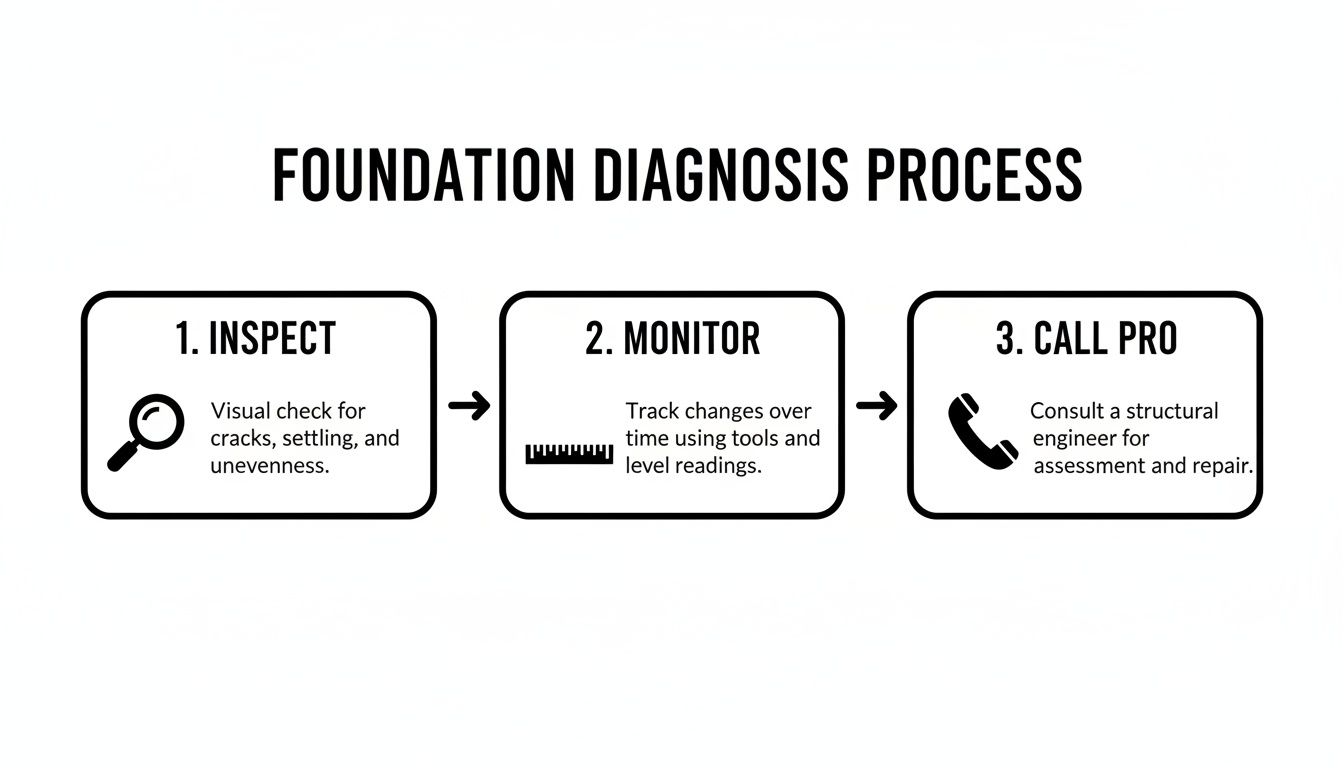
After you've done your own walkthrough and maybe watched a crack for a few weeks, bringing in a professional is the crucial step. They're the ones who can truly diagnose the root cause and map out the right repair strategy.
Solutions for Cracks and Leaks
When you're dealing with cracks that haven't caused the wall to bow or shift, the game plan is twofold: restore some structural integrity and, just as critically, stop water from getting in. Water is the number one enemy of a foundation, leading to mold, rot, and breaking down the blocks themselves over time.
Here are a couple of common fixes for these issues:
- Epoxy or Polyurethane Injection: This is way more advanced than just squirting some caulk in a crack. A technician injects a specialized resin right into the gap. Epoxy is incredibly strong and basically glues the two sides of the crack back together. Polyurethane is more flexible; it expands to create a durable, waterproof seal, which is perfect for stopping active leaks. This approach is best for vertical cracks that aren't structural.
- Tuckpointing: This is an old-school masonry skill used for crumbling mortar joints, especially those ugly stair-step cracks. We carefully grind out the old, failing mortar and replace it with a fresh, strong mix that matches the original. It not only makes the wall look right again but also helps it carry the weight of your house like it's supposed to.
These repairs are fantastic for isolated problems, but they won't add the muscle needed to hold back a wall that's actively failing from outside pressure. You can dig deeper into various approaches to masonry and concrete restoration in our detailed guide.
Reinforcing Bowing or Bulging Walls
When a cinder block wall starts to bow inward, that's a five-alarm fire. It's a clear sign that the soil pressure outside is overwhelming your foundation. The repair has to add serious strength to fight back. Luckily, modern engineering gives us some powerful, and surprisingly unintrusive, solutions.
Carbon Fiber Straps
One of the slickest ways to stabilize a bowing wall is with carbon fiber straps. These aren't just some fancy tape; we're talking about a woven material that is literally stronger than steel.
The process is precise but doesn't take long:
- First, we grind the interior surface of the block wall smooth where the straps will go.
- Next, a powerful epoxy is applied to both the wall and the straps.
- The straps are then pressed firmly onto the wall, usually spaced about four feet apart.
Once that epoxy cures, the strap becomes one with the wall. It creates an unbreakable reinforcement system that completely stops any more inward movement. This is the perfect fix for walls that have bowed two inches or less and haven't started sliding inward at the floor.
Expert Insight: The best part about carbon fiber is how low-profile and fast it is. The straps lie almost perfectly flat against the wall. You can easily paint right over them or even finish your basement with drywall without losing space. We can often get the whole job done in a single day.
Wall Anchors
For more severe bowing, or if the bottom of the wall has started to shift, we need to bring in the heavy artillery. That's where wall anchors, sometimes called earth anchors, come into play. This system acts like a massive brace, using the stable, undisturbed soil in your yard to hold the foundation wall in place.
Here’s the breakdown:
- A heavy-duty anchor plate is buried deep in the soil a good distance from your house, for example, 10-15 feet out into the yard where the ground is compact.
- A high-strength steel rod connects that outdoor anchor to a steel plate on the inside of your foundation wall.
- We tighten the rod, which immediately stabilizes the wall and halts any further bowing. Over time, these anchors can often be tightened more to help pull the wall back toward its original position.
While they're more invasive than carbon fiber straps, wall anchors offer incredible holding power. They are a proven, permanent fix for seriously compromised foundation walls.
When Major Foundation Repairs Are Needed
In the worst-case scenarios, just reinforcing the existing wall isn't going to cut it. This can happen if a wall has bowed too far, the cinder blocks themselves are crumbling, or the whole foundation has settled significantly.
One solution is a partial wall rebuild. This involves digging out the soil from the exterior of the damaged section, putting up temporary supports for the house, and then carefully rebuilding the failed part of the wall with new blocks and steel rebar. It's a complex, labor-intensive job, but sometimes it's the only path forward.
Another major repair is underpinning. This is the go-to solution when the foundation is sinking because it was built on weak or shifting soil. The goal is to extend the foundation deeper until it rests on solid ground or bedrock. We do this by driving steel piers (either push piers or helical piers) deep into the earth—sometimes 20, 30, or even 50 feet down—and attaching them to your foundation, lifting it and supporting it for good. Underpinning gets to the root cause of settlement, offering a permanent fix for a sinking home.
Budgeting for Foundation Repair: What to Expect in Atlanta
When you find a problem with your foundation, two big questions pop into your head right away: "How much is this going to cost?" and "How long will my house be a construction zone?"
Getting a handle on the budget and timeline for a cinder block foundation repair is the first step toward getting it fixed right. The final numbers will always depend on your specific situation, but after years in the field here in Atlanta, we can give you a realistic idea of what to expect.
The cost isn't a single number—it’s a range. The biggest factor, of course, is the type and severity of the damage. Sealing a few small cracks is a world away from rebuilding a wall that's about to give way. Access to the area is another huge variable. A tight, cluttered crawlspace simply takes more labor to work in than an open, unfinished basement, and that time adds up on the final bill.
Breaking Down Typical Repair Costs
Cinder block foundation repairs have some of the most variable costs in the industry. We've seen projects range from $350 for simple crack sealing to well over $25,000 for major rebuilds that involve digging up the yard and reinforcing the whole structure. For a little perspective, the national average for all types of foundation repair is around $5,100.
With specialized labor rates climbing close to $200 per hour, it's always smart to get a few detailed quotes before you sign on the dotted line. You can find more details on national foundation repair cost averages on Angi.com.
And since water is so often the root cause of these issues, it’s a good idea to figure out whether homeowners insurance covers water damage. Most policies have very specific rules, so pull yours out and see what's covered.
Here’s a real-world example: Imagine a home in Marietta where a basement wall has bowed inward by about 1.5 inches. The basement is unfinished and easy to access, making it a perfect candidate for carbon fiber straps. That job might involve installing seven straps, take a single day, and cost somewhere between $4,000 and $7,000. But if that same wall had bowed 3 inches and started to slide inward at the bottom, we'd be looking at a much different solution, like wall anchors. That's a multi-day project requiring excavation, likely costing $8,000 to $12,000 or more.
Understanding Project Timelines
Just like the costs, the time it takes to complete a repair can vary wildly. A simple fix might be done in a few hours, while a complex job could take a week or even longer. The repair method itself is what really dictates how long our crew will be at your home.
- Quick Fixes (Less than a day): Injecting minor cracks with epoxy or polyurethane is usually a quick job. The same goes for tuckpointing some crumbling mortar joints in a small section of your wall.
- Intermediate Projects (1-3 days): Installing a full set of carbon fiber straps to stabilize a bowing wall is typically a one-day affair. A wall anchor installation, which needs some digging outside, usually takes two to three days.
- Major Projects (A week or more): Underpinning a sinking foundation or doing a partial wall rebuild are the big ones. These jobs require serious excavation, heavy equipment, and time for new concrete to cure. You can expect these to stretch over a week and almost always require building permits.
Estimated Repair Costs and Timelines in Atlanta
Here's a straightforward guide to help you budget and plan for common cinder block foundation repairs based on local market estimates.
| Repair Method | Estimated Cost Range | Typical Project Timeline | Best For |
|---|---|---|---|
| Epoxy/Polyurethane Injection | $500 – $1,500 | 2-4 hours | Sealing non-structural cracks to stop water leaks. |
| Tuckpointing | $700 – $2,500 | 1 day | Repairing deteriorated mortar in stair-step cracks. |
| Carbon Fiber Straps | $4,000 – $10,000+ | 1-2 days | Stabilizing walls with minor to moderate bowing (<2 inches). |
| Wall Anchors | $7,000 – $15,000+ | 2-4 days | Correcting severely bowing or sliding walls. |
| Underpinning (Piers) | $10,000 – $25,000+ | 1-2 weeks | Lifting and stabilizing a sinking or settling foundation. |
Keep in mind these are just estimates. The only way to get a firm price and schedule is to have a professional come out and assess the situation firsthand.
Choosing the Right Foundation Repair Partner in Atlanta
Handing over your foundation to a contractor can be a nerve-wracking experience. It’s a huge repair, and you need to get it right. But it doesn't have to be a gamble. Picking the right partner is the most critical decision you'll make, and a solid vetting process ensures your home is in truly capable hands.
First things first, let's cover the absolute must-haves. Any foundation specialist you consider in Georgia absolutely needs to have both general liability and workers' compensation insurance. Don't just tick a box on this one—ask to see the actual, current certificates. This isn't just paperwork; it’s what protects you from financial disaster if an accident happens on your property.
Look for Local Expertise
Beyond insurance, you need a crew that knows Atlanta's dirt. Our infamous expansive clay soil and the hydrostatic pressure it creates are a unique challenge. A contractor who primarily works elsewhere might not understand the specific forces battering your cinder block walls. This is where local, hands-on experience makes the difference between a quick fix and a lasting repair.
As you start your search, stick to licensed professionals. It's always a good idea to understand the importance of verifying a contractor's CSLB license—it confirms they meet state standards and are accountable for their work.
Key Takeaway: A portfolio of completed jobs is more than just a gallery—it’s proof of capability. Look for examples of projects similar to yours, especially those involving cinder block foundation repair. Does their work look clean, professional, and built to last?
Questions to Ask Every Potential Contractor
Once you've got a short list, it's interview time. A contractor worth their salt will be happy to answer your questions clearly and without hesitation. Here’s what I’d recommend asking:
- Experience: "How many years have you been specifically repairing cinder block foundations here in the Atlanta area?"
- Methodology: "Can you walk me through the repair method you're proposing? Why is it the best solution for my foundation?" For example, ask, "Why are you recommending carbon fiber straps instead of wall anchors for my specific situation?"
- Warranty: "What does your warranty cover, how long does it last, and can I transfer it if I sell my house?"
- Team: "Will your own employees be doing the work, or do you bring in subcontractors?"
- Timeline: "What's a realistic start date, and how long do you expect the project to take?"
Their responses will tell you everything you need to know about their experience and how they operate. You can see the kind of detailed work we’re proud of by checking out our portfolio of Atlanta-based projects.
In the end, this decision comes down to trust. You're looking for a team that's transparent, has proven local experience, and is focused on fixing the root problem, not just patching the symptoms. A proper cinder block repair is a serious investment in your home’s future, so take your time and choose well.
Your Top Cinder Block Repair Questions Answered
When you're dealing with foundation issues, a lot of questions pop up. It's completely normal to feel a bit overwhelmed by the cost, the process, and what it all means for your home's future. I've heard just about every question in the book, so let's tackle some of the most common ones right now.
Can I Just Fix My Cinder Block Foundation Myself?
It’s tempting to look at a crack and think a little sealant from the hardware store will do the trick. For a hairline crack that isn't structural, maybe. But for anything more serious, it’s a huge gamble.
We're talking about things like horizontal cracks, stair-step cracks you can slide a pencil into, or any hint of a bowing wall. These aren't just cosmetic flaws; they're symptoms of massive forces at play, like the immense weight of water-logged soil pressing against your home.
The real job of a professional isn't just to patch the crack—it's to figure out why it happened in the first place. Was it a drainage problem? Soil expansion? A botched DIY job can actually make things worse by trapping moisture or, even more dangerously, masking a problem that's getting worse by the day. Putting a band-aid on a structural issue often leads to a far more expensive and invasive repair later on.
A professional repair gets to the root cause of the damage—like soil pressure—while a DIY fix usually just covers the symptom. That's the difference between a real solution and a temporary patch that could cost you dearly.
Will a Repaired Foundation Tank My Home’s Resale Value?
Honestly, it's the other way around. It's the unrepaired foundation problem that will absolutely kill your home's value and scare away nearly every potential buyer. Nobody wants to inherit a major structural headache.
A professionally repaired foundation, however, can be a genuine asset when you go to sell. You’ll have all the paperwork showing exactly what was done, by whom, and—most importantly—a transferable warranty. For example, being able to show a potential buyer an engineer's report, the signed contract with a reputable company, and a lifetime warranty for the wall anchor system turns a potential negative into a proven positive, demonstrating the home's stability.
How Do I Stop Foundation Problems Before They Start?
The best defense is a good offense, and when it comes to foundations, that means managing water. The less water soaking into the soil around your foundation, the less hydrostatic pressure you’ll have pushing against those cinder block walls.
Here’s a quick checklist for keeping your foundation dry and happy:
- Keep Gutters Clean: Clogged gutters are useless. Make sure they're clear of leaves and gunk so water can flow freely.
- Extend Your Downspouts: Rainwater should be directed at least five to ten feet away from your foundation. If your downspouts just dump water right next to the house, you're asking for trouble.
- Check the Slope: The ground around your home should gently slope away from the foundation. This is called "positive grading," and it encourages water to drain away naturally. You should see a drop of about six inches over the first ten feet away from your house.
- Landscape Smart: Be careful about planting big trees or shrubs too close to the house. Their root systems can be incredibly powerful and can disrupt or damage your foundation over time.
A little bit of weekend maintenance here and there can save you from a world of expensive trouble.
Is a Horizontal Crack Really That Much Worse Than a Vertical One?
In almost every scenario, yes. A horizontal crack is the classic sign that your foundation wall is failing under immense outside pressure. It's bowing inward, and that's a direct threat to your home's stability that needs immediate attention.
Stair-step cracks are also a major concern because they indicate the foundation is settling unevenly, which puts stress on the entire structure. While small, vertical cracks can sometimes be from the concrete curing, you shouldn't ignore them either. Here's a good rule of thumb: if you can stick a coin in any crack, it's time to have an expert take a look.
Don't sit on foundation worries and let them get worse. The team at Atlanta Concrete Solutions has the local expertise to figure out exactly what's going on with your cinder block foundation and provide a solution that lasts. Schedule your free, no-obligation inspection today and get the peace of mind you deserve.