
Finding a crack in your foundation is unnerving, to say the least. But that discovery is the first critical step toward a lasting fix. For most homeowners, concrete block foundation repair means strengthening the walls against the immense pressure of the surrounding soil or, in some cases, lifting the house itself to correct settlement. For instance, a homeowner in Decatur noticed stair-step cracks in their basement and a sticking patio door; this led them to discover their foundation had settled nearly two inches on one side due to soil erosion from a poorly placed downspout.
This guide will walk you through the entire process, from diagnosis to repair, so you can protect your home's structure and its value with confidence.
Your Guide to a Stable Home Foundation in Atlanta
Think of your foundation like the chassis of a car—if it's out of alignment, the whole vehicle feels off. Here in the Atlanta area, concrete block foundations are everywhere, and for good reason. They’re strong and efficient to build. But they aren't invincible, especially when dealing with Georgia's notorious red clay soil.
Seeing a foundation problem doesn't mean your house is about to collapse. It's usually a sign that the ground underneath has shifted, and the foundation has moved right along with it. That movement is what causes all the classic warning signs, like those zig-zag cracks in the mortar or a bedroom door that suddenly sticks. For example, a home in Marietta might experience significant bowing in its basement walls after a particularly rainy spring, as the saturated clay soil expands and exerts thousands of pounds of pressure.
Why This Guide Is for You
We created this guide to cut through the confusion and give you some peace of mind. We're going to break down everything an Atlanta-area homeowner should know about concrete block foundations, literally from the ground up.
You’ll learn how to:
- Spot the Real Warning Signs: We'll show you the difference between a minor hairline crack from normal settling and a major red flag that points to serious structural stress. For example, a thin vertical crack in the mortar of a new home is likely from curing, while a horizontal crack wide enough to fit a dime into indicates dangerous external pressure.
- Get to the Root of the Problem: You'll understand why Georgia's expansive clay soil is so often the main reason foundations start to fail.
- Explore Proven Repair Solutions: We’ll demystify the modern, engineered methods that professionals use to secure foundations for good, such as installing helical piers to lift a sinking corner of a house.
- Know When to Call for Help: We’ll cover the risks of DIY repairs and give you tips on how to find a trustworthy local foundation expert.
A solid foundation is more than just blocks and mortar. It’s the bedrock of your family’s safety and your home’s future value. Fixing problems the right way isn't just a repair; it’s an investment.
By the time you're done reading, you'll have a much clearer picture of what's happening with your foundation and what can be done about it. Armed with the right information, you can move forward knowing that even the scariest-looking issues have reliable, permanent solutions.
Decoding the Warning Signs: What Your Foundation Is Telling You
Spotting foundation trouble early is the single most important thing you can do to protect your home's value and structural integrity. Your house has its own way of communicating—it sends out subtle (and sometimes not-so-subtle) signals when its foundation is under stress. Learning to read these signs is like understanding your home’s unique language, giving you the power to catch issues before they escalate into major, expensive repairs.
Think of it like a persistent cough. It might be nothing, but it could also be a symptom of something more serious that needs a doctor's attention. In the same way, that door that suddenly sticks or a small crack spidering across the drywall might seem like minor annoyances, but they're often the first whispers of foundation movement. Ignoring them won't make the problem go away. A homeowner might dismiss a jamming bedroom door as a humidity issue, when in reality the entire door frame has been twisted out of square by a sinking foundation pier.
This chart helps visualize the connection between a visible problem (like a crack), its deeper cause, and the right repair.
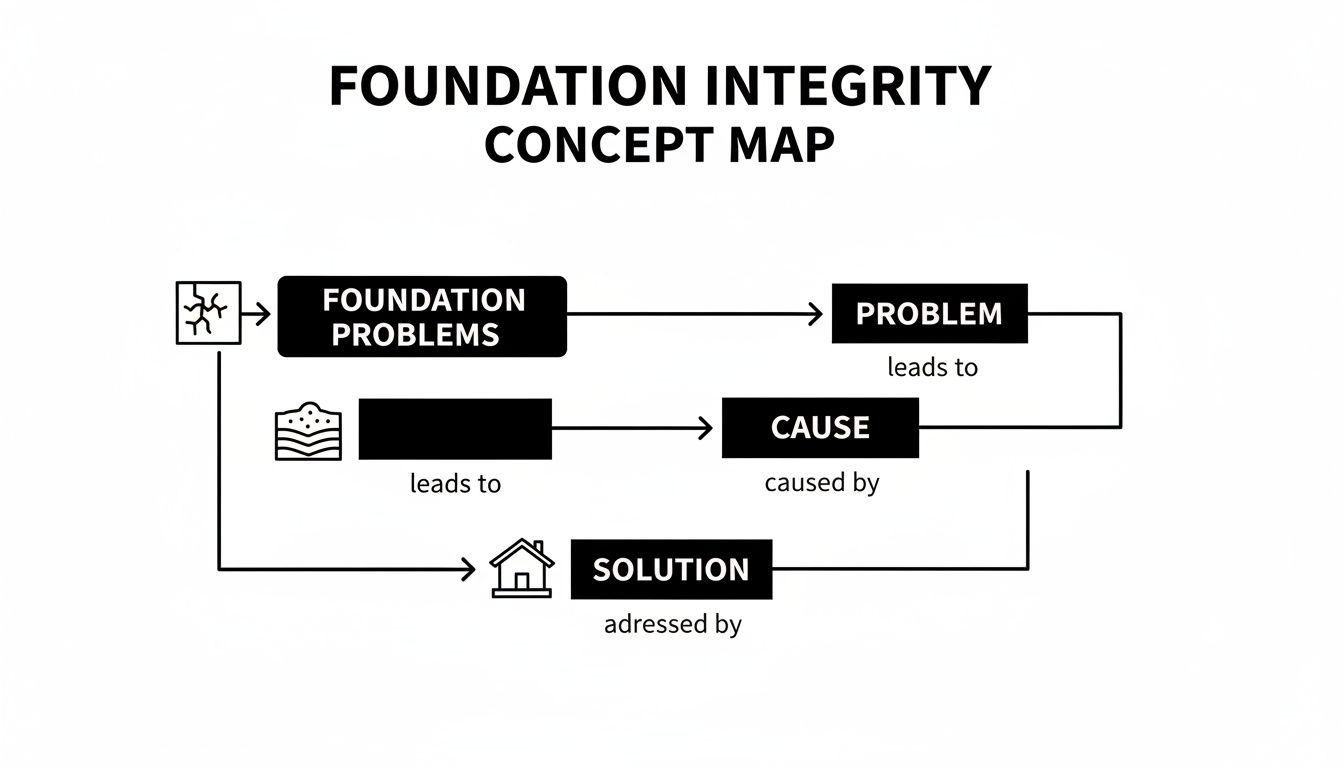
As you can see, a surface-level issue is just a symptom. A real, lasting solution has to tackle the root cause—which usually comes down to soil and water pressure.
Reading the Cracks in Your Foundation Walls
Not all cracks are created equal. The type, direction, and width of a crack in your concrete block foundation tell a very specific story about what kind of forces are pushing and pulling on your home.
- Hairline Vertical Cracks: If you see thin, vertical cracks less than 1/8th of an inch wide, don't panic just yet. These are often due to the concrete curing process or minor, natural settling of the house. A good example is a faint crack appearing in the mortar of a one-year-old home's foundation.
- Stair-Step Cracks: This is a big one. These diagonal cracks zigzag along the mortar joints between blocks, looking like a set of stairs. This pattern is a classic sign of differential settlement, which means one section of your foundation is sinking faster than another. You might see one of these start near the corner of your garage.
- Horizontal Cracks: A horizontal crack running across a foundation wall is one of the most serious red flags you can find. It’s almost always caused by intense outside pressure from soil and water, which is literally causing the wall to bow inward. An example would be a long, continuous horizontal crack in the middle of a basement wall, which may feel slightly bulged inward when you run your hand across it. This situation requires immediate professional attention.
These problems are incredibly common. North America is expected to hold about 45% of the global foundation repair market by 2026, largely due to aging homes and challenging soil. In areas with expansive soil, it’s estimated that up to 25% of block-foundation homes show significant settling in their first 10 years. Here in Georgia, our infamous red clay soil only makes things worse, contributing to over 15,000 foundation-related service calls across the state each year.
Signs Inside Your Home
Foundation problems rarely stay confined to the basement or crawlspace. Since your entire house sits on top of the foundation, any movement below will inevitably travel upward, showing up in your living areas.
When the foundation moves, everything attached to it moves too. A sticking door isn't a door problem—it's often a symptom of the entire door frame being pulled out of square by a settling foundation.
Keep your eyes peeled for these common interior signals:
- Sticking Doors and Windows: Are doors jamming at the top? Are windows suddenly a struggle to open or close? Their frames are likely being warped by foundation shifts. For example, the French doors leading to your patio might suddenly refuse to latch properly.
- Cracks in Drywall or Plaster: Look for cracks shooting out from the corners of door and window frames. These are classic stress fractures caused by settlement. A diagonal crack running from the top corner of a doorway toward the ceiling is a prime example.
- Uneven or Sloping Floors: If a floor feels bouncy, spongy, or is noticeably sloped, it could point directly to failing support joists or a sinking foundation slab. A clear sign is when you drop a marble on the floor and it consistently rolls to the same spot.
You should also be on high alert for any signs of major water intrusion. For example, having to deal with drying out a flooded basement can be a critical sign of hydrostatic pressure that is actively damaging your foundation. Being vigilant is the key to protecting your home’s structural integrity. To get a better sense of all the potential issues, you can learn more about our comprehensive https://www.atlantaconcretesolutions.com/residential-foundation-concrete and what goes into a lasting repair.
Foundation Health Inspection Checklist
To help you get started, here is a simple checklist you can use to perform a quick walk-around inspection of your own home. It’s a great first step in catching problems before they get out of hand.
| Area of Inspection | What to Look For | Severity Level (Low/Medium/High) |
|---|---|---|
| Exterior Walls | Horizontal, vertical, or stair-step cracks in block or mortar | Medium to High |
| Walls that appear to be bowing or bulging inward/outward | High | |
| Interior Walls | Cracks in drywall, especially around door and window frames | Medium |
| Wallpaper pulling away from the wall or showing wrinkles | Low to Medium | |
| Doors & Windows | Doors or windows that stick, jam, or no longer latch properly | Medium |
| Visible gaps between the frame and the wall | Medium to High | |
| Floors | Sloping, sagging, or uneven floors | Medium to High |
| Cracks appearing in tile or concrete slab floors | High | |
| Basement/Crawlspace | Musty smells, visible mold, or standing water | Medium |
| Water stains (efflorescence) on concrete block walls | Low to Medium |
Walking through this checklist a couple of times a year can make all the difference. Remember, the sooner you identify a potential issue, the simpler and more affordable the solution is likely to be.
Why Foundations Fail in Georgia's Clay Soil
To get a real handle on why concrete block foundation repair is so common around Atlanta, you have to look at what’s happening right under our feet. The main troublemaker is our infamous red clay soil. You can think of it as a massive, powerful sponge wrapped around the base of your home.
When it pours, that Georgia clay soaks up a ton of water and swells, pushing against your foundation walls with incredible force. That push is what we call hydrostatic pressure. Then, when things dry out, the clay shrinks and pulls away, leaving gaps and voids. This relentless cycle of swelling and shrinking makes the ground unstable, causing foundations to shift, settle unevenly, and crack.
The Expansive Clay Soil Problem
Imagine trying to build a house on a platform that’s constantly getting bigger and smaller all year long. That’s the reality for your foundation every single day. This constant movement is what creates those tell-tale stair-step cracks and bowing walls that signal serious trouble. For example, a home built during a dry summer might experience severe foundation stress during its first wet winter as the clay soil swells for the first time, pushing against the newly cured foundation walls.
This isn't just some local headache; it's a major reason the foundation repair industry is booming. The global market has grown significantly, driven by aging homes and tricky soil conditions just like ours here in the Southeast. In fact, some estimates suggest that in areas with expansive clay, as many as 60% of homes might need foundation work within 20-30 years, simply because of how the soil behaves. You can dig into the specifics of these market trends in various detailed industry reports.
The ground beneath your home is not static. It’s a dynamic environment that reacts to every change in moisture. Understanding this interaction is the first step in protecting your foundation from long-term damage.
All this pushing and pulling puts immense stress on the mortar joints holding your blocks together. Over time, if you don't address it, that stress can lead to outright failure.
Common Contributing Factors
While our clay soil is the main villain in this story, a few other things can speed up the damage. These issues often team up with the soil to create a perfect storm for foundation failure.
- Improper Drainage: This is probably the biggest and most destructive culprit. When your gutters are clogged or the downspouts just dump water right beside the house, it super-saturates the clay in that one spot. That creates intense, focused pressure on that section of your wall. A prime example is a downspout that terminates right at the corner of your house, leading to stair-step cracks originating from that exact corner.
- Poor Yard Grading: Your yard should always slope away from the house. If it slopes inward, rainwater will collect and pool against the foundation, causing the same oversaturation and pressure problems. You might notice this if you have persistent puddles next to your home after it rains.
- Plumbing Leaks: A slow, hidden leak in the pipes under your slab can feed a constant stream of water into the soil. This weakens the ground's ability to support the weight of your home, often causing one corner or section to sink. An unusually high water bill can sometimes be the first clue to this type of problem.
- Inadequate Soil Compaction: Before a home is built, the dirt beneath the foundation has to be packed down tightly to create a stable base. If that step was rushed or done poorly, the soil will continue to compress and settle over time, and your foundation will sink right along with it. This is a common issue in newer housing developments where construction timelines are tight.
It's important to recognize these factors because they show that foundation problems are often caused by the environment, not necessarily a flaw in the home's construction or something the homeowner did wrong. By managing the water around your house and understanding the ground it sits on, you can take smart, proactive steps to protect your biggest investment.
Modern Solutions for Concrete Block Foundation Repair
So, you’ve spotted some of the warning signs—those stair-step cracks or that unsettling bow in your basement wall. The big question now is, what can actually be done about it? The good news is that modern engineering offers some incredibly effective, permanent solutions for concrete block foundation repair. These aren't just cosmetic patches; they get to the root cause of the problem to make your home structurally sound again.
Think of it like setting a broken bone. You wouldn't just put a bandage on it and hope for the best. You need a sturdy cast to hold everything in the right position so it can heal properly. In much the same way, professional foundation repair uses specialized tools and materials to brace, lift, and permanently stabilize your home's foundation.
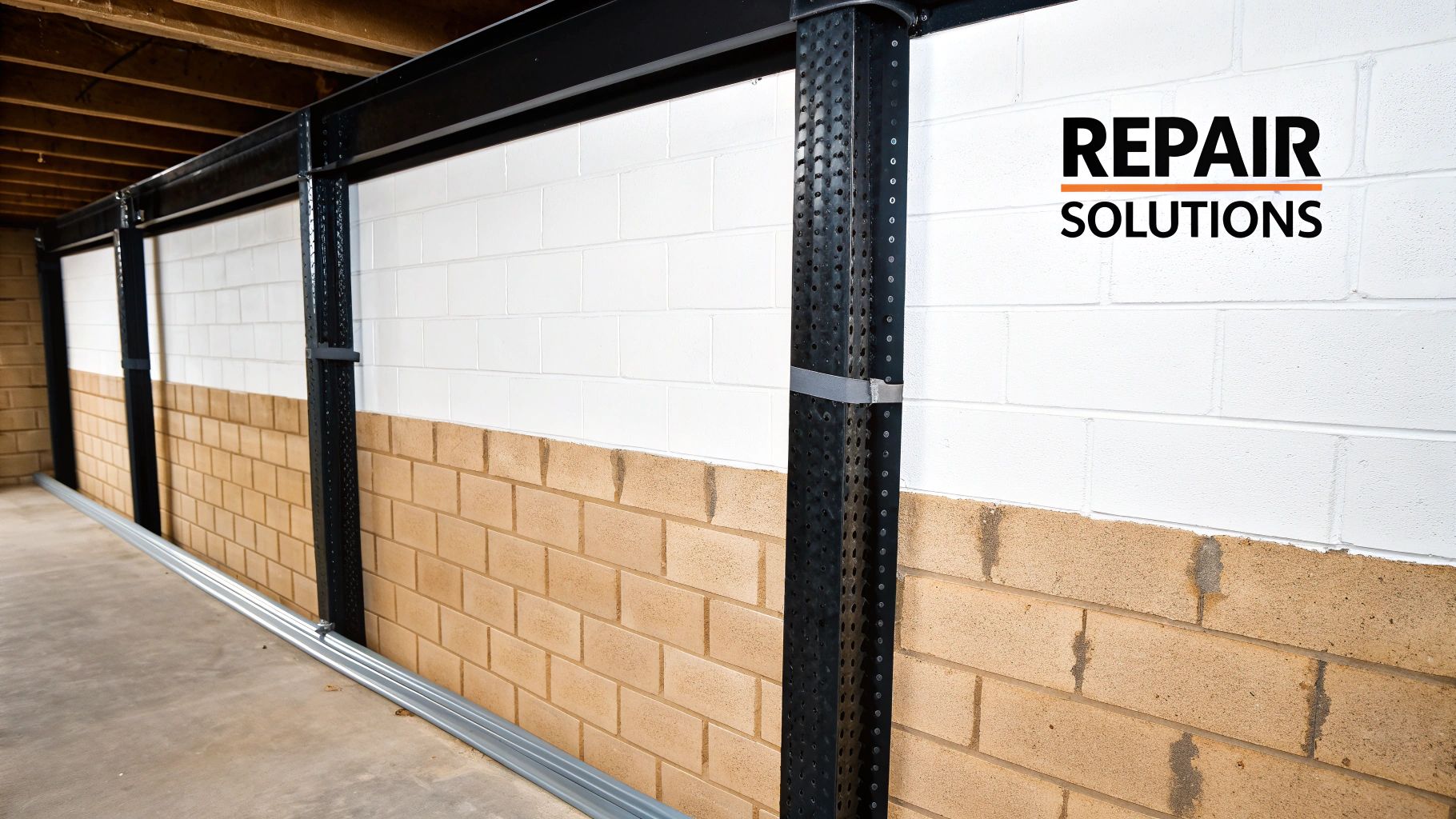
These solutions are engineered specifically to fight back against the immense pressure from Georgia's expansive clay soil, giving you real peace of mind that the problem is truly solved. Let’s walk through the most common and reliable techniques we use today.
Reinforcing Bowing Walls From The Inside
When the soil outside your home gets saturated with water, it expands and pushes inward on your foundation walls. That immense pressure is what causes them to bow or lean, which is one of the more serious issues for a block foundation. The repair strategy here is to add reinforcement from the inside to counteract that external force and stop the wall from moving any further.
We have two go-to methods for this:
- Carbon Fiber Straps: Picture a high-tech, super-strong brace for your foundation wall. These woven carbon fiber straps are actually 10 times stronger than steel. We bond them directly to the interior of the bowing wall with a powerful structural epoxy. For example, if a 20-foot long basement wall is bowing inward by one inch, a series of these straps installed every four feet can permanently halt the movement. The result is a reinforcement system that's incredibly strong yet surprisingly low-profile. It’s a fantastic solution for walls that have bowed less than two inches.
- Steel I-Beams: For more significant bowing, we bring in the heavy-duty support of steel I-beams. These beams are anchored securely to the concrete floor below and the floor joists above. They act as a rigid interior buttress, physically stopping the wall from bowing any more, no matter how much pressure the soil exerts. This is the preferred method for a wall that has bowed more than two inches and shows significant horizontal cracking.
The choice between carbon fiber straps and steel I-beams comes down to the severity of the bow. A professional assessment is essential to figure out which solution will provide the right level of structural support for your home.
Lifting And Stabilizing A Settling Foundation
If your foundation is sinking or settling unevenly, we have to go deeper—literally. The goal is to bypass the unstable soil right under your home and anchor the foundation to solid, load-bearing ground far below. This process is called underpinning.
The most trusted way to do this is by installing foundation piers:
- Helical Piers: Think of these as giant steel screws. We use hydraulic machinery to drill them deep into the earth until they hit stable soil or even bedrock that can easily support your home's weight. For instance, in an area with soft topsoil, a pier might need to be driven 20-30 feet down to reach a solid layer. Special brackets are then used to connect the piers to your foundation's footing.
- Push Piers: These are long sections of steel pipe that we hydraulically drive into the ground, one by one, until they reach solid strata. Just like with helical piers, they are then connected to the foundation using heavy-duty brackets. This method is often used when bedrock is deeper, as the piers can be driven to greater depths.
Once the piers are locked in place, we transfer the weight of your home off the weak soil and onto the solid ground below. In many cases, we can then use the hydraulic system to carefully lift the settled parts of the foundation back toward their original position, which often closes up cracks and levels out floors.
Sealing Cracks And Stopping Water Intrusion
While cracks are usually a symptom of a bigger structural problem, they're also a wide-open door for water to get into your basement or crawlspace. Sealing them properly is a critical part of any complete repair plan.
For this, we use high-pressure injection methods:
- Epoxy Injection: We use this for structural crack repair. Epoxy is a two-part resin that, once injected, essentially glues the concrete back together. For example, a stair-step crack caused by minor settlement can be injected with epoxy to restore the wall's structural integrity after the settlement has been addressed. It restores the wall's original strength and creates a totally waterproof seal.
- Polyurethane Injection: This is our go-to for waterproofing. It’s a flexible material that, when injected into a crack, reacts with any present moisture and expands into a dense, foam-like gasket. If you have a leaking crack that drips water after a heavy rain, a polyurethane injection will expand to fill the entire void and stop the leak. It completely fills the void and blocks water from ever getting through again. For more information on fixing various concrete issues, especially those related to moisture and deterioration, some outside resources offer great explanations.
Understanding these modern repair methods shows that even the most daunting foundation problems have proven, reliable solutions. The key is simply matching the right technique to the specific issue your home is facing. To explore options for your property, learn more about our specialized residential concrete and masonry repair services designed to address these exact challenges.
DIY vs. Professional Repair for Your Foundation
When you spot that first crack in your foundation, your immediate thought might be a quick trip to the hardware store. It's tempting to think a tube of epoxy or some caulk can make the problem disappear over a weekend. But with concrete block foundation repair, what seems like a simple fix is often a dangerous illusion.
Treating a foundation issue like a minor home improvement task is a bit like putting a bandage on a broken arm. Sure, you've covered the visible problem, but you haven't done a thing to address the real injury underneath. The heart of foundation repair isn't just filling a gap; it's about understanding and counteracting the massive forces—from shifting soil to hydrostatic pressure—that caused the crack to begin with.
The Allure and Risks of DIY Foundation Repair
The biggest draw for any DIY project is saving money, and foundation repair is no exception. A crack injection kit might set you back a hundred dollars, which sounds a lot better than the initial quote from a pro. Unfortunately, this path is riddled with hidden risks that can end up costing you a fortune down the road.
Imagine sealing up a vertical crack, feeling proud of your handiwork. What you might not realize is that the crack was a warning sign of differential settlement. While you've hidden the evidence, one side of your home continues to sink, leading to far more catastrophic structural damage. For example, a DIY patch on a basement wall crack might look fine for six months, but the continued inward bowing of the wall could eventually lead to a structural failure costing tens of thousands to fix, versus a few thousand for carbon fiber straps if addressed correctly from the start.
"A foundation repair is not a patch job; it's a structural engineering solution. Attempting it without a deep understanding of soil mechanics and load-bearing principles can inadvertently turn a manageable issue into a catastrophic failure, jeopardizing both the safety and the value of your home."
The Clear Advantages of Professional Expertise
Hiring a professional foundation repair contractor is an investment in your home's long-term health and your own peace of mind. The difference starts with a proper diagnosis. A seasoned expert knows how to read the story your foundation is telling—interpreting the type of crack, the exact degree of wall bowing, and the surrounding soil conditions to pinpoint the root cause.
This professional assessment is everything. There's a reason the global market for foundation repair services is projected to hit USD 4.11 billion by 2028, and a huge chunk of that is driven by homes with concrete block foundations. Here in the Southeast, where our moisture-rich soils love to shift, millions of homes are at risk. Professional repairs typically range from $5,000 to $15,000 because they provide a real solution. For instance, teams like Atlanta Concrete Solutions have successfully boosted the structural integrity of homes by up to 90% for thousands of clients by applying the correct, engineered fix right from the start. You can dig deeper into these global foundation repair market trends to see the full picture.
Beyond just an accurate diagnosis, professionals come equipped with engineered solutions, heavy-duty equipment, and—crucially—a warranty. That transferable warranty does more than just let you sleep at night; it protects your home's resale value, giving future buyers solid proof that the work was done right and is guaranteed to hold. Choosing a pro isn't just about fixing a problem; it's about securing your most valuable asset.
Deciding between a weekend project and calling in an expert is a major crossroads. The following table breaks down what’s really at stake.
DIY vs. Professional Foundation Repair: A Risk-Benefit Analysis
| Aspect | DIY Repair | Professional Repair (e.g., Atlanta Concrete Solutions) |
|---|---|---|
| Diagnosis | Relies on guesswork and visual cues, often missing the root cause. | Uses professional assessment tools and expertise to identify the underlying issue (soil, water, settlement). |
| Solution | Limited to cosmetic fixes like epoxy or caulk, which don't address structural forces. | Implements engineered solutions like carbon fiber straps, helical piers, or wall anchors designed to last. |
| Cost | Low initial cost ($100 – $500), but high risk of future costs due to unresolved problems. | Higher upfront investment ($5,000 – $15,000+), but solves the problem permanently, preventing costlier damage. |
| Safety | High risk of personal injury or causing further structural damage to the home. | Performed by trained, insured crews following strict safety protocols. |
| Time & Effort | Can take multiple weekends with no guarantee of success. | The project is completed efficiently, often in just a few days, with minimal disruption. |
| Resale Value | Can actively harm resale value, as DIY repairs are a red flag for home inspectors. | A transferable warranty provides proof of a professional, permanent fix, protecting or even increasing home value. |
| Warranty | None. If the fix fails, you're back at square one, and out the money and time. | Comprehensive, often lifetime, transferable warranties that guarantee the work. |
Ultimately, while the DIY route seems like a shortcut to savings, it's a gamble with the structural integrity of your home. A professional repair is a calculated investment in safety, stability, and value.
How to Choose the Right Atlanta Foundation Repair Contractor
Picking the right team for a concrete block foundation repair is every bit as important as the repair method itself. This one decision determines the quality of the work, the long-term safety of your home, and frankly, your own peace of mind. Getting it right the first time means partnering with a qualified, reputable contractor who will protect your biggest investment.

Think about it like hiring a surgeon. You wouldn't just go with the cheapest option or the one with the slickest ad. You'd want someone with a proven track record, the right credentials, and years of successful outcomes. It's the exact same logic here—your home's entire structural integrity is at stake.
Vetting Your Potential Contractors
Your first step is to build a shortlist of contractors to evaluate. A truly great contractor will be transparent from the get-go, demonstrating deep knowledge and patiently answering every question without making you feel pressured.
Use this simple checklist to help guide you through the vetting process:
- Verify Licensing and Insurance: This is an absolute must. Any contractor you're serious about should be fully licensed to work in Georgia and carry both general liability and workers' compensation insurance. Don't be shy about asking to see their certificates; a professional will have them ready. For example, check their credentials against the Georgia State Licensing Board for Residential and General Contractors.
- Ask for Local References: A company proud of its work will be happy to provide a list of recent jobs completed right here in the Atlanta area. Talking to their past customers is the best way to get unfiltered feedback on everything from their communication style to the quality of the finished repair. Ask for the address of a recently completed job in a neighborhood like Alpharetta or Roswell so you can see the quality of their exterior work.
- Inquire About Their Process: A reputable expert should be able to walk you through their diagnostic process and explain the proposed solution in plain English. They should clearly articulate why a certain repair is the best fit for your home's unique problem. For example, they should explain why helical piers are better for your soil conditions than push piers.
Understanding the Quote and Warranty
When the quotes start coming in, you need to look past the final number. A vague, one-line estimate is a huge red flag. A professional proposal will be itemized, breaking down the scope of work, materials, labor, and a realistic timeline.
A detailed quote is a sign of professionalism and transparency. It shows the contractor has done their homework and is confident in their plan, leaving no room for surprise costs down the road.
Just as important is the warranty. A strong warranty is a company’s promise that they stand behind their work. For any major structural repair, you should insist on a comprehensive, transferable warranty. This protects you and adds real value to your home if you ever decide to sell. For example, a lifetime warranty on underpinning work means that if the foundation settles again in that area, the company will return to fix it at no cost to you or the future homeowner.
Red Flags to Watch Out For
As you meet with different companies, keep your eyes peeled for some common warning signs of a less-than-reputable operator.
- High-Pressure Sales Tactics: Be wary of anyone who pushes you to sign on the spot or uses scare tactics to rush your decision. For example, a contractor who offers a "today only" price that is significantly lower should be viewed with suspicion.
- Vague or Non-Itemized Quotes: A lack of detail often signals a lack of experience or, worse, an intent to hide costs. If a quote just says "Foundation Repair: $12,000," that's a major red flag.
- "One-Size-Fits-All" Solutions: Every foundation problem is unique. A contractor who suggests the same fix for every issue without a thorough inspection isn't doing their job. If they recommend steel piers before ever measuring the wall's bow or checking the soil, be cautious.
Choosing a contractor with deep local roots and a genuine commitment to quality makes all the difference. To see the values and experience that set a dedicated team apart, you can learn more about our company and how we serve the Atlanta community. By asking the right questions and doing your homework, you can hire a team you truly trust.
Got Questions? We've Got Answers
If you're worried about your foundation, you're not alone. Most homeowners have the same questions running through their minds. Let's tackle the big ones right now so you know what to expect when it comes to repairing your concrete block foundation.
How Much Does Concrete Block Foundation Repair Cost in Atlanta?
This is usually the first question on everyone's mind, and the honest answer is: it depends. The price tag is tied directly to what's causing the problem and the specific fix your home needs.
- Minor Fixes: Simple, non-structural crack sealing is the most budget-friendly repair. For example, injecting a 10-foot vertical crack with polyurethane foam to stop a water leak might cost between $400 and $800.
- Moderate Repairs: If you have a bowing wall, reinforcing it with carbon fiber straps is a common solution. This typically runs between $3,000 to $8,000, based on the length of the wall and how bad the bowing is. A 25-foot wall with moderate bowing might require 6 straps, costing around $5,000.
- Major Structural Work: For a sinking or settling foundation, you'll likely need underpinning with steel piers. This is a much bigger job, and costs usually start around $10,000 and go up from there depending on the scale of the project. For example, stabilizing one corner of a home with 3-4 helical piers could cost between $10,000 and $15,000.
The only way to get a firm number is to have a professional come out, inspect the foundation, and diagnose the core issue.
How Long Will My House Be a Construction Zone?
Probably not as long as you think. The timeline really depends on the job's complexity, but most professional crews work efficiently to minimize the disruption to your life.
A straightforward crack injection can be wrapped up in just a few hours. Reinforcing a wall with carbon fiber straps or steel I-beams is often a 1 to 3-day job. Even a full-scale underpinning project to lift the home is usually done in about 3 to 5 days. Any good contractor will give you a clear, day-by-day schedule before they ever break ground. For example, Day 1 might be excavation, Day 2-3 pier installation, Day 4 lifting and stabilization, and Day 5 backfilling and cleanup.
A professional repair is all about efficiency. The goal isn't just to fix the problem, but to do it permanently with as little interruption to your family's routine as possible. It should be a smooth, predictable process from start to finish.
Is This a Permanent Fix, or Just a Patch?
When it’s done right, absolutely. A professional concrete block foundation repair is engineered to be a permanent, one-and-done solution. Modern methods get to the root of the problem instead of just covering up the cracks you can see.
The materials used today, like industrial-grade carbon fiber and galvanized steel piers, are designed to outlast the home itself. For instance, galvanized steel piers are coated to resist corrosion and can have a design life of over 100 years, ensuring the repair remains stable for generations. This is exactly why choosing a seasoned, reputable contractor is non-negotiable. They will stand behind their structural work with a long-term, transferable warranty, which protects your investment and gives you total peace of mind for years to come.
Ready to get a clear, no-obligation assessment of your foundation? The experts at Atlanta Concrete Solutions are here to provide a detailed inspection and a customized repair plan for your home. Protect your investment by ensuring the job is done right.
Visit us online to schedule your free estimate today.