
That spiderweb of cracks in your driveway or patio can be a real eyesore, and it's easy to jump to the worst-case scenario. But take a breath—most of the time, it's not a sign of a looming catastrophe. Concrete cracks. It's just what it does, thanks to everything from natural curing and shrinkage to our wild weather cycles. For example, a new driveway might develop tiny hairline cracks within the first year as it settles—this is completely normal.
The secret isn't preventing every single crack; it's catching them early and using the right concrete crack repair products to stop a small problem from turning into a big, expensive headache.
Why Your Concrete Cracks and When to Fix It
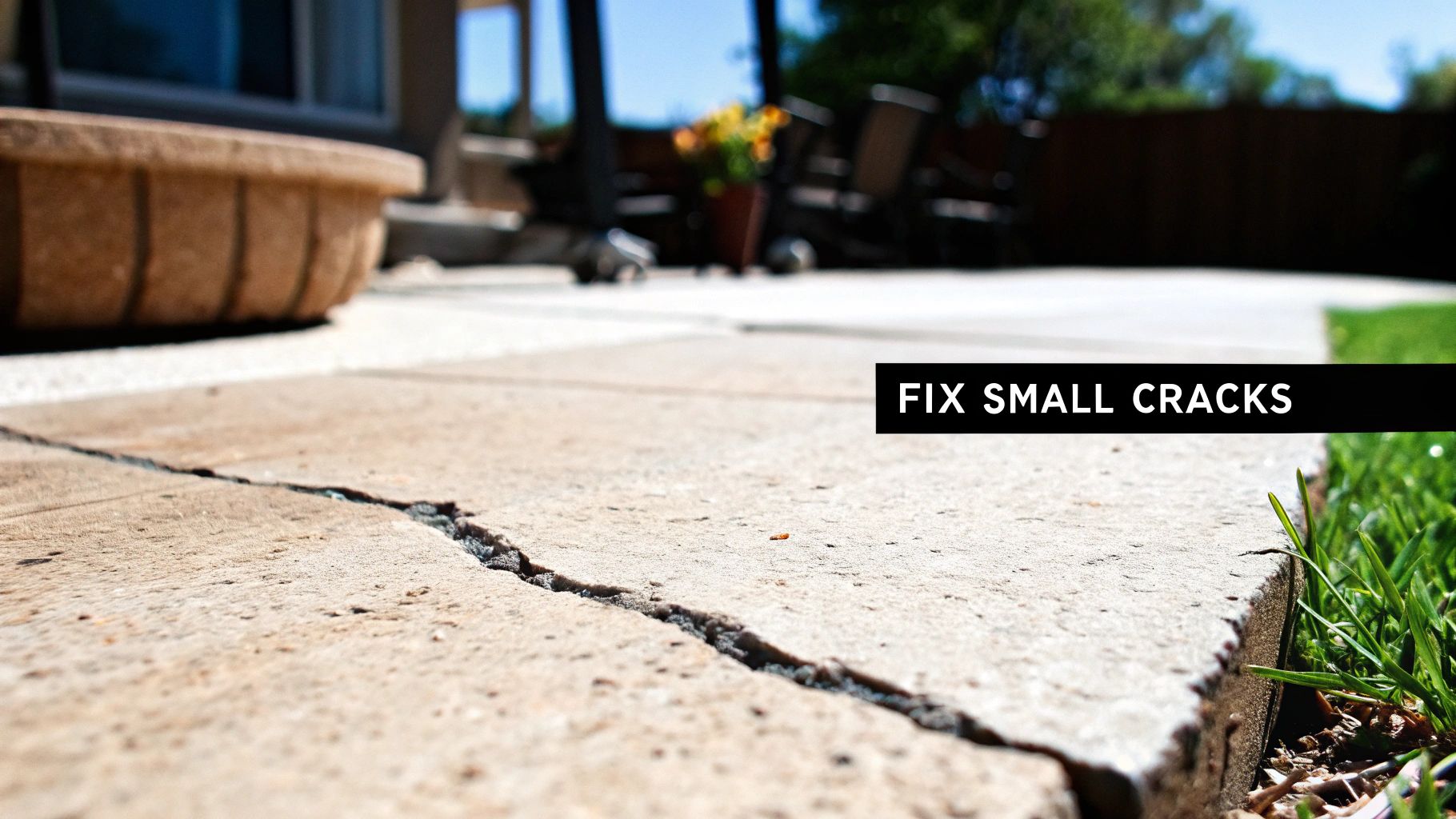
Finding a new fissure in your concrete is rarely a welcome sight. But it helps to know that concrete is almost designed to crack over time. Here in Atlanta, our infamous clay-rich soil is a major culprit; it swells up when wet and shrinks when dry, constantly pushing and pulling on the slabs above. Other common causes include heavy vehicle traffic on a driveway not built for it, or tree roots pushing up a sidewalk from below.
Think of that small crack like a tiny chip in your car's windshield. At first, it's just an annoyance you can fix quickly and affordably. But if you ignore it, that chip will inevitably spread, eventually forcing a full, costly replacement. Your concrete works the exact same way.
Understanding the Urgency of Repair
Once a crack appears, your biggest enemy is water. Moisture finds its way into that opening, and when temperatures drop, it freezes and expands, forcing the crack wider. For instance, a small 1/8-inch crack can easily widen to 1/4-inch after just one harsh winter. Over time, that water can also wash away the soil supporting the slab, causing it to sink and become uneven. A little bit of the right sealant now is your best line of defense.
Sealing those openings is a smart move that protects your property by:
- Preventing Water Infiltration: This is the big one. It stops moisture from getting underneath the slab where it can cause erosion and freeze-thaw damage. A good example is sealing cracks in a pool deck to stop chlorinated water from degrading the rebar inside.
- Stopping Weed Growth: Nothing makes a crack look worse than weeds popping through. Sealing it keeps them from taking root and pushing the concrete apart.
- Maintaining Structural Integrity: A sealed crack is a stable crack. It prevents minor, non-structural issues from growing into serious problems that could impact your home's foundation. You can learn more about protecting your home with professional residential foundation services.
A proactive approach is crucial. A small investment in the right concrete crack repair products today can save you from spending thousands on a full replacement tomorrow.
It's not just a local issue, either. The need for effective repair solutions is booming everywhere. The global market for concrete repair materials is expected to hit $1,429.2 million by 2025, largely because we all have aging infrastructure to maintain.
For homeowners in Atlanta, where our humid climate can speed up the cracking process, this trend just underscores why pros rely on high-quality products to deliver repairs that actually last.
A Look at Your Concrete Crack Repair Options
Walking down the concrete repair aisle can be overwhelming. You're faced with a wall of different tubes, tubs, and kits, and they all promise to fix your problem. But here's the thing: each one is a specialized tool for a very specific job.
Think of it like a mechanic's toolbox. You've got heavy-duty wrenches for big structural jobs and delicate instruments for fine-tuning. You wouldn't use a sledgehammer to change a spark plug, right? The same logic applies here. Picking the right product is the most important step toward a repair that actually lasts.
Let's break down the main players so you know exactly what you're looking for.
1. Epoxy Injection Kits: The Structural Weld
When a crack isn't just a cosmetic issue but a threat to the stability of your foundation or a support column, you need to bring in the heavy artillery. That’s where epoxy injection kits shine. These are the "super glue" of the concrete world, designed to restore structural integrity. Popular brands include Sika and Quikrete, which offer complete kits with injection ports and the two-part epoxy.
Epoxies are two-part systems—a resin and a hardener. When you mix them, they create a chemical reaction that results in a bond that is, believe it or not, often stronger than the original concrete. This process essentially "welds" the crack back together, making the slab whole again. It’s the go-to solution for serious vertical cracks in basement walls or any concrete element holding up a load.
- What it's good at: Incredible bonding strength, restores the slab's original strength, doesn't shrink.
- Keep in mind: Can be pricier, doesn't offer flexibility, and requires careful mixing and application.
- Perfect for: Repairing a structural crack in a poured concrete foundation wall.
2. Polyurethane Sealants: The Flexible Filler
Concrete is always on the move. It expands in the summer heat and shrinks in the winter cold. For cracks in surfaces that face these daily and seasonal shifts, a rigid fix like epoxy will just crack again. You need something that can move with the concrete, which is exactly what polyurethane sealants are made for. Look for products like Sikaflex or Loctite PL, which come in caulk tubes for easy application.
Think of polyurethane as a tough, rubber-like caulk. It fills the crack to keep water out but remains flexible enough to stretch and compress as the concrete moves. This makes it the ideal choice for non-structural cracks in driveways, sidewalks, garage floors, and patios. It’s your best defense against the freeze-thaw cycle that turns small cracks into big ones.
For any horizontal crack that needs to stand up to weather and movement, polyurethane is almost always the answer. Its ability to accommodate the concrete's natural shifting is what makes the repair last.
3. Hydraulic Cement: The Emergency Leak Stopper
Is there water actively seeping through a crack in your basement wall? This is a four-alarm fire in the world of home maintenance, and hydraulic cement is your fire extinguisher. This stuff is pretty amazing—it's engineered to set and harden incredibly fast, even underwater. A well-known example is DRYLOK Fast Plug, which you mix into a putty-like consistency.
As it cures, hydraulic cement actually expands, forcing itself into every nook and cranny of the crack to plug the leak and form a waterproof seal in just a few minutes. It's a true emergency patch. It won't fix the structural issue, but it will stop the bleeding so you can figure out what's causing the water problem in the first place.
- What it's good at: Stops active water leaks almost instantly, sets up in minutes.
- Keep in mind: It's not a structural fix, can be brittle, and you have to work fast.
- Perfect for: Plugging a hole in a basement wall where water is actively pouring or seeping through.
4. Cementitious Patching Compounds: The Cosmetic Fix
Not every crack is a crisis. For minor surface issues—hairline cracks, little chips, or areas where the top layer has flaked off (spalling)—a cementitious patching compound is all you need. These are essentially pre-mixed, cement-based putties designed for easy application. Products like Dap's Concrete Patch or Sakrete's Concrete Repair are common examples found in most hardware stores.
Their main job is to improve the look of your concrete and prevent small blemishes from trapping dirt and water. They blend in well with the surrounding texture and color, but they don't add any real strength or flexibility. For a quick aesthetic touch-up on your patio or to smooth out a rough spot on the garage floor, these compounds are perfect.
To see what these different types of products look like and compare their specifications, you can browse through Yasutrading's complete range of concrete repair products for a good overview of what’s available on the market.
Quick Guide to Concrete Crack Repair Products
Feeling a bit overwhelmed? It's a lot to take in. This simple table breaks down the key players to help you match the product to your problem at a glance.
| Product Type | Best For | Key Feature | Flexibility |
|---|---|---|---|
| Epoxy Injection | Deep, structural cracks in foundations, walls, columns | Restores structural strength; stronger than concrete | Low |
| Polyurethane Sealant | Non-structural cracks in driveways, sidewalks, patios | Stretches and compresses with concrete movement | High |
| Hydraulic Cement | Actively leaking cracks and holes in basement walls | Sets in minutes, even underwater, to stop leaks | Low |
| Patching Compound | Hairline cracks, spalling, chips, and cosmetic flaws | Easy to apply and blends with existing concrete | Low |
Think of this chart as your cheat sheet. Find the description that best matches your crack, and you’ll know exactly which type of product you need to look for.
How to Choose the Right Product for Your Crack
Now that you know what's on the shelf, the real work begins: playing detective with your concrete. Choosing the right repair product isn't about grabbing the most expensive or "strongest" option. It's about matching the solution to the specific problem you're facing.
To do this right, you need to ask a few simple but critical questions. Your answers will cut through the noise and point you directly to the product that will give you a lasting repair, not just a temporary cover-up.
Analyze the Crack's Characteristics
First thing's first: take a good, hard look at the crack itself. Its size, location, and behavior tell you everything you need to know. A hairline crack that hasn't changed in years on a basement floor is a completely different beast than a wide, shifting crack in a driveway that gets baked by the sun and driven over daily.
Start by asking these key diagnostic questions:
- Is it structural or non-structural? This is the big one. If the crack is wider than a quarter-inch, follows a zig-zag pattern, or if one side of the crack is higher than the other (a sign of shifting), you're almost certainly looking at a structural problem. These demand a high-strength fix like epoxy.
- Is it on a horizontal or vertical surface? Think about gravity. A horizontal crack in a garage floor or patio is perfect for a self-leveling sealant that flows down into the gap. But if you try that on a foundation wall, you’ll just have a mess. Vertical cracks need a thicker, non-sag formula that stays put while it cures. For example, Sika makes both self-leveling and non-sag versions of their polyurethane sealants for this reason.
- Is the crack active or dormant? Is it still growing? A simple trick is to take a pencil and mark the very ends of the crack. Come back in a month or two. If the crack has grown past your marks, it's "active." Active cracks need a flexible product like polyurethane that can stretch and compress with the movement.
This decision tree gives you a great visual for that first, most important question: Is my crack structural?
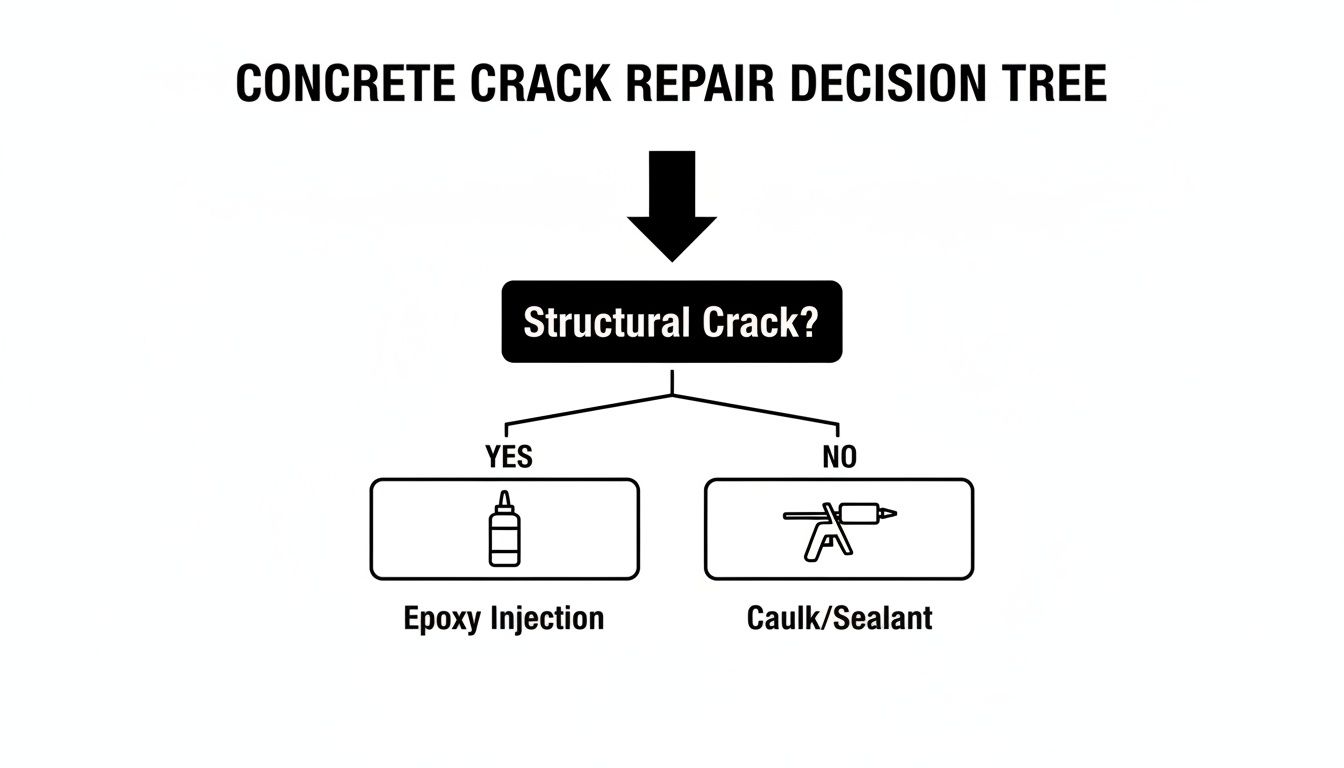
As you can see, this one fork in the road immediately sends you down the path toward either a rigid structural bond or a flexible non-structural seal.
Match the Product to the Problem
Once you've got your answers, you can start matching them to the right product with confidence. That tiny, non-structural crack on your enclosed patio might just need a simple cementitious patch for a quick cosmetic fix. On the other hand, that wide, active crack in your Atlanta driveway needs a tough, flexible polyurethane sealant that can handle our sweltering summers and chilly winters without giving up.
The goal is to choose a product that addresses not only the crack itself but also the forces acting upon it. A mismatched product is a repair that's doomed to fail.
Getting this choice right is a big deal, which is why the global concrete repair market is projected to hit $12.02 billion by 2025. Crack repair is a huge piece of that pie because sealing these fissures is the number one way to prevent water from seeping in and rusting the rebar—the cancer of concrete.
For local pros like us at Atlanta Concrete Solutions, using the right material isn't just best practice; it's how we deliver repairs that actually last and save homeowners from bigger headaches down the road. You can learn more about the concrete repair system market trends. By taking a moment to diagnose the problem, you're making the same smart choice a professional would.
Your Basic Guide to the Concrete Repair Process
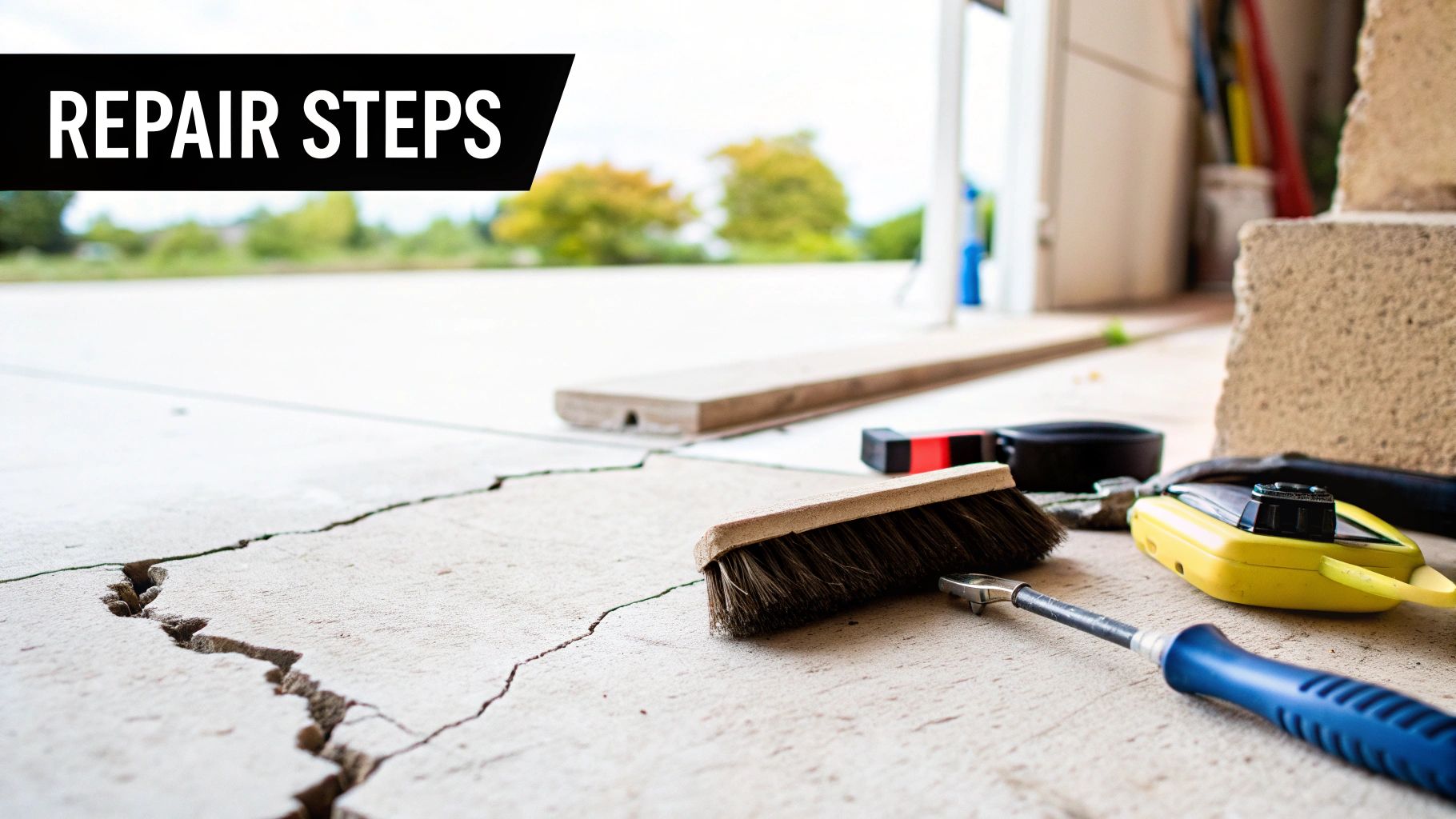
So, you’ve picked your product and you're ready to tackle that crack yourself? Fantastic. With the right materials, many concrete repairs are well within reach for a determined DIYer. The process isn't rocket science, but the secret to a repair that lasts lies in patience and paying close attention to the details.
Think of it like painting a room—the final coat only looks as good as the prep work underneath. Cutting corners in the beginning is the number one reason repairs fail down the road. This guide will walk you through the typical steps, giving you a clear game plan for a solid, professional-looking fix.
Step 1: Prep the Crack for Repair
This is, without a doubt, the most important part of the job. If your repair material can't get a tenacious grip on the inside of the crack, it's just a matter of time before it fails and pops out. Good prep is all about creating the perfect surface for adhesion.
You need to start with a clean slate. Grab a wire brush, a small chisel, or even a pressure washer to get all the gunk out—loose concrete bits, dirt, weeds, and any old, flaky sealant. For cracks wider than 1/4 inch, pros often use an angle grinder with a diamond wheel to slightly widen and bevel the edges, creating a "V" shape for the new material to lock into. Your goal is to expose the raw, solid concrete on both sides of the crack. A shop vacuum is your best friend here for sucking out that last bit of stubborn dust.
Step 2: Mix and Apply the Repair Product
With the crack clean and completely dry, you're ready to go. The golden rule here is to read the manufacturer's instructions on your specific product. They’re not just suggestions; different materials have very different rules.
- For Cartridge-Based Sealants: This is the easy part. Just load the tube into a caulk gun, snip the tip to match the crack’s width, and lay down a consistent bead, making sure to force it deep into the crevice. For deep cracks, you might first insert a foam backer rod to save on sealant and provide the right depth.
- For Two-Part Epoxies or Compounds: You’ll be mixing a resin and a hardener. Follow the ratios exactly and work efficiently—once mixed, these products have a limited “pot life” before they start to harden.
Safety First: Don't skip the safety gear. Always wear safety glasses and gloves. Concrete dust is nasty stuff to breathe in, and many repair chemicals can be rough on your skin.
Step 3: Finish and Let It Cure
Once the crack is filled, the final touch is to make it look good. Use a putty knife or a small trowel to smooth the material, feathering the edges so it sits flush with the surrounding concrete. For a better texture match on walkways, some people sprinkle a little sand over the top of the wet repair material.
Now for the hardest part: waiting. Every product has a specific cure time, which is how long it needs to sit undisturbed to reach its maximum strength and durability. For example, a polyurethane sealant might be tack-free in a few hours but require 72 hours before you can drive a car over it. Be patient and keep traffic off the area until it’s fully cured.
Knowing these steps gives you a realistic idea of what the job takes. While many small cracks are perfect for a weekend project, bigger and more complicated problems often need a professional touch. If you're looking at a major repair, checking out professional concrete repair services in Atlanta is a smart move to guarantee the job is done right the first time.
When to Call a Professional for Concrete Repair
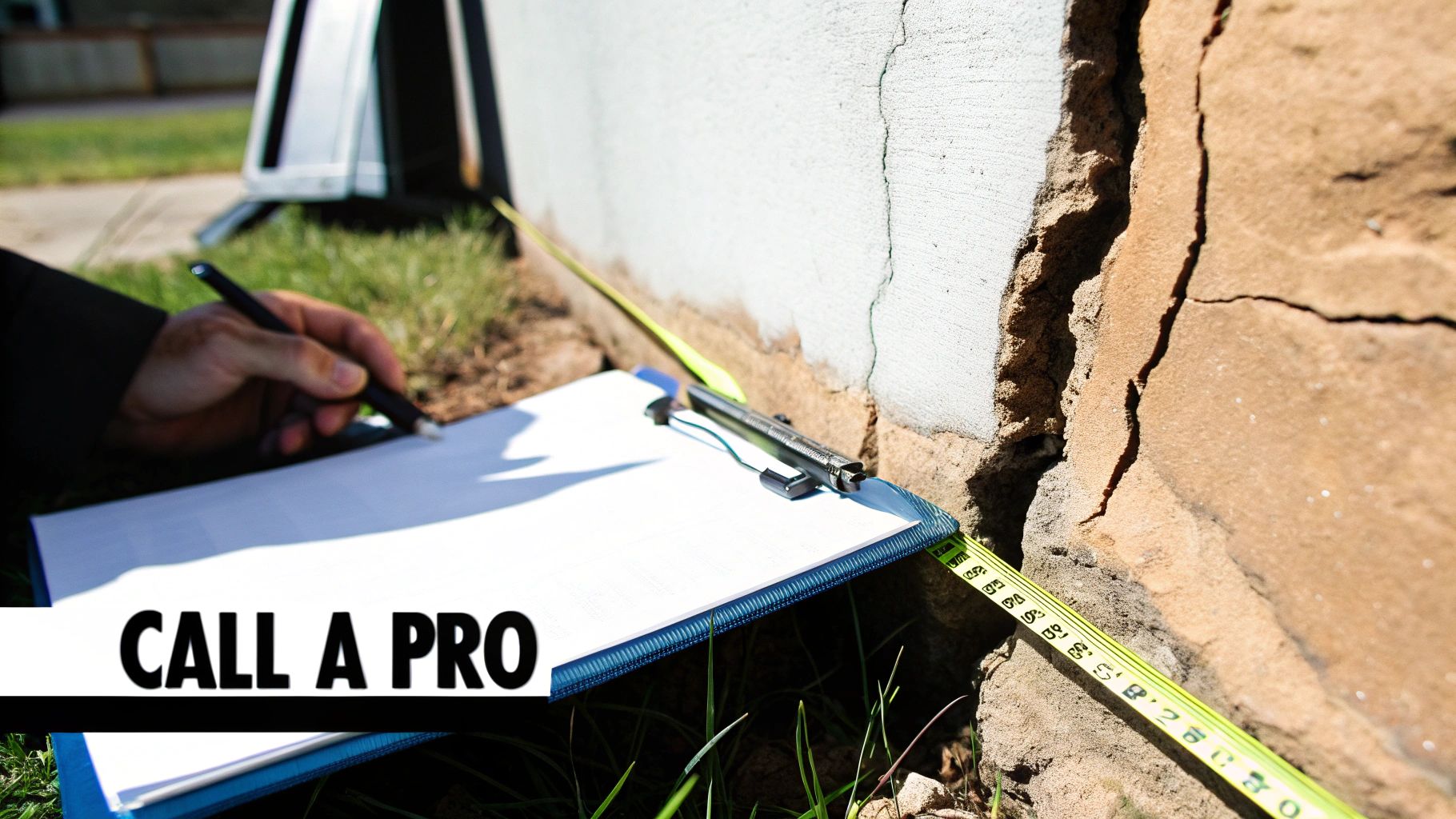
Look, I'm all for rolling up your sleeves for a good weekend DIY project. Many small concrete cracks are perfect for that. But some cracks are more than just ugly—they’re your home’s way of screaming for help.
Knowing when to put down the patching compound and pick up the phone is the most important part of concrete maintenance. The truth is, some problems are warning signs of serious underlying trouble, and off-the-shelf concrete crack repair products just can't fix them. Attempting a DIY fix on a major issue only hides the evidence, allowing the root cause to get worse.
Spotting the Real Red Flags
So, how do you tell the difference between a simple hairline crack and a five-alarm fire? You have to learn to read the signs. Certain cracks tell a story of structural distress, and ignoring them can lead to some eye-watering repair bills and safety hazards down the road.
Here are the tell-tale signs that you need an expert, no questions asked:
- The Crack is Wide: Anything wider than half an inch (1/2") is a big deal. This isn't a simple shrinkage crack; it's a sign of significant movement.
- One Side is Higher Than the Other: If you run your hand across the crack and feel a "step," that’s called vertical displacement. A 1/4-inch difference between slabs on a walkway is not just an eyesore, it's a major trip hazard. It’s a clear signal the ground underneath is shifting, sinking, or failing.
- You See a Network of Cracks: When you see a "spiderweb" or "alligator" pattern of interconnected cracks, it often points to widespread stress or failure across the slab. This can sometimes be caused by a poor concrete mix or an improperly prepared sub-base.
- Cracks in Foundation Walls: Pay close attention to horizontal cracks in a foundation wall or stair-step cracks running through the mortar of a block wall. These are classic signs of intense pressure from water or soil.
Why a Professional Diagnosis Matters
When you see any of those red flags, remember that the crack is just the symptom. The real problem is hidden. A professional contractor doesn’t just show up to fill the crack; they come to find out why it happened in the first place.
Is it poor drainage? Unstable soil? Hydrostatic pressure? For instance, they might discover your home's downspouts are dumping water right next to the foundation, saturating the soil and causing the pressure that led to the crack. They have the experience and tools to diagnose the root cause. For anyone facing these kinds of serious issues, understanding what's involved in a professional concrete driveway repair can shed light on the types of long-term solutions required.
A professional assessment isn't a cost—it's an investment. You're buying peace of mind and making sure you aren't just slapping a bandage on a problem that could threaten your entire home.
For complex structural issues, an expert might recommend advanced solutions like slab jacking (mudjacking) or underpinning, which go way beyond a simple filler. If you're in the Atlanta area and see any of these worrying signs, the team at Atlanta Concrete Solutions has seen it all. You can learn more about their comprehensive approach to residential concrete and masonry repair and see how they can protect your property for the long haul.
Got Questions About Concrete Repair? We've Got Answers.
Even after you've learned about the different products and techniques, it's natural to have a few questions rolling around. Getting the small details right is what separates a quick patch from a permanent fix. Let's tackle some of the most common questions we hear from homeowners to make sure you can move forward with total confidence.
Can I Use the Same Product for My Driveway and My Basement?
This is probably the number one question we get, and the short answer is almost always no. A one-size-fits-all product is a recipe for trouble because these two areas have completely different needs.
Think about your driveway. It’s out in the elements, getting baked by the sun and then hit with rain, causing it to expand and contract constantly. It needs a repair material with serious flexibility, which is where a polyurethane sealant shines. It’s designed to move and stretch with the concrete.
Your basement foundation, on the other hand, is a whole different ballgame. A crack there often needs to be structurally sound. An epoxy injection is usually the go-to because it doesn't just fill the crack—it essentially glues the concrete back together, restoring its original strength. A flexible sealant simply can't do that.
How Long Should a Good Concrete Crack Repair Last?
When done right, a quality repair can easily last for years—often for the rest of the concrete's lifespan. But its longevity really boils down to three key things.
First, you have to pick the right product for the job. Using a rigid filler in a joint that needs to flex is just asking for it to fail. Second is all about the prep work. The crack has to be spotlessly clean and dry, with no lingering dust or debris, so the material can get a death grip on the concrete.
Finally, and this is the big one, you have to fix what caused the crack in the first place. For example, if a large tree root is causing a sidewalk slab to heave and crack, filling the crack won't solve the problem long-term. The root must be addressed. If you have drainage issues or unstable soil, the ground will keep shifting. The original repair might hold, but new cracks will just pop up right next to it.
Can I Paint Over the Repaired Crack?
Yes, you absolutely can with most modern repair products. The majority of polyurethane sealants and epoxy fillers are made to be paintable once they've fully cured. This is great for getting a clean, uniform look on visible surfaces like a painted basement wall, garage floor, or patio.
The key is patience. Always check the product's label or technical data sheet. It will tell you exactly how long to wait before painting and might even recommend a specific primer to get the best adhesion. If you jump the gun, you'll end up with peeling or bubbling paint.
What's the Real Difference Between a "Filler" and a "Sealant"?
It’s easy to get these two mixed up, but they have completely different jobs.
Think of it like this:
- A sealant is a flexible barrier. Its main goal is to seal a joint or a non-structural crack to keep water and dirt out while allowing the concrete to move naturally. Polyurethane is the classic example here.
- A filler is all about strength and structure. It’s used to fill a void and restore the concrete’s integrity, sometimes even making it stronger than it was before. Epoxy injection kits are a perfect example of a filler.
Getting this right is critical. Concrete crack fillers are a huge deal in property maintenance, with the global market hitting $1.5 billion in 2023. These materials are engineered to block moisture, which is the culprit behind an estimated 70% of all concrete failures. For folks in the Atlanta area, where our shifting clay soils are notorious for moving slabs, using the right product is the only way to prevent serious water damage and dangerous trip hazards. You can learn more about the global concrete crack fillers market for a deeper dive.
If you're looking at a repair that feels out of your league or you just want the peace of mind that comes with a professional job, Atlanta Concrete Solutions is ready to help. Our team has the experience to get to the root of the problem and provide a solution that lasts. Contact us today for a free, no-obligation quote and let's get it fixed for good.