
That first crack in your driveway can feel a little disheartening. It’s a common sight for homeowners, especially here in the Atlanta area where our infamous red clay soil and wild weather swings put concrete to the test. But don't panic. The key is understanding what you're looking at, because not all cracks are created equal. For instance, a thin, shallow crack might just be cosmetic, while a wide, uneven one could signal a serious issue with the ground underneath.
What Those Driveway Cracks Are Telling You
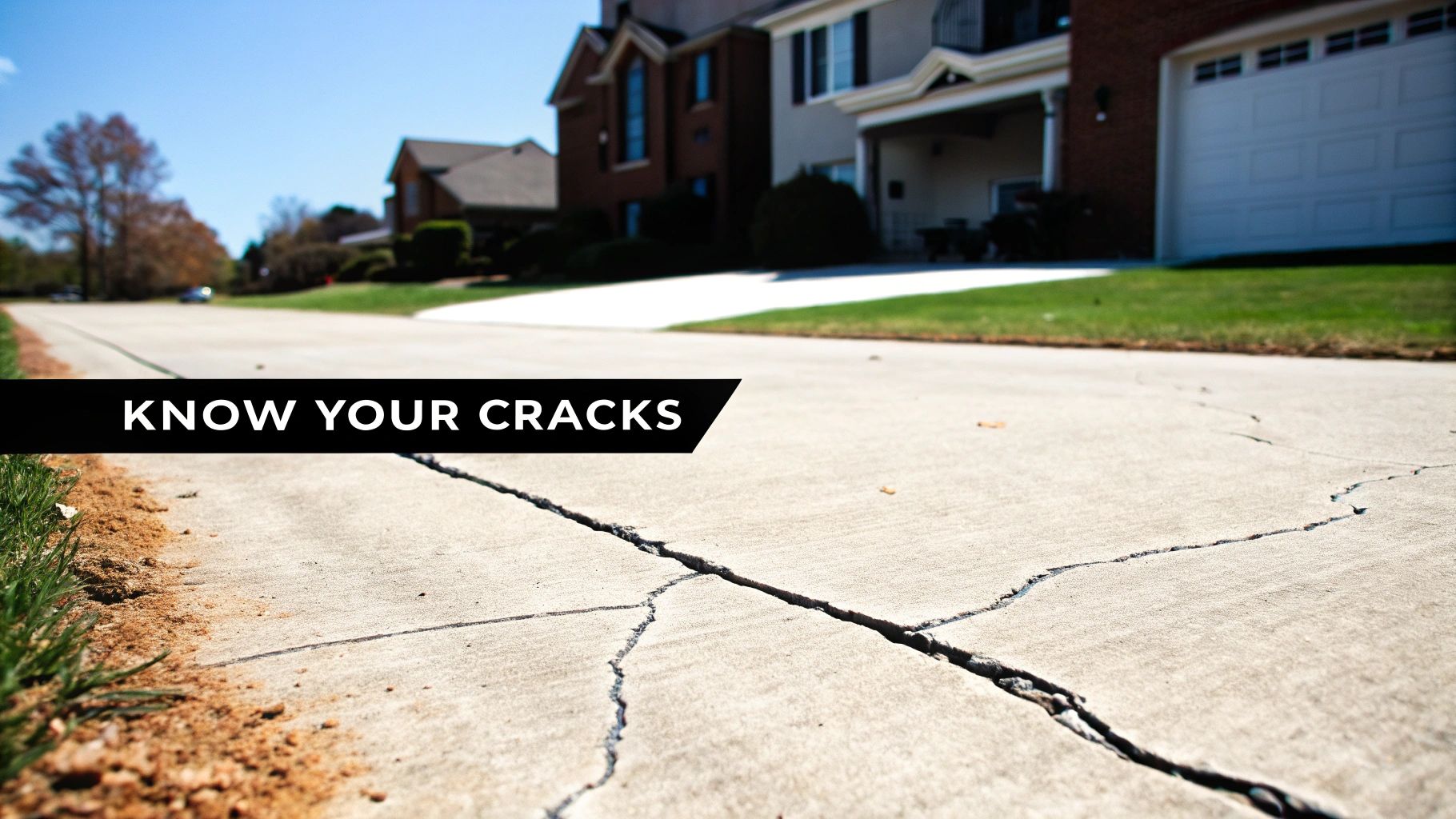
Think of your driveway's cracks as a story written in stone. Each line, web, and split tells you something about the forces at play—from subtle ground shifts deep underneath to the simple, natural aging of the concrete itself. Many are just cosmetic, a normal part of your driveway's journey.
But ignoring them isn't the best strategy. Even a small crack is an open invitation for water. When that water freezes and expands in the winter, it acts like a wedge, slowly prying the crack open wider. This freeze-thaw cycle is one of the biggest culprits behind concrete breaking down over time. For example, water expands by about 9% when it freezes, exerting immense pressure from within the crack.
A Quick Guide to Common Crack Types
Learning to "read" the cracks is the first step. Each type has a different backstory and signals a different level of urgency. Getting this initial assessment right helps you decide what to do next.
- Hairline or Craze Cracks: These look like a fine, web-like pattern of shallow cracks on the surface. They usually show up soon after the concrete is poured and are almost always a cosmetic issue, not a structural red flag. An example would be seeing a faint, map-like pattern across the slab's surface that you can't fit a fingernail into.
- Shrinkage Cracks: As new concrete cures, it loses moisture and shrinks. If this happens too fast, you might see random, jagged cracks. They’re typically wider than hairline cracks but still don’t go too deep. For instance, a single, irregular crack might appear near the center of a slab a few months after it was poured.
- Structural Cracks: These are the ones that need your attention. We’re talking about cracks wider than a credit card (over 1/8 inch), that run deep into the slab. Sometimes, one side of the crack will be higher than the other. This usually points to a bigger problem with the soil or foundation underneath. An example is a long crack running the full width of the driveway where one side is a quarter-inch lower than the other, creating a trip hazard.
Driveway cracks are a fact of life, particularly with Atlanta's expansive clay soil. It’s a massive issue nationwide, too—with an estimated 9 billion cubic yards of concrete in place across the U.S., much of it is getting old and showing its age. In fact, poor soil management is the root cause of roughly 30% of all concrete surface problems, which just shows how crucial a solid base is. You can dig deeper into these numbers by checking out these concrete repair industry findings.
A crack in your driveway is more than just a blemish; it's a direct line of communication from the ground beneath your property. Learning to read these signs empowers you to act before minor issues become major expenses.
To make things even easier, here's a simple table to help you quickly identify what you're seeing and what it likely means.
A Homeowner's Quick Guide to Driveway Cracks
| Crack Type | What It Looks Like | Common Cause | Initial Severity |
|---|---|---|---|
| Hairline Cracks | A fine, web-like pattern of shallow cracks on the surface. | Rapid surface drying during the curing process. | Low |
| Shrinkage Cracks | Jagged, irregular cracks that are wider than hairline cracks. | The natural shrinking of concrete as it hardens and dries. | Low to Moderate |
| Settlement Cracks | Long, continuous cracks where the slab has sunk or shifted. | Poorly compacted soil or erosion beneath the driveway. | High |
| Heaving Cracks | Cracks where the slab is pushed upward, often in a spiderweb pattern. | Expansive clay soil swelling or tree roots pushing from below. | High |
This quick reference should give you a solid starting point for figuring out what’s happening with your driveway and just how serious it might be.
Why Driveways Crack: The Real Culprits
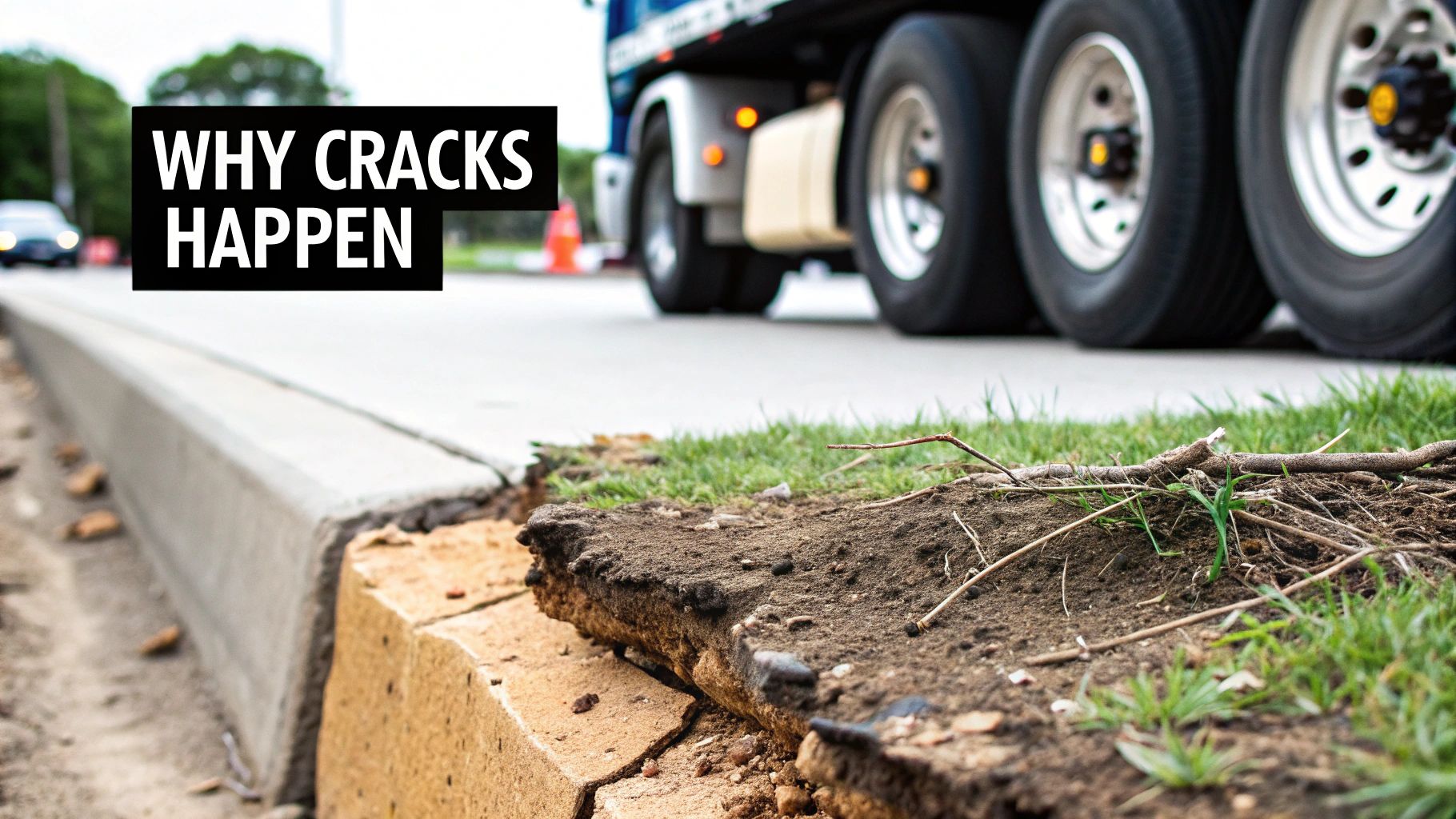
To figure out why your driveway is cracking, you have to look deeper than just the surface. Concrete might seem indestructible, but it's in a constant battle with forces from above, below, and even within itself. These invisible pressures are the real reason cracks start to spoil your home's curb appeal.
Believe it or not, most concrete problems are set in motion the day it's poured. As the fresh concrete cures, it naturally loses water and shrinks. Picture a mud puddle drying out in the sun—as the water evaporates, the mud pulls apart, leaving a web of fine cracks. Your driveway does the exact same thing, leading to what we call shrinkage cracks.
The Problem Beneath Your Feet
For anyone living in the Atlanta area, the biggest enemy of a pristine driveway is something you can't even see: the ground itself. Our region is famous for its red clay soil, which is what geologists call "expansive." In simpler terms, it acts just like a kitchen sponge.
When it rains, that clay soaks up an incredible amount of water and swells, pushing upward against your heavy concrete slab with tremendous force. Then, during our hot, dry summers, the clay dries out, shrinks, and pulls away from the bottom of the driveway. This constant cycle of swelling and shrinking leaves behind voids and unsupported pockets. For example, a heavy summer rain can cause the soil to swell and lift a corner of your driveway by a fraction of an inch, only for it to drop back down during a dry spell.
"The ground beneath your driveway is not static; it's a dynamic foundation that shifts with the seasons. In areas with expansive clay soil, this movement is the primary antagonist, creating stresses that concrete alone cannot withstand."
Over time, the sheer weight of the concrete—plus the cars parked on it—causes those unsupported sections to give way, settling or cracking under the strain. This is why you often see cracks where one side is higher than the other; the ground has literally dropped out from underneath.
Other Powerful Forces at Play
While our expansive soil is a huge part of the problem, it’s rarely working alone. Several other factors are constantly working against your driveway, often teaming up with soil movement to cause damage.
If you ignore them, these pressures can turn a tiny crack into a major headache.
- Heavy Loads: Your driveway was engineered to handle regular cars and SUVs. When heavy vehicles like delivery trucks, construction equipment, or a large RV park on it, they concentrate a massive amount of weight in one spot. This can easily exceed the concrete's design limits, especially near the edges and corners, which are the weakest points. For example, a 30,000-pound concrete mixing truck parking on your 4-inch thick residential driveway can cause immediate cracking.
- Invasive Tree Roots: That beautiful, mature oak in your front yard might be a double-edged sword. As it grows, its roots are powerfully expanding underground, searching for water. This slow-motion force can lift and fracture a concrete slab from below with surprising ease. You might see a crack that starts near the base of a large tree and spreads outwards as the roots grow year after year.
- Georgia's Freeze-Thaw Cycles: Atlanta's winters might be mild, but we still get those cold snaps where temperatures dip below freezing. Water seeps into existing hairline cracks, and when it freezes, it expands by about 9%. This expansion acts like a tiny, powerful jack, wedging the crack open a little wider each time it happens.
Shrinkage cracks are almost always the first to appear, especially when new concrete cures too fast during a hot Atlanta summer. For local homeowners, where soil heaving from our clay contributes to 30% of surface problems, you're fighting a battle on two fronts. That's why proper installation is so crucial. Adding control joints every 10-15 feet gives the concrete a planned place to crack, controlling the stress from both shrinkage and ground movement. Understanding how professionals prevent different types of concrete cracks can give you a better appreciation for what a quality job looks like.
Once you can spot these culprits at work, you'll have a much better idea of what’s happening to your driveway and why calling in an expert is often the smartest move.
How to Assess Your Driveway Damage
Now that you know what causes those pesky cracks, it's time to play detective with your own driveway. Figuring out whether you're looking at a minor cosmetic issue or the first hint of a serious structural problem is the crucial next step. A quick health check will give you a much clearer picture of what you're up against.
Think of your driveway like a patient in a doctor's office. A few surface scrapes are one thing, but a deep, widening crack often points to an underlying condition. Your job is to gather the symptoms before you can even think about the right treatment.
Start with a Simple Visual Inspection
First thing's first: take a slow walk along the entire length of your driveway. Get a good look at everything. Notice the obvious stuff, like the fine, web-like craze cracks versus the bigger, more defined structural ones we talked about earlier. Pay attention to where the cracks are. Are they tucked away in one corner, or do they stretch across an entire slab of concrete?
The location and pattern of a crack tell a story. For instance, if you see cracks spreading out from the corner where the delivery truck always parks, that's a pretty good sign it's a weight issue. A long, straight crack running parallel to your garage? That could point to a problem with the foundation joint.
The Credit Card Test: A Key Diagnostic Tool
One of the easiest and most reliable DIY methods for checking a crack's severity is the credit card test. It’s a surprisingly simple way to measure the width and figure out if you're dealing with a surface flaw or something that needs real attention.
Just grab a standard credit card and try to slide it into the crack.
- If the card doesn’t fit: You're most likely looking at a hairline crack. These are typically less than 1/8 inch wide and are usually just cosmetic. Sealing them is a smart move to keep them from getting worse.
- If the card fits snugly: This is a red flag. A crack this wide can let a lot of water seep underneath, which is exactly what you don't want. You'll want to seal these promptly before they have a chance to expand.
- If the card fits easily with room to spare: Houston, we have a problem. Any gap wider than a credit card is a strong signal that the issue isn't just with the concrete but with the base underneath it.
This little test gives you a solid, consistent baseline. If you check a crack today and the card doesn't fit, but a few months from now it slides in easily, you've got definitive proof the problem is getting worse.
Look for Uneven Slabs and Growth Over Time
Beyond just the width, two other critical signs point to deeper trouble: soil settlement and active movement. These are the kinds of issues you can't ignore, as they almost always mean the subgrade is failing and you'll need a professional fix.
Start by checking for unevenness. Get down low and look across the surface of your driveway. Do you see one side of a crack sitting higher than the other? This is a classic sign of heaving or settlement. An uneven slab isn't just ugly; it's a serious trip hazard and clear evidence that the ground beneath your driveway is shifting. For example, if you lay a 4-foot level across a crack and there's a half-inch gap under one end, you have a significant settlement problem.
A driveway crack that is getting wider or longer is an active problem. Keeping an eye on this change is critical because it tells you there's ongoing stress from soil movement, tree roots, or freeze-thaw cycles that a simple patch just won't fix.
Finally, become a crack historian. Snap a few pictures of the cracks, and place a coin or a ruler next to them for scale. Come back in a few months—especially after a wet Atlanta season or a cold snap—and take another photo from the exact same spot. Comparing the pictures will tell you if the cracks are stable or if they're actively growing, which is vital information for any repair plan.
For a deeper dive into long-term care, you can explore our complete guide to residential driveway concrete solutions. Staying on top of these small things now can save you a fortune in major repairs later on.
Choosing Your Repair Method: DIY vs. Professional
Once you’ve figured out what’s causing the cracks in your driveway, it's time to decide how to fix them. The big question is always: can I handle this myself, or do I need to call in a pro? It really just comes down to the size and seriousness of the cracks you're dealing with.
For the small stuff, a DIY approach can be a perfectly good, wallet-friendly option. But trying to patch a major structural issue yourself is like putting a small bandage on a deep wound—it might cover the problem for a little while, but it won't actually fix it.
Handling Small Repairs Yourself
If your inspection turned up nothing more than a few minor, stable hairline cracks—those less than 1/8 inch wide—you're in luck. These are prime candidates for a weekend DIY project. Sealing them up now prevents water from getting in, freezing, and turning a tiny crack into a big problem.
The absolute key to making a DIY repair last is preparation. So many people rush this part, and that's why their patch jobs fail within a year.
A Step-by-Step Guide for Simple Crack Filling:
- Clean the Crack Thoroughly: First things first, get everything out of that crack. Dirt, weeds, loose bits of concrete—it all has to go. A stiff wire brush and a shop vac are your best friends here. For example, if you have a small weed growing in the crack, you must remove the entire root.
- Rinse and Dry: Blast out any leftover dust with a pressure washer or a hose. Then, and this is crucial, you have to let it dry completely. Patience is a virtue. For instance, wait a full 24 hours after rinsing before you apply sealant.
- Apply the Sealant: Grab a high-quality, flexible concrete crack sealant and a caulk gun. You want to push the sealant deep into the crack, overfilling it just a bit.
- Smooth the Surface: Use a simple putty knife to level the sealant with the rest of the driveway. This not only looks better but also gets rid of any potential trip hazard.
This method works great for cosmetic fixes and is a solid way to keep moisture out. But if you're looking at anything more severe, it’s time to think about bringing in some heavier firepower.
This simple decision tree can help you quickly assess whether a crack is a DIY job or needs an expert eye.
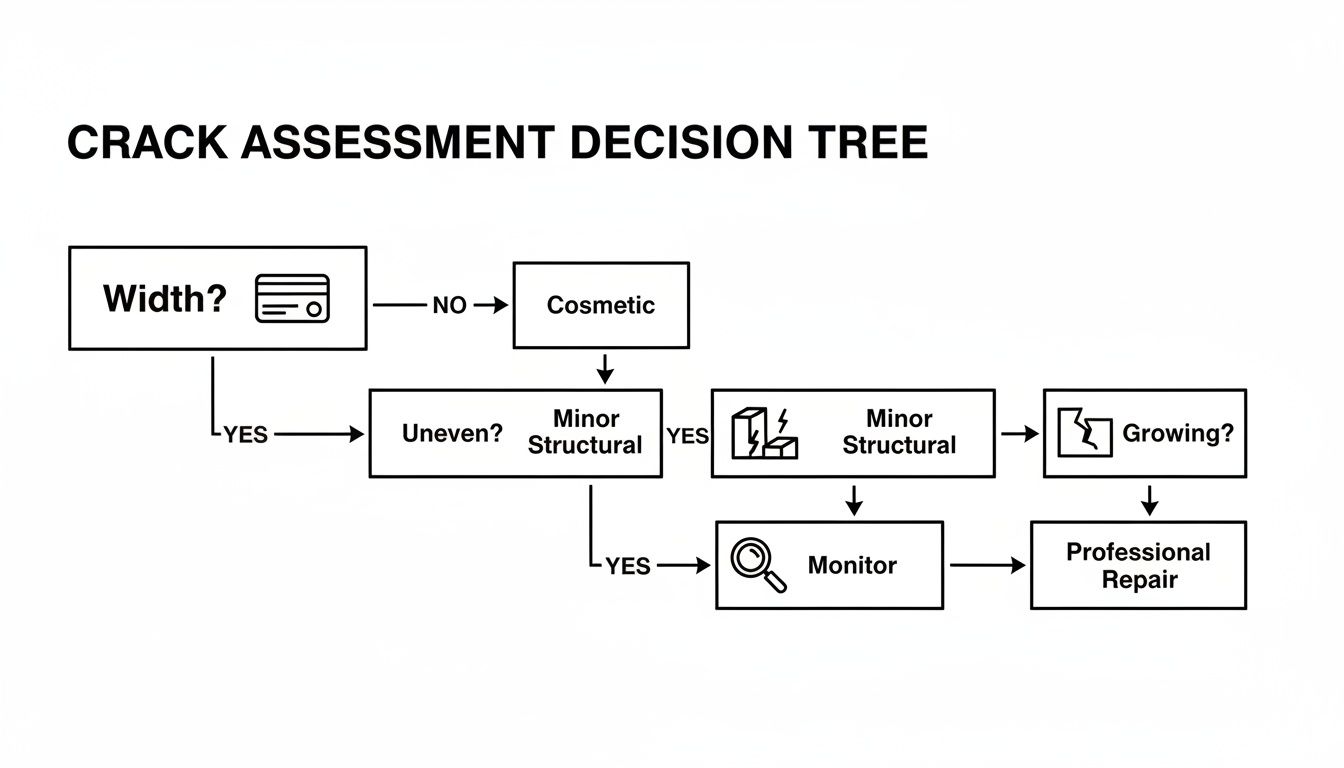
As you can see, the moment a crack is uneven, getting wider, or growing longer, it's a clear signal that the problem is more than skin-deep. That's professional territory.
When to Call in the Professionals
Wide, deep, or uneven cracks are your driveway's way of telling you there's a problem with its foundation. This is where a professional's experience is non-negotiable. They have the right equipment and know-how to diagnose what’s happening underneath and provide a real, long-term fix.
Two of the most common professional solutions are concrete resurfacing and slab jacking.
- Concrete Resurfacing: This is a fantastic option when the driveway slab itself is still solid, but the surface is a mess of fine cracks, flaking, and stains. A pro will apply a new cement-based overlay, giving the entire driveway a fresh, uniform finish without the massive cost of a full replacement. An ideal example is a 10-year-old driveway that has no major structural cracks but is covered in craze cracking and discoloration.
- Slab Jacking (or Mudjacking): Got a slab that's sunk or tilted? Slab jacking is the answer. A contractor drills small, strategic holes and pumps a specialized slurry or polyurethane foam underneath. This lifts the concrete back into place, fixing the unevenness and stabilizing the ground beneath it. For example, if the slab nearest your garage has sunk two inches, slab jacking can lift it back to its original level.
To help you weigh your options, this table breaks down the most common repair methods, from a simple DIY fill to a full-blown replacement.
Comparing Driveway Crack Repair Methods
| Repair Method | Best For | Typical Cost | Durability | Required Skill |
|---|---|---|---|---|
| DIY Crack Filler | Hairline cracks (under 1/8") | Low ($20 – $50) | 1-3 years | Beginner |
| Concrete Resurfacing | Widespread surface damage | Moderate ($3 – $7 / sq. ft.) | 8-15 years | Professional |
| Slab Jacking | Sunken or uneven slabs | Moderate to High ($5 – $15 / sq. ft.) | 5-10+ years | Professional |
| Full Replacement | Extensive structural damage | High ($8 – $18+ / sq. ft.) | 20-30+ years | Professional |
Choosing a professional isn’t just about getting the job done right; it’s an investment in a permanent solution that fixes the root cause of the problem.
Making the right call now protects your home's value and saves you from much bigger headaches down the road. For a closer look at what goes into this kind of work, you can explore the details of our residential concrete and masonry repair services.
Budgeting for Driveway Repair in Atlanta
Before you dive into fixing those annoying driveway cracks, it’s smart to get a handle on the potential costs. In the Atlanta area, prices can swing quite a bit depending on what you’re dealing with, but knowing the ballpark figures helps you plan properly and avoid any sticker shock.
Think of it this way: a tiny scratch on your car is a quick, cheap touch-up job. A bent frame? That’s a whole different story—and a much bigger bill. The same logic applies to your driveway. The fix has to match the problem.
Breaking Down Typical Repair Costs
For most Atlanta homeowners, driveway repair costs will fall into one of three buckets. The price you'll pay is directly linked to how bad the damage is and the work required to fix it right.
- Minor Crack Filling: For those simple, stable hairline cracks, a pro can seal them up to keep water out. You're looking at around $3 to $5 per linear foot for this kind of work. For example, sealing 50 feet of hairline cracks might cost between $150 and $250.
- Concrete Resurfacing: When your driveway's surface looks tired and covered in small cracks but is still solid underneath, resurfacing is a fantastic option. This typically runs between $3 and $7 per square foot. For a standard 600-square-foot driveway, this could mean a project cost of $1,800 to $4,200.
- Full Driveway Replacement: If you're facing deep, sprawling cracks, major sinking, or crumbling concrete, a total replacement is usually the only long-term fix. This is the biggest investment, ranging from $8 to $18+ per square foot. That same 600-square-foot driveway could cost anywhere from $4,800 to over $10,800 to replace.
As you start budgeting, it's really helpful to understand the truth behind hardscape pricing to see what goes into a quality job. It helps you look past the price and focus on the value you're getting.
What Drives the Final Price Tag?
You might get two wildly different quotes for two driveways that look almost the same. That’s because the real cost drivers are often hidden beneath the surface.
The money spent fixing cracked concrete is huge—it’s a $4 billion industry annually across the U.S. Here in Atlanta, our notorious clay soil and poor initial ground prep are to blame for about 30% of these failures. Being proactive with something like a concrete overlay can add 20-50 years to your driveway's life and save you 40-60% compared to a full tear-out later on. It's a smart play.
The biggest factor in your repair cost isn't always the crack you see. It's the problem you can't see: the condition of the soil base under the concrete. A cheap patch on a bad foundation is just throwing money away.
So, what exactly determines your project's final cost?
- Extent of Damage: A few small, isolated cracks are a simple fix. A web of deep, connected cracks that threaten the slab's integrity is a much bigger, more expensive problem.
- Driveway Size: The total square footage is a basic multiplier. More space means more materials and more labor, especially for resurfacing or a full replacement.
- Subgrade Condition: This is the big one. If the soil underneath has washed out or was never compacted correctly, it has to be fixed. That means digging out the old stuff and rebuilding the base, which adds a lot to the cost. For example, fixing a poorly compacted base could add $1-$2 per square foot to the total replacement cost.
- Material Choices: Want a decorative stamped look or colored concrete? Those custom finishes look amazing but will cost more than a standard broom-finish slab.
- Site Accessibility: Is your driveway on a steep hill? Is it tough to get equipment to the site? These kinds of challenges can increase labor costs.
While a professional repair might seem like a bigger check to write upfront, you're paying for better materials, expert labor, and a solid warranty. It's an investment that saves you from the headache and expense of re-doing cheap fixes every few years.
Keeping Your Driveway Healthy and Crack-Free
When it comes to concrete driveway cracks, the best offense is a good defense. Stopping them before they even start is the name of the game. A little proactive maintenance goes a long way in protecting your investment, whether your driveway is brand new or you've just had it repaired. Think of it like regular check-ups for your car; a small amount of effort now can save you from a massive repair bill down the line.
These simple habits will drastically extend the life of your concrete, keeping it solid and looking sharp for years to come. It all comes down to managing the things concrete hates most: water, harsh chemicals, and too much weight.
Build a Strong Maintenance Routine
A consistent routine is your driveway's best friend. Just like any other part of your home, regular inspections and cleaning can stop big problems from ever taking root.
Start by simply keeping it clean. Sweep away leaves, dirt, and other gunk that traps moisture against the surface, which can cause ugly stains and gradual decay. And while you're focused on structural health, don't forget the aesthetics—learning how to remove rust stains from concrete can make a world of difference. For example, wet leaves left on concrete over winter can leave behind dark, tannin stains that are difficult to remove.
Next up, and this is a big one, is sealing.
Applying a quality concrete sealer is arguably the single most effective maintenance task you can perform. It acts like a waterproof jacket, shielding the porous surface from water penetration—the main culprit behind freeze-thaw damage in the Atlanta climate.
For the best protection, plan to reapply a quality sealer every two to three years. This simple job creates a tough barrier that repels not just water, but also oil and other chemicals that can eat away at the concrete.
Smart Strategies to Prevent Damage
Beyond cleaning and sealing, a few other smart habits can protect your driveway from its biggest enemies. It's all about managing water flow and avoiding unnecessary stress on the slab.
Proper drainage is an absolute must. Water is concrete’s nemesis, especially when it pools on the surface or seeps underneath. This slowly erodes the soil foundation, creating hollow spots that cause the slab to sink and crack under its own weight.
Here are a few essential tips to keep in mind:
- Manage Water Runoff: Make sure your gutters and downspouts are aimed well away from your driveway. If you have low spots in your yard where water tends to collect, fixing that grading can prevent a lot of headaches. For example, adding a simple downspout extender can redirect thousands of gallons of water away from your driveway's foundation each year.
- Avoid Harsh De-Icing Salts: When temperatures dip, stay away from rock salt. These corrosive chemicals can soak into the concrete and rust the steel rebar inside, causing it to expand and crack the slab from within. Sand or a "concrete-safe" de-icer are much better choices.
- Be Mindful of Heavy Loads: Your driveway was built for cars and SUVs, not a garbage truck or a fully loaded moving van. The sheer weight of these heavy-duty vehicles can easily fracture the slab, especially along the edges where it's most vulnerable. For instance, if you're having a large delivery, ask the driver to park on the street if possible.
Of course, the best defense starts with a professional installation on a well-compacted base. But by following these maintenance tips, you can take control, protect that initial investment, and keep your driveway looking great for decades.
Your Concrete Driveway Questions Answered
After walking through all the causes, fixes, and prevention tips for driveway cracks, you probably still have a couple of questions rattling around. That’s perfectly normal.
Here are the most common ones we hear from homeowners around Atlanta. We’ll tackle them head-on to give you the clarity you need.
Can All Concrete Driveway Cracks Be Repaired?
I wish I could say yes, but the honest answer is no. While most small cracks are definitely repairable, not every crack is a good candidate for a simple patch job.
Hairline cracks and anything up to about a half-inch wide? Absolutely. Sealing these up is a fantastic maintenance move to stop water from getting in and making things worse. But for bigger issues, a patch is just a band-aid. If you’re looking at wide, deep cracks—or especially if one side of the crack is heaving up higher than the other—that’s a red flag for a problem with the ground underneath. At that point, you need a pro to diagnose whether you need something more serious like slab jacking or a total replacement. For example, a crack that is an inch wide with one side pushed up is not a repair candidate; it's a sign of replacement.
How Often Should I Seal My Concrete Driveway In Georgia?
Here in the Atlanta area, with our brutal summer sun and the occasional freeze-thaw cycle in winter, sealing your driveway isn't optional—it's essential.
Plan on applying a quality sealer every 2 to 3 years. Think of it as sunscreen for your concrete. It blocks moisture, UV damage, and nasty oil stains, and it’s easily the most cost-effective thing you can do to keep your driveway looking good and prevent cracks from starting in the first place. For instance, if water no longer beads up on the surface after a rain, it's a clear sign it's time to reseal.
Is It Better to Repair My Driveway or Replace It?
This really comes down to the big picture. If your driveway is mostly solid but has a few isolated, stable cracks, then repairing and resurfacing is a great, wallet-friendly choice. It can easily buy you several more years of service life.
But if you're looking at a spiderweb of large cracks, crumbling surfaces, or obvious sinking, replacement is the smarter long-term play. Pouring a new slab is the only way to truly fix the underlying soil problems and give you a fresh, properly reinforced surface that’s built to last for the next few decades. As an example, if more than 25-30% of your driveway's surface is covered in interconnected structural cracks, replacement is almost always the more cost-effective option in the long run. If you’re on the fence, contact our team for a professional evaluation and we can help you weigh the options.
Will Stamped Concrete Crack More Easily?
That's a common misconception, but a properly installed stamped concrete driveway is just as tough as a traditional one. The decorative pattern itself doesn't make it weaker.
The real secret to a crack-free driveway—stamped or not—is all in the prep work. It needs a well-compacted base, the right concrete thickness, steel rebar for strength, and correctly placed control joints to manage natural expansion. When a crew gets all those details right, a stamped driveway is a beautiful and incredibly durable choice for any home. For example, the control joints are often cleverly hidden within the stamped pattern, making them functional without detracting from the aesthetic.