
Fixing your concrete driveway starts with one simple rule: diagnose before you DIY. I can't tell you how many times I've seen homeowners waste a perfectly good Saturday (and a lot of money) on a repair that didn't last. For example, a neighbor once spent hours filling a wide, uneven crack with a simple caulk sealant, only to see it split open again after the first heavy rain. The real problem wasn't the crack itself, but the sinking ground beneath it. Figuring out whether you're looking at a simple surface crack or a serious structural problem is the absolute key to a permanent fix.
How to Assess Your Driveway's Damage
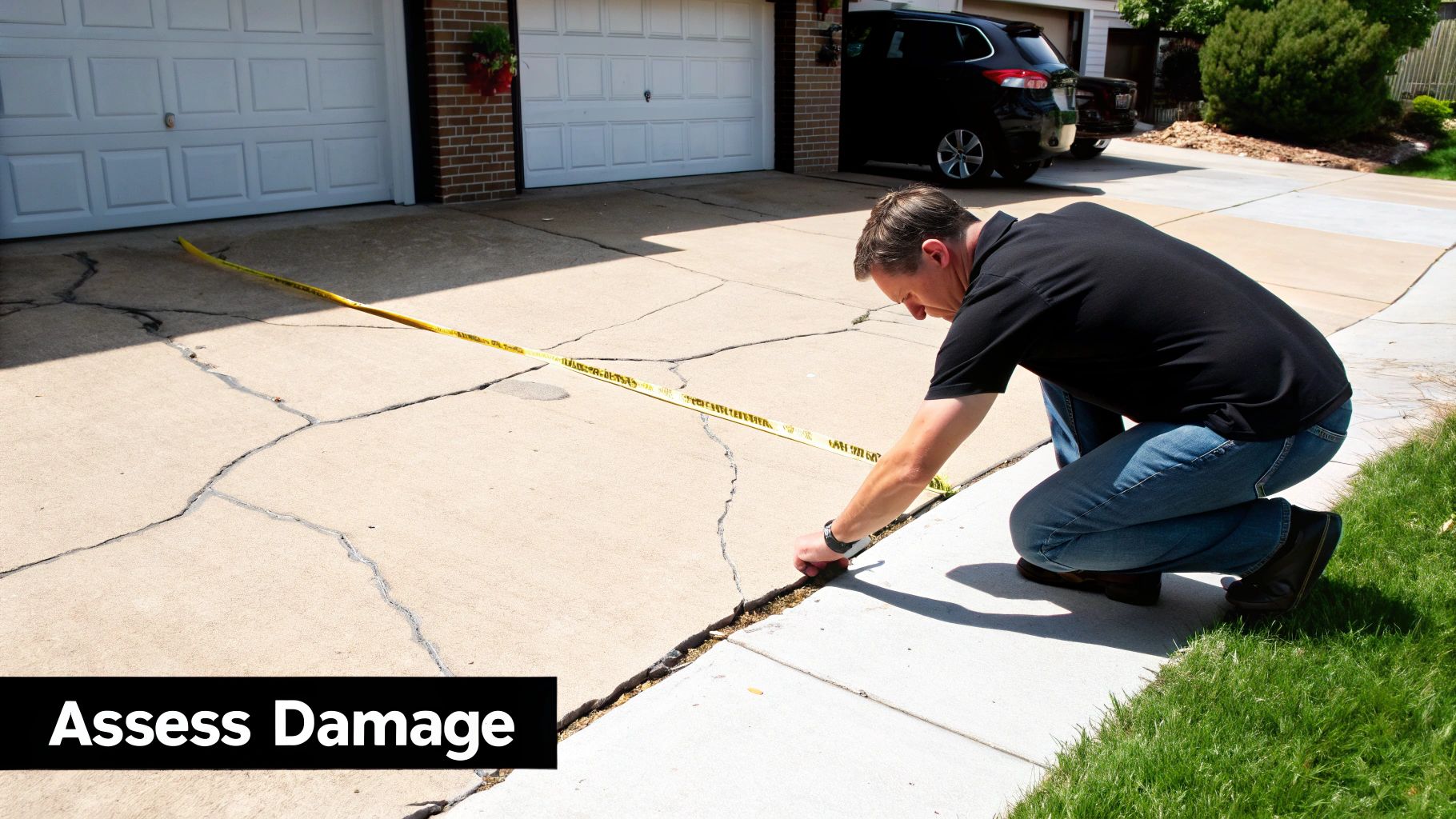
Before you even think about mixing concrete or buying sealant, you need to play detective. Your driveway is telling a story, and you have to learn to read it. Is that crack from the garbage truck that parks on it every week? Or is it a sign that water is undermining the whole slab from below?
Atlanta's famous freeze-thaw cycles, where temperatures can swing from the 50s to below freezing in a single day, can be brutal on concrete. Poor drainage is another common culprit. For instance, a clogged gutter downspout that constantly dumps water next to the driveway can saturate the soil, causing it to heave or settle. Nailing down the "why" behind the damage ensures you pick the right repair strategy. If you don't, that hairline crack you patch today will just be back next year, and it’ll probably bring friends.
Distinguishing Between Minor and Major Issues
Not all cracks are created equal. Grab a cup of coffee and take a slow walk around your driveway, really looking at what’s going on. You're trying to figure out if you have a weekend project or a job for a pro.
Here’s what to look for with real-world examples:
- Hairline Cracks: These are the super-thin ones, usually less than 1/8-inch wide—about the thickness of a credit card. They’re mostly a cosmetic issue, often caused by the concrete shrinking a bit as it originally cured. You'll often see them in a random, web-like pattern.
- Wider Structural Cracks: If you can fit a quarter in the crack (about 3/32"), or if one side is higher than the other, that's a red flag. This points to a much bigger issue happening underneath, like soil erosion, a weak sub-base, or even a tree root pushing things around. A common example is a long, continuous crack running the length of a control joint.
- Spalling and Pitting: Does the surface look like it’s flaking off, with little pockmarks exposing the gravelly stuff underneath? That's spalling. It's usually caused by water getting into the concrete, freezing, and "popping" the top layer off. A prime example is the area near the street where de-icing salts from winter road crews accumulate.
- Sunken or Heaved Slabs: This is the most serious sign. If an entire section of your driveway has dropped or buckled upwards, the problem isn't the concrete itself—it's the ground underneath. For example, if the slab nearest your garage has sunk an inch, creating a tripping hazard, that's almost always a sign of major water issues or soil settlement.
To help you sort it out, this decision tree gives you a clear path from identifying the problem to knowing what to do next.
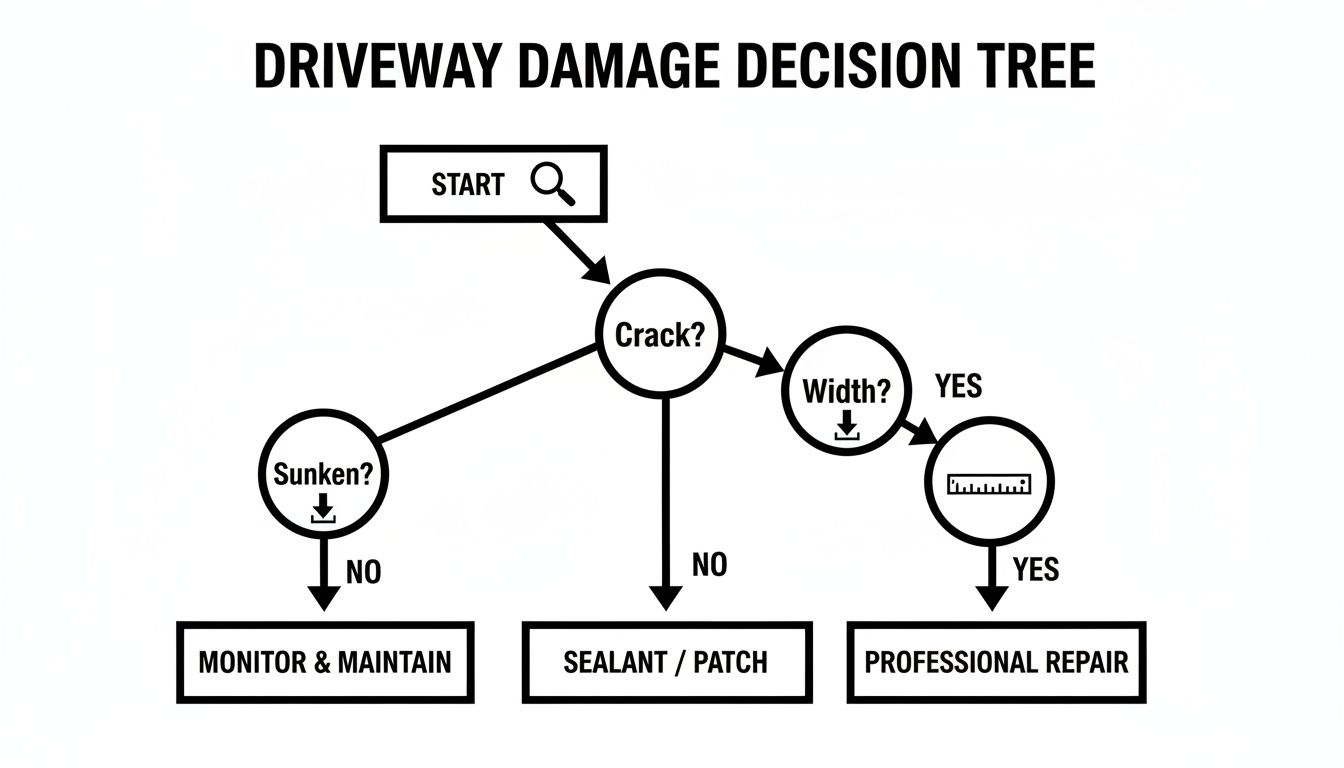
As you can see, small cracks are often a perfect DIY job. But once you get into major settlement or deep, shifting cracks, it's time to call in someone with heavy equipment and years of experience.
To make things even clearer, I've put together this quick diagnostic chart. Find the symptom that matches your driveway to get a better idea of what you're up against.
Driveway Damage Diagnostic Chart
| Symptom | Common Causes | Severity Level | Typical DIY Fix |
|---|---|---|---|
| Hairline Cracks (<1/8") | Curing shrinkage, minor surface stress | Low | Flexible sealant or crack filler |
| Spalling / Pitting | Freeze-thaw cycles, de-icing salts | Moderate | Concrete resurfacer or patch compound |
| Wide Cracks (>1/4") | Sub-base failure, soil movement, tree roots | High | Professional assessment recommended |
| Uneven / Sunken Slabs | Poor drainage, soil erosion, settlement | Very High | Slabjacking or professional replacement |
This chart is a great starting point, but remember that every driveway is different. For example, a wide crack in a brand-new driveway is much more alarming than one in a 30-year-old slab. When in doubt, getting a second opinion never hurts.
The Growing Need for Concrete Repair
If your driveway is showing its age, you're not alone. The market for concrete repair mortars is projected to hit USD 6.54 billion by 2034, largely because of all the aging infrastructure out there. A well-poured driveway can last for decades, but most start showing signs of wear and tear within 10-15 years, especially with our shifting Atlanta temperatures and heavy vehicle traffic like delivery trucks and garbage collection vehicles.
The good news is that repair materials have come a long way. Modern epoxy-based mortars, for example, can create a bond that’s up to 50% stronger than the original concrete, meaning the fix is likely to outlast the rest of the slab. This is a dramatic improvement over older, simple cement patches that often failed within a single season.
To see what a professional-grade repair looks like on a seriously damaged driveway, you can check out this gallery of residential and commercial projects to understand the kind of transformation that's possible.
Equipping Your DIY Concrete Repair Toolkit
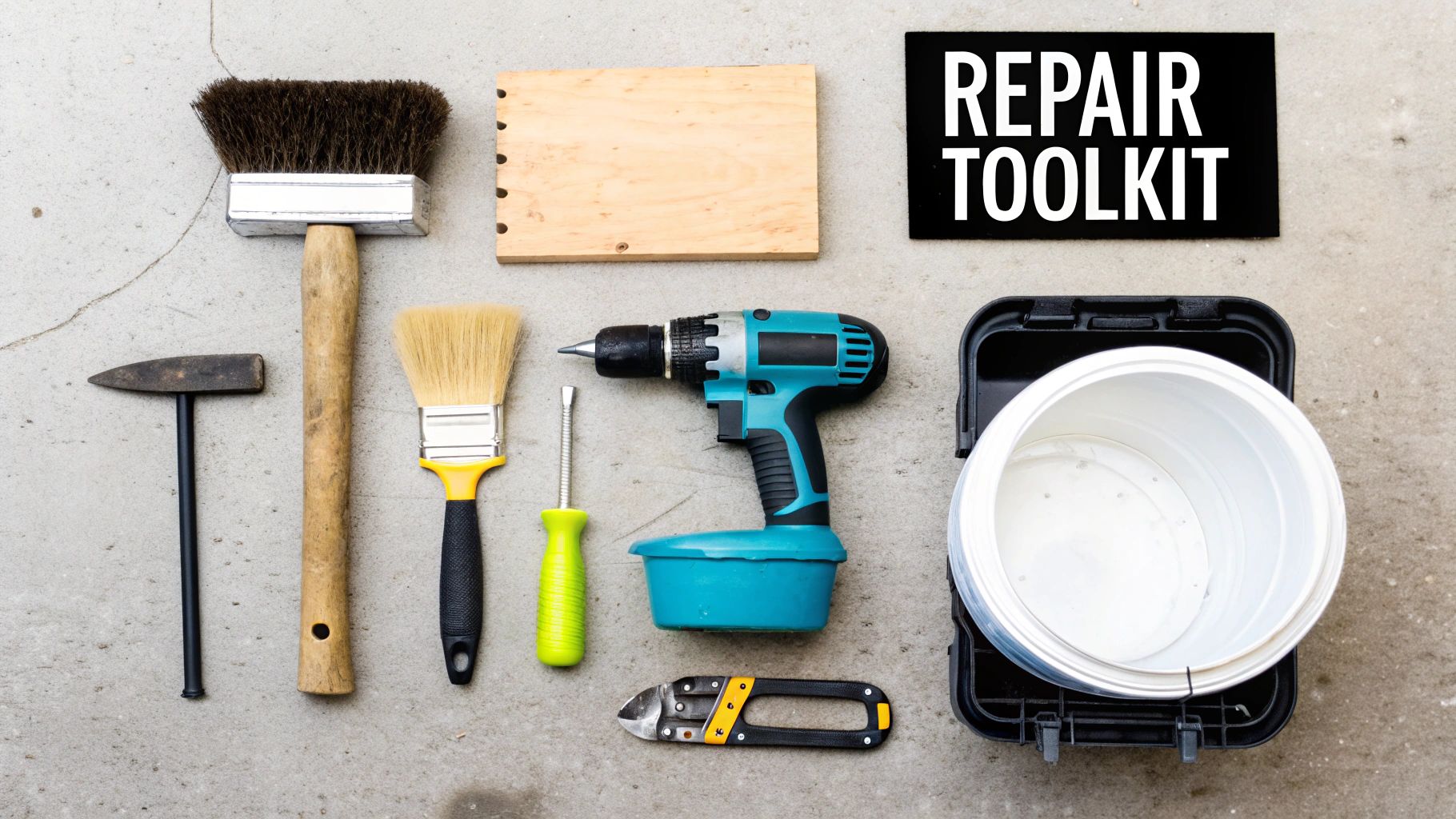
The real secret to a lasting concrete repair isn’t brute force—it’s having the right gear on hand before you even start. Nothing kills a project's momentum like a frantic, mid-repair run to the hardware store for a tool you didn't realize you needed.
What you'll need really depends on the job at hand. Fixing a few hairline cracks is one thing; patching a chunky, spalled-out section is a whole different ballgame. Let's break down what your toolkit should look like for each scenario.
The Essentials for Simple Crack Filling
For those skinny, annoying cracks that are more of an eyesore than a real problem, your supply list is pretty simple. You probably have a few of these things in your garage already.
- Stiff Wire Brush: Your number one tool for cleaning. You’ll use this to get all the loose bits of dirt, debris, and flaky old sealant out of the crack. A brush with a built-in scraper on the end is a great choice.
- Hammer and Chisel: A must-have for chipping away any crumbling, weak concrete along the crack's edges. Your new filler needs to bond to a solid, stable surface. A small, 1/2-inch cold chisel is perfect for this detailed work.
- Shop-Vac or Blower: After all that brushing and chipping, you’re left with fine dust. A powerful vacuum or a leaf blower is the best way to get the crack perfectly clean.
- Caulk Gun: For applying flexible sealants, a caulk gun gives you the control you need to get a clean, even bead right into the joint. Look for a "drip-free" model to avoid messes.
- Utility Knife: Perfect for cutting the tip on the sealant tube and for trimming any excess after you’ve applied it.
This basic setup is all you need for cracks less than a quarter-inch wide. The goal here is straightforward: clean it out thoroughly and fill it with something flexible that can move with the concrete as it expands and contracts.
Gearing Up for Larger Patches and Spalling Repair
When you start tackling wider cracks, spalling, or pitted areas, your tool and material list gets a bit more serious. These bigger jobs demand more aggressive prep work and much tougher materials to make sure the fix actually lasts.
The single most important tool you’ll add for this kind of work is an angle grinder with a diamond wheel. This is a total game-changer. Instead of just cleaning the crack, you’ll use the grinder to "chase" it—cutting a V-shaped groove along its length. This widens the base of the crack, creating a rock-solid mechanical lock that anchors the patch material in place. Honestly, this is one of the biggest steps that separates a pro-level repair from a temporary DIY patch.
Pro Tip: Concrete dust is no joke. When you fire up that angle grinder, you absolutely must wear safety glasses, hearing protection, and a good dust mask (an N95 respirator is recommended). The dust contains silica, which is really harmful to your lungs. Taking a few extra minutes to shape the crack properly is the foundation of a repair that will last for years.
Here’s the full list of what you’ll need to assemble:
- Pressure Washer: The best way to deep-clean the entire repair area and blast away years of ground-in dirt and grime. A model with at least 2,000 PSI is ideal for this job.
- Angle Grinder with Diamond Wheel: As I mentioned, this is essential for cutting clean, V-shaped grooves into wider cracks for a much stronger repair. A 4.5-inch grinder is a versatile size for homeowners.
- Mixing Buckets: Grab at least two sturdy 5-gallon buckets. You'll use one for measuring water and the other for mixing your patching material.
- Drill with Paddle Mixer: Trust me, trying to mix polymer-modified cement by hand is a recipe for a lumpy, inconsistent mess. A heavy-duty, corded drill provides the torque needed for this.
- Trowels: You'll want a pointed trowel (like a brick trowel) to help you press the mix deep into cracks and a flat finishing trowel to smooth out the surface of your patch.
- Margin Trowel: This smaller, rectangular trowel is fantastic for scooping material out of the bucket and working it into tight spots.
Choosing the Right Repair Material
Having the right tools is only half the battle. If you use the wrong repair material, you’re just guaranteeing that you’ll be fixing that same spot again next year.
- Polyurethane or Epoxy Sealants: These usually come in standard caulk tubes and are what you want for narrow cracks. Their key feature is flexibility, which allows them to stretch and shrink with the concrete. For example, a polyurethane sealant can stretch up to 70% of its original width.
- Polymer-Modified Cement: This is your workhorse for patching wider cracks and fixing spalled areas. It’s a pre-blended mix containing cement, sand, and special polymer additives that make it incredibly strong and help it bond tightly to old concrete. A good example is a vinyl-fortified patching compound.
- Concrete Resurfacer: If your driveway has widespread but shallow damage—like flaking or pitting—a resurfacer is the answer. It’s designed to be spread in a very thin layer over the entire slab, giving you a brand-new, fresh surface.
With this gear ready to go, what seemed like a huge task becomes a very doable weekend project. Now, let’s get into the step-by-step process of actually fixing those cracks.
A Practical Guide to Fixing Concrete Cracks
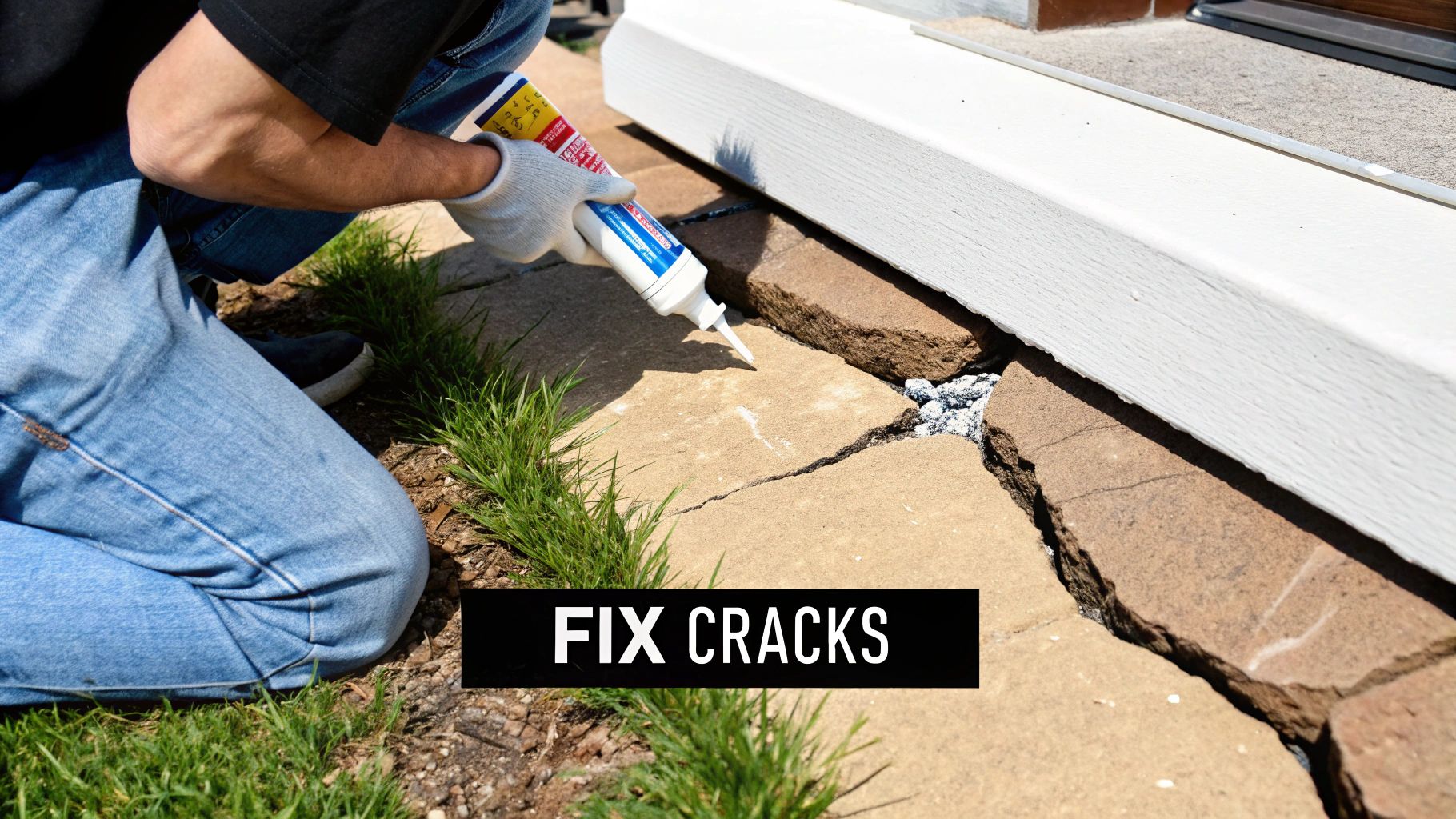
Alright, it's time to roll up your sleeves and get to work. The secret to a long-lasting crack repair isn't the patching material itself—it's the prep work. Honestly, this is where most DIY fixes go wrong. A lazy prep job guarantees you'll be doing this again next year, so let's focus on getting it right from the start.
The First and Most Critical Step: Meticulous Cleaning
Think of your repair compound as a high-strength adhesive. For it to stick, it needs a clean, solid surface. Any dust, crumbling bits of old concrete, or grime left in the crack creates a weak point, preventing a solid bond. The patch will just pop right out after the first winter. A classic example of failure is seeing a perfect line of filler peeling away from the edges of a crack because it was applied over a layer of fine dust.
Your goal here is to get that crack surgically clean. Grab a stiff wire brush and really go to town on the inside edges. You need to scrub out every bit of loose debris, moss, and any old, failed sealant. Don't be timid; if a piece of concrete flakes off while you're scrubbing, it was too weak to provide a good anchor anyway.
Next, take a hammer and a small chisel to tap along the edges. You’re listening for the sound. A solid "thud" tells you the concrete is stable, but a hollow, dull sound means it's compromised and needs to be chipped away. Once that’s done, break out the shop vac or a leaf blower to suck out every last speck of dust. For a truly perfect clean, I always finish with a quick blast from a pressure washer.
Create a Mechanical Lock by Undercutting
For any crack wider than about a quarter-inch, just filling it isn't going to cut it. Concrete expands and contracts with temperature swings, and that movement will eventually squeeze a straight-sided patch right out of the crack. The pro trick to prevent this is called undercutting.
Using an angle grinder or your hammer and chisel, you’ll carefully widen the base of the crack so it’s slightly broader than the opening on the surface. This creates a dovetail shape, almost like a reverse "V". For instance, a 1/2-inch wide crack at the surface might be cut to be 3/4-inch wide at its base.
When you fill this undercut groove, the hardened patch is mechanically locked into place. It can't be pushed out because it's physically wider at the bottom than at the top. This single step dramatically increases the longevity of your concrete driveway repair.
Mixing and Applying the Repair Compound
With your prep work finally done, you can mix your polymer-modified cement. The consistency you're shooting for is a thick peanut butter—stiff enough that it won't sag or run, but still workable enough to push into the crack.
A Few Pro Mixing Tips:
- Always add the powder to the water, not the other way around. This simple trick prevents those stubborn dry clumps from forming at the bottom of your bucket. For example, for a 10 lb bag of mix that requires 2 quarts of water, you'd add the 2 quarts to the bucket first, then slowly add the powder.
- Only mix what you can use in 15-20 minutes. Most of these compounds set up fast. Trying to add more water to a mix that’s already hardening will just ruin its strength.
- Use a drill with a paddle mixer attachment. It's the only way to get a perfectly smooth, lump-free consistency that’s tough to achieve by hand.
Once it's mixed, use a pointed trowel to press the material firmly into the crack. Make sure to overfill it just a bit, packing it down tightly to eliminate any air pockets. Air voids are the enemy; they become weak spots that collect water and cause the patch to fail down the road.
This kind of work is a huge part of the concrete restoration industry, which is projected to be a $17.6 billion global market by 2025. It makes sense when you consider that driveways bear 80% of a home's vehicle traffic. In the U.S., an estimated 20-25% of the work done by 92,904 concrete contracting firms is residential repairs just like this. If you're curious about the business side of it, you can dive deeper into the full concrete restoration market report.
Finishing and Curing Your Patch
After the crack is packed, the final touch is creating a seamless finish. Take a flat finishing trowel and skim the excess material off the surface, making it perfectly level with the surrounding driveway. For a repair that blends in well, slightly dampen your trowel and "feather" the edges of the patch into the existing concrete texture.
Now for the most overlooked step: curing. Curing is a chemical process, not just about drying out.
Cover your fresh patch with a plastic sheet for at least 24-48 hours. This traps the moisture inside, allowing the concrete to hydrate and gain its full design strength. On hot or windy days, it’s a good idea to lightly mist the patch with water before you cover it. For example, on a 90°F day, misting the patch every 4-5 hours for the first day can prevent premature drying and cracking. Don't rush this—improper curing is a top reason for weak, crumbly repairs that just don't last.
Giving Your Driveway a Complete Facelift with Resurfacing
Sometimes, a driveway is plagued with more than just a few isolated cracks. When you’re dealing with a surface full of pits, stains, and flaky spots, trying to patch everything individually is an exercise in futility. This is the perfect scenario for resurfacing.
Think of it as giving your driveway a brand-new face. You're applying a thin, tough layer of a specialized concrete mix right over the old slab, hiding all those imperfections and creating a fresh, uniform finish. This approach is a game-changer for driveways with widespread but shallow damage, like spalling from road salts or years of general wear.
The Prep Work: Your Foundation for Success
I can't stress this enough: the success of a resurfacing job is 90% preparation. That new layer is only as strong as the old surface it's bonded to. The goal here is to get rid of every bit of weak, unsound material and create a clean, slightly rough profile that the resurfacer can really grab onto.
Start with a powerful pressure washer. You’re not just cleaning off dirt; you're blasting away any loose, crumbling concrete. If you have stubborn oil stains or old sealants, you might need to bring out an angle grinder fitted with a diamond cup wheel. For example, grinding an old oil spot until the concrete looks fresh and clean is a necessary step. Grinding the entire surface scuffs it up perfectly, creating an ideal texture for a rock-solid bond.
Once you're done grinding, give the driveway another thorough pressure wash to get rid of all the dust. You want the surface to be damp but with absolutely no standing puddles when you start applying the product. A good test is to see if the concrete is dark from moisture but not shiny with water.
Primer and Mix: Getting the Chemistry Right
With a clean, profiled surface ready to go, the next move is to apply a concrete bonding agent, often called a primer. It's a milky, thin liquid you can roll or brush on. Apply it to the damp concrete just before you pour the resurfacer. This stuff is like a chemical and mechanical double-sided tape, ensuring the new layer and the old slab become one.
Now, it’s time to mix your resurfacing compound. This is where you need to be a stickler for the rules. Follow the manufacturer's instructions exactly, and use a paddle mixer attached to a drill for a perfectly smooth, lump-free consistency.
One of the biggest mistakes I see people make is mixing the whole bag at once. Most of these products have a working time of only 20-30 minutes before they start to set. Work in smaller, more manageable sections. For a typical two-car driveway (around 400 sq ft), I’d suggest dividing it into four or six sections, using the existing control joints as your natural boundaries.
The global concrete resurfacer market is booming for a reason—it’s projected to hit $4.58 billion in 2025 and swell to $8.49 billion by 2037. A well-done resurfacing job can add up to 15 years to your driveway's life, a huge return on your investment. For a look at the tools behind this trend, check out this in-depth market analysis on paving equipment.
The Application: Pour, Spread, and Finish Like a Pro
Once your bonding agent is tacky and your resurfacer is mixed, you're on the clock. Pour the mixture onto your first section and get to work immediately.
- Spread the Material: Grab a long-handled squeegee and pull the resurfacer evenly across the area. You’re aiming for a thin, consistent coat, usually no thicker than 1/8-inch. Overlapping each pass by a few inches helps create a seamless look.
- Add a Non-Slip Texture: After the section is covered, let it set up for just a few minutes—long enough for the initial wet sheen to disappear. Then, take a clean push broom and gently drag it across the surface in a single, straight direction. For example, start at the garage and pull the broom towards the street without stopping.
- Respect the Joints: Never, ever cover your control joints. They are there for a reason—to allow the slab to expand and contract. After brooming, use the edge of a trowel to clean out the grooves and re-establish these critical lines.
Resurfacing gives you a clean slate, and this is where you can get creative. Many homeowners add color or stamped patterns at this stage. For those in our area looking for ideas, our gallery of residential decorative concrete options can show you just what’s possible.
Finally, like all concrete work, the job isn’t done until it’s cured. Keep the new surface lightly misted with a hose and covered with plastic sheeting for 48-72 hours. This slow curing process is what gives the concrete its ultimate strength and durability.
Knowing When to Call a Professional
Knowing how to patch a concrete crack is a fantastic skill for any homeowner. But the mark of a truly smart DIYer is knowing when not to do the job themselves.
While tackling hairline cracks or small patches can be incredibly satisfying, some driveway problems are just symptoms of a much bigger issue lurking underneath. Pushing ahead with a DIY fix on a major structural problem is a recipe for wasted time, money, and a repair that’s bound to fail.
Recognizing the red flags that signal a job is beyond a weekend project is the most important step. These are the situations where the problem isn't just the concrete you can see, but the unstable ground you can't.
Red Flags That Demand a Pro's Attention
Some types of damage are clear signs that you're dealing with more than simple wear and tear. If you spot any of these issues, it's time to put down the trowel and pick up the phone.
- Significant Sinking or Heaving: Has one slab of your driveway dropped or pushed up more than an inch compared to the one next to it? This is a huge warning sign. That kind of movement points directly to a failing sub-base, usually because of poor soil compaction or water washing away the ground underneath. A prime example is when your garage floor is now an inch higher than the driveway slab adjacent to it.
- Widespread "Alligator" Cracking: A spiderweb of interconnected cracks that looks like reptile skin is a classic sign of deep structural failure. This isn't just a few random cracks; it means the entire slab has lost its integrity and is crumbling from the bottom up. For instance, if the area where your car tires always rest has turned into a mosaic of small, cracked pieces, the base has likely failed.
- Major Drainage Issues: Is your driveway now sloping toward your garage or foundation instead of away from it? This is a serious problem. Water is concrete's worst enemy, and an improper slope can lead to catastrophic foundation damage. If you notice puddles forming against your garage door after it rains, that's a perfect example of a dangerous drainage problem. Correcting a grade issue is a complex job that requires professional expertise.
You can't fix these problems with a bag of patch mix from the hardware store. They often require specialized equipment like mudjacking or poly-lifting pumps to inject material under the slab and float it back into place. More importantly, a pro can diagnose and fix the root cause—like poor drainage—so the problem doesn't come right back.
The True Cost of DIY vs. Hiring a Contractor
Let's be honest, the biggest appeal of any DIY project is saving on labor costs. But when it comes to large-scale concrete repair, a botched job can end up costing you far more to fix than hiring a pro from the get-go would have.
Imagine spending a weekend and $400 on materials to resurface a large, pitted area, only to watch it delaminate and flake off within six months because the underlying slab was unstable. A professional would then have to grind off your failed repair before they can even begin their work, adding serious labor and cost to the final bill.
A professional assessment is an investment in peace of mind. For complex issues, a contractor can diagnose the underlying cause of failure, which is something a simple visual inspection might miss. This prevents you from spending money on a surface-level fix for a sub-base problem.
To help you decide, let's look at some common repair scenarios and how they stack up.
DIY Vs Professional Repair Cost and Complexity
| Repair Type | DIY Cost Estimate | Professional Cost Estimate | Recommendation |
|---|---|---|---|
| Filling Hairline Cracks | $25 – $75 | $200 – $400 | DIY-Friendly |
| Patching Spalled Areas | $100 – $300 | $500 – $1,200 | DIY for small spots, Pro for large areas |
| Resurfacing Full Driveway | $400 – $900 | $1,500 – $3,000+ | Consider Pro for a uniform finish |
| Slab Lifting (Mudjacking) | Not a DIY project | $600 – $2,000+ | Professional Only |
As you can see, the bigger the job, the more it makes sense to bring in an expert who has the right tools and experience to guarantee a lasting result.
Finding a Reputable Atlanta Contractor
When you decide it’s time to call for backup, finding the right contractor is everything. Here in Atlanta, you want a team with a proven track record of dealing with our specific clay soil and climate. A great first step is to explore options for residential concrete and masonry repair in Atlanta to get a feel for the services local experts offer.
When you start vetting companies, make sure you do your homework:
- Check for Licensing and Insurance: This is absolutely non-negotiable. It protects you from any liability if there's an accident on your property. For example, ask to see their certificate of general liability insurance.
- Ask for a Portfolio and References: Any good company will be proud to show you photos of their work and connect you with happy customers. Ask for addresses of recent local jobs so you can drive by and see the quality firsthand.
- Get a Detailed Written Estimate: The quote should clearly break down the costs for labor, materials, and any necessary permits. A good estimate will specify the exact products being used and the warranty offered. No surprises.
Deciding to hire a professional for a complex driveway repair isn't admitting defeat. It’s making a smart call to protect your home's value and ensure the job is done right the first time.
Got Questions? Let's Talk Driveway Repairs
Even with the best guide in hand, you're bound to run into a few head-scratchers during a real-world concrete repair project. Every driveway has its own story and its own set of problems. Getting these details right is what separates a quick fix from a repair that actually lasts.
Let's dive into some of the questions I hear most often from homeowners who are right in the thick of it. Think of this as the troubleshooting part of the job.
How Long Until I Can Park on My Repaired Driveway?
This is the big one, and I can't stress this enough: be patient. Jumping the gun is probably the number one reason I see DIY patches fail. The magic that makes concrete strong is a chemical reaction, and it simply can't be rushed.
For most of the polymer-based patches and epoxy fillers you'll find at the hardware store, you need to give it a solid 24 to 48 hours before you even think about walking on it. But for a vehicle? That's a different story. You'll want to wait at least 72 hours, and honestly, a full seven days is the gold standard. That gives the patch enough time to build up the strength to handle the weight of a car without protest. For example, a patch might feel hard to the touch in a few hours, but it hasn't yet developed the internal compressive strength to resist a 4,000-pound SUV.
Pro Tip: Your best guide is always the bag or tube the product came in. Curing times can swing wildly depending on the formula, the temperature, and the humidity. A cool, damp Atlanta morning will make things cure much slower than a blazing hot summer afternoon.
Can I Fix My Driveway When It's Cold Out?
Tackling a concrete repair in the winter is a gamble, and I usually advise against it. Nearly every repair product you can buy has a minimum temperature for application, typically around 40-50°F (4-10°C).
When the temperature dips below that, the hardening process grinds to a halt. You end up with a weak, brittle patch that will probably crumble by spring. The real killer is a frost. If the water in your repair mix freezes before it cures, it expands and completely shatters the patch from the inside out. All your hard work, gone.
If you absolutely have to make a repair in the colder months, you've got to be smart about it:
- Look for specialized cold-weather formulas made to cure in lower temperatures.
- Cover the fresh patch with insulating blankets to trap heat and protect it.
- Only work on a day when the forecast promises to stay above freezing for at least the next 24 hours.
What's the Best Way to Stop New Cracks from Forming?
An ounce of prevention is worth a pound of cure, and that’s especially true with concrete. Once you’ve patched things up, your focus should shift to maintenance. It'll save you a ton of time and money later. The most important job? Keep water out.
The single best thing you can do is seal your driveway every two or three years. A good quality penetrating sealer doesn't just sit on top; it soaks into the concrete's pores to block out water, oil, and de-icing salts. This is your number one defense against the freeze-thaw cycles that cause so much spalling and cracking. A good example is a silane/siloxane sealer, which provides excellent water repellency without changing the look of the concrete.
Beyond sealing, take a walk around your property. Make sure your gutter downspouts and sprinklers aren't dumping water onto the driveway, which can wash away the base from underneath. And in the winter, try to avoid harsh de-icing chemicals. Sand is a great alternative, or look for a product that's specifically marked as safe for concrete, such as those containing calcium magnesium acetate.
When you're facing bigger problems or thinking about a total driveway makeover, getting the right pro on your side is key. Atlanta Concrete Solutions has been handling tough concrete jobs in the Atlanta area for over a decade. Whether it's a tricky repair or a brand-new decorative driveway, our crew knows how to get it done right. Head over to our site at https://atlantaconcretesolutions.com to get a free quote and let us take a look.