
Pouring a new driveway isn't just about mixing cement and water; it's about creating a durable, long-lasting surface that can handle everything from a family sedan to a heavy delivery truck. The secret? It all comes down to the mix. For a residential driveway, the gold standard is a concrete mix with a compressive strength of at least 4,000 PSI. This ensures it can bear vehicle weight without failing. For example, a typical family sedan weighs around 4,000 pounds, but that weight is concentrated on four small tire patches, creating immense pressure. A 4,000 PSI mix handles this daily stress easily.
But strength is only part of the equation. A great mix also needs air-entrainment to survive freeze-thaw cycles and a carefully controlled water-to-cement ratio to prevent future cracks. Getting these elements right from the start is the difference between a driveway that lasts a few years and one that lasts for decades.
Your Driveway's Foundation: The Perfect Concrete Mix
Choosing the right concrete mix for a driveway is easily the most critical decision you'll make in the entire project. Think of it like baking a cake—if your ingredients are off or the proportions are wrong, you end up with a crumbly mess. The same is true for concrete. A weak or poorly designed mix, for example, one with too much water, will inevitably lead to spalling, cracking, and expensive repairs down the road.
A proper mix is engineered to withstand daily abuse, from the weight of an SUV to the specific climate challenges we see here in the Atlanta area. It’s a precise formula that strikes a careful balance between three key factors:
- Strength: The raw power to support heavy loads without fracturing. For instance, a 4,000 PSI mix can support 4,000 pounds of pressure on every single square inch of its surface.
- Durability: The ability to resist weather, chemicals, and general wear and tear over time. A durable mix won't flake or pit after being exposed to road salt in winter.
- Workability: How easily the wet concrete can be poured, spread, and finished. A mix that is too stiff is impossible to smooth out, while one that is too watery will be weak.
Nailing this balance ensures your investment pays off for years to come, giving you a solid, reliable surface that boosts your home's curb appeal. While the details of a professional installation can get technical, understanding the basics of the mix is the perfect place to start. If you want to see how the pros handle it, you can learn more about our residential driveway concrete process.
Core Components at a Glance
Before we get into the nitty-gritty, let's look at the big picture. The ideal concrete mix isn't just a haphazard blend of cement, sand, and rock. It's a carefully crafted recipe designed for peak performance.
A well-specified concrete mix is the foundation of a 30-year driveway. Cutting corners on the mix often means cutting the lifespan of your driveway in half, leading to failures within just a few years.
To make things simple, the table below breaks down the must-have specifications for a high-quality driveway mix. Think of it as a cheat sheet for what really matters.
Key Components of an Ideal Driveway Concrete Mix
This table provides a quick summary of the essential specifications for a durable and long-lasting driveway concrete mix.
| Component | Recommended Specification | Why It Matters |
|---|---|---|
| Compressive Strength | 4,000 PSI Minimum | Provides the muscle to support cars, SUVs, and occasional heavy trucks without cracking under the pressure. |
| Air Entrainment | 5–7% (for freeze-thaw climates) | Creates microscopic air pockets that give freezing water room to expand, preventing surface damage like spalling and scaling. |
| Aggregate Size | 3/4 inch maximum | A balanced blend of sand and small-to-medium gravel creates a dense, strong matrix that resists wear and reduces shrinkage cracking. |
| Water-to-Cement Ratio | 0.45 to 0.50 | Less water means more strength. Too much water is the number one cause of weak, porous concrete. |
| Slump | 4–5 inches | This measures the concrete's consistency. This range is the sweet spot—workable enough to finish smoothly but not so wet that it loses strength. |
Getting these five components right is the key to a driveway that performs as good as it looks, year after year.
Getting a Handle on Concrete Strength: What PSI Really Means for Your Driveway
When we talk about the right concrete mix for a driveway, there's one term you'll hear over and over: PSI. It stands for Pounds per Square Inch, and it’s the single most important number you need to know. Think of it as the concrete's toughness rating—a direct measure of how much compressive force it can take before it gives up and cracks.
It’s a lot like the weight limit on a heavy-duty storage shelf. You wouldn't stack engine blocks on a shelf meant for paperbacks. In the same way, the concrete mix you use for a simple garden path just won't cut it for a surface that has to support a two-ton SUV every single day. For example, a basic sidewalk mix at 2,500 PSI would quickly fail under the stress of a turning vehicle, leading to crumbling edges and cracks.
Why 4,000 PSI is the Gold Standard for Driveways
You can't just use any old concrete mix and expect it to last. For instance, the mix used for most city sidewalks is rated around 3,000 PSI. That sounds like a lot, but it’s only designed to handle people walking and maybe a light lawnmower. Your driveway is in a completely different league, dealing with the concentrated weight of vehicles stopping, starting, and turning.
That’s why for any residential driveway, the absolute minimum we recommend is 4,000 PSI. That extra 1,000 PSI isn't just a number; it's a crucial performance buffer. It gives the slab the muscle to withstand daily stress without showing signs of fatigue, like spiderweb cracks or surface spalling, a few years down the line. A real-world example is how 4,000 PSI concrete resists the damage caused by heavy delivery trucks, which can place over 8,000 pounds on a single axle.
A higher PSI doesn't just mean more strength. It creates a denser, less porous slab that's better at shrugging off water, road salts, and the brutal freeze-thaw cycles we get in the Atlanta area. It's an investment in durability.
The Real Secret to Strong Concrete: The Water-to-Cement Ratio
So where does this strength come from? It all boils down to a simple but critical recipe: the water-to-cement ratio. This is just what it sounds like—the weight of the water in the mix compared to the weight of the cement. It might seem backwards, but adding more water actually makes the concrete weaker. For instance, for every 100 pounds of cement, a ratio of 0.45 means you use 45 pounds of water.
Too much water creates tiny voids between the cement particles as it evaporates, leaving you with a porous, sponge-like structure that's much weaker.
- A Lower Ratio (around 0.45): This is the sweet spot. It creates a thick, dense paste that locks the sand and gravel together tightly, resulting in strong, durable concrete that’s perfect for a driveway.
- A Higher Ratio (0.60 or more): This makes the concrete soupy and easy to pour, but it’s a trap. A mix with a 0.60 ratio can lose up to 40% of its potential strength compared to a 0.45 ratio mix. The finished product will be weak, brittle, and prone to all sorts of problems.
For a proper 4,000 PSI mix, we keep that water-to-cement ratio tight, somewhere between 0.45 and 0.50. Nailing this perfect balance is a huge part of what makes a professional installation so much more reliable than a DIY job.
It's a big deal on a global scale, too. The concrete materials market was valued at over USD 312 billion in 2024 and is expected to hit nearly USD 365.6 billion by 2029. This massive market means there are lots of material options, but it also highlights the economic balancing act homeowners face: pay a little more now for a high-performance mix, or risk paying a lot more later for repairs. If you're interested in the market dynamics, you can read the full research about the concrete market landscape.
Getting the Right Ingredients in Your Driveway Mix
Cement and water get all the credit, but they’re only part of the story. A concrete mix that’s truly built to last for a driveway relies on a few other key players to give it strength, durability, and the right consistency to work with. Getting this supporting cast right is non-negotiable for a slab that will stand up to decades of traffic and weather.
Think of it like baking a cake. Flour and eggs are essential, but without the right sugar, baking powder, and salt, you won't get the result you're after. Concrete is no different—the "glue" of the cement needs a solid structure and some performance enhancers to do its job. For example, using the wrong type of sand (like "beach sand" with high salt content) can interfere with curing and cause corrosion.
Aggregates: The Unsung Hero of Concrete Strength
The real backbone of your concrete is the aggregate—the mix of sand and gravel that gives it substance. Believe it or not, aggregates make up 60% to 75% of the total volume of your concrete, providing the raw compressive strength needed to hold up a car, an SUV, or even a moving truck. A typical mix might consist of one part cement, two parts sand (fine aggregate), and three parts gravel (coarse aggregate).
But you can't just shovel in any old sand and rocks. The key is using clean, well-graded aggregates. This means you have a specific mix of particle sizes, from fine sand all the way up to larger stones (usually around 3/4 inch for a driveway). This variety is crucial because it allows the smaller particles to nestle tightly in the gaps between the larger ones, creating a super-dense, strong matrix with almost no empty space.
Imagine trying to build a stone wall using only big, round boulders. You'd have huge gaps. Now, imagine filling those gaps with smaller stones, then pebbles, and finally sand. You’d end up with an incredibly solid, interlocked structure. That’s exactly what well-graded aggregate does for your driveway.
Admixtures: The Secret Sauce for Durability
If aggregates are the skeleton, then admixtures are the secret sauce. These are specialty chemicals added in very small amounts to give the concrete specific properties it wouldn't have otherwise. For a driveway in the Atlanta area—with our sweltering summers and the occasional winter freeze—these aren't just nice-to-haves; they're essential.
Two admixtures are absolutely critical for a long-lasting driveway:
- Air-Entraining Agents: These clever chemicals create billions of microscopic air bubbles throughout the mix. When any trapped water freezes and expands (the main cause of flaking and pop-outs), these tiny pockets act as relief valves, giving the ice a place to go without blowing the surface of your concrete apart. A non-air-entrained driveway in a cold climate might show spalling after just one or two winters.
- Water-Reducing Admixtures: We already know that more water means weaker concrete. These admixtures make the concrete flowy and workable without adding extra water. This prevents the all-too-common mistake of a contractor adding water from a hose on-site just to make the concrete easier to spread, a shortcut that can seriously compromise the final strength.
Slump: Finding the "Goldilocks" Consistency
Finally, let's talk about slump. It's a funny word, but it's an incredibly important measurement of the concrete's consistency—basically, how wet or stiff it is. We measure it with a "slump test," where a cone is filled with fresh concrete, lifted off, and we see how much the pile of concrete "slumps" down. A 12-inch tall cone is used, so a 4-inch slump means the concrete pile dropped by 4 inches.
The best way to think about slump is like pancake batter. Too thick, and it’s a lumpy blob you can’t spread. Too thin and runny, and you get a flat, crispy crepe instead of a fluffy pancake.
It’s the same with concrete. A high-slump mix (e.g., 7-8 inches) is runny and easy to pour, but it’s weak and will crack easily. A low-slump mix (1-2 inches) is super strong but so stiff it's nearly impossible to work with.
For a driveway, the sweet spot is a slump of 4 to 5 inches. This gives you a mix that's workable enough for the crew to place and finish beautifully, but not so wet that you sacrifice the strength and durability you're paying for. Any reputable concrete supplier will dial in the slump perfectly before it ever leaves their plant.
Choosing Between Ready-Mix and Bagged Concrete
When it's time to pour your driveway, one of the first big decisions you'll face is where the concrete comes from. Are you going to haul dozens of bags from the local hardware store, or will you have a big truck deliver professionally prepared ready-mix concrete? The answer has a massive impact on your project's cost, quality, and the sheer amount of back-breaking labor involved.
Think of it like this: making a single cupcake from a box mix is easy. Catering a 100-person wedding with those same box mixes? That's a recipe for disaster. Bagged concrete is the cupcake mix—perfect for small jobs. A driveway is the wedding banquet.
The Case For Bagged Concrete
Bagged concrete certainly has its place. It gives you complete control over your timeline and materials, which is fantastic for small-scale projects where you can work at your own pace.
- Best for Small Repairs: It’s the go-to for setting a mailbox post or patching a chip in the patio. A single 80-pound bag, for example, will fill a space of about 0.6 cubic feet.
- Total Control: You mix what you need, when you need it. No waiting for a truck or rushing against the clock.
- No Minimums: Need just one 80-pound bag? No problem.
But for a full driveway, these benefits quickly become liabilities. A typical two-car driveway (e.g., 18 ft by 30 ft at 4 inches thick) requires about 7 cubic yards of concrete. This would translate to over 300 of the 60-pound bags. That's over 18,000 pounds of concrete you'd have to load, unload, and mix by hand. That's a monumental task, and it's incredibly difficult to keep the mix consistent from one bag to the next.
Why Ready-Mix Is The Superior Choice
For a project the size of a driveway, ready-mix concrete is the only real professional choice. It’s mixed to your exact specifications at a batch plant under controlled conditions and delivered right to your curb, ready to pour.
Ready-mix concrete takes the two biggest risks out of the equation: inconsistent mixing and sheer physical exhaustion. It guarantees that every part of your driveway has the same strength and durability, which is absolutely critical for a slab that needs to last for decades.
This professional approach delivers a level of quality that’s nearly impossible to achieve by hand. You save an incredible amount of time and labor, ensuring the pour happens smoothly and efficiently before the concrete starts to set up.
The decision tree below gives you a glimpse into the kind of customization a ready-mix plant can offer, especially when it comes to admixtures for specific climates or needs.
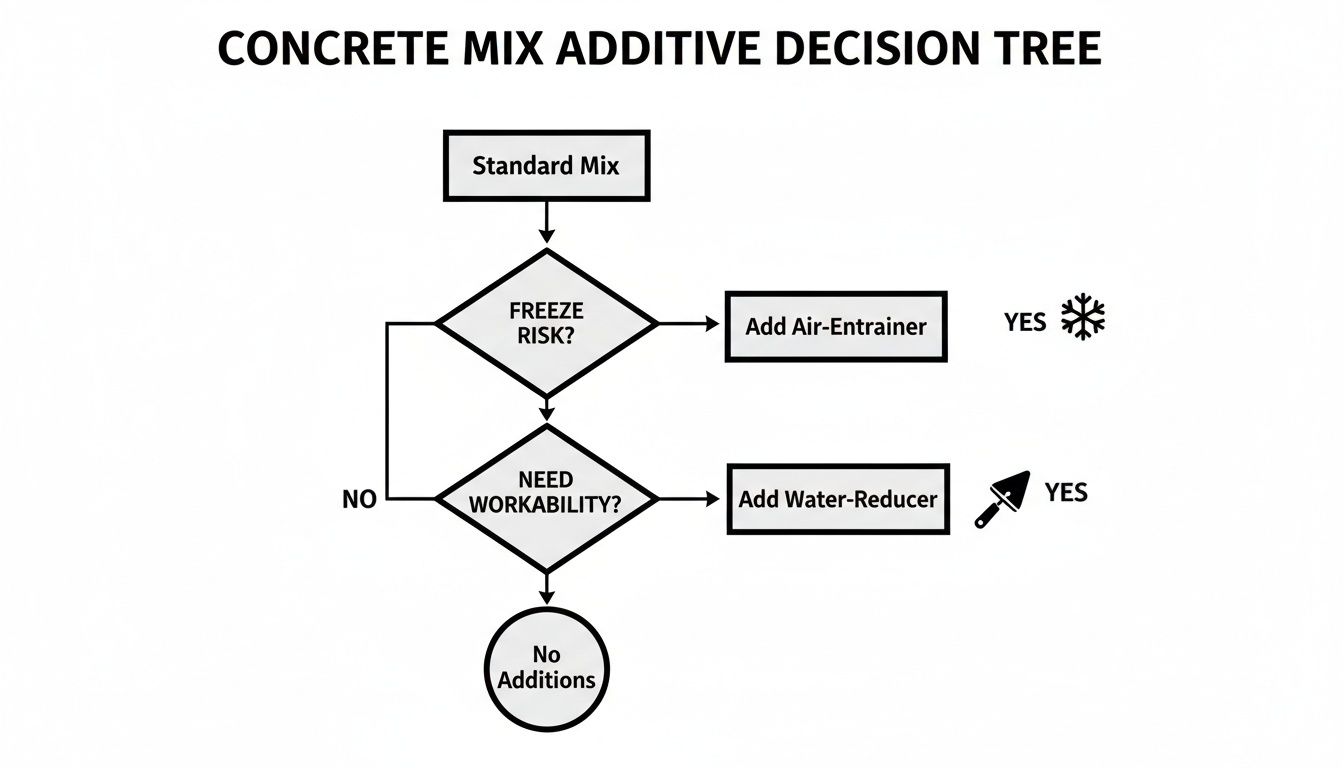
This level of precision is exactly why the pros use it. In fact, the U.S. concrete contracting industry, projected to be a $91.2 billion market by 2025, overwhelmingly relies on ready-mix suppliers to maintain quality standards and avoid costly failures. Learn more about the U.S. concrete contracting market.
Ready-Mix vs. Bagged Concrete for a Driveway Project
To make the choice crystal clear, here’s a direct comparison of how the two stack up for a driveway installation.
| Factor | Ready-Mix Concrete | Bagged Concrete Mix |
|---|---|---|
| Best Use Case | Driveways, foundations, large patios | Small repairs, post setting, small pads |
| Consistency | Excellent. Computer-batched for uniform strength and slump. | Poor. Varies with each hand-mixed batch, risking weak spots. |
| Labor | Low. The truck does the mixing; you focus on placing and finishing. | Extremely high. Involves lifting, opening, and mixing 150+ bags. |
| Time | Fast. The entire driveway can be poured in a few hours. | Very slow. Mixing alone can take an entire day or more. |
| Cost | More cost-effective for large volumes (over 1-2 cubic yards). | Cheaper for tiny projects but very expensive for a full driveway. |
| Quality | Professional-grade. Ensures long-term durability and performance. | DIY-grade. Prone to inconsistencies that shorten lifespan. |
Ultimately, the right choice comes down to scale. While bagged mix is a great tool, it's the wrong one for a driveway. Any professional team handling residential poured concrete projects will exclusively use ready-mix to ensure the job is done right, delivering a strong, beautiful, and long-lasting result every time.
How Climate and Site Conditions Affect Your Mix
Picking the right concrete mix for a driveway goes way beyond just grabbing a bag with a high PSI number. A mix that works perfectly in a dry, mild climate like San Diego could literally crumble apart in an area with harsh winters or the type of soil we have here in Georgia. You have to respect the powerful forces of your local environment when designing the mix.
It's a lot like choosing tires for your car. You wouldn't put slick racing tires on your truck to drive through a snowstorm, right? In the same way, your concrete needs to be engineered to handle the specific challenges of your property, from the freeze-thaw cycles that can hit north of the city to the brutal summer heat we all know and love.
Getting this part right ensures your driveway isn't just strong the day it's poured, but stays that way for decades. Honestly, ignoring these local factors is one of the biggest reasons we see driveways fail prematurely with ugly cracks, flaking surfaces, and expensive repair bills.
Defeating the Freeze-Thaw Cycle
For any place that sees freezing temperatures, the number one enemy of concrete is the freeze-thaw cycle. Water inevitably seeps into the tiny, microscopic pores of the concrete. When that water freezes, it expands by about 9%, creating massive internal pressure. This pressure can literally pop off the surface of your driveway, a type of damage called spalling. For example, a single night of freezing rain followed by a thaw can exert thousands of pounds of pressure inside the slab.
To fight this, air-entrainment is an absolute must-have in your concrete mix. This special admixture creates billions of microscopic air bubbles throughout the concrete.
Think of these tiny air pockets as miniature shock absorbers. When water freezes and expands, it has somewhere to go—it pushes into these empty bubbles instead of blowing your concrete apart. It's the single best defense against winter damage.
For climates with regular freezes, your mix should have an air content somewhere between 5% and 7%. This single spec is what separates a driveway that lasts from one that ends up looking pockmarked and damaged after just a few winters.
Preparing for Your Specific Site and Soil
Beyond the weather, the ground under your driveway is a massive factor in its long-term health. Pouring concrete straight onto unprepared soil is like building a house on a sand dune—it's just a matter of time before it shifts and cracks. This is especially true here in Georgia, where expansive clay soils are common. This type of soil swells up when it's wet and shrinks dramatically when it's dry, constantly moving the ground beneath your slab. For instance, after a heavy rain, the clay can heave upward, and during a drought, it can sink, creating voids under the concrete that lead to cracking.
Proper site prep is every bit as critical as the concrete mix itself. Any professional installation should always include:
- A Solid Sub-Base: First, we lay down and compact a layer of gravel, usually 4 to 6 inches deep, underneath the concrete. This creates a stable, even platform that provides excellent drainage, wicking moisture away from the bottom of your driveway slab.
- Good Drainage: The whole area needs to be graded correctly so that rainwater flows off and away from the driveway. A common standard is a slope of at least 1/4 inch per foot to ensure water doesn't stand still. You never want water pooling near the edges or seeping underneath.
This solid foundation ensures the concrete is fully supported, distributing the weight of your cars evenly and preventing the stress fractures that are inevitable on unstable ground.
Managing Hot Weather Pours
Pouring concrete in the Georgia heat brings its own set of problems. If the concrete loses its moisture too quickly, the chemical reaction (called hydration) that gives it strength stops dead in its tracks. This rapid drying leads to a web of surface cracks called plastic shrinkage cracks and a weaker final product overall. For example, pouring concrete on a 95°F day with a light wind can cause the surface to dry out in minutes.
To get around this, we have to use specific hot-weather techniques. The main goal is to keep the slab moist during the first few critical days of curing. This might mean spraying on an evaporation retardant, misting the surface with water, or covering the whole thing with special curing blankets. By slowing down the drying process, we make sure the concrete reaches its maximum potential strength, giving you a smooth, crack-free finish that can handle our long, hot summers.
Why Professional Installation Is Your Best Investment
Choosing the perfect concrete mix for a driveway is a great start, but it’s only half the battle. You can have the best materials in the world, but they'll fail spectacularly if the installation is botched. This is where bringing in a pro isn't just a good idea—it's essential for getting a driveway that lasts.
A successful concrete pour is a carefully choreographed dance of timing, technique, and a whole lot of prep work. Going the DIY route to save a few bucks is tempting, but it's loaded with risk. One tiny mistake in preparing the sub-base, placing the rebar, or finishing the surface can lead to a cracked, spalling mess that costs a fortune to tear out and replace. For example, if control joints are cut too late or not deep enough, random, ugly cracks will almost certainly appear within the first year.
The Professional Edge: From Groundwork To Curing
An experienced contractor does so much more than just pour concrete. They quarterback the entire project, starting with obsessive site preparation. This means excavating to the right depth and, crucially, compacting the gravel sub-base until it's rock-solid. A weak, poorly compacted base is the number one reason driveways crack and sink over time.
Pros also know exactly how to place reinforcement like rebar or fiber mesh to give the concrete its tensile strength—the power to resist the pulling and flexing forces that try to tear it apart. They’ve got the right tools and the well-honed skills to float a perfectly smooth surface, all while ensuring it has the proper slope for water to drain away, not pool up and cause problems later.
Think of a professional installation not as an expense, but as an insurance policy for your investment. It guarantees that the high-quality concrete mix you specified is given the best possible chance to perform for decades, preventing the costly headache of a premature replacement.
Peace of Mind and Long-Term Value
The final, and most often overlooked, step is curing. A pro knows that concrete doesn't just "dry" like paint; it undergoes a chemical reaction called hydration to gain its strength. They'll take the right steps, like applying a curing compound or keeping it wet, to control moisture during those critical first few days. This process is absolutely vital for the concrete to reach its full potential.
The demand for quality, long-lasting driveways is a major force in the hardscaping industry. In fact, the global concrete pavers market, driven largely by driveway projects, was valued at around USD 16.4 billion in 2023 and is expected to climb to USD 29.2 billion by 2032. You can read more about the global concrete pavers market on dataintelo.com. This explosive growth shows just how much homeowners value quality and durability.
When you hand your project over to an expert team, you're ensuring every single detail—from the dirt below to the final cure—is handled correctly. By exploring our professional concrete services, you can see how we deliver a beautiful, high-performance driveway that adds real, lasting value to your home.
A Few Common Questions We Get About Driveway Concrete
Even after picking the perfect concrete mix for a driveway, most homeowners still have questions about what happens next. Knowing the nuts and bolts of the installation and curing process helps you understand what to expect and how to protect your brand-new investment from the get-go.
Here are some straightforward answers to the questions we hear all the time.
How Thick Does My Driveway Really Need to Be?
The absolute bare minimum for a concrete driveway is 4 inches thick. For most everyday cars—your sedans, crossovers, and small SUVs—a 4-inch slab will do the job just fine.
But it's smart to think about what you might park on it down the road.
If you own a heavy-duty pickup, a big three-row SUV, or expect the occasional delivery truck or RV, bumping that up to a 5-inch slab is one of the best investments you can make. That single extra inch dramatically boosts the driveway's load-bearing capacity, giving you a crucial safety margin against cracks from heavier vehicles. For example, a 5-inch slab can support nearly 50% more weight than a 4-inch slab. Just remember, the concrete's thickness is only half the battle; it needs a solid, well-compacted gravel base underneath it to work as a complete system.
How Long Until I Can Park on My New Driveway?
This is where a little patience goes a long way. Concrete doesn't just "dry" like paint; it cures, which is a chemical process where it gains strength over time. Driving on it too soon can cause permanent ruts and cracks.
Concrete gets to about 70% of its final strength in the first seven days. If you put a heavy vehicle on it during that critical first week, you can interrupt the curing process and seriously compromise its long-term durability.
Here’s a safe timeline we always recommend:
- 24-48 Hours: It's okay to walk on it, but try to be gentle.
- 7 Days: Go ahead and park your regular passenger cars on the new slab.
- 28 Days: Hold off on any heavy hitters—like big trucks, RVs, or construction equipment—for the full 28-day curing period. This gives the concrete time to reach its full design strength.
Can I Get My Driveway in a Different Color?
Absolutely. Adding color is a fantastic way to get a custom look that really complements your home's exterior. There are two main ways to do it, and each has its own advantages.
Integral Color: This is where we add a powdered pigment right into the concrete mix for a driveway before it even leaves the plant. The color goes all the way through the slab, so if you ever get a chip or a deep scratch, the color underneath is the same. For example, adding a terracotta-colored pigment can give the driveway a warm, earthy look that matches a brick home.
Color Hardeners: With this method, we broadcast a colored powder over the fresh, wet concrete and trowel it into the top layer. This gives you a very vibrant, dense color and actually makes the surface a bit tougher. Since the color is only on the surface, it’s a go-to choice for decorative stamped concrete projects, like creating a dark gray "slate" finish.
A great-looking, long-lasting driveway is all about using the right materials and having it installed by people who know what they're doing. If you're ready to upgrade your property with a professionally installed concrete driveway built to last, you can trust the team at Atlanta Concrete Solutions.
Get in touch with us today for a free, no-obligation quote by visiting atlantaconcretesolutions.com.