
That uneven or cracked sidewalk isn't just dragging down your Atlanta home's curb appeal—it's a ticking clock on a potential liability claim. When you find yourself Googling "concrete sidewalk repair near me," it's a sign you're ready to get proactive about your property's safety and value. Putting off these repairs doesn't just look bad; it can lead to bigger, more expensive headaches down the road. For example, a homeowner in Decatur recently faced a lawsuit after a delivery person tripped on a slab that had lifted by just one inch—a problem that could have been fixed for a fraction of the legal cost.
Is Your Sidewalk a Hazard? Spotting the Warning Signs
Concrete rarely fails out of the blue. It usually gives you plenty of warning signs that something is wrong, often starting from deep within the soil base. For homeowners here in the Atlanta area, learning to read these signals means you can get ahead of the problem.
Think of it like a check-up. Catching the symptoms early often means a simpler, more affordable fix. A tiny crack might seem harmless today, but our Georgia climate has other plans. The combination of intense summer humidity, heavy downpours, and the occasional winter freeze-thaw cycle can turn a small issue into a major one, fast. Water gets in, the soil underneath washes away, and suddenly you have a much bigger problem on your hands. For example, a hairline crack can widen over a single winter, allowing water to freeze and expand, eventually splitting a slab in two.
Key Indicators That Your Sidewalk Needs Help
Learning to spot the early signs of damage can be the difference between a simple repair and a full-blown replacement. Here’s what I tell homeowners to watch out for, with some real-world examples:
- Visible Cracks: Whether they look like fine spiderwebs (craze cracking) or deep, separated fissures, any crack is a sign of stress. They’re usually the first clue that something isn’t right. An example is a large crack radiating from the corner of a slab, often indicating the ground beneath has settled unevenly.
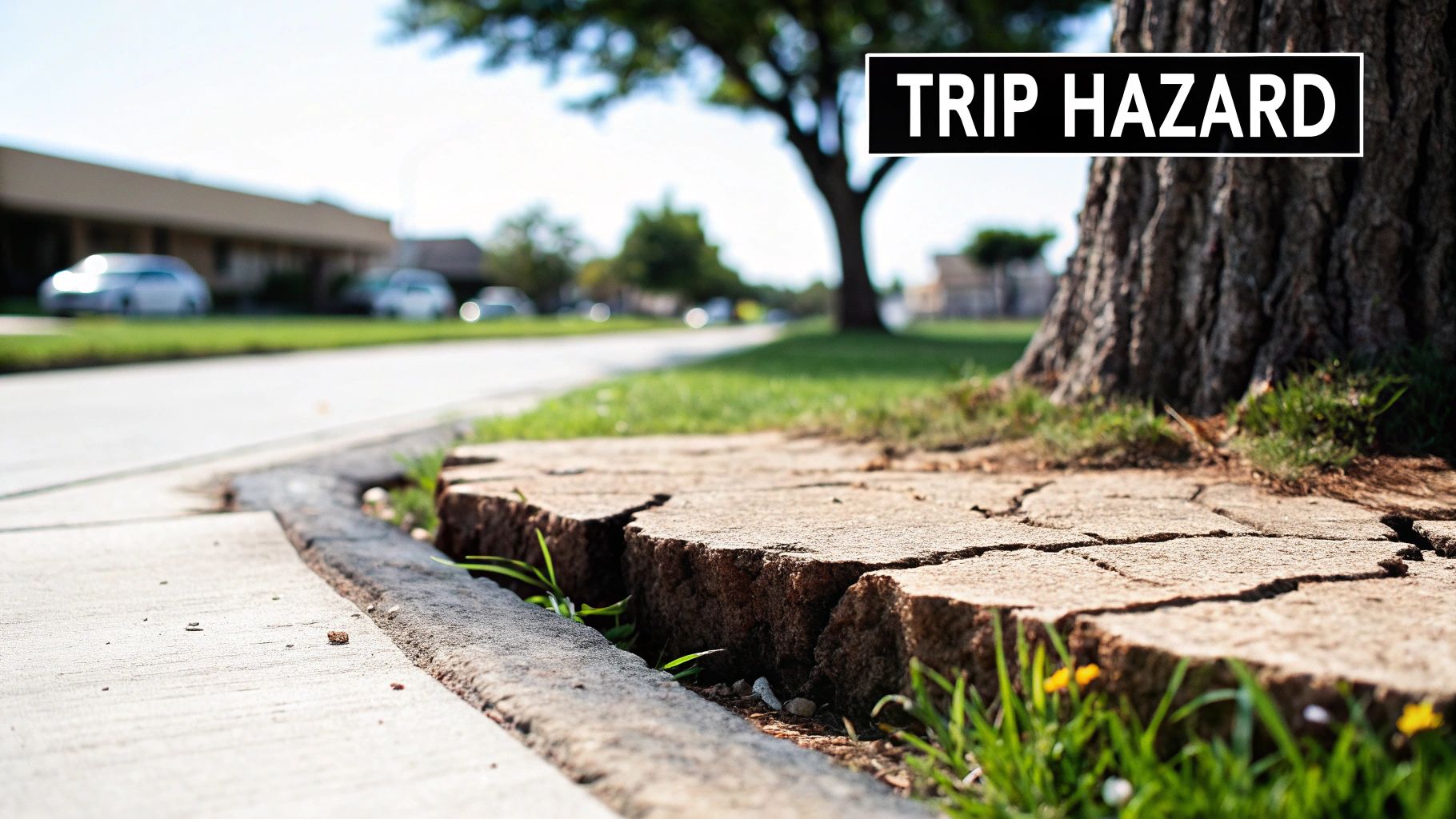
- Uneven Slabs (Trip Hazards): This is a big one. When one concrete slab sinks or heaves up, creating a "lip," you've got a serious trip hazard. The Americans with Disabilities Act (ADA) considers any vertical change over 1/4 inch a potential hazard that needs to be fixed. We often see this near large oak trees, where roots have pushed a slab upward by an inch or more.
- Spalling and Crumbling: Ever see the top layer of concrete flaking or chipping away? That's called spalling. It’s a sure sign the concrete itself is compromised, often from water damage or even a bad pour years ago. A common example is seeing a pockmarked, rough surface where smooth concrete used to be, especially after a winter where rock salt was used.
- Sunken Sections: If you see entire sections of your sidewalk dipping or creating a low spot, it's a classic sign of soil washout or poor compaction underneath. These spots become puddles, which only makes the erosion worse over time. For instance, a section near a downspout that constantly sinks is a tell-tale sign of water erosion washing away the soil base.
This graphic gives you a great visual of how these problems get worse, moving from simple cracks to total failure.
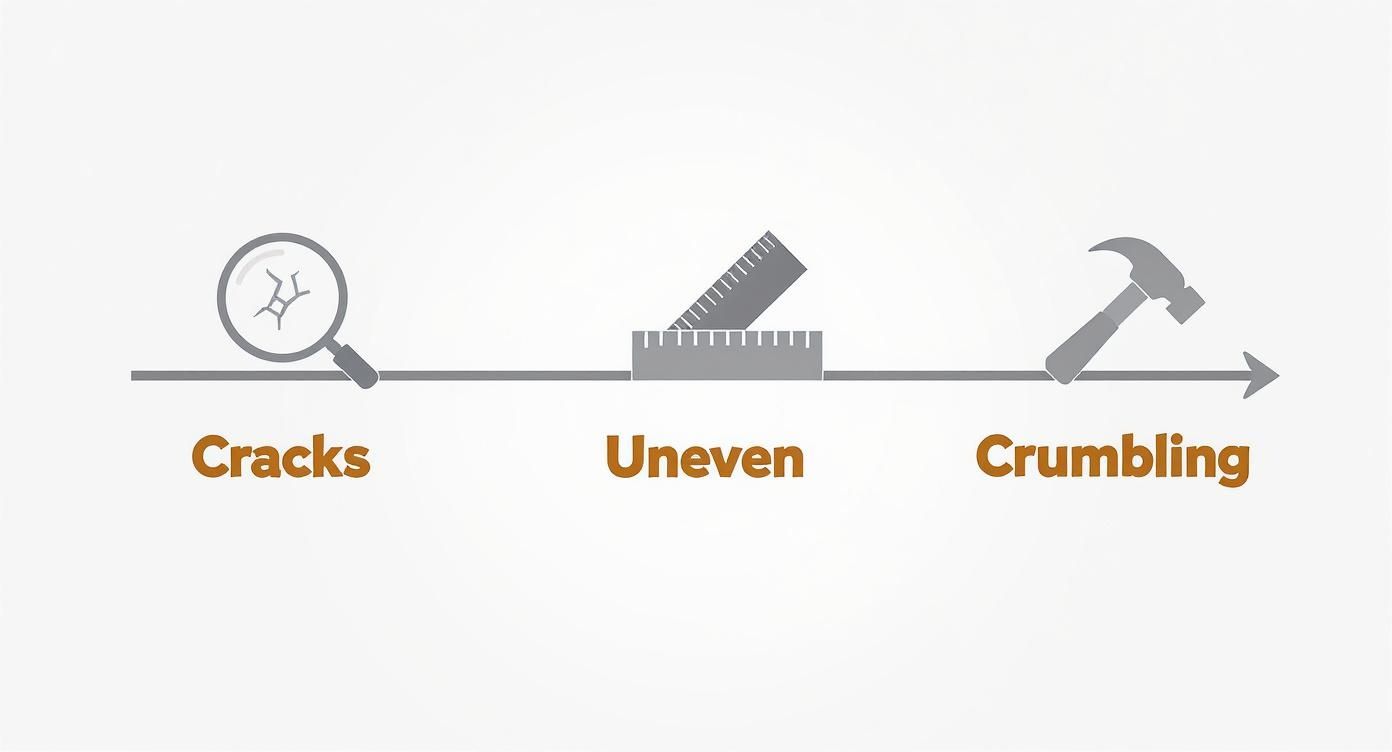
The takeaway is simple: fixing a problem in the "cracks" stage is always going to be easier and cheaper than waiting until your sidewalk is crumbling apart.
Sidewalk Problem Diagnosis Chart
Use this quick guide to identify your sidewalk issue, understand its risk level, and see the most common repair solution in the Atlanta area.
| Symptom You See | Common Atlanta Cause | Potential Risk | Likely Repair Solution |
|---|---|---|---|
| Hairline or "Spiderweb" Cracks | Normal concrete shrinkage, seasonal temperature changes | Low | Crack Sealing & Resurfacing |
| Sinking/Uneven Slabs (Trip Hazard) | Soil erosion from heavy rain, tree root growth | High | Concrete Leveling (Slabjacking) |
| Deep, Wide Cracks | Poor soil base, water intrusion, freeze-thaw cycles | Medium to High | Partial Slab Replacement or Leveling |
| Flaking or Crumbling Surface (Spalling) | Water damage, old/poor quality concrete mix | Medium | Resurfacing or Partial Replacement |
Keep in mind, this is a general guide. The best solution always depends on a professional, on-site inspection of your specific situation.
Why You Can't Afford to Ignore Sidewalk Damage
I get it—nobody wants to add another project to their to-do list. But waiting on sidewalk repairs is a gamble. A hazardous sidewalk is a real risk for everyone from your mail carrier to kids playing in the neighborhood.
A trip-and-fall accident on your property can quickly escalate into a massive liability claim. Suddenly, that cracked slab isn't just an eyesore; it's a legal and financial nightmare. Staying on top of your sidewalk's condition is just part of being a responsible homeowner.
Besides the safety risk, delaying almost guarantees you'll pay more later. A small crack that could be sealed for a couple hundred dollars can expand and destroy the slab's integrity, forcing a full replacement that costs thousands. By learning to read the warning signs, you protect your wallet, your property, and your peace of mind.
Repair Options From Simple Patching to Full Replacement
Once you've spotted the trouble signs on your sidewalk, the next move is figuring out the right fix. Not every crack means you need to call in the demolition crew. Thankfully, we have a whole range of repair options today, from simple touch-ups to a complete do-over, and each one is tailored to a specific kind of damage.
Think of it like treating an injury. A small scrape just needs a bandage, but a broken bone requires a cast. Matching the treatment to your sidewalk's specific problem is the secret to a repair that lasts and doesn't break the bank.
Minor Fixes for Minor Problems
When you're dealing with surface-level issues—think hairline cracks or a bit of chipping—the best approach is usually simple and direct. These methods are all about stopping a small problem from turning into a big one.
- Crack Filling and Sealing: This is your first line of defense. We apply a flexible, waterproof sealant to small cracks to keep water from getting underneath and wreaking havoc. It's the same idea as caulking a window to keep rain out—a straightforward, preventative step that makes a huge difference. For example, sealing a 1/8-inch crack prevents it from collecting water, freezing, and widening into a 1/2-inch gap over the winter.
- Concrete Patching: Got a small, contained area where the concrete is crumbling or spalling? A high-strength patching compound is perfect. We clean out the bad spot, apply the new material, and smooth it over to blend in with the rest of your sidewalk. This is an ideal solution for a corner of a slab that has chipped off, restoring the sharp edge.
These fixes are great for cosmetic issues and catching damage early. They won't, however, fix the root cause of bigger structural problems, like a sunken slab.
Concrete Leveling: The Non-Invasive Surgery
So what do you do when the problem isn’t just on the surface, but underneath? When soil erodes or compacts, sidewalk slabs can sink, creating nasty trip hazards that a simple patch can't fix. This is where concrete leveling comes into play.
These techniques are like performing minimally invasive surgery on your sidewalk. Instead of tearing out the whole slab, we lift it back into place from below.
The whole point of concrete leveling is to get your sidewalk back to its original height and make it stable again, all without the mess and expense of a full replacement. It’s a smart, targeted solution that gets right to the root of the problem—the empty space under the slab.
We have two main ways of doing this:
- Slab Jacking (or Mudjacking): This is the classic method. We drill a few small holes (about 1-2 inches in diameter) in the sunken slab and pump a slurry (a mix of cement, soil, and water) underneath. The pressure from this slurry lifts the concrete right back up where it belongs.
- Polyurethane Foam Lifting: This is the modern, high-tech approach. We use a lightweight, high-density polyurethane foam injected through even smaller holes (typically 5/8-inch). The foam expands, filling the void and lifting the slab with incredible precision. It's incredibly strong, waterproof, and cures in just a few minutes, meaning you can walk on the sidewalk almost immediately.
Resurfacing and Full Replacement
Sometimes the damage is too widespread for patching, but you don't need to tear everything out. And in other cases, the concrete is just too far gone to save.
Concrete Resurfacing
If your sidewalk’s foundation is still solid but the surface is a mess of stains, spalling, or a web of tiny cracks, resurfacing is a fantastic option. We apply a thin, tough layer of a polymer-modified cement overlay right on top, giving you a brand-new, durable surface. It’s like putting new siding on a house that still has a great frame. For example, a 20-year-old sidewalk that is structurally sound but looks worn and stained can be made to look brand new with a resurfacing coat.
This technique is becoming incredibly popular. The global market for concrete resurfacers was valued at over $4.36 billion in 2025 and is expected to hit $6.9 billion by 2035. That growth speaks volumes about how effective it is, especially in places where you want a great result with minimal disruption.
Partial or Full Replacement
When a sidewalk slab is severely cracked, shattered into pieces, or has been heaved up by massive tree roots, a repair just won't cut it. At this point, the only real solution is replacement. This involves breaking up and hauling away the old concrete, re-compacting the soil underneath, and pouring a brand-new slab. For example, if a large water oak has pushed a slab up by 4 inches and broken it into multiple pieces, replacement is the only viable option.
It's definitely the most intensive option, but it gives you a fresh start with a solid foundation, guaranteeing your sidewalk will be safe and stable for decades to come. To learn more about when replacement is the right call, take a look at our detailed guide on residential sidewalk concrete solutions.
Budgeting for Sidewalk Repair in the Atlanta Area
Alright, let's talk about the bottom line. When you're trying to figure out what a sidewalk repair will cost, it's easy to get lost in the numbers. But understanding the price is the first real step toward making a smart decision for your property.
Think of it this way: when you take your car to the shop, the final bill depends on what's actually broken, how long it takes to fix, and the complexity of the repair. Concrete work is no different. The final quote isn't just a random number—it’s a reflection of the specific challenges your sidewalk presents.
What Drives the Cost of Your Repair
The quote you receive will be based on more than just the cracks you can see from your front door. A seasoned professional assesses the entire situation to give you an accurate price.
Here are the main things that will influence your final cost, with examples:
- The Repair Method: This is the big one. As we've discussed, concrete leveling is almost always more wallet-friendly than tearing everything out and starting from scratch. For instance, lifting one sunken slab might cost $700, while replacing that same slab could cost $1,200 or more.
- Scale of the Damage: How much concrete are we talking about? Fixing a single, sunken 4×4 foot slab is a much different job than replacing an entire 50-foot walkway that's been destroyed by tree roots. The more square footage involved, the higher the overall cost, though the price per square foot may decrease on larger jobs.
- Site Accessibility: How easy is it for us to get our crew and equipment to the problem area? A wide-open front yard is straightforward. A narrow path in a fenced-in backyard might require more manual labor and time, such as using wheelbarrows instead of a concrete buggy, which can affect the cost.
- The "Hidden" Stuff: We always aim to be upfront about potential extras. These can include city permit fees, the cost of hauling away and disposing of the old, broken concrete, or the extra work needed to navigate massive tree roots, which may require specialized cutting tools.
The mark of a good estimate is total transparency. You should see a clear breakdown of materials, labor, and any other charges so you know exactly what you’re paying for. No surprises.
It's a growing need, too. With so much of our local infrastructure aging, the global market for concrete repair is expected to hit $25 billion by 2033. Here in the U.S., the average cost for sidewalk repair in 2025 hovers around $1,599, though most projects fall somewhere between $726 and $2,485. You can read more about these trends and what's driving them in this concrete repair products market report.
Estimated Sidewalk Repair Costs in Atlanta
To help you get a ballpark idea for your budget, we've put together a quick look at typical costs for different sidewalk repair methods here in the Atlanta area.
A comparative look at typical costs for different sidewalk repair methods to help you plan your project budget.
| Repair Method | Typical Atlanta Cost Range | Ideal Use Case |
|---|---|---|
| Concrete Leveling (Slabjacking) | $600 – $1,800 per job | Fixing sunken but structurally sound slabs. It's a fast, affordable way to eliminate trip hazards. |
| Concrete Resurfacing | $4 – $9 per square foot | Covering up widespread surface flaws like spalling or hairline cracks on an otherwise solid slab. |
| Full Concrete Replacement | $12 – $25 per square foot | The only real solution for concrete that's severely cracked, shattered, or heaved beyond repair. |
Of course, these numbers are just a starting point. Every property is unique, and seeing the damage firsthand is the only way to know for sure. You can see how different problems result in different solutions by viewing our completed sidewalk projects in Atlanta.
The best way forward is to schedule a free, on-site consultation. We can assess the situation, explain your options, and give you a precise, no-obligation quote tailored to your home.
Navigating Atlanta Permits and ADA Compliance
Fixing a sidewalk in the Atlanta area is rarely just about mixing concrete. Many homeowners are caught off guard when they discover that what seems like a straightforward repair is tangled up in local rules and regulations. Trust me, ignoring these steps is a recipe for disaster—it can lead to hefty fines and even an order to tear out your brand-new work.
Think of the permitting process as your project's official green light. It’s the city’s way of ensuring the work is done safely, legally, and to a standard that protects everyone. When you're looking up "concrete sidewalk repair near me," finding a contractor who gets the local red tape is just as crucial as their skill with a trowel.
When Do You Need a Permit in Metro Atlanta?
A tiny patch on a hairline crack probably won't require a call to the city. But for anything more involved, you’ll almost certainly need a permit, especially if the work is in the public right-of-way—that strip of land between your property line and the street that usually includes the sidewalk.
You'll definitely want to plan on getting a permit for sidewalk projects that involve:
- Full or Partial Replacement: Ripping out old, broken slabs and pouring new ones is a major job, and city inspectors will want to sign off on it. For example, replacing three 5×5 foot sidewalk panels in the city of Atlanta requires a Right-of-Way permit.
- Curb Modifications: If you're altering the curb in any way, like adding a new driveway entrance, you'll need the city's blessing first. This often involves detailed plans to ensure proper water drainage.
- Work Near Public Utilities: Is your repair anywhere near water mains, gas lines, or other buried infrastructure? A permit is non-negotiable to prevent a dangerous accident. Before any digging, a "Call Before You Dig" (811) request is mandatory to have utility lines marked.
The permitting process isn't just about paperwork; it's a vital safety checkpoint. It makes sure your project doesn't accidentally slice through a utility line or create a new hazard for your neighbors.
A seasoned contractor takes this entire headache off your plate. They know the difference between dealing with the city of Alpharetta versus Marietta and handle all the filings correctly, saving you from frustrating delays and potential legal trouble.
Understanding ADA Compliance Essentials
Beyond local permits, your sidewalk has to meet the standards of the Americans with Disabilities Act (ADA). These are federal rules designed to make public walkways safe and usable for everyone, especially folks with mobility challenges. If your sidewalk isn't compliant, you could be held liable for any accidents.
Here are the key ADA rules your sidewalk repair must meet, with examples:
- No Trip Hazards: Any abrupt vertical change over 1/4 inch is a trip hazard and must be ground down to a bevel. If the lip is more than 1/2 inch, it has to be removed or ramped. For example, a 3/4-inch lift caused by a tree root cannot simply be ground down; the slab must be lifted or replaced.
- Proper Slope: Sidewalks can't be too steep. The cross slope (from side to side) must be 2% or less to allow for drainage without making it difficult for someone in a wheelchair. This means for a standard 4-foot wide sidewalk, the height difference from one side to the other cannot exceed about one inch.
- Minimum Clear Width: The pathway must be at least 36 inches wide, with no obstructions, to allow for easy passage. This is crucial in areas where landscaping or mailboxes might encroach on the walkway.
Hiring a contractor who speaks fluent "code"—both local and federal—is your best insurance against expensive do-overs. They'll make sure your concrete sidewalk repair near me is not only solid and good-looking but also safe, legal, and accessible for the whole community.
Finding the Right Sidewalk Repair Contractor in Atlanta
Picking the right crew for your sidewalk repair is easily the most critical decision you'll make in this whole process. It's not just about getting the job done; it's about the quality of the work, how long it will last, and your peace of mind. When you're searching for "concrete sidewalk repair near me," you’re looking for a partner, not just a name on a truck.
The good news is that making a smart choice really just comes down to knowing what to look for and which questions to ask. Any true professional will welcome your questions and give you straight answers. Think of it less like an interrogation and more like an interview to find the perfect fit for your property's needs.
Your Vetting Checklist: The Must-Ask Questions
Before you even think about signing a contract, you need to have a real conversation. This initial chat will tell you volumes about a company’s professionalism and expertise. Use these questions to get the ball rolling and see who you're dealing with.
- "Are you licensed for my city and fully insured?" Don’t just take their word for it. Ask to see proof of their current business license and, just as importantly, their liability insurance. This is your safety net, protecting you from any potential accidents or property damage on your site. For example, if a worker accidentally damages your sprinkler system, their insurance should cover the repair costs.
- "Can I get a detailed, itemized estimate in writing?" A vague quote scribbled on a piece of paper is a huge red flag. A proper estimate breaks down the costs clearly—labor, materials (e.g., cubic yards of concrete, linear feet of sealant), permit fees, and even debris removal—so you know exactly where your money is going.
- "What does your warranty cover, and for how long?" A contractor who believes in their work will stand behind it with a solid warranty. Find out exactly what it covers—is it the materials, the labor, or both? For instance, a good warranty might cover the repaired slab against sinking for 2-5 years but may not cover new cracks caused by soil movement. Understanding the terms gives you long-term security for your investment.
These questions are your first line of defense. They help you quickly weed out the unqualified or less-than-professional outfits. The goal is to find a team that is transparent, prepared, and genuinely committed to quality.
How to Read an Estimate and Spot the Red Flags
Once you have a few written estimates in hand, it's time to compare. My advice? Don't just reflexively go for the lowest bid. A price that seems too good to be true usually is, often signaling that they're cutting corners with cheap materials or inexperienced labor.
Here’s what you want to see from a trustworthy contractor:
- A Professional Proposal: The estimate is clear, detailed, and looks like it was prepared by a professional business.
- A Clear Timeline: They can give you a realistic start date and a solid estimate of how long the job will take.
- Good Communication: They take the time to answer your questions and actually return your calls promptly.
On the flip side, be on high alert for these common red flags:
- High-Pressure Sales Tactics: Any contractor pushing you to "sign today before the price goes up" is not looking out for you. A legitimate offer will be valid for a reasonable period, like 30 days.
- Demanding Full Payment Upfront: A reasonable deposit is standard practice (10-30%), but never, ever pay the full amount before the work is finished to your satisfaction. A typical payment schedule might be 30% upfront, 40% upon completion of the main work, and the final 30% after the final inspection.
- Vague or Verbal-Only Promises: If it’s not in writing, it doesn't count. Make sure every single detail and promise, from the type of concrete mix to the cleanup process, is documented in the contract.
Choosing a contractor is about building a foundation of trust before a single bag of concrete is opened. A true professional will invest the time to make sure you feel confident and informed every step of the way.
The need for skilled concrete work is on the rise. The global concrete restoration market was valued at $17.6 billion in 2025 and is projected to hit $23.02 billion by 2029. This boom is fueled by the critical need to maintain our aging infrastructure with durable materials and expert craftsmanship—a standard that both federal and state transportation departments demand. You can learn more about the trends in the concrete restoration market to see why quality is more important than ever. Partnering with a professional ensures your repair meets these high standards, giving you a safe and lasting solution.
Your Local Sidewalk Repair Experts in Metro Atlanta
When you type "concrete sidewalk repair near me" into a search bar, you’re not just looking for a service. You’re looking for a local team that actually gets it—someone who knows the ground beneath your feet.
Here in Metro Atlanta, that means understanding our notorious red clay soil, which can swell and shrink with the seasons. It means knowing how to deal with the aggressive roots from our beautiful old oak trees that can tear a sidewalk apart.
This isn't just a job for us; it’s our community. Atlanta Concrete Solutions is your neighbor, and we’re proud to help keep our neighborhoods safe and looking their best. We've built our expertise right here, solving the real-world sidewalk problems Atlanta homeowners face every day.
Proudly Serving Communities Across the Metro Area
Our deep roots in the area mean we bring a specific kind of know-how to every job. We've spent years working across the region, so we’re familiar with the unique ground conditions and local codes in your specific city.
You’ll find our crews working hard for your neighbors in communities like:
- Alpharetta
- Marietta
- Johns Creek
- Roswell
- Sandy Springs
- Duluth
This local experience really matters. In historic Roswell and Marietta, for example, we’ve become experts at carefully repairing sidewalks that have been completely upended by massive, mature tree roots. Over in newer communities like Johns Creek, we’re often called in to fix sinking slabs caused by soil that wasn't properly compacted years ago.
Choosing a local pro means you're getting someone who knows that a repair on a steep slope in Sandy Springs needs a different touch than one on the flatter ground of Duluth. That boots-on-the-ground knowledge is what makes a repair last.
Your Partner for a Safe and Beautiful Property
We look at every job as a partnership. Our mission is simple: leave you with a safe, attractive, and fully compliant sidewalk that boosts your property's curb appeal and gives you peace of mind. We pair top-notch workmanship with clear communication, making the entire process feel easy, from the first call to the final walkthrough.
Don’t let a cracked or uneven sidewalk remain a tripping hazard for one more day. Partner with a team that truly knows Atlanta.
Ready to get started? Request your free, no-obligation estimate from Atlanta Concrete Solutions today. We’re here to help.
Got Questions About Sidewalk Repair? We've Got Answers.
When you're facing a sidewalk repair project, a lot of questions can pop up. As Atlanta's go-to concrete experts, we've heard them all. We believe an informed homeowner is a confident one, so we’ve put together some straight-talk answers to the most common questions we get.
Let's clear things up so you can make the best decision for your property.
How Long Will This Whole Process Take?
This is usually the first thing people ask, and for good reason! The timeline really hinges on the type of repair and the size of the job.
- Concrete Leveling: This is the fast option. Whether we're using slab jacking or poly-foam injection, most residential jobs—like lifting a few sunken squares—are done in just a couple of hours. The best part? You can usually walk on it almost as soon as we pack up our tools. For instance, a typical three-slab lift can be completed between 9 AM and 11 AM.
- Full Replacement: A full tear-out and re-pour is a bigger undertaking. You can expect this to take anywhere from 1 to 3 days, depending on how much sidewalk we're replacing. Once the new concrete is poured, it needs to cure properly, so you'll have to stay off it for another 24 to 48 hours. A 30-foot replacement might take a full day for demolition and prep, and a few hours the next day for pouring and finishing.
Should I Repair It, or Just Replace the Whole Thing?
The classic "repair vs. replace" dilemma. The right choice boils down to the condition of your concrete and what caused the problem in the first place.
Here’s an easy way to think about it: if the concrete slabs themselves are still in good shape but have just sunk because of soil shifting underneath, a repair like concrete leveling is a fantastic, wallet-friendly fix. On the other hand, if the concrete is a crumbling, cracked-up mess, or if aggressive tree roots are tearing it apart, replacement is really the only way to get a lasting solution. For example, a slab with one major crack but is otherwise solid is a great candidate for repair. A slab that has shattered into a "spiderweb" of many cracks is likely beyond saving and needs replacement.
Our philosophy is straightforward: save what's salvageable, and replace what's beyond repair. A quick, professional look at your sidewalk will tell us exactly which approach will give you the best long-term value.
Can You Do Sidewalk Work in Any Season?
For the most part, absolutely. Our relatively mild Atlanta climate means we can tackle most concrete sidewalk repair near me projects all year long.
Concrete leveling, especially the polyurethane foam method, isn't very sensitive to temperature swings. The big exception is a full replacement. Pouring fresh concrete requires temperatures to stay above freezing for it to cure correctly. For example, we wouldn't pour new concrete if the overnight low is expected to be 25°F, as this can ruin the strength of the finished product. To ensure a top-quality, durable finish, we'll always avoid pouring concrete during heavy rain or a cold snap.
Will the New Part Match My Old Sidewalk?
Getting a perfect color match is tricky, and it’s important to be realistic. Your existing sidewalk has been out in the sun and rain for years, giving it a unique, weathered look. Any new concrete or patch is going to look a bit different at first.
That said, we work hard to make the transition as seamless as possible. When we patch or resurface, we use materials formulated to blend in. For brand-new slabs, the color difference will be more obvious initially, but over time, as the new section weathers, it will begin to look much more like its neighbors. For instance, a new, light gray slab will darken over 6-12 months of exposure to rain and sun, blending in better with older, darker gray slabs.
Don't let unanswered questions keep you from having a safe, beautiful sidewalk. The team at Atlanta Concrete Solutions is here to give you clear answers and expert guidance. For a straightforward plan and a free, no-pressure estimate, visit us at https://atlantaconcretesolutions.com and book your consultation today.