
Pouring a concrete slab for a basketball court gives you a perfectly level playing field and a predictable ball bounce. Thanks to reinforced concrete, you’ll spend far less time on upkeep and more time on the court.
Why Choose A Concrete Slab For Basketball Court
When your surface stays within a ¼-inch tolerance, imperfections practically disappear and tripping hazards vanish. A well-built concrete court can easily last 30+ years, sparing you the headache and expense of early replacement.
- Exceptional flatness within a ¼-inch tolerance
- Lifespan of 30+ years, slashing long-term costs
- Predictable bounce from end line to sideline
- Minimal maintenance compared to asphalt
- Lower lifetime expense thanks to fewer repairs
Concrete also accepts acrylic coatings that boost grip and fend off UV damage, keeping your surface safe and color-fast.
One Atlanta community gym swapped out its aging asphalt pad for a 5-inch reinforced slab. Almost immediately, players noticed crisper bounces and steadier footing.
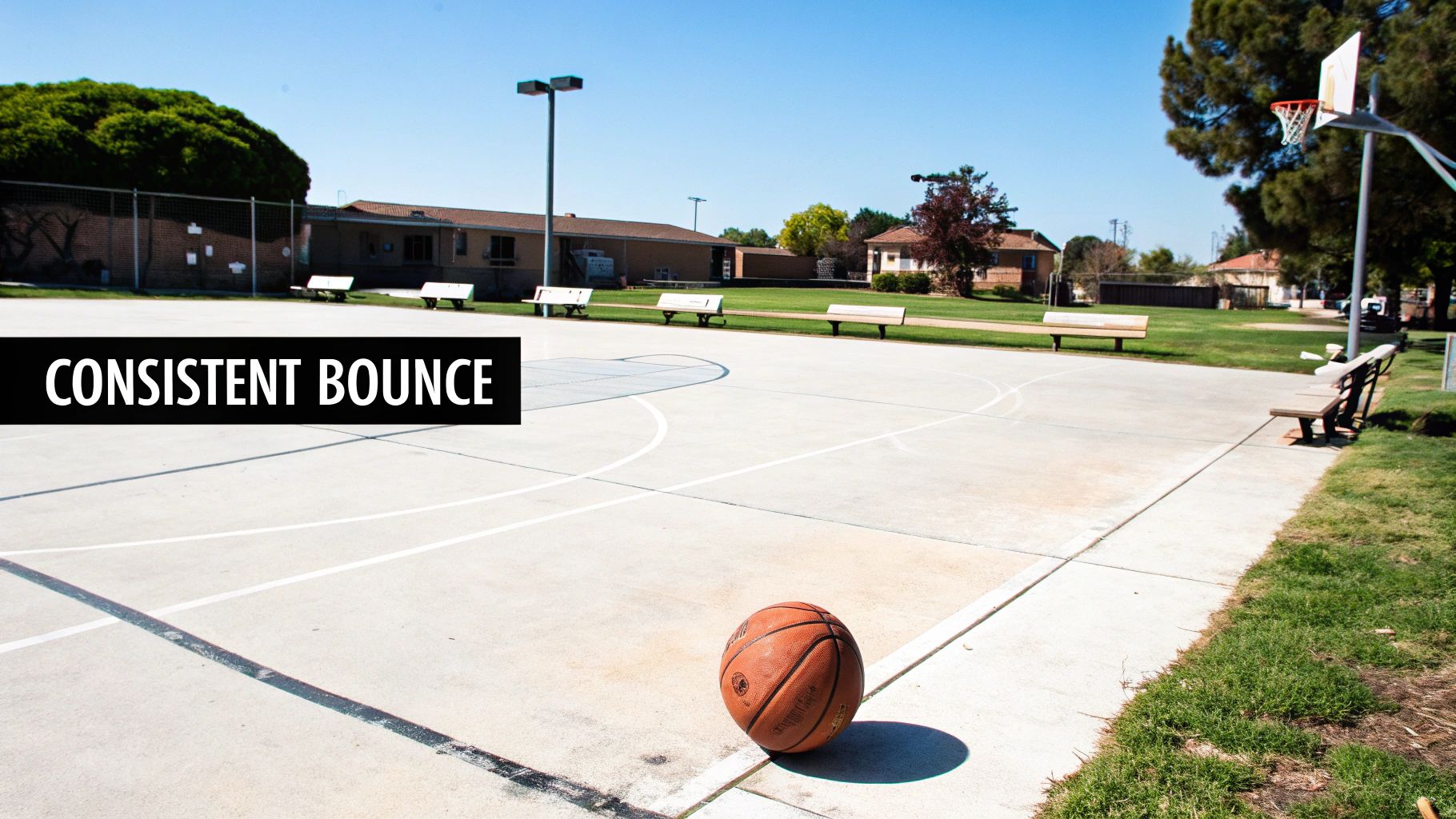
“Reinforced concrete transformed our gym floor into a performance asset,” says a facility manager in Buckhead.
Real World Cost Savings
Midtown Prep Academy’s switch from asphalt to concrete cut maintenance outlay by 80%.
That equates to roughly $2,500 saved each season.
- Asphalt repairs: $1,800 per year
- Concrete upkeep: $300 per year
Those savings stack up fast when you factor in fewer patches and seal coats.
Concrete Vs Asphalt Slab Comparison
Below is a quick look at how concrete and asphalt stack up for a basketball court:
| Feature | Concrete | Asphalt |
|---|---|---|
| Flatness | Tolerance within 0.125 inches | Varies up to ½ inch |
| Durability | 30+ years | 10–15 years |
| Maintenance | Occasional sealant application | Frequent patching and sealing |
| Ball Response | Uniform and predictable bounce | Inconsistent in extreme temperatures |
Despite a slightly higher upfront investment, concrete’s longevity and consistency often deliver the best value over time. For example, a homeowner in Alpharetta replaced an asphalt mini-court and saw a 50% drop in annual repair bills.
Homeowners tackling small courts often stick with a 4-inch slab reinforced by welded wire mesh. One Decatur project powered through three freeze-thaw cycles with barely a crack.
- Lay a 2% pitch toward drains to avoid pooling
- Place #3 rebar on 18-inch centers for steady reinforcement
- Cover with plastic sheeting for at least 7 days to control shrinkage
Safety And Performance Improvements
A smooth, even slab does more than just look good—it actively reduces injuries.
- Better traction minimizes slips and twisted ankles
- Consistent rebound sharpens shooting and ball control
- Fewer cracks and divots keep debris off the court
For example, a local rec center in Sandy Springs noted a 30% drop in slip-related incidents after resurfacing with an acrylic overlay, improving both safety and play quality.
Key Setup Tips
- Flag out court boundaries before excavation starts (e.g., a homeowner in Roswell used survey flags to nail placement on a sloped lot)
- Confirm subgrade compaction with a plate compactor or soil test
- Maintain a 0.5–1% slope toward drains to prevent standing water
- Schedule your pour on a mild, dry day for even curing
- Insert control joints every 10–12 feet to guide cracking
“Our backyard court still plays like new after five Atlanta summers,” notes a local homeowner.
Whether you’re going DIY or hiring a crew, getting these basics right pays dividends over time. Next up: evaluating your Atlanta site, dealing with that clay-heavy soil and drainage quirks. And don’t forget to check local codes for minimum slab thickness and reinforcement specs.
Concrete courts are dominating today’s market. The global basketball court construction industry hit $3.2 billion in 2024 and is projected to reach $5.1 billion by the early 2030s. Premium builds almost always favor concrete for its unmatched structural integrity. Read more about court construction trends at FTS Hellas.
This guidance will have your court play-ready in no time.
Evaluating Site Conditions For Your Court
Before you break ground, take a close look at what lies beneath. Atlanta’s clay-heavy terrain is notorious for holding water and shifting under pressure. A quick percolation test paired with a visual sweep for low spots can save you headaches down the road.
Assessing Site Conditions
Loamy or sandy soils drain much faster than dense clay—something you’ll want to note immediately. As you inspect, jot down:
- Soil Texture And Composition: Estimate clay content and organic matter.
- Water Retention Rate: Run percolation tests at several points (for instance, a Roswell homeowner performed three tests across his lot to map out wet zones).
- Groundwater Depth: High water tables can spell frost‐related heave.
“Failing to detect poor soil led to our slab shifting after heavy rains,” recalls one homeowner in Atlanta.
On many suburban lots, you’ll discover slopes under 1%. That subtle decline invites puddles right under your slab, so plan on re‐grading to keep water at bay.
Managing Drainage Slopes
A gentle 0.8% pitch away from the court perimeter will channel rainwater off the surface. In practice, crews:
- Mark stakes around the court, string them tight.
- Take elevation readings every 10 feet with a laser level.
- Add or remove fill dirt until the slope stays consistent.
In Johns Creek, a homeowner fixed poor grading by tucking a French drain along the low side. That simple addition steers runoff to a legal outlet without triggering permit hassle.
Surveyors can set your benchmark points to match city code and speed up approvals. And when you map out spot elevations for control joints and anchor sleeves now, the concrete crew wastes zero time later.
Integrating Structural Integrity Data
For a bounce‐consistent court, uniform slab thickness is key. Studies show sections vibrating between 634–732 Hz at 2.73–3.15 meters thick deliver the most even performance. Learn more about those findings
In practical terms, insist on the same pour depth under both the hoop zones and midcourt. That way, every dribble and shot feels just right.
Creating A Permit Friendly Plan
Local permit offices want proof you’ve handled drainage and slope correctly. A complete package usually includes:
- A detailed site map showing contours and runoff arrows.
- Soil test results outlining percolation numbers.
- Your full drainage design, be it swales or French drains.
In Alpharetta, one homeowner presented a combined site map and French drain layout, cutting permit turnaround from three weeks to eight days.
Planning Test Pits And Soil Reports
Digging test pits uncovers layers you can’t see from the surface. Aim for at least four pits—in each corner and the center—down to about 12 inches. For each hole, record:
- Pit Depth And Location: Corner and center spots tell different stories.
- Layer Description: Note color shifts, moisture levels, and soil firmness.
- Photo Log And Notes: Snap a pic, write the details.
Share this log with your contractor. They’ll know whether you need stabilizers or lime treatments to prevent future cracking. Solid testing today means your basketball slab can stand firm for decades.
Preparing Base Layers And Reinforcement
Laying a rock-solid sub-base is non-negotiable if you want your basketball court to last. In Atlanta’s clay-rich soils, that means digging down to undisturbed ground and stripping away every trace of organic matter.
Local pros often carve trenches at least 6 inches wider than the beam itself. That extra clearance makes setting up sturdy formwork a breeze and keeps those edges sharp when the concrete hits.
Once you’ve got clean soil, it’s time to pack it. A plate compactor will push you toward 95% of maximum dry density—just what you need to lock out future settlement.
- Excavation Depth: Remove 8 inches of topsoil and loose fill
- Subgrade Compaction: Hit 95% Proctor density in lifts no more than 4 inches
- Lean Mix Bed: Spread a uniform 4-inch layer before laying base stones
Foundation Excavation Techniques
Trenches should have square, crisp edges and be free of loose debris. A quick check with a laser level ensures consistent depth across the court’s length.
Don’t forget drainage. A simple gravel layer beneath your beams eases hydrostatic pressure and keeps water from pooling under the slab. For example, a Decatur installation used a 4-inch gravel sub-layer and saw zero edge water intrusion after heavy storms.
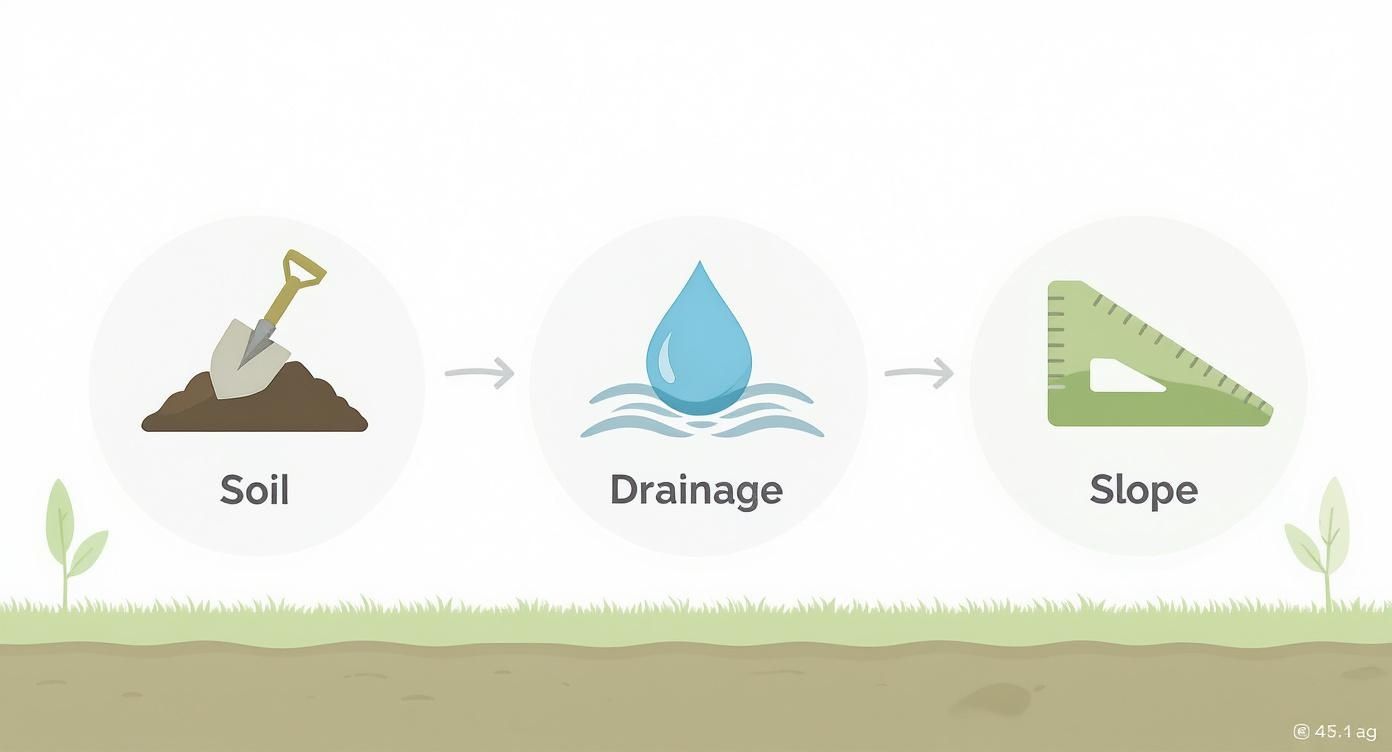
This infographic breaks down the must-do soil tests, drainage checks, and slope measurements. In fact, early slope evaluation can trim settlement issues by up to 15%.
Selecting Crushed Stone Base
For drainage and strength, we trust a No. 2 crushed-stone blend. Here’s how we handle it:
- Shovel and rake a single 4-inch lift
- Compact the stone in two 2-inch lifts to avoid voids
- Aim for 95% Proctor density before moving on
In Tucker, crews laid the same stone sequence and passed compaction tests on the first try, speeding up project timelines by two days.
| Parameter | Recommendation |
|---|---|
| Compactor Type | 4,000 lbs plate |
| Lift Thickness | 2 inches |
| Density Target | 95% Proctor |
Laying Steel Mesh And Rebar
Metal reinforcement stops cracks from running wild. Our teams place 6×6 W2.9 welded wire on plastic chairs, centering it in the slab. Then we lock in #4 bars by BS20 standards, spacing them every 18 inches.
Typically, the sequence looks like this: ground survey → grading → beam excavation → rebar and mesh setup → stone base. Along the way, thermal expansion joints and consistent compaction keep surprises at bay.
In Pooler, following this exact sequence prevented any mid-slab fractures even after a winter freeze cycle.
For a more detailed timeline of court installation, check out Angi’s article: How Much Does It Cost To Install A Basketball Court?
Under-compaction is a common culprit behind post-pour cracks. In Atlanta, crews often tackle corners first, which can shave roughly 20% off labor expenses.
Check out our guide on residential foundation concrete. This resource dives deeper into sub-base techniques that keep slabs perfectly level.
Proper staging and reinforcement placement can make or break slab longevity.
A final 4-inch lean mix fill smooths out minor dips and keeps the stones from wandering. Since lean mix has a low cement ratio, it won’t turn the base into a moisture trap.
- Keep the plate compactor moving to avoid punching through the subgrade
- Overlap each pass by at least 50% for even density
- Watch your lift thickness to maintain consistent compaction
Local crews often plan these steps around calm weather windows. Over the last decade, we’ve seen careful base prep cut crack repair calls by nearly 50%.
Key Takeaways
Getting your excavation, stone selection, and reinforcement right now pays off later. Stick to BS20 standards and those 2-inch rebar covers—and you’ll dodge corrosion headaches down the road.
Quality checks like nuclear gauges or drive-rail tests confirm you’ve hit 95% Proctor throughout. Moisture levels in the lean mix should stay under 8% before pouring the next layer.
- Verify compaction with reliable instruments
- Inspect chairs and ties to ensure correct mesh height
- Confirm a 2-inch rebar cover to protect against rust
Do this right, and your court will stand strong for decades of pick-up games and championship shots. Next up, let’s walk through pouring, curing, and finishing your freshly primed surface.
Pouring Curing And Finishing Concrete
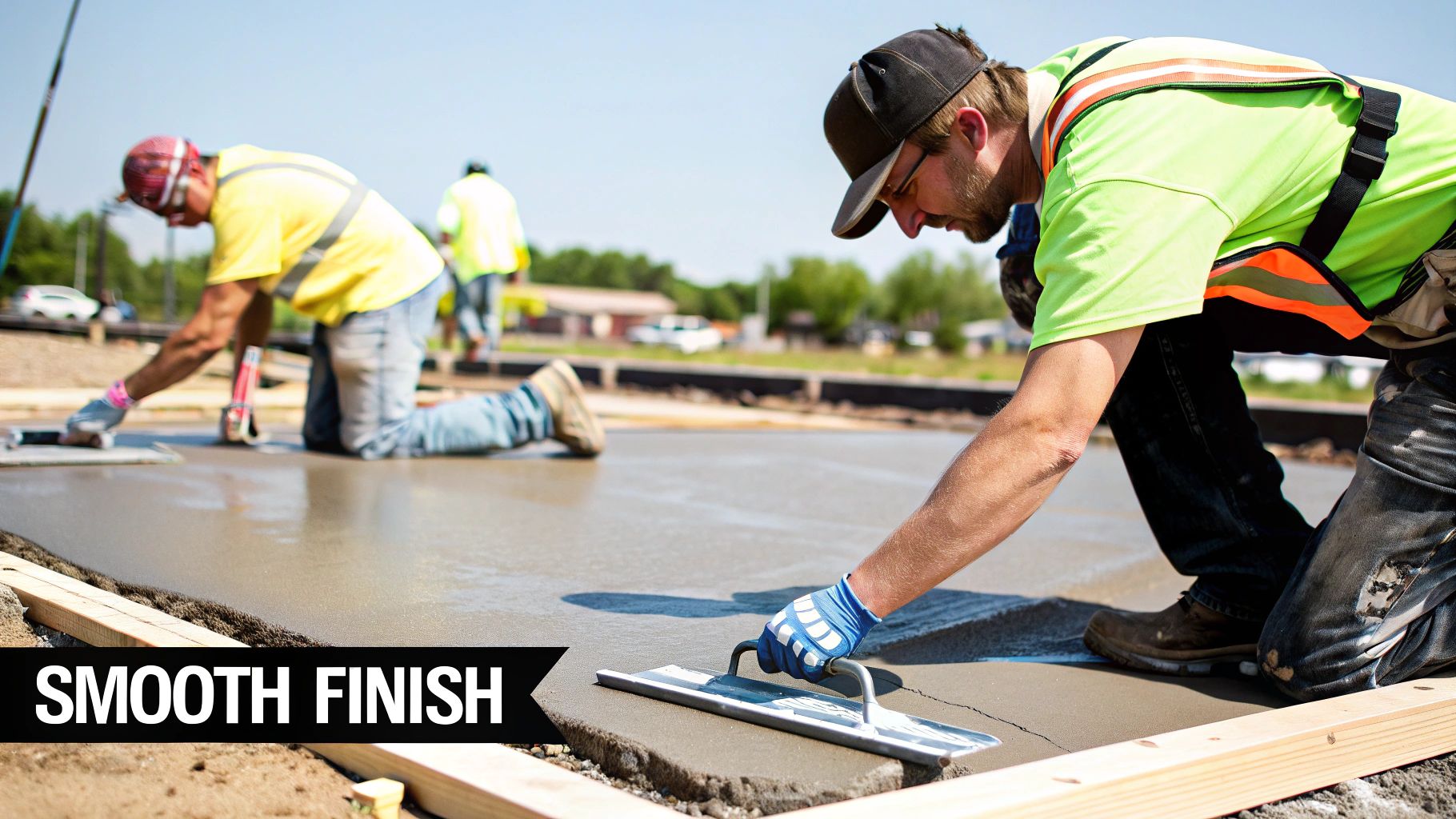
Choosing the right slump is all about balancing flow with strength. Under Atlanta’s sun, you want concrete that reaches every corner but doesn’t sag once in place. In most courts, a 4–5 inch slump hits that sweet spot.
Getting the mix consistent also prevents honeycombing and hidden voids—real troublemakers down the road.
To nail a flat, bounce-friendly slab, follow these on-site moves:
- Use internal or external vibrators at 30-second intervals per panel
- Work in 10×10 foot sections to keep a wet edge
- Verify flatness with a laser level or straightedge before finishing
Techniques For Smooth Finishes
Power floats and hand trowels each have a moment to shine. First up, the magnesium float—it packs aggregate and knocks down high spots. Once the concrete firms, switch to a steel trowel for that glossy, durable sheen.
Timing is everything. Too soon, and you’re pulling paste off the slab; too late, and you’re chasing a stiff surface. Wait until bleed water fully disappears before you start. One contractor in Smyrna credits his zero-crazing record to precise timing and consistent blade angle adjustments.
- Trowel only after bleed water evaporates
- Adjust blade angle gradually for an even sheen
- Lighten up on corners to prevent stress zones
“Proper floating timing can cut surface crazing by up to 40%,” shares a local contractor I trust
Curing Strategies For Hot Summers
Georgia heat can rob moisture in minutes. To slow things down, alternate between misting, membrane compounds, and shade. Aim to keep slab temperatures between 50°F and 90°F so hydration runs its course.
- Mist with water every 4 hours for the first 72 hours
- Apply a curing compound within 2 hours of finishing
- Throw down reflective blankets overnight to reduce thermal stress
At Marietta High School, crews used a combination of water misting and insulated blankets, cutting shrinkage cracks by half during a July pour.
| Method | Timing | Benefit |
|---|---|---|
| Water Misting | Every 4 hrs | Maintains humidity |
| Membrane Compound | 2 hrs post | Seals moisture in slab |
| Insulating Cover | First 3 days | Reduces temp spikes |
Quality curing isn’t optional—it’s what makes a slab last through thousands of games.
Coatings Sealers And Color Additives
After the slab cures for at least 7 days, it’s time for the finishing touches. Acrylic coatings boost UV resistance and traction, while sealers stop oil spots and stains. For a custom vibe, mix in pigments or multi-stage color additives.
- Clean the surface thoroughly before applying any coatings
- Choose 100% acrylic formulas rated for sports courts
- Apply each coat at around 20 mil thickness
At a Buckhead backyard court, the homeowner added a custom maroon and gold pigment, matching their favorite pro team’s colors and improving court visibility in twilight.
For more on protective finishes, see our detailed guide on residential poured concrete.
Key Takeaway: Patience pays. Waiting for the right moment ensures proper adhesion and a finish that stands up to play
Example From Midtown Resurfacing
In Midtown Atlanta, one crew tackled a 5-inch slab at 6 am to dodge the afternoon heat. They logged slab temperatures hourly with an infrared gun—keeping readings under 85°F—and rotated damp burlap covers to cure every section evenly.
- Start pours early to beat the heat
- Keep a daily log of temperature and humidity for quality assurance
Now you’re set for a court that bounces and performs, season after season.
Installing Hoops And Anchoring Hardware
Once your concrete slab for basketball court has cured completely, you’re ready to anchor in the hoop. Getting those embedment sleeves spot on keeps everything rock-solid, even when the game turns intense.
Before you begin, map out FIBA clearance needs and estimate how the system will handle dynamic loads during dunks and drives.
- 15’ behind the baseline and 3’ from each sideline
- Embedment sleeves for fresh pours; surface anchors for retrofit jobs
- Check backboard overhang to maintain safe play space
Positioning Anchors
Mark your anchor points before pouring concrete or setting forms. High-visibility chalk or spray paint helps avoid guesswork once rebar and mesh are in place.
- Measure 4 feet from the baseline to the backboard’s center
- Verify at least 5 feet of sideline clearance
- Drill pilot holes for surface anchors on retrofit installations
“Accurate sleeve placement cut our installation time by 30%,” recalls an Atlanta installer.
Perfect alignment here means less shimming and grout work later. If you’re retrofitting, surface anchors bolt into pre-drilled holes using diamond-tipped bits.
Securing Goal Posts
After sleeves or anchors are set, slide metal shims into the base to eliminate wobble. Then mix non-shrink grout exactly as the manufacturer prescribes—grout pads under the pole help absorb the shock of every dunk.
- Tighten anchor bolts to 80 ft-lbs torque for a firm hold
- Maintain a ¼-inch gap around sleeves when grouting
- Add foam backstop padding for added player safety
In one Decatur installation, the crew used a torque wrench and approved grout, reporting zero lateral movement after a full season of heavy use.
| Anchor Type | Load Capacity | Installation Time |
|---|---|---|
| Embedment Sleeve | 3,000 lb | 1 hour per pole |
| Surface Anchor | 2,500 lb | 2 hours per pole |
Leveling the backboard plate is just as crucial. Use a precision level on the mounting bracket before you torque down the final bolts. And don’t forget annual inspections: remove sleeve covers, clear out debris, and you’ll extend the hardware’s life by years.
A quick pull test on the rim before your first game will catch any loose bolts early.
Final Checks And Tips
After everything’s locked in, simulate a dunk by leaning on the rim. If anything shifts, tighten those bolts right away.
Keep a project notebook with torque specs and shim details—future you will thank present you.
- Inspect anchor bolts monthly, especially after extreme weather
- Replace grout pads that compress more than 10%
- Re-level mounting plates every 6 months
One Alpharetta homeowner adds a small silicone bead around each sleeve cap to keep moisture out and prevent rust.
Key Takeaway: Getting anchors right the first time prevents costly wobble fixes later.
Now your hoops rest on a rock-solid foundation, ready for decades of slam dunks.
Navigating Permits Contractor Selection And Cost Estimates
Getting the green light on local approvals sets the pace for your concrete slab for basketball court project. In Atlanta, you’ll juggle zoning sign-offs, engineered submissions, and a series of inspections before the first shovel hits the ground.
Permit Requirements In Atlanta
Atlanta’s permitting process starts with a detailed site plan and fee payment. Once the zoning board signs off, inspections will focus on subgrade compaction and steel placement.
- Zoning Approval: Requires a property survey, site map, and drainage plan.
- Structural Permit: Engineered drawings showing slab thickness and reinforcement layout.
- Final Inspection: Verifies flatness tolerances, control joints, and bond between slab and forms.
In Buckhead, one homeowner bundled his court permit with a pool permit, saving nearly four weeks on review time.
Choosing Your Contractor
A skilled crew keeps work moving and avoids costly delays. Before any agreement, verify that your team holds a valid license, liability insurance, and bond coverage.
“We vetted three local firms and saved 15% on labor by comparing mobilization fees,” recalls a contractor who’s built five courts around Marietta.
Evaluating Contractor Bids
Lay contractor bids side by side to spot hidden fees in materials or site mobilization. Whenever possible, coordinate pours with nearby jobs to secure bulk discounts.
- Labor can eat up 40% of total court costs—always ask for an itemized hourly rate.
- Materials include cement, rebar, mesh, sealers, and forms; confirm brand names in writing.
- Mobilization Fees vary widely; bundling back-to-back projects often trims those charges.
In Smyrna, two neighbors combined sites and slashed mobilization fees by $1,200 on their joint court project.
Cost Breakdown For Court Construction
Before you lock in numbers, take a look at this typical expense distribution for an Atlanta court slab.
| Expense Category | Percentage of Total Cost | Approximate Cost |
|---|---|---|
| Materials | 35% | $8,500 |
| Labor | 40% | $9,600 |
| Permits | 5% | $1,200 |
| Equipment | 10% | $2,400 |
| Contingency | 10% | $2,400 |
This table gives you a clear budget framework and helps shrink surprise expenses.
Visit the Atlanta Concrete Solutions Services page for full details on permit handling and cost planning.
Saving On Your Project
Coordinating your slab pour with adjacent jobs can lower mobilization costs by around 20%. One homeowner in Buckhead teamed up with a local school board and saved $1,500 on pump truck fees.
- Align schedules with nearby contractors.
- Ask about back-to-back discounts.
- Share equipment to reduce rental days.
By filing a joint permit application, they also cut architectural review fees by 30%, saving $360. Shared trenching for utilities chipped off another $800 from mobilization.
Always stash 10% of your budget for surprises like soil stabilization. Review material quotes twice to catch cement or rebar price hikes.
- Lock in rates with a signed proposal to avoid mid-project markups.
- Consider off-season pours to take advantage of lower labor rates.
- Treat drainage devices or French drains as separate line items.
“Securing permits early and grouping slab pours can shave weeks off your timeline,” notes an Atlanta contractor.
Next Steps
Kick off permits at least 4 weeks before your desired pour date. Keep records of every inspection by snapping photos and logging approvals. For example, one DeKalb County homeowner used a shared Trello board to track inspection photos and comments.
- Use project management tools like Trello or Asana to assign tasks.
- Schedule a pre-pour meeting with both your crew and the inspector.
Once permits are in hand, confirm your concrete delivery and mix design. Double-check slump value, admixture types, and mesh placement.
- Mark control joint locations on the forms.
- Ensure wire mesh sits at least 2 inches above the base using chairs.
With a meticulous permit process and a vetted contractor team, your slab will go in on schedule. Track due dates, compare at least three bids, and factor inspections—often spaced 1–2 days apart—into your timeline.
Let this guide be your roadmap to a hassle-free build. Ready? Break ground with confidence today.
Frequently Asked Questions
When you’re weighing the idea of a concrete slab for your basketball court, it’s natural to wonder about thickness, upkeep, and finding the right contractor. This FAQ section cuts through the noise to give you clear, practical answers so you can move ahead with confidence.
- Slab Thickness Options And Why Reinforcement Matters
- Acrylic Coating Reapplication Timelines
- Crack Repair Techniques To Keep Your Surface Game-Ready
- Contractor Credentials To Verify Before Hiring
Slab Thickness Guidance
What’s the ideal slab thickness for a backyard or community court? Most installations do well with a 4–6 inch reinforced concrete slab. If you anticipate heavier use—think leagues, frequent tournaments or heavy hoop systems—going with 6 inches helps limit deflection and long-term sag.
In a north Atlanta neighborhood park, they poured a 6-inch slab back in 2020. Three years later, regular players still rave about the consistent bounce.
“Choosing a thicker slab saved us on long-term repairs,” recalls a Marietta facilities manager.
Surface Maintenance Schedule
How often should you refresh that acrylic coating? Plan for a new coat every 2–3 years, adjusting for strong sun exposure and how much foot traffic you get. A quick annual inspection for peeling or dull spots lets you catch wear long before it becomes a problem.
When you spot hairline cracks, a fast fix keeps the court sealed and safe:
- Scrub the crack with a wire brush and clear away all dust.
- Inject a polymer-modified cement filler to allow for slight movement.
- Roll on a matching acrylic sealer to restore the surface’s uniform look.
Key Tip: Early crack repairs extend slab life and preserve bounce consistency.
Contractor Credentials To Check
Which credentials should you ask about before signing on the dotted line? At minimum, verify they have:
- An active Georgia general contractor license
- Liability insurance covering at least $1 million
- A portfolio showing three or more completed basketball court slabs
- References or recent inspection reports from similar Atlanta-area projects
Always insist on a line-item contract detailing labor, materials and mobilization fees to keep hidden costs at bay.
Before you commit, request a tour of one of their finished courts in the Atlanta area.
Ready to start building? Get expert guidance from Atlanta Concrete Solutions and ensure your court stands the test of time.