
Choosing a foundation is the most critical decision in any construction project, directly impacting your property's stability, long-term performance, and overall value. For homeowners and developers in the Atlanta area, where variable soil conditions and significant annual rainfall present unique challenges, the concrete slab foundation is a prevalent yet frequently debated choice. This guide is designed to cut through the noise and provide a clear, comprehensive analysis of concrete slab foundation pros and cons.
We will move beyond generic lists to offer specific, actionable insights tailored to the local environment. You will learn not just the "what" but the "why" behind each point, supported by real-world examples relevant to Georgia's clay soil and humid climate. For example, we'll explore why the upfront cost savings make slabs popular for new subdivisions in Gwinnett County, but also why the same clay soil can lead to cracking issues that require expensive repairs down the line.
This article breaks down the eight most important factors to consider, including:
- Initial installation costs versus long-term maintenance.
- Structural performance in Atlanta's specific soil types.
- Energy efficiency and moisture control.
- Accessibility for utility lines and future renovations.
By the end of this roundup, you will have a practical framework for determining if a slab-on-grade foundation is the right structural base for your new home, addition, or commercial building, or if an alternative like a crawl space or basement better suits your project's needs and budget.
1. Pro: Cost-Effectiveness and Lower Installation Expenses
One of the most significant advantages drawing builders and homeowners to a slab foundation is its remarkable cost-effectiveness. When analyzing the pros and cons of a concrete slab foundation, the upfront savings are often the deciding factor. For instance, a typical 2,000-square-foot slab foundation might cost between $10,000 and $20,000, whereas a full basement for the same footprint could easily exceed $50,000.
The savings stem directly from the simplicity of the installation process. A slab foundation requires less excavation, fewer materials, and a more streamlined labor process. Unlike a basement, which needs deep, extensive digging and the construction of walls and a floor, a slab is a monolithic pour of concrete directly onto a prepared grade. This streamlined approach significantly reduces both the time and manpower needed for the job, translating directly into lower project costs.
How the Savings Break Down
The cost efficiency of a concrete slab foundation is rooted in several key areas:
- Reduced Labor: The process is faster and requires fewer specialized skills than building basement walls or a crawl space structure. A slab can often be prepped and poured in a week, while a basement can take 4-6 weeks, significantly cutting down on billable hours from your construction crew.
- Fewer Materials: You are essentially paying for the concrete, rebar, and vapor barrier. A crawl space requires additional materials like floor joists, subflooring, and insulation, while a basement needs concrete for walls and extensive waterproofing systems. This can represent a material savings of over 50%.
- Less Equipment: While site preparation is still crucial, the excavation for a slab is minimal compared to digging out a full basement, which requires heavy machinery like large excavators for a longer duration.
This financial benefit makes slab foundations a popular choice in regions with suitable soil and climate, like many parts of the Atlanta metro area. For example, they are commonly used for new residential developments in suburbs like Marietta and Lawrenceville, where builders aim to offer competitive pricing.
Actionable Tip: To maximize your savings, get at least three detailed quotes from reputable contractors like Atlanta Concrete Solutions. Also, inquire about bundling foundation work with other concrete services like pouring a driveway or patio. Contractors often provide better pricing for larger, multi-part projects.
2. Con: Vulnerability to Cracking and Settling Issues
While simple in design, one of the most significant cons of a concrete slab foundation is its susceptibility to movement. These foundations are poured directly onto the ground, making them highly sensitive to changes in the underlying soil. Issues like settling, heaving, and cracking are common concerns, particularly in regions with problematic soil conditions. A hairline crack might be cosmetic, but a structural crack wider than a quarter-inch can indicate a serious problem costing thousands of dollars to repair.
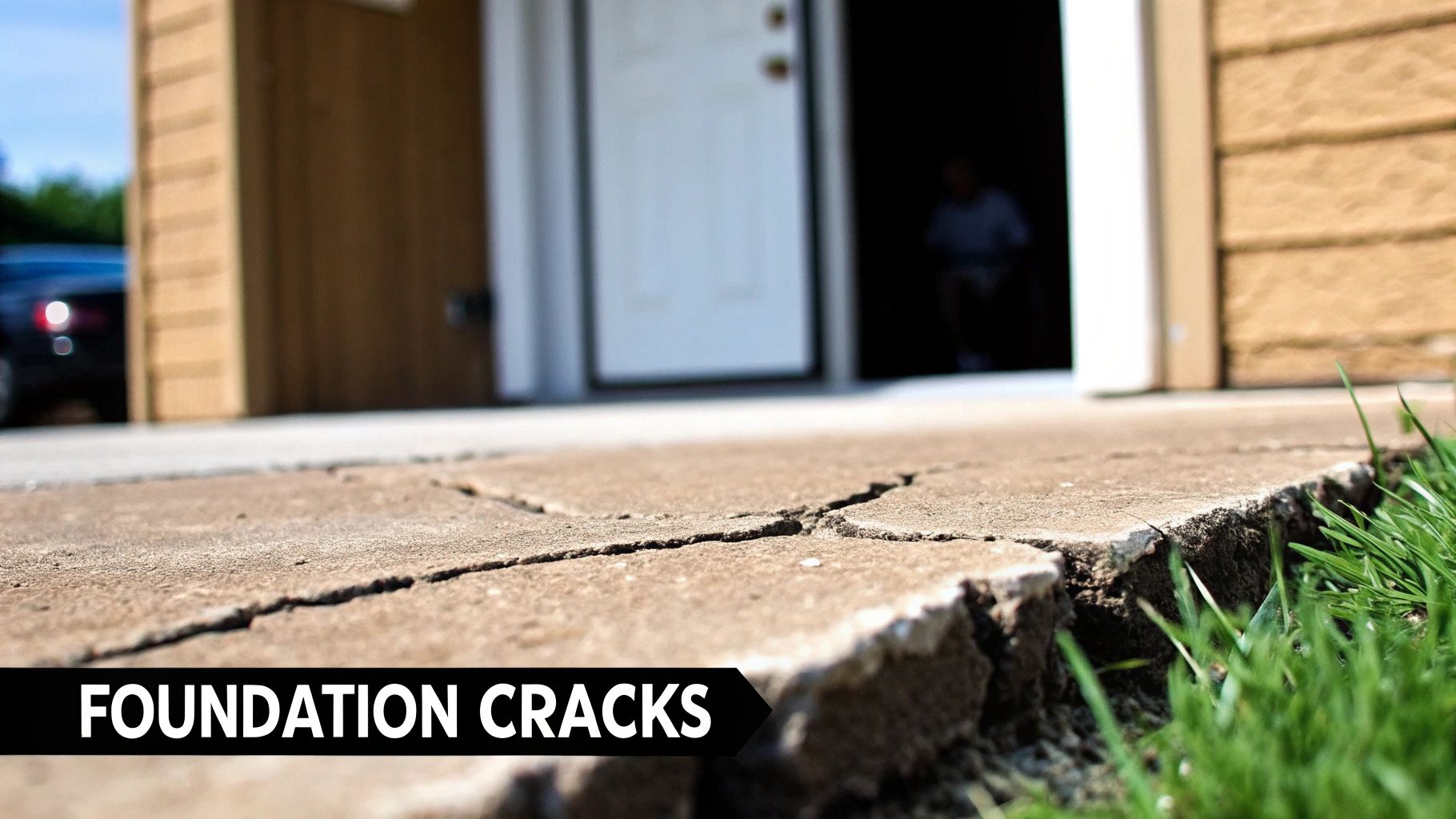
This vulnerability is a critical point to consider when evaluating the pros and cons of a concrete slab foundation. Unlike basements or crawl spaces with deeper footings, a slab's stability is almost entirely dependent on the top layer of soil. If that soil expands, contracts, or erodes, the rigid concrete slab above has no choice but to move with it, often resulting in damaging cracks that can telegraph through the home's flooring and even cause doors to stick.
Why Slabs Are Prone to Movement
The potential for foundation failure is often linked to the ground beneath it. Several factors can compromise the integrity of a slab foundation:
- Expansive Soils: The "Georgia Red Clay" common in the Atlanta area is known to expand significantly when wet and shrink dramatically when dry. This constant movement exerts immense pressure on a slab, leading to heaving and cracking. For example, a severe drought followed by heavy rains can cause soil volume to change by as much as 10%, easily cracking a poorly reinforced slab.
- Poor Drainage: If water is allowed to pool around or under the foundation, it can saturate the soil, causing it to lose its supportive strength. A common example is a downspout discharging water directly at the corner of a slab, which can lead to localized sinking or settling.
- Temperature Cycles: In regions with freeze-thaw cycles, moisture in the soil can freeze, expand, and push the slab upward (a phenomenon known as "frost heave"). When it thaws, the soil contracts, leaving a void that can cause the slab to crack as it settles.
Repairing these issues often involves complex and invasive procedures like slabjacking (mudjacking) or piering, which can be disruptive and costly. Early prevention through proper site preparation is the most effective strategy.
Actionable Tip: Before committing to a slab foundation, invest in a professional soil test and a geotechnical report. This analysis will identify the soil composition (like expansive clay) and recommend specific site preparation techniques, such as soil stabilization or using engineered fill, to create a stable base and mitigate the risk of future movement.
3. Pro: Space Efficiency and Usable Floor Area
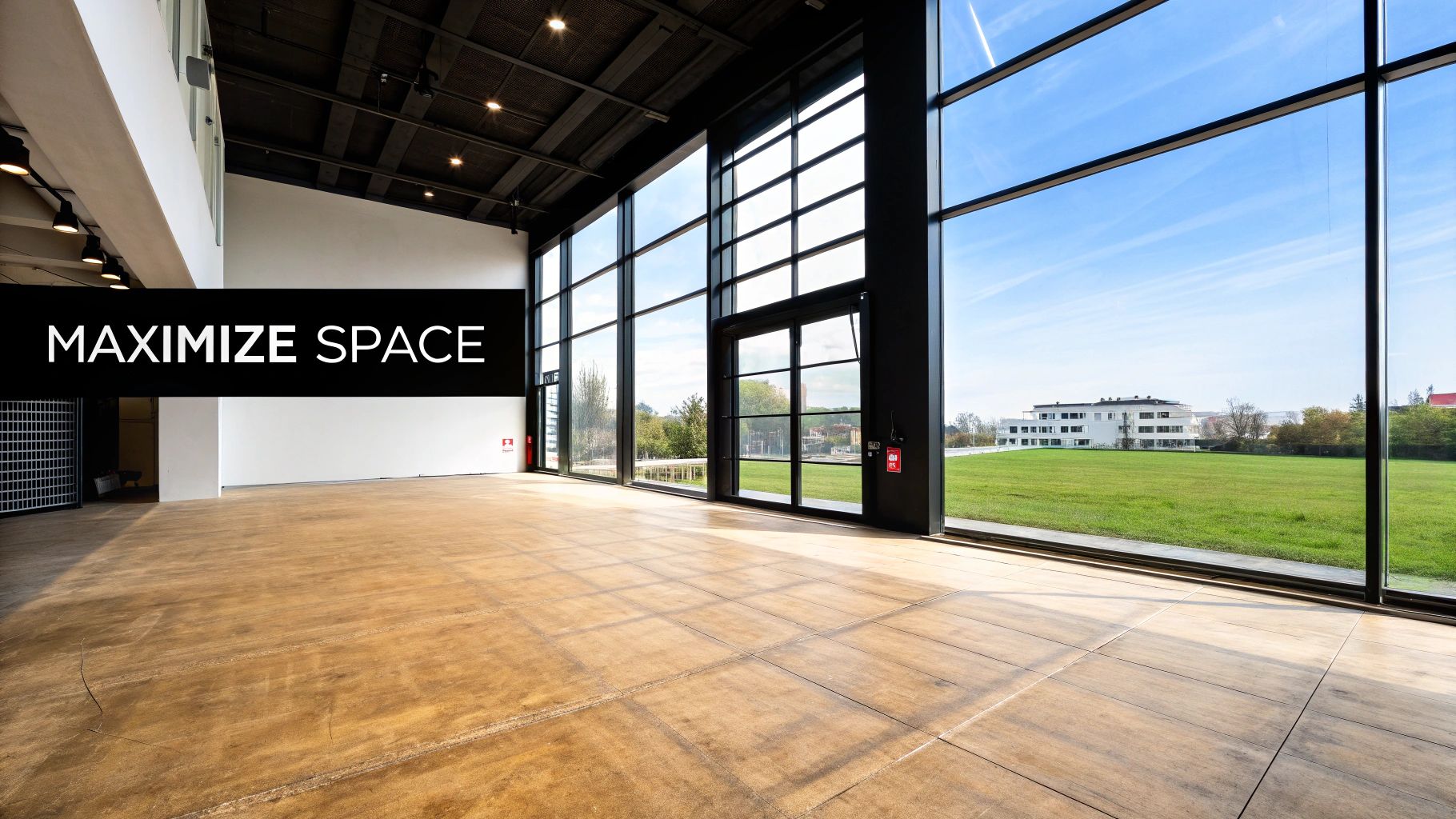
Another compelling benefit when examining the pros and cons of a concrete slab foundation is its exceptional space efficiency. By design, this foundation type eliminates the need for any transitional structures like a basement or crawl space, allowing builders to maximize the usable living or commercial area directly at ground level. The slab itself serves as the subfloor, providing immediate functionality without the need for additional structural layers like joists and subflooring.
This integrated design is particularly advantageous for modern open-concept residential layouts and commercial buildings where every square foot counts. For a 2,000-square-foot home, a slab foundation provides exactly 2,000 square feet of usable ground-floor space, whereas a home with a basement stairwell might lose 30-40 square feet of that main level. This makes it a go-to choice for developers and property owners focused on maximizing return on investment.
How Space Efficiency Translates to Value
The direct conversion of the foundation footprint into usable floor space offers several practical advantages in various construction scenarios:
- Commercial Applications: For retail shopping centers, office parks, and warehouse facilities, maximizing leasable square footage is a primary financial goal. A slab foundation is the most direct way to achieve this, avoiding the cost and complexity of subterranean levels.
- Modern Residential Design: Slab foundations are ideal for popular single-story homes, especially in Sun Belt regions like Georgia. They support sprawling, open-concept floor plans without the structural interruptions that can come with crawl space access points or basement stairwells.
- Accessibility and Safety: A ground-level slab provides a solid, stable surface that is inherently more accessible. This design simplifies compliance with ADA (Americans with Disabilities Act) standards by allowing for stepless entry points, a significant benefit for both public buildings and residential "aging-in-place" designs. For instance, creating a zero-threshold shower is much simpler on a concrete slab.
This focus on maximizing usable area makes the concrete slab a strategic choice for projects where budget, layout, and functionality are tightly interwoven.
Actionable Tip: Before the concrete pour, carefully map out all utility runs, including plumbing, electrical conduits, and HVAC lines. Consider embedding extra "chase" conduits in strategic locations. These empty pipes will provide a pathway for running future wiring or plumbing without needing to cut into the finished slab, offering crucial flexibility for future renovations or technology upgrades.
4. Con: Drainage and Moisture Infiltration Problems
A significant drawback when evaluating the pros and cons of a concrete slab foundation is its vulnerability to moisture. Because the slab sits directly on or very close to the ground, it has minimal separation from soil moisture. This direct contact creates a pathway for water to penetrate the concrete through capillary action, leading to a host of problems that can compromise the building's integrity and the health of its occupants.
Without a meticulously planned and executed drainage and moisture-proofing strategy, water intrusion is a persistent risk. This is especially true in regions with heavy rainfall like Atlanta, which averages nearly 50 inches of rain per year. The consequences range from musty odors and damaged flooring to serious mold growth and structural decay, making moisture management a critical consideration for this foundation type.
How Moisture Causes Damage
The risk of water infiltration in a slab foundation is multifaceted and can lead to costly repairs if not addressed proactively during construction:
- Capillary Action: Concrete is a porous material. It can wick moisture directly from the damp ground underneath, transmitting it into the interior. An example is seeing dark, damp spots on a garage floor after a rainstorm.
- Poor Site Drainage: If the surrounding landscape is not properly graded, rainwater will pool against the foundation and seep underneath. A classic example is flower beds built up against the house, which can trap moisture and channel it under the slab.
- Plumbing Leaks: Since plumbing lines are often embedded within or beneath the slab, a leak can go undetected for a long time, silently saturating the concrete and soil from below. This can manifest as an unexplained warm spot on the floor or a sudden spike in the water bill.
- Lack of Vapor Barrier: An improperly installed or nonexistent vapor barrier under the slab allows ground moisture to evaporate directly into the building, raising indoor humidity and promoting mold.
Effective drainage is a non-negotiable part of any successful residential foundation concrete project.
Actionable Tip: Insist that your contractor install a high-quality vapor barrier (at least 6-mil polyethylene) and ensure the ground is graded with a minimum 1% slope away from the foundation (about one inch of drop for every eight feet). For properties in areas with a high water table, installing a perimeter French drain system before the slab is poured is a crucial preventative measure.
5. Con: Limited Accessibility for Repairs and Maintenance
One of the most critical drawbacks to consider when evaluating the pros and cons of a concrete slab foundation is the severe lack of access to utilities. Unlike basements or crawl spaces that offer open areas to reach plumbing and electrical lines, a slab encases these vital systems directly within or beneath the concrete. This design creates a significant long-term maintenance challenge, turning what might be a simple repair into a major, destructive project.
If a water pipe leaks, a drain line clogs, or an electrical conduit needs replacing, technicians cannot simply walk under the house to fix it. Instead, they must use specialized equipment to locate the exact point of failure and then break through the finished flooring and the concrete slab itself. This process is not only invasive and disruptive but also significantly more expensive due to the intensive labor and subsequent repair work required.
How This Limitation Creates Challenges
The long-term implications of this inaccessibility are a primary concern for property owners and can lead to costly and stressful situations:
- Destructive Repairs: Any issue with under-slab plumbing requires jackhammering through the foundation. For example, fixing a leaky copper pipe under a tiled kitchen floor means demolishing the tile, breaking up the concrete, making the repair, pouring new concrete, and then attempting to match the original tile.
- Increased Costs: The labor and equipment needed for slab penetration are expensive. What could be a $300 pipe repair in a crawl space can easily become a $3,000-$5,000 project for a slab foundation, including the cost of restoring the floor. This is why our experts in concrete and masonry repair always advise meticulous planning.
- Difficult Upgrades: Modernizing or rerouting utilities is a logistical nightmare. For instance, adding a new bathroom or moving a kitchen sink becomes a far more complex and costly renovation project when the slab must be opened to run new drain lines.
This accessibility issue is a crucial factor, particularly for homeowners who plan to live in their property for many years or commercial building owners who anticipate future layout changes.
Actionable Tip: During construction, insist that your contractor creates a detailed "as-built" map showing the exact location of all pipes and conduits. Additionally, have them install extra, empty conduits in strategic locations to make it easier to run new wiring or data cables in the future without breaking the slab.
6. Pro: Enhanced Energy Efficiency and Thermal Performance
An often-overlooked advantage when weighing the pros and cons of a concrete slab foundation is its inherent thermal performance. Concrete acts as an excellent thermal mass, meaning it absorbs, stores, and slowly releases heat. This natural characteristic helps to regulate a building's indoor temperature, mitigating extreme fluctuations and contributing to lower energy consumption over the long term.
The direct contact with the ground, which maintains a more stable temperature (around 55-60°F in the Atlanta area) year-round than the air, further enhances this effect. Unlike a vented crawl space, which can allow cold winter air to circulate beneath the floor, a slab foundation minimizes heat loss through the bottom of the structure. This thermal stability can reduce the load on your HVAC system, leading to tangible savings on heating and cooling bills.
How Thermal Performance Translates to Savings
The energy efficiency of a concrete slab foundation is rooted in its physical properties and modern construction methods:
- Thermal Mass: The dense concrete slab absorbs heat during a sunny winter day and radiates it back into the living space at night. This passive solar design principle can reduce heating costs by keeping the home warmer naturally.
- Reduced Air Leakage: As a solid, continuous barrier, a slab foundation has far fewer joints and cracks than a crawl space or basement foundation, drastically reducing air infiltration that can lead to energy loss.
- Insulation Integration: Modern construction practices involve installing rigid foam insulation beneath and around the perimeter of the slab. This creates a thermal break from the ground, further enhancing its efficiency and making it a key component in energy-conscious designs like LEED-certified buildings and Passivhaus projects.
This energy performance makes slab foundations an excellent choice for modern residential projects in temperate climates like Atlanta, where both heating and cooling are required throughout the year.
Actionable Tip: To maximize energy efficiency, insist on proper sub-slab insulation during construction. Ask your contractor, like Atlanta Concrete Solutions, about installing at least two inches of high-density rigid foam insulation, such as expanded polystyrene (EPS), beneath the entire slab and especially around the perimeter to prevent thermal bridging. This is also the ideal time to consider installing a radiant floor heating system directly within the slab for ultimate comfort and efficiency.
7. Pro: Rapid Construction and Reduced Project Timeline
In the world of construction, time is money. A significant advantage that places concrete slab foundations ahead of their alternatives is the speed of installation. When evaluating the pros and cons of a concrete slab foundation, the accelerated construction schedule is a powerful benefit. This foundation type can often be prepared and poured in a fraction of the time required for more complex systems.
The streamlined installation process is the key to this speed. Unlike a basement, which involves deep excavation, forming walls, waterproofing, and backfilling, a slab foundation is a more direct procedure. It consists of site preparation, grading, laying a vapor barrier and reinforcement, and then pouring the concrete. This simplicity means construction can move from the foundation stage to framing much faster, often in just one to two weeks, compared to the four to eight weeks typical for a basement or crawl space.
How the Timeline Accelerates
The time savings associated with a concrete slab foundation are a result of its efficient, multi-stage process that can be completed quickly:
- Faster Site Prep: The excavation is minimal, focusing on leveling the grade rather than digging a deep pit. For a typical residential lot, this can be completed in one or two days, versus a week or more for a basement.
- Simplified Formwork: Forms are only set around the perimeter of the slab, a much quicker task than building the extensive formwork required for basement walls.
- Single-Stage Pour: For a monolithic slab, the footing and floor are poured in a single, continuous operation, condensing multiple steps into one. This efficiency is a hallmark of modern residential poured concrete techniques.
- Quicker Curing for Framing: While concrete takes about 28 days to reach full strength, framing can typically begin much sooner, often within 7 days. This overlap allows the project to maintain forward momentum.
This rapid turnaround makes slab foundations an ideal choice for large-scale residential developments in areas like the Atlanta suburbs, where builders aim to complete homes quickly. For a 100-home subdivision, this time saving can translate into millions of dollars in reduced carrying costs for the developer.
Actionable Tip: Coordinate logistics meticulously to maximize speed. Schedule your concrete delivery for early in the morning on a clear day to allow maximum time for finishing. Ensure your framing crew is scheduled and ready to begin work as soon as the concrete has reached sufficient initial strength, typically after about a week, to avoid any downtime in the project schedule.
8. Versatility in Climate Adaptability and Geographic Application
One of the key reasons for the global popularity of concrete slab foundations is their remarkable versatility across different climates and geographic regions. When evaluating the pros and cons of a concrete slab foundation, this adaptability is a significant factor. While they are a natural fit for certain environments, modern engineering techniques allow them to be successfully used almost anywhere, provided the design accounts for local conditions.
This versatility stems from the fundamental simplicity of the slab, which can be modified to counteract specific environmental challenges. In warm, dry climates with stable soil, a standard monolithic slab performs exceptionally well. However, in regions with frost heave risks or problematic soils, the design can be reinforced with deeper footings, insulation, and improved drainage to ensure long-term stability and performance.
How Climate and Geography Impact Design
The success of a slab foundation is directly tied to how well its design addresses local environmental factors. A one-size-fits-all approach is not effective; customization is key.
- Warm Climates (Southern USA): In areas like Atlanta, Florida, and Texas, where the ground rarely freezes, standard slab-on-grade foundations are the most common and cost-effective choice. The primary concerns are managing moisture and ensuring proper soil compaction to handle the local clay.
- Cold Climates (Northern USA/Canada): To prevent frost heave (where freezing soil expands and lifts the foundation), slabs must be designed as Frost-Protected Shallow Foundations (FPSF). This involves adding rigid insulation around the perimeter and sometimes underneath to keep the ground below from freezing.
- Expansive Soils (Texas, Colorado): In regions with highly reactive clay soils, slabs require significant reinforcement. Post-tensioned slabs, which contain steel cables that are tightened after the concrete cures, are often necessary to create a rigid "mat" that resists cracking and structural damage.
- Seismic Zones (California): In earthquake-prone areas, slabs must be engineered with enhanced steel reinforcement (rebar) and grade beams to resist lateral forces and maintain structural integrity during a seismic event.
This geographic adaptability ensures that the benefits of a slab foundation, such as cost-effectiveness and quick installation, can be realized in a wide range of construction projects worldwide.
Actionable Tip: Before finalizing your foundation plan, invest in a geotechnical soil report for your specific property. This analysis provides crucial data on soil type, moisture content, and load-bearing capacity, allowing engineers at a firm like Atlanta Concrete Solutions to design a slab foundation that is perfectly suited to your site's unique conditions.
8-Point Concrete Slab Foundation Pros & Cons
| Item | 🔄 Implementation complexity | ⚡ Resource requirements | ⭐ Expected outcomes | 📊 Ideal use cases | 💡 Key advantages |
|---|---|---|---|---|---|
| Cost-Effectiveness and Lower Installation Expenses | 🔄 Low — single pour, minimal excavation | ⚡ Low materials & labor; economical equipment needs | ⭐ High cost savings (lower initial construction costs) | 📊 Budget-conscious residential, retail, warehouses, warm climates | 💡 Get multiple quotes; bundle site prep; optimize layout |
| Vulnerability to Cracking and Settling Issues | 🔄 Medium–High — needs soil mitigation and monitoring | ⚡ Potentially high if soil treatment or repairs required | ⭐ Variable — good short term, high long‑term risk if unmitigated | 📊 Avoid expansive-clay or freeze‑thaw regions unless engineered | 💡 Conduct soil tests; install drainage and moisture control |
| Space Efficiency and Usable Floor Area | 🔄 Low — eliminates below‑grade structures | ⚡ Low–Medium — minimal extra materials but requires utility planning | ⭐ High — maximizes usable ground‑level floor area | 📊 Open‑plan homes, commercial retail, offices, warehouses | 💡 Plan utilities pre‑pour; install conduits for future needs |
| Drainage and Moisture Infiltration Problems | 🔄 Medium — requires waterproofing and drainage design | ⚡ Medium–High — vapor barriers, drains, sump pumps may be needed | ⭐ Poor if unmanaged; can cause mold and structural damage | 📊 Not recommended in high water‑table or poorly drained sites unless mitigated | 💡 Use perimeter drains, under‑slab vapor barrier, proper grading |
| Limited Accessibility for Repairs and Maintenance | 🔄 Medium — utilities embedded, access planning required | ⚡ Low initial resources but high future repair costs (demolition) | ⭐ Low maintainability; repairs are disruptive and expensive | 📊 Best for low‑change utility plans; avoid when frequent access expected | 💡 Document utility maps; add access boxes and oversized conduits |
| Energy Efficiency and Thermal Performance | 🔄 Medium — requires insulation and thermal design | ⚡ Medium — insulation, perimeter/floor treatments, possible radiant systems | ⭐ High when insulated — improved thermal stability and HVAC savings | 📊 Temperate/cold climates, Passivhaus/LEED, radiant‑heated floors | 💡 Install rigid foam under/perimeter; integrate radiant heating |
| Rapid Construction and Reduced Project Timeline | 🔄 Low — straightforward site prep and pour | ⚡ Low — fewer trades, speedy execution (1–2 weeks) | ⭐ High — significantly reduces project duration and financing costs | 📊 Mass‑produced housing, prefab systems, fast commercial projects | 💡 Schedule during optimal weather; pre‑arrange concrete delivery |
| Versatility in Climate Adaptability and Geographic Application | 🔄 Medium — needs regional engineering adjustments | ⚡ Variable — may require frost protection or enhanced drainage | ⭐ Good when engineered for local conditions; performance varies by region | 📊 Ideal in warm/dry climates; adaptable elsewhere with modifications | 💡 Perform geotechnical testing; follow local codes and FPSF designs |
Your Next Steps: Building a Foundation with Confidence in Atlanta
We’ve navigated the complex landscape of concrete slab foundation pros and cons, breaking down the critical factors that influence this fundamental decision. From the undeniable appeal of lower initial costs and rapid construction timelines to the serious considerations of soil stability and long-term repair accessibility, the choice is far from simple. It’s clear that a slab-on-grade foundation is not a one-size-fits-all solution; its success is deeply intertwined with the specific conditions of your build site, particularly here in the Atlanta metro area.
The journey through this guide has equipped you with the knowledge to ask the right questions and evaluate your options with a critical eye. You now understand that while a slab foundation can offer excellent thermal mass for energy efficiency, its performance is directly tied to proper site preparation and moisture management. Without these, the risk of water infiltration and costly foundation damage increases significantly. Similarly, the benefit of maximizing usable floor space is tempered by the challenge of accessing under-slab plumbing and electrical systems for future repairs.
Synthesizing the Pros and Cons for Your Atlanta Property
Making the final call requires synthesizing these competing factors and applying them to your unique situation. Let's distill the core takeaways to guide your decision-making process:
- Cost vs. Long-Term Value: The upfront savings of a slab foundation are compelling. However, you must weigh this against the potential future costs of addressing cracks caused by Atlanta's expansive clay soil or the complex process of repairing a burst pipe beneath the concrete. An investment in a geotechnical survey and superior site prep can mitigate these risks, ensuring the initial savings don't lead to expensive headaches later.
- Speed vs. Accessibility: The efficiency of a slab pour can accelerate your construction schedule, which is a major advantage for builders and homeowners eager to complete their projects. The trade-off is the near-permanent enclosure of your home's vital systems. If you anticipate needing to upgrade or frequently service your plumbing, the limited access of a slab foundation might be a significant drawback compared to a crawlspace.
- Climate and Soil are Paramount: Perhaps the most critical takeaway is that local conditions dictate everything. In areas like Roswell or Alpharetta, where soil composition can vary from one lot to the next, what works for your neighbor might not work for you. The high moisture content and shrink-swell potential of Georgia clay demand a foundation designed with these challenges in mind, incorporating robust vapor barriers and appropriate reinforcement.
Key Insight: The debate over concrete slab foundation pros and cons isn't about finding a universally "best" option. It's about identifying the right option for your specific plot of land, budget, and long-term goals. A professional site assessment is the only way to bridge the gap between theoretical advantages and real-world performance.
Ultimately, building a foundation with confidence means moving beyond the general list of pros and cons and into a phase of specific, expert-led analysis. It requires a partner who understands the nuances of local geology and construction best practices. Your foundation is the single most important structural element of your property; investing the time and resources to get it right from the beginning will protect your investment and provide peace of mind for decades to come.
Ready to turn these insights into action? The team at Atlanta Concrete Solutions specializes in designing and installing concrete foundations engineered to thrive in Georgia’s unique soil conditions. We provide the expert analysis needed to confidently weigh the concrete slab foundation pros and cons for your specific project, ensuring your new construction is built on a solid, reliable, and durable base.
Get Your Free, No-Obligation Foundation Quote from Atlanta Concrete Solutions Today!