
Think of a concrete waterproof sealer as an invisible shield for your driveway, patio, or foundation. It’s a specialized liquid that you apply to the surface, and its main job is to stop water from soaking in and causing all sorts of expensive problems, like cracking, spalling, and mildew growth.
In short, it’s one of the best ways to protect your concrete and keep it looking great for years. For instance, a properly sealed driveway can resist oil stains and prevent the ugly flaking caused by winter freezes, saving you from costly repairs down the road.
Why Your Concrete Needs Protection from Atlanta's Weather
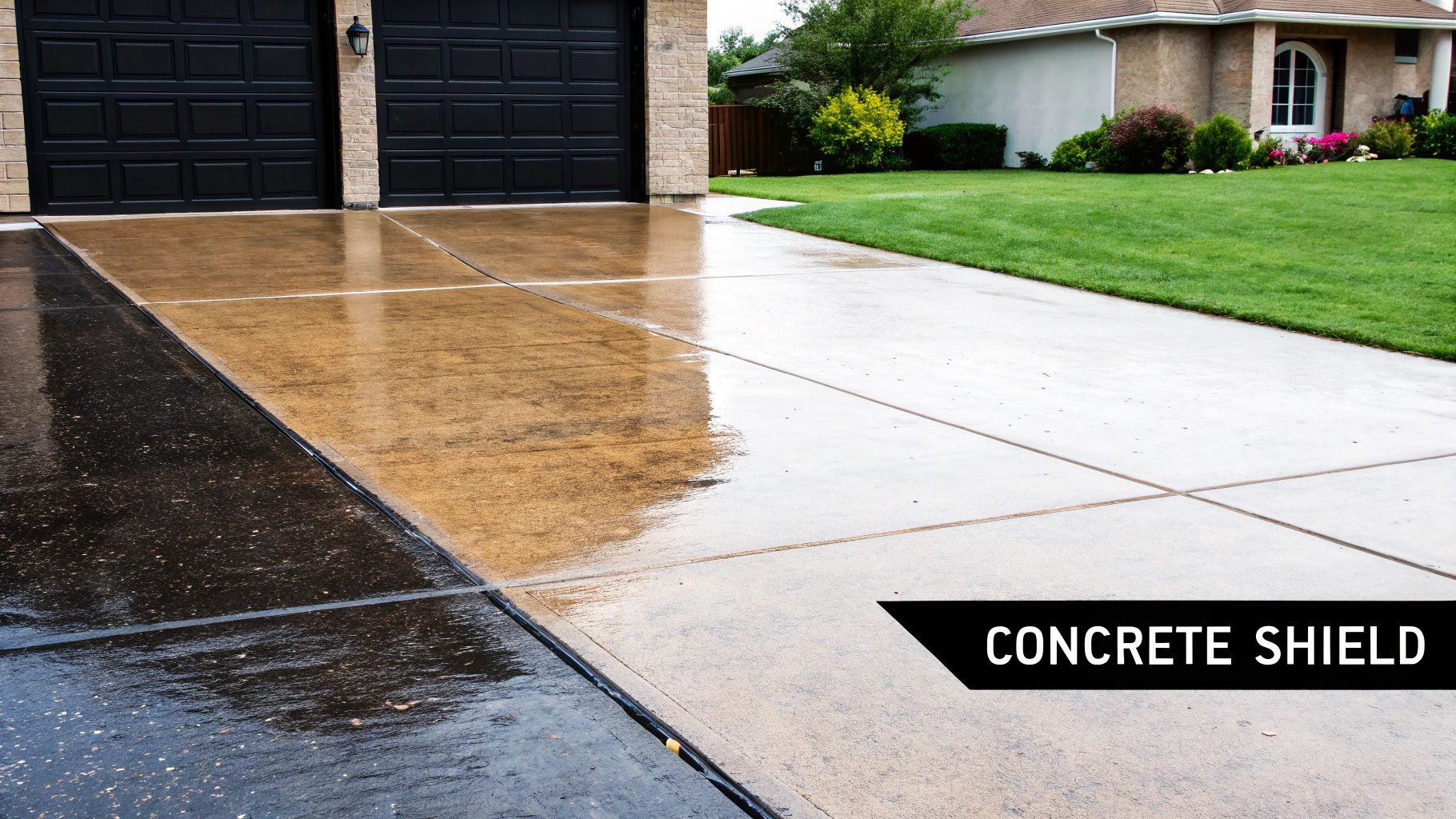
We love living in Atlanta, but let's be honest—the weather can be brutal on our homes. With nearly 50 inches of rain a year and that famous Georgia humidity, our concrete surfaces are constantly under assault from moisture.
The real issue is that concrete is porous. It’s full of tiny, microscopic holes that act like a sponge. When it rains, that water doesn't just sit on top; it gets absorbed deep inside. For example, an unsealed concrete slab can absorb over a gallon of water per 100 square feet during a heavy downpour. That’s where the trouble really begins.
What Happens to Unsealed Concrete?
When water seeps into your concrete, a whole chain reaction of damage can kick off. In the winter, any water trapped inside can freeze. As water freezes, it expands by about 9%, creating powerful pressure that can crack the concrete from the inside out. This freeze-thaw cycle is the number one cause of spalling (when the surface flakes off) and ugly cracks.
It’s not just the cold, either. All that dampness creates the perfect breeding ground for mold and mildew, which is why you see those stubborn green and black stains on so many sidewalks and driveways. These aren't just cosmetic issues; they're signs of a bigger problem. For example, black mold can become a slip hazard and can even degrade the concrete surface over time.
You can think of a concrete waterproof sealer like a high-quality raincoat for your property. Just like a good jacket keeps you dry in a storm, a quality sealer creates a barrier that forces water to bead up and roll right off, preventing it from ever soaking in.
A Smart Move for Any Homeowner
Sealing your concrete is one of the smartest preventative maintenance tasks you can do for your home. It’s a simple, proactive step that helps you avoid shelling out thousands for major repairs later. For example, repairing a long, structural crack in a driveway can cost over $1,000, while a full resealing job often costs much less and prevents those cracks from forming in the first place. Protecting your foundation is especially important, and you can see more on our approach to residential foundation concrete for details.
By keeping the elements at bay, you’re ensuring your concrete stays strong, clean, and durable for the long haul. Sometimes homeowners also weigh other long-term options, like the pros and cons of converting your concrete driveway to pavers. This guide will cover everything you need to know about sealers to make the best choice for your Atlanta home.
How a Concrete Waterproof Sealer Actually Works
First things first, let's talk about what concrete really is. It might look like a solid, impenetrable rock, but it's actually more like a super-dense sponge. As concrete cures, the excess water evaporates, leaving behind a massive network of tiny pores and microscopic tunnels called capillaries.
This porous nature is concrete's Achilles' heel. It’s what lets Atlanta's heavy rains and soupy humidity seep deep into the slab, setting the stage for all sorts of damage. A waterproof sealer’s entire job is to either plug up those pores or create an invisible shield that stops water dead in its tracks.
The Two Primary Defense Strategies
Every concrete sealer out there uses one of two core strategies to protect your concrete. Some form a protective film right on the surface, while others soak in and work their magic from the inside out. Getting this difference is the key to picking the right product for your home.
Here are the two fundamental approaches you'll find:
- Topical Sealers (Film-Forming): These create a physical, protective layer on top of the concrete. Examples include acrylics, epoxies, and urethanes.
- Penetrating Sealers (Reactive): These soak into the concrete to form an internal, water-repelling zone. Examples include silanes, siloxanes, and silicates.
Each one has its own playbook, with distinct pros and cons that make it a better fit for certain situations.
Topical Sealers: A Protective Surface Film
Think of a topical sealer as a high-quality raincoat for your concrete. When you apply these products—typically acrylics, epoxies, or urethanes—they dry into a thin, durable film that sits right on the surface. This film physically blocks water, oil, road salt, and other junk from ever reaching the concrete itself.
For instance, that glossy "wet look" you see on a decorative stamped patio? That's almost always an acrylic topical sealer. It not only protects the patio from rain but also deepens the color and gives it a finished shine. This surface film acts as the first line of defense, taking the brunt of foot traffic and weather to shield the slab underneath.
Because this protective layer is exposed to UV rays and daily wear, it will eventually break down. You'll typically need to reapply a topical sealer every one to three years to keep the protection solid.
Topical sealers are all about surface-level defense. They create a visible, impermeable layer that shields the concrete below, much like wax protects a car's paint from rain and dirt.
Penetrating Sealers: An Invisible Internal Shield
Now, let's look at the other side of the coin. A penetrating concrete waterproof sealer works more like a deep-conditioning treatment. Instead of sitting on top, these incredibly thin liquids—like silanes, siloxanes, and silicates—soak deep down into the concrete’s porous network.
Once inside, they don’t just sit there. They spark a chemical reaction with the minerals in the concrete, forming a hydrophobic (water-repellent) barrier inside the pores themselves. The surface looks and feels exactly the same—no gloss, no color change—but it can no longer absorb water.
A perfect real-world example is using a siloxane penetrating sealer on a driveway. It won’t make the surface slippery or look any different, but the next time it rains, you'll see the water bead up and roll right off instead of soaking in and leaving dark, wet patches. This internal shield is incredibly long-lasting, often for five to ten years or more, because it isn't exposed to surface traffic. This makes it a fantastic long-term defense against Atlanta's freeze-thaw cycles, which crack concrete when trapped water expands into ice.
Choosing Between Topical and Penetrating Sealers
Picking the right concrete waterproof sealer isn’t just a technical decision—it directly impacts how your property looks, how safe it is, and how well it holds up over time. The two main players in this field, topical and penetrating sealers, offer completely different ways to protect your concrete.
Your project, whether it's a high-traffic driveway or a decorative patio, will point you toward the perfect fit. One works on the surface, while the other works from within. Understanding that key difference is the first step to making the right call.
This simple guide can help you visualize which path to take, depending on your concrete's condition and the final look you're after.
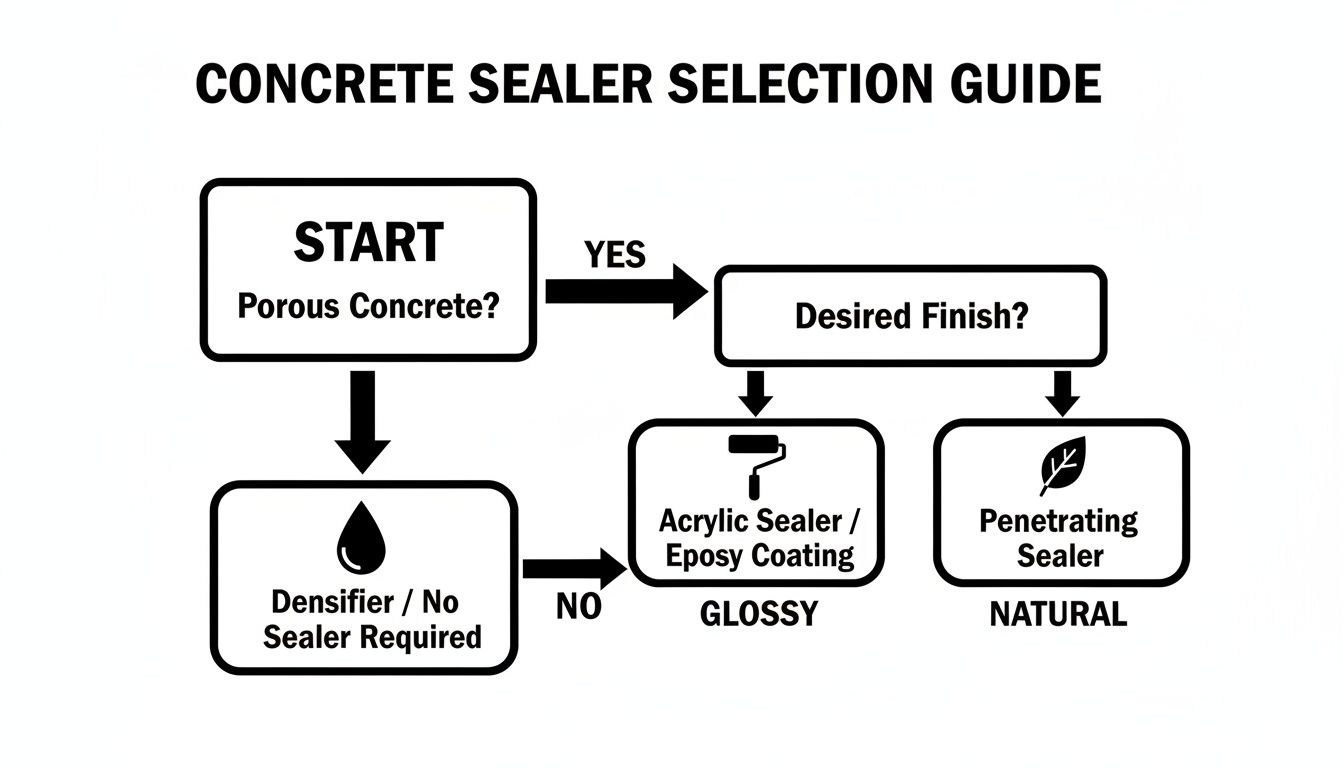
As the flowchart shows, the choice often comes down to a simple question: do you want to change how your concrete looks with a gloss finish, or do you need to keep its natural, slip-resistant texture?
Topical Sealers: A Closer Look
Think of topical sealers as the aesthetic enhancers for concrete. These products, which are most often acrylic-based, create a protective film right on top of the surface. This clear barrier provides fantastic protection against spills, chemicals, and everyday abrasion, all while deepening the concrete’s color and adding a beautiful satin or high-gloss sheen.
For example, an acrylic topical sealer is the perfect choice for a stamped concrete patio with rich colors and intricate patterns. It'll make those colors pop, give the surface that finished "wet look," and guard it against anything from spilled wine to BBQ grease. The tradeoff? This film can get slippery when wet and usually needs to be reapplied every 1-3 years to keep it looking and performing its best.
Penetrating Sealers: An In-Depth View
Penetrating sealers are the unsung heroes of concrete protection. They are the silent workhorses. Formulations like silanes and siloxanes are engineered to soak deep into the concrete's pores. Once inside, they set off a chemical reaction, forming a water-repellent barrier from within—all without changing the look or feel of the surface one bit.
This makes them the clear winner for any surface where safety and long-term durability are the main goals. Take a steep driveway or a poolside walkway in Atlanta; a penetrating sealer offers powerful protection from water damage without creating a slick, dangerous surface. Since the protection is inside the concrete, it doesn’t wear away with foot traffic or cars, often lasting 5-10 years or even longer.
This durable, low-maintenance performance is a big reason why penetrating sealers are quickly becoming the go-to strategy for smart concrete protection. They are emerging as the fastest-growing segment in the industry, poised to outpace others in a market expanding from $2.03 billion in 2024 to an estimated $2.95 billion by 2030. Their ability to let moisture vapor escape is especially critical in Atlanta’s humid climate, preventing ugly spalling and scaling. You can explore more about these market trends and what they mean for homeowners.
Direct Comparison: Which Sealer Wins?
To make your decision a little easier, let's put these two sealer types head-to-head. It’s important to remember that neither one is universally "better"—the best sealer is always the one that’s right for the job.
Comparing Topical and Penetrating Concrete Sealers
| Feature | Topical Sealers (Film-Forming) | Penetrating Sealers (Reactive) |
|---|---|---|
| Appearance | Adds a satin or gloss finish; can enhance color. | Invisible, matte finish that does not alter appearance. |
| Durability | Shorter lifespan (1-3 years) due to surface wear. | Very long lifespan (5-10+ years) as protection is internal. |
| Slip Resistance | Can become slippery when wet, especially with a gloss finish. | No change to surface texture, maintaining original slip resistance. |
| Breathability | Low breathability; can trap moisture if applied incorrectly. | Excellent breathability; allows moisture vapor to escape. |
| Best Uses | Decorative patios, stamped concrete, indoor floors. | Driveways, sidewalks, pool decks, garage floors, basement walls. |
Ultimately, choosing between them comes down to a fundamental question.
Do you want to coat the surface for aesthetic pop and protection (topical), or do you want to fortify the concrete from within for invisible, long-term durability (penetrating)?
A glossy, color-enhancing acrylic sealer is a fantastic choice for a low-traffic, decorative space. But for most of the hardworking, high-traffic areas around an Atlanta home—like your driveway, walkway, or pool deck—the tough, long-lasting, and slip-resistant nature of a penetrating sealer makes it the far more practical and safer investment.
Best Sealer Applications for Atlanta Homes
When it comes to choosing the right concrete waterproof sealer, you have to match the product to the specific job. A one-size-fits-all approach just won’t cut it, especially around an Atlanta home where the demands on your driveway are completely different from your basement walls or patio.
To get real, lasting protection, you need to think like a pro. That means looking at each concrete surface, identifying its biggest enemy, and picking a sealer designed to fight that specific battle.
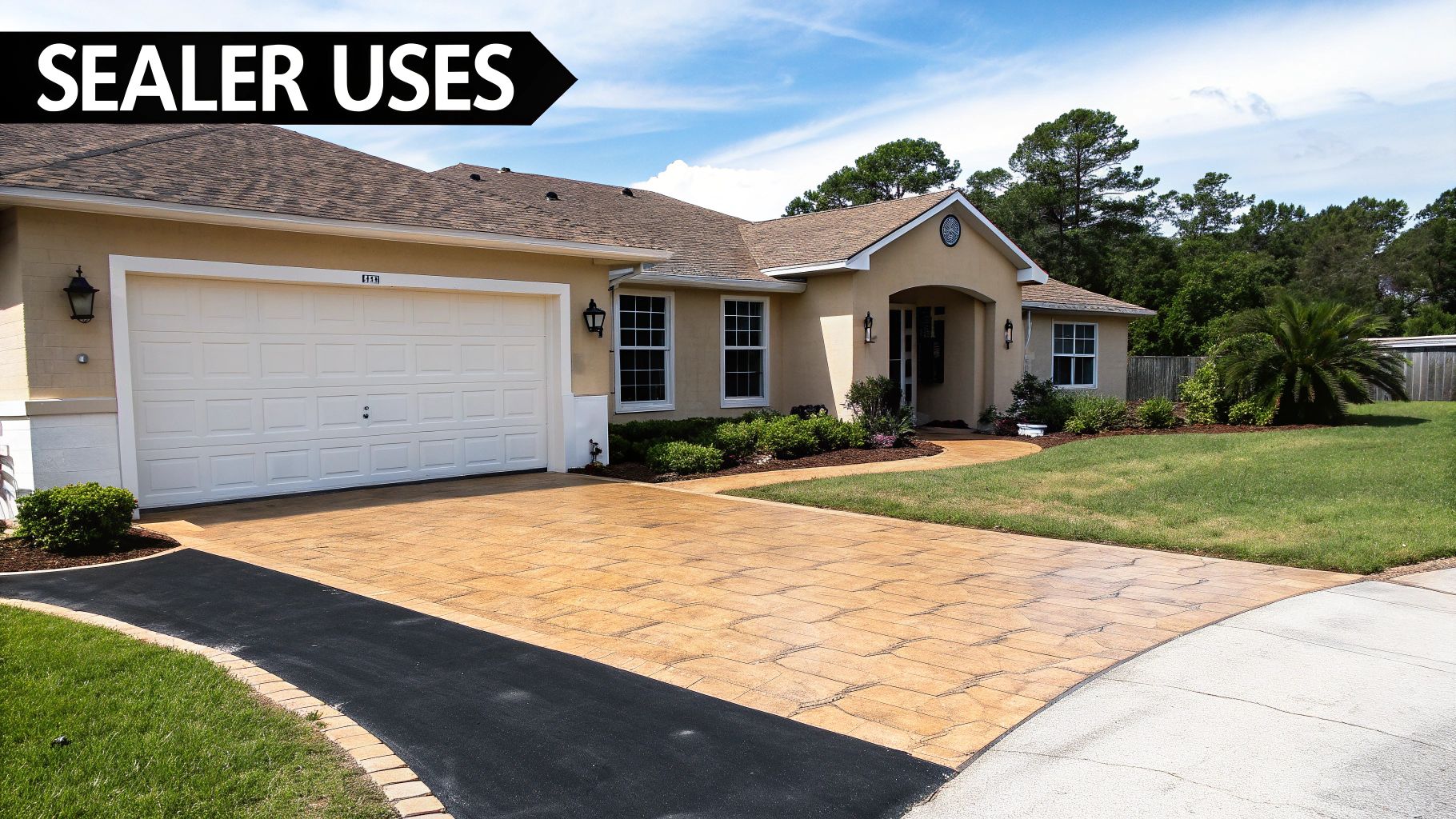
Sealing Your Driveway for Maximum Durability
Your driveway is easily the hardest-working slab of concrete on your entire property. It’s under constant assault from vehicle weight, oil drips, and the infamous Atlanta problem of hot-tire pickup—where hot tires literally soften and lift cheap, film-forming sealers right off the surface. For a driveway, toughness is everything.
This is where a penetrating silane/siloxane sealer really shines. Instead of forming a film on top, this type of sealer dives deep into the concrete's pores to create an internal, water-repelling barrier. It's the perfect solution for a high-traffic area.
- No Surface Film: Hot tires can't peel away something that isn't there. Problem solved.
- Keeps Natural Traction: Because there’s no slick coating, your driveway won’t turn into a slip-and-slide when it rains.
- Seriously Long-Lasting: The protection is inside the concrete, so it doesn't just wear off. You can expect it to last 5-10+ years.
Think of it as an invisible shield. It protects your driveway from the inside out against cracking and stains without changing its look or making it unsafe. You can see more about how we handle these critical surfaces in our guide to residential driveway concrete installation and repair.
Protecting Patios and Pool Decks
For patios and pool decks, the game changes. Here, you’re trying to strike a balance between good looks and safety. You want to enhance the beauty of your decorative concrete but you can't afford to make it slippery.
If you have a stamped concrete patio, a high-quality, UV-resistant acrylic sealer is a fantastic choice. It adds a subtle sheen that makes the colors and patterns pop while protecting the surface from spills and the harsh Georgia sun. Just be sure to choose one with a slip-resistant additive, like a fine-grit polymer, which can be mixed in before application.
Around a pool deck, however, safety becomes the absolute top priority. A penetrating sealer is often the smarter pick. It provides incredible water repellency to prevent mildew and freeze-thaw damage, all without creating a slick surface. It keeps the area cleaner and, most importantly, safer for bare feet.
The right sealer should solve the biggest problem an area faces. For driveways, it’s durability against traffic. For patios, it’s UV protection and aesthetics. For pool decks, it’s slip resistance.
Waterproofing Basement Walls and Foundations
Your foundation and basement walls are fighting a completely different war. Their main enemy is hydrostatic pressure—the constant force of groundwater pushing its way in from the outside. If you don't stop it, that pressure will force moisture right through the pores of your concrete, leaving you with a damp, musty basement.
For interior basement walls, a penetrating silicate densifier and sealer is a powerhouse. This product soaks into the concrete and triggers a chemical reaction, forming hard, insoluble crystals inside the pores. These crystals literally plug the microscopic pathways water uses to get through, creating a permanent barrier from the inside that can stand up to serious water pressure. For example, some silicate sealers are rated to withstand over 100 feet of water head pressure.
This focus on durable, low-maintenance surfaces isn't just for homeowners. Commercial properties are a huge driver in the sealer market. The global industry was valued at $1.7 billion in 2021 and is expected to hit $3.1 billion by 2031. Businesses are increasingly investing in these solutions for parking lots and commercial slabs, especially in high-rainfall cities like Atlanta. You can dig into more of this market data over at stratviewresearch.com.
A Pro's Guide to the Concrete Sealing Process
Applying a concrete sealer might look easy, but getting that durable, long-lasting shield you see on professionally sealed surfaces is all about the process. It's a game of inches where every single detail matters. This isn't just about rolling on a product; it’s a multi-stage operation where skipping a single step can cause the entire job to fail.
Let's walk through how the pros get it done right.
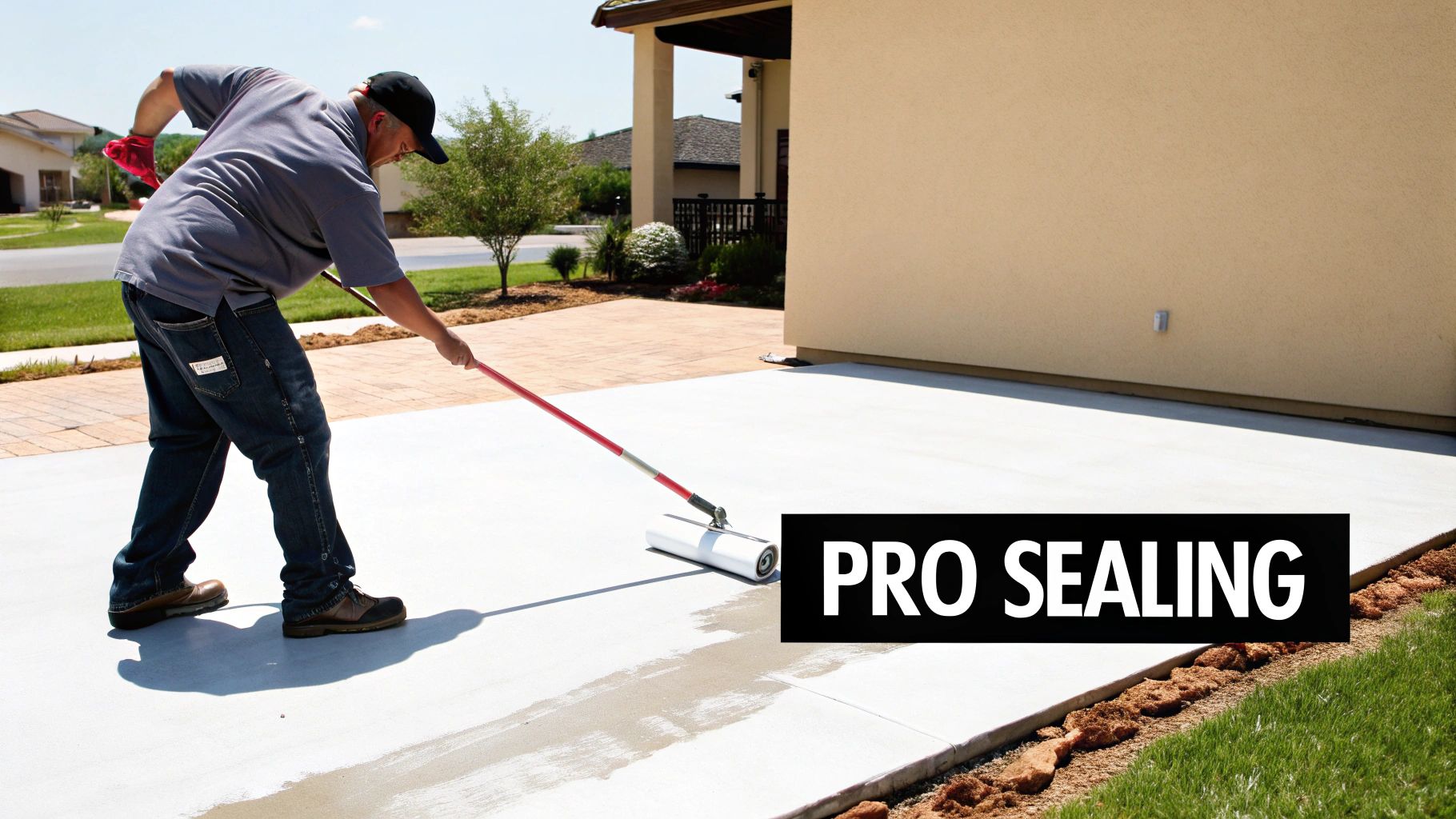
This methodical approach is what creates a powerful, lasting bond between the sealer and the concrete.
Stage 1: Deep Cleaning and Surface Prep
Everything starts with a deep, thorough cleaning. A sealer needs to bond directly with the concrete itself, so every last bit of dirt, oil, and any old, failing coatings has to go. This isn't a quick job with a garden hose.
Professionals bring out the heavy equipment—high-powered pressure washers, often 3,000 PSI or more, to force out the grime that's been ground into the concrete’s pores over the years. For stubborn oil and grease spots, we use specialized degreasers that lift and dissolve the stains, preventing them from creating a barrier between the concrete and the new sealer. In some cases, a light acid etch with muriatic or phosphoric acid is used to open up the concrete's pores for maximum sealer absorption.
Think of it like painting a wall. If you try to paint over dust and greasy fingerprints, the paint will bubble and peel almost immediately. The exact same principle applies to sealing concrete—the surface must be surgically clean for the sealer to stick.
Stage 2: Meticulous Concrete Repair
With the surface stripped bare, it's time for a close inspection. Sealing over cracks or spalling (flaky, crumbling spots) is like putting a band-aid on a broken bone. You're just hiding the problem, and it won't be long before the damage shows through and ruins the new coating.
A professional crew will carefully fix these issues first:
- Crack Repair: We'll chase smaller cracks with a grinder to create a clean "V" shape and fill them with a flexible, waterproof polyurethane caulk or an epoxy filler. This allows the concrete to expand and contract naturally without reopening the crack.
- Spall Repair: Any flaking areas get patched with high-strength cementitious materials, bringing the surface back to a solid, uniform state.
This repair phase is non-negotiable. It creates the stable, sound foundation the sealer needs to do its job properly.
Stage 3: Ensuring a Perfectly Dry Surface
If there's one thing that causes more sealer failures than anything else, it's moisture. Applying sealer to damp concrete is a recipe for disaster. Moisture is the enemy of adhesion.
When you trap moisture under a sealer, it creates a cloudy, white haze called "blushing." Worse yet, that trapped water prevents the sealer from curing correctly, which often leads to it delaminating and peeling off in big sheets. That's why professionals are patient. We use moisture meters or perform a simple plastic sheet test (taping a plastic square to the concrete for 24 hours to see if condensation forms) to be absolutely certain the slab is bone-dry. We wait at least 24-48 hours after pressure washing.
Stage 4: Expert Application Techniques
Finally, the moment of truth. With a clean, repaired, and completely dry surface, we can apply the sealer. This is where technique really counts.
Professionals use high-quality, non-shedding rollers or professional-grade low-pressure sprayers to lay down a thin, even coat. The goal is to get consistent coverage without any puddles or thick spots, as those can cure improperly and create weak points. For example, a typical application rate is about 150-300 square feet per gallon. We stick to the manufacturer’s instructions like glue, making sure the coverage rates and number of coats are perfect to deliver the protection and lifespan you're paying for.
Keeping Your Sealed Concrete in Top Shape for Years to Come
Putting down a quality waterproof sealer is a smart move for protecting your concrete, but the job doesn't stop once it's dry. Think of it less like a one-and-done task and more like the start of a simple maintenance routine. A little bit of care goes a long way in making sure you get the most out of your investment and keep your concrete looking great for as long as possible.
The lifespan of your seal job really comes down to which type of product you used. A topical sealer, which creates a protective film over the surface, will typically need a fresh coat every 1-3 years. Things like heavy foot traffic, direct sunlight, and frequent vehicle use can break it down more quickly. On the other hand, a penetrating sealer soaks into the concrete itself and can last anywhere from 5-10 years—sometimes even longer. It’s a much more set-it-and-forget-it solution.
Spotting the Signs: When Is It Time to Reseal?
No sealer lasts forever. The trick is to catch the early warning signs of wear before moisture starts creeping in and causing problems. If you wait too long, you could end up with the very issues—like spalling or cracking—that you were trying to prevent.
Keep an eye out for these tell-tale signs that your sealer is starting to fail:
- Visible Wear and Tear: You might see the sealer looking thin, patchy, or even starting to flake off. This is most common in high-traffic zones, like the middle of your walkway or right where your car tires hit the driveway every day.
- A Dull, Faded Look: If your topical sealer used to have a nice satin or gloss finish, it might start to look flat, cloudy, or just plain lifeless.
- Water Is Soaking In: This is the most definite sign. When the sealer is working, water should bead up like it does on a freshly waxed car. If rain darkens the concrete and soaks right in, the protective barrier is gone.
The Quick and Easy Water Test
You don't need any fancy tools to figure out if your sealer is still working. The "water test" is your best friend here, and it only takes a minute.
Just splash a bit of water on a few different spots of your sealed concrete. If you see tight, distinct beads of water sitting on the surface, you’re still in good shape. But if the water immediately spreads out and starts to darken the concrete, that’s your cue—it’s time to reseal.
Simple Maintenance for a Longer-Lasting Seal
A little upkeep can make a huge difference. The biggest enemy of your sealer (besides time and traffic) is built-up dirt and grime, which can slowly eat away at the protective layer.
Simply sweeping the surface regularly and rinsing it with a garden hose can work wonders. For more stubborn dirt, a gentle cleaner and a light scrub will do the job. For example, a mixture of mild dish soap and water is often enough to remove most surface grime without damaging the sealer. Getting familiar with general cleaning methods for outdoor surfaces, like knowing how to clean pool deck like a pro, can give you some great techniques.
Of course, if you see more serious issues like deep cracks or chipping, the problem might be more than just a worn-out sealer. In those cases, it's best to look into professional options for residential concrete and masonry repair.
Deciding Between DIY Sealing and a Professional Service
So, you’re sold on the benefits of sealing your concrete. Now comes the big question: should you tackle this yourself or call in the pros? The temptation of a weekend DIY project is real, but this decision really boils down to the scale of your project and your tolerance for risk. It's a classic trade-off between saving a few bucks upfront versus ensuring the job is done right.
A small, straightforward job—think a little ground-level patio with no cracks or stains—might be a perfectly fine DIY adventure. But the stakes get much higher when you’re looking at a big driveway, a basement foundation, or a sprawling pool deck. These aren't the kind of projects where you want a do-over.
The Professional Advantage
Hiring an experienced crew like Atlanta Concrete Solutions isn't just about convenience; it's about getting access to expertise and equipment that most homeowners simply don't have. The single most important factor is surface preparation. A pro team rolls up with high-powered pressure washers, concrete grinders, and industrial-strength cleaners to get the surface perfectly prepped. This step is non-negotiable for a sealer to bond correctly and last.
Beyond the gear, you're paying for experience and efficiency. A seasoned expert knows exactly which sealer formula will perform best in Atlanta’s humid climate. For instance, they'll know whether a solvent-based acrylic is better than a water-based one for your specific needs, or if a hybrid silane/siloxane offers the best protection. They also have the right tools, like commercial sprayers, to apply a perfectly even coat—something that’s tricky to do with a roller. What might take you a whole weekend of back-breaking work, a professional crew can often knock out in a single day, and they'll stand behind their work.
A Quick Checklist to Assess Your Project
Still on the fence? Run through this quick checklist. The more of these you check off, the more you should lean toward calling a professional.
- Project Size: Is the area larger than 200 square feet?
- Existing Damage: Do you see any cracks, flaking, or deep-set oil stains?
- Critical Area: Is it a high-traffic driveway, a basement foundation, or a garage floor?
- The Right Gear: Do you have access to a pressure washer that’s at least 3,000 PSI?
- Product Know-How: Are you 100% confident you can pick the right sealer and apply it at the correct thickness?
Investing in a quality waterproof sealer is one of the smartest moves you can make to protect your property's value. There's a reason the global market for these products is projected to hit $3.1 billion by 2031—people are realizing the massive savings. A professional application can add years to your concrete's life and slash long-term maintenance costs by 30-40%. You can learn more about the growth of the concrete sealers market to see how big this trend is.
At the end of the day, hiring a professional service is about buying peace of mind. It guarantees the job is done right the first time, giving you the durable, lasting protection your concrete needs to face whatever Atlanta’s weather throws at it.
For a professional consultation and a free, no-obligation quote, trust the experts at Atlanta Concrete Solutions. Ensure your concrete is protected by a team with over a decade of local experience. Visit us at https://atlantaconcretesolutions.com to get started.