
When you start dreaming about a new patio or driveway, one of the first questions that pops into your head is, "What's this actually going to cost me?" For stamped concrete, the answer isn't a single number. On average, you can expect to pay somewhere between $8 and $19 per square foot, but where you land in that range depends entirely on how simple or intricate you want the final look to be.
Think of it like this: a simple, elegant finish is one thing, but a detailed, multi-colored masterpiece is another level entirely. For example, a basic broom-finished concrete patio might be just $6 per square foot, while a complex stamped design mimicking hand-laid flagstone with custom coloring could easily exceed $20 per square foot. The difference lies in the artistry, materials, and labor involved.
Understanding Stamped Concrete Costs in Atlanta
Stamped concrete is a fantastic choice for homeowners in our area. It gives you the high-end look of natural stone or pavers without the eye-watering price tag, plus it's incredibly durable. It's one of many ways to finish a concrete surface; if you're curious about all the possibilities, this definitive guide to flooring for concrete slabs offers a great overview.
The final price is really a spectrum. A basic job with a single color and pattern will sit at the lower end. For instance, a simple running bond brick pattern in a single terracotta color is a straightforward project. On the other hand, a complex project with custom colors, detailed hand-finishing, and multiple patterns—like an ashlar slate pattern with a contrasting cobblestone border—will be at the higher end.
Let's break down what you can expect to pay for stamped concrete projects right here in the Atlanta area. We'll look at the cost per square foot for different levels of complexity and how that translates to real-world projects.
Stamped Concrete Cost At a Glance
The table below gives you a quick snapshot of what to expect for different project tiers.
| Complexity Level | Average Cost Per Sq. Ft. | Common Project Example (400 Sq. Ft. Patio) |
|---|---|---|
| Basic (Single Color & Pattern) | $8 – $12 | $3,200 – $4,800 |
| Mid-Range (Two Colors & Detailed Pattern) | $12 – $18 | $4,800 – $7,200 |
| High-End (Custom Colors & Complex Design) | $18+ | $7,200+ |
As you can see, the final cost is all about the details. Let's dig a little deeper into what each of these levels actually includes.
Three Tiers of Stamped Concrete Pricing
To help you match your vision with your budget, we can group stamped concrete projects into three general categories. This is how most contractors think about it, and it's a great way to frame your own project from the get-go.
-
Basic Stamped Concrete: This is your most wallet-friendly option. It typically involves one base color and one straightforward pattern, like a classic cobblestone or a simple ashlar slate. For example, a patio might feature an integral color mixed into the concrete, like a light tan, with a basic stamp applied. It's a huge step up from plain gray concrete without a massive investment.
-
Mid-Range Stamped Concrete: This is the sweet spot for most homeowners and by far the most popular choice. Here, you get more creative freedom. We often use a base color plus a secondary "release" color, which adds incredible depth and makes the pattern look much more realistic. A great example is a "Weathered Sage" base color with a "Charcoal" release agent on a random stone pattern, which creates realistic shadows and highlights in the texture. You also get a much wider library of patterns to choose from.
-
High-End Custom Stamped Concrete: This is where the artistry really comes in. We’re talking about unique, one-of-a-kind surfaces with multiple colors, intricate patterns that mimic wood planks or custom stonework, and even hand-applied stains for extra detail. An example would be a pool deck with a stamped wood plank pattern, a decorative stamped border in a contrasting pattern, and hand-staining to create realistic wood grain variations. If you can dream it, we can probably create it in concrete.
For homeowners in the Atlanta metro area, stamped concrete is a smart investment. Local data shows the average cost ranges from $8 to $19 per square foot installed, making it a beautiful and practical alternative to pricey natural stone. For a standard 400 sq. ft. patio, that puts your total project cost somewhere between $3,200 and $7,600. You can see how these numbers stack up against national averages on sites like HomeGuide.
Breaking Down the Key Pricing Factors
When you get a quote for stamped concrete, you’re not just paying for a flat surface area. It's a common mistake to think that two patios of the exact same size will cost the same. In reality, the final price is built from several layers, much like the bill for a great dinner includes more than just the main course—it's the appetizers, the drinks, and the dessert that create the full experience.
To really understand where your money is going and budget effectively, you need to look at each of these components. Let's pull back the curtain on every element that shapes the final cost of stamped concrete per square foot.
Materials: The Foundation of Your Project
The most obvious cost is the concrete itself, but it's not a one-size-fits-all product. The specific mix, its strength, and any special additives all have a direct impact on the price tag.
- The Concrete Mix: A standard mix works for some projects, but driveways need something tougher—often 3500 PSI or more—to handle the weight of vehicles. A simple patio, for example, might use a 3000 PSI mix, while a driveway that will hold an RV may require a 4000 PSI mix. We also frequently add fiber mesh reinforcement right into the mix to help prevent cracking down the road, which slightly increases the material cost.
- Color Hardeners and Dyes: This is where the magic happens. A basic job might just have a single color mixed all the way through the concrete. But for that truly authentic, high-end look, we use a base color and a secondary powder, called a release agent. This second color gets pressed into the nooks and crannies of the stamp pattern, creating incredible depth and realistic texture. For example, using a light gray integral color with a dark charcoal release agent on a slate pattern creates the look of real stone with natural-looking grout lines.
- Reinforcement: Inside the slab, we almost always install a grid of steel rebar or wire mesh. For a standard patio, we might use a wire mesh grid, but for a driveway subject to heavy loads, we'll install a thicker rebar grid on chairs to ensure it's positioned correctly within the concrete slab. This is an absolutely critical step for long-term durability.
This chart gives you a quick visual on how these different material and labor choices stack up into different budget tiers.
As you can see, the jump from a basic design to a high-end one is all about adding layers of complexity—both in the materials used and the skill required to install them.
Labor: The Skill Behind the Beauty
Stamped concrete isn't just construction; it's a craft. It takes an experienced, coordinated crew to pull it off. Unlike a simple pour, the entire process is a race against the clock, and every step demands an expert touch.
The biggest variables in stamped concrete pricing are almost always labor and site prep, especially here in the competitive Atlanta market. The skill of the crew directly determines how good the final product looks and how long it lasts, making it a place you don’t want to cut corners.
The labor cost covers everything from the initial grading work to the final sweep of sealer. A complex pattern with multiple colors and hand-touched details naturally requires more hands and more hours than a simple, single-color design, and your quote will reflect that. For example, stamping a simple square patio takes less time and precision than stamping a winding, curved walkway with a decorative border.
Site Preparation: Setting the Stage for Success
Long before the concrete truck arrives, the groundwork has to be perfect. This prep work is the unsung hero of a durable installation and can be a surprisingly significant part of the budget.
- Grading and Excavation: We have to dig out the area to the proper depth and then grade it carefully so water drains away from your house, not toward it. Here in Georgia, that often means dealing with dense red clay, which can require more intensive work and impact this cost. For example, a sloped yard may require building up one side with extra gravel and soil, adding to the labor and material costs.
- Sub-Base Installation: A thick layer of compacted gravel goes down before any concrete is poured. This creates a stable, solid foundation that keeps the slab from shifting, heaving, or cracking over time. For a typical patio, this might be a 4-inch layer, but for a driveway, we'll use a 6-inch or thicker base.
- Formwork: We build a temporary frame, usually from wood, around the perimeter. This is what holds the wet concrete in place and gives your patio, walkway, or driveway its final shape. A simple rectangular form is quick to build, whereas creating curved forms for a free-form pool deck is a much more time-consuming and skilled task.
Removal and Permits: The Hidden Costs
Two things often catch people by surprise: cleanup and paperwork. If you're replacing an old, cracked patio, that old concrete has to be broken up and hauled away. That disposal process comes with its own cost, typically running $3 to $7 per square foot.
On top of that, most cities and counties require permits for this kind of work to make sure it's up to code. Your contractor will handle the process, but the fee gets passed on to you. For example, in Fulton County, a permit for a new driveway or large patio can cost several hundred dollars. These easily forgotten details, combined with the complexity of your chosen design, are what ultimately determine the final price. You can find more detail on how these services are priced by checking out cost estimators for Atlanta projects.
Real Project Cost Examples in Atlanta
Averages and price ranges are a good starting point, but what do these numbers look like for actual projects here in Atlanta? Let's move from theory to reality. Seeing how the costs break down for common installations can give you a much clearer picture of what to budget.
We've put together three typical scenarios to show how project size, the complexity of the design, and site conditions all play a role in the final price. Whether you're in Marietta, Alpharetta, or right in the city, these examples give you a solid baseline for your own project.
Example 1: The Cozy Backyard Patio
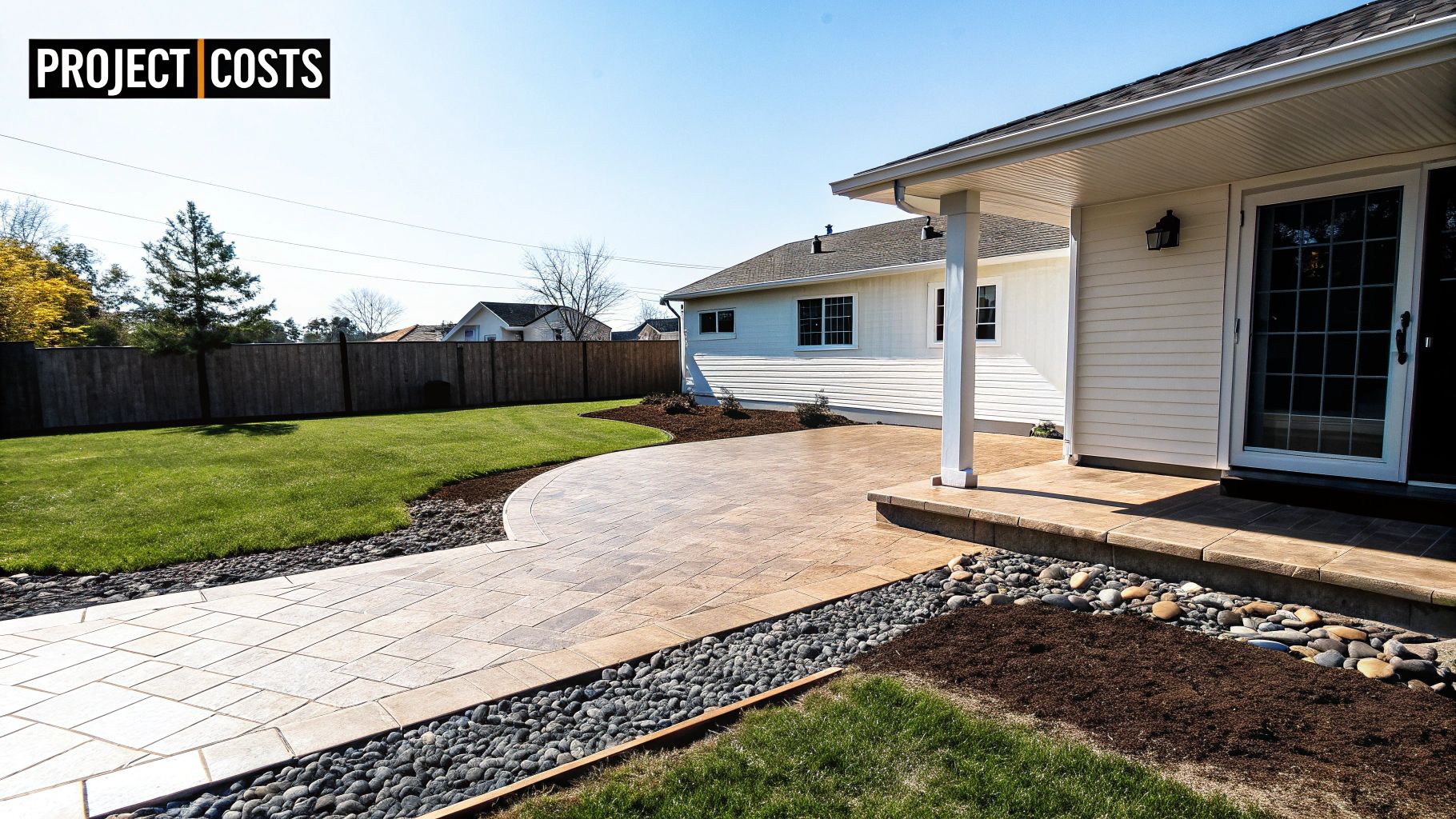
Let's start with a classic: a 20×20 foot patio. It's the perfect size for a grill, some comfortable chairs, and an outdoor dining table. This is a great mid-range project that completely transforms a backyard without breaking the bank.
- Project Size: 400 square feet
- Complexity: Mid-Range
- Design: A popular Ashlar slate pattern with a two-tone finish (a base color plus a darker release agent to create depth).
- Site Conditions: A fairly level yard with good access for our equipment.
Estimated Cost Breakdown:
| Item | Estimated Cost | Details |
|---|---|---|
| Site Prep & Grading | $800 – $1,200 | Excavating the area and laying a solid gravel base. |
| Materials | $1,600 – $2,000 | Concrete, steel rebar, color hardener, and release agent. |
| Labor & Stamping | $2,400 – $3,600 | Building the forms, pouring the slab, stamping, and finishing. |
| Sealing | $400 – $600 | Applying a high-quality acrylic sealer for protection and shine. |
| Total Estimated Cost | $5,200 – $7,400 | This works out to an average of $13 – $18.50 per square foot. |
Example 2: The Functional Two-Car Driveway
Replacing an old, cracked driveway is one of the biggest curb appeal boosters you can do. A stamped concrete driveway isn't just about looks; it's a tough, durable surface built to last. This job is a bit more involved because it has to be strong enough to handle cars day in and day out.
- Project Size: 600 square feet (roughly 24'x25')
- Complexity: Basic-to-Mid Range
- Design: A simple but elegant cobblestone pattern with a single color mixed directly into the concrete.
- Additional Work: Tearing out and hauling away the old asphalt driveway.
Keep in mind that demolition is a significant part of any replacement project. Removing old concrete or asphalt can add $3 to $7 per square foot to the total cost. It’s a necessary step to create a stable foundation for the beautiful new surface.
Estimated Cost Breakdown:
- Old Driveway Removal: $1,800 – $4,200
- Site Prep & Base: $1,200 – $1,800
- Materials (4000 PSI Concrete): $2,400 – $3,000
- Labor, Stamping & Finishing: $3,600 – $5,400
- Sealing: $600 – $900
- Total Estimated Cost (Including Removal): $9,600 – $15,300
- Cost Per Square Foot (New Install Only): $13 – $18.50
Example 3: The Luxurious Pool Deck
A pool deck is where stamped concrete truly gets to show off. It needs to be beautiful, but it also has to be functional and safe. These projects often feature more intricate patterns, flowing curves, multiple colors, and a non-slip finish. To see what's possible, take a look at the gallery of our completed stamped concrete projects.
- Project Size: 800 square feet
- Complexity: High-End
- Design: Custom random stone pattern, a decorative border, two colors, and a non-slip additive mixed into the sealer.
- Site Conditions: A complex, free-form shape that follows the curves of the pool.
Estimated Cost Breakdown:
| Item | Estimated Cost | Details |
|---|---|---|
| Site Prep & Complex Forming | $2,000 – $2,800 | Labor-intensive formwork is needed to match the pool's shape. |
| Materials & Custom Colors | $3,200 – $4,400 | Includes premium coloring agents and a non-slip aggregate. |
| Labor (Intricate Stamping) | $8,000 – $11,200 | More skilled labor is needed for detailed hand-finishing and borders. |
| Sealing (with Additive) | $900 – $1,200 | Applying sealer that includes a special grip-enhancing additive. |
| Total Estimated Cost | $14,100 – $19,600 | The final price averages $17.60 – $24.50 per square foot. |
Comparing Stamped Concrete With Other Paving Options
Choosing the right material for your patio, driveway, or pool deck is a huge decision. You’re not just picking a surface; you’re investing in your home’s value and daily enjoyment. While the cost of stamped concrete is often a major draw, how does it really stack up against popular alternatives like pavers, natural stone, or even just plain gray concrete?
The best choice isn’t just about the initial price tag. It’s about finding that perfect sweet spot between long-term value, durability, and the specific look you’re dreaming of.
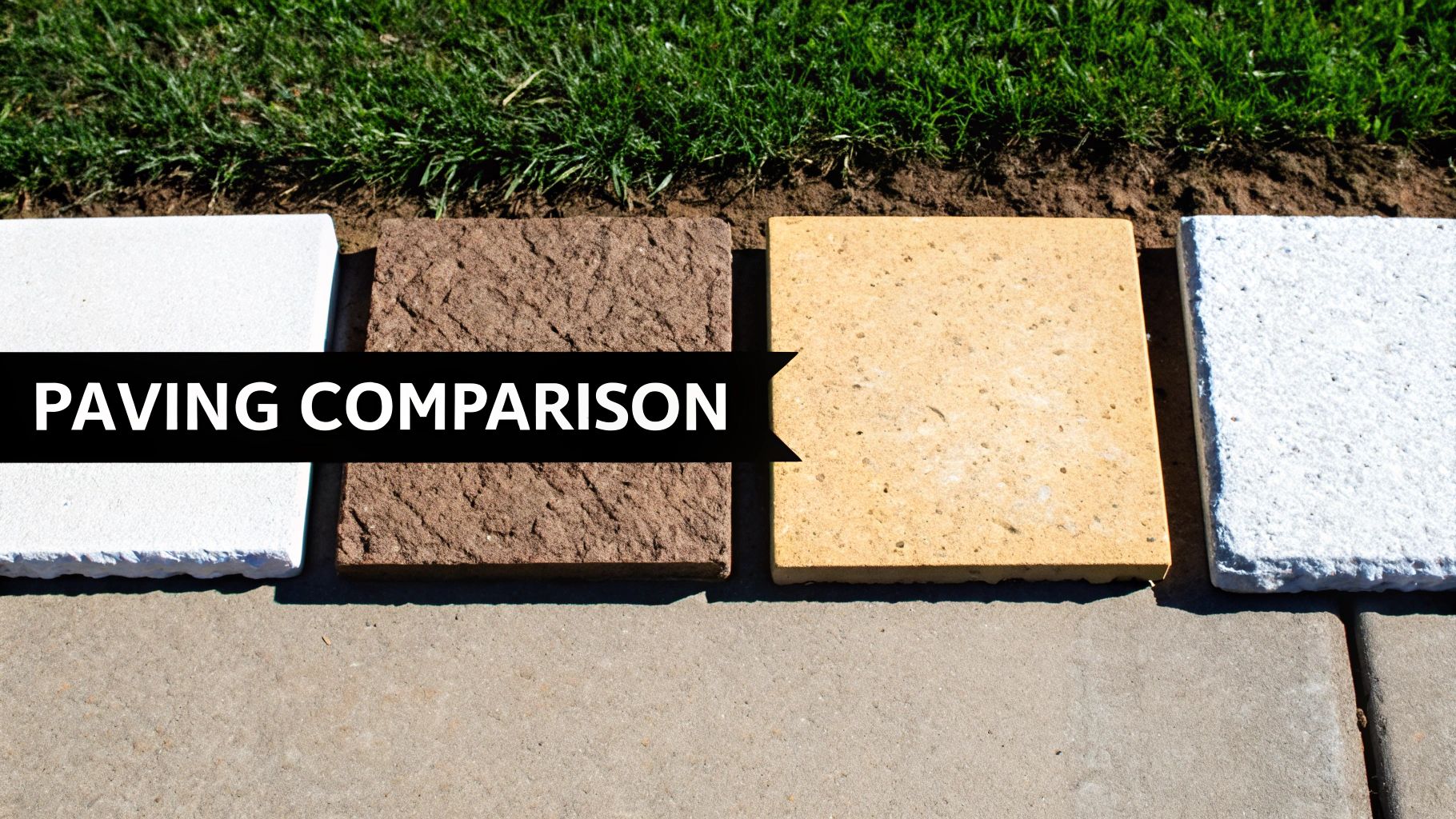
Think of it like choosing kitchen countertops. You’ve got options like granite, quartz, and laminate. They all give you a place to chop vegetables, but they bring vastly different aesthetics, price points, and maintenance needs to the table. Paving materials are exactly the same. Let's dig into how these options perform over the long haul to see where the true value lies.
A Head-to-Head Material Showdown
To really get a feel for the pros and cons, it helps to see everything side-by-side. I've put together a quick comparison to break down the key factors for each material, from what you'll pay upfront to what you can expect down the road.
Cost and Feature Comparison: Paving Materials
| Material | Avg. Cost Per Sq. Ft. | Lifespan | Maintenance Level | Aesthetic Value |
|---|---|---|---|---|
| Stamped Concrete | $12 – $20 | 25+ Years | Low-Medium | High |
| Concrete Pavers | $15 – $25 | 30-50 Years | Medium | Very High |
| Plain Concrete | $6 – $12 | 30+ Years | Very Low | Low |
| Natural Stone | $25 – $50+ | 50+ Years | Low | Premium |
This table really highlights why so many homeowners in Atlanta land on stamped concrete. It elegantly bridges the gap between the purely functional and the truly high-end. You get a customized, luxurious look for a price that’s much easier to swallow than natural stone or even some of the more premium pavers. The design possibilities are practically endless, making it a fantastic choice for all kinds of residential decorative concrete projects.
Unpacking the Long-Term Value
The initial price is just one piece of the puzzle. Over the next 25 years, things like maintenance costs and overall durability start to paint a much clearer picture of the total cost of ownership.
Stamped concrete consistently hits a sweet spot between aesthetic appeal and cost-effectiveness. It delivers the luxurious appearance of natural materials but remains 20-40% cheaper than options like brick or premium pavers, offering significant long-term savings.
Take pavers, for instance. They cost more upfront, but they have one killer feature: easy spot repairs. If a single paver cracks or gets a nasty oil stain, you can just pop it out and replace it. Repairing a crack in a stamped concrete slab is a more involved process, and getting a perfect color and texture match can sometimes be tricky.
On the flip side, pavers bring their own set of chores. You're always going to be fighting weeds in the joints, and over time, shifting ground can cause pavers to settle unevenly, creating trip hazards that need re-leveling. For example, after a few years of Georgia's freeze-thaw cycles, you might find a corner of your paver patio has sunk, requiring you to pull up the pavers, add more base material, and re-level them. Stamped concrete, being one solid, monolithic slab, completely sidesteps those issues.
Comparing the Numbers Over Time
Here in a competitive market like Atlanta, stamped concrete’s value proposition really shines. Sure, plain concrete is cheap and lasts forever, but it offers zero design flair. Pavers look fantastic, but you can expect to pay around 30% more for a similar installation compared to a beautiful stamped design.
Ultimately, stamped concrete offers an incredible middle ground. It gives you a fully customizable, high-end look that boosts your home's curb appeal while demanding less day-to-day maintenance than pavers and costing a fraction of what you'd pay for natural stone. It’s that balance of beauty, durability, and smart value that makes it a top contender for almost any outdoor project.
Smart Ways to Manage Your Project Budget
Getting that high-end stamped concrete look doesn't have to come with a high-end price tag. With a bit of strategic thinking, you can have a surprising amount of control over the final cost. It’s all about knowing where to be flexible without skimping on quality.
Making a few smart decisions upfront can really help manage your investment. Simple tweaks to your design, project timing, and even a little bit of prep work can add up to real savings, putting that beautiful, durable surface well within your reach.
Simplify Your Design
One of the quickest ways to bring down the cost is to simplify the design. The more complex the pattern and the more colors you add, the more time and materials it takes, which naturally drives up the price.
- Opt for a Single Color: A design with one primary color is much more budget-friendly than a multi-toned finish that needs a base color plus a secondary color for highlights. You still get a gorgeous, uniform look that’s miles ahead of plain gray concrete. An example would be choosing a single "Sandstone" integral color for your whole patio, which still looks beautiful and is much less expensive than a two-color process.
- Choose a Standard Pattern: Go for popular patterns like Ashlar slate or classic cobblestone. Contractors almost always have these stamps on hand, and their crews are experts at laying them down efficiently. A custom or more obscure pattern might mean the contractor has to rent or buy a new stamp set, and that cost will be passed on to you.
A simple change, like picking one color instead of two, can drop the cost of stamped concrete per square foot by $2 to $4, sometimes even more. On a 400-square-foot patio, that's an instant savings of $800 to $1,600.
Be Strategic with Scheduling and Prep
It’s not just about the design. When and how your project gets done can also make a real difference to your wallet. A little planning on your end can make the whole job smoother for your contractor, and those savings often get passed right back to you.
Timing and Access Can Lower Labor Costs
Booking your project during a contractor's slower season, like late fall or early winter, can sometimes land you a more competitive quote as they work to keep their crews busy. Making sure the site is ready to go is another easy win.
- Ensure Clear Access: Check that there's a wide, obvious path for equipment and workers. If the crew has to maneuver around tight corners or haul materials across your entire yard, you're paying for that extra labor time. For example, if a fence panel can be temporarily removed to allow a small machine access, it can save hours of manual labor with wheelbarrows.
- Handle Minor Prep Yourself: If you can clear the area of plants, patio furniture, or old debris beforehand, the crew can get right to work on the actual installation. You're paying them for their concrete expertise, not their landscaping skills.
Think About Long-Term Savings
Managing your budget is about more than just the initial price tag; it's also about avoiding big expenses down the road. The best way to protect your investment is with proper maintenance.
Resealing your stamped concrete every 2-3 years is the single most important thing you can do. This clear, protective layer shields the surface from stains, water damage, and sun-fading. A typical resealing job for a 400 sq. ft. patio might cost $400-$600, a small price to pay to keep the surface looking new. It keeps your patio or driveway looking fresh and helps you avoid the kind of damage that leads to pricey crack repairs or a full resurfacing job. A small investment in sealant now can save you a fortune later.
Ready for a Quote on Your Atlanta Project?
Getting a handle on the cost of stamped concrete per square foot is the first real step in turning your vision into a reality. Now that you know what goes into the pricing—from materials and labor to the complexity of the design—it’s time to get a concrete plan for your own property.
But picking the right pattern and color is only half the battle. The quality, durability, and overall beauty of your new patio or driveway really come down to the skill of the team you hire. This is where choosing a true local expert makes all the difference.
Why Atlanta Experience is So Important
The Atlanta area has its own unique quirks, from our heavy clay soil to our humid summers and occasional winter freezes. A contractor who works here day in and day out knows exactly how to handle these conditions. They’ll use the right concrete mix and preparation techniques to make sure your investment looks great for years, not just a season.
That local know-how goes beyond the technical stuff. It means they’re familiar with what styles work well in our neighborhoods and are committed to building a solid reputation. At Atlanta Concrete Solutions, our team has been doing this for over a decade. We know what it takes to deliver a finished product that’s not just stunning but built to last, managing everything from the first shovel in the ground to the final coat of sealer.
A good quote isn't just a number. It's a roadmap. It should break down every single cost—materials, labor, site prep, finishing—so you can feel totally confident in your decision. No guesswork, no surprises down the line.
How We Get Your Project Done Right
Starting a new project should feel exciting, not overwhelming. We’ve built our process to be simple, clear, and collaborative from start to finish. When you reach out for a no-pressure estimate, here’s what you can expect.
Here’s our straightforward approach:
- Let's Talk: We start by listening. We want to hear your ideas, understand your goals, and figure out a plan that fits your budget.
- On-Site Visit: One of our experts will come out to your property to take measurements, check out the site conditions, and spot any potential challenges ahead of time.
- A Clear, Detailed Quote: You’ll get an itemized proposal that explains exactly where your money is going. We'll happily walk you through it line by line so everything makes sense.
- The Final Walkthrough: Once the job is done, we'll walk the site with you to make sure every last detail is perfect and meets our high standards—and more importantly, yours.
Ready to see how great your home could look with a professionally installed stamped concrete surface? The next step is easy. Contact Atlanta Concrete Solutions today to set up your free estimate and get the ball rolling.
Your Top Stamped Concrete Questions, Answered
Planning a big project always brings up questions, and that's a good thing! It means you're being thorough and thinking like a smart homeowner. Here are a few of the most common questions we get from folks around Atlanta, with some straight-to-the-point answers.
Is Stamped Concrete Tougher Than Pavers?
This is a great question because it gets right down to what "durable" really means for your home. While both are strong, they handle wear and tear in completely different ways. Imagine stamped concrete as one solid piece of quartz countertop, while pavers are more like a floor made of individual ceramic tiles.
Because stamped concrete is one continuous, reinforced slab, it's incredibly strong. You'll never see weeds popping up in the middle of your patio. With a good sealant, a stamped concrete surface can easily last 25 years or more.
Pavers have a different strength: they're flexible. Since they are separate pieces, they can move a bit if the ground shifts, which can prevent cracking. If a single paver breaks, you can just pop it out and put a new one in. The trade-off? You'll eventually be pulling weeds from the sand-filled joints, and over time, some pavers might start to settle unevenly.
While pavers can be replaced one by one, a professionally installed stamped concrete slab offers unmatched structural strength. It completely prevents weed growth and uneven settling, giving you a solid, low-maintenance surface for decades to come.
Can You Stamp an Old Concrete Patio?
This is a common source of confusion, so let's clear it up. You can't stamp concrete that's already cured and hard. The magic of stamping has to happen while the concrete is freshly poured and still soft enough to take an impression.
But that doesn't mean you're out of luck! If your existing concrete is still in good shape—no major, deep cracks or sinking—we can use a stamped overlay. This involves applying a special, thin layer of a polymer-cement mix right over the top of your old slab. We can then stamp and color this new layer just like it was a brand-new pour. For example, a boring, gray, but structurally sound patio can be transformed into what looks like a brand-new slate or stone surface for a fraction of the cost of demolition and replacement. It's a fantastic way to get a completely new look without the cost and mess of tearing everything out.
Is Stamped Concrete Slippery?
Safety first, always. This is especially important for pool decks and walkways. And yes, if not done correctly, a sealed stamped concrete surface can become slick when it's wet.
Thankfully, there’s a simple and standard solution that any good professional will use. When we apply the final coat of sealer, we mix in a non-slip additive. Think of it as a super-fine, gritty powder that becomes part of the sealant. You can't see it, but it creates a subtle texture on the surface, similar to fine-grit sandpaper. This texture gives you plenty of grip, making your new stamped concrete safe for bare feet and busy kids, even right after a summer rain.
Ready to see what a stamped concrete project would cost per square foot for your home? The team here at Atlanta Concrete Solutions can walk you through it. We'll give you a clear, detailed estimate with no strings attached. We’ve been doing this in the Atlanta area for years, and we pride ourselves on building beautiful surfaces that last.
Let's start the conversation. Visit us online to get your free quote: https://atlantaconcretesolutions.com