
Trying to pin down the cost to excavate for your Atlanta project can feel like chasing a moving target. The truth is, it's rarely a one-size-fits-all price. Most professional services will quote you either by the hour or as a flat rate for the entire job.
Here in the Atlanta area, you can generally expect to budget between $100 and $300 per hour for an experienced excavation crew and their equipment. For example, a small job like digging a trench for a new water line might be quoted hourly. In contrast, a large project like excavating a full basement will almost always be a project-based flat rate that covers all aspects of the job. Of course, the total cost depends entirely on what you need done.
Your Guide To Atlanta Excavation Costs
Getting ready to break ground is one of the most exciting parts of any construction project. Whether you're laying the foundation for a new home, digging out the backyard for a swimming pool, or trenching for utility lines, it all starts with moving dirt. This first step—excavation—sets the stage for everything else, so getting a handle on the costs is key to keeping your budget on track.
The price of earthwork here in Georgia isn't just about the size of the hole you need. It’s a mix of local factors that every good contractor has to consider.
- The Scope of Your Project: There's a world of difference between digging a small trench for a sewer line, which might only be a few dozen cubic yards of soil, and carving out an entire basement for a new house, which can easily involve moving over 300 cubic yards of earth.
- How Easy is it to Access Your Site?: Trying to work in a tight, established neighborhood like Decatur might mean bringing in smaller, more specialized equipment, like a mini-excavator that can fit through a standard gate. This can impact the timeline and the price compared to an open lot in a new subdivision where large, more efficient machinery can operate freely.
- What Kind of Dirt Are We Dealing With?: Our famous Georgia red clay can be a real challenge. It's dense and heavy, often demanding more powerful machinery and more time to haul away compared to looser, sandier soils found in other regions. Hitting a large granite deposit, which is common in areas like Stone Mountain, is another example of a geological surprise that can require special equipment like hydraulic breakers.
A Snapshot Of Common Project Costs
So, what does this look like for real-world projects? Below is a quick breakdown to give you a clearer picture of typical excavation costs around the Atlanta metro area.
Estimated Excavation Costs For Common Atlanta Projects
This table gives you a ballpark idea of what to expect, from simple hourly work to larger, more involved projects.
| Project Type | Typical Hourly Rate (Atlanta) | Estimated Total Cost Range |
|---|---|---|
| General Excavation | $100 – $300 | Varies by project size |
| Foundation/Basement | N/A (Project-based) | $5,000 – $15,000+ |
| Swimming Pool | N/A (Project-based) | $2,500 – $8,000+ |
| Trenching (Utilities) | $150 – $250 | $800 – $2,000+ |
Keep in mind, these are estimates. For instance, a small 800-square-foot crawl space foundation might be on the lower end of that range, while a 2,000-square-foot full basement with challenging soil will be at the higher end. The final cost will always depend on the unique details of your property and project requirements.
To help visualize this, the infographic below shows some common price ranges you'll see quoted.
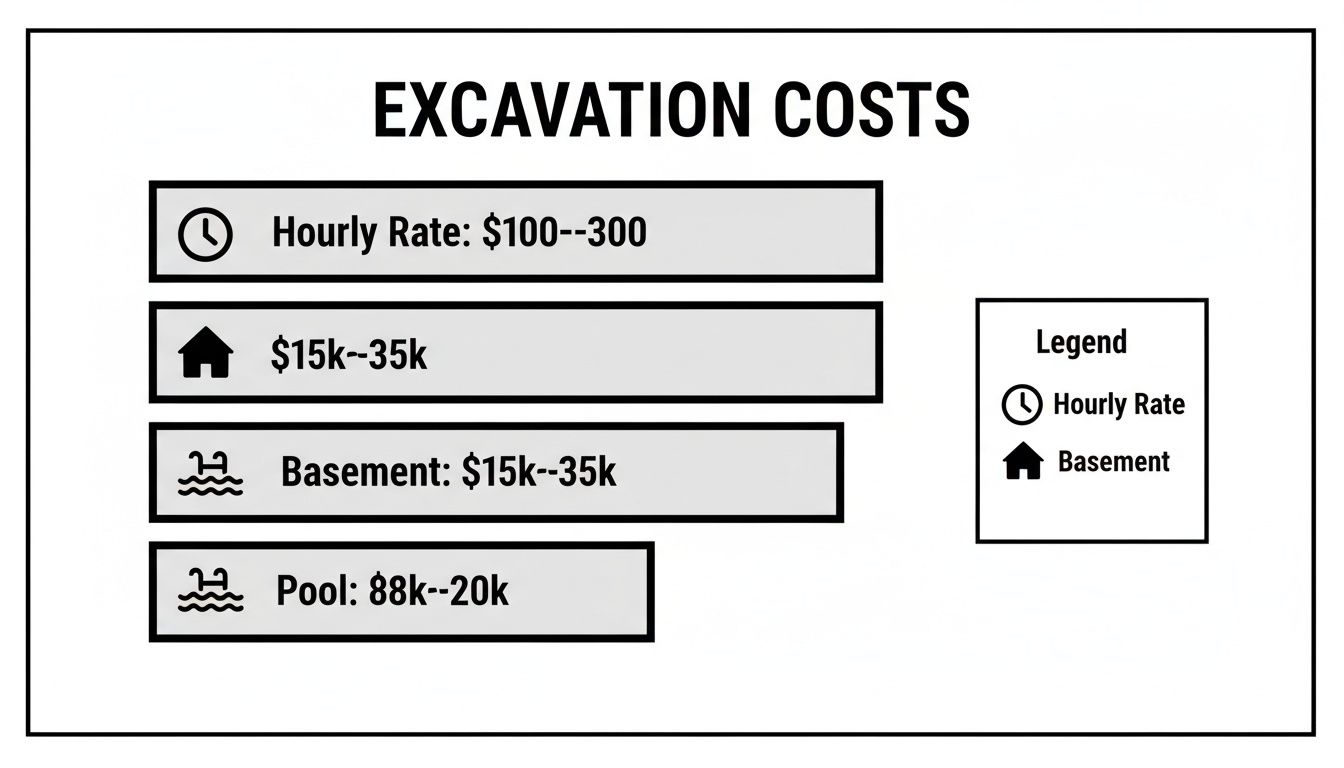
As you can see, costs for big jobs like basements and pools are much higher than a simple hourly rate. That’s because they reflect the massive volume of earth being moved and all the complexities that go with it. These local figures are a great starting point, but it's also helpful to see how we compare nationally.
In 2025, the average cost to excavate across the U.S. is between $100 and $300 per hour, but that number can swing wildly based on the region and the work itself. For example, Texas rates often run from $175 to $400 per hour—a 15% to 25% jump over the national average. This is thanks to tough soil conditions like caliche and expansive clay, plus a red-hot construction market. In Florida, by contrast, the sandy, easy-to-dig soil often results in lower hourly rates, sometimes starting as low as $80 per hour for basic work.
Key Takeaway: When you're budgeting, remember it’s about more than just the digging. The total estimate includes labor, the cost of running heavy equipment, and the huge logistical task of hauling away hundreds or even thousands of cubic yards of soil.
Want to see how these costs translate into real-world results? Take a look at a gallery of our completed excavation projects across the Atlanta area.
In the next sections, we'll dig even deeper into these numbers, breaking down exactly what goes into a fair and accurate excavation quote.
Making Sense of Your Excavation Quote
Getting an excavation quote can sometimes feel like trying to decipher a secret code. It’s a list of terms and numbers that don't always mean much at first glance. But once you understand what each line item represents, the total price starts to make perfect sense. It’s the key to knowing exactly where your money is going.
Think of it like getting a detailed receipt from a mechanic. You don’t just see the final price; you see the cost for parts, the hourly labor rate, and maybe even a fee for shop supplies. For example, a quote might list "Excavator Rental: 8 hours @ $150/hr" and "Operator Labor: 8 hours @ $75/hr" as separate line items. Breaking down an excavation quote demystifies the cost to excavate and puts you in a much better position to talk intelligently with your contractor.

The Team and The Tools
The two most significant and easy-to-understand costs are labor and equipment. Labor isn't just about having a person on-site; it’s about paying for the skill and experience of a professional operator who can run heavy machinery safely and efficiently. Their expertise is what keeps the project on track, and their hourly rates—often between $40 and $100 per hour—reflect that.
The machinery itself is the other big-ticket item. These are massive, expensive pieces of equipment that require constant maintenance and a lot of fuel to run. The specific machines needed for your job will heavily influence this part of the quote.
- Mini-Excavator: If you're digging a pool in a tight Roswell backyard, this smaller machine is perfect. It can get into confined spaces without tearing up your whole yard.
- Heavy-Duty Excavator: For a large commercial site in Alpharetta, you'll need the big guns. A larger excavator can move a massive amount of dirt in a short amount of time.
- Dump Trucks: These are the unsung heroes of any dig. The more dirt you move, the more trucks you'll need to haul it all away. A typical tri-axle dump truck, for example, can hold about 12-15 cubic yards of soil.
Ultimately, the scale of your project and the accessibility of your property will dictate what kind of iron shows up on site.
The Ground Beneath Your Feet: Dealing with Georgia Clay
Here in Georgia, we know that not all dirt is the same. Our famous red clay is dense, heavy, and can be a real pain to dig through. It takes more power, more time, and more fuel to excavate clay compared to looser, sandy soils. That extra effort translates directly to higher costs.
On the other hand, if your property has loamy or sandy soil, the job will go much faster and more smoothly. If the crew hits a lot of rock, that’s another challenge altogether, often requiring special hydraulic breakers to get through. A good contractor will always check your soil conditions first, because this single factor can dramatically change the project's timeline and budget.
Here's a simple way to think about it: Imagine trying to dig a hole at the beach with a kid's plastic shovel. The dry sand is easy. Now, picture trying to use that same shovel in a pit of wet, sticky clay after a rainstorm. It's a completely different level of effort, right? Heavy machinery feels that same difference.
This is exactly why there’s no such thing as a one-size-fits-all price for excavation. The ground itself has a lot to say about the final cost.
Getting Rid of the Dirt: Haul-Off and Disposal
One of the most commonly overlooked costs is what happens to all the earth after it’s been dug up. You can't just leave a mountain of dirt on the curb. Every cubic yard of soil, especially our heavy clay, weighs thousands of pounds, and getting it off your property is a serious logistical step.
Think of it as a "reverse delivery fee." Instead of paying for a truck to bring something to you, you’re paying for multiple trucks to take something away. This line item on your quote covers a few key things:
- Loading: The time and labor it takes to load all that dirt into the dump trucks.
- Transportation: The fuel and driver's time to get the material from your site to a proper disposal facility.
- Dumping Fees: The actual cost the facility charges to accept the soil. For example, some local landfills might charge $30-$50 per ton for clean fill.
A simple basement dig can easily generate over 200 cubic yards of soil, which could mean dozens of round trips for a dump truck. It's a huge part of the job that can't be ignored. By understanding these individual pieces, your quote becomes less of an intimidating document and more of a clear, logical roadmap for your project.
How Your Project's Goals Drive Excavation Costs
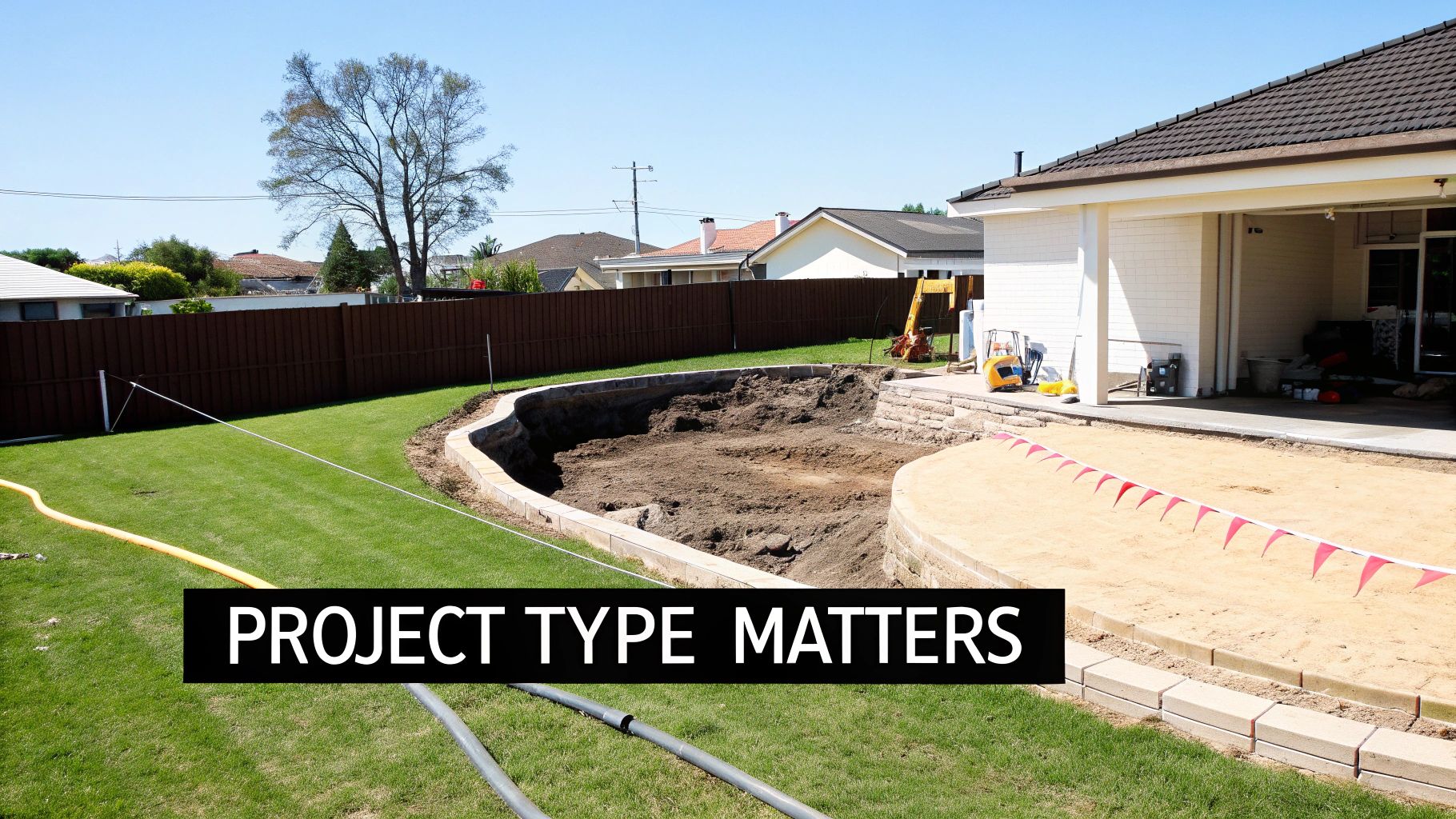
The word "excavation" might bring to mind a simple image of digging a hole, but in reality, it's a lot more nuanced. The why behind the dig—your project's specific goal—is the single biggest factor dictating the equipment, techniques, and time needed to get the job done. This, of course, has a direct impact on the final cost to excavate.
Think of it this way: one job might need the brute force of a sledgehammer, while another requires the delicate precision of a scalpel. Understanding these key differences is the first step to building a realistic budget for your Atlanta-area project.
This kind of groundwork is the engine of the entire construction industry. Globally, the excavation and demolition market is expected to grow from $527.54 billion in 2024 to $539.7 billion in 2025 alone. It’s part of a much larger construction sector valued at $11.4 trillion in 2024, which is forecasted to grow at a 5-6% rate through 2030. If you're interested in the big picture, you can read the full report on construction growth and economic concerns from industry experts.
New Home Foundations: Precision is Everything
When we’re digging for a new home foundation or basement, there is absolutely zero room for error. This isn’t just about making a big hole in the ground; it's about creating a perfectly level, precisely measured base that will support the entire weight of a house for the next century.
The costs here are driven by that need for exactness. Our operators have to follow the architectural plans to the inch, making sure every corner is square and the depth is perfectly uniform.
Consider this: If a foundation dig is off by just a few inches, it creates a domino effect of problems. Concrete forms won't fit, plumbing lines will be misaligned, and the framing will be thrown off. The cost of getting it right the first time is a fraction of what it costs to fix these kinds of mistakes later.
For a new home build in a Marietta suburb, this means slower, more methodical work with constant measurements and careful grading—all of which adds to the project's labor hours.
Swimming Pools: Navigating Shapes and Tight Spaces
Digging a swimming pool comes with a completely different set of hurdles, especially in established Atlanta neighborhoods. Pool designs are rarely simple rectangles. They often have freeform curves, multiple depths, and very specific slopes.
The biggest cost drivers for pool excavation usually come down to logistics.
- Complex Shapes: An operator can’t just dig in a straight line. They have to carefully sculpt the earth to match the pool’s design, which takes significantly more time and skill.
- Tight Access: Many backyards in areas like Decatur or Roswell weren't built with heavy equipment in mind. This often means we have to use smaller mini-excavators that, while nimble, move less dirt per scoop and extend the project's timeline.
- Utility Lines: Backyards are a maze of hidden utility lines for gas, water, and power. Finding them and digging around them is a slow, careful process where a single mistake can be costly.
A kidney-shaped pool, for example, will almost always cost more to excavate than a rectangular one of the same size, simply because of the extra machine and operator time required to create those gentle curves.
Driveway Removal: It’s All About Brute Force and Volume
When it's time to tear out an old concrete or asphalt driveway, precision takes a backseat to raw power and efficiency. The goal is simple: break up the old material and haul it away as fast as possible. This is where we bring in the heavy-hitters like skid steers with powerful breaker attachments and large loaders.
Here, the cost to excavate is shaped by two things:
- Material Thickness: A thick, rebar-reinforced concrete driveway is a beast to break up compared to a thin layer of old asphalt. For example, a 6-inch thick driveway with wire mesh will take significantly longer to demolish than a 4-inch one with no reinforcement.
- Debris Volume: You're not just paying for the demolition; you're paying to haul away tons of heavy debris. The bigger the driveway, the more dump truck loads are needed, which adds to both transportation and disposal fees.
On a job like this, it's all about moving quickly. The faster the crew can clear the site, the lower the final cost will be.
Utility Trenching: A Game of Inches
Digging a narrow trench for a water line or electrical conduit might seem straightforward, but it’s another task where precision is king. The crew has to dig to an exact depth and maintain a specific grade. A sewer line, for instance, needs a consistent downward slope of about a quarter-inch per foot to let gravity do its job.
The biggest variable here is risk. Hitting a buried gas line or fiber optic cable is a nightmare scenario that can lead to dangerous situations and incredibly expensive repairs. This means operators have to spend time locating existing utilities and digging with extreme caution, which turns a seemingly small job into a meticulous process.
Excavation Cost Factors By Project Type In Atlanta
To see how these differences play out, here’s a quick comparison of what drives costs for the most common excavation projects we see around Atlanta.
| Project Type | Primary Cost Driver | Typical Equipment | Common Atlanta Challenge |
|---|---|---|---|
| New Home Foundation | Precision & Accuracy: Leveling and dimensions must be perfect. | Large Excavator, Laser Level, Grader | Hitting unexpected rock or hardpan Georgia clay that requires special equipment. |
| Swimming Pool | Access & Shape: Tight backyards and complex curves add time. | Mini-Excavator, Skid Steer | Limited backyard access in older neighborhoods like Virginia-Highland. |
| Driveway Removal | Volume & Haul-Off: The amount of heavy debris to be removed. | Skid Steer with Breaker, Front Loader, Dump Truck | Disposal fees for concrete and asphalt, which can vary by landfill. |
| Utility Trenching | Risk & Obstructions: Avoiding existing underground lines is critical. | Mini-Excavator, Trenching Machine | Navigating a web of unmarked or poorly documented utility lines in dense areas. |
As you can see, no two excavation jobs are alike. The "why" behind the dig sets the stage for everything that follows, from the tools we use to the challenges we anticipate.
Putting It All Together: Real Atlanta Excavation Scenarios
Knowing the cost factors is one thing, but seeing them play out on a real job site is how it all starts to click. Let's move from theory to practice and walk through three common projects we see every day here in the Atlanta metro area.
Think of these as real-world blueprints. They'll show you exactly how the volume of dirt, the ease of access, and the required precision all stir the pot to create the final price tag for your excavation.
Scenario 1: The Marietta Basement Dig
Let's start with a classic new home build in a Marietta suburb. You've got plans for a 1,200-square-foot basement that needs to be dug 8 feet deep. The best part? It's a wide-open lot, so we can bring in the big machinery without a problem.
Here’s a peek at how a contractor breaks this down:
-
Figure Out the Volume: First things first, we need to know how much dirt we're actually moving. The math is simple: Length x Width x Depth.
- 40 feet (Length) x 30 feet (Width) x 8 feet (Depth) = 9,600 cubic feet
-
Convert to Cubic Yards: In our world, everything is priced by the cubic yard. To get there, we just divide the cubic feet by 27.
- 9,600 cubic feet / 27 = approximately 355 cubic yards
-
Run the Numbers: Now, we can apply typical Atlanta-area pricing.
- Excavation Cost: 355 cubic yards at roughly $50/yard comes to $17,750.
- Haul-Off & Disposal: Getting rid of that dirt costs about $20/yard, adding another $7,100.
- Estimated Total: You're looking at around $24,850.
This is a pretty straightforward job where the sheer volume of soil is the main driver of the cost. The easy access keeps the per-yard price right in the sweet spot. If you want to dive deeper into foundation work, you can learn more about laying a reliable foundation for residential projects here.
Scenario 2: The Alpharetta Pool with Tricky Access
Next up, imagine a beautiful kidney-shaped pool going into an established Alpharetta backyard. The pool is about 600 square feet with an average depth of 5 feet. Here's the catch: the only way in is through a narrow side gate.
That single detail changes everything. The big, efficient excavator we used in Marietta won't fit. We have to use a smaller, pricier mini-excavator, which means the job will take a lot longer.
The Key Takeaway: It’s not just about how much dirt you move, but how you move it. A smaller machine can easily double the labor hours and equipment run-time, bumping up the cost per yard, even on a smaller job.
Let’s see how that impacts the estimate:
- Volume: Around 111 cubic yards.
- Excavation Cost (with tight access premium): That per-yard price jumps to around $75/yard, making it $8,325.
- Haul-Off & Disposal (slower loading): The slower process nudges this up to $25/yard, for a total of $2,775.
- Estimated Total: About $11,100.
See the difference? We're moving less than a third of the dirt from the basement scenario, but the logistical hurdles and extra time on site make the per-yard cost significantly higher.
Scenario 3: The Decatur Utility Trench
Finally, let's look at a much smaller, more precise job: digging a 150-foot-long trench for a new sewer line in a Decatur neighborhood. The trench only needs to be 2 feet wide and 4 feet deep.
- Calculate the Volume: 150 ft (L) x 2 ft (W) x 4 ft (D) = 1,200 cubic feet. After dividing by 27, we get a mere 44 cubic yards.
For a job this small and specialized, no contractor is going to price it by the yard. It just doesn't make sense. Instead, you'll almost certainly be quoted a flat day rate. This covers the specialized trenching machine, the operator's skill, and the high-stakes work of digging near existing utility lines.
- Labor & Equipment (Day Rate): For a mini-excavator with a trenching bucket and a skilled operator, expect to pay $1,200 – $1,800 for the day.
- Haul-Off: Often, the excavated dirt is used to backfill the trench once the pipe is laid, so disposal costs are often zero.
- Estimated Total: Around $1,500.
In this situation, the price isn't about volume at all. It's driven entirely by the need for precision, specialized equipment, and the operator's expertise. These examples show you that every project really is its own unique puzzle of volume, access, and complexity.
Smart Ways To Manage Your Excavation Budget
Let's be clear: managing your excavation budget isn't about cutting corners. It's about smart planning and making sure you and your contractor are on the same page from day one. A few strategic decisions can keep your project on track and prevent costs from spiraling, without ever compromising the quality of the work.
These are a few practical tips, especially useful for projects here in the Atlanta area, that can have a real impact on your final invoice. It all boils down to being prepared and thinking ahead about how to handle the dirt that gets moved.
Prepare The Site Yourself
Here’s an easy win. One of the simplest ways to knock a few dollars off the cost to excavate is to do some of the initial site prep on your own. Every minute an equipment operator spends clearing junk out of the way is a minute you're paying for. If you can clear the path for them, they can get right to work on the actual digging.
Before the crew shows up, spend a little time doing the following:
- Clear Debris: Pick up any loose rocks, fallen branches, old lawn furniture, or kids' toys in the project zone.
- Handle Vegetation: A freshly mowed lawn and trimmed-back shrubs make a world of difference for visibility and access.
- Mark Obstacles: Use bright flags to mark anything you don't want to be run over, like sprinkler heads, shallow utility lines, or landscape lighting.
Think of it this way: a small amount of your own sweat equity can save you real money in labor costs. For example, if it takes the crew an hour to clear the site at a rate of $200/hr, that's $200 you could have saved by doing it yourself on a Saturday afternoon.
Discuss Reusing Excavated Soil
Hauling away truckload after truckload of Georgia red clay is a significant cost driver on almost any excavation job. But what if you didn't have to haul it all away? It's always worth asking your contractor if some of that excavated soil can be repurposed right there on your property.
This is a brilliant move if you have other landscaping projects on your to-do list.
For example, the dirt from a new foundation dig could be perfect for leveling out a sloped section of your backyard. You could use it to build up landscape berms for added privacy or create a raised bed for a future garden. This one conversation could save you thousands in trucking and disposal fees.
You’re essentially turning a "waste" product into a valuable asset, cutting your costs while simultaneously improving another part of your property.
Schedule During The Right Season
Anyone who has lived in Georgia for a while knows our weather can be unpredictable. When you can, try to schedule your excavation work during the drier months—think late spring or early fall. Rain isn't just an inconvenience; it can stop a project cold and lead to expensive delays.
When the ground is saturated, that clay becomes incredibly heavy and sticky. It’s much harder to dig, slows down the equipment, and costs more to haul. For instance, a dump truck that could legally haul 15 tons of dry soil might only be able to haul 12 tons of wet, saturated soil, increasing the number of trips needed. By aiming for a dry window, you’re not just avoiding a muddy mess; you're actively protecting your budget and your timeline from mother nature.
How To Choose The Right Atlanta Excavation Contractor
Picking the right partner for your project is just as important as nailing down the budget. The success of your dig—and everything built on top of it—really comes down to the skill and reliability of the contractor you bring on board. Making a smart choice here is the best way to ensure the final cost to excavate matches the initial quote and you don't get hit with nasty surprises later.
Hiring a contractor isn't just a race to the bottom on price. You're looking for a team with a solid local track record, the right insurance coverage, and a clear, well-thought-out plan for your specific job. It's like picking a pilot; you want someone with enough flight hours to handle a little turbulence if it pops up.

Key Questions To Ask Before Signing A Contract
To help you sort the pros from the rest, here are the essential questions you should be asking. The quality of their answers will tell you everything you need to know about their experience and professionalism. A contractor who knows their stuff will have no problem answering every single one.
-
Are you fully licensed and insured in Georgia? This one’s a deal-breaker. Always ask to see proof of their general liability insurance and workers' compensation. This is what protects you from any liability if an accident happens on your property.
-
Can you provide some local references? A good company will have a trail of happy clients right here in the Atlanta area. Ask for contacts from projects similar in scope to yours, and actually take a few minutes to call them. For example, if you're planning a pool, ask for references from other pool excavation jobs they've completed.
-
How do you handle surprises? What happens if the crew unearths a massive slab of granite or an old, forgotten septic tank? A true professional has a protocol: they stop work, they call you, and they clearly explain how this discovery impacts the cost and timeline before moving forward.
-
Who is responsible for getting the permits? The contractor should be the one to handle all the necessary permits with your city or county, whether you're in Fulton, DeKalb, or Gwinnett. This isn't an extra—it's a fundamental part of the service that ensures all work is done legally and to code.
Digging Deeper Into Their Reputation
Once you’ve gone through the checklist, take a moment to look into the company's background. How long have they been working in the Atlanta community? What do they stand for? For example, you can see our dedication to quality and client satisfaction by reading the story behind Atlanta Concrete Solutions.
Expert Insight: Never, ever accept a quote over the phone. A serious contractor will always insist on visiting your property first. They need to see the soil, check the access points, and spot potential obstacles with their own eyes to give you a detailed, written estimate that's actually worth something.
That on-site visit is the mark of a pro who cares about getting the price right from the get-go.
Making Your Final Decision
At the end of the day, you're looking for a partner who communicates clearly, operates with transparency, and has the local experience to see problems coming and solve them. By asking these direct questions upfront, you put yourself in the driver's seat. A little due diligence now is the best investment you can make to ensure your project starts on solid ground and finishes on budget.
Got Questions About Excavation? We've Got Answers.
Even after you've crunched the numbers, it's completely normal to have a few questions rolling around in your head before the first scoop of dirt is moved. Getting a handle on the details is what gives you the confidence to start your project on the right foot. We get these questions all the time from homeowners across the Atlanta area, so let's tackle them head-on.
Think of this as the final checklist to make sure there are no surprises with your project's timeline, budget, or the paperwork involved.
Project Timelines and Permitting
Let’s start with the big one: "How long is this going to take?" It’s a fair question, as the excavation timeline sets the pace for everything that follows.
How long does a typical residential excavation take?
For most standard home projects—think digging a basement or a new swimming pool—we're usually looking at a timeframe of one to three days of machine work. But that's just a starting point. The real answer depends on the specifics. The size and depth of the hole, wrestling with that dense Georgia red clay, or hitting unexpected rock can definitely add time.
A simple trench for a utility line might be done in a few hours. A large, complex foundation for a custom home could push a week or more. Any good contractor will give you a realistic timeline upfront in their proposal, factoring in what they know about your property.
Do I need a permit for excavation in Atlanta?
The short answer is: almost certainly, yes. If you're digging for a new foundation, pool, or a major addition, you will need a permit from your local city or county office, whether that's Fulton, DeKalb, Cobb, or Gwinnett. Minor work like digging fence post holes or small landscaping projects typically does not require a permit.
Permits aren't just red tape; they're there to make sure the work is done safely and meets all the local building codes and zoning rules. A professional, trustworthy contractor won't even ask you to handle this—they’ll manage the entire permitting process as part of their service. It’s just how it’s done.
Handling Unexpected Discoveries
You never really know what's buried in your yard until you start digging. How a contractor deals with the unexpected is what separates the pros from the amateurs.
What happens if you find unexpected things during the dig?
This is a fantastic and crucial question. Any excavation crew with real-world experience has a plan for this. We've seen it all: massive granite boulders, remnants of old foundations, and improperly marked utility lines. The moment something unexpected turns up, the machines stop. Safety first, always.
Your contractor should immediately contact you, explain exactly what they've found, and lay out a clear plan for how to deal with it, including any impact on the cost. For example, they might say, "We've hit a large granite boulder. We can bring in a hydraulic breaker for an additional $1,500, which will add a day to the schedule, or we can try to dig around it, which may alter the foundation footprint. Which would you prefer?" You should approve any changes before work continues. In these situations, transparency is non-negotiable.
Ready to start your project on solid ground? The team at Atlanta Concrete Solutions has the local expertise and professional equipment to handle any excavation job, big or small. Contact us today for a free, no-obligation quote and let's discuss your project.