
It’s one of the most common mix-ups in the world of construction, and you hear it all the time: people talking about their "cement driveway" or a "cement sidewalk." While everyone knows what they mean, the reality is that cement and concrete are two completely different things.
Think of it like baking a cake. Cement is the flour—a critical ingredient, but not the final product. Concrete is the finished cake—the strong, durable material you actually build with. You can’t have the cake without the flour, but you’d never call the cake "flour." For example, a baker might use King Arthur brand flour (the cement) to bake a red velvet cake (the concrete).
Understanding Cement Vs. Concrete: The Core Relationship
At its heart, the relationship is simple: cement is the key active ingredient that makes concrete work. On its own, cement is just a fine, grayish powder. But when you mix it with water and other materials, it transforms into the rock-solid substance we rely on for everything from skyscrapers to backyard patios.
The real magic happens when you create the complete concrete mix. It’s a precise recipe that combines a few key components:
- Cement: The binding agent, or the "glue," that holds everything together. Its job is to react with water and coat all the other materials.
- Water: The catalyst that triggers a chemical reaction in the cement called hydration, causing it to harden and gain strength. For example, a typical mix might use about 3 gallons of water for every 94-pound bag of cement.
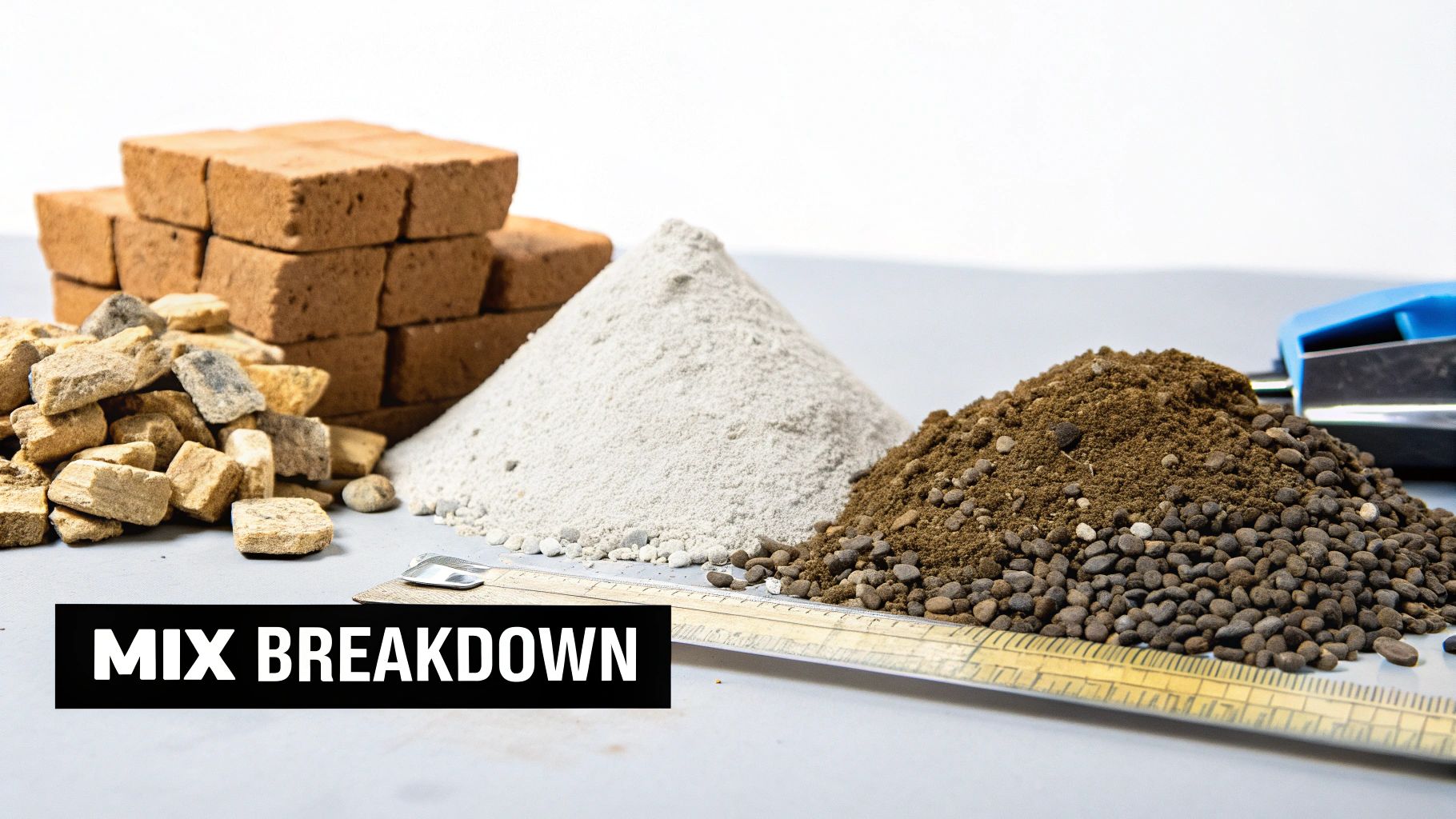
- Aggregates: This is the real substance of concrete. It includes fine aggregates (like sand) and coarse aggregates (like gravel or crushed stone) that provide bulk, stability, and compressive strength.
This simple visual breaks down that core difference perfectly.
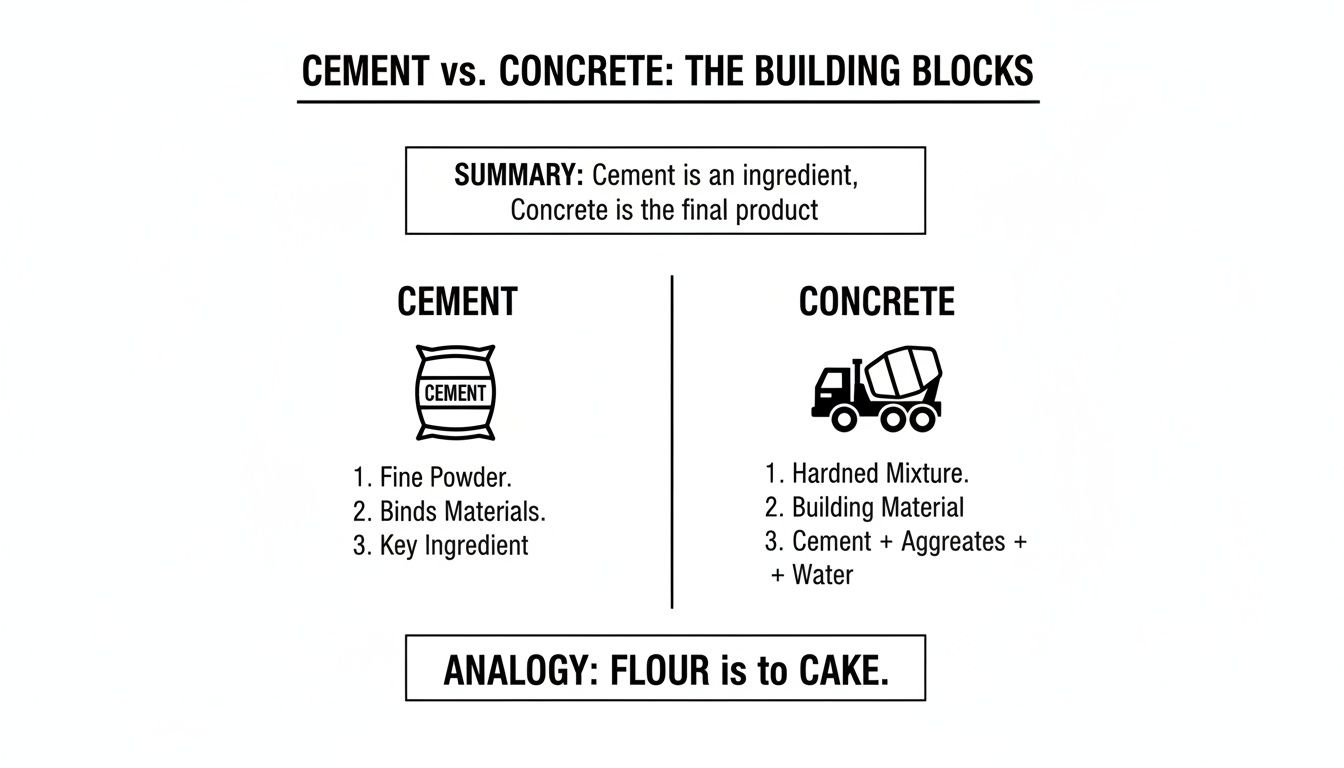
The infographic nails the key distinction: cement is just an input, while concrete is the complete structural material. Getting this right is fundamental to any successful project. In fact, the quality of professional Atlanta concrete work depends entirely on mastering the right blend of high-quality cement, aggregates, and water.
Key Takeaway: You can walk into any hardware store and buy a bag of cement powder. You can't buy a "bag of concrete." Concrete is always a mixture, whether it's mixed by hand on-site for a small repair or delivered ready-to-pour from a truck. For instance, a small bag of QUIKRETE® Fast-Setting Concrete Mix is a pre-blended mix of cement, sand, and gravel—you just add water to create concrete.
To make this even clearer, here's a quick side-by-side breakdown of the essentials.
Cement vs. Concrete at a Glance
This table simplifies the foundational differences between the two materials.
| Attribute | Cement | Concrete |
|---|---|---|
| Basic Definition | A fine, dry powder that acts as a binding agent when mixed with water. | A composite building material made from cement, water, and aggregates. |
| Primary Components | Limestone, clay, shells, and other minerals superheated and ground. | Cement, water, sand, and gravel or crushed stone. |
| Physical State | A dry powder until mixed with water. | A plastic, workable slurry when wet; a hard, solid mass when cured. |
| Example Use | Main active ingredient in mortar for bricklaying. | Building a foundation slab, a driveway, or a bridge. |
Seeing them laid out like this really highlights that one is a single, processed ingredient, while the other is the finished, multi-component building material.
A Closer Look at What's Inside: Cement vs. Concrete Composition
To really get to the bottom of the cement vs. concrete confusion, you have to look at what they're made of. It all starts with cement, a man-made powder that’s basically the "super glue" in the final concrete mix. But it's not just some simple dust—its creation is a serious, high-temperature industrial affair.
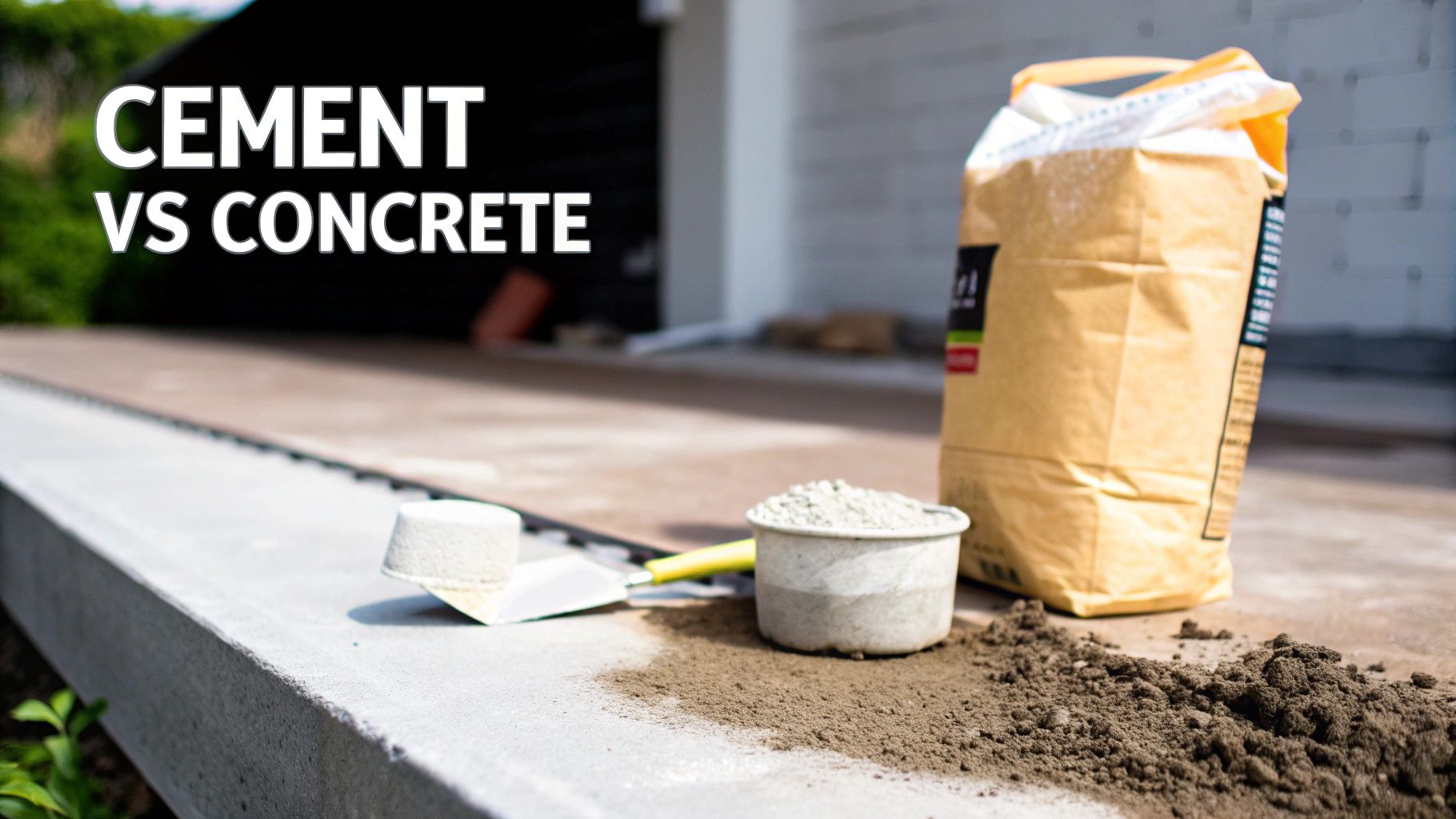
The process kicks off with raw materials like limestone, clay, shells, and silica sand. These ingredients are tossed into a giant rotating kiln and blasted with heat, often getting cooked at temperatures over 2,640°F (1,450°C). This intense heat triggers chemical reactions, creating little marble-sized pellets called clinker. Once cooled, the clinker is ground into the fine gray powder we all recognize as Portland cement, which is the go-to type used just about everywhere.
What Exactly Is in Cement?
The magic of cement is all in its chemistry. That specific recipe is what gives it the power to bind everything together.
The main ingredients are:
- Limestone: The star of the show, providing calcium carbonate. It often makes up 80% or more of the raw mix.
- Clay and Shale: These bring silica, alumina, and iron oxide to the party.
- Gypsum: A small amount is added at the end to regulate how quickly the concrete sets. Without it, the mix might harden too fast to be workable.
Without this carefully engineered, heat-treated blend, cement couldn't kick off the hydration process—the chemical reaction with water that gives concrete its incredible strength.
The most fundamental difference is one of ingredients and scale. Cement is the binding powder made from limestone and clay. Concrete is the final building material you get when you mix that cement with sand, gravel, and water. Just to give you an idea of its importance, global cement production hit 4.1 billion metric tons, with China alone producing 2.1 billion metric tons—more than 50% of the entire world's supply. It's truly the foundation of modern construction.
The Recipe for Concrete
So, now that we have our "glue," let's talk about the final product. Concrete isn't one thing; it's a composite material. Think of it as a recipe where the precise proportions of each ingredient dictate the final strength, workability, and lifespan of the structure.
A typical concrete mix breaks down like this:
- Portland Cement: The active ingredient, but it only makes up about 10% to 15% of the total volume.
- Aggregates: These are the fillers, making up the bulk of the mix at 60% to 75%. This includes fine aggregates (sand) and coarse aggregates (gravel or crushed stone).
- Water: This is the catalyst. When mixed with cement, it creates a paste that coats all the aggregates and hardens, locking everything together.
- Air: Believe it or not, tiny air bubbles are often intentionally added, taking up 5% to 8% of the volume to help the concrete withstand freeze-thaw cycles without cracking.
For jobs with unique demands, we also use admixtures. These are special additives that can tweak the concrete's behavior. For example, a "superplasticizer" might be added to increase fluidity for pouring into complex forms, or a "retarder" might be used on a hot day to slow down the curing time. Need it to stay workable longer on a hot summer day or flow easily into intricate residential poured concrete forms? There are admixtures for that, too. This ability to customize the mix is what makes concrete such a versatile and trusted building material.
Comparing Strength and Durability
When you get down to brass tacks, the functional difference between cement and concrete is night and day. A pile of cement powder on its own has zero structural integrity. Its real power is unleashed only when you add water, kicking off a chemical reaction called hydration.
This reaction turns the powder into a paste, which then acts as a super-glue, coating and binding aggregates like sand and gravel together into a rock-solid mass. This is the secret behind the immense compressive strength that concrete is famous for, allowing it to hold up everything from buildings and bridges to the F-150 parked in your driveway.
Compressive Strength vs. Tensile Strength
To really appreciate what concrete can do, you need to understand its two core strengths—or in one case, its weakness. This is where the material truly defines itself.
- Compressive Strength: This is concrete's superpower. It’s a measure of how well it resists being squashed. Because the aggregates are locked so tightly together, a typical residential concrete mix can handle pressures of 3,000 to 4,000 pounds per square inch (PSI). For example, a 4,000 PSI mix is standard for a home driveway that needs to support cars and trucks.
- Tensile Strength: On the flip side, this is concrete’s Achilles' heel. It refers to the material’s ability to resist being pulled apart. Concrete is notoriously bad at this, possessing only about 10% of its compressive strength in tension. That’s why it cracks when it bends or the ground beneath it shifts. A simple example is an unsupported concrete beam cracking in the middle from its own weight.
This fundamental imbalance is exactly why you see steel rebar and wire mesh inside concrete slabs. The steel provides the tensile strength that concrete is missing, creating a composite material that can handle being pushed, pulled, and bent. Cement, by itself, offers none of these properties.
The Critical Role of the Water-to-Cement Ratio
If there's one thing that makes or breaks the quality of concrete, it's the water-to-cement ratio. Getting this right is a delicate dance. You need enough water to start the hydration process and make the mix workable, but every drop you add beyond that point weakens the final product.
A low water-to-cement ratio makes stronger, more durable concrete because it minimizes the number of pores in the hardened material. Too much water creates a weaker, porous structure that's an open invitation for weather damage and wear.
Think about it this way: adding just one extra gallon of water to a cubic yard of concrete can slash its compressive strength by up to 200 PSI and increase the likelihood of shrinkage cracks. This is why professional contractors are so meticulous about their mix designs—they aim for the lowest water content possible while ensuring the concrete can still be placed and finished correctly.
Engineering Concrete for Durability
Beyond sheer strength, concrete can be engineered for specific environmental threats, a feat cement alone can't accomplish. Here in Atlanta, we have to contend with the dreaded freeze-thaw cycle.
When water gets into the tiny pores of concrete, freezes, and expands, it can cause the surface to flake off (scaling) or create deep cracks. To prevent this, pros use air-entraining admixtures. These special additives create billions of microscopic air bubbles throughout the mix. Now, when water freezes, the expanding ice has a place to go—into these tiny pockets—instead of blowing the concrete apart from the inside. This simple trick dramatically boosts the long-term durability of our driveways, patios, and sidewalks.
Practical Uses: Where Each Material Belongs
Knowing the technical difference between cement and concrete is one thing, but seeing where each one truly belongs in the real world makes it all click. Think of it this way: cement is rarely the hero of the story. Instead, it’s the essential supporting actor—the binder that makes other materials perform.
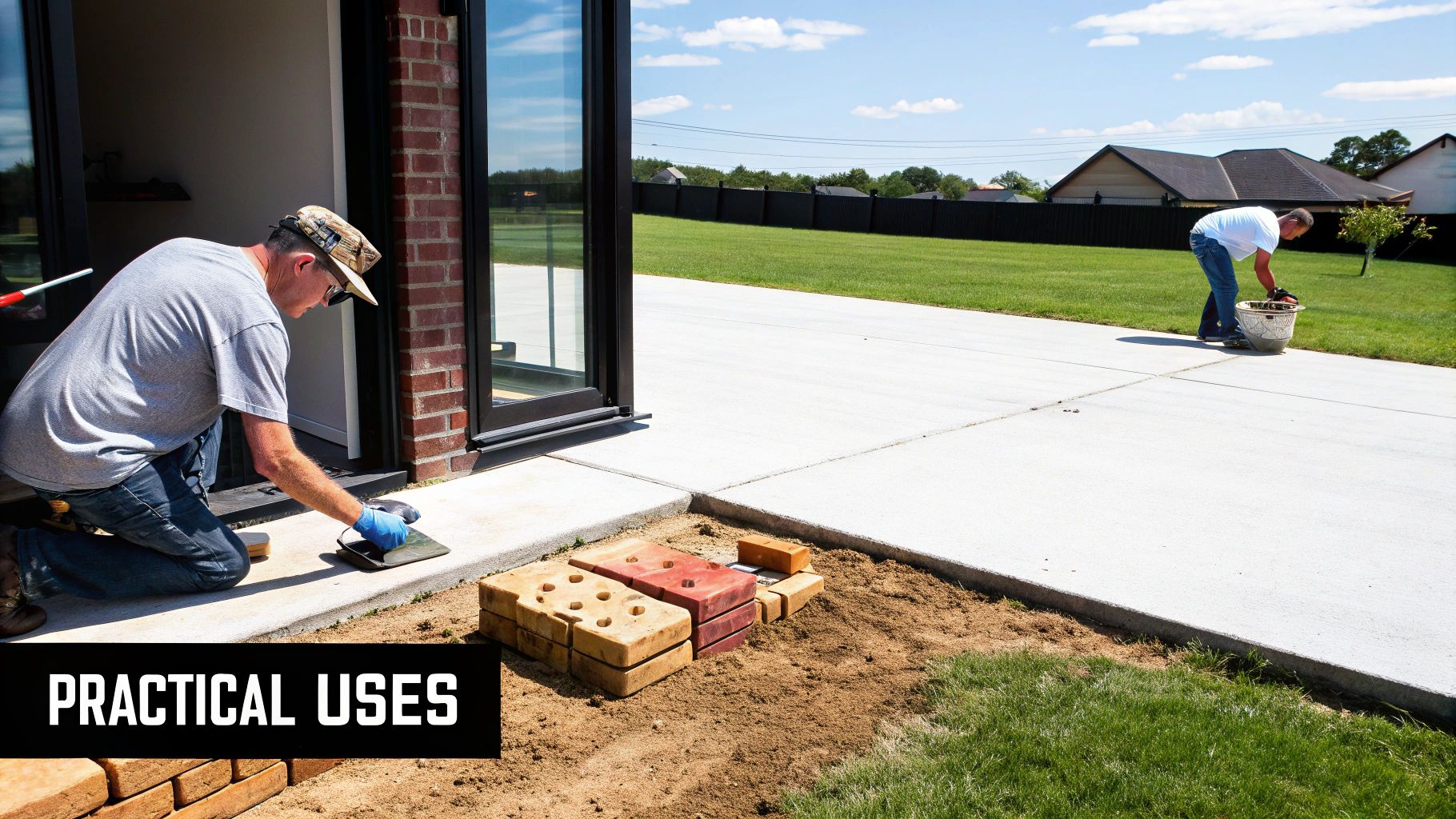
You’ll find cement as the key active ingredient in mortars, grouts, and other products designed for bonding things together. It’s the stuff holding bricks together in a wall or neatly filling the gaps between your bathroom tiles. In these roles, cement’s only job is to create a powerful, adhesive paste that turns individual pieces into one solid structure.
Cement: The Ultimate Binder
Cement’s true power is in its ability to bind other materials, not in being a structural giant on its own. Its applications are specialized and precise.
- Mortar: This is a simple mix of cement, fine sand, and water. It's the "glue" for masonry work. It doesn’t need the immense compressive strength of concrete, just enough to hold bricks, blocks, and stones together securely. For example, the joints you see between bricks on a house are filled with mortar.
- Grout: Very similar to mortar but with more water to make it flowable, grout is designed to pour into and fill gaps. It’s perfect for tiling projects, where it locks every tile in place and keeps moisture out. An example is the material filling the spaces between your kitchen backsplash tiles.
- Stucco: A plaster-like material that relies on cement as a binder to create a durable, weather-resistant finish for exterior walls.
Concrete: The Structural Workhorse
When the job calls for strength, volume, and long-term durability, concrete is the undisputed champion. It's the final product you see and use every single day, forming the backbone of modern construction. From your home's foundation to massive skyscrapers, concrete’s versatility is simply unmatched.
The modern distinction between the two was really cemented (pun intended) with the invention of Portland cement back in 1824. That breakthrough turned cement into the reliable, consistent binding agent that made massive concrete structures possible. Today, global cement capacity has soared to 5.5 billion tonnes annually, all to feed the world's insatiable demand for strong, durable concrete.
Because concrete is a composite material, it can be poured into virtually any shape. This makes it the go-to choice for everything from simple flatwork to complex architectural forms. Its strength comes from the combined power of cement, aggregates, and water working together.
This adaptability has led to a huge range of uses far beyond basic construction. For most homeowners, the most common and visible application is the driveway. A properly poured slab gives you a tough surface that can handle daily traffic and harsh weather for decades. You can learn more about what goes into a top-notch installation in our guide on residential concrete driveways.
But concrete isn't just about pure function anymore. It has a decorative side, too. For example, stamped concrete can mimic high-end materials like slate, stone, or brick for a patio. Polished concrete floors offer a sleek, modern look for interior spaces, and custom concrete countertops have become a popular, stylish choice in kitchen design. It's proof that a material can be both incredibly strong and surprisingly beautiful.
Cost and Environmental Considerations
Beyond their physical differences, cement and concrete have vastly different stories when it comes to cost, long-term upkeep, and environmental impact. Getting a handle on these factors is key to making the right call, whether you're tackling a small weekend project or managing a major construction build. The initial price tag on a bag of cement is just the tip of the iceberg.
At first glance, cement seems cheap. You can grab a 94 lb. bag of Portland cement for around $15. But remember, that's just one ingredient. The final cost of finished concrete is a whole different ballgame, factoring in the price of sand and gravel, water, any special additives, plus the heavy hitters: labor and delivery. That ready-mix truck pulling up to your job site represents a much bigger financial commitment than a few sacks of powder, with concrete often priced per cubic yard (e.g., $125-$150 per yard).
Analyzing the Economic and Maintenance Differences
The long-term costs also tell different tales. Unused cement just needs to be kept dry. A finished concrete slab, on the other hand, requires a bit of care to protect your investment over the years.
- Concrete Sealing: To keep water out and prevent stains and freeze-thaw damage, you’ll want to seal surfaces like driveways and patios every few years. It’s a crucial step for longevity. For example, applying a penetrating sealer can prevent de-icing salts from damaging the surface in winter.
- Crack Repair: Even the strongest concrete can crack. Filling those cracks quickly with a flexible sealant is essential to stop moisture from getting underneath and creating bigger problems down the road.
We also have to talk about safety. Working with either material involves health risks, and understanding the necessary Australian Personal Protective Equipment requirements is non-negotiable. Proper gear adds to the overall project cost, but it's a small price to pay to protect yourself and your crew from chemical burns and respiratory damage.
The scale of these two materials is massive, both financially and environmentally. Cement production is incredibly energy-intensive, but concrete itself can be used in versatile and sustainable ways. The global cement market is expected to hit USD 673.8 billion by 2033, yet it's concrete that truly drives the construction economy—its market is set to grow by USD 481.6 billion between 2025-2029 as infrastructure projects boom.
The Environmental Footprint and Green Innovations
When it comes to the environment, the conversation almost always starts with cement. Its production is a major contributor to global carbon emissions. The process requires heating limestone to extreme temperatures, which not only consumes a tremendous amount of energy but also releases huge quantities of CO2. In fact, the cement industry is responsible for roughly 8% of the world's total carbon emissions.
But it's not all bad news. The industry is pushing hard for greener solutions. "Green concrete" is no longer just a buzzword; it’s a real and growing field focused on slashing the environmental impact.
This is done by:
- Using recycled materials like crushed old concrete or glass as aggregates. An example is using recycled asphalt pavement (RAP) in new concrete mixes for road construction.
- Replacing a portion of the Portland cement with supplementary cementitious materials (SCMs). These include things like fly ash (a byproduct from burning coal) and slag (waste from making steel).
These innovations don't just reduce the carbon footprint. In many cases, they actually improve the final concrete's strength and durability, making modern concrete a much more sustainable and high-performing choice than it was just a decade ago.
Common Questions We Hear All the Time
Even after you get the basic difference between cement and concrete down, some practical questions always pop up, whether you're on a job site or just planning a weekend project at home. Nailing these details is often what separates a repair that lasts for years from one you'll have to redo next season. Let's clear up a few of the most common points of confusion.
Can I Just Use Cement and Water to Patch My Driveway?
Please don't. This is easily one of the biggest (and most costly) mistakes a homeowner can make. When you only mix cement and water, you get a brittle paste that has zero structural integrity. Sure, it'll get hard, but it's missing the crucial internal framework that aggregates provide.
Think about it this way: without sand and gravel to give it body and strength, a cement-only patch will crack and crumble the first time a car drives over it or a hard freeze hits. For any real repair job, you need a proper concrete mix that includes sand and gravel, or at the very least, a specialized mortar mix (which has sand) specifically designed for patching. A good example of the right product would be a vinyl concrete patcher, which is formulated for this exact purpose.
Pro Tip: Aggregates are the skeleton of concrete. A paste of just cement and water is the "glue" with no bones to hold it together. It simply can't stand up to any real pressure or tension.
So, What's the Difference Between Concrete and Mortar Then?
This is another frequent question, and the answer comes down to two things: the size of the aggregate and what you're trying to do with it. Both use cement to bind everything together, but the recipes are tweaked for totally different jobs.
- Concrete: This is the heavy-hitter. It uses both fine aggregate (sand) and coarse aggregate (gravel or crushed stone). Having both large and small stones creates an incredibly dense and strong final product, which is why we use it for structural things like foundations, slabs, and driveways. It’s built to take a beating.
- Mortar: This is more of a bonding agent. It only uses fine aggregate (sand) mixed with cement and water. The result is a much smoother, stickier paste perfect for holding bricks, blocks, or stones together. It’s not meant to bear a heavy load on its own; its job is to "glue" masonry units together to form a solid wall.
The easiest way to remember it? You build things with concrete (like a patio), but you stick things together with mortar (like the bricks for a fireplace).
How Long Does It Really Take for Concrete to Cure?
The way concrete hardens is a fascinating chemical process, and it takes a lot longer than most people realize. While it gets solid fairly fast, reaching its full, designed strength is a marathon, not a sprint.
Here’s a rough timeline of what to expect:
- Initial Set: Within the first few hours, the concrete will start to stiffen up. For example, after 2-4 hours, it may no longer be workable.
- Walk-On Hardness: You can usually walk on it carefully within 24 to 48 hours.
- Serious Strength: After the first 7 days, concrete has already gained about 70% of its final strength. This is why you can often start driving on a new driveway after about a week.
- Full Cure: From an engineering standpoint, concrete is considered fully cured and at its target compressive strength after 28 days. But the hydration process actually keeps going for months, even years, meaning the concrete continues to get slightly stronger over time.
Rushing this is a classic mistake. Putting heavy loads on new concrete before it's ready is the number one cause of premature cracks and damage. A little patience goes a long way.
Ready to start a project with a team that gets the science behind great concrete? Atlanta Concrete Solutions has the know-how to make sure your driveway, patio, or foundation is mixed, poured, and cured perfectly for a lifetime of strength. Get your free, no-obligation quote today!