
If you're wondering how long a concrete driveway should last, the straight answer is anywhere from 25 to 40 years. But that range comes with a big "if." For example, a professionally installed driveway in a moderate climate like Nashville might easily reach 40 years, while a poorly done DIY job in a harsh climate like Minneapolis could fail in under 15. The real lifespan of your driveway depends almost entirely on the quality of the installation, your local climate, and how well you take care of it over the years.
Think of it this way: your driveway is an investment, and the choices you make upfront and the care you provide over time will directly determine how well that investment pays off.
What the Numbers Really Mean
When an expert gives you a lifespan of 25 to 40 years, it's not a guarantee—it's a spectrum of possibility based on real-world conditions.
Picture two driveways poured on the very same day. The first one gets the full professional treatment: a solid, 6-inch compacted gravel base, a 4,000 PSI concrete mix appropriate for the climate, steel rebar reinforcement, and regular sealing every three years. The second is a rushed job with a thin layer of uncompacted dirt as a foundation, a weak 2,500 PSI mix, no rebar, and zero follow-up care. The first driveway could easily look fantastic on its 40th birthday, while the second might be a cracked, crumbling mess in under 15 years.
This is why understanding the potential is so crucial. You’re not just pouring a slab of concrete; you're creating a durable, functional part of your home that adds to its curb appeal and overall value for decades.
A Look at the Data
That 25 to 40-year estimate isn't just a guess; it's backed by a ton of industry data and studies. For instance, research on concrete pavement performance by organizations like the American Concrete Pavement Association points to an average life expectancy of 27.5 years before major repairs are needed. That's a solid baseline.
But here's the exciting part: with an expert installation and excellent care, some residential driveways are known to last 50 years or even longer. For example, driveways built in the 1970s using high-quality methods are still in service today in many established neighborhoods. It proves that hitting the high end of that range is absolutely achievable.
The longevity of a concrete driveway isn’t about luck. It's about the deliberate, smart choices made during installation and over the decades of its use. A top-quality installation is truly the foundation for a long life.
Concrete Driveway Lifespan at a Glance
To give you a clearer picture of how these factors play out in the real world, let's look at a few common scenarios. Each path leads to a very different outcome, highlighting just how much planning and maintenance matter.
| Scenario | Typical Lifespan | Key Influencing Factors & Examples |
|---|---|---|
| Poor Installation & Total Neglect | 10-15 Years | A thin 3-inch slab on unprepared soil, a watery mix, no reinforcement, and never sealed. Cracks appear within 5 years. |
| Average DIY Installation | 15-25 Years | A decent 4-inch gravel base, a standard 3,000 PSI concrete mix, sealed maybe once after installation. Shows significant wear after 15 years. |
| Professional Installation & Basic Care | 25-40 Years | Proper 4-inch compacted sub-base, correct 4,000 PSI mix, rebar reinforcement, and sealing every 3-5 years. The industry standard. |
| Premium Installation & Diligent Care | 40+ Years | Expert ground prep with drainage, high-strength 4,500+ PSI mix, robust rebar grid, proper drainage, and professional sealing every 2-3 years. |
As you can see, reaching that 40-year mark—or even pushing past it—isn't random. It’s the direct result of a solid plan, from the moment the ground is broken to the simple maintenance you do years later.
If you're thinking about a new driveway, understanding these variables is the first step toward making a smart, long-lasting investment. Getting it right from the start is key, so it's always worth looking into professional residential driveway concrete services to ensure your project begins on the right foot.
What Makes a Concrete Driveway Last? The 6 Key Factors
Ever wonder why your neighbor's driveway still looks brand new after 30 years, while the one down the street was a mess of cracks in less than a decade? It’s not just luck. A driveway’s lifespan is a direct result of several critical factors working together from day one.
Think of it like baking a cake. If you skimp on ingredients (like using a weak concrete mix), rush the prep (inadequate base compaction), or get the temperature wrong (pouring in freezing weather), you end up with a flop. But when you follow the recipe with care and use quality ingredients, you get something strong and reliable. Let’s look at the recipe for a driveway that’s built to last.
1. Installation Quality: It All Starts at the Bottom
If there’s one thing that matters more than anything else, it's the quality of the installation. You can pour the best concrete mix in the world, but if the groundwork isn't right, the driveway is doomed from the start. This begins with the sub-base—the layer of compacted earth and gravel that the concrete sits on.
Imagine trying to build a house on a foundation of soft sand versus solid rock. It's the same principle. A proper sub-base, typically 4-6 inches of compacted crushed stone, has to be graded correctly for drainage and compacted until it’s rock-solid. This creates a stable platform that won’t shift or sink, preventing the heavy concrete slab from cracking under its own weight. For example, a contractor who simply scrapes the grass off and pours on top of the existing topsoil is guaranteeing failure within a few years.
2. The Concrete Mix and Reinforcement
Not all concrete is the same. The "recipe" for the mix itself is a huge part of the puzzle, involving a precise balance of cement, sand, gravel, and water. A common shortcut is adding too much water to make the concrete easier to pour, but this seriously compromises its strength once it cures. For a driveway, you should be using a mix rated for at least 4,000 PSI (pounds per square inch).
Just as important is what’s inside the slab. Concrete is incredibly strong under compression but weak when it gets pulled or stretched. That's where reinforcement comes in.
- Rebar: Think of these steel rods as the driveway's skeleton. Laid in a grid pattern (e.g., #3 or #4 rebar spaced 18-24 inches apart), they provide serious structural strength to resist cracking from soil movement.
- Wire Mesh: This grid of steel wire does a similar job, helping hold the slab together and distribute the stress from heavy loads or ground movement.
Without this internal support, a driveway is just asking for trouble when the ground inevitably shifts.
3. Drainage and Vehicle Loads
Water is public enemy number one for concrete. If it pools on the surface or soaks the ground underneath, problems are sure to follow. A properly installed driveway should have a slight, almost unnoticeable slope—usually about a quarter-inch per foot—to guide water away from your foundation and off the slab entirely. A clear example of bad drainage is a driveway that's perfectly level or, worse, slopes back toward the garage, creating a permanent puddle after every rainstorm. This leads to erosion under the driveway, creating hollow spots that cause the concrete to sink and crack.
The weight you put on it matters, too. A standard 4-inch-thick driveway is perfectly fine for everyday cars and SUVs like a Toyota Highlander or a Ford Explorer. But if you're parking something heavier like a 30-foot RV, a big Ford F-350 work truck, or a boat, you need to plan for it. That means a thicker slab, usually 5 to 6 inches, with beefier reinforcement to handle the extra stress.
A driveway is a long-term structural element of your property. Its ability to reach its full potential lifespan is directly tied to the expertise invested in its creation and the consistent care it receives afterward.
4. Maintenance and Sealing
A great installation gets you in the game, but ongoing care is what wins it. The combination of installation quality and maintenance is what separates a driveway that lasts the minimum 20 years from one that looks great past 50 years.
The most important task here is sealing. Applying a quality sealant every few years creates a protective barrier. It stops water, oil, de-icing salts, and other chemicals from soaking into the concrete's porous surface and causing it to degrade from within. For instance, studies by concrete industry groups have shown that a simple, consistent maintenance routine can easily add 10 or more years to a driveway's life compared to one that's ignored. To learn more about this, see how proper care can extend your driveway's life on marstellaroilconcrete.com.
How Climate and Weather Impact Your Concrete
Even a perfectly installed driveway is in a constant battle with the elements. Your local weather is a powerful, relentless force, and environmental factors play a massive role in how long your concrete will hold up. From scorching summer heat in Phoenix to bone-chilling winter freezes in Chicago, your driveway has to endure it all.
Think of concrete as a rigid sponge. It’s full of microscopic pores that soak up water. In warm, dry weather, that's no big deal. But when winter rolls in, the real damage begins.
The Destructive Freeze-Thaw Cycle
The freeze-thaw cycle is concrete’s number one enemy, especially in colder climates. When water seeps into the concrete's pores and freezes, it expands by about 9%. This expansion acts like a tiny, powerful wedge, creating immense internal pressure that literally pushes the concrete apart from the inside. A single winter in a place like Buffalo, New York can put a driveway through more than 50 of these cycles.
Then, when the temperature rises, the ice melts. The next time it freezes, the water expands all over again, forcing those microscopic cracks to get just a little bit bigger. After dozens or even hundreds of these cycles in a single winter, the cumulative effect is a slow, methodical breakdown of the concrete's surface, leading to flaking, scaling, and spalling.
The constant push and pull from freezing and thawing water is a battle of inches. It’s slow, silent damage that accumulates over years until visible signs of distress appear on the surface.
How Different Climates Challenge Concrete
The climate you live in determines the specific challenges your driveway will face. A driveway in snowy Michigan has a completely different set of problems to deal with than one in the humid South. Understanding these regional differences is the key to getting ahead of maintenance.
For instance, a well-installed driveway in Michigan’s harsh climate might last 20 to 30 years. A similar slab in the more moderate weather of St. Louis, however, could easily reach 25 to 35 years. The extreme temperature swings up north accelerate deterioration as the concrete constantly expands and contracts. You can find more insights on how Michigan's climate impacts concrete on michrose.com.
But freezing temperatures aren't the only threat. Other weather elements contribute to the wear and tear:
- De-Icing Salts: In snowy regions, the chemical salts used to melt ice (like sodium chloride or calcium chloride) are incredibly corrosive. They mix with the melting snow, seep into the concrete, and chemically attack the paste that holds everything together.
- High Humidity: Down south, in places like Florida or Louisiana, constant moisture and humidity can encourage mold and mildew growth. This not only stains the concrete but can also trap moisture against the surface, preventing it from ever truly drying out.
- UV Exposure: The sun’s ultraviolet rays are another silent killer. Over time, UV radiation breaks down the protective sealer on your driveway, leaving the raw concrete exposed and much more vulnerable to damage from moisture and chemicals, much like how paint fades on a car left in the sun.
Key Considerations for Atlanta Concrete Driveways
While the basics of pouring a good concrete driveway are universal, here in Atlanta, we have our own unique set of challenges. If your contractor doesn't know how to handle them, you could be looking at a much shorter lifespan for your investment. Understanding these local quirks is the key to getting a driveway that truly lasts.
Our biggest headache is right under our feet: that famous Georgia red clay. This stuff is notorious for being "expansive," which is just a technical way of saying it swells up like a sponge when it gets wet and shrinks dramatically when it dries. For example, after a heavy summer thunderstorm, the clay can swell and push upwards, and then during a dry spell, it can shrink and leave a void. This constant movement creates an unstable bed for a rigid slab of concrete, putting it under incredible stress and leading to serious cracking and heaving.
Taming the Georgia Clay and Roots
To get a concrete driveway to last for decades in the Atlanta area, a contractor has to do more than just scrape the ground flat. The real secret is creating a stable buffer between our troublesome clay and your new concrete. This means digging out more of that red clay and putting down a thick, well-compacted layer of crushed stone, often called graded aggregate base (GAB).
Of course, we also have to contend with Atlanta's beautiful urban forest. The same massive oaks and pines that give our city its character have powerful root systems. As they grow, those roots can easily push up from below with enough force to lift and crack a four-inch slab, creating an uneven mess and a nasty trip hazard. A prime example is seeing a sidewalk panel tilted at a 30-degree angle by a mature oak root.
For an Atlanta driveway, proper site preparation isn't just a best practice—it's the single most important factor in preventing premature failure. A robust sub-base is the only effective defense against unstable clay and invasive tree roots.
Fighting Humidity and Occasional Freezes
Atlanta’s climate throws a few more curveballs. Our high humidity means concrete slabs rarely get a chance to dry out completely, which can wear down the surface over time. And while we don't get Minnesota winters, we definitely see our share of deep freezes. When a slab that's saturated with moisture freezes, the water expands and can cause the surface to pop and flake off—a problem known as spalling.
To win this fight, you need a smart game plan:
- Proper Drainage: This is non-negotiable. Simple solutions, like a French drain running alongside the driveway, can work wonders by pulling excess water away from the sub-base and keeping the clay soil more stable.
- Targeted Concrete Mix: We can also fight back with the concrete itself. Using a mix with a lower water-to-cement ratio and air-entraining additives creates tiny, microscopic air pockets. These give freezing water a place to expand without blowing out the surface of the slab, acting like tiny relief valves.
By tackling these local factors from the start, you can get a driveway built not just to last, but to thrive in our specific environment. To see how the pros handle these challenges, you can learn more about specialized Atlanta concrete installation techniques.
When To Repair Versus Replace Your Driveway
Not every crack, chip, or stain on your concrete driveway means it’s game over. Some issues are just cosmetic annoyances, but others are serious red flags pointing to deep, structural problems. Knowing how to tell the difference is the key to making a smart financial decision.
Think of it like being a driveway detective. You need to survey the scene, assess the evidence, and figure out if you're dealing with a minor scuff that needs a simple patch-up or a major failure that demands a full-scale replacement. For example, a few thin, hairline cracks might be easily fixed with a flexible sealant, but a wide crack where one side is an inch lower than the other signals a much bigger problem underground. You can live with hairline cracks and a little discoloration, but ignoring the big stuff will only lead to bigger, more expensive headaches down the road.
Decoding The Damage
First things first, you have to accurately identify what kind of damage you're looking at. A small, lonely crack is a completely different story than a web of deep, interconnected fissures that look like a roadmap. In the same way, a bit of surface flaking isn’t nearly as bad as an entire section of your driveway sinking into the ground.
The trick is to look for signs that the damage is more than skin-deep. Any problem that compromises the slab's structural integrity—its fundamental ability to support weight and stay put—is a strong signal that you might be looking at a replacement.
This decision tree helps Atlanta homeowners get to the bottom of common local issues that can wreck a driveway's health and shorten its lifespan.
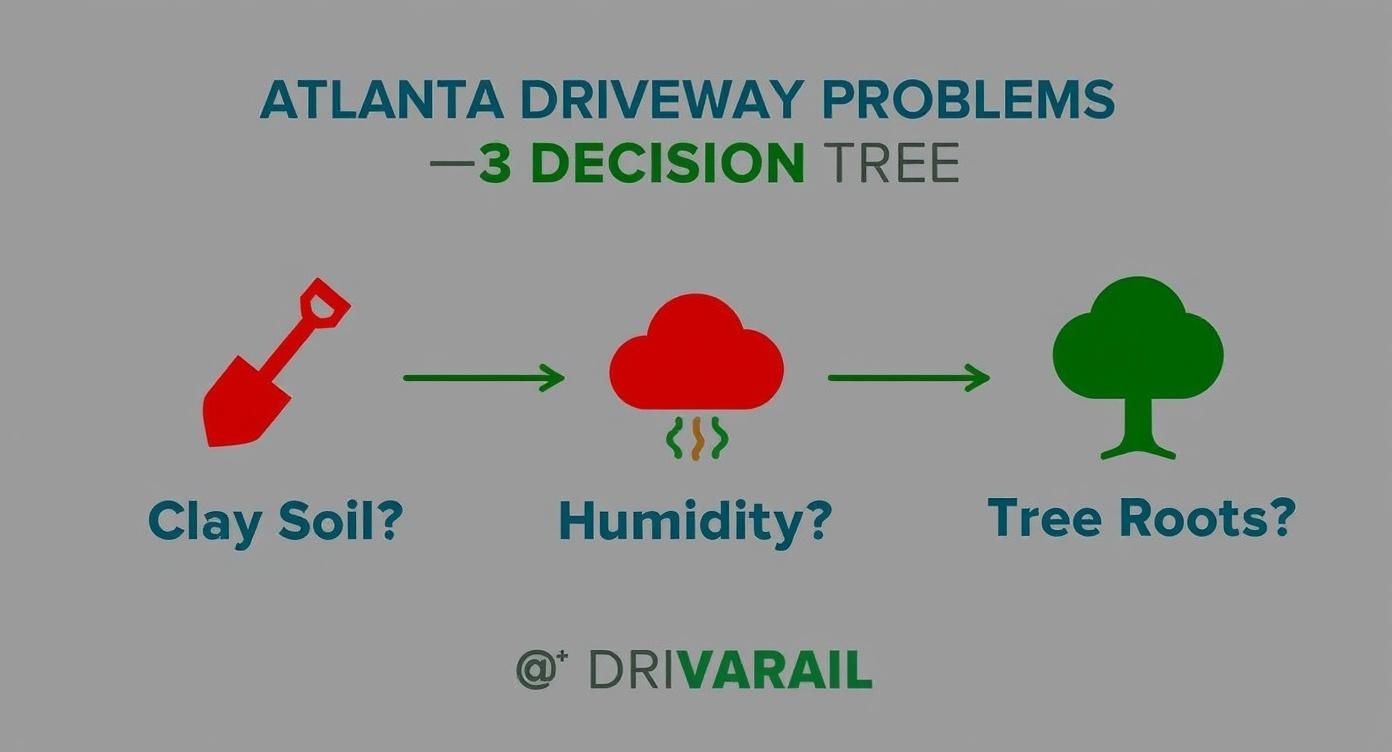
As the infographic shows, Atlanta’s unique environment throws some specific challenges our way. That expansive red clay soil, the relentless humidity, and those stubborn tree roots are often the true culprits behind major driveway damage that a simple patch job just won't fix.
Making The Final Call
Once you've got a handle on the problem, the choice between repair and replacement usually becomes a lot clearer. Repairs are fantastic for getting more years out of a driveway that's still structurally sound. On the other hand, replacement is the only real long-term investment for a slab that has fundamentally failed.
If you're dealing with a mix of issues and aren't sure which way to go, exploring professional residential concrete and masonry repair services can give you clarity from experts who've seen it all.
To help you sort it out, here’s a quick guide to common driveway damage and what it usually means.
Repair or Replace? A Guide to Concrete Driveway Damage
Use this table as a starting point to assess the damage to your driveway and figure out the most logical next step.
| Type of Damage | Description | Recommended Action (Repair or Replace) | Explanation & Example |
|---|---|---|---|
| Hairline Cracks | Tiny, spiderweb-like cracks that are less than 1/8 inch wide. | Repair | These are almost always cosmetic, often from the concrete curing too quickly. Sealing them with a flexible caulk keeps water out and prevents them from worsening. |
| Spalling/Flaking | The top layer of the concrete is chipping, flaking, or peeling away, exposing the gravel underneath. | Repair | Minor spalling can be patched or resurfaced. This is often caused by freeze-thaw cycles or a poor finishing job. If it covers less than 25% of the surface, repair is viable. |
| Deep, Wide Cracks | Cracks wider than a quarter-inch that go deep into the slab. Often one side is higher than the other. | Replace | This is a tell-tale sign of a major structural failure. The problem is almost certainly with the sub-base. Just sealing the crack is like putting a bandage on a broken arm. |
| Sinking/Heaving | One or more sections of the driveway are visibly lower or higher than the rest, creating a trip hazard. | Replace | A classic symptom of an unstable base. The culprit could be poor compaction, water erosion, or a large tree root pushing up from below. The foundation is compromised. |
| Widespread Cracking | The driveway is covered in a network of large, interconnected cracks, looking like a shattered piece of glass. | Replace | This is often called "alligator cracking." It means the slab has lost all of its structural integrity and can no longer distribute weight effectively. It has failed. |
By taking a close, honest look at the type and extent of the damage, you can confidently decide on the most effective and economical solution. Making the right call ensures your driveway remains a safe, functional, and attractive part of your home for many years to come.
Got Questions? Let's Talk Driveway Lifespans
Alright, let's dig into some of the questions that almost always come up when homeowners are thinking about a concrete driveway. Getting these answers straight can make all the difference, whether you're about to pour a new slab or trying to get the most out of the one you already have.
We’ve covered a lot of ground, but these are the details that tie everything together.
How Does an Asphalt Driveway Lifespan Compare?
This is probably the biggest head-to-head matchup in the driveway world. The short answer? An asphalt driveway typically gives you 15-20 years of service, while concrete can easily push 25-40 years.
Sure, asphalt often has a lower price tag upfront, which can be tempting. For example, a standard two-car driveway might cost $3,000-$5,000 in asphalt versus $5,000-$8,000 in concrete. But you have to look at the bigger picture. Asphalt demands more of your time and money down the road, needing a fresh seal coat every 3-5 years to fend off water and sun damage. It also softens in the summer heat and can get rutted by heavy vehicles. When you run the numbers over a few decades, concrete's incredible durability often proves to be the smarter financial move.
Does Sealing a Concrete Driveway Really Make a Difference?
Yes. 100%. If you do just one thing to maintain your driveway, make it this.
Think of unsealed concrete as a giant, hard sponge. Its surface is full of tiny pores that drink up anything that lands on them—rainwater, oil, and those corrosive de-icing salts we use in winter.
A good penetrating sealer (like a silane/siloxane product) acts like a coat of armor, creating an invisible barrier that stops all that nasty stuff from soaking in. Here in Georgia, where we get those pesky freeze-thaw cycles, this is a game-changer. Keeping water out of the slab prevents it from freezing, expanding, and creating cracks from within. A consistent sealing schedule—for example, every third autumn—can easily add a decade or more to your driveway's life.
Sealing isn't just about making your driveway look nice; it's the single most powerful defense a homeowner has. It’s how you directly fight back against premature aging and keep the surface from deteriorating.
Will a Stamped or Colored Finish Affect Longevity?
This is a great question, and the answer comes down to one thing: craftsmanship. When a skilled pro handles the job, a decorative finish like stamping or coloring won’t take a single day off your driveway's lifespan.
The durability is all in the technique and the materials used.
- Integrated Color: The best contractors mix high-quality color pigment right into the concrete batch or broadcast a color hardener on top while it's still wet. Either way, the color becomes a permanent part of the slab itself, not just a thin layer of paint on top that can peel.
- Proper Stamping: The act of stamping a pattern (e.g., cobblestone or slate) into the surface is purely textural. It doesn't weaken the concrete's structural integrity one bit.
- Protective Sealing: This is crucial. A decorative driveway must be sealed properly to protect the beautiful finish from scuffs, UV fading, and moisture damage. For example, a stamped patio that isn't sealed will look faded and worn within five years, while a sealed one will look vibrant for over a decade.
With a professional installation and the right maintenance, a stunning stamped driveway can be just as tough and long-lasting as its plain-Jane cousin.
A durable, professionally installed driveway is one of the best investments you can make in your home's curb appeal and long-term value. If you're in the Atlanta area and want to ensure your project is built to last, the team at Atlanta Concrete Solutions has the local expertise to get it done right. Learn more about their services and get a free quote by visiting atlantaconcretesolutions.com.