
It's a common question we hear from Atlanta homeowners: "How long will my new concrete actually last?" The short answer is that properly installed concrete can easily last 50 years or more. For example, a well-built residential driveway, with proper care, can still be in great shape a half-century after it was poured.
But the real, honest answer is a bit more nuanced. The true lifespan of your concrete depends entirely on its purpose, the quality of the initial pour, and the environment it lives in. Think of it like a quality leather jacket; with the right care, it can become a treasured heirloom, but neglect it, and its years are numbered.
The Real Lifespan of Your Concrete
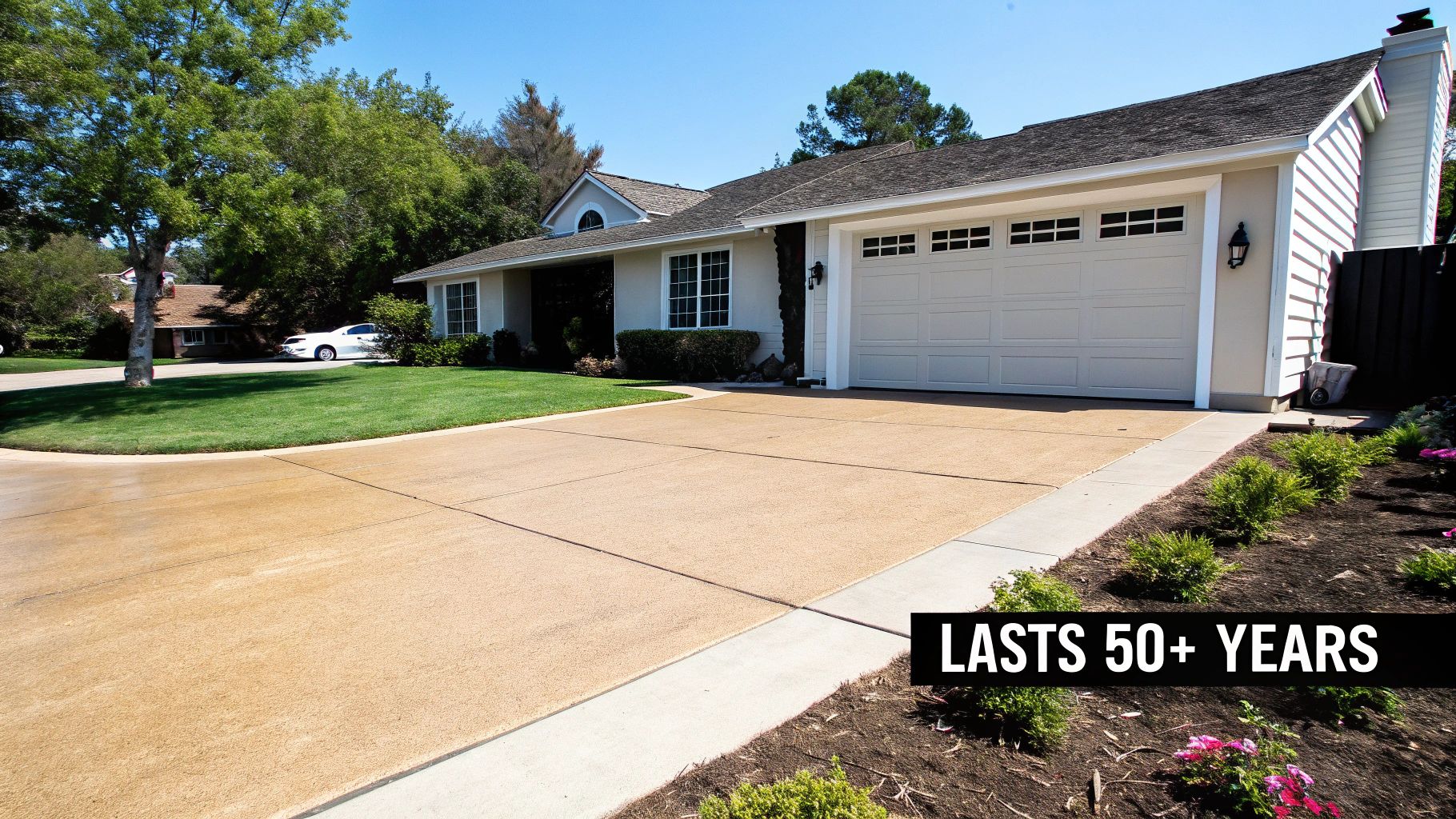
When you choose concrete, you're investing in a material known for its sheer strength and resilience. But asking how long it lasts is a lot like asking how long a car will run—the answer always starts with, "Well, it depends." For instance, a Honda Civic might last 200,000 miles with regular oil changes, while the same model, neglected, might die at 80,000 miles. Concrete longevity is influenced by similar principles of care and initial quality.
The longevity of your driveway, patio, or foundation isn't a fixed number. It’s a range influenced by a handful of critical factors. Let's break down what you can realistically expect from different concrete surfaces around your home.
Typical Concrete Lifespan by Application
Not all concrete is created equal, mainly because not all concrete does the same job. A decorative patio slab that sees only foot traffic and patio furniture just doesn't face the same daily abuse as a foundation supporting a 300,000-pound house, or a driveway that has a 5,000-pound SUV rolling over it every week.
Understanding these differences is key to setting realistic expectations. Here's a quick reference table showing what you can generally expect for common residential projects here in the Atlanta area.
Typical Concrete Lifespan by Application
| Concrete Application | Typical Lifespan | Key Influencing Factors |
|---|---|---|
| Driveways | 25-50 years | Vehicle weight, installation quality, soil stability |
| Patios & Walkways | 30-60+ years | Foot traffic, drainage, exposure to chemicals |
| Foundations | 100+ years | Soil conditions, water management, reinforcement |
As you can see, the specific use plays a massive role. The constant weight of vehicles puts a unique kind of stress on a driveway slab, which is why a 30-year-old driveway might show significant wear while an adjacent walkway looks practically new. For a deeper dive, check out our guide on residential driveway concrete solutions.
The Potential for Extreme Durability
There’s a reason concrete is one of the most trusted building materials on the planet. Under the right conditions, it has the potential to last up to 100 years or more. Some ancient examples, like the nearly 2,000-year-old Pantheon in Rome, which boasts the world's largest unreinforced concrete dome, prove just how incredibly durable this material can be.
Of course, achieving that kind of longevity today depends heavily on the modern mix design, proper installation techniques, and how it holds up to our local Atlanta climate.
Ultimately, the lifespan of your concrete isn't set in stone—pun intended. With a professional installation and a little bit of maintenance, you can ensure your surfaces meet, and even beat, these estimates, giving you decades of reliable performance.
What Really Determines Concrete's Lifespan?
It’s one thing to know the average lifespan of a driveway or patio, but the real question is why one slab looks great after 50 years while another starts to crack and crumble in just a few. It’s not one single secret. The truth is, concrete's longevity comes down to five critical factors working in harmony.
Getting a handle on these elements is the key to understanding how long your concrete will last and ensuring you end up with a surface built for the long haul. Think of it less like a simple slab of rock and more like a complex system where every component, from the initial recipe to the final finish, has a direct impact on its strength and resilience.
The Mix Design: It All Starts with the Recipe
Long before a single drop is poured, the foundation for durable concrete is set. It all begins with the mix design—essentially, the recipe. Much like a baker meticulously measures out flour, sugar, and water, a concrete supplier has to precisely balance three core ingredients.
- Cement: This is the glue, the binding agent that holds the whole mixture together. A typical mix is about 10-15% cement.
- Aggregates: Sand and gravel form the structural backbone, giving the concrete its bulk and strength. This makes up 60-75% of the mix.
- Water: This is the catalyst. Water kicks off a chemical reaction called hydration, which is what actually makes the cement harden. This is typically 15-20% of the mix.
Getting the ratios right is everything. A mix with too much water, for instance, results in weaker, more porous concrete that's a magnet for future damage. A professionally tailored mix, on the other hand, is designed to hit a specific compressive strength (measured in PSI), ensuring it’s ready to stand up to decades of use. For example, a residential driveway typically requires a mix of at least 4,000 PSI.
The Crucial Role of a Quality Installation
You can have the best concrete mix on the planet, but if it’s installed poorly, it simply won't last. The installation quality is probably the single most important factor determining your concrete's lifespan. The best ingredients in the world can't save a poorly baked cake, and the same logic applies here.
A proper installation isn't just about pouring and smoothing. It involves several non-negotiable steps, starting with careful ground preparation to create a stable, compacted base that won’t shift or settle. Then comes the curing process. This isn't just about letting it dry; curing is a controlled process where moisture is managed over time, for example, by covering the new slab with plastic sheeting or applying a curing compound. This allows the concrete to build up its maximum internal strength. Rushing this step is a surefire way to get a weak surface prone to cracks.
A professional installation ensures the concrete isn't just placed, but is carefully engineered to withstand the specific challenges of its location. This includes proper grading for drainage, correct joint placement to control cracking, and a finishing process that creates a durable, non-porous surface.
Environmental Exposure and Local Conditions
Concrete doesn't exist in a bubble; it's constantly interacting with its environment. Here in Atlanta, our climate throws some unique challenges its way. The combination of high humidity, heavy rain, and the occasional freeze-thaw cycles puts a constant strain on outdoor concrete.
In the winter, moisture finds its way into the tiny pores of the concrete. When the temperature drops, that trapped water freezes and expands with up to 2,000 pounds per square inch of force. This cycle of freezing and thawing is what causes the surface to flake and crumble over time—a problem called spalling. A well-sealed, properly installed slab has a much better defense against this kind of moisture intrusion.
The Load It Has to Carry
What is the concrete actually going to be used for? This question directly influences its design and, ultimately, how long it will hold up. The physical stress, or load, that concrete has to endure is a primary factor in its durability. A simple walkway designed for foot traffic has completely different needs than a driveway that has to support a 5,000-pound SUV every day.
That’s why a driveway needs a thicker slab (typically 4 inches) and often a stronger concrete mix (measured in PSI) than a backyard patio (often 3.5 inches). Trying to cut corners with a thinner slab for a high-load area, such as a spot where a heavy boat or RV will be parked, is a guaranteed way to shorten its life, often dramatically. The concrete has to be specified for the job it's being asked to do.
Reinforcement: The Skeleton Within
While concrete is incredibly strong under compression (it's very hard to crush), it’s surprisingly weak when it comes to tension (it can be pulled apart relatively easily). This is where reinforcement comes into play. Think of steel rebar or fiber mesh as a hidden skeleton embedded inside the slab.
This internal framework gives concrete the tensile strength it needs to resist forces that try to bend or pull at it, such as shifting soil or heavy loads. For example, when a heavy truck drives over a slab, the top compresses while the bottom experiences tension; rebar in the lower half of the slab prevents it from cracking under this stress. But this steel has its own Achilles' heel. While engineers in the early 20th century thought reinforced concrete might last a thousand years, we now know that corrosion of the rebar can lead to significant problems within 50 to 100 years. This happens when moisture and chemicals eventually seep through the concrete and start attacking the steel. If you're curious about the science, you can learn more about the challenges with reinforced concrete.
What Breaks Concrete Down Over Time?
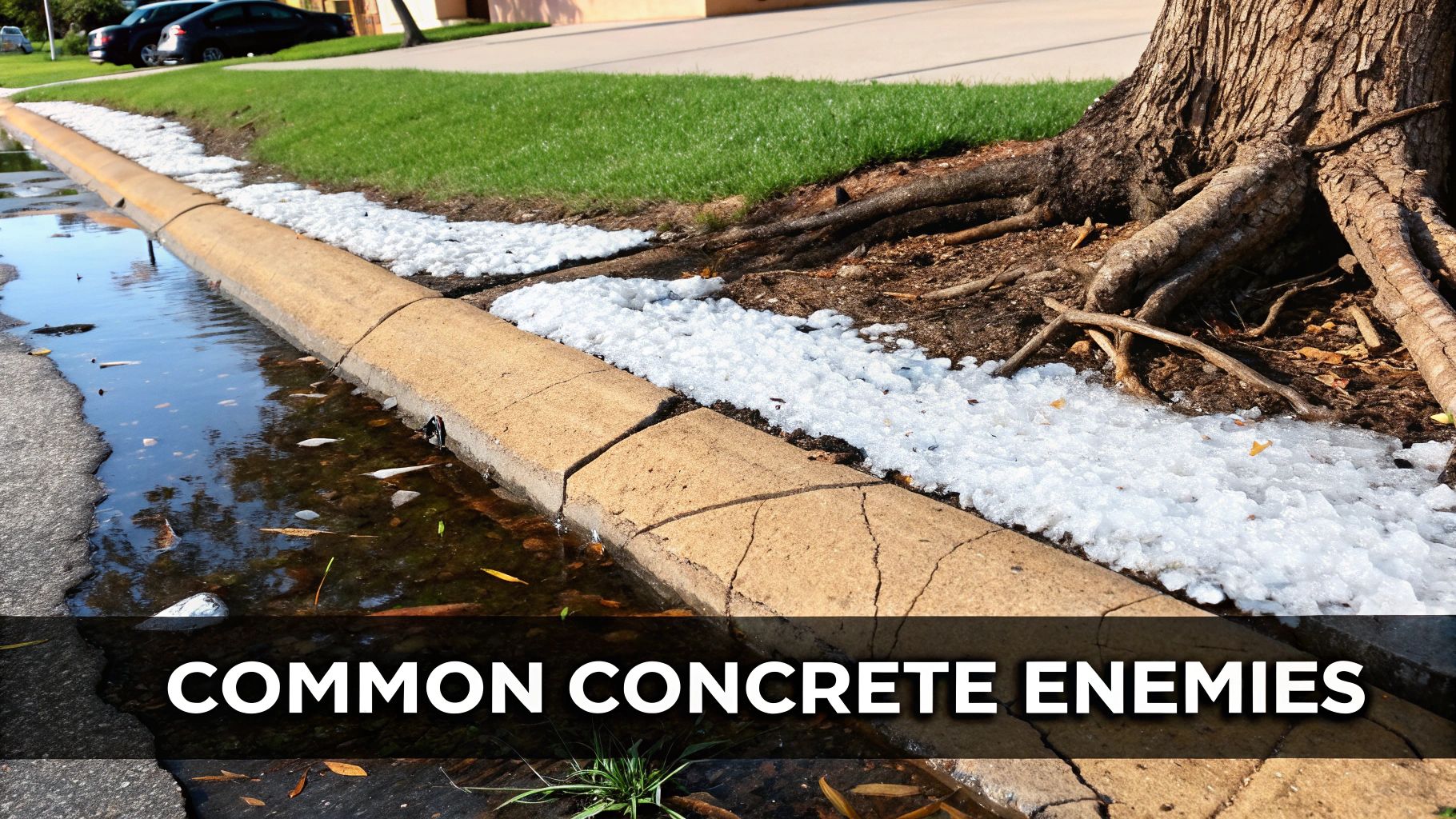
While we think of concrete as permanent, it's constantly fighting a slow battle against a handful of forces. These aren't dramatic, overnight events; they're more like a slow, persistent drip that gradually wears down even the strongest slab over years and decades.
Knowing what you’re up against is the key to protecting your investment. Spotting the early signs of these attackers is how you get the most life out of your driveways, patios, and walkways.
Water: Concrete's Number One Enemy
If concrete has a sworn enemy, it's water. It's ironic, since water is essential to create concrete in the first place, but once it cures, water becomes a relentless source of damage. Concrete is naturally porous, so water can seep right in and start causing trouble from the inside out.
Here in Georgia, with our heavy rains and humidity, this is a major issue. The real damage happens during the freeze-thaw cycle. When water inside the concrete freezes, it expands by about 9%. This expansion creates incredible internal pressure that literally pops off the surface of the concrete, a process called spalling.
Water is the primary vehicle for concrete damage. It not only causes physical damage through freezing but also carries corrosive chemicals and erodes the soil base supporting the slab, leading to cracks and settling.
Imagine a tiny, unsealed crack in a driveway that collects rainwater. When an Atlanta winter brings a surprise freeze, that trapped water expands and forces the crack wider. This happens again and again, turning a minor flaw into a major failure.
Chemical Attacks from Everyday Sources
You'd be surprised by the number of chemicals your concrete is exposed to every day, many of which are surprisingly corrosive. These substances slowly dissolve the cement paste that holds everything together, weakening the surface and leaving it pitted and discolored.
These chemical aggressors are more common than you think:
- De-Icing Salts: While we don't use them as often as our northern neighbors, the salts used to melt ice and snow are extremely harsh on concrete. For example, sodium chloride (rock salt) can accelerate the freeze-thaw cycle and chemically attack the cement paste.
- Fertilizers and Pesticides: The sulfates and nitrates in many common lawn care products can trigger chemical reactions that degrade the surface of your patio or walkway. A common example is ammonium sulfate, found in many fertilizers, which can aggressively eat away at concrete.
- Acid Rain: Over many years, pollutants in the atmosphere can make rain slightly acidic, which slowly etches away at the cement.
It's a lot like spilling lemon juice on a marble countertop—over time, the acid eats away at the surface. The same thing is happening to your concrete on a much slower scale.
The Slow Grind of Abrasion and Physical Wear
This is the most straightforward enemy of all: simple, day-in, day-out use. Every car that rolls up the driveway, every time you drag the grill across the patio, and every scrape from a snow shovel causes microscopic damage.
This constant abrasion slowly grinds down the smooth top layer of the concrete, exposing the rougher aggregate stones beneath. While the process is incredibly slow, it really adds up over 20 or 30 years. You'll always see this wear show up first in high-traffic areas, like the exact spots where your car tires rest every day or the main path on a walkway.
Unstable Ground and Sneaky Tree Roots
Sometimes, the biggest threat to your concrete is hiding right underneath it. The ground isn't static; it moves, settles, and shifts, putting enormous stress on the rigid slab sitting on top.
In the Atlanta area, our famous red clay soil is a huge factor. This expansive clay swells up like a sponge when it gets wet and shrinks dramatically when it dries out. This constant cycle of heaving and contracting can lift, drop, and ultimately crack concrete slabs.
Invasive tree roots are another powerful underground force. A root that starts out as thin as a pencil can grow with enough force to lift and buckle a four-inch-thick sidewalk. A classic example is a large oak or maple tree planted too close to a walkway; over 15-20 years, its roots can easily displace entire concrete panels. If the ground underneath moves, the concrete has no choice but to break.
Proactive Maintenance That Extends Concrete Life
Knowing what harms concrete is one thing, but actively preventing that damage is how you truly protect your investment. Proactive maintenance isn't some complicated, expensive chore. It's simply the most effective way to add decades to your concrete's life.
Think of it like owning a car. You don’t wait for the engine to seize before you change the oil. Small, regular actions prevent massive, costly breakdowns. The same logic applies to your concrete—a simple seasonal routine can stop major issues before they ever get a chance to start.
Spring Cleaning and Inspection
Once winter breaks, spring is the perfect time for a thorough concrete check-up. It's your chance to wash away months of accumulated grime and get a good look at what’s going on with the surface.
Start by giving it a good cleaning. You can use a pressure washer on a low setting (under 2,000 PSI) or just a stiff-bristled brush with a quality concrete cleaner. This isn't just about looks; clearing the dirt gives you an unobstructed view. As you clean, keep an eye out for new hairline cracks, chips, or any spots where the surface seems flaky or pitted. These are often the first tell-tale signs of damage from winter's freeze-thaw cycles.
Summer Sealing for Sunscreen-Like Protection
The warm, dry weather of summer creates the perfect window for applying a concrete sealer. The best way to think about sealer is like sunscreen for your concrete. It creates an invisible barrier that guards against its two biggest enemies: moisture and UV rays.
A good penetrating sealer soaks deep into the concrete's pores, effectively blocking water from getting in. This is your number one defense against the brutal freeze-thaw cycle that will inevitably arrive next winter. As a bonus, it also helps repel stains from oil spills, fertilizer, and other chemicals, keeping your driveway or patio looking sharp. Sealing every 2-3 years is a small job that pays off in a big way. This is especially true for interior surfaces; for example, you can see the benefits of maintaining a sealed and polished concrete finish in a garage or basement.
Proactive maintenance is fundamental to durability, not just for homes but for major infrastructure. The average lifespan of concrete bridges worldwide is estimated between 50 and 70 years, a figure heavily influenced by consistent maintenance regimes. Neglecting this care can shorten a structure's life by decades. You can discover more insights on how maintenance impacts concrete's life cycle on concrete.org.
Fall Crack Repair Before Winter Arrives
When autumn rolls around, it’s time to fix any of those little problems you spotted back in the spring. Filling small cracks before winter sets in is critical. If you ignore them, those tiny gaps will fill with water, which will then freeze, expand, and turn a minor flaw into a major fracture.
For hairline cracks less than 1/4 inch wide, a flexible concrete caulk or sealant is your best friend. The fix is easy: clean out the crack with a wire brush or compressed air, apply the filler, and smooth it out. A ten-minute repair like this prevents water from gaining a foothold, stopping that destructive cycle dead in its tracks.
Winter Protection and Smart De-Icing
Winter is, without a doubt, the toughest season on concrete. While Atlanta isn't buried in snow all season, ice is a frequent visitor. The most important thing to remember is to avoid using rock salt (sodium chloride) on your concrete. Period. Rock salt is incredibly corrosive and chemically attacks the cement, causing the surface to scale and flake away.
Instead, reach for de-icing products that are much safer for your concrete. Here are a few better choices:
- Calcium Chloride: It works at much colder temperatures (down to -25°F) and is far less harmful than standard rock salt.
- Magnesium Chloride: This is widely considered one of the safest de-icers for both concrete and any nearby plants or grass.
- Sand or Kitty Litter: These won't melt the ice, but they provide immediate traction on slippery spots without causing any chemical damage. A great example is spreading sand before guests arrive for a holiday party to ensure a safe walkway.
By running through this simple seasonal checklist, you take control of your concrete's lifespan, ensuring it remains a strong, attractive part of your property for years to come.
Knowing When to Repair Versus When to Replace
Staring at a cracked or pitted slab of concrete can be intimidating. You're left wondering: is this a simple patch job, or am I looking at a major overhaul? The great news is that not every flaw spells disaster. Knowing how to spot the difference between a minor cosmetic issue and a serious structural red flag is the key to making a smart, cost-effective choice.
Think of it like deciding whether to patch a car tire or buy a new one. A small nail hole is an easy, safe fix. But a shredded sidewall means the tire's integrity is compromised, and replacement is the only safe option. Concrete works on the same principle—some problems are just on the surface, while others tell you the slab itself has failed.
Signs That Point to Repair
Most of the time, minor surface damage is just a sign of normal wear and tear. The trick is to catch it early before it morphs into a much bigger headache. These are the kinds of issues we can typically tackle with professional repair techniques, saving you the considerable expense and disruption of a full replacement.
Repairs are usually the way to go for cosmetic flaws that don't affect the concrete's underlying strength. These fixes restore the look of your driveway or patio and protect the surface from future damage.
You should be thinking "repair" if you spot things like:
- Hairline Cracks: We’re talking about those tiny fissures, usually less than 1/4 inch wide. They're often the first sign of surface stress but rarely signal a deeper structural problem.
- Minor Surface Pitting or Spalling: This looks like small pockmarks or shallow flaking on the surface, a common result of Atlanta's freeze-thaw cycles. If it's not too deep or widespread, resurfacing is a fantastic solution. For example, if a small patch near the curb is flaking, it can be resurfaced without replacing the whole driveway.
- Light Staining: Discoloration from spilled oil, rust, or even fallen leaves is purely an aesthetic issue. These can often be removed with specialized cleaners or covered entirely with a new surface coating.
For these manageable problems, looking into professional residential concrete and masonry repair services can bring back both the beauty and function of your concrete.
Red Flags That Signal Replacement
On the flip side, some symptoms point to a much deeper, more serious failure happening within the slab or in the ground beneath it. In these situations, a simple patch is like putting a bandage on a broken arm—it hides the problem but does absolutely nothing to fix it. Ignoring these red flags will almost certainly lead to more extensive and costly damage down the road.
Replacement becomes the necessary route when the concrete slab is no longer structurally sound. This means it can't safely support the weight it was designed for or has been fundamentally compromised by forces from below.
Replacement is often the only real long-term solution for:
- Large Structural Cracks: Any crack wider than a credit card, running the full depth of the slab, or where one side is higher than the other (a "trip hazard") is a serious warning.
- Significant Sinking or Heaving: If a whole section of your patio or driveway has sunk or risen by more than an inch, it’s a clear sign of a major problem with the soil base underneath.
- Widespread Deep Spalling: When the surface is crumbling away over a large area and you can see the gravel aggregate below, the original concrete mix has likely failed.
- Signs of Foundation Failure: Any major cracks or shifts in a slab that connects to your home's foundation demand an immediate professional evaluation. Replacement is almost a certainty here.
This simple chart breaks down the key steps in a seasonal maintenance routine that can stop minor issues from turning into major replacement projects.
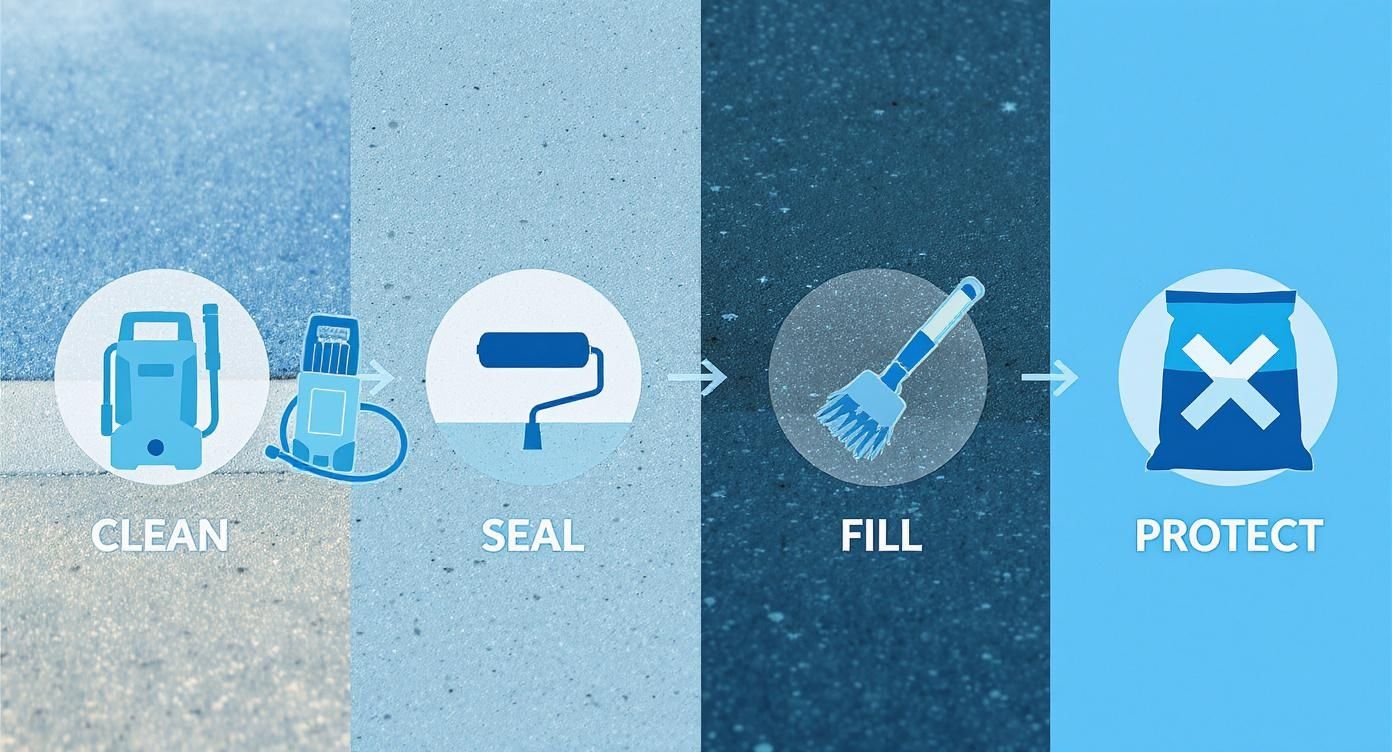
As you can see, proactive steps like cleaning, sealing, and filling small cracks are absolutely vital for getting the most life out of your concrete.
Repair or Replace Decision Guide
To make the decision even easier, we've put together this quick guide. Just find the symptom you're seeing to understand the best course of action.
| Symptom | Recommended Action | Explanation |
|---|---|---|
| Cracks < 1/4" Wide | Repair | These are typically surface-level and can be sealed to prevent water intrusion. |
| Cracks > 1/4" Wide or Uneven | Replace | This indicates a deeper structural issue or significant ground movement that a patch can't solve. |
| Minor Pitting/Flaking | Repair | Resurfacing can create a durable new top layer, restoring the appearance and function. |
| Deep, Widespread Spalling | Replace | When large areas are crumbling, the integrity of the original concrete mix is compromised. |
| Slab Sinking < 1 Inch | Repair | This can sometimes be corrected with slab-jacking or mudjacking techniques. |
| Slab Sinking > 1 Inch | Replace | Significant sinking signals a failure in the sub-base that requires a complete tear-out and re-pour. |
Ultimately, a careful inspection is the best way to determine the right path forward. Catching problems early almost always gives you more options and saves you money in the long run.
Your Top Questions About Concrete Longevity Answered
After digging into the science of concrete durability and the best ways to keep it in prime condition, you probably have a few specific questions bubbling up. This is where we get down to brass tacks.
Here are the straightforward, no-nonsense answers to the most common questions we get from Atlanta homeowners and property managers every single day. Think of it as your quick-reference guide for making smart, cost-effective decisions about your concrete.
How Does Atlanta’s Clay Soil Affect My Concrete?
This is the million-dollar question for anyone living in our area. That infamous red Georgia clay is more than just a nuisance; it's a powerful force of nature working against your concrete. It’s what we call an "expansive" soil—it swells up dramatically when it’s wet and shrinks back down when it dries out. A prime example is seeing wider cracks in your yard and around your foundation during a dry summer drought, then watching them close up after a week of heavy rain.
This constant cycle of expanding and contracting forces the ground beneath your concrete to shift. It’s a slow-motion heave and settle that puts immense stress on rigid slabs, leading to those ugly cracks, uneven surfaces, and serious structural problems in driveways, patios, and even your home's foundation.
So, how do we fight back? It all comes down to smart prep work before a single drop of concrete is poured. Proper site grading and drainage are non-negotiable to keep water away from the slab's base. We also have to build a highly compacted, stable sub-base that won't give in to the clay's movement. In some cases, beefing up the slab with steel rebar or pouring it thicker is the only way to win the battle.
Is Sealing My Driveway Really Worth the Hassle?
One hundred percent. Yes. If you do just one thing to protect your concrete, this is it. Sealing offers the biggest bang for your buck in terms of proactive maintenance, hands down.
Think of a high-quality sealer as invisible armor for your concrete. It’s the single most effective barrier against water, which is the root cause of most surface damage here in Georgia, especially when winter brings those pesky freeze-thaw cycles.
For a pretty small investment every 2-3 years, a good sealer does a few critical jobs:
- Blocks Moisture: This is its main purpose. It keeps water from seeping into the concrete's pores, which stops the freeze-thaw cycle from popping and flaking the surface (a problem known as spalling).
- Resists Stains: It acts as a shield against oil drips from your car, rust stains from patio furniture, and everyday grime, making your driveway much easier to keep clean.
- Fights Sun Damage: It provides protection from harsh UV rays that can slowly break down the cement paste and fade the color of your concrete over time.
When you weigh the minimal cost of sealing against the sky-high price of a full replacement, it’s an absolute no-brainer.
Can I Just Pour New Concrete Over My Old, Cracked Driveway?
It might sound like an easy, budget-friendly fix, but pouring new concrete over an old, failing slab is almost always a terrible idea. This technique, called an "overlay," is usually just a temporary band-aid on a much bigger problem.
The issue is that the old slab's problems don't just disappear. Those cracks and unstable sections will telegraph right up through the new layer, a phenomenon known as "reflective cracking." For example, if you have a large crack running down the middle of your old driveway, you can bet that a new crack will appear in the exact same spot on the overlay within a year or two. You'll end up with a brand new slab that has the exact same crack pattern as the old one, because you never fixed the root cause—whether it was bad soil or a broken base.
The only time an overlay is even a remote possibility is if the original slab is structurally perfect and only has minor cosmetic blemishes on the surface. For any real cracking, heaving, or settling, the only real, lasting solution is to tear out the old stuff and start fresh with a properly prepared foundation.
What’s the Difference Between Concrete and Cement, Anyway?
You’re not alone in asking this! It’s easily the most common mix-up in the industry. The best way I’ve found to explain it is with a simple baking analogy.
- Cement is just one ingredient in the recipe, like flour is to a cake. It's the fine gray powder that works as the binder.
- Concrete is the finished product, like the baked cake itself.
When you mix cement (the powder) with water, sand, and gravel (which we call aggregates), a chemical reaction kicks off that causes the whole mixture to harden into the rock-solid material we know as concrete. So, you pour concrete, not cement!
Your concrete surfaces are a huge part of your property's value and usability. Knowing how to take care of them is the key to making that investment last for decades. If you’re seeing issues with your driveway, patio, or foundation, the expert team at Atlanta Concrete Solutions is here to help. We offer honest assessments and durable, long-term solutions to protect your property. Contact us today for a free, no-obligation quote.