
Figuring out how many bags of concrete you need can feel like a shot in the dark, but it's actually pretty straightforward math. For one full cubic yard of concrete, you’re looking at roughly 90 fifty-pound bags, 75 sixty-pound bags, or 45 eighty-pound bags.
Knowing these numbers is your best starting point for any small-to-medium-sized job.
The Quick Answer: How Many Concrete Bags Per Yard
Before you even think about breaking ground on a project—whether you're setting a simple fence post or pouring a small patio—you need to know the basic conversion from bags to a cubic yard. A cubic yard is the industry-standard measurement for concrete volume. Imagine a cube that’s three feet long, three feet wide, and three feet deep; that’s 27 cubic feet, and that's one cubic yard.
Since bagged concrete is sold by weight, not volume, understanding this conversion is critical for planning.
Why Bag Weights Matter
At the hardware store, you'll typically find concrete mix in 50, 60, and 80-pound bags. It’s simple: the heavier the bag, the more concrete mix it contains and the more volume it will yield. This detail is huge for planning. Hauling and mixing 90 bags is a vastly different job—physically and logistically—than wrangling 45.
This chart breaks down how many bags you'll need to hit that one-cubic-yard mark.
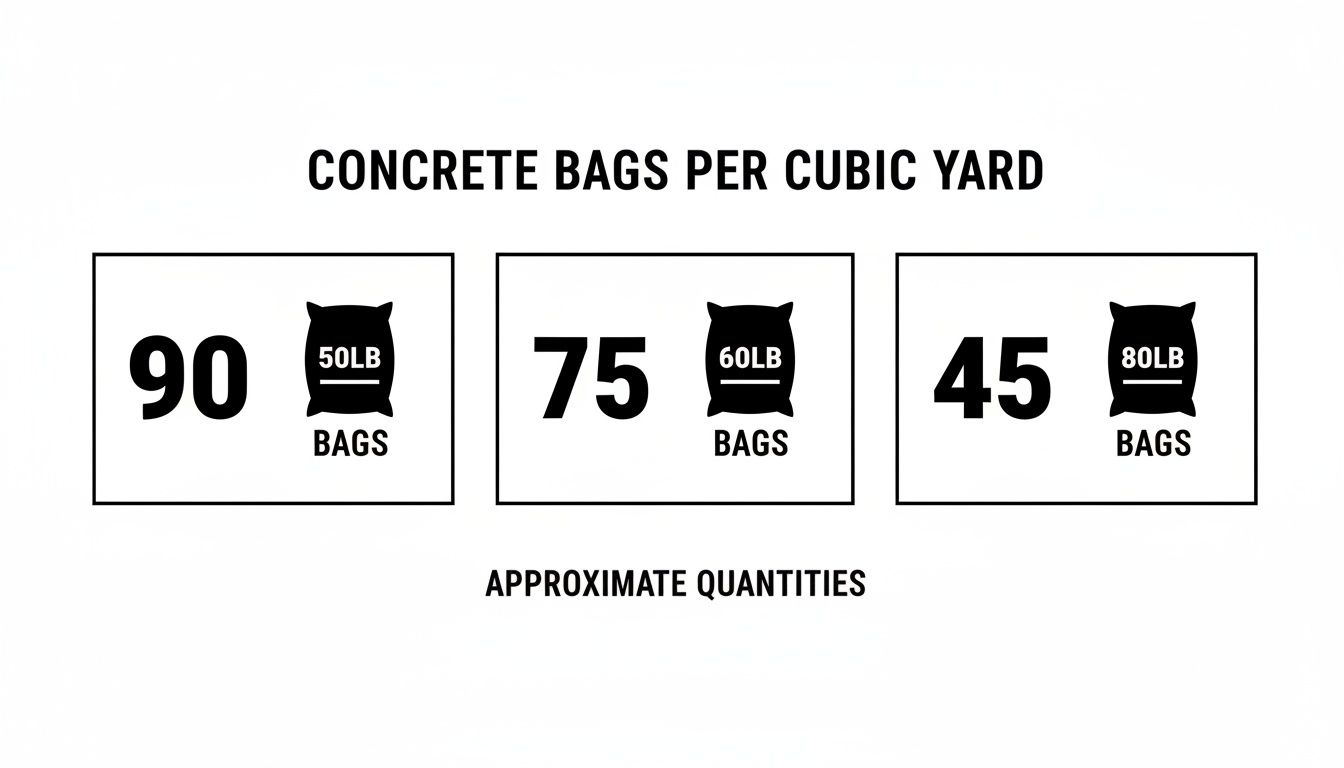
As you can see, just by choosing the larger 80-pound bags, you can literally cut the number of bags you have to handle in half.
For a quick reference, here’s a simple table that lays out the numbers.
Concrete Bags Per Cubic Yard Quick Reference Guide
| Bag Weight | Yield per Bag (Cubic Feet) | Bags Needed per Cubic Yard |
|---|---|---|
| 50 lb | ~0.375 cu. ft. | ~90 bags |
| 60 lb | ~0.45 cu. ft. | ~75 bags |
| 80 lb | ~0.60 cu. ft. | ~45 bags |
Keep this chart handy when you're at the store—it's an easy way to make sure you grab the right amount for the job.
Putting It Into Practice
Let's talk about how this plays out in the real world. Knowing the bag-to-yard conversion can save Atlanta homeowners a ton of money and hassle on projects like a new driveway. Manufacturers like Quikrete and Sakrete confirm that a standard 80-pound bag yields about 0.60 cubic feet of concrete. That means you'll need right around 45 of those bags to get a full cubic yard.
Now, imagine a small 10×15-foot driveway slab poured at a standard 4-inch thickness. That project requires about 1.85 cubic yards of concrete. Do the math, and you're looking at hauling and mixing nearly 84 of those 80-pound bags. That is a backbreaking amount of work for a DIYer, often spread over days, which increases the risk of uneven settling and cracks. You can learn more about the math behind these projects from experts at Volume Concrete.
Expert Tip: These numbers are a fantastic starting point, but they assume perfect conditions. The real world isn't so perfect. An uneven subgrade, a bit of spillage during mixing, or adding a little too much water can all change your final yield. My advice? Always buy a little extra.
Calculating Your Concrete Needs Accurately
Before you can even think about how many bags of concrete to buy, you first have to nail down the total volume your project needs. Getting this calculation right is honestly the most critical part of the whole process. The basic formula itself is simple: Length × Width × Thickness.
Where things often go sideways, especially for DIY projects, is in applying that formula correctly. The biggest and most common mistake I see is people mixing their units of measurement—they try to multiply feet directly by inches, and that just doesn't work.
To sidestep this common error, you have to convert all your measurements to the same unit before you multiply. Since concrete is ordered and sold by the cubic yard (which is 27 cubic feet), it makes the most sense to convert everything into feet from the get-go.
The Secret to Converting Inches to Feet
Here’s the simple trick: just divide your thickness measurement in inches by 12. This quick conversion changes your slab's depth into a decimal, giving you a number in feet that you can use in your volume calculation.
Let's walk through a classic example: a small 10×10 foot patio slab that needs to be 4 inches thick.
- Length: 10 feet
- Width: 10 feet
- Thickness Conversion: 4 inches ÷ 12 = 0.333 feet
With all units in feet, you can now multiply them together: 10 ft × 10 ft × 0.333 ft = 33.3 cubic feet. That's the total volume of wet concrete you'll need to fill that space.
A common point of confusion is converting cubic feet to cubic yards. To do this, simply divide your total cubic feet by 27. For our patio example, 33.3 cubic feet ÷ 27 equals 1.23 cubic yards.
Planning for Real-World Conditions
Math is perfect, but job sites rarely are. The ground you've graded might have a slight dip, or your form boards might have a subtle bow. These small imperfections can quickly add up, leaving you a few shovels short right at the end of your pour.
Here’s a pro tip: take several depth measurements inside your forms and use the average. If the subgrade is particularly uneven, it's smart to add a small buffer—think 5% to 10% extra—to your final volume. This little bit of overage is your insurance policy, saving you from a frantic, last-minute run to the hardware store. Of course, accurate calculations start with good measurements, which is why having the right essential construction measurement tools is a non-negotiable for any concrete work.
Putting the Math to Work: Real-World Project Examples
Okay, now that we have the core formula down, let’s get practical. This is where theory meets reality, and a little bit of pro insight can save you from a major headache (and a bunch of extra trips to the hardware store). We’ll walk through a couple of common scenarios to see how the numbers really stack up.
Example 1: The Standard Driveway Extension
Let's say you're widening your driveway with a 10-foot by 20-foot extension. For a standard residential slab that needs to support a car, you’re looking at a minimum thickness of 4 inches.
Here’s how we'd break down the math:
- Convert Thickness to Feet: 4 inches ÷ 12 = 0.333 feet
- Calculate Volume in Cubic Feet: 10 ft × 20 ft × 0.333 ft = 66.6 cubic feet
- Convert to Cubic Yards: 66.6 cubic feet ÷ 27 = 2.47 cubic yards
Now, let's turn that 2.47 cubic yards into a shopping list.
- With 60 lb Bags: 2.47 yards × 75 bags/yard = ~185 bags
- With 80 lb Bags: 2.47 yards × 45 bags/yard = ~111 bags
Suddenly, that "small" extension involves a lot of material to haul, mix, and pour by hand. Seeing the project laid out in bag counts is a real eye-opener.
Example 2: A Winding Garden Path
Not everything is a perfect rectangle, right? For a winding garden path, the easiest approach is to break it down into smaller, manageable sections that you can measure like rectangles.
Imagine your path is 2 feet wide, 30 feet long in total, and poured at a 3-inch thickness.
- Convert Thickness to Feet: 3 inches ÷ 12 = 0.25 feet
- Calculate Volume in Cubic Feet: 2 ft × 30 ft × 0.25 ft = 15 cubic feet
- Convert to Cubic Yards: 15 cubic feet ÷ 27 = 0.56 cubic yards
This is a much smaller job where bags are the perfect fit.
- With 60 lb Bags: 0.56 yards × 75 bags/yard = ~42 bags
- With 80 lb Bags: 0.56 yards × 45 bags/yard = ~25 bags
That's a much more doable number for a weekend project. You can see how we apply these same principles to much larger jobs in our gallery of completed Atlanta concrete projects.
The Pro Secret: The Waste Factor
Here’s a non-negotiable rule every professional lives by: always order 10% extra. We call this the "waste factor," and it's your best insurance against coming up short.
Spills happen. An uneven subgrade might steal a little extra concrete. A slight miscalculation can leave you scrambling. That extra 10% is your buffer.
For our driveway example needing 2.47 cubic yards, a 10% waste factor means ordering an additional 0.25 cubic yards. This ensures you have more than enough material to finish the job perfectly without stopping.
This becomes critical on larger jobs. Think about it: a standard pallet of 80-pound bags is only about one cubic yard. For a 20×20-foot pickleball court needing nearly 5 cubic yards, you'd need 225 bags plus another 23 bags for your waste factor. At that scale, ready-mix delivery isn't just a convenience—it's the only logical choice.
Bagged Concrete vs. Ready-Mix Delivery: Which Is Right for You?
Now that you can calculate how many bags of concrete are in a yard, the real question becomes: should you even be using bags in the first place? Deciding between wrestling with bags from the big-box store and having a ready-mix truck show up at your curb is one of the most important calls you'll make. This choice goes way beyond convenience—it directly impacts your budget, your timeline, and the final quality of your work.
Bagged concrete is undeniably the go-to for smaller projects. If you're just setting a fence post, pouring a small pad for an AC unit, or patching a crack, grabbing a few bags is the most efficient and sensible option. But once your project hits a certain size, the benefits of bagged concrete evaporate, and ready-mix delivery becomes the obvious choice.
The Tipping Point: When to Ditch the Bags for a Truck
So, where's that line in the sand? In my experience, the tipping point is right around one cubic yard. For anything smaller, stick with bags. But if your project is one cubic yard or bigger, you need to give a ready-mix truck serious consideration.
Think about it: a single cubic yard of concrete means you'd have to mix 45 of those heavy 80-pound bags. That is a grueling, non-stop physical effort. You're talking about hours of back-breaking labor just to get the material ready to pour.
All that manual work introduces huge risks. It's nearly impossible to get the water-to-mix ratio perfectly consistent across dozens of separate batches. These slight variations can create weak spots throughout your slab, leaving it vulnerable to cracking and early failure.
Pro Tip: Time is working against you. On a one-yard pour, the first bit of concrete you placed could already be starting to harden by the time you've mixed and poured the last bag. This creates a "cold joint"—a weak seam where the two batches meet—that compromises the structural integrity of the entire slab.
A Head-to-Head Cost Comparison
Most DIYers assume mixing bags is always the cheaper route, but the numbers often paint a very different picture. Let's do a quick cost breakdown for a small, two-cubic-yard project, like a simple driveway extension.
-
Bagged Concrete: To get two cubic yards, you'd need 90 of the 80 lb bags. At an average price of $5.00 per bag, you're looking at $450 in materials before tax. And that doesn't even factor in your fuel costs or the value of your time and labor.
-
Ready-Mix Delivery: In the Atlanta area, a two-yard delivery will typically run you somewhere between $400 and $450, including the delivery fees. The price is practically a wash, but the advantages are enormous.
With a ready-mix truck, you get a perfectly uniform, high-strength mix poured out in just a few minutes. This frees you up to focus on the most important part: finishing the concrete for a smooth, professional-grade surface. For contractors, streamlining the front office with tools like construction answering services can be just as crucial as optimizing the work on-site.
Making the right choice between bagged mix and a truck delivery is key to a successful project. Here's a quick table to help you decide.
Bagged Concrete vs. Ready-Mix Truck: Which is Right for Your Project?
| Factor | Bagged Concrete | Ready-Mix Delivery |
|---|---|---|
| Project Size | Ideal for projects under 1 cubic yard (e.g., fence posts, small repairs). | Best for projects over 1 cubic yard (e.g., patios, driveways, foundations). |
| Cost-Effectiveness | Cheaper for very small quantities. Becomes expensive quickly as volume increases. | More economical for larger volumes. Often cheaper than bags for 1.5+ yards. |
| Labor | Extremely labor-intensive. Requires hauling, opening, mixing, and pouring dozens of bags. | Minimal labor. The truck does all the mixing and pouring for you. |
| Consistency & Quality | Prone to inconsistencies in water ratio, leading to potential weak spots. | Computer-batched for perfect consistency and guaranteed strength (PSI). |
| Time | Very time-consuming. Mixing can take hours, risking cold joints. | Extremely fast. A multi-yard pour can be completed in minutes. |
| Convenience | Can be bought anytime at a home improvement store. | Requires scheduling in advance and clear access for a large, heavy truck. |
Ultimately, while bagged concrete has its place, the efficiency, superior quality, and surprisingly competitive cost of ready-mix make it the clear winner for any job over a yard.
When you're ready to tackle that bigger project and demand a flawless finish without the hassle, exploring professional concrete services in Atlanta is your smartest move.
Why a Professional Pour Makes All the Difference
Knowing how many bags of concrete are in a yard is one thing. Actually pulling off a flawless pour is a whole different ballgame, and it’s where a professional’s experience really shines. The truth is, the difference between a DIY job and a professional installation is often what determines if a slab lasts five years or fifty.
The work goes far beyond just doing the math right. Critical steps like preparing the subgrade properly, strategically placing reinforcement mesh, and mastering the art of finishing and curing are what give concrete its real strength and longevity. Without that expertise, even the most precise calculations can lead to a surface that cracks, spalls, and fails long before its time.
The Problem with Mixing by Hand
When you're looking at a project that needs dozens of bags, mixing them all by hand is a recipe for inconsistency. No matter how careful you are, it's next to impossible to get the exact same water-to-cement ratio for every single batch you mix up in a wheelbarrow.
This isn't just a minor detail—it creates weak points all throughout the slab.
- Weak Spots: Batches with too much water are significantly weaker and far more likely to chip and degrade over time.
- Inconsistent Curing: Different water ratios mean parts of your slab cure at different speeds, which builds up internal stress.
- Visible Flaws: These inconsistencies often lead to blotchy coloring and an uneven finish, ruining the look of your new patio or driveway.
A professional pour using a ready-mix truck takes all that guesswork out of the equation. The concrete is batched by computer to precise specifications, guaranteeing every cubic foot of material has the same strength, consistency, and durability.
It's More Than Just the Pour
A seasoned concrete contractor doesn't just pour the mud; they manage the entire project to deliver a final product that adds real, lasting value. It starts with proper subgrade compaction, which keeps the ground from shifting and causing your slab to sink or crack. From there, steel rebar or wire mesh is expertly placed to give the concrete the tensile strength it needs to handle heavy loads and seasonal temperature swings.
Finally, the finishing and curing process is a craft all its own. A pro knows the exact moment to float, trowel, and edge the concrete to get that smooth, durable surface. They also understand that proper curing is what allows the concrete to reach its full design strength, so they use proven techniques like applying curing compounds or covering the slab to lock in moisture.
For any project where quality and durability are top priorities, calling in the experts is the smartest move you can make. If you're planning a project in the Atlanta area, you can learn more about our process for residential poured concrete and see how we deliver a perfect result, every single time.
Got More Questions? We've Got Answers.
Once you’ve wrestled with the math of how many concrete bags are in a yard, the practical, real-world questions usually start popping up. We get these all the time from folks planning their projects, so let's tackle a few of the most common ones.
Think of this as moving beyond the calculator and getting ready for the job site.
What’s a Yard of Concrete Going to Cost Me?
This is usually the first question on everyone's mind, and for good reason. The price tag on concrete can swing quite a bit depending on where you are and who you buy from.
As a general rule of thumb, you can expect a cubic yard of ready-mix concrete, delivered right to your site by a professional truck, to run somewhere between $150 and $200. Now, you might do the math on bagged concrete and see the material cost is similar, but that number is deceptive. It doesn't account for delivery fees for all those bags, or more importantly, the back-breaking labor of mixing it all yourself.
A Quick Tip from the Field: Ready-mix companies often have a "short load" fee if you're ordering a small amount. Don't let that scare you off. For any job that's a cubic yard or more, getting a truck is almost always the smarter, more cost-effective choice. It saves your back and gives you a much better, more consistent final product.
Is It Okay to Pour a Big Slab in Sections?
Technically, yes, you can pour a large slab in sections. The proper way to do this involves creating control joints, which are essentially planned weak spots that tell the concrete where to crack as it cures and settles over the years.
But this isn't as simple as it sounds. It takes serious planning to make sure the sections lock together properly and the final surface looks seamless. If you don't get it right, you can end up with weak points or an uneven finish. For strength and a professional look, a single, continuous pour is always the best way to go whenever it's feasible.
How Thick Should My Driveway Be?
Slab thickness is all about strength—what kind of weight does it need to handle? For a standard residential driveway that will see nothing heavier than cars, SUVs, and pickup trucks, 4 inches is the gold standard.
That depth is more than enough to stand up to daily use for decades without breaking a sweat.
But what if you've got heavier toys?
- If you need to park an RV or a heavy-duty work truck, you’ll want to bump that thickness up to 5 or even 6 inches.
- That extra concrete does a much better job of spreading out the heavy load, which is your best defense against cracking and premature failure. It's a small upfront cost to protect your investment for the long haul.
When you need the job done right the first time with precision and a flawless finish, it’s time to call in the experts. Atlanta Concrete Solutions has the experience to tackle any concrete project, from a small patio to a massive driveway. Visit us at https://atlantaconcretesolutions.com to get your free quote today.