
Figuring out how much concrete you need all boils down to a simple process: calculate the volume of your project in cubic feet, then divide that number by 27. Why 27? Because there are 27 cubic feet in a single cubic yard, which is the standard unit for ordering ready-mix concrete. This little piece of math is the foundation for getting the right amount for any job, whether it's a small patio slab or a massive commercial footing. For example, a 10×10 foot slab that is 4 inches thick requires 1.23 cubic yards, a calculation we'll break down step-by-step.
Why Accurate Concrete Estimates Matter
Before we jump into the formulas, let's talk about why this is so critical. Getting your concrete estimate wrong isn't just a minor hiccup; it can throw your entire project off track, balloon your budget, and even compromise the final structure. Learning how to properly determine your concrete yardage is the first real step toward a professional-grade result.
The consequences of a bad measurement are immediate and frustrating. Ordering too little is a classic rookie mistake. It leads to a panicked, last-minute phone call to your supplier, hoping they can squeeze in another delivery. This almost always means paying a second delivery charge, which can range from $100 to $200. More importantly, it creates what's known as a "cold joint"—a weak seam where the new, wet concrete is poured against the first batch that has already started to cure. This joint can reduce the slab's strength by up to 40% at that seam.
The Cost of Inaccuracy
On the flip side, ordering way too much concrete also hurts your bottom line. A small buffer is smart, but a significant overage means you've paid for material you simply can't use. You might even get hit with disposal fees. For instance, a concrete supplier might charge a "washout fee" of over $150 if they have to dispose of more than a yard of leftover concrete. Ready-mix trucks have to wash out the excess concrete somewhere, and that leftover slurry becomes your problem to manage.
Taking the time to measure twice and calculate once is non-negotiable for a few key reasons:
- Avoids Costly Mistakes: You won't be on the hook for extra delivery fees or paying for concrete you have to throw away. A simple miscalculation on a 10-yard pour could easily cost you an extra $500 in wasted material and fees.
- Ensures Structural Soundness: You completely eliminate the risk of cold joints, which are notorious weak points in any slab or footing.
- Saves Time and Headaches: A precise order means a smooth, one-shot pour on project day. No frantic phone calls, no delays waiting for a second truck.
A good rule of thumb I've learned over the years: The cost of ordering 10% extra concrete as a safety net is almost always cheaper than the cost of a second truck and the potential for a weak, compromised final product. For a 5-yard project, that extra half-yard might cost around $75, while a short-load delivery could cost $200 plus the price of the extra concrete.
Ultimately, getting your numbers right is about taking control. By mastering a few straightforward calculations, you gain control over your budget, your timeline, and the quality of your work. This guide will walk you through the exact math you need—from measuring your project area to converting inches into feet and applying the right formulas. Whether you're pouring a project here in Atlanta or anywhere else, this is your best insurance against a costly mistake.
Calculating Concrete for Slabs and Driveways
When it comes to most concrete projects around the house—patios, driveways, or garage floors—you're usually dealing with simple squares and rectangles. This makes figuring out how much concrete you need pretty straightforward, but there’s one little detail that trips up a lot of people.
The main formula you’ll use is (Length ft × Width ft × Depth ft) ÷ 27. This calculation gives you the total volume in cubic yards, which is how ready-mix concrete is sold. The trickiest part? The depth. Your tape measure reads in inches, but the formula needs feet. Nail this conversion, and you're golden.
The All-Important Inches-to-Feet Conversion
To get your depth measurement ready for the formula, you just have to divide the number of inches by 12. It’s a simple step, but forgetting it is the single most common mistake and the fastest way to end up with way too much or, even worse, not enough concrete.
Here’s a quick cheat sheet for common slab depths:
| Inches | Conversion (Inches ÷ 12) | Feet (Decimal) |
|---|---|---|
| 4" | 4 ÷ 12 | 0.333 ft |
| 5" | 5 ÷ 12 | 0.417 ft |
| 6" | 6 ÷ 12 | 0.5 ft |
| 8" | 8 ÷ 12 | 0.667 ft |
Always do this conversion first. It ensures all your units are consistent, which is non-negotiable for getting the right number.
Putting the Formula to Work: Real-World Examples
Let's run through a common scenario. Say you’re pouring a new patio that’s 12 feet long by 10 feet wide and a standard 4 inches thick.
- Convert the Depth: First, turn those inches into feet. 4 ÷ 12 = 0.333 feet.
- Find the Volume in Cubic Feet: Now, multiply all three dimensions together. 12 ft (L) × 10 ft (W) × 0.333 ft (D) = 39.96 cubic feet.
- Get Your Cubic Yards: Finally, divide that number by 27 to find the yardage. 39.96 ÷ 27 = 1.48 cubic yards.
For that patio, you'd be ordering 1.48 cubic yards of concrete.
Let's try a bigger project. Knowing the ideal size for a 2 car garage is your starting point, and a common size is 24×24 feet. Let’s calculate the concrete for a slab that size with a beefier 5-inch thickness.
- Depth in Feet: 5 inches ÷ 12 = 0.417 feet
- Total Cubic Feet: 24 ft × 24 ft × 0.417 ft = 240.19 cubic feet
- Total Cubic Yards: 240.19 ÷ 27 = 8.90 cubic yards
Mastering this formula is crucial, especially for larger jobs. A typical residential driveway replacement in Atlanta might be 80 feet long by 24 feet wide with a standard 5-inch depth, requiring a whopping 29.58 cubic yards of concrete. Pros recommend adding a 10% buffer for spillage and uneven subgrades, bumping the order to about 32.5 yards, a practice echoed in over 90% of U.S. concrete estimates per industry surveys.
By following these steps, you can confidently calculate the yardage for any rectangular slab. If you are planning a driveway project, you can find more detailed information in our guide on residential driveway concrete.
Estimating Yardage for Footings and Walkways
Not every concrete project is a big, flat slab. Plenty of jobs involve pouring long, narrow forms for things like foundation footings, support piers for a deck, or a simple garden path. The math is essentially the same, but the dimensions just look a little different on paper. The trick is to just treat these long, skinny shapes like any other rectangle.
Think about the footings for a new deck or shed. You’re typically pouring concrete into a trench or a series of Sonotubes. These are really just deep, narrow slabs. For example, a footing trench might be 16 inches wide (1.33 ft) and 24 inches deep (2 ft). You still measure the length, width, and depth, get everything into feet, and run the numbers to find your cubic yardage. It’s the same process, just applied to a different shape to ensure you get a rock-solid base for your structure.
Calculating for a Standard Walkway
Let’s walk through a real-world example most homeowners can relate to: pouring a new sidewalk. Say you're planning a path that’s 30 feet long, 4 feet wide, and a standard 4 inches deep.
First thing's first, you need all your measurements in the same unit. Since length and width are in feet, let's convert that 4-inch depth. Just divide by 12.
- 4 inches ÷ 12 = 0.333 feet
Now you can find the total volume in cubic feet by multiplying all three dimensions.
- 30 ft (L) × 4 ft (W) × 0.333 ft (D) = 39.96 cubic feet
The final step is converting cubic feet to the cubic yards that suppliers use. Simply divide by 27.
- 39.96 ÷ 27 = 1.48 cubic yards
For this particular walkway, you'd need to order just under 1.5 cubic yards of concrete.
To bring it closer to home, think about a typical sidewalk or patio project in an Atlanta suburb like Alpharetta or Johns Creek. A common 25-foot by 5-foot path, also at 4 inches deep, would require 1.54 cubic yards. Getting this right matters, especially in Atlanta, where municipalities and HOAs pour over 500,000 linear feet of sidewalks every year. Many of those projects are driven by 2010 ADA updates that mandate 4- to 6-inch depths, so precise yardage is key to staying on budget.
Special Considerations for Footings
Footings are a bit different because their dimensions aren't just up to you—they’re often dictated by local building codes. These codes specify the minimum depth and width needed to support the load and, crucially, to prevent issues like frost heave. For example, a code might require a footing to be 16 inches wide and extend 12 inches below the local frost line.
Always double-check with your local Atlanta-area building department before you dig or finalize your footing dimensions. Pouring footings that are too shallow is a very expensive mistake that can put the safety and stability of your entire project at risk.
Remember, the concrete itself is only part of the equation. A solid structure often relies on other hardware, like wedge anchors in concrete for attaching posts for decks and fences. Getting these foundational steps right from the very beginning is what ensures a stable, compliant, and long-lasting build. For a deeper dive into foundation work, take a look at our guide to residential foundation concrete.
How to Handle Circular Slabs and Odd Shapes
Let's face it, not every concrete project is a perfect square or rectangle. When your design calls for a circular hot tub pad, a winding garden walkway, or any other custom shape, that old length-times-width formula just won't cut it. But don't worry—figuring out the yardage for these unique shapes just means we need to pull a different tool from the math toolbox.
For circular slabs, the process is just as straightforward, but we swap out length and width for the radius. That's simply the distance from the very center of your circle to its edge.
The formula you'll need is: (π × Radius² × Depth in ft) ÷ 27
Let's walk through a real-world example. Imagine you're pouring a circular pad for a fire pit that's 10 feet across (that's the diameter).
- First, find the radius. The radius is always half the diameter, so 10 feet ÷ 2 = 5 feet.
- Next, square the radius. This just means multiplying it by itself: 5 ft × 5 ft = 25 square feet.
- Convert your depth to feet. Let's say the slab is 4 inches thick. To get this into feet, we divide by 12: 4 ÷ 12 = 0.333 feet.
- Calculate the cubic feet. Now, we bring in pi (π), which we'll round to 3.14: 3.14 × 25 sq ft × 0.333 ft = 26.14 cubic feet.
- Finally, get your cubic yards. Divide by the magic number, 27: 26.14 ÷ 27 = 0.97 cubic yards.
So, for this fire pit pad, you'd need just under one full cubic yard of concrete.
No matter the shape, the core steps remain the same: accurate measurement, correct calculation, and a quick check of any local codes.
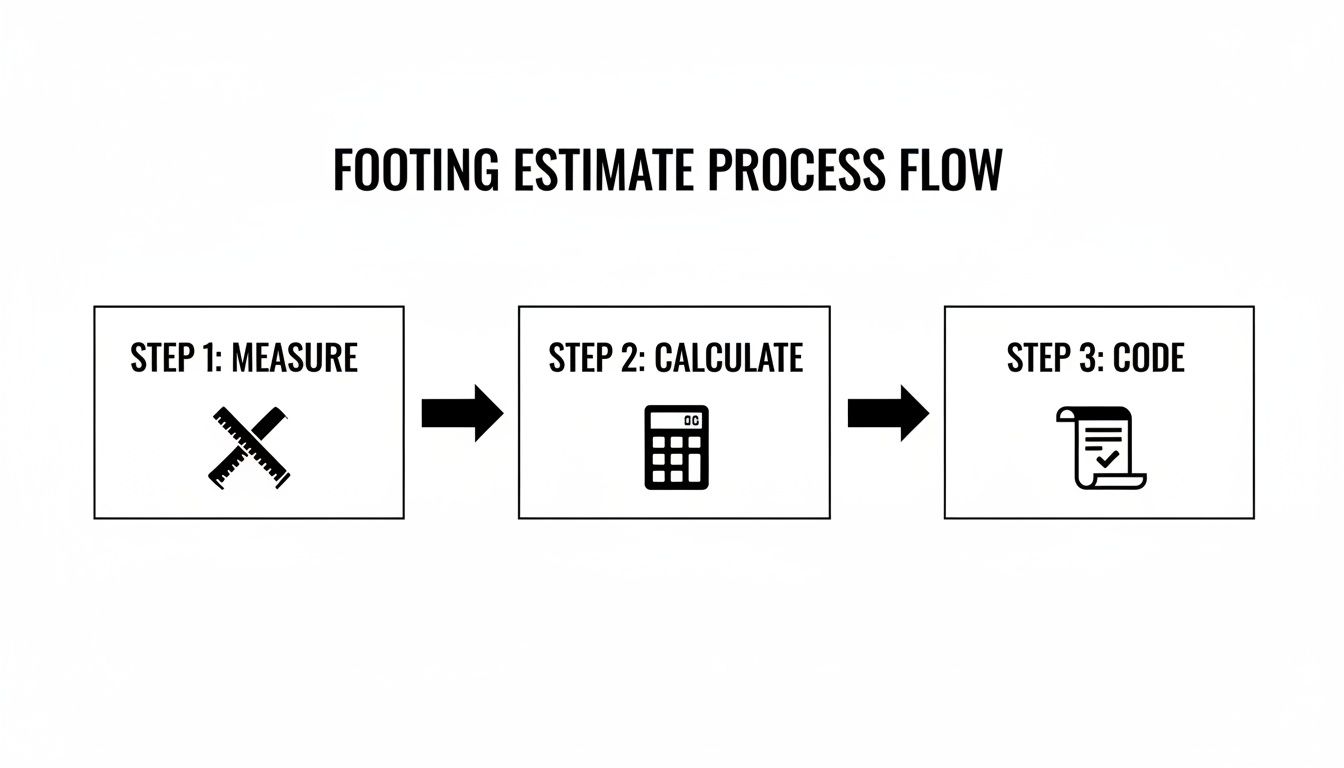
This process shows that everything starts with getting your measurements right. From there, it's about applying the right formula before giving any final requirements a once-over.
The Divide and Conquer Method for Irregular Shapes
What happens when your project has a truly funky shape that isn't a simple circle or square? For a custom patio with swooping curves and sharp angles, the best strategy is what I call the "divide and conquer" approach.
You simply break the complex shape down into a collection of smaller, manageable pieces—rectangles, squares, triangles, maybe even a half-circle. For example, an L-shaped patio can be calculated as two separate rectangles. A patio with a rounded end can be treated as one rectangle and one half-circle.
This method turns a potentially overwhelming calculation into a series of simple, bite-sized steps. Instead of hunting for some complex formula, you're just doing basic math several times over and adding it all up at the end.
Calculate the cubic yardage for each small section individually. Once you have the volume for every piece, just add them together. The grand total will be a surprisingly accurate estimate for your entire project. This technique takes the guesswork out of even the most creative designs, so you can order with confidence.
Precision here is key, especially for popular local projects. A circular patio or basketball half-court in a Duluth backyard with a 6-foot radius and a 6-inch depth will need 2.09 cubic yards. We’ve even seen a lot of Atlanta Concrete Solutions' clients putting in pickleball courts—a sport that has boomed 150% since 2020. For a 20-foot diameter practice circle (10 ft radius) at a 5-inch depth (0.417 ft), you're looking at about 4.85 yards for a solid base.
If you're interested in the business side of construction, you can find more insights on project calculations over at Invoicefly.com.
Tips for Ordering from a Concrete Supplier
Once you’ve double-checked your math and feel good about your numbers, it’s time to get on the phone. Figuring out how many yards you need is half the battle, but knowing how to talk to your supplier is what really sets you up for a smooth pour day. A few insider tips can make all the difference.
First thing's first: never, ever order the exact amount you calculated. On paper, everything looks perfect. But out on the job site, the ground is rarely perfectly level, and forms can bow out a bit from the sheer weight of the concrete. To handle these real-world curveballs, there's a simple rule every pro lives by.
Always Add a Safety Buffer
Pad your final number by at least 10%. So, if your project calls for 5 cubic yards, you should be ordering 5.5 yards. Think of this little bit of overage as your insurance policy against spills, an uneven subgrade, or other small issues that can leave you just short. For a large 30-yard driveway pour, this buffer is 3 extra yards—a crucial safeguard against costly delays.
Trust me on this one. The cost of having a little concrete leftover is nothing compared to the nightmare of paying a second delivery fee and creating a weak cold joint because you ran out. That 10% buffer is the cheapest insurance you can buy for your project.
This small step saves you from that panicked phone call, trying to get another truck out to your site before the first batch starts to harden up.
Understand Truck and Order Logistics
It helps to know a bit about how a ready-mix plant operates before you call. Your standard concrete truck can hold between 9 and 10 cubic yards. Keep that in mind for bigger jobs, as you might need to schedule multiple trucks and time them correctly. For example, a 25-yard order would require two full trucks and a third, partially-filled one.
You also need to ask about minimum order sizes. Most suppliers have a "short load charge" for smaller orders, usually anything under four to six yards. This fee just covers their cost of sending out a truck that isn’t full. If you only need a yard or two for a footing, be sure to ask about this charge so it doesn’t catch you by surprise. It can often be $150 or more.
When you're ready to place the order, have this information ready:
- Confirm Your Yardage: Tell them the final number, including your buffer. Don't just say "five yards," say "I need five and a half yards, please."
- Specify the Mix (PSI): Let them know what you're pouring. Is it a 3000 PSI mix for a patio or a stronger 4000 PSI for a driveway that will see heavy traffic? Provide the mix design number if you have one.
- Schedule Your Delivery: Concrete waits for no one. You have to be completely ready to go when that truck pulls up. Make sure the site is accessible for a large, heavy truck and give them a realistic delivery window.
Thinking through these details is just as crucial as getting the initial measurements right. For a deeper dive into the different concrete mixes and professional installation, take a look at the various concrete services we offer in the Atlanta area. Clear communication and solid planning are what guarantee a great result.
Common Questions About Ordering Concrete
Even with the right formulas, some real-world questions always pop up when you're planning a pour. Getting your head around the little details is the key to avoiding headaches on delivery day. Here are some of the most common things we get asked by folks here in Atlanta.
How Do I Account for a Slab with Varying Thickness?
This is a great question because very few slabs are perfectly level. Most driveways and patios are built with a slight slope for drainage, which means your concrete depth won't be uniform. The trick is to work with an average depth.
It's pretty simple. Just measure the thickness at the deepest point and the shallowest point of your form. Add those two numbers together, then divide by two. That gives you a solid average to plug into your calculations.
For instance, say your driveway slab slopes from 6 inches thick near the garage down to 4 inches at the curb. Your average depth is (6 + 4) / 2 = 5 inches. Now, just convert that to feet (5 / 12 = 0.417 ft) and use it in the volume formula. This little extra step gives you a much more accurate estimate for sloped work.
What Is a Short Load Fee and How Can I Avoid It?
A "short load fee" is something concrete suppliers charge when you order a small batch that doesn't fill much of the truck. Think of it this way: it costs the same in fuel and driver time to send a truck out whether it's full or nearly empty. This fee helps cover that operational cost for smaller orders, typically anything under 4 to 6 cubic yards.
You've got a couple of options here. If you have multiple small projects, try to schedule them for the same day. Pouring footings for a new deck and a small generator pad at the same time might get you over the minimum order threshold. For instance, if the footings require 2.5 yards and the pad needs 1 yard, your 3.5-yard total might still incur a fee, but it will be more cost-effective than two separate small deliveries.
But if your project is really small, like setting a mailbox post, you're almost always better off grabbing a few bags of mix from the hardware store. For anything over 1 cubic yard, however, getting a truck delivery—even with the fee—often makes more sense when you factor in the back-breaking labor you'll save.
A short load fee isn’t a penalty. It’s just the business reality of dispatching a massive, expensive piece of equipment. The truck, the fuel, and the driver's time are major costs, no matter how much concrete is in the drum.
Can I Use an Online Concrete Calculator?
Absolutely. Online concrete calculators are handy tools, but I always tell people to use them as a double-check, not as their primary method. Do the math yourself first.
Why? Because working through the calculations by hand forces you to understand your project's actual dimensions and helps you spot your own measurement mistakes. It's easy to punch in a wrong number and get a flawed result from a calculator without realizing it. For example, accidentally entering a depth of 4 feet instead of 4 inches would result in an order 12 times larger than needed—a catastrophic and costly error.
Think of it as a safety net. Run your own numbers, then use a calculator to confirm you're on the right track. After all, any tool is only as good as the information you feed it.
Ready to turn those calculations into a solid foundation? The team at Atlanta Concrete Solutions is here to help you get exactly the right amount of high-quality concrete for your project in the Atlanta area. Contact us today for a free, no-obligation quote.