
To figure out how much concrete you need, you first have to find the volume of your project in cubic feet. That’s just a simple Length x Width x Thickness calculation. Once you have that number, you divide it by 27 to convert it into cubic yards. For example, a 10 ft by 10 ft patio that is 4 inches thick requires 1.23 cubic yards of concrete.
That simple conversion is the key to ordering the right amount for any job, whether it's a small backyard patio or a full-size driveway. Nailing this calculation from the get-go is the best way to avoid some expensive—and frustrating—mistakes.
Why Getting Your Concrete Measurement Right Matters
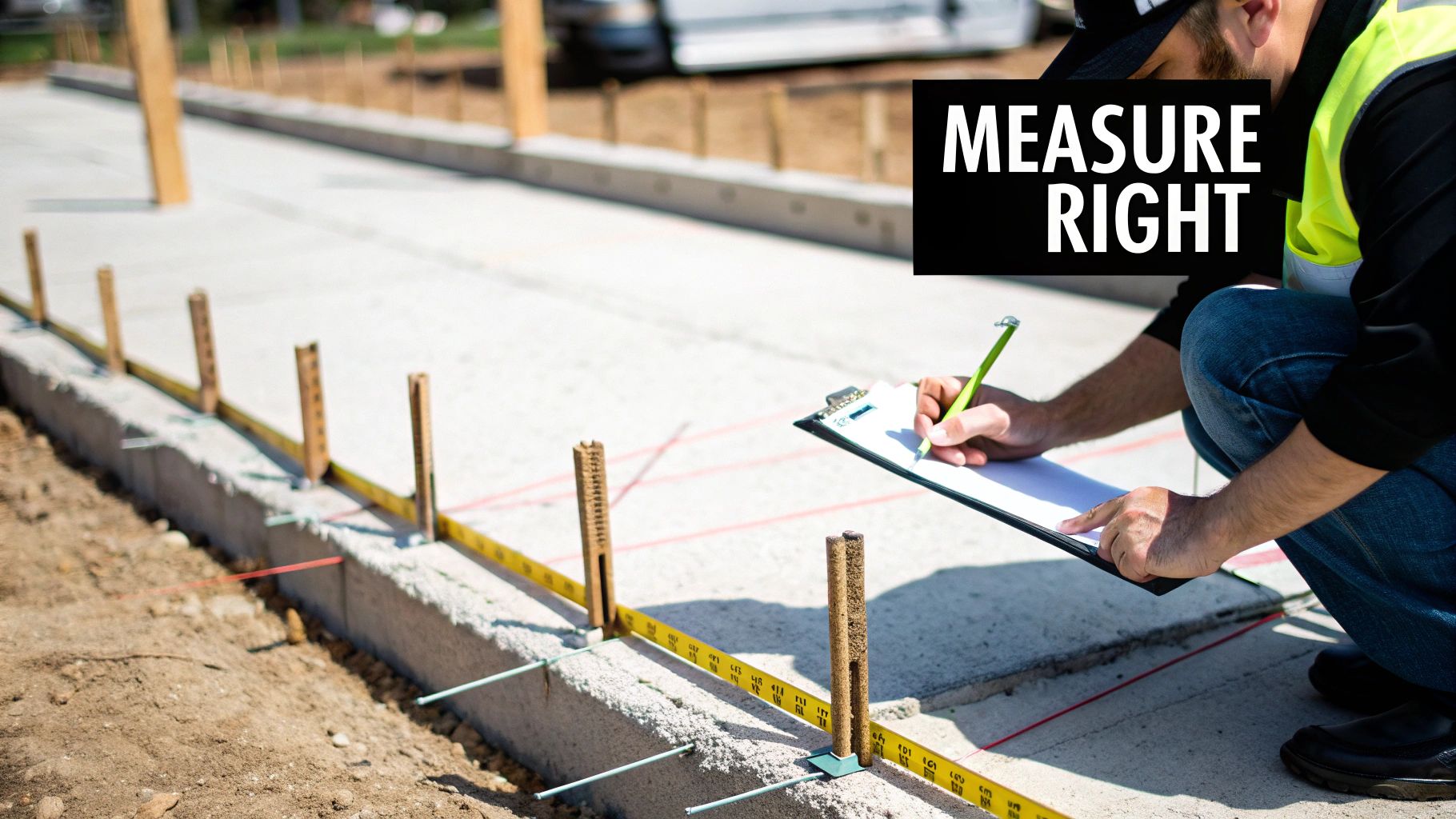
Ever wondered why concrete pros are so meticulous with their tape measures? It’s because unlike a can of leftover paint you can stick in the garage, a miscalculation with concrete creates real, project-killing problems.
Ordering too little is a rookie mistake, but it's a serious one. A shortage means a frantic call to the ready-mix plant, which almost always comes with hefty short-load fees and agonizing delays. For instance, needing just one more yard can cost you an extra $150-$200 in fees alone. Even worse, it can create "cold joints"—weak points where fresh, wet concrete is poured against concrete that has already started to harden. These joints are a recipe for future cracks and can compromise the integrity of the entire slab.
On the flip side, ordering too much gives you a whole different kind of headache. You're stuck paying for material you can't use, and you might even get hit with extra fees to dispose of the excess. For example, a ready-mix company might charge a "washout fee" of $100 or more if the driver has to clean out a significant amount of leftover concrete.
Getting your volume correct isn't just about saving a few bucks; it’s about ensuring the strength and longevity of your investment. A few extra minutes with a tape measure now can prevent a lifetime of structural issues later on.
This guide is designed to cut through the guesswork. We'll walk you through exactly how to measure for common projects, giving you the confidence to get this critical first step right. While most projects are straightforward, learning about using a conversions calculator effectively can offer some extra help for more complex shapes.
The Three Key Measurements You'll Need
Before you can even think about ordering concrete, you need to grab a tape measure and get three specific numbers from your project site. Honestly, this is where most of the costly mistakes happen, but if you take your time, it's pretty simple to get it right.
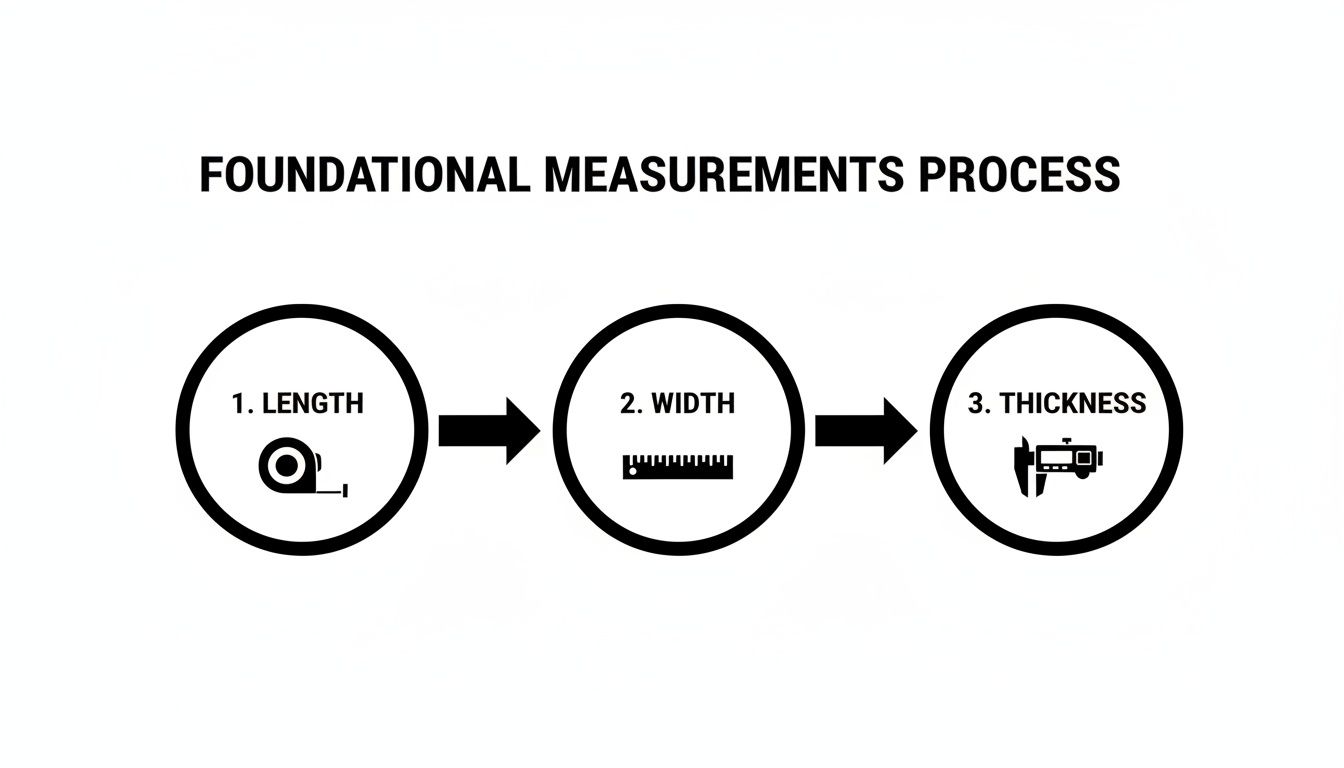
The magic numbers are length, width, and thickness. For any square or rectangular job—think patios, driveways, or a shed base—you'll measure the length and width of the area you've framed up. For example, a typical two-car driveway might measure 18 feet wide by 40 feet long. A good tip is to use stakes and string lines to get clean, straight boundaries that are easy to measure.
Keep Your Units Straight—It's a Must
Here’s the single most important rule: get all your measurements into the same unit before you multiply anything. It's so easy to mess this up. You’ll probably measure your slab’s thickness in inches, but the length and width will almost always be in feet. Mixing those two will give you a completely wrong number.
Feet is the unit you want to work with. Everything needs to be converted to feet before you do the math. That means the most important conversion you'll make is turning your slab's thickness from inches into feet.
It's simple: just divide the thickness in inches by 12.
- 4-inch slab: 4 ÷ 12 = 0.333 feet (This is a standard thickness for patios and walkways).
- 6-inch slab: 6 ÷ 12 = 0.5 feet (Often used for driveways or areas supporting heavier loads).
- 8-inch slab: 8 ÷ 12 = 0.667 feet (Common for heavy-duty commercial applications).
Forgetting this one small step is the most common pitfall we see, and it can leave you short on pour day. For a deeper dive into designing slabs that last, check out our guide on residential foundation concrete.
Quick Conversion from Inches to Feet
To make things even easier, here's a handy table for converting common slab thicknesses from inches into the decimal feet you need for the formula.
| Thickness in Inches | Thickness in Decimal Feet (Inches ÷ 12) |
|---|---|
| 4" | 0.333 ft |
| 5" | 0.417 ft |
| 6" | 0.500 ft |
| 8" | 0.667 ft |
| 10" | 0.833 ft |
| 12" | 1.000 ft |
Just find your slab's thickness in the first column and grab the corresponding decimal value from the second column. Plug that number right into your calculation.
What About Uneven Ground?
So, what happens if your ground isn't perfectly flat? A poorly graded site can soak up a lot more concrete than you bargained for, and you won't realize it until the truck is running empty.
Don't just measure the thickness in one spot. To get a true average, take several depth measurements across the entire area. For example, on a 10×10 patio, you might measure the depth at all four corners and once in the center. Add them all together, then divide by the number of spots you measured.
This simple averaging trick will give you a much more realistic thickness to work with, protecting you from a last-minute panic. Once you have your length, width, and average thickness—all in feet—you're ready for the next step.
Getting Your Concrete Math Right for Common Shapes
Alright, you've got your three key measurements—length, width, and thickness. Now it's time to translate those numbers into an actual concrete order. The core formula is surprisingly simple: multiply your length, width, and thickness together to find the total cubic footage of your project.
But here’s the crucial final step: you need to divide that number by 27. Why? Because concrete is sold by the cubic yard, and there are 27 cubic feet in every cubic yard. That’s it. This simple conversion is all it takes to figure out the volume for any square or rectangular slab.
Let's walk through a couple of real-world examples you might encounter on a job site right here in Atlanta.
Example: A Standard Driveway Slab
Imagine you're pouring a new driveway for a home in the suburbs. It's a clean, rectangular shape. You've pulled your tape measure and have these dimensions:
- Length: 50 feet
- Width: 18 feet
- Thickness: 4 inches (which is 0.333 feet)
First, let's find the volume in cubic feet:
50 ft × 18 ft × 0.333 ft = 299.7 cubic feet
Now, convert that into the number your supplier needs—cubic yards:
299.7 ÷ 27 = 11.1 cubic yards
This quick process is exactly how we move from on-site measurements to a final, order-ready number.
What About Circular or Odd-Shaped Slabs?
Of course, not every job is a perfect rectangle. What do you do when you’re pouring a circular patio or a unique L-shaped walkway? The good news is, the math is still very straightforward.
For a circular slab, you’ll need a slightly different formula: π × radius² × thickness. Just remember, the radius is always half of the total width (diameter) of the circle. So, for an 8-foot wide circular hot tub pad, the radius is 4 feet.
If you have an L-shaped patio, just treat it as two separate rectangles. Calculate the volume for each rectangular section on its own, then simply add the two totals together. This "divide and conquer" strategy works for almost any irregular shape you can break down into smaller squares and rectangles, making it a go-to method for many residential poured concrete projects.
Pro Tip: When you're dealing with a complex shape, sketch it out on a piece of paper first. Drawing the area and labeling the dimensions of each individual section makes the math feel less intimidating and goes a long way in preventing costly mistakes.
Getting these units right matters. Back in 1959, an international agreement standardized the yard as exactly 0.9144 meters, ending small but significant differences between the US and UK. That level of precision is critical for us today. A simple miscalculation can easily lead to 15-20% material waste on a residential job—an expensive mistake that good measurement easily avoids.
The Pro Secret for Avoiding Shortages: Overage
Here’s a tip from the field that separates the rookies from the seasoned pros: never, ever order the exact amount of concrete you calculate. After you’ve done all that careful measuring and run the numbers, the final, crucial step is to add a buffer. We call this an overage.
This isn't about being wasteful. Think of it as cheap insurance against a very expensive, project-killing mistake.
Coming up short on concrete in the middle of a pour is a legitimate disaster. It creates a "cold joint"—a weak spot that's practically guaranteed to crack and fail down the road. You can't just stop and wait for another truck.
Why You Always Need a Little Extra
No matter how perfect your math is, the real world has other plans. Several on-site factors can easily turn your precise calculation into a frustrating shortage, and these are things you just can't predict with a tape measure.
- Uneven Subgrade: The ground you've prepared might look perfectly flat, but subtle dips and pockets will drink up more concrete than you planned for.
- The Inevitable Spill: A bit of spillage during the pour is almost guaranteed, especially if you're using wheelbarrows or have a few green hands on the crew.
- Bowing Forms: The sheer weight and pressure of wet concrete can cause your wooden or metal forms to bow outwards just slightly, increasing the volume you need to fill. For example, a 20-foot long form that bows out by just half an inch can consume an extra cubic foot of concrete.
- What Sticks to the Truck: A certain amount of mud always gets left behind, clinging to the inside of the mixer drum and the chute. You pay for it, but you can't use it.
Ordering a little extra isn't a sign of poor planning—it's the mark of a pro who anticipates these variables. It’s a core part of project management, similar to the forecasting responsibilities outlined in a quantity surveyor's duties.
So, how much extra is enough? For most straightforward jobs like a simple patio, driveway, or sidewalk, adding a 5% buffer is a safe rule of thumb. In our driveway example of 11.1 cubic yards, a 5% overage would mean ordering 11.66 yards—rounding up to 11.75 or even 12 yards is a safe bet.
But if you’re tackling a more complex pour, dealing with a heavily compacted or uneven subgrade, or working with a less experienced crew, bumping that safety net up to 10% is a really smart move. That small addition buys you invaluable peace of mind and is key to a smooth, successful pour.
Smart Tips for Ordering Concrete in Atlanta
Getting your concrete measurements right is half the battle. The other half is actually getting the concrete to your site. A few insider tips for the Atlanta market can be the difference between a smooth pour and a major headache.
Before you even place an order, ask your potential supplier about their "short load fees." Most ready-mix companies have a minimum order requirement, often around 4-5 cubic yards. If your project needs less than that, they'll usually tack on a hefty fee to make the trip worthwhile. For instance, if you only need 2 cubic yards, you might pay for 4 yards' worth of delivery costs.
For very small jobs, like setting a single fence post, you might be better off mixing the concrete on-site yourself with bagged mix. It's also worth asking if the supplier can combine your delivery with another one happening nearby—it can sometimes save you a lot of money.
Preparing for Your Delivery
Don't wait until the last minute to schedule your delivery, especially during the busy season. When that truck shows up, your site needs to be 100% ready to go.
Think about the logistics. A fully loaded concrete truck can weigh over 60,000 pounds, so you need a clear and stable path for it to access your pour site. Take steps to protect your lawn, landscaping, or existing driveway from damage.
You'll also need to tell the supplier what strength of concrete you need, which is measured in PSI (pounds per square inch). The requirements vary based on the job:
- 3,000 PSI: This is a standard mix, great for a simple garden path or small patio not subject to heavy loads.
- 4,000 PSI: For anything that needs to bear weight, like a driveway or garage slab, you'll want this stronger mix.
Did you know the basic formulas for these calculations have been around since the 1920s? They are the bedrock of modern concrete work here in Atlanta and beyond. Yet, miscalculations are still a huge problem. Nationally, it's estimated that 12% of the 400 million cubic yards of ready-mix concrete used each year is wasted due to poor planning. You can learn more from this deep dive into the history of concrete pavement engineering.
From measuring and calculating to scheduling and site prep, ordering concrete requires careful planning. If you'd rather have an expert handle all the details, the team at Atlanta Concrete Solutions is ready to manage the entire process for you. Check out our full range of Atlanta concrete services to get started.
Common Questions We Hear About Measuring Concrete
Even after you've run the numbers, a few questions always seem to pop up. This is totally normal, especially if you haven't ordered concrete a dozen times before. Getting these details straight is the key to a project that goes smoothly, from the first measurement to the final pour.
Here are a few of the most common things people ask us.
How Much Does a Yard of Concrete Weigh?
It’s easy to forget just how heavy this stuff is. A single cubic yard of standard ready-mix concrete tips the scales at about 4,000 pounds—that's a full two tons. For perspective, that's roughly the weight of a Toyota RAV4.
This incredible density is why we stress proper ground prep and strong formwork; it’s not something you can afford to cut corners on. It also explains why you need a massive truck for delivery, not just a pickup. Understanding that weight really puts the whole project into perspective.
Can I Trust an Online Concrete Calculator?
Online calculators are great for one thing: getting a quick, ballpark estimate. They're perfect when you're in the early stages and just trying to figure out a rough budget for materials. For example, quickly inputting your driveway dimensions can tell you if you're looking at a $1,500 or $3,000 material cost.
But here’s the thing: a calculator can't see your job site. It doesn’t know about that slight dip in the subgrade on one side or the weird angle of your formwork.
Think of an online calculator as a starting point. It helps you get your bearings, but your own careful, on-site measurements are what you should trust for the final order. Your tape measure is your most reliable tool here.
What Happens If I Run Out of Concrete Mid-Pour?
This is the nightmare scenario. Running short on concrete before a slab is finished creates what we call a "cold joint."
It's a weak seam where the partially set concrete meets the new batch you pour later. That joint will never truly bond, creating a permanent vulnerability. It's an open invitation for cracks and water damage, which will absolutely compromise the strength and lifespan of your slab. This is exactly why we always add a bit extra.
Should I Adjust My Calculation for Rebar?
That’s a sharp question. For most residential jobs—think driveways, patios, or basic footings—the answer is no. You don't need to subtract the volume of the rebar or wire mesh from your total.
The amount of space the steel takes up is tiny. For example, in a 100 square foot slab that's 4 inches thick (1.23 cubic yards), the rebar might only displace 0.02 cubic yards of concrete. This is more than covered by the standard 5-10% overage you should already be adding to your order. Keeping the math simple here avoids confusion and won't put you at risk of a short load.
Ready to skip the math and get a perfect pour every time? The crew at Atlanta Concrete Solutions can handle everything from precise measurements to professional installation. Contact us today for a free, no-hassle quote!