
At the heart of every great pickleball match is a court built to precise specifications. The official playing area for an outdoor pickleball court is a rectangle measuring 20 feet wide by 44 feet long. What's great is that this size is the standard for both singles and doubles play, so you never have to guess. For example, if you and a friend are playing a one-on-one singles match, you use the exact same court boundaries as a four-person doubles match.
Decoding the Official Court Layout
A pickleball court might look straightforward, but those lines aren't just for show. They create a dynamic playing field designed for strategy and quick reflexes. Think of that 20’ x 44’ rectangle as the game board where every zone has a specific job, influencing how points are won and lost. For instance, the very existence of the non-volley zone forces players to develop a soft "dink" game instead of relying solely on power.
Getting these measurements right is the first, most crucial step, whether you're building a brand-new court or just taping off a space in your driveway. Let's break down the lines and zones that make the game tick.
Key Zones and Their Purpose
The court is divided into distinct areas, and knowing what they are is key to understanding the flow of the game.
- Sidelines and Baselines: These are the outer boundaries. The sidelines run the full 44-foot length, and the baselines mark the 20-foot width at each end. If the ball lands outside these lines, it's out. For example, if your opponent hits a serve that lands beyond your baseline, the point is immediately yours.
- The Non-Volley Zone (The "Kitchen"): This is the most iconic part of the court. It’s a 7-foot area that extends from the net back on both sides. You can't hit a volley—that is, hit the ball out of the air—while any part of your body is in the Kitchen. This rule is what encourages the strategic "dink" shots the game is famous for and prevents players from simply smashing the ball right at the net. For example, even if just your toe is touching the Kitchen line while you make contact with a volley, it is a fault.
- Service Courts: On each side of the net, a centerline splits the area between the Kitchen and the baseline into two equal halves. This creates the right and left service courts where serves must land. For instance, a serve from the right side must land in the service court diagonally opposite it.
This infographic gives a fantastic visual breakdown of how the playing area and its key zones fit within the larger recommended space.
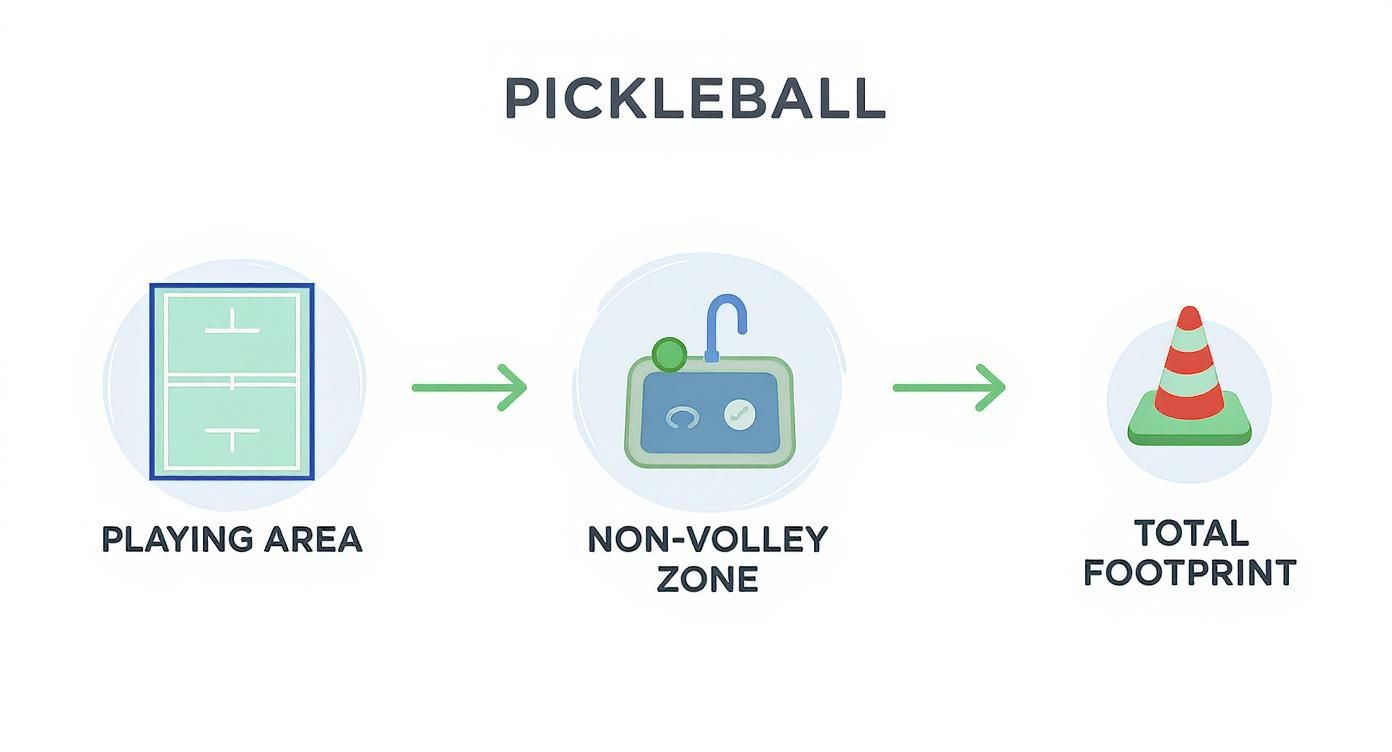
As you can see, the court itself is just one part of the total footprint. That extra room around the edges is absolutely critical for safe, competitive play.
The official court size is just one piece of the puzzle. While the playing lines are strict, the space around them—the "out-of-bounds" area—is just as crucial for safety and unrestricted movement during a fast-paced game.
For anyone looking to get the details just right, here's a quick summary of the key measurements.
Official Pickleball Court Dimensions At a Glance
| Court Area | Dimension (Feet) | Dimension (Meters) |
|---|---|---|
| Playing Area Width | 20 feet | 6.10 meters |
| Playing Area Length | 44 feet | 13.41 meters |
| Recommended Total Width | 30 feet | 9.1 meters |
| Recommended Total Length | 60 feet | 18.3 meters |
This table lays out the USA Pickleball specifications, showing both the non-negotiable playing dimensions and the recommended total space for a proper court.
While the playing area itself is quite compact, you can see why the total recommended area is much larger—a minimum of 30 feet wide by 60 feet long. This "safety apron" gives players room to chase down lobs and angled shots without running into a fence or another court. For example, a defensive shot called an "Erne," where a player legally runs around the kitchen to volley the ball, is only possible with adequate sideline space. You can learn more about official pickleball court standards on pickleballcourtexperts.com. Having this extra space is what separates a makeshift court from a truly great playing experience.
Why the Space Around the Court Matters
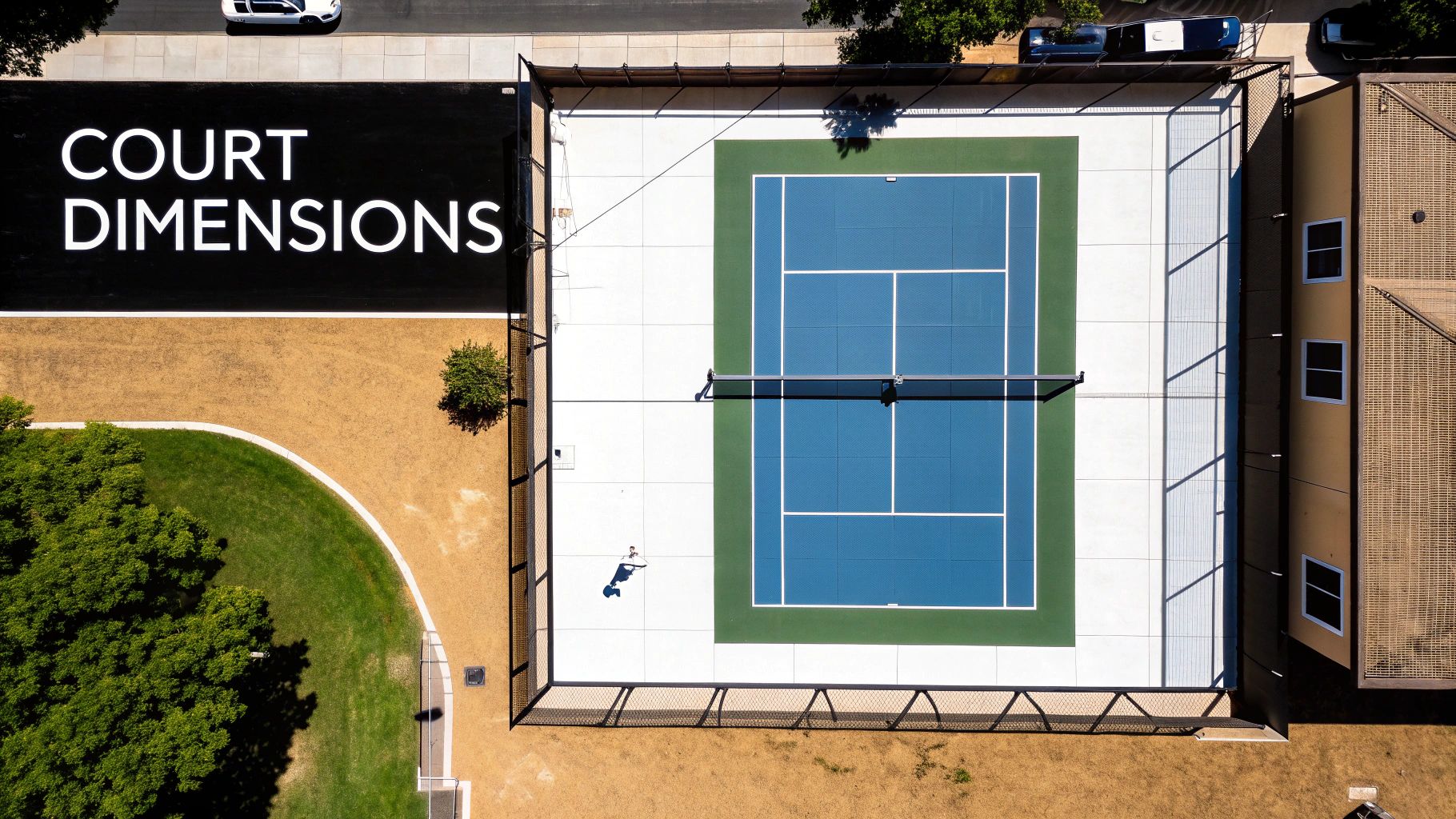
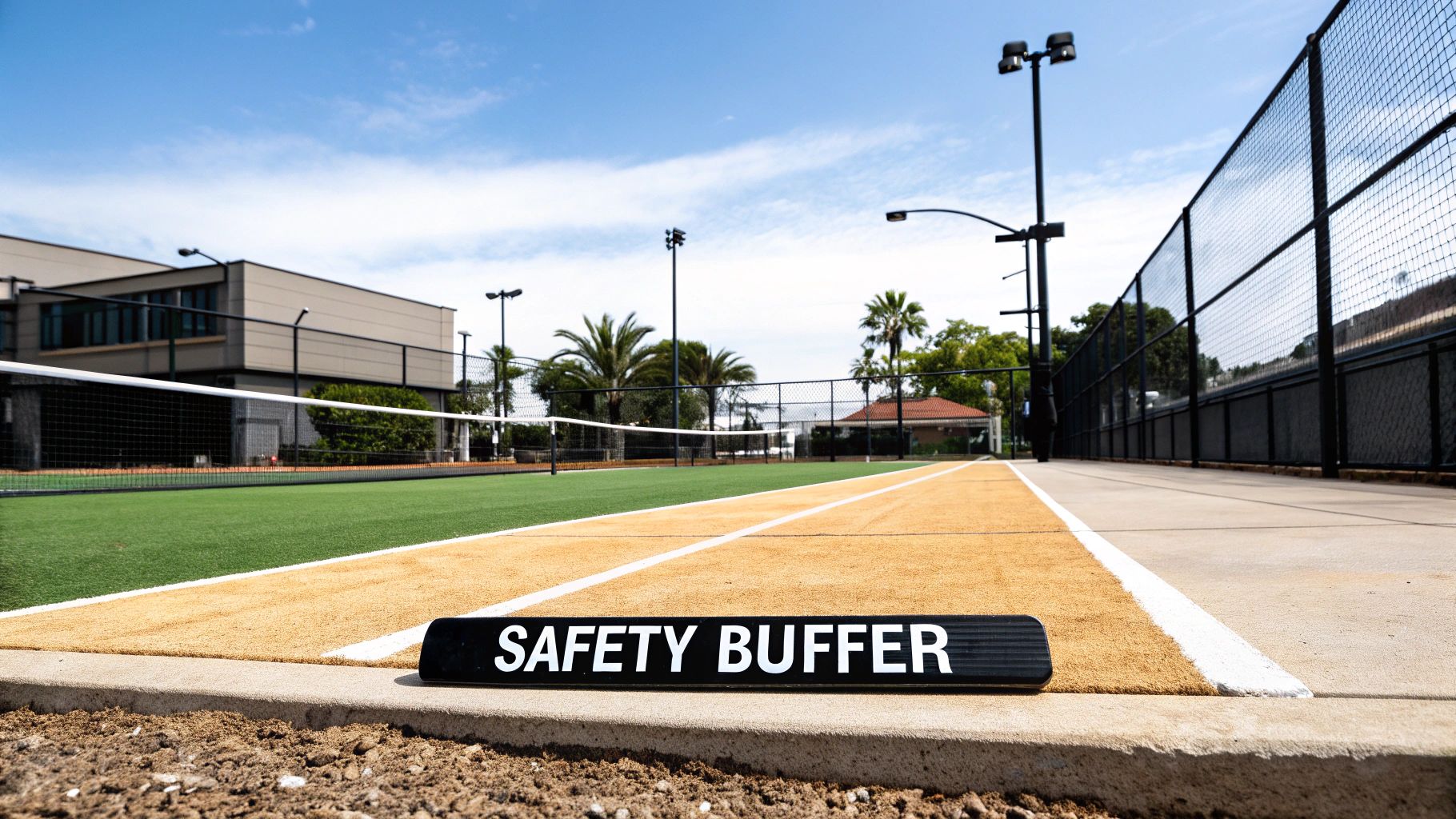
Sure, the game itself happens within a 20-foot by 44-foot box. But anyone who’s played a serious match knows the real action spills way beyond those lines. That’s why the gold standard for a total court footprint is 30 feet by 60 feet. That extra space isn't just for looks; it’s a crucial safety buffer.
Think about it. You're in a tough rally, and your opponent lobs one deep over your head. You're scrambling backward, eyes on the ball, with no time to check what's behind you. Or maybe you're lunging for a sharp cross-court dink, stretching as far as you can. The last thing you want to worry about is crashing into a fence, a bench, or another player.
This runoff area, or "safety apron," is designed for exactly those moments. It gives you the room to make athletic plays without risking a collision or a nasty fall. I've seen too many preventable injuries happen simply because there wasn't enough clearance. It can turn a fun game into a dangerous one in a split second.
Planning for Safety and Functionality
The recommended 10-foot buffer behind each baseline and 5-foot space on the sides is about more than just avoiding crashes during a point. It's about creating a court that's truly functional and enjoyable for everyone. This zone is where you can safely walk on and off the court, and it’s where you’ll place all the essential amenities without them getting in the way.
You have to account for things like:
- Player Benches: You need a spot for players to rest between games, but those benches have to be far enough away from the sidelines to be non-issues. For example, placing a bench 6-7 feet from the sideline ensures a player lunging wide won't trip over it.
- Spectator Areas: If you have friends or family watching, they need a safe place to stand or sit where they won't interfere with the game or get hit by a stray shot. This could be a designated area behind the baseline fence.
- Equipment Storage: Things like ball holders, paddle racks, and water coolers need a home that isn't a trip hazard. A common example is placing a small equipment table near the net post but well outside the 5-foot side buffer.
When you plan this out correctly, these features make the experience better, not more dangerous.
A well-designed court anticipates how players move. That out-of-bounds area is your safety net, giving players the confidence to go for a tough shot without worrying about what’s around them.
In the end, this space elevates a simple playing surface into a complete, professional-feeling court. It ensures clear sightlines, easy movement on and off the court, and a much safer environment for competitive play. So when you’re planning your court, always think beyond the lines. A great court starts with a solid foundation, and that includes the space all around it. To learn more about getting that base just right, see our guide on the importance of a professionally prepared residential poured concrete foundation. It’s what makes sure your safety apron is just as reliable as the court itself.
How Pickleball Courts Compare to Tennis Courts
To really get a feel for how brilliantly outdoor pickleball courts are designed, it helps to see how they stack up against other racket sports. One of pickleball's biggest strengths is its compact size, which is a huge reason why it’s so much more accessible for communities, clubs, and even homeowners who don’t have a ton of space to spare. It's not just a shrunken-down tennis court; it's a court thoughtfully designed for a completely different game.
This smart use of space is a major factor behind the sport's incredible boom. When property owners and facility managers realize they can serve a much larger group of people in the same footprint, the lightbulb goes on.
A Game of Numbers: The Court Size Showdown
The easiest comparison is with a standard tennis court. A regulation pickleball court is 20 feet by 44 feet, giving you a total playing area of 880 square feet. A tennis court, on the other hand, has a playing area of 36 feet by 78 feet—a whopping 2,808 square feet before you even factor in the necessary runoff space.
Here’s where it gets interesting. Because of this size difference, you can fit four pickleball courts almost perfectly into the space of a single tennis court just by painting new lines. It’s a simple, powerful bit of math. For example, a community park with two underused tennis courts could convert them into eight bustling pickleball courts, potentially quadrupling the number of active residents at any given time. If you want to dig deeper into these conversions, the team at Miller Sports & Entertainment has a great breakdown.
This makes converting an old, underused tennis court a no-brainer for clubs and parks trying to keep up with the massive demand for pickleball.
By the numbers, a tennis court's playing area is over three times larger than a pickleball court's. This difference is the secret behind pickleball's adaptability and rapid expansion into existing athletic facilities.
Unlocking Potential in Existing Spaces
This size difference isn't just a fun fact; it fundamentally changes who can build a court and where.
- For Homeowners: That backyard that could never dream of hosting a tennis court? It might be the perfect spot for a pickleball court with the right safety clearances. For example, a typical suburban backyard might have a 40×70 foot flat area, which is too small for tennis but ideal for a pickleball court with full runoff.
- For Communities: Parks can get four times as many pickleball players on the court as tennis players in the same space. That means less waiting around and more people playing. A great example is a city replacing one tennis court with four pickleball courts, allowing 16 people to play simultaneously instead of just four.
- For Clubs: A tennis club can breathe new life into a single, quiet tennis court by turning it into a vibrant hub with four pickleball courts, instantly boosting its value for members. This strategy, for instance, can attract a whole new demographic of players to the club, increasing membership revenue.
At the end of the day, the smaller dimensions make building a pickleball court less of an intimidating project and far easier to fit into almost any environment. It’s this brilliant design that has been key to opening up the game to millions of new players.
Building Your Court from the Ground Up
Knowing the court dimensions is one thing, but building a court that actually lasts? That starts from the ground up—literally. The foundation you lay is, without a doubt, the most critical part of the entire project. Skimp on the base, and you're building a house on sand. It’s only a matter of time before you're dealing with frustrating cracks, low spots, and puddles.
A stable, well-drained base is the unsung hero of a great pickleball court. This layer is your insurance against the concrete slab shifting, heaving from frost, or settling unevenly. For example, a proper base might consist of 4-6 inches of compacted gravel, which allows water to drain away freely and prevents the ground from expanding during a winter freeze. And good drainage is non-negotiable; it channels water away from the court, protecting both the surface and the sub-base from long-term damage.
The Concrete Slab Foundation
After the base is prepped and compacted, it's time for the concrete slab—the stage for every game you'll play. For a standard backyard or recreational pickleball court, a 4-inch thick concrete slab is typically all you need to ensure a solid, durable surface.
But what if your court will see near-constant action, or you live in an area with harsh freeze-thaw cycles? In that case, bumping the thickness up to 6 inches and adding reinforcement like rebar or wire mesh is a wise investment. For example, a community court in a northern climate that hosts daily league play should almost certainly be built with a reinforced 6-inch slab to prevent cracking from heavy use and ice formation. That extra strength helps spread out the stress on the slab, dramatically cutting down the risk of cracking down the road.
The real strength of your court is hidden beneath the surface. Investing in a properly compacted base and a reinforced concrete slab is the single best decision you can make to ensure your court withstands years of play and whatever the weather throws at it.
A professionally poured slab is also essential for getting the drainage slope just right. We aim for a subtle 1% grade running from side-to-side or end-to-end. You’ll barely notice the incline, but it’s working 24/7 to keep your court dry and ready for play after it rains. You can see how a quality foundation makes all the difference by looking at some of our completed concrete projects in the Atlanta area.
Choosing the Right Playing Surface
A bare concrete slab is just a blank canvas. The acrylic surfacing system you apply over it is what brings the court to life, dictating everything from ball bounce and player comfort to the court's overall lifespan. It's what separates a basic court from a high-performance one.
This isn't just a coat of paint. It's a multi-layer system where each part has a specific job:
- Primer/Resurfacer: This first coat sinks into the concrete, filling any small voids to create a smooth, uniform texture. It’s the key to making sure the next layers bond perfectly.
- Cushion Layers: While optional, these rubberized acrylic layers are a game-changer for comfort. They provide shock absorption that's much easier on your joints. For example, a court for a senior community might have five cushion layers to reduce impact on knees and backs.
- Color Coats: These are the vibrant, textured layers that form the actual playing surface. We can adjust the amount of sand mixed in to fine-tune the court's speed and provide that crucial non-slip grip. A tournament court, for instance, might have a finer sand mixture for faster play.
- Line Paint: The finishing touch is laying down crisp, white lines using a specialized, non-slip acrylic paint to mark out the court.
Each layer builds on the last to create a safe, durable, and fantastic playing experience that you simply can't get from slapping a coat of paint on concrete.
Getting the Net and Lines Perfectly Right
With your concrete cured and the new surface gleaming, it's the final details that officially turn a slab into a pickleball court. The two most critical finishing touches are the net and the lines. Getting these right isn't just about aesthetics—it's about creating a court that meets regulation standards and guarantees fair play for every game.
The Heart of the Court: The Net
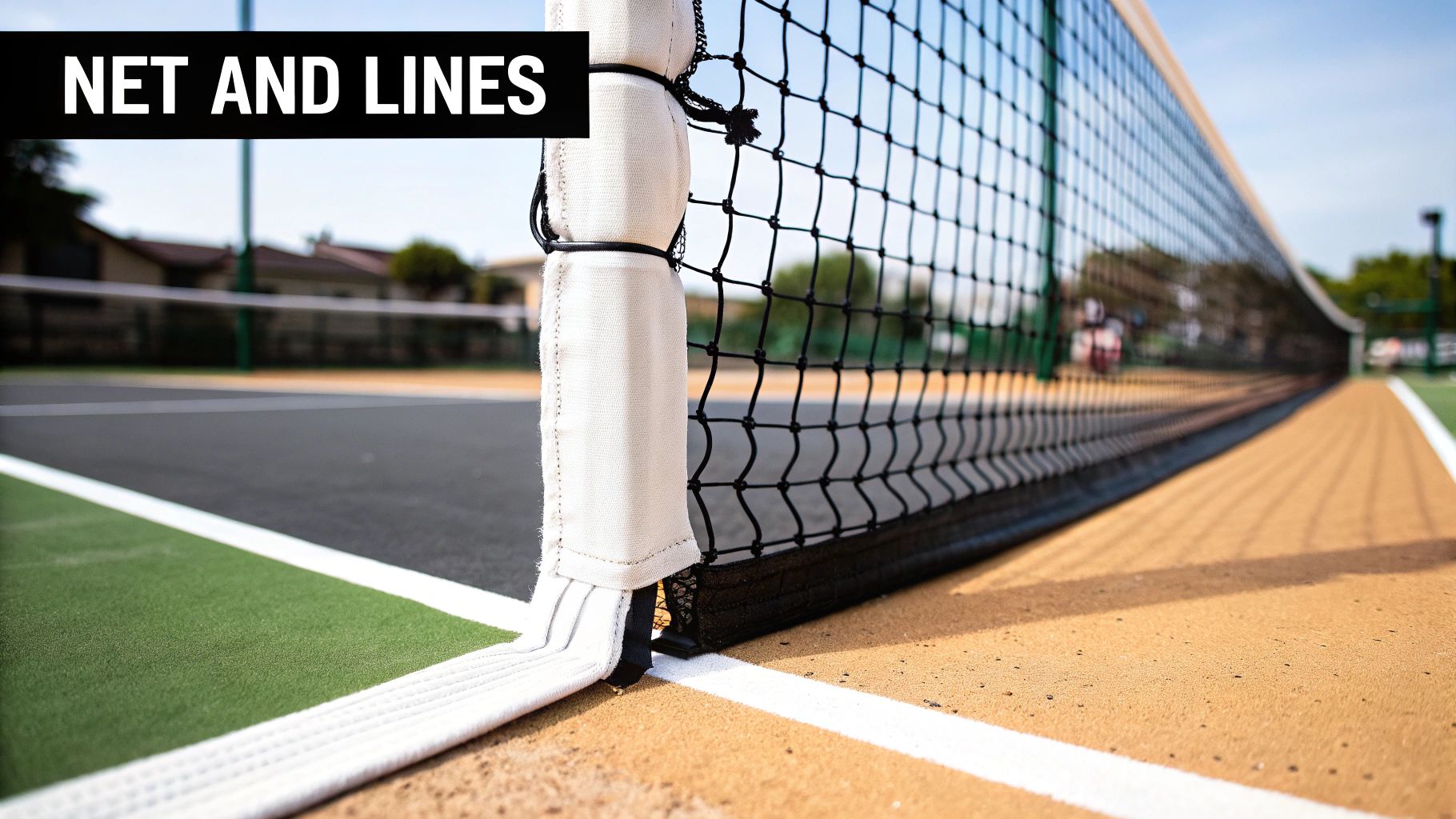
The net literally divides the court, and its height is everything. According to USA Pickleball rules, the net needs to be 36 inches high where it meets the sidelines. From there, it should have a slight, intentional droop to 34 inches right in the center.
That subtle two-inch drop is a surprisingly big deal. It's what makes those strategic, cross-court dinks possible and is usually held in place by a center strap. When you're installing the net posts, think long-term. For example, choosing stainless steel or powder-coated aluminum posts will prevent rust and ensure the net stays taut for years, unlike cheaper alternatives. Investing in durable, weather-resistant posts will save you from the headaches of rust and sagging down the road.
Marking the Court with Precision
Once the net is up, it's time to paint the lines that lay out the field of play. These aren't just suggestions; they are the rules of the game brought to life. Every single line on a pickleball court has to be exactly 2 inches wide, making them clearly visible from anywhere on the court.
For this job, you'll want a high-quality, non-slip acrylic paint. This isn't the place to cut corners. For example, using standard exterior paint might seem like a cost-saver, but it will quickly become slick when wet and will likely peel within a single season. That specialized paint gives players the grip they need for quick pivots and stands up to the constant scuffing and harsh weather.
A perfectly marked court removes all the guesswork from the game. When your lines are crisp, clear, and exactly 2 inches wide, players can focus on their next shot, not on arguing whether a ball was in or out.
To make sure your court dimensions are spot-on, it’s best to follow a specific order when painting:
- Lay Down the Perimeter: Start by marking the full 20-foot by 44-foot outer boundary, which includes the baselines and sidelines.
- Define the Kitchen: Next, measure exactly 7 feet out from the net on both sides and paint the Non-Volley Zone lines. This area is famously known as "the Kitchen."
- Draw the Centerline: Finally, find the center point of each baseline (at the 10-foot mark) and connect it straight to the Kitchen line on the same side. This divides the space into the left and right service courts.
Following this step-by-step process ensures all your outdoor pickleball court dimensions are precise, giving you a professional-grade playing surface that's ready for its first serve.
Bringing Your Pickleball Court Project to Life
So, you've got the dimensions down. That’s a great start, but turning that empty space into a high-quality pickleball court involves a lot more than just lines on a slab. This is where planning and professional expertise make all the difference, helping you map out a realistic budget and timeline from day one.
It's the small, often-overlooked details that truly separate a court that's just "okay" from one that's a joy to play on for years to come.
Thinking Beyond the Playing Surface
When we plan a court, we're not just looking at the concrete and the paint. We're considering how the court fits into its environment and how people will actually use it. Skipping these steps is a classic DIY mistake that can lead to expensive fixes down the road.
- Court Orientation: We almost always recommend a north-south orientation. It might seem like a minor detail, but it’s a game-changer for minimizing sun glare during those prime morning and afternoon playing times. For instance, with an east-west court, one team is always staring directly into the rising or setting sun, making it nearly impossible to see the ball.
- Fencing: You'll want a solid fence, usually 8 to 10 feet high, to keep the game moving. Nothing stops the fun faster than chasing stray balls after every point. A common material choice, for example, is vinyl-coated chain-link, which is durable and reduces noise compared to bare metal.
- Lighting: If you ever want to play after the sun goes down, lighting isn't optional—it's essential. We focus on proper placement and height to light up the court evenly, without creating weird shadows that can throw off your game. A typical example involves using two poles with angled LED fixtures on each side of the court to provide consistent illumination.
We look at the whole picture, not just the playing area. By thinking about orientation, fencing, and lighting from the very beginning, we build a complete pickleball environment that’s safe, functional, and ready for a match whenever you are.
From the Ground Up with an Expert Hand
Working with a team like Atlanta Concrete Solutions means we sweat the details so you don't have to. Our process always starts with a careful look at your site. From there, we manage everything—the precise concrete pour, the drainage slope, the specialized acrylic surfacing, and painting those perfectly crisp lines.
Our relationship doesn't end when the last line is painted, either. Even the best-built courts need a little TLC over time, whether it's filling a crack or resurfacing after years of intense matches. Having an experienced contractor on your side means you have a partner for the initial build and all the maintenance that follows.
To see what's involved in a professional build-out, take a look at our complete list of concrete installation and repair services.
Answering Your Top Questions About Pickleball Court Dimensions
When you're planning a new court, a lot of questions pop up. It makes sense—you want to get it right the first time. Over the years, we've heard just about all of them, so let's tackle the most common ones we get from homeowners and facility managers.
What’s the Real Minimum Space for a Pickleball Court?
The actual playing lines measure 20 feet wide by 44 feet long, but that's only part of the story. You can't just pour a slab that size and call it a day. For safe, competitive play where people are running and lunging, you need runoff room.
The absolute smallest footprint we recommend is 30 by 60 feet. This gives you a critical 5-foot buffer along the sidelines and an 8-foot buffer behind each baseline, allowing players to move freely without risking a collision. For example, this buffer zone gives you enough space to legally return a shot even after you've run past the baseline to retrieve a lob.
Can I Just Paint a Court on My Driveway?
You absolutely can! For a fun, temporary setup, your driveway is a fantastic option. Grab some chalk or durable tape and mark out the 20’ x 44’ playing area, and you're ready to go.
Just be aware of one thing: most driveways are built with a pretty steep slope for water drainage. This grade is often much more than the recommended 1% for a proper court, which can make the ball bounce a little unpredictably. For example, a ball hit to your left might bounce lower and faster than one hit to your right due to the exaggerated slope. It's perfect for practice and casual games, though.
How High Does the Fence Need to Be?
You definitely want a fence to keep the game moving and stop you from chasing balls all day. For most backyard or recreational courts, a fence that’s 8 to 10 feet high is the sweet spot.
This height is tall enough to contain the vast majority of shots, even the wild ones, without making the court feel like a cage. If your court is right up against a neighbor's property or a busy area, you might consider going a bit taller, but 10 feet is usually plenty. A good example of when to use a shorter fence is for a single, isolated court where a 4-foot fence might be enough to simply define the area without blocking a view.
Don't cut corners on the overall footprint. That recommended 30×60 foot area is a safety standard for a reason. It's built to handle the quick, dynamic movements that define pickleball and helps keep players from getting hurt.
Building a court that meets precise outdoor pickleball court dimensions is a job for a seasoned pro. If you want a flawless installation here in the Atlanta area, put your trust in the team at Atlanta Concrete Solutions. Get your free quote today!