
Picture this: your backyard, once just a patch of grass, is now the heart of your home's outdoor life. It's where you host weekend cookouts, enjoy a quiet cup of coffee in the morning, or watch the kids play. A simple concrete patio is what makes all that possible. It's far more than just a gray slab; it's the solid, clean foundation for your grill, your patio set, and all the good times that happen out back. For example, a basic 12×12 foot patio provides enough space for a small dining set and a grill, instantly creating an outdoor room.
Why a Simple Concrete Patio Is the Perfect Atlanta Upgrade
When you're thinking about upgrading your outdoor space here in Atlanta, a simple concrete patio is one of the smartest, most practical moves you can make. It's an investment that directly tackles the realities of our local environment. You're not just adding a patio; you're expanding your home's living area with a feature that asks for very little in return.
Forget the yearly staining a wood deck demands or the constant battle with weeds popping up between pavers. For example, a homeowner might spend an entire weekend every spring pressure washing and re-staining a wood deck. With concrete, that same weekend is spent enjoying the patio, not working on it. Concrete gives you a single, solid surface that’s built to last for decades.
This is a huge deal in our climate. Atlanta's sticky, humid summers and the occasional winter freeze-thaw cycle are notoriously hard on outdoor materials. Concrete, however, is built to handle it.
- It laughs at humidity and moisture. Unlike wood, concrete won't rot, warp, or become a feast for termites. A common Atlanta problem is subterranean termites, which can destroy a wood deck from the ground up, an issue concrete is immune to.
- It handles our temperature swings. A properly installed slab with control joints is designed to manage the expansion and contraction that comes with hot Georgia days and cooler nights, preventing uncontrolled cracking.
- It sheds our heavy rains. When a pro pours your slab with the right slope, water drains away perfectly. A typical example is a slope of a quarter-inch per foot, which is subtle but effective at keeping water from pooling up against your home's foundation.
More Than Just a Slab: It's an Investment in Your Home
Beyond its sheer toughness, a concrete patio adds real, measurable value to your property. It’s an amenity that home buyers actively look for, giving them more usable space without the high cost of a full-blown addition. For instance, a home with a well-maintained patio is often more appealing to buyers than an identical home with just a patch of grass, potentially leading to a faster sale.
You’re essentially creating a whole new room for your home—an open-air space for dining, relaxing, or entertaining that immediately boosts your curb appeal and your overall quality of life.
When it comes to return on investment, a well-designed concrete patio is one of the top home improvement projects you can tackle. You often get back a huge chunk of the cost when you sell, making it a feature that pays you back in both enjoyment and equity. For example, a $5,000 patio could add $3,500 or more to your home's resale value.
At the end of the day, opting for a simple concrete patio means you'll spend less of your free time on maintenance and more of it actually using your backyard. It's the ultimate low-effort, high-reward solution for creating a beautiful, lasting outdoor space that's perfectly suited for the Atlanta lifestyle.
Exploring Your Patio Finish Options
When you think of a simple concrete patio, what comes to mind? For most people, it’s a plain, gray slab. But that's just the starting point. The finish is what gives a patio its personality, defining everything from its look and texture to how safe it is underfoot. It’s the final step that elevates a basic slab into a thoughtful part of your landscape design.
Choosing the right finish is about balancing style with practicality. It's a bit like picking out tires for your car. You wouldn't put slick racing tires on a family SUV that drives in the rain, right? The same logic applies here. For example, a beautiful, smooth finish might be perfect for a covered porch, but it could be a safety hazard for an open-air pool deck.
The great news is you don't need to get overly complicated to achieve a fantastic result. The most common finishes for simple concrete patios are popular for a reason: they look great, they're durable, and they get the job done without breaking the bank.
This infographic lays out the core reasons why concrete remains a top choice for homeowners.
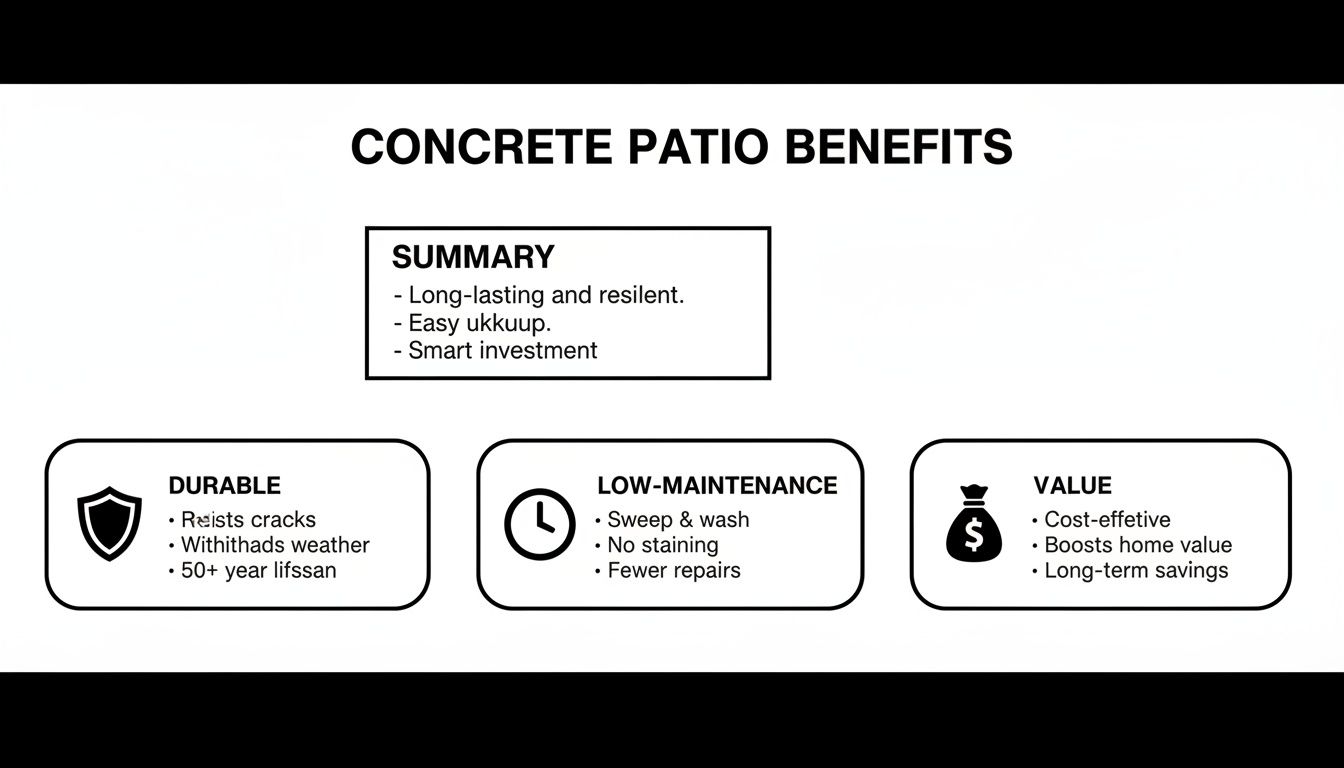
As you can see, the combination of strength, easy upkeep, and long-term value makes a concrete patio a smart investment for just about any home.
The Classic Broom Finish
You've walked on a broom finish a thousand times, even if you didn't know its name. It’s the industry standard for outdoor concrete, and for good reason. After the concrete is poured and smoothed over, we take a specialized broom and lightly drag it across the surface just before it completely hardens. This simple action creates a pattern of fine, slightly rough lines.
That texture isn't just for show—it's a critical safety feature. It provides fantastic slip resistance, which is essential for any surface that's going to get wet. This makes it the go-to finish for pool decks, walkways, and patios where you don’t want to worry about slips and falls. The result is a clean, classic look that's built to be lived on.
The Sleek Trowel Finish
If you're aiming for a more modern, refined vibe, a smooth trowel finish is a great way to go. To get this look, we use hand trowels or a large power trowel to work the surface until it’s perfectly flat, dense, and non-porous. Picture the smooth, almost polished surface of a high-end garage or basement floor—that’s the aesthetic we’re talking about.
This finish is perfect for covered patios or outdoor "rooms" where you want a chic, minimalist foundation. Just keep in mind that its beauty is also its one drawback: a smooth surface can get very slippery when wet. Because of this, it's best reserved for areas that are well-protected from the rain. For example, this finish would be an excellent choice for a screened-in porch that merges with an indoor living space. Of course, concrete isn't your only option; there are many beautiful reasons to choose flagstone for your backyard patio if you're exploring natural stone alternatives.
Adding a Touch of Color
Want to move beyond gray? Adding color is one of the easiest ways to customize your patio. We do this with something called integral color, which means the pigment is mixed directly into the concrete batch before it ever leaves the truck.
Because the color runs all the way through the slab, you never have to worry about it fading or chipping away. A surface scratch won't reveal a patch of plain gray concrete underneath. This method can transform your patio into a warm terracotta, an earthy tan, or a sophisticated charcoal that ties in perfectly with your home's color scheme. For instance, a "sandstone" integral color can complement a brick home beautifully, creating a seamless visual transition from the house to the yard. You can check out a gallery of https://www.atlantaconcretesolutions.com/residential-decorative-concrete to see the possibilities.
Homeowners are increasingly choosing these customized options. The decorative concrete market was valued at USD 19.84 billion and is expected to climb to over USD 26 billion by 2031, showing just how much people value beautiful, long-lasting outdoor spaces.
To help you decide, here’s a quick breakdown of how these three simple finishes stack up against each other.
Comparing Simple Concrete Patio Finishes
| Finish Type | Best For | Look & Feel | Typical Cost Range (per sq ft) |
|---|---|---|---|
| Broom Finish | All-purpose outdoor use, high-traffic areas, pool decks | Textured, matte, clean lines, utilitarian | $6 – $10 |
| Smooth Trowel Finish | Covered patios, modern designs, indoor-outdoor spaces | Sleek, smooth, minimalist, slightly reflective | $7 – $11 |
| Integral Color | Customizing any finish to match home or landscape | Adds warmth/depth, consistent color, natural tones | Adds $1 – $3 to base finish cost |
Each finish has its place, and the best choice really comes down to your priorities—whether that's maximum safety, a specific aesthetic, or a custom color palette.
How to Budget for Your Atlanta Concrete Patio
Alright, let's talk money. Nailing down a realistic budget is the very first step to getting that concrete patio you've been dreaming of. It's easy to get hung up on a single price-per-square-foot number, but the truth is, the final cost really hinges on the unique quirks of your property.
Think of it like buying a car. You see the starting price for the base model, but once you add the features you actually want—like heated seats or a better sound system—that number starts to change. Your patio is no different. For example, a simple square patio on flat ground is the "base model." A patio on a sloped yard requiring a retaining wall and extra grading is like adding the "premium package."
Key Factors That Shape Your Patio Cost
Beyond the basic dimensions, a few on-the-ground realities will really move the needle on your final quote. Getting a handle on these will help you have a much more productive chat with your contractor and keep surprises at bay.
- Site Prep: Is your yard perfectly flat? Probably not. If there's a significant slope, the crew will need to do some grading to create a level base. For example, a yard that drops two feet over the patio area might require a small retaining wall or significant soil work, adding hundreds or even thousands to the cost. Tearing out an old deck, removing stubborn bushes, or dealing with rocky soil will also add to the prep costs.
- Slab Thickness: For most patios, a four-inch-thick slab is the gold standard. It’s plenty strong for all your furniture, grills, and foot traffic. But what if you're dreaming of a heavy hot tub or a full-blown outdoor kitchen? For a six-person hot tub, which can weigh over 4,000 pounds when full, you'll need to upgrade to a thicker, reinforced slab of five or even six inches. This means more concrete and a higher material cost.
- The Finish: We touched on this earlier, but the finish you choose has a direct impact on the price. A simple broom finish is your most wallet-friendly option. Deciding to add color to the concrete mix or going for a sleek, smooth trowel finish will bump up that per-square-foot rate.
Typical Cost Ranges in the Atlanta Area
So, what can you actually expect to pay? For a professionally installed, simple concrete patio here in the Atlanta metro, a good ballpark figure is somewhere between $8 to $15 per square foot. This range typically covers standard site preparation and a classic broom finish.
To put that in perspective, a common 12×12 foot patio (144 sq ft) would likely land in the $1,150 to $2,160 range. A more spacious 20×20 foot patio (400 sq ft) could run anywhere from $3,200 to $6,000. Think of these numbers as a solid starting point for your planning.
It’s important to see this as more than just an expense—it's an investment in your home. A wood deck might seem comparable at first glance, but you're signing up for a lifetime of staining and sealing. Pavers look great, but they can settle unevenly over time, creating trip hazards and giving weeds a place to call home. Concrete, on the other hand, gives you a rock-solid, low-maintenance surface that pays you back with decades of enjoyment.
DIY Patio vs. Hiring a Professional Contractor
So, you’re thinking about a simple concrete patio. The first big question you need to answer is: should you tackle this yourself or call in the pros? The DIY path can look mighty tempting, especially when you think about the potential cost savings. But before you start loading up on bags of concrete mix, it’s worth taking a hard look at what you’re really signing up for.
Pouring a patio isn't just a matter of mixing and spreading. When you go it alone, you become the general contractor, the laborer, and the finisher, all rolled into one. This is a physically demanding job that requires a surprising amount of precision. For instance, you'll need to build solid wood forms to hold the wet concrete, and getting the slope just right—usually a quarter-inch drop per foot—is crucial so rainwater drains away from your house, not towards it. A 12-foot wide patio, for example, should be three inches lower on the far side than it is against the house foundation.
Make no mistake, this is a race against time. Once you start pouring, the clock is ticking. You have a very small window to get that entire slab leveled, smoothed, and finished before it starts to harden. One mistake—an uneven surface, a poorly compacted base—can lead to a patio that cracks, pools water, or just looks sloppy. Trying to fix those mistakes later often costs more than hiring a pro in the first place.
The Professional Advantage: Peace of Mind and Guaranteed Quality
Hiring a professional contractor completely changes the game. You're not just paying for a crew to do the heavy lifting; you're investing in experience, specialized equipment, and the assurance that the job will be done right. A seasoned concrete team has this process down to a science.
A professional installation means your patio gets a properly compacted base, the right concrete mix for Atlanta's specific climate, and strategically placed control joints. Those joints are the secret weapon against the random, ugly cracking that can ruin a DIY job. For example, on a 20×20 patio, a pro would likely place joints to create a grid of 10×10 squares.
A good contractor also handles all the behind-the-scenes work that you might not even think about.
- Code Compliance: They know the local Atlanta-area building codes and permit requirements, so you can be sure your project is above board from the get-go.
- Mistake Avoidance: Their experience allows them to spot potential problems, like grading issues that could cause major drainage headaches down the road.
- Guaranteed Results: A reputable company will stand behind their work, leaving you with a beautiful, durable patio built to last for decades—without all the stress.
The choice really boils down to how you value your time, your back, and your tolerance for risk. If you’re still curious about the DIY route, it’s smart to get a full picture of the process. This guide on how to build a patio is a great resource to understand the steps involved.
While there’s a real sense of accomplishment in building something yourself, the guaranteed quality and long-term durability of a professionally installed patio often make it the smarter investment. You can learn more about what a pro brings to the table for residential poured concrete to help you decide what’s best for your home.
Inspiring Layouts for Your Simple Patio Design
The finish you pick for your patio gives it character, but its shape and placement? That’s what defines how you'll actually live in your outdoor space. Moving beyond a simple square slab opens up a whole new world of creating functional, beautiful outdoor 'rooms' that truly fit your yard and your lifestyle.
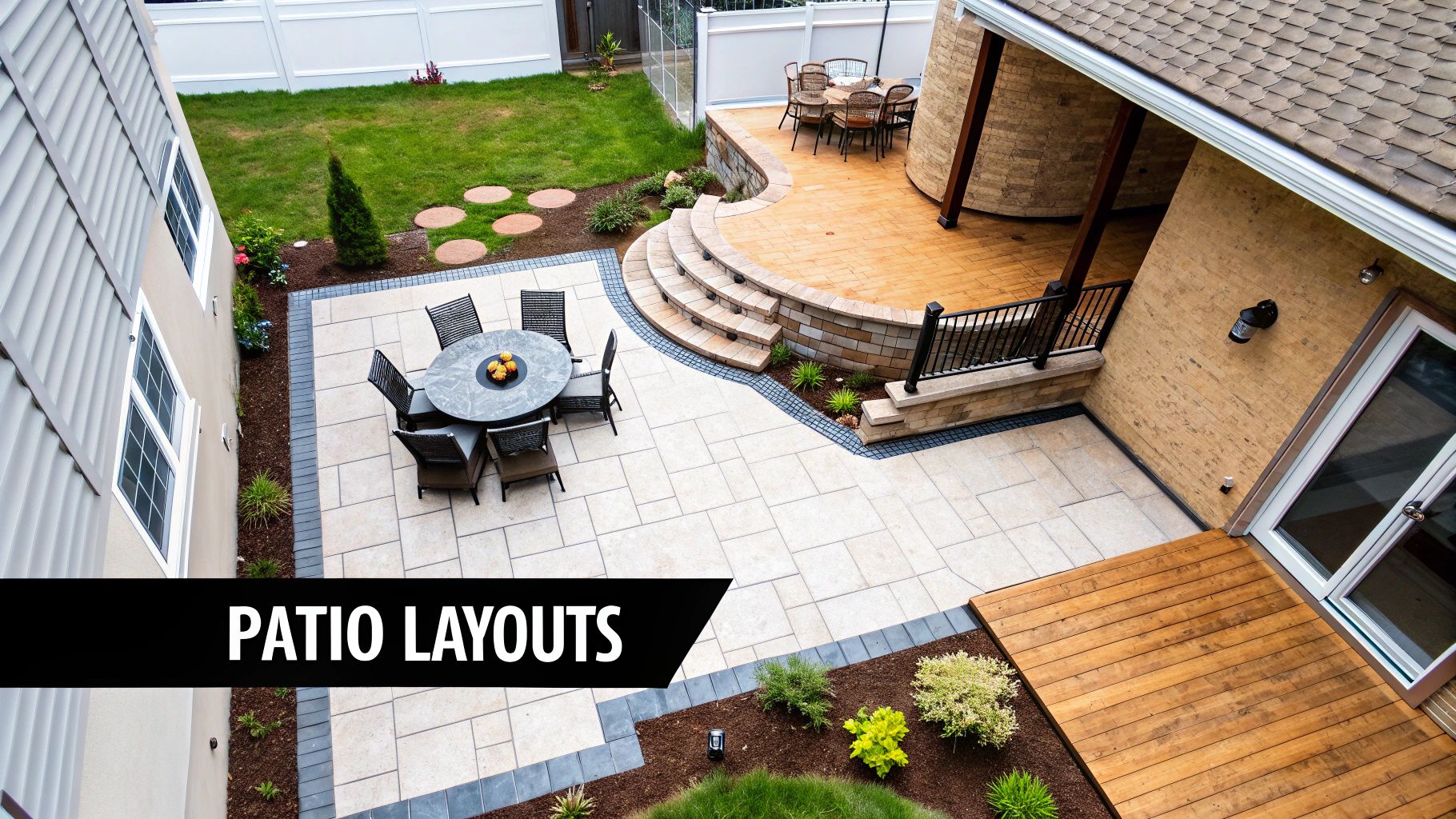
Think of the layout as the blueprint for your backyard experience. A smart design can direct foot traffic, carve out separate zones for grilling and relaxing, and make the whole space feel like a natural extension of your home and garden.
Classic and Curved Patio Shapes
The most direct and cost-effective layout for a simple concrete patio is a classic rectangle. It's clean, orderly, and incredibly efficient. This shape works perfectly for a big dining table or a formal seating arrangement, acting almost like an outdoor rug that clearly defines the living area. For example, a 16×20 foot rectangular patio comfortably fits a dining table for six and a separate conversation area with a couple of chairs.
But if you want to soften things up, a curved or free-form layout can completely change the vibe. Gentle arcs and organic shapes break up the hard, straight lines of a house or fence line, helping the patio blend more naturally with the surrounding landscape. It’s a great way to create cozy nooks, like a small, kidney-shaped patio designed to wrap around a favorite shade tree or garden bed.
Think of your layout as the foundation for your outdoor lifestyle. A rectangular shape creates a formal dining room, while a free-form curve designs a relaxed conversation pit. The shape dictates the function.
Multi-Level Designs for Sloped Yards
If your Atlanta property has a bit of a slope, don't look at it as a problem—see it as a design opportunity. A multi-level patio is an elegant solution that can turn a tricky grade into a stunning, high-end feature.
By creating two or more connected levels, you can naturally establish different zones.
- Upper Level: This is the perfect spot for grilling, situated right off the back door for easy access to the kitchen. An example would be a 10×12 foot upper patio for the grill and a small café table.
- Lower Level: A few steps down, you can create a more secluded destination for a fire pit or a quiet lounge area, away from the main house. For instance, a 15×15 foot circular patio on the lower level can become the dedicated fire pit zone.
This approach doesn't just solve drainage and elevation challenges; it adds a ton of visual interest and dimension to your backyard. You can see how these ideas play out in real life by looking through a gallery of completed Atlanta concrete patio projects.
This move toward creating more sophisticated outdoor living areas is happening worldwide. The Asia-Pacific region, for instance, now accounts for 28% of the global concrete paver market (a closely related industry) and is projected to hit 31% as more people invest in beautiful, functional outdoor spaces. You can find more about this expanding market on cognitivemarketresearch.com.
Simple Care to Keep Your Concrete Patio Looking New
One of the best things about a simple concrete patio is how easy it is to take care of. While it's definitely less work than a wood deck, "low-maintenance" isn't the same as "no-maintenance." Thankfully, a little bit of straightforward care is all you need to protect your investment and keep your patio looking sharp for years to come.
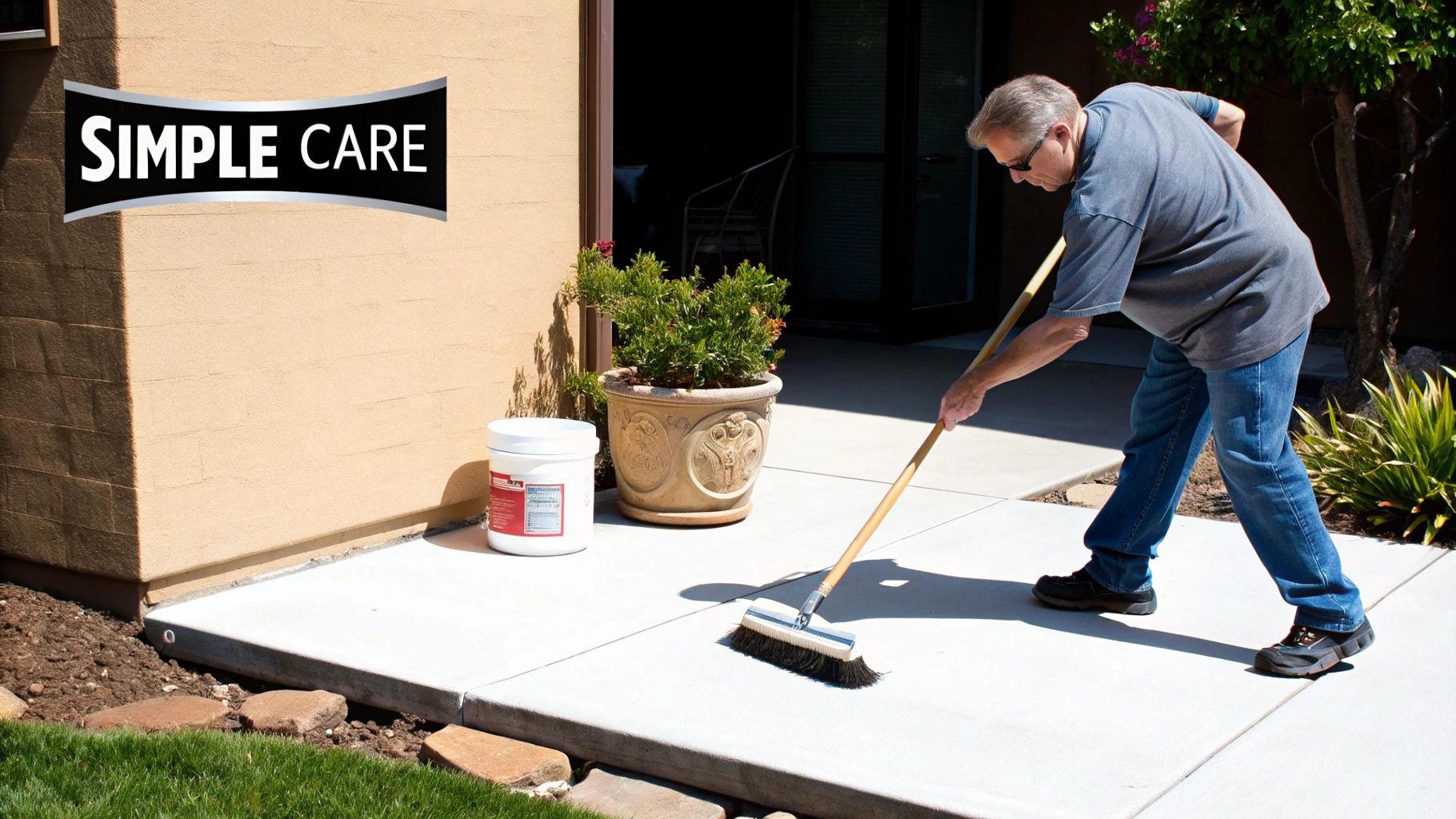
Think of it like washing your car. You don't have to be a professional detailer, but a quick wash every now and then stops dirt from becoming a permanent fixture. Your patio works the same way; a simple cleaning routine makes a huge difference.
This is especially true here in Atlanta. We all know that infamous yellow-green layer of spring pollen that covers everything. If you let it sit, it can quickly turn into a mildew problem. A quick sweep or rinse is all it takes to keep that from happening. A good example of proactive care is hosing down the patio after a big storm to wash away fallen leaves and debris that could leave stains.
Your Simple Patio Maintenance Plan
Keeping your patio in top shape doesn't have to be a weekend-long project. It's really about small, consistent habits that stop bigger problems before they start. For most patios, a good cleaning a couple of times a year is plenty.
Here’s a simple, three-step routine that works wonders:
- Clear the Surface: First, just sweep away all the loose stuff—leaves, dirt, twigs, you name it. A leaf blower makes this part even quicker.
- Gentle Wash: Mix a mild soap or detergent (like a squirt of dish soap in a bucket of water) with water and give the surface a good scrub with a stiff-bristle brush. If you have some stubborn grime, a pressure washer on a low setting works well. Just be careful—never use a high-pressure nozzle, as it can damage the concrete's surface. A good example of a safe setting is using a 40-degree (white) nozzle and keeping it at least a foot away from the surface.
- Thorough Rinse: Hose the whole thing down to wash away the soap and any leftover dirt. You want to make sure no suds are left behind.
The most important maintenance step you can take is applying a quality sealer. Think of it as sunscreen for your concrete—it provides a protective barrier against moisture, stains, and UV rays that can cause fading over time.
Sealing isn't a one-and-done job, but it’s not something you have to do every year, either. Reapplying a good penetrating sealer every 3 to 5 years is usually enough to keep your patio protected from the weather. This one step will dramatically extend its life and preserve its original look, ensuring it remains the centerpiece of your Atlanta backyard for a long, long time.
Your Concrete Patio Questions, Answered
Even with all the details sorted, it's completely normal to have a few last-minute questions before you get started. Let's tackle some of the most common things Atlanta homeowners ask us about simple concrete patios. We've put together some straight-to-the-point answers to give you the confidence you need.
How Long Does a Simple Concrete Patio Last in the Atlanta Climate?
You can expect a professionally installed concrete patio to be a very long-term addition to your home, easily lasting 30 years or more, even with Atlanta's unique weather. The real secret to that kind of longevity isn't just the concrete itself, but everything that happens before the first pour.
It all starts with a solid, well-compacted base of crushed stone, usually about 4 inches deep. This foundation prevents the ground from shifting and settling underneath. We also make sure the slab is the right thickness and has proper drainage to handle our heavy rains. With a simple cleaning now and then and resealing every few years, your patio will stand strong against moisture and temperature swings for decades.
A great patio isn’t just about the concrete mix; it’s about the entire system working together. A solid foundation and smart water management are what guarantee a patio that can truly stand up to Georgia's weather.
Will My Concrete Patio Crack Over Time?
Let's be honest: all concrete has the potential to develop tiny hairline cracks. But a professional installation is all about managing that potential. That’s where control joints come in.
During the installation, we strategically cut these shallow grooves into the surface. They create predictable weak points, essentially telling any future cracks exactly where to go—in a straight, clean line hidden within the joint. This simple but critical step is what prevents the ugly, random spiderweb cracks you see on poorly planned projects, keeping your patio looking sharp for its entire life. For example, a control joint will guide a natural shrinkage crack into a neat line, which is far less noticeable than a jagged crack running across the middle of the slab.
Do I Need a Permit for a Concrete Patio in Atlanta?
This is a classic "it depends" situation. Permit rules can change quite a bit from one city or county to the next here in the metro Atlanta area. For example, in unincorporated DeKalb County, a simple on-grade patio typically does not require a permit, but in the City of Decatur, regulations might be different. If your project is on the larger side, is part of a larger construction, or if you're thinking about adding a permanent roof down the road, the rules can change.
Figuring out local codes can be a real headache. That's why working with an experienced contractor is so valuable—we handle all of it. We'll figure out exactly what, if any, permits are needed for your specific home and project, making sure everything is built safely, legally, and to code. It’s total peace of mind.
Ready to transform your backyard with a durable, beautiful, and low-maintenance patio? The experts at Atlanta Concrete Solutions are here to bring your vision to life with professional craftsmanship and unmatched local expertise. Get your free, no-obligation quote today!