
Let's get right to it. You're wondering about the stamped concrete cost per square foot, and the short answer is you can expect to pay anywhere from $9 to over $25. That's a pretty wide range, and it all comes down to the complexity of your design, the preparation needed, and where you're located. For example, a simple one-pattern patio in a suburban area might be closer to $9, while a multi-patterned, custom-colored driveway in a dense urban setting could easily exceed $25.
What Is The True Cost of Stamped Concrete?
Stamped concrete is one of the smartest ways to get that high-end look of natural stone, brick, or even wood without the hefty price tag. It's a clever process where we pour fresh concrete and then, before it sets, we press specialized mats into the surface to create realistic patterns and textures. What you get is a beautiful, incredibly durable surface that seriously boosts the curb appeal of patios, driveways, and walkways.
This isn't just about pouring a slab of gray concrete, though. It’s a craft that blends color, pattern, and expert technique. So, what does this artistry mean for your budget? That $9 to $25 per square foot range might seem a bit daunting at first, but once you understand what goes into it, the numbers make perfect sense. For instance, creating an "Ashlar Slate" pattern requires large, heavy mats and careful alignment, while a simple "Cobblestone" stamp is more straightforward, directly impacting the labor time and cost.
Understanding the Price Tiers
Think about stamped concrete pricing like you would about buying a car. You've got your standard, reliable base models, and then you have the fully-loaded luxury versions with all the custom bells and whistles. Stamped concrete works the same way. A straightforward project with a single pattern (like a simple brick look) and one color will naturally fall on the lower end of that price scale. On the other hand, a complex design with multiple patterns (like a slate field with a cobblestone border), custom colors, and detailed hand-finishing is going to be a premium investment.
The key takeaway is that stamped concrete offers incredible versatility. You're not just buying a slab; you're investing in a custom-designed surface that can be tailored to fit both your aesthetic vision and your financial plan.
To give you a clearer picture of what your money gets you, here’s a quick summary of what to expect at different price points.
Here is a quick summary of typical stamped concrete costs per square foot based on project complexity.
| Project Tier | Average Cost Per Square Foot | Common For |
|---|---|---|
| Basic | $9 – $13 | Simple patios, walkways, or a basic upgrade from plain concrete. |
| Mid-Range | $13 – $18 | Most residential projects, including driveways, patios with borders, and two-tone designs. |
| High-End | $18 – $25+ | Elaborate pool decks, intricate multi-pattern layouts, and custom-stained outdoor living areas. |
This table helps visualize how different levels of detail and customization affect the final price tag for your project.
Let's dig a little deeper into what each tier typically includes:
-
Basic Designs ($9 – $13 per sq. ft.) This is your entry point. Perfect for homeowners who want a clean, simple upgrade from plain concrete. This tier usually covers one stamp pattern and a single, uniform color. An example would be a 200 sq. ft. patio stamped with a basic running bond brick pattern in a single terracotta color.
-
Mid-Range Designs ($13 – $18 per sq. ft.) This is the sweet spot for most people and our most popular option. It opens the door to more creativity, often including contrasting borders, a second accent color, and more intricate stamp patterns. For example, a driveway might feature a main field of "Ashlar Slate" texture with a darker, contrasting "Soldier Course Brick" border.
-
High-End Designs ($18 – $25+ per sq. ft.) For those who want a true showpiece, this tier delivers. We're talking about complex, multi-pattern designs, hand-applied stains for color variation, custom saw-cut details, and meticulous finishing work. An example could be a pool deck with a "Random Stone" pattern, hand-stained with multiple earth tones for a natural look, and saw-cut "grout lines" for added realism.
Breaking Down The Main Cost Factors
So, why does one stamped concrete project run $9 per square foot while another, identical in size, can hit $25 or more? It all comes down to the details. The final cost isn't a single number but an equation with several key variables, each pushing the bottom line up or down.
Think of it like building a custom car. The base model has a set price, but that figure climbs fast once you add a bigger engine, a pearlescent paint job, and hand-stitched leather seats. Stamped concrete is no different. Getting a handle on these components is the first step to building a realistic budget.
This diagram gives a great visual of the primary elements that shape your project's final price tag, from the design's complexity to the specific pattern you choose.
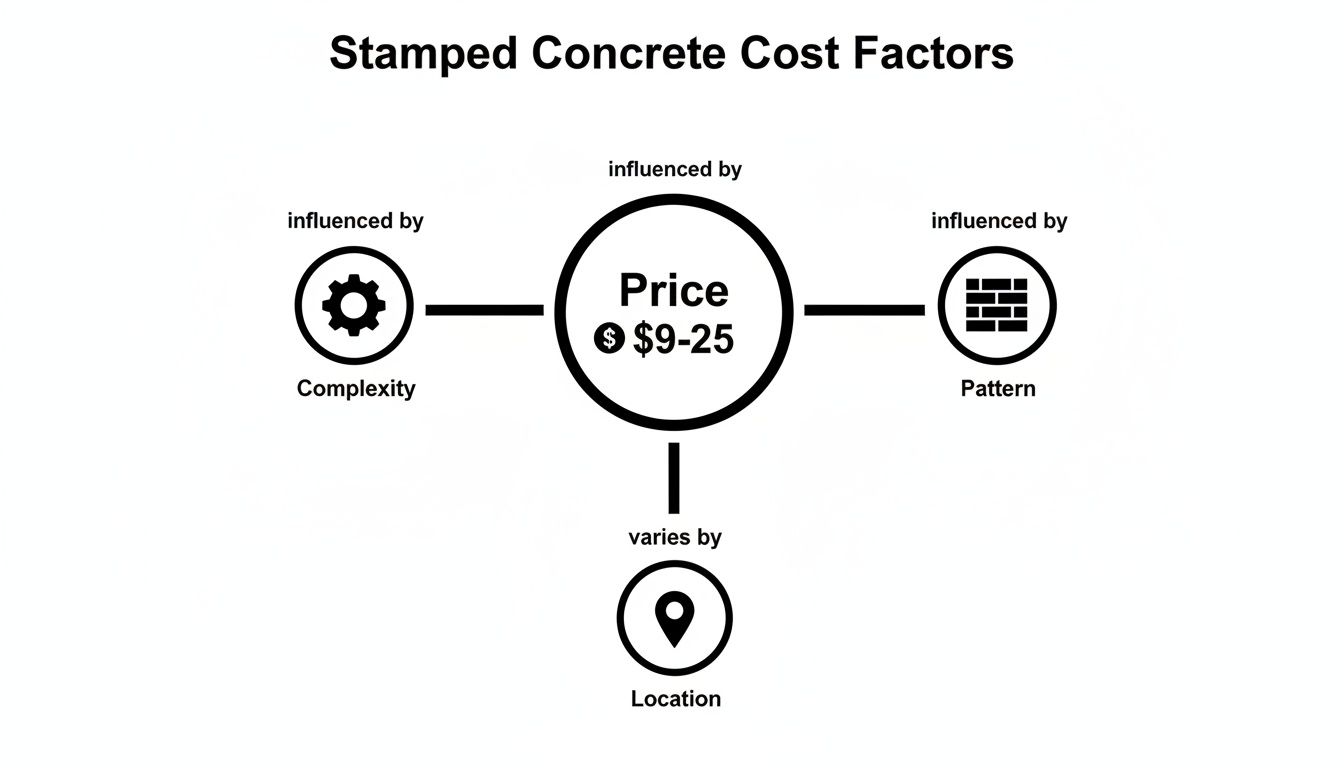
As you can see, every choice you make has a direct impact on the final investment. Let’s dig into what those factors really mean for your wallet.
Material Selection and Quality
First up are the materials themselves. This is about more than just the concrete. While the strength of the concrete mix (measured in PSI) is important, the real cost variation comes from the decorative elements.
These materials include:
- Color Hardeners: These are special powders worked into the surface to create a deep, durable base color that won't just chip off. For example, a premium, darker color hardener might cost more than a standard light gray or tan.
- Release Agents: This is the "magic dust" that prevents the stamps from sticking. It also adds a secondary, often darker, color that settles into the low spots, creating a beautiful, antiqued look. Using a charcoal release on a gray base, for instance, creates realistic depth in a stone pattern.
- High-Quality Sealers: A great sealer is absolutely essential. It's the final coat of armor that protects your investment from stains, UV fading, and harsh weather. For example, a solvent-based acrylic sealer provides a high-gloss "wet look," while a water-based version offers a more subtle matte finish, with prices varying accordingly.
Opting for premium colors or a more robust, long-lasting sealer will nudge the cost per square foot higher, but it's a smart investment in how your project looks and holds up over time.
Labor Rates and Professional Expertise
Let’s be clear: labor is often the biggest piece of the pie, sometimes making up over 50% of the total cost. Stamped concrete is a craft that blends muscle with artistry, and it is definitely not a DIY-friendly weekend project.
This whole process is a race against the clock. The crew has to pour, color, stamp, and detail the concrete before it sets. It demands incredible coordination, skill, and experience. An amateur crew can easily leave you with uneven patterns, blotchy color, or a slab that cracks and flakes within a year.
Labor rates also change quite a bit depending on where you live. For example, labor costs in a major metropolitan area like Atlanta are typically higher than in a rural town due to higher living costs and demand. You’re paying for a team with proven local experience—pros who know exactly how our summer heat and humidity affect curing times and material performance.
Design Complexity and Patterns
Now for the biggest variable of all: the complexity of your design. The more detailed the look you’re after, the more time, skill, and materials it’s going to take.
Here's a simple way to think about it. A basic, single-pattern patio is like painting a room one solid color—it's efficient and looks fantastic. But a high-end design with multiple patterns, custom-colored borders, and hand-applied accent stains? That's more like commissioning a detailed mural. It takes more time, more specialized talent, and a much higher level of precision to get it right.
A simple, one-color pattern often lands in the $9–$13 per square foot range, which is a great value. For example, a straightforward "Running Bond Brick" pattern is less labor-intensive. On the other hand, intricate designs like a "European Fan" or a custom medallion with multiple colors can easily push the cost up to $18–$25+ per square foot because of the painstaking labor involved.
Site Preparation and Accessibility
Finally, there are the often-overlooked costs of getting the site ready. Before we can pour a single yard of concrete, the ground has to be perfectly prepared to guarantee a stable, long-lasting foundation.
This prep work can include:
- Demolition and Removal: If you have an old, cracked patio or walkway, it has to be broken up and hauled away. This can run from $3 to $8 per square foot, depending on thickness and reinforcement.
- Excavation and Grading: We need to dig down to the proper depth and grade the entire area so water drains away from your house, not toward it. For example, a yard with a steep slope will require more extensive grading than a flat one.
- Installing a Gravel Base: A compacted sub-base of gravel is critical for preventing heaving and cracking, especially with Georgia’s clay soil.
Site access is another big one. If the project area is in a tight backyard with no room for a concrete truck or bobcat, it means a lot more manual labor with wheelbarrows. That extra time and effort will naturally be reflected in the quote. Understanding these foundational steps is key to getting a complete cost picture for all of our concrete services.
Estimating Your Project Cost By Size and Type
So, how does that "cost per square foot" number actually translate into a real budget for your home? This is where the rubber meets the road. Moving from a general price range to a solid financial estimate means plugging in the actual dimensions of your project, whether it's a new patio, driveway, or walkway.
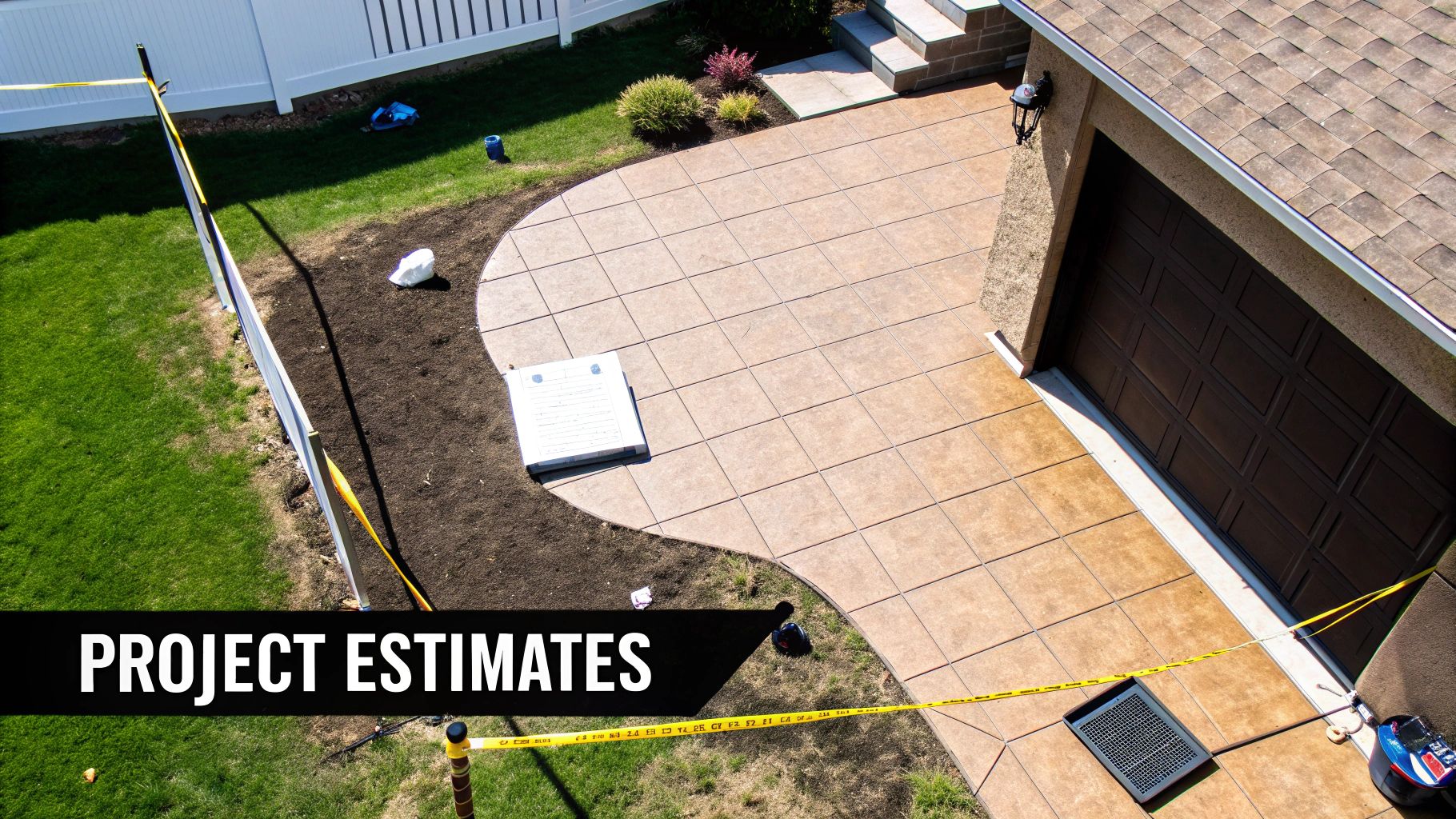
Looking at some typical project sizes is the best way to start visualizing what your investment might look like. It helps turn an abstract price into a tangible number you can plan around.
Sample Costs for Common Projects
To give you a better idea, let's walk through some of the most popular projects we see. The numbers below are based on what I'd call "mid-range" designs—think one or two colors and a standard, attractive pattern like an Ashlar Slate. This is the sweet spot for most homeowners who want a great look without breaking the bank.
Here’s a table to quickly visualize the costs for some common projects. These are ballpark figures based on national averages for mid-range designs, but they give you a fantastic starting point.
| Sample Stamped Concrete Project Cost Estimates |
| :— | :— | :— |
| Project Type | Typical Size (Sq. Ft.) | Estimated Cost Range (Mid-Range Design) |
| A Cozy Stamped Concrete Patio | 200 sq. ft. | $2,600 – $3,600 |
| A Standard Two-Car Driveway | 600 sq. ft. | $7,800 – $10,800 |
| An Elegant Front Walkway | 150 sq. ft. | $1,950 – $2,700 |
As you can see, the per-square-foot price comes to life when applied to a real-world project. It's one of the most exciting parts of the planning process, and if you need some inspiration, you can see tons of beautiful residential stamped concrete projects we've completed.
The Impact of Economies of Scale
Here’s something that often surprises people: bigger projects usually have a lower cost per square foot than smaller ones. It seems backward at first, but it all comes down to economies of scale.
Think of it like catering. Ordering food for 10 people might cost $20 per person, but ordering for 100 people might only be $15 per person. The caterer has fixed costs—renting the kitchen, paying the staff—that get spread out over more meals. Stamped concrete is the exact same principle.
Every job has fixed setup costs, no matter how big or small. We have to get the crew and equipment to your site, meet a minimum order from the concrete plant, and block out a full day for the team. All those costs get divided by the total square footage.
This is why a tiny, 100-square-foot landing might have a higher per-square-foot price, perhaps $16/sq ft. Those fixed costs are spread over a much smaller area. On the other hand, a big 1,000-square-foot patio can absorb those same costs more efficiently, which could bring the average price per square foot down to $14 for the exact same design.
Real-World Project Data
The numbers from across the country back this up. National homeowner data consistently shows that as the project size goes up, the per-square-foot cost tends to go down.
-
Smaller jobs, like a 200-square-foot patio, often run between $1,800 and $3,250, which breaks down to $9 to $16.25 per square foot.
-
Larger projects, like a 1,000-square-foot driveway, can range from $9,000 to $22,000. That's a wider range of $9 to $22 per square foot, depending on complexity.
The average project cost nationally, according to Angi's 2025 data, sits right around $5,298. This just goes to show how size and design choices play a huge role in the final price tag.
Stamped Concrete vs. The Alternatives: A Cost Showdown
When you're choosing a paving material, you're juggling three things: how it looks, how long it lasts, and what it costs. Stamped concrete hits a sweet spot right in the middle, but to really understand its value, you need to see how it stacks up against the other big players.
Let's put it head-to-head with plain concrete, pavers, and natural stone. This isn't just about the price per square foot; it's about what you get for your money, both on day one and years down the road.
Stamped Concrete vs. Plain Concrete
This is the most straightforward comparison you can make. At its core, stamped concrete is just plain concrete that's been given a major aesthetic upgrade. A standard, brush-finished concrete slab is the king of budget-friendly options, usually running just $6 to $10 per square foot. It's strong, it's practical, and it does its job without any fanfare.
The catch? It has absolutely zero decorative value. It's a surface, not a statement.
Think of plain concrete as a blank canvas—strong and reliable, but lacking any artistry. Stamped concrete is that same canvas transformed into a finished painting, complete with color, texture, and depth. That artistic upgrade is what accounts for the higher stamped concrete cost per square foot.
For what is often a pretty reasonable price increase, for example, just $3-$4 more per square foot, you're transforming a boring gray slab into a feature that looks like it cost a fortune.
Stamped Concrete vs. Interlocking Pavers
Pavers are probably the closest rival to stamped concrete, both in terms of look and price. You can expect to pay anywhere from $10 to $25 per square foot for a paver installation, depending heavily on the paver quality and how intricate the design is. For instance, a basic paver costs less than a premium, tumbled-style paver.
Both give you that high-end, custom look, but they are built in completely different ways. Pavers are a collection of individual blocks sitting on a base of sand and gravel, while stamped concrete is one continuous, solid slab of reinforced concrete. That fundamental difference is where the long-term maintenance issues start to show up.
- Weed Patrol: Those little joints between pavers are magnets for weeds. You'll be pulling them or spraying them forever.
- Shifting and Sinking: Over time, pavers can settle unevenly, creating annoying dips and trip hazards that need to be professionally re-leveled.
- Fading Colors: Cheaper pavers can lose their color under the relentless sun, while the color in stamped concrete is mixed all the way through, making it much more UV-resistant.
The one advantage for pavers is that you can replace a single cracked one pretty easily. But with stamped concrete, you get a solid, unbroken surface that completely sidesteps the problems of weeds and shifting.
Stamped concrete vs. Natural Stone
Now we're moving into the luxury category. Materials like flagstone, slate, and travertine offer an authentic, timeless beauty that's impossible to perfectly replicate. Each piece is unique, a product of nature. Of course, that kind of authenticity comes with a hefty price tag.
Professionally installed natural stone starts at around $25 per square foot and can easily soar past $50. The cost is driven up by two things: the expense of quarrying and shipping heavy stone, and the meticulous, labor-intensive work required. A skilled mason has to cut, shape, and set every single stone by hand. For example, a Pennsylvania Bluestone patio requires individual placement of each unique stone, which is far more time-consuming than pouring and stamping concrete.
Here's a quick look at where everything lands:
| Paving Material | Average Cost Per Square Foot | Key Characteristic |
|---|---|---|
| Plain Concrete | $6 – $10 | Most affordable, purely functional |
| Stamped Concrete | $9 – $25 | Best value for decorative finish |
| Interlocking Pavers | $10 – $25 | Similar cost, prone to weeds/shifting |
| Natural Stone | $25 – $50+ | Highest cost, authentic natural beauty |
This is where stamped concrete truly shines. It gives you the high-end, elegant look of natural stone for a fraction of the investment. Modern techniques have gotten so good that the result is incredibly convincing. You get the beauty without the budget-breaking price.
How to Save Money on Your Project
Getting that high-end stamped concrete look doesn't mean you have to break the bank. With a bit of smart planning, you can bring the overall stamped concrete cost per square foot down significantly without compromising on the quality or the "wow" factor. It really comes down to making savvy choices in design, timing, and prep work.
These aren't just about pinching pennies; these are practical tips for getting the most value out of your investment and sidestepping the common expenses that can sneak up on you.
Simplify Your Design Choices
Let's be honest: the biggest factor that drives up the price is complexity. By pulling back just a little on the design, you can make a huge dent in the final bill, mostly by cutting down on the intensive labor costs.
Think about these tweaks:
- Opt for One Color: Instead of a multi-toned, hand-stained look, choosing a single integral color can save a surprising amount on both materials and labor. For example, using a single "sandstone" color throughout is much more cost-effective than adding a dark brown antique release agent and hand-staining individual "stones."
- Select a Less Complex Pattern: Really intricate patterns, like a detailed Ashlar slate or a custom medallion, take a lot more time and skill to get right. A simpler, classic pattern like a running bond brick is much faster to stamp, which directly translates to lower labor costs.
This is all about working smarter, not cheaper. You still end up with a gorgeous, durable surface, but the installation is much more straightforward.
Prepare Your Site Thoroughly
One of the most common ways a budget gets blown is with surprise site issues. You can get ahead of this by making sure the area is completely ready for the crew before they even show up. When they can hit the ground running, they work more efficiently.
A well-prepped site means clearing out any obstacles like old patio furniture, kids' playsets, or landscaping debris. Even more important is ensuring there's a clear, wide path for their equipment. For example, if a fence panel can be temporarily removed to allow a small bobcat access versus having the crew use wheelbarrows all day, you can save hundreds in labor costs.
Think of it this way: every hour your contractor spends on unexpected prep is an hour not spent on the skilled work you’re actually paying for. A little bit of cleanup on your part can translate into real savings.
Be Smart About Timing and Quotes
When you schedule your project and who you hire are two other powerful ways to control costs. The worst thing you can do is rush into a decision without doing your homework.
First, get multiple quotes. You should always talk to at least three reputable local contractors. This lets you compare not just their prices but their approach and timelines. It’s the only way to get a true feel for the fair market rate in Atlanta and find the best value for your specific job.
Second, think about scheduling your project during the off-season. Concrete contractors are slammed in the late spring and summer. If you can book your installation for the early spring or fall, you might find that companies offer more competitive pricing to keep their crews busy.
Invest in Long-Term Maintenance
At the end of the day, the cheapest project is the one you only have to do once. While sealing your new stamped concrete adds a small cost upfront—usually around $1 to $3 per square foot—it is one of the smartest investments you can make.
A good sealer protects the surface from stains, fading from UV rays, and moisture damage, which dramatically extends its life. Spending a little, for example, $300-$500 to reseal a patio every two or three years is a drop in the bucket compared to paying for major repairs or a full replacement down the line. This simple, proactive step locks in the value of your initial investment for decades.
Planning Your Atlanta Stamped Concrete Project
Alright, you've got the rundown on what drives the stamped concrete cost per square foot. From the pattern you pick to the prep work needed, you can see how every detail fits together. Now for the fun part: let's bring it all home and start planning your project right here in Atlanta.
This is where your vision starts to take shape. It’s about taking those ideas swirling in your head and turning them into a solid plan. The next step is simply gathering your thoughts and finding a local pro who can give you a straightforward quote for your specific property.
Getting a Precise Quote in Atlanta
A good quote isn't a guess; it's a reflection of good information. The more details you can give a contractor upfront, the more accurate their estimate will be, which means no sticker shock later on. Before you even make the call, getting a few key details together can make the whole process much smoother.
To help us give you the best possible numbers, try to have this info handy:
- Project Dimensions: Grab a tape measure and get a rough idea of the length and width. Knowing the approximate square footage (e.g., "my patio is about 15 feet by 20 feet, so 300 square feet") is the number one thing we need for a ballpark estimate.
- Design Inspiration: What look are you going for? Maybe it's the rustic feel of natural slate or the timeless look of classic brick. If you're not sure, take a look through our gallery of stunning local stamped concrete projects to get some ideas flowing.
- Current Site Conditions: What’s there now? Is it just grass, or do we need to tear out an old, cracked patio first? Demolition is a big part of the job, so letting us know is a huge help.
Doing this little bit of homework helps us get on the same page from day one and deliver an estimate that’s genuinely useful to you.
Key Takeaways Before You Call
Let's do a quick recap of the essentials. Think of these as the core ideas that will help you have a confident, productive chat with any concrete contractor you speak with.
The most important thing to remember is that you're in the driver's seat. Your choices, from the complexity of the stamp pattern to the colors you select, are the biggest factors influencing the final price. With smart planning, a stunning result is possible at almost any budget.
Keep these key points in mind:
- The Cost Spectrum: Expect a typical range between $9 and $25 per square foot. Simple, single-color jobs will be on the lower end, while intricate, multi-colored designs with custom borders will be at the top of that range.
- Value Comparison: Stamped concrete gives you the luxurious look of materials like pavers or natural stone but without their high cost and constant maintenance headaches (think weeds and wobbly stones).
- Local Expertise Matters: An experienced Atlanta contractor knows our clay soil and humid climate inside and out. That local knowledge is critical for an installation that won't crack, shift, or fade, giving you a beautiful surface that truly lasts.
Armed with this knowledge, you're more than ready to take the next step. Reach out to Atlanta Concrete Solutions today for a free, no-pressure quote, and let's get started on bringing your dream outdoor space to life.
Got Questions About Stamped Concrete? We've Got Answers
Let's tackle some of the most common questions homeowners have before they dive into a stamped concrete project. Getting these details ironed out will help you feel confident you're making the right call for your home.
Is Stamped Concrete a Better Deal Than Pavers?
This is probably the number one question we get, and it's a great one. While the upfront cost for both can be surprisingly close, stamped concrete often pulls ahead in long-term value. Why? It's all about maintenance.
Pavers look great, but those sand-filled joints are a magnet for weeds. They can also shift and settle over time, creating an uneven surface that needs professional re-leveling. For example, tree roots can easily heave individual pavers, creating a trip hazard.
Stamped concrete, on the other hand, is one solid, continuous surface. That means zero chance for weeds to sprout through the middle and no individual pieces to sink or create tripping hazards. It saves you from future headaches and repair bills down the road.
How Long Can I Expect My Stamped Concrete to Last?
When it's installed by a pro, stamped concrete is built for the long haul. With proper care, you can easily expect it to last for 25 years or more. The secret sauce is a quality concrete mix, a solid sub-base, and a little bit of maintenance.
This impressive durability makes the stamped concrete cost per square foot a fantastic investment in your home's value and curb appeal. It’s tough enough to handle everything from heavy foot traffic to vehicle weight and Atlanta's unpredictable weather.
Stamped concrete has become a go-to for a reason. In fact, data shows that simply sealing it every 2-3 years can slash potential repair costs by an incredible 70%. This small step is the key to protecting your investment for decades. You can find more insights on stamped concrete durability on Lawnstarter.com.
Can I Put a Stamped Overlay on My Old Concrete?
Absolutely! If your existing concrete slab is in decent shape—meaning it's not full of major cracks, crumbling, or heaving—a stamped overlay is a fantastic option. For example, if you have a structurally sound but stained and boring broom-finished patio, an overlay can completely transform it.
The process involves applying a special cement-based coating right over your old slab, which is then stamped with your chosen pattern. It's a brilliant way to get a completely new look without the major cost and mess of tearing everything out and starting from scratch.
Does the Sealer Add a Lot to the Initial Cost?
Including a high-quality sealer right from the start is a small piece of the budget, but it's non-negotiable for a lasting finish. Sealing usually adds between $1 to $3 per square foot to the total project cost. It might be tempting to skip it to save a few bucks, but that's a mistake you'll regret.
Think of the sealer as the clear coat on your car's paint job. It's the invisible shield that protects the color from fading in the sun, stops oil and other spills from staining, and locks out moisture. For instance, a quality sealer will cause spilled red wine to bead up on the surface for easy cleanup, rather than soaking in and creating a permanent stain. It’s what keeps your beautiful new surface looking vibrant for years to come.
Ready to see what a beautiful, durable, and cost-effective surface can do for your property? The team at Atlanta Concrete Solutions is here to bring your vision to life with expert craftsmanship and transparent pricing. Contact us today for a free, no-obligation quote!