
Concrete is far more than just a simple gray slab; it's the versatile, foundational material of modern construction. From the driveway of an Atlanta home to the sprawling floors of a commercial warehouse, the specific concrete mix used is critical for ensuring strength, durability, and the desired aesthetic. However, navigating the many different types of concrete can be overwhelming for homeowners and property managers alike. The material you need for a simple garden path is fundamentally different from the high-performance mix required for a heavily trafficked parking deck or a vibrant pickleball court.
Choosing incorrectly can lead to premature cracking, surface deterioration, and costly repairs down the line. Does your project need to withstand Atlanta's notorious freeze-thaw cycles? Are you trying to manage heavy stormwater runoff in a new development? Or is the goal a decorative, high-gloss finish for an interior space? Before embarking on any concrete project, accurately estimating your material needs is a critical first step; understanding the basics of calculating the right amount of Quikrete for your project can save you time and money.
This comprehensive guide is designed to eliminate the guesswork. We will break down 12 essential types of concrete, providing clear definitions, practical examples, and expert insights tailored for the Atlanta metro area. We'll explore the unique pros, cons, and ideal applications for each formulation, from standard ready-mix to advanced fiber-reinforced and permeable options. Our goal is to equip you with the knowledge to select the perfect material, ensuring your project is not only built to last but also perfectly suited to its purpose.
1. Normal Strength / Ready-Mix Concrete
Often called Ordinary Portland Concrete (OPC), normal strength or ready-mix concrete is the foundational material for modern construction. This is one of the most common types of concrete you'll encounter. It is produced in a batch plant according to a specific recipe—for example, a typical mix might be one part cement, two parts sand, and three parts coarse aggregate—then delivered to the project site in a truck with a rotating drum. This process ensures exceptional consistency and quality control that is difficult to achieve when mixing on-site.
Its versatility and reliability make it the industry standard for a vast range of projects. The strength of this concrete typically ranges from 2,500 to 5,000 PSI (Pounds per Square Inch), making it more than adequate for most residential and light commercial needs. For instance, a residential driveway typically requires a 4,000 PSI mix to handle daily vehicle traffic.
Common Applications
This concrete is the go-to choice for fundamental structural and flatwork projects, including:
- Residential Driveways and Garage Slabs: Provides a durable, long-lasting surface for daily vehicle traffic.
- Sidewalks and Walkways: Creates safe, stable paths for pedestrian use.
- Foundations: Forms the strong, stable base for homes and small commercial buildings.
- Patios and Outdoor Living Spaces: Offers a clean, solid surface for backyard entertainment areas.
Atlanta Climate Tip: In Atlanta's hot, humid summers, concrete can set very quickly. Consider ordering a mix with a retarder admixture to slow the curing process. This gives finishers more time to achieve a smooth, professional surface without defects.
When to Call Us
For a perfectly poured driveway, a solid foundation, or a pristine sidewalk, precision is key. If your project is in communities like Marietta, Duluth, or the surrounding Atlanta metro, Atlanta Concrete Solutions ensures your ready-mix project is handled correctly from start to finish. Call us for a free, detailed quote and expert installation.
2. Reinforced Concrete (RC)
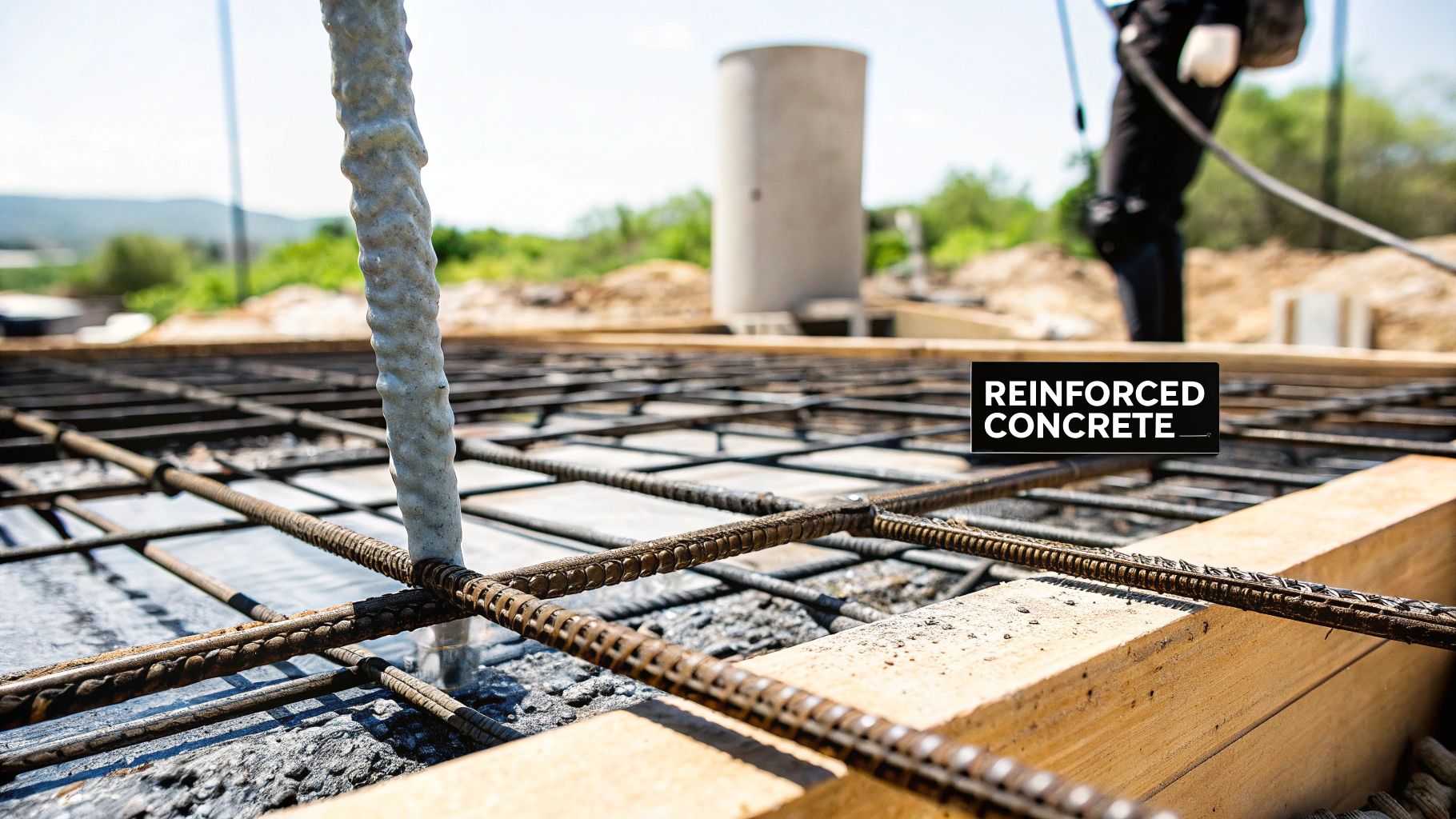
Reinforced Concrete (RC) is a composite material where concrete's high compressive strength is combined with the high tensile strength of steel. This is achieved by embedding steel reinforcement bars (rebar), mesh, or cables within the concrete before it sets. While concrete is incredibly strong under compression (squeezing forces), it is relatively weak under tension (pulling forces). For example, a plain concrete beam would snap easily if bent, but a reinforced beam can flex and support significant weight. The steel reinforcement carries these tensile loads, creating a powerful synergy that makes RC one of the most important and versatile types of concrete for modern engineering.
This combination allows structures to handle complex stresses, vibrations, and movements far beyond the capacity of plain concrete. The result is a material capable of forming the backbone for everything from massive bridges to towering skyscrapers, ensuring both strength and long-term durability.
Common Applications
Because of its superior strength and load-bearing capabilities, reinforced concrete is essential for most major structural projects:
- Beams, Columns, and Slabs: Forms the fundamental skeleton for residential homes and large commercial buildings.
- Bridges and Overpasses: Provides the necessary strength to span long distances and support heavy vehicle loads. An example is the I-75/I-85 Downtown Connector in Atlanta, which relies heavily on reinforced concrete.
- Building Foundations: Creates a robust base that can withstand soil pressure and structural weight. Learn more about our expert residential foundation services.
- Dams and Retaining Walls: Offers the immense strength required to hold back tons of soil or water.
Atlanta Climate Tip: Atlanta's clay soil expands and contracts significantly with moisture changes. Properly engineered reinforced foundations are critical to prevent cracking and structural failure. Ensure your contractor uses the correct rebar size and spacing specified by local building codes for our region's soil conditions.
When to Call Us
Reinforced concrete is not a DIY project; it requires precise engineering and flawless execution. For structural elements like foundations, retaining walls, or load-bearing slabs in areas like Alpharetta, Roswell, or anywhere in the Atlanta metro, trust the experts. Atlanta Concrete Solutions has the technical expertise to ensure your reinforced concrete project is engineered for safety and built to last. Contact us today for an expert consultation.
3. Prestressed Concrete
Prestressed concrete represents an advanced engineering technique where internal stresses are strategically introduced into the material before it supports any external loads. This is one of the most innovative types of concrete for large-scale construction. High-strength steel cables or tendons are tensioned within the concrete formwork and then anchored, creating a powerful compressive force that actively counteracts the tensile stresses that will occur once the structure is in use. For example, a bridge girder is "squeezed" by the internal cables, making it much stronger and more resistant to bending under traffic.
This pre-compression allows for significantly longer spans, thinner structural elements, and enhanced crack resistance compared to traditional reinforced concrete. The result is a lighter yet stronger structure, often with a compressive strength well over 5,000 PSI, making it ideal for ambitious engineering projects where efficiency and durability are paramount.
Common Applications
This high-performance concrete is essential for projects demanding superior structural integrity and the ability to span large distances without intermediate supports:
- Bridge Girders and Decks: Enables the construction of long, elegant bridges over highways and waterways.
- Parking Garages: Allows for wide, open floors with fewer columns, improving navigation and maximizing space.
- Large Commercial Roofs: Supports extensive roof systems for warehouses, stadiums, and convention centers like the Georgia World Congress Center.
- Airport Runways and Slabs: Provides the exceptional durability needed to withstand the immense weight of aircraft.
Atlanta Climate Tip: The high-strength concrete mixes used for prestressing are sensitive to temperature and humidity variations. In Atlanta's climate, careful monitoring of curing conditions is critical to prevent shrinkage and ensure the intended compressive strength is achieved before the prestressing forces are fully transferred.
When to Call Us
Prestressed concrete is a specialized field requiring deep engineering expertise and precision. While Atlanta Concrete Solutions focuses on foundational, flatwork, and decorative concrete for residential and commercial clients, we often collaborate with structural engineers on projects that incorporate these advanced elements. If your project in areas like Sandy Springs, Alpharetta, or the greater Atlanta region involves prestressed components, we can ensure the surrounding foundational and site work meets the rigorous standards required.
4. High-Performance Concrete (HPC)
High-Performance Concrete (HPC) represents the pinnacle of cement technology, engineered to surpass the capabilities of standard mixes. As one of the most advanced types of concrete, HPC is formulated with carefully selected premium materials, supplementary cementitious materials (SCMs) like silica fume or fly ash, and advanced admixtures. This precise engineering results in exceptional strength, often exceeding 10,000 PSI, alongside superior long-term durability and resistance to chemical and environmental attack. A real-world example is the concrete used in the columns of skyscrapers, which must bear incredible weight.
While standard mixes are suitable for many applications, HPC is specified for projects where structural integrity and longevity are absolutely non-negotiable. Its low permeability makes it highly resistant to water, chlorides, and freeze-thaw cycles, ensuring a much longer service life. For common outdoor installations such as concrete patios and walkways, understanding the various types of concrete available can help achieve desired aesthetics and functionality.
Common Applications
HPC is the material of choice for monumental and mission-critical structures that must withstand extreme conditions, including:
- High-Rise Buildings and Skyscrapers: Provides the necessary compressive strength to support immense vertical loads, as seen in structures like the Burj Khalifa.
- Bridges and Overpasses: Offers enhanced durability to resist heavy traffic loads and harsh weather exposure over decades.
- Parking Garages: Its resistance to salt and water penetration protects reinforcing steel from corrosion.
- Marine and Offshore Structures: Endures the relentless corrosive effects of saltwater and harsh marine environments.
Atlanta Climate Tip: For infrastructure projects in Atlanta, like major bridge decks or parking structures exposed to de-icing salts in winter, specifying HPC can drastically reduce long-term maintenance costs. Its dense, impermeable nature offers superior protection against the freeze-thaw cycles we experience.
When to Call Us
While HPC is typically reserved for large-scale commercial or civil engineering projects, the principles behind it inform our approach to all high-stakes jobs. If you have a specialty project in places like Alpharetta, Sandy Springs, or anywhere in the Atlanta metro that requires maximum durability and a scientifically-backed mix design, Atlanta Concrete Solutions has the expertise. Contact us to discuss your project's unique performance requirements.
5. Fiber-Reinforced Concrete (FRC)
Fiber-Reinforced Concrete (FRC) enhances standard concrete by embedding short, discrete fibers throughout the mix. These fibers, which can be made of steel, glass, synthetic polymers, or polypropylene, act as a multi-directional reinforcement system. This is one of the more innovative types of concrete, designed to control cracking and improve the material’s structural integrity after initial cracks appear. For instance, in an industrial floor, polypropylene fibers help prevent small surface cracks from forming as the concrete cures.
The primary role of the fibers is to bridge micro-cracks as they form, preventing them from propagating and turning into larger, more serious fractures. This significantly increases the concrete’s toughness, impact resistance, and overall durability. It creates a more resilient material that can withstand greater stress and environmental pressures.
Common Applications
FRC is the ideal choice for projects where enhanced toughness and crack control are critical:
- Industrial Flooring and Warehouse Slabs: Resists heavy loads, impacts from machinery, and surface abrasion.
- Tunnel Linings and Underground Structures: Provides superior resistance to stress and seismic activity. An example is the use of steel fiber reinforced shotcrete (sprayed concrete) in tunnel linings.
- Blast-Resistant Barriers: Offers enhanced energy absorption for protective and security structures.
- Precast Concrete Elements: Improves the durability of pre-made pipes, septic tanks, and architectural panels during transport and installation.
Atlanta Climate Tip: For outdoor slabs in the Atlanta area, such as heavy-duty driveways or commercial aprons, polypropylene fibers can reduce plastic shrinkage cracks that often form during rapid surface drying in our hot summers.
When to Call Us
When a project demands superior durability and crack resistance, FRC is a smart investment. For industrial floors in Alpharetta, precast components in Roswell, or any high-stress application across the Atlanta metro, Atlanta Concrete Solutions has the expertise to correctly specify and install your FRC. Contact us to discuss how this advanced concrete can benefit your project.
6. Lightweight Concrete
Lightweight concrete is an innovative material engineered to reduce the dead load of a structure without compromising its integrity. Unlike traditional mixes, its lower density is achieved by replacing heavy stone aggregates with lighter alternatives like expanded shale, clay, or slate. This makes it one of the most strategic types of concrete for large-scale or multi-story construction. A famous example is its use in the construction of the upper levels of the One World Trade Center to reduce the building's overall mass.
The primary benefit is a significant reduction in structural weight, typically ranging from 90 to 130 pounds per cubic foot compared to the 140-150 pounds of normal concrete. This weight savings translates directly to smaller, more cost-effective foundations and supporting columns, allowing for more ambitious architectural designs, especially in tall buildings.
Common Applications
This specialized concrete is ideal for projects where weight is a critical design factor, such as:
- Tall Building Construction: Reduces the overall load on the building's foundation and structural frame.
- Bridge Decks: Decreases the dead load on bridge superstructures, allowing for longer spans.
- Precast Panels and Slabs: Makes transportation and installation of prefabricated elements easier and more economical.
- Insulating Roof Decks: Provides thermal insulation properties in addition to structural support.
Atlanta Climate Tip: The porous nature of lightweight aggregates can affect the concrete's drying and shrinkage rates. In Atlanta's variable humidity, it's crucial to monitor the curing process closely to prevent excessive cracking and ensure the mix reaches its designed strength.
When to Call Us
Lightweight concrete requires precise mix design and expert handling to perform correctly. For complex commercial projects in areas like Alpharetta, Sandy Springs, or anywhere in the Atlanta metro that demand structural efficiency, Atlanta Concrete Solutions has the expertise. Contact us to discuss how this advanced material can benefit your next major project.
7. Self-Consolidating Concrete (SCC)
Self-Consolidating Concrete (SCC) is a highly fluid and stable mix that flows under its own weight, completely filling formwork and encapsulating reinforcement without needing mechanical vibration. This advanced material is one of the most innovative types of concrete available today. Its unique properties are achieved through a precise mix design using high-range water reducers and viscosity modifiers, resulting in exceptional flowability and a smooth, uniform surface finish. An example of its use is in casting intricate architectural panels with sharp details that would be impossible to achieve with standard concrete.
This concrete’s ability to navigate complex forms and congested steel reinforcement makes it a game-changer for intricate architectural designs and challenging structural elements. The result is a void-free, high-quality concrete placement with reduced labor costs and faster construction schedules.
Common Applications
SCC is the ideal choice for projects where conventional vibration is difficult or impossible, and a superior finish is required:
- Architectural Finishes: Creates smooth, blemish-free surfaces for walls, columns, and decorative features.
- Heavily Reinforced Sections: Flows easily around dense rebar cages in columns, beams, and shear walls.
- Precast Concrete Products: Ensures perfect consolidation and sharp details in factory-produced panels and elements.
- Underground Structures: Ideal for tunnels and foundations where access for vibration equipment is limited.
Atlanta Climate Tip: The high fluidity of SCC is sensitive to temperature. During Atlanta's hot summers, it's crucial to manage mix temperature and work with a supplier experienced in producing consistent SCC. This prevents premature setting and ensures the concrete maintains its specified flow characteristics until placement is complete.
When to Call Us
Achieving a perfect SCC placement requires technical expertise and precision. If your project involves complex architectural shapes or heavily reinforced structures in areas like Sandy Springs, Roswell, or anywhere in the greater Atlanta area, Atlanta Concrete Solutions has the experience to manage it. Contact us for a specialized quote and ensure your project benefits from this advanced concrete technology.
8. Permeable Concrete (Porous Concrete)
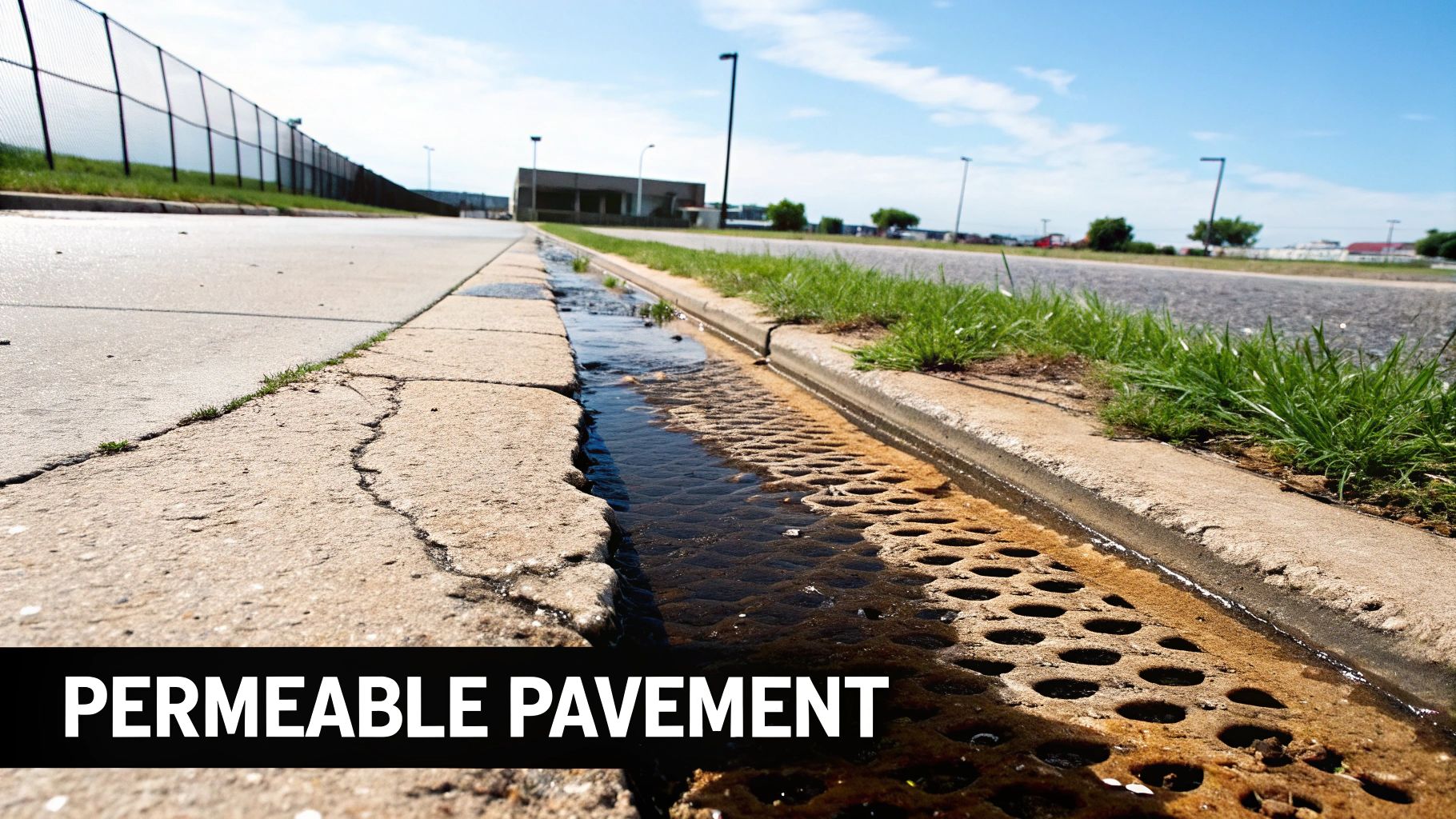
Permeable concrete, also known as porous or pervious concrete, is an innovative environmental solution designed to manage stormwater runoff. Unlike traditional concrete, this is one of the more sustainable types of concrete available. It's engineered with a special mix that significantly reduces or eliminates fine aggregates like sand, creating a network of interconnected voids. This unique structure allows water to pass directly through the pavement and into the ground below, mimicking natural drainage. For example, after a rainstorm, a permeable parking lot will appear dry much faster than an asphalt one, as the water has drained through it.
This process helps replenish groundwater tables, reduces the burden on storm sewer systems, and filters out pollutants. Its growing popularity, championed by organizations like the EPA and LEED initiatives, reflects a major shift toward green building practices. The strength is suitable for light to moderate traffic, making it a functional and eco-friendly choice for specific applications.
Common Applications
Permeable concrete is ideal for projects where stormwater management and environmental impact are primary concerns:
- Parking Lots and Driveways: Reduces standing water and prevents runoff from carrying oils and other pollutants into local waterways.
- Sidewalks and Pedestrian Pathways: Keeps pedestrian areas safer by preventing puddles and ice formation.
- Green Infrastructure: Used in bioretention areas, tree surrounds, and rain gardens to support sustainable urban design.
- Patios and Hardscapes: Provides an environmentally friendly surface for outdoor living spaces that allows rain to nourish surrounding landscaping.
Atlanta Climate Tip: Atlanta's heavy rainstorms can overwhelm municipal drainage systems. Installing a permeable driveway can significantly reduce your property's stormwater runoff, potentially helping you meet local building codes and even qualify for stormwater utility fee credits in some municipalities.
When to Call Us
A successful permeable concrete installation requires expertise in site preparation, sub-base design, and mix formulation. For properties in Sandy Springs, Roswell, or anywhere in the Atlanta area looking to implement a green paving solution, Atlanta Concrete Solutions has the specialized knowledge to get it done right. Contact us for an expert consultation on how permeable concrete can benefit your project.
9. Ready-Mixed Concrete (RMC)
Ready-Mixed Concrete (RMC) is a highly precise and efficient method of concrete production. Rather than mixing ingredients on the job site, RMC is manufactured in a specialized batching plant according to strict engineering specifications. It is then transported to the construction site in a truck-mounted, rotating drum mixer, arriving ready for immediate placement. This process guarantees superior quality control and consistency that is nearly impossible to replicate with on-site mixing. For example, a large commercial slab pour requiring 100 cubic yards of concrete needs the consistency that only a ready-mix plant can provide.
The primary advantage of RMC is its reliability. By centralizing production, ready-mix producers can ensure accurate measurements of cement, aggregates, water, and admixtures, resulting in concrete that meets exact strength and performance requirements. This makes it an indispensable resource for nearly all modern construction, from large-scale commercial developments to residential projects.
Common Applications
RMC is the standard for projects where quality, speed, and consistency are critical. Its applications are extensive and include:
- Large Commercial Foundations: Provides the engineered strength needed for high-rise buildings and industrial facilities.
- Road and Highway Construction: Ensures durable, uniform pavement for high-traffic infrastructure projects.
- Residential Housing Developments: Streamlines the construction of multiple foundations and driveways with consistent quality.
- Virtually All Modern Building Construction: From retaining walls to high-performance floors, RMC is the go-to solution.
Atlanta Climate Tip: When scheduling an RMC delivery in Atlanta, communication is key. Inform your producer about the expected temperature and humidity. They can adjust the mix with admixtures to ensure you have the right workability window, preventing premature hardening on hot days. Always have your crew ready for the truck's arrival to avoid delays.
When to Call Us
For any project requiring consistent, high-quality concrete, from a new home foundation to extensive flatwork, RMC is the answer. Atlanta Concrete Solutions coordinates with the best local producers to ensure your project in areas like Sandy Springs, Alpharetta, or Decatur gets the perfect mix delivered on time. For expertly managed residential poured concrete projects, contact us for a comprehensive quote.
10. Roller-Compacted Concrete (RCC)
Roller-Compacted Concrete (RCC) is a unique, zero-slump material placed with machinery similar to asphalt paving and then compacted by heavy vibratory rollers. This method produces a strong, dense, and highly durable concrete surface quickly and economically. Unlike conventional mixes, RCC’s drier consistency allows it to support the weight of heavy equipment almost immediately, dramatically accelerating construction schedules. A great example is paving a massive distribution center's lot, where the surface needs to be ready for truck traffic in a matter of days, not weeks.
This innovative approach blends the strength and durability of traditional concrete with the efficient, high-volume placement methods of asphalt. As one of the more specialized types of concrete, its primary advantage is speed, making it ideal for large-scale industrial and civil engineering projects where time and budget are critical factors.
Common Applications
RCC is the go-to solution for projects that require a vast, heavy-duty paved surface delivered on a tight timeline, including:
- Industrial Pavements and Yards: Perfect for container ports, distribution centers, and log sorting yards that endure constant heavy loads.
- Heavy-Duty Parking Lots: Provides a long-lasting surface for truck stops, commercial lots, and military facilities.
- Dams and Water Control Structures: Used for mass concrete placements like the Muskingum Dam, offering a fast and cost-effective construction method.
- Local Roads and Streets: A durable alternative to asphalt for low-volume roads, offering a longer service life with less maintenance.
Atlanta Climate Tip: RCC placement is sensitive to ambient temperature and moisture. In Atlanta's summer heat, work should be scheduled for early mornings to control the concrete's temperature and prevent premature drying, which can hinder proper compaction and density.
When to Call Us
RCC projects demand specialized equipment and meticulous coordination between the batch plant, transport, and paving crew. If your commercial or industrial project in areas like Kennesaw, Alpharetta, or the wider Atlanta metro requires a high-strength pavement installed fast, Atlanta Concrete Solutions has the expertise. Contact us to discuss how RCC can meet your project’s demands.
11. Recycled Aggregate Concrete
Recycled Aggregate Concrete (RAC) is a sustainable building material that champions environmental responsibility. Among the modern types of concrete, this innovative solution incorporates recycled concrete aggregate (RCA) sourced from demolished structures, reducing landfill waste and conserving natural resources. By crushing and processing old concrete—for example, from a demolished highway bridge—we create a high-quality aggregate that can partially or fully replace virgin materials in a new mix. This process promotes a circular economy in construction while delivering reliable performance.
This eco-friendly concrete maintains structural integrity for many applications, making it an excellent choice for green building initiatives. The key to its success lies in sourcing quality RCA and adjusting the mix design to account for the aggregate's unique properties, such as higher water absorption. When properly engineered, its performance is comparable to conventional concrete.
Common Applications
Recycled Aggregate Concrete is increasingly specified in projects where sustainability and environmental impact are primary concerns:
- Building Foundations: Provides a solid, eco-conscious base for residential and commercial structures, often contributing to green building certifications.
- Secondary Roads and Pavements: Ideal for low-traffic areas, bike paths, and sub-bases where it offers durability and reduces the project's carbon footprint.
- Structural Infill and Mass Concrete: Used for large-volume placements where the primary goal is mass and stability rather than high tensile strength.
- LEED and Green Building Projects: A popular choice for developers aiming for certifications from organizations like the U.S. Green Building Council (USGBC).
Atlanta Climate Tip: The higher absorption rate of recycled aggregate can affect the concrete’s workability in Atlanta's heat. It's crucial to pre-wet the aggregate or adjust the water-cement ratio with precision to prevent the mix from becoming too stiff to finish properly during hot weather pours.
When to Call Us
Incorporating recycled materials requires expertise to ensure a predictable and durable final product. If your project prioritizes sustainability without compromising quality, trust Atlanta Concrete Solutions. We serve clients in Alpharetta, Roswell, and across the Atlanta area, expertly designing and installing recycled aggregate concrete mixes that meet both performance and environmental goals. Contact us today for a quote on your green building project.
12. Colored and Decorative Concrete
Moving beyond purely functional applications, colored and decorative concrete elevates a simple structural material into a high-end design element. This is one of the most versatile types of concrete for achieving specific aesthetic goals. By introducing integral pigments, topical stains, or specialized stamping and polishing techniques, we can transform plain gray slabs into stunning, durable surfaces that mimic materials like stone, brick, or tile. For example, a stamped concrete patio can be made to look exactly like expensive flagstone, complete with custom colors and realistic textures.
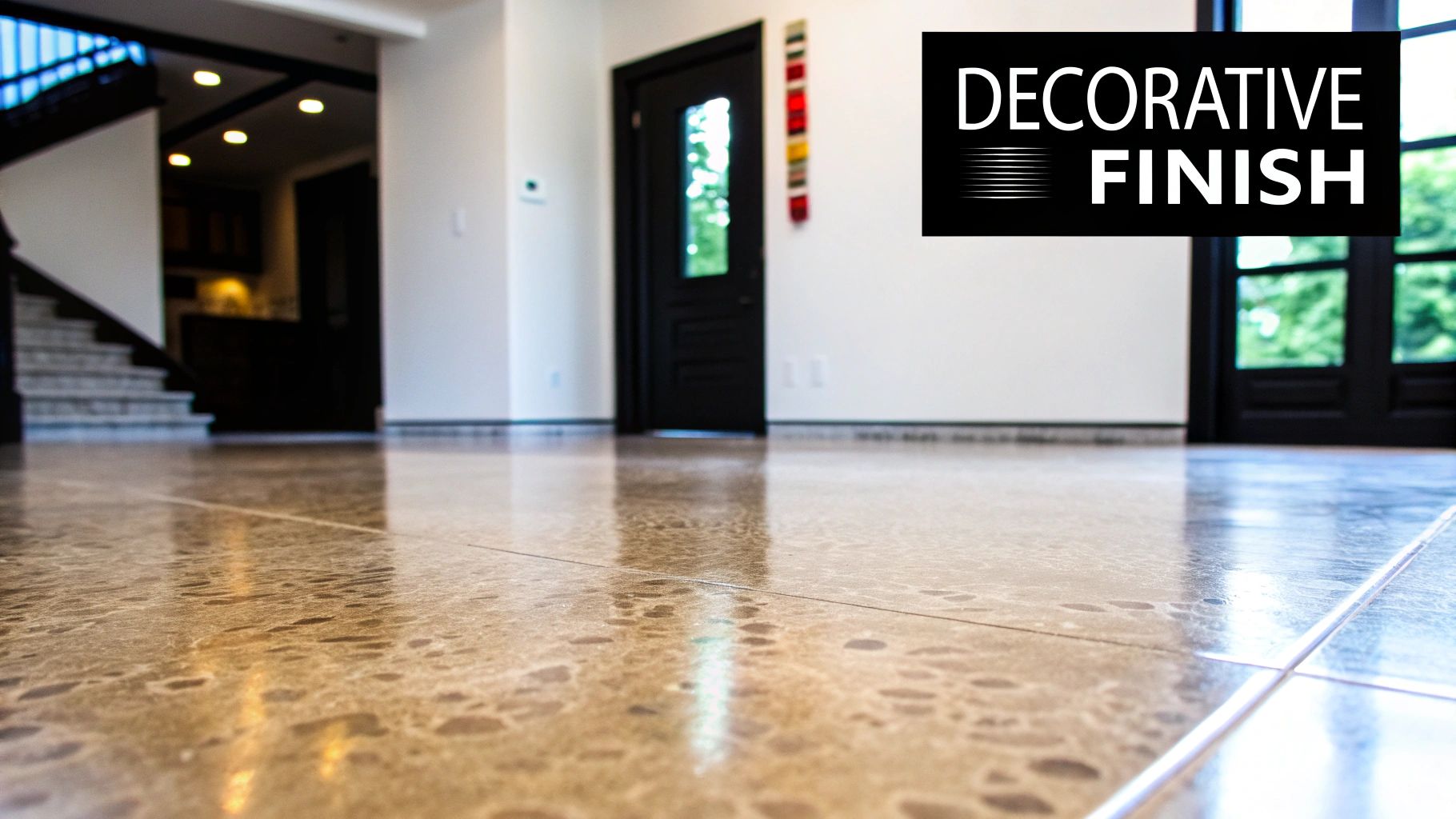
The creative possibilities are nearly limitless, allowing for complete customization in color, texture, and pattern. This design flexibility makes it a favorite among architects and homeowners looking to add unique character to their properties while retaining the strength and longevity of traditional concrete.
Common Applications
This concrete is the ideal choice for projects where visual appeal is just as important as structural integrity:
- Stamped Concrete Patios and Walkways: Creates the look of expensive pavers or natural stone at a fraction of the cost.
- Polished Concrete Floors: Delivers a sleek, modern, and low-maintenance surface for retail stores, showrooms, and residential interiors.
- Architectural Facades and Walls: Provides a unique, textured finish for building exteriors and feature walls.
- Stained Driveways and Pool Decks: Adds rich, translucent color and custom designs to enhance curb appeal.
Atlanta Climate Tip: The intense Georgia sun can cause some topical colorants and sealers to fade over time. For outdoor projects like patios or driveways, opt for integral pigments mixed directly into the concrete and a high-quality UV-resistant sealer for maximum color longevity and protection.
When to Call Us
Achieving a flawless decorative finish requires specialized skill and an artistic eye. If you're envisioning a stunning stamped patio in Alpharetta or a modern polished floor for your business in Roswell, Atlanta Concrete Solutions has the expertise. We can guide you through the design possibilities. Learn more about our residential decorative concrete services and call us for a custom quote.
Comparison of 12 Concrete Types
| Concrete Type | 🔄 Complexity | ⚡ Resources / Equipment | ⭐ Expected performance | 📊 Ideal use cases | 💡 Key advantages / Tips |
|---|---|---|---|---|---|
| Portland Cement Concrete (PCC) | Low — standard mixing & curing | Moderate — cement, aggregates, mixers | ⭐⭐⭐⭐ Good compressive strength (3–4k PSI); durable | Foundations, sidewalks, highways, dams | Cost‑effective; allow 7–28 day curing; control w/c ratio |
| Reinforced Concrete (RC) | Medium‑High — rebar placement & formwork | High — rebar, skilled labor, quality control | ⭐⭐⭐⭐⭐ High tensile & compressive capacity; crack control | Buildings, bridges, columns, beams | Handles tension/compression; ensure proper cover & corrosion protection |
| Prestressed Concrete | High — specialized prestressing operations | Very high — tendons, jacks, trained engineers | ⭐⭐⭐⭐⭐ Long spans, reduced cracking, high serviceability | Long‑span bridges, large decks, parking garages | Use experienced prestressing engineers; monitor prestress losses |
| High‑Performance Concrete (HPC) | High — precise mix design & QC | High — SCMs, admixtures, advanced mixing/curing | ⭐⭐⭐⭐⭐ Very high strength (8k–15k+ PSI); low permeability | High‑rises, marine/offshore, harsh environments | Specify SCMs clearly; invest in QC and extended curing |
| Fiber‑Reinforced Concrete (FRC) | Medium — modified mixing procedures | Moderate‑High — fibers (steel/synthetic), mixing adjustments | ⭐⭐⭐⭐ Improved toughness, crack bridging, impact resistance | Industrial floors, tunnels, precast, blast‑resistant elements | Prevent fiber balling; test fiber distribution; consider hybrid fibers |
| Lightweight Concrete | Medium — aggregate selection & design | Moderate — lightweight aggregates (expanded clay, pumice) | ⭐⭐⭐ Lower density with moderate strength (2k–5k PSI); better insulation | Tall buildings (reduced dead load), precast slabs, roof decks | Account for lower modulus; reinforce to control cracking; monitor aggregate quality |
| Self‑Consolidating Concrete (SCC) | High — sensitive mix design for flowability | High — high powder content, viscosity modifiers, testing | ⭐⭐⭐⭐ Excellent flow and surface finish; good consolidation | Architectural elements, complex formwork, precast | Conduct slump‑flow/J‑ring tests; use consistent materials and experienced producers |
| Permeable (Porous) Concrete | Medium — gradation control & maintenance planning | Moderate — coarse aggregates, maintenance regimes | ⭐⭐ High porosity, low strength (1k–3k PSI); excellent infiltration | Permeable parking, sidewalks, green infrastructure | Design maintenance schedule to avoid clogging; consider underdrains |
| Ready‑Mixed Concrete (RMC) | Low‑Medium — plant batching & logistics | Moderate — batching plant, transit mixers, scheduling | ⭐⭐⭐ Consistent quality; performance depends on timing | Most building projects, roads, large pours | Schedule deliveries to placement capacity; verify mix design before pour |
| Roller‑Compacted Concrete (RCC) | Medium — specialized compaction process | Moderate‑High — rollers, vibratory equipment, flat laydown area | ⭐⭐⭐ Durable monolithic pavements; rapid placement | Dams, pavements, large industrial floors, parking areas | Use proper rolling technique; control moisture and temperature during placement |
| Recycled Aggregate Concrete | Medium — quality control of recycled sources | Moderate — RCA supply, testing, possible mix adjustments | ⭐⭐⭐ Comparable strength with proper design; lower embodied carbon | Sustainable structures, secondary roads, LEED projects | Source controlled demolition material; test aggregates and adjust water/cement |
| Colored & Decorative Concrete | Medium — skilled finishing & color control | Moderate — pigments, stains, sealers, experienced finishers | ⭐⭐ Aesthetic performance; structural behavior per base mix | Polished floors, stamped patios, architectural façades | Produce mockups for color/finish; apply sealers and plan maintenance |
Build with Confidence: Partner with Atlanta's Concrete Experts
Navigating the diverse world of concrete can feel overwhelming, but as we've explored, understanding the distinct types of concrete is the foundational step toward a successful and enduring project. This comprehensive roundup has moved beyond simple definitions, providing a practical roadmap for selecting the ideal material for your specific needs, whether you're in the heart of Atlanta or its surrounding communities.
We've seen that the choice is far from one-size-fits-all. A simple driveway replacement might call for durable and cost-effective Ready-Mixed Concrete, while a high-traffic commercial warehouse in an industrial park near Hartsfield-Jackson demands the superior compressive strength of High-Performance Concrete (HPC). Similarly, a homeowner in a historic Marietta district looking to add a charming patio might opt for Decorative or Colored Concrete, carefully stamped to mimic natural stone, whereas a new subdivision in Alpharetta could benefit from Permeable Concrete driveways to manage stormwater runoff and comply with local environmental codes.
Key Takeaways for Your Atlanta Project
The critical lesson is that material selection directly impacts performance, longevity, and cost. Choosing the wrong type of concrete isn't just an aesthetic mistake; it can lead to premature cracking, spalling, and costly repairs down the line, especially given Atlanta's cycle of humid summers and occasional winter freezes.
Here are the most important takeaways to remember:
- Function Dictates Form: The primary purpose of your surface is the most critical factor. The mix for a decorative garden path is fundamentally different from what's required for a prestressed concrete beam in a commercial building. Always start with the end use in mind.
- Local Climate Matters: Atlanta's climate, with its high humidity and potential for freeze-thaw cycles, makes certain concrete properties essential. For exterior flatwork like sidewalks and driveways, considering options like air-entrained concrete can significantly enhance durability by resisting damage from freezing moisture.
- Sustainability is Accessible: Options like Recycled Aggregate Concrete and Permeable Concrete are not just niche, eco-friendly choices. They offer practical benefits, from reducing landfill waste to improving on-site water management, which is increasingly important for new developments in areas like Johns Creek and Duluth.
- Aesthetics and Strength Can Coexist: You don't have to sacrifice durability for beauty. With advancements in Stamped, Colored, and Polished Concrete, you can achieve a high-end look that is just as tough and low-maintenance as traditional concrete, perfect for modernizing a retail space or creating a standout residential pool deck.
From Knowledge to Action: Your Next Steps
Armed with this knowledge, you can now approach your project with a strategic mindset. You understand why a contractor might recommend Fiber-Reinforced Concrete for your new basketball court to minimize surface cracking or why Roller-Compacted Concrete is the go-to for heavy-duty industrial pavements. This understanding empowers you to ask the right questions, evaluate proposals effectively, and ensure you're getting the best value and performance for your investment.
The ultimate success of any project, however, hinges not just on the right materials but on expert execution. Proper site preparation, precise mixing, expert finishing, and meticulous curing are what transform a plan into a lasting asset. This is where partnering with a seasoned local professional becomes non-negotiable. An experienced contractor doesn't just pour concrete; they analyze soil conditions, ensure proper drainage, and adhere to all local building codes, safeguarding your project from day one.
Choosing the right partner means building with confidence, knowing that every detail, from the sub-base to the final sealant, is handled with precision.
Don't leave your project's success to chance. At Atlanta Concrete Solutions, we specialize in matching the right types of concrete to your specific needs and ensuring flawless installation. Contact us today for a free, no-obligation quote and let our team of local experts bring durability, function, and beauty to your next project.