
Ever noticed those pockmarks, flakes, or chips on your concrete driveway or patio? That’s a classic sign of concrete spalling. It’s the surface of your concrete literally breaking apart and flaking away, exposing the rougher, rocky aggregate underneath.
Think of it like the outer layer of an onion peeling away. This happens when something creates immense pressure from inside the concrete, pushing the surface outward until it pops off. For example, a tiny drop of water seeping into a pore, freezing overnight, and expanding is enough to start the process.
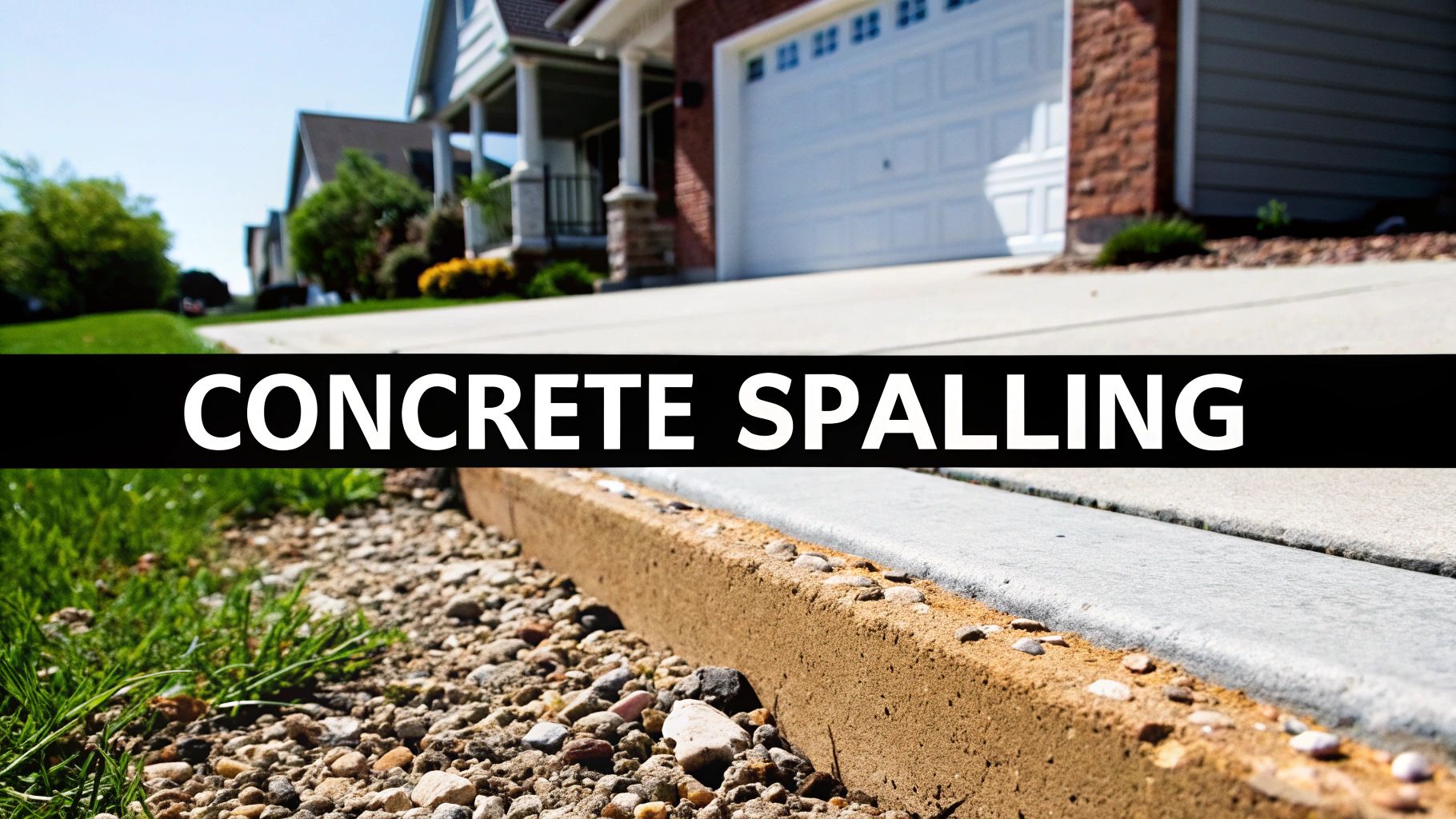
While a few small flakes might not seem like a big deal, spalling is your concrete’s way of crying for help. It’s often the first visible symptom of deeper, more serious issues that can threaten the entire structure's strength and longevity. For instance, a small spall on a balcony edge could be the first sign that the internal steel rebar is rusting, which is a serious structural problem. Catching it early can save you from a massive repair bill down the road.
What’s Really Making Your Concrete Fall Apart?
So, what causes this internal pressure? Several culprits can be at play, each attacking your concrete in its own unique way. The result, however, is always the same: a weakened, crumbling surface. Figuring out the root cause is the single most important step in creating a lasting repair.
The usual suspects often involve moisture, chemical reactions, or even mistakes made during the initial installation. Let’s break down the most common ones.
Spalling is a distress signal. It’s telling you that powerful internal forces are tearing your concrete apart from the inside out. It's a signal you definitely don't want to ignore.
To get a quick overview, here’s a look at the most frequent reasons your concrete might be flaking away. We'll dive deeper into each of these throughout this guide, but this table is a great starting point.
Quick Guide to Common Concrete Spalling Causes
This summary table outlines the primary triggers for spalling, helping you quickly identify potential issues with your concrete surfaces.
| Cause | How It Leads to Spalling |
|---|---|
| Rebar Corrosion | Moisture and salts sneak in, causing the internal steel rebar to rust. This rust expands, cracking the concrete from within. For example, the columns in a parking garage often show this type of damage near the base. |
| Freeze-Thaw Cycles | Water soaks into tiny pores, freezes, and expands by about 9%. This repeated expansion acts like a tiny jackhammer, breaking the surface. This is common on sidewalks where snow melts and refreezes. |
| Deicing Salts | These chemicals don't just melt ice; they can accelerate rebar corrosion and create more damaging freeze-thaw cycles. Think of the pitted and flaked surface of a driveway that is salted every winter. |
| Poor Mix/Installation | A concrete mix with too much water or an improper finish creates a weak, porous surface that's highly susceptible to damage. An example is a patio that starts flaking within the first year because too much water was added to the mix. |
| Alkali-Silica Reaction | A slow-moving chemical reaction inside the concrete forms a gel. This gel swells with moisture, causing extensive internal cracking. You might see this on old highway barriers that have large, map-like cracks and pop-outs. |
| Moisture & Poor Drainage | Constant water exposure is public enemy number one. It weakens concrete and fuels nearly every other cause on this list. A prime example is spalling near a downspout that constantly drains onto a concrete walkway. |
Understanding these factors is key to protecting your property. For homeowners in and around Atlanta, the team at Atlanta Concrete Solutions has the local expertise to accurately diagnose and fix any spalling problem, no matter the cause.
The #1 Cause of Spalling: Corroded Steel Rebar
If you're looking for the single biggest culprit behind concrete spalling, look no further than the steel reinforcement bars—or rebar—hidden inside. Think of rebar as the skeleton that gives concrete its incredible tensile strength, allowing it to support everything from a parking deck to a massive bridge. But when that hidden skeleton begins to rust, it sets off a destructive chain reaction from the inside out.
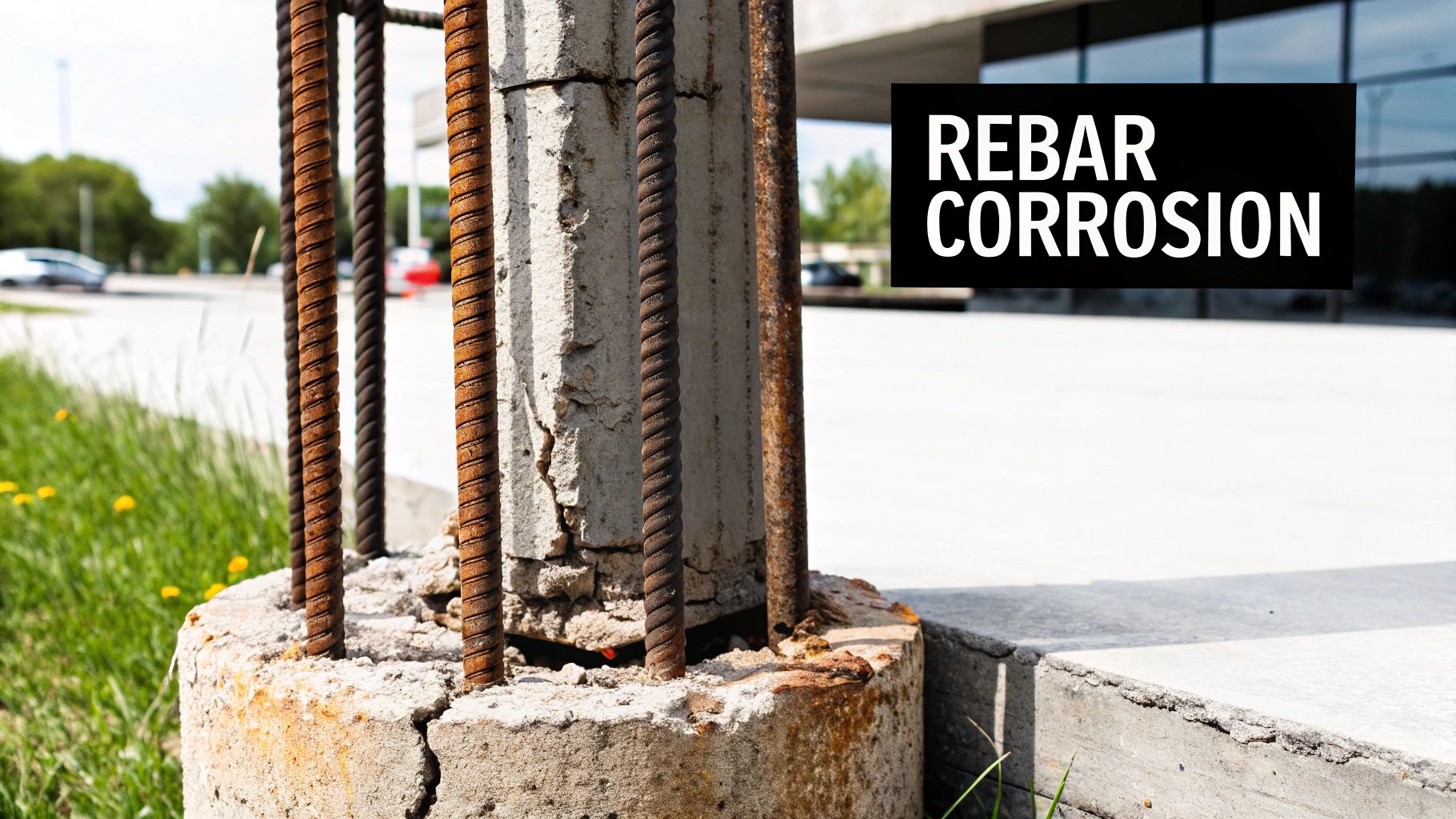
Fresh concrete is a fantastic protector of steel. Its highly alkaline chemistry creates a natural, rust-proof shield around the rebar, keeping it stable for decades. The problem is, this shield isn't permanent. Over time, environmental factors can wear it down, leaving the steel exposed and vulnerable.
How The Protective Shield Fails
Two common culprits are constantly at work breaking down concrete's natural defenses, neutralizing its protective alkaline environment and inviting rust to take hold.
-
Carbonation: This is a slow, creeping process. Carbon dioxide (CO2) from the atmosphere seeps into the concrete, reacting with its internal chemistry and gradually lowering the pH. Once the pH drops too low, that protective shield around the rebar simply dissolves, and corrosion is free to begin. An example would be an older, uncoated concrete building in an urban area with high vehicle emissions.
-
Chloride Infiltration: Chlorides are the chemical equivalent of a battering ram. They're far more aggressive than CO2 and are usually introduced by deicing salts in the winter or salt spray in coastal areas. These chloride ions muscle their way through the concrete and directly attack the rebar, kickstarting corrosion even if the concrete's pH is still high. A classic example is the spalling seen on bridge piers located near the ocean.
This is exactly why you see the worst spalling on structures that get a regular dose of these elements.
Think about places like:
- Parking garage columns that get splashed with salty slush from cars all winter.
- Bridge decks and supports that are constantly treated with deicing chemicals.
- Coastal balconies that are always exposed to humid, salt-heavy air.
The Science Behind the "Concrete Explosion"
Once the rebar's shield is down and moisture gets in, rust (iron oxide) starts to form. This isn't just a surface-level problem; it's a powerful physical force. As steel corrodes, it expands with incredible force, growing up to ten times its original volume. This is one of the most fundamental causes of concrete spalling.
This immense pressure has to go somewhere. Trapped inside the concrete, the expanding steel pushes outward, forcing the surface to bulge, crack, and eventually pop right off.
That internal fracturing is the very definition of spalling. The chunks and flakes you see on the ground are the final, visible signs of a battle that the concrete lost from within. Ignoring these symptoms is a big mistake. It leaves the rebar even more exposed, allowing more water and salt to get in, which only speeds up the corrosion and leads to bigger, more expensive structural problems down the road.
Environmental Attackers: Freeze-Thaw Cycles and Deicing Salts
While problems from within the slab are a huge threat, some of the most relentless damage to concrete comes from the outside world. This is especially true in climates like Atlanta's, where we get those seasonal temperature swings. Two of the worst offenders are the freeze-thaw cycle and the deicing salts we use to clear away ice. They work together as a powerful one-two punch that can tear a concrete surface apart in just a few seasons.
When people ask "what causes concrete spalling?"—especially on driveways, patios, and walkways—this process is one of the most common culprits.
The Unseen Power of the Freeze-Thaw Cycle
To get a picture of what's happening, think about what happens when you leave a can of soda in the freezer. As the liquid turns to ice, it expands with incredible force, often bulging or even bursting the aluminum can. Your concrete goes through a very similar process, just on a microscopic level.
See, concrete is naturally porous. It’s full of tiny, interconnected holes and capillaries. When it rains or snow melts, water soaks into these pores. Once the temperature drops below freezing, that trapped water turns to ice and expands by about 9%. This expansion puts immense pressure on the concrete from the inside, acting like countless tiny hydraulic jacks pushing it apart.
Then, when the temperature rises, the ice melts, and the pressure lets up. But the cycle starts all over again with the next freeze. Each time this happens, the push-and-pull weakens the concrete’s internal bonds, creating micro-cracks that grow, connect, and eventually cause the surface to pop right off. For example, the corner of a concrete step is a common failure point, as it absorbs water from three sides, making it highly susceptible to this cycle.
How Deicing Salts Make a Bad Situation Worse
When ice covers your driveway, grabbing a bag of deicing salt feels like the smart move. And while it does melt the ice and make things safer, it also throws gasoline on the fire of the spalling process. It does this in two key ways.
First, salts lower the freezing point of water. This means instead of your concrete going through just a few deep freezes during a cold snap, the slush on your driveway can re-freeze and thaw over and over again as the temperature hovers right around that 32-degree mark. This massively increases the number of damaging freeze-thaw cycles your concrete has to survive in a single winter.
Salt doesn't just melt ice; it multiplies the opportunities for water to freeze, expand, and break down your concrete. More cycles mean more damage, faster.
Second, most deicing products are loaded with chlorides. As we talked about with rebar, these chemicals are extremely corrosive. When that salty water soaks into the concrete, the chlorides can eventually work their way down to the steel reinforcement, eating away at its protective layer and starting the rusting process. This leads to much deeper, more severe spalling. This dual threat is exactly why areas you salt regularly often show the worst signs of flaking and chipping.
Where You'll See This Type of Damage
The damage from freeze-thaw cycles and deicing salts is most obvious on flat, exposed surfaces where water can sit and that get treated frequently in the winter.
Common examples include:
- Driveways: Even though they're sloped, low spots can hold water. They're also prime targets for salt.
- Sidewalks: These high-traffic areas are almost always salted for safety, which puts them at very high risk. For a deeper look into maintaining these crucial walkways, you can learn more about protecting your residential sidewalk concrete and preventing this kind of damage.
- Patios and Pool Decks: Water often pools on these surfaces. While you might not salt them as often, they are still completely exposed to the natural freeze-thaw cycle.
- Garage Floors: Your cars track in salty slush all winter long. It then melts and puddles on the floor, creating the perfect storm for spalling to start right inside your garage.
Other Major Culprits Behind Concrete Spalling
While rebar corrosion and the freeze-thaw cycle are the usual suspects, they aren't the only things that can cause concrete to spall. Sometimes, the problem is more subtle, originating from the concrete's own chemistry, mistakes made during installation, or even sudden, extreme events.
Getting to know these other causes gives you a more complete picture of what could be compromising your concrete surfaces. Each one creates internal stress differently, but they all lead to the same ugly result: a surface that flakes, chips, and falls apart.
The Slow-Motion Cancer: Alkali-Silica Reaction
One of the most destructive, hidden causes of spalling is a chemical process called Alkali-Silica Reaction (ASR). The best way to think of it is like a slow-growing cancer inside your concrete. It happens when the highly alkaline cement paste has a bad reaction with certain types of silica found in aggregates—the sand and gravel that make up most of the mix.
This reaction creates a gel-like substance that acts like a sponge, soaking up any moisture it can find. As the gel absorbs water, it swells and expands, creating immense internal pressure that forms a web of micro-cracks. Eventually, that pressure has to go somewhere, and it pushes outward, causing the surface to spall and crack.
You might be looking at ASR damage if you see:
- Large, map-like or web-like cracking patterns spreading across the surface.
- Spalling that pops up for no apparent reason, even without freezing temperatures.
- Areas of the concrete that look like they're being pushed up from the inside.
The telltale sign of ASR is often that extensive, web-like cracking that goes along with the spalling. It’s a dead giveaway that the concrete's own ingredients are at war with each other.
When a Bad Pour Is the Real Problem
Sometimes, the root of the problem isn't an outside force at all, but a flaw that was literally mixed in from the very beginning. Poor construction practices can create weak, porous concrete that's a sitting duck for every other issue we've talked about.
A classic mistake is getting the water-to-cement ratio wrong. Adding too much water makes the concrete mix flow easily, which can seem like a good idea on installation day. But all that extra water has to go somewhere. As it evaporates, it leaves behind a network of tiny voids and channels that act like superhighways for moisture to get in, kickstarting freeze-thaw damage and rust. For example, if a contractor adds water to the truck to make the concrete easier to spread, that new patio may start flaking within a year.
Another common slip-up is improper finishing. If the crew overworks the surface or seals it before bleed water can escape, they can create a weak top layer that doesn't properly bond to the slab below. This thin, brittle "crust" is prone to delamination and will quickly chip and flake away.
Damage from Fire or a Heavy Hit
Finally, spalling can happen in an instant due to extreme events like intense heat or a direct impact. A heavy piece of equipment dropped on a warehouse floor or a vehicle collision can easily fracture the surface, creating an immediate spall. It’s less common for a driveway, but a major concern for commercial and industrial concrete.
Fire is another major threat. When concrete is exposed to high temperatures, it can lead to a dangerous phenomenon called explosive spalling. Around 212°F (100°C), any free water trapped inside the concrete’s pores boils and turns to steam. This creates enormous internal pressure. If that steam can’t escape fast enough, the pressure builds until it violently blows the surface layer of concrete clean off. For a deeper dive, you can explore more about the effects of high temperatures on concrete and the science behind this process. A recent example is the damage seen to highway overpasses after a vehicle fire underneath.
How To Diagnose and Repair Spalling Concrete
Once you’ve spotted those tell-tale flakes and chips, the next step is figuring out what you’re really dealing with. A proper diagnosis is everything, because the right fix depends entirely on how deep the problem goes. Just slapping a patch over the damage without understanding the why behind it is a surefire way to watch it fail, and you'll be right back where you started next season.
Take a close look at the damaged spot. Is it just minor surface flaking, where only the very top "cream" layer has popped off? That might just be a cosmetic issue. But if the damage is deeper—exposing the rocky aggregate or, even worse, the steel rebar—you’ve got a much bigger headache on your hands.
Assessing the Severity of the Damage
First, grab a hammer and gently tap the area around the spall. If you hear a hollow, drum-like sound, that means the surface has delaminated. It's no longer bonded to the concrete below, even if it hasn't flaked off yet. That entire hollow section is compromised and has to go.
Next, get a rough idea of the depth.
- Minor Spalling: We're talking less than a half-inch deep with no rebar in sight. This is usually surface-level stuff caused by a poor finishing job or a mild freeze-thaw cycle. An example is fine flaking on a new patio surface.
- Moderate Spalling: If you're seeing damage up to an inch deep and the coarse aggregate (the small rocks in the mix) is clearly exposed, it points to more significant moisture getting in or the early stages of a corrosion problem. A good example is a driveway where chunks the size of a quarter have popped out.
- Severe Spalling: This is the big one—spalling deep enough to expose the steel rebar. Exposed rebar is a massive red flag that points to a potential structural issue. It needs immediate, professional attention. An example would be the underside of a bridge where you can see the rusty metal grid.
The Steps for a Long-Lasting Repair
A professional, durable repair isn’t just about filling a hole; it's a multi-step process that tackles the root cause. Skipping any of these steps is the difference between a fix that lasts for years and one that fails before winter is even over. This decision tree shows just how many factors can lead to spalling, which is why a thoughtful diagnosis is so critical.
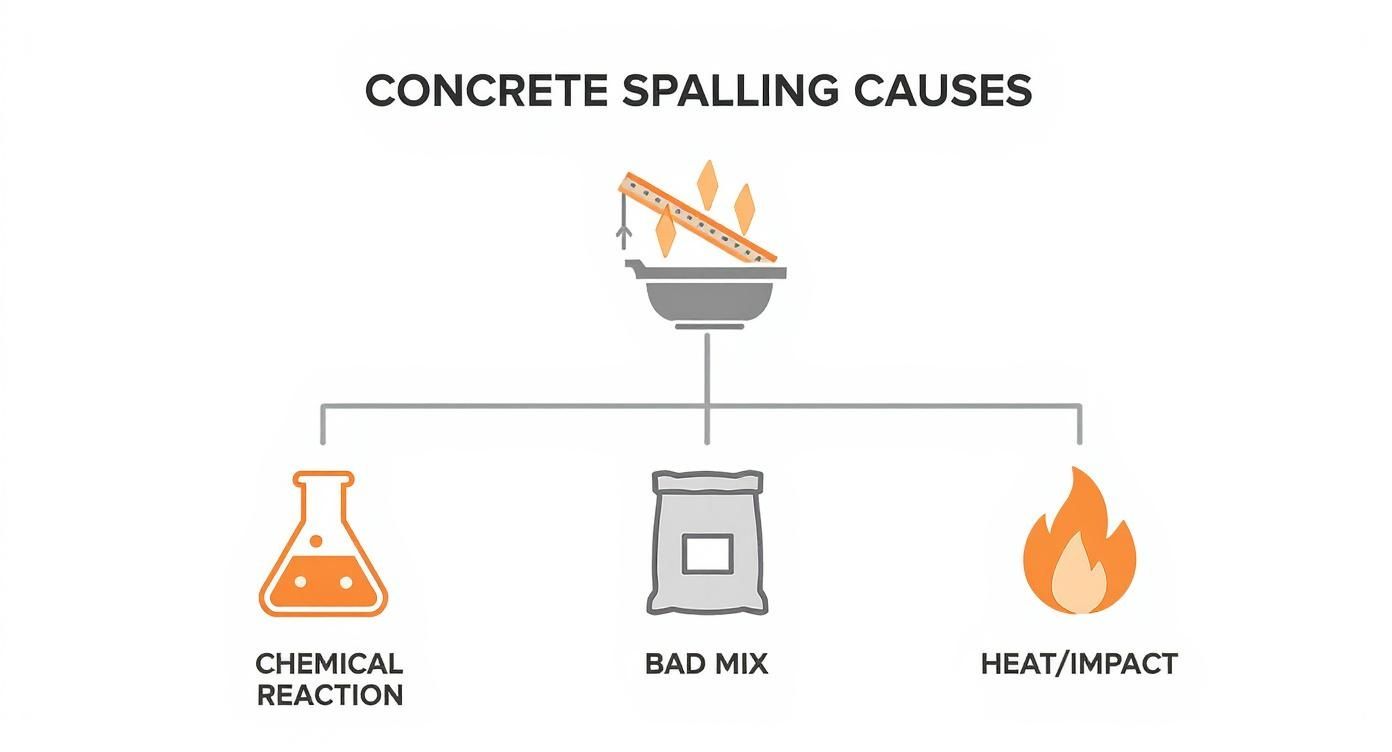
As the graphic illustrates, a proper repair has to account for the underlying cause. Here’s how the pros do it:
- Define the Area: The first move is to saw-cut a clean, rectangular perimeter just outside the damaged and delaminated zone. This creates a solid, stable "shoulder" for the new patch material to bond to.
- Remove Unsound Concrete: Using a chipping hammer, all the loose, cracked, and hollow-sounding concrete inside that perimeter is removed until only solid, healthy concrete remains.
- Treat Exposed Rebar: If rebar is exposed, it absolutely must be cleaned of all rust and scale. After that, it gets coated with a specialized anti-corrosion primer to stop the rusting in its tracks.
- Apply a Bonding Agent: The clean, dry patch area is then primed with a bonding agent. Think of it like super-strong, double-sided tape that ensures the new repair material forms a powerful, seamless bond with the old concrete.
- Fill the Patch: A high-quality, polymer-modified repair mortar is packed into the void. It’s usually done in layers to make sure there are no trapped air pockets.
- Cure the Repair: Finally, the fresh patch has to be cured properly. This means keeping it moist and protecting it from drying out too quickly, which is crucial for it to reach its full design strength.
When to Call a Professional: If you see exposed rebar, the spalling covers a large area (more than a few square feet), or it's happening on a structural element like a column or beam, it’s time to put the tools down. These are clear signs you need an expert to ensure the structure's safety and integrity.
Deciding between a quick DIY patch and a professional repair often comes down to weighing a short-term fix against a long-term solution.
DIY Patch vs. Professional Spalling Repair
| Feature | Typical DIY Patch | Professional Repair |
|---|---|---|
| Preparation | Surface cleaning, often minimal. | Saw-cutting, chipping to sound concrete, rebar prep. |
| Materials | Basic, pre-mixed concrete patch from a hardware store. | High-strength, polymer-modified mortars, bonding agents. |
| Longevity | Short-term; often fails within 1-2 years. | Long-term; designed to last for years, matching the slab. |
| Cost | Low initial cost for materials. | Higher upfront investment. |
| Best For | Minor, non-structural, cosmetic surface chips. | Moderate to severe spalling, especially with exposed rebar. |
While a DIY approach can be tempting for small spots, it rarely addresses the underlying cause, meaning the problem will almost certainly return.
For a comprehensive evaluation of any concrete damage, exploring residential concrete and masonry repair options with a certified expert is always the safest and most effective path forward. The team at Atlanta Concrete Solutions can provide a thorough structural assessment and make sure any repair is done right—the first time.
Concrete Spalling in Atlanta: What Local Property Owners Should Know
It's one thing to understand what causes concrete spalling in theory, but here in Atlanta, our local conditions add a whole different level of complexity. The specific climate and regional practices mean your concrete faces challenges that folks in other parts of the country just don't encounter. Getting a handle on these local factors is the first step toward effective prevention and repair.
Atlanta's weather is a huge part of the problem. We get those long, humid summers that drench concrete in moisture, followed by winters that can spring sudden, unpredictable freezes on us. This creates the perfect storm for aggressive freeze-thaw cycles. It only takes a few cold nights for that trapped water to freeze, expand, and start breaking apart your driveway or patio from the inside.
Georgia-Specific Environmental Factors
When winter weather hits, the Georgia Department of Transportation (GDOT) gets to work treating major highways like I-75, I-85, and I-285 with a brine solution and rock salt. It keeps the roads safe, but it has a nasty side effect for nearby properties. Every time you drive, your car tracks that corrosive, salt-caked slush right onto your driveway and into your garage, which massively speeds up rebar corrosion and surface damage.
On top of that, the type of aggregate—the stone and sand mixed into the concrete—can vary depending on the local quarry. Some regional aggregates have a higher silica content. When you combine that with our high humidity, it can make the concrete more vulnerable to a problem called Alkali-Silica Reaction (ASR), a slow-moving chemical reaction that essentially destroys concrete from within.
For Atlanta property owners, it isn't just one thing causing spalling; it's the combination of our intense humidity, occasional freezes, and the salts tracked in from major roadways that creates a uniquely damaging environment for concrete surfaces.
Your Local Concrete Experts
Because of these regional quirks, a one-size-fits-all repair job just won't cut it. You need a team that gets the unique pressures placed on Atlanta concrete. At Atlanta Concrete Solutions, we bring over a decade of hands-on experience to the table, diagnosing and fixing spalling caused by our local climate. We know which materials and techniques will actually hold up to Georgia’s specific challenges.
Don't let Atlanta's weather win the battle against your property. If you're seeing chipping, flaking, or pitting on your concrete, that's a clear sign these local forces are already at work. Reach out to Atlanta Concrete Solutions today for a free, no-obligation consultation, and let our local experts provide a solution built to last.
Got Questions About Spalling? We've Got Answers.
We've covered a lot of ground, but you might still have a few questions rolling around. That’s perfectly normal. Here are some straightforward answers to the things we hear most often from property owners dealing with spalling concrete.
Can I Just Slap Some Paint Over It?
That’s a definite no. While painting over spalled concrete seems like a quick and easy cosmetic fix, it’s actually one of the worst things you can do.
Think of it like putting a band-aid on a deep wound. The paint creates a seal that traps moisture inside, which just accelerates the damage you can't see. The rebar will keep rusting, the concrete will keep deteriorating, and eventually, the problem will just bust right through the paint, leaving you with an even bigger, uglier mess to fix. The right way involves getting rid of all the weak, damaged concrete, treating the root cause (like cleaning and sealing the rusty rebar), and then patching it with a high-strength repair mortar.
What's the Bill Going to Look Like for Spalling Repair?
This is a tough one to answer without seeing the damage, as the cost can swing pretty wildly. The final price tag really hinges on three things:
- Size and Depth: A small, shallow flake on your patio is a world away from a deep, widespread repair on a load-bearing column.
- Rebar Involvement: If the steel reinforcement is exposed and needs to be cleaned and treated, that adds both labor and material costs to the job.
- Accessibility: Fixing a spot on your driveway is simple. Repairing a spalled area on a second-story balcony or a ceiling? That's going to be more complex and costly.
As a very rough ballpark, a few small cosmetic patches might run you a few hundred dollars. But for serious structural work that involves heavy demolition and rebar treatment, the cost can easily climb into the thousands. Your best bet is always to get a professional to lay eyes on it and give you a detailed quote.
Is Spalled Concrete a Structural Concern?
It absolutely can be. A little bit of surface flaking might just be an eyesore, but once you start seeing the underlying aggregate (the stones in the mix) or, worse, the steel rebar, you've got a red flag.
When you see exposed, corroded rebar, it means the concrete's internal "skeleton" is compromised. This weakens the structure’s ability to handle tension, which can affect the integrity and safety of beams, slabs, or foundation walls over time.
It’s tough for an untrained eye to tell the difference between a cosmetic problem and a structural one. That's why we always recommend having an expert inspect any spalling that’s more than skin deep. For example, spalling on a basement wall is far more concerning than a similar-sized spall on a garden path.
How Do I Keep Spalling From Happening in the First Place?
An ounce of prevention is worth a pound of cure, especially with concrete. The name of the game is keeping water out. If you're pouring new concrete, that means using a proper low water-to-cement ratio and making sure it cures correctly.
For concrete that's already in place, your best defense is a good offense. Applying a high-quality penetrating sealer every few years creates an invisible barrier against water and deicing salts. Beyond that, make sure you have good drainage. Water should always flow away from your concrete slabs, never pool on top of them. For example, check that your gutter downspouts direct water away from your patio or driveway, not onto it. That's a simple step that makes a huge difference in the long run.
If you're looking at spalled concrete and want a solution that lasts, you need a team that understands Atlanta’s unique climate challenges. Trust the experts at Atlanta Concrete Solutions. We can pinpoint the cause of the spalling on your property and deliver a permanent repair. Contact us today for a free, no-obligation quote!