
Concrete on its own is a powerhouse, but it has one major weakness: it cracks under tension. Think of concrete reinforcement as the hidden skeleton that gives it the muscle it needs to stand up to the real world. It’s typically a network of steel bars, mesh, or even tiny fibers embedded within the concrete before it hardens.
For example, when a heavy truck drives onto a plain concrete driveway, the slab bends slightly. The top surface gets squeezed (compression), which concrete handles well, but the bottom surface gets stretched (tension), causing it to crack. Reinforcement is placed inside to absorb that stretching force, holding the concrete together. This internal framework is what turns a brittle slab into a resilient, long-lasting structure capable of supporting everything from your family car to a downtown skyscraper.
What Is Concrete Reinforcement at Its Core?
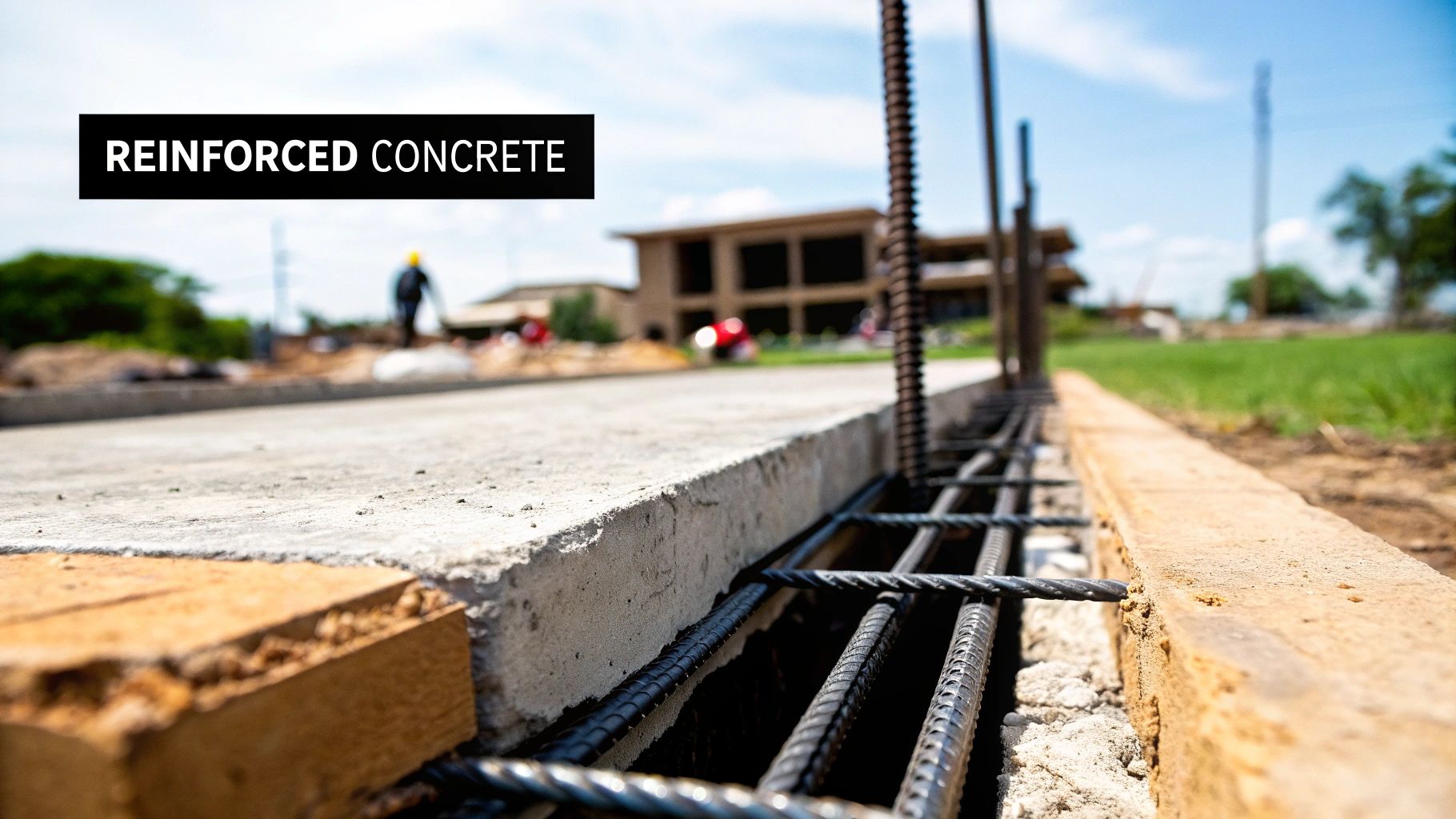
Here's a simple way to think about it. Imagine a ceramic coffee mug. You could probably stand on it without it breaking. That’s because it has fantastic compressive strength—it can handle being squeezed. But if you tried to bend or pull it apart, it would snap in a heartbeat. That’s poor tensile strength.
Plain, unreinforced concrete is exactly the same. It can withstand incredible compressive force, which is why it's great for things like foundation footings that just sit there and support weight. But the moment you introduce tension—from ground shifting, heavy loads, or even just temperature changes—it cracks. A real-world example is a simple, unreinforced concrete paver left on uneven ground. When you step on the unsupported edge, it will likely snap in half because it can't handle the bending force.
The Power of Partnership
This is where reinforcement steps in. We’re essentially creating a strategic partnership. Steel, for instance, has incredible tensile strength but using it alone for massive structures would be wildly expensive. Concrete is cheap and excels under compression.
By embedding steel inside the concrete, we get the best of both worlds. The concrete handles the squeezing forces, and the steel handles the pulling forces. For instance, in a bridge beam, the weight of cars pushes down, compressing the top of the beam and stretching the bottom. The concrete on top easily handles the compression, while the steel rebar embedded in the bottom half takes on the immense tension, preventing the beam from cracking and failing.
This combination creates a composite material that is strong under both compression and tension, forming the backbone of modern construction from residential driveways to towering skyscrapers.
The reinforcement is the unsung hero, grabbing onto the concrete and holding it together when forces try to pull it apart.
To put it simply, here’s a quick breakdown of how reinforcement changes the game for concrete.
Concrete's Strengths and Weaknesses at a Glance
| Property | Plain Concrete | Reinforced Concrete | Example |
|---|---|---|---|
| Compressive Strength | Excellent | Excellent | A concrete column easily supports a building's weight. |
| Tensile Strength | Very Poor | Excellent | A reinforced concrete beam can span a wide garage door opening without cracking. |
| Durability | Good | Excellent | A reinforced driveway withstands freeze-thaw cycles better than a plain slab. |
| Load Flexibility | Low (Brittle) | High (Ductile) | If overloaded, a reinforced slab will sag and crack slowly, giving warning. A plain slab would snap suddenly. |
| Crack Control | Poor | Very Good | Small shrinkage cracks in a reinforced patio stay hairline thin instead of widening. |
As you can see, adding that internal skeleton completely transforms concrete’s performance, making it far more versatile and reliable.
Key Roles of Concrete Reinforcement
Without this internal support, concrete would be relegated to simple, low-stress jobs. Reinforcement is what truly unlocks its potential.
- Boosts Durability: It's the number one defense against large, structural cracks that can compromise an entire slab or foundation, massively extending its service life. For example, reinforced concrete in a seaside retaining wall will better resist the constant pressure and moisture that would quickly degrade unreinforced concrete.
- Improves Load-Bearing Capacity: It allows concrete elements like beams, bridges, and suspended floors to safely bend and flex under heavy loads without catastrophic failure. A great example is a multi-story parking garage floor, which must support the weight of hundreds of cars—something impossible without a dense grid of rebar.
- Controls Cracking: All concrete cracks a little. Reinforcement helps ensure those cracks—whether from drying shrinkage or temperature swings—stay small and tightly controlled. Think of a long sidewalk; reinforcement helps keep the natural cracks at the control joints, preventing a spiderweb of cracks from forming across the panels.
The industry clearly recognizes these benefits. The global market for concrete fiber reinforcement alone was valued at USD 2.53 billion in 2024 and is expected to more than double to USD 5.58 billion by 2034. You can dig into more of the numbers on this growing market at Precedence Research.
Why Your Concrete Project Needs Reinforcement
Concrete is a tough material, no doubt. It’s fantastic at handling compression—basically, being squished. But it has an Achilles' heel: it's incredibly weak when it comes to tension, the force that pulls it apart.
Think about a heavy delivery truck pulling onto your driveway. That weight pushes down, causing the bottom of the concrete slab to stretch. Without anything to counteract that pulling force, the concrete will inevitably crack. It’s a fight it just can’t win on its own.
The Everyday Forces That Weaken Concrete
It’s not just the big, obvious loads that cause problems. A whole host of invisible, everyday forces are constantly working to tear your concrete apart from within. This is precisely why reinforcement isn't just a good idea; it's essential for any lasting concrete work.
- Ground Movement: Here in Atlanta, our clay soil is notorious for swelling and shrinking with moisture. This shifting ground creates uneven support under a slab or foundation, bending it and introducing powerful tensile stress. For example, after a heavy rain, the wet clay can heave one corner of a patio slab upwards, and without rebar to hold it together, that slab will crack.
- Thermal Expansion and Contraction: Concrete is always on the move. As the Georgia sun beats down and temperatures drop at night, it expands and shrinks. This constant cycle creates internal stress that eventually manifests as cracks. A long, unreinforced concrete ribbon curb is a classic example—you'll often see it cracked every few feet from this thermal stress.
- Freeze-Thaw Cycles: Water is concrete’s frenemy. It seeps into microscopic pores, and when it freezes, it expands with incredible force, slowly breaking the concrete apart from the inside out. Reinforcement helps hold the concrete mass together, resisting the spalling and scaling that this cycle can cause on surfaces like steps and sidewalks.
Without a steel skeleton to absorb these pulling and bending forces, concrete is left to fight a battle it was never designed to win. The result is always the same: cracking, shifting, and eventual structural failure. You can see how professionally reinforced concrete stands up to these challenges in some of our Atlanta-area projects.
Reinforcement is the safety net. It’s what holds the concrete together, distributing stress across the entire structure. It turns a brittle material into a resilient one, dramatically extending its lifespan and keeping it safe.
Beyond Just Preventing Cracks
The job of reinforcement goes way beyond just controlling a few cracks. It fundamentally changes how concrete performs, making your investment safer and more durable for the long haul. For example, in a basement wall, reinforcement doesn't just prevent cracks; it provides the strength to resist the immense lateral pressure from the surrounding soil, preventing the wall from bowing inward. You’re not just preventing cosmetic issues; you’re preventing catastrophic failure, boosting load-bearing capacity, and buying long-term peace of mind.
This need for durability is driving some big changes in the industry. For instance, the global market for concrete reinforcing fibers hit around $2.49 billion in 2024, and it's still growing as builders look for better ways to create stronger concrete. You can dig into the numbers in this concrete reinforcing fiber market analysis.
Ultimately, when you add reinforcement, you're not just pouring concrete—you're building a structure that’s meant to last.
Choosing the Right Type of Reinforcement
Think of it like a chef picking the right knife for the job. You wouldn't use a cleaver for delicate slicing, and you wouldn't rely on a paring knife to break down a side of beef. Selecting the right concrete reinforcement is just as critical for your project's long-term health. Each type—rebar, mesh, and fiber—offers a totally different mix of strength, flexibility, and crack control.
Making the right call here is the difference between a driveway that lasts for decades and one that's a cracked mess in a few years. Let's break down the three main players you'll see on any job site to understand where they fit in.
Steel Rebar: The Structural Powerhouse
When you picture concrete reinforcement, you're almost certainly thinking of steel rebar. It's the classic ribbed steel bar that forms the skeleton inside foundations, columns, and heavy-duty slabs. For pure structural muscle, rebar is the undisputed champ.
Its entire purpose is to take on the heavy lifting—specifically, the tensile loads that would otherwise snap brittle concrete in half. That ribbed texture isn't just for show; it's designed to create an unbreakable mechanical grip with the concrete, forcing the two materials to work as one. When a massive load pushes down on a beam, the rebar inside takes all the stretching force.
- Example Application: For a new home foundation in Marietta, you absolutely need an engineered grid of #4 or #5 rebar. It's the only thing with the backbone to support the house's weight while fighting back against the pressures from Atlanta's infamous expansive clay soil.
Welded Wire Mesh: The Crack Controller
Where rebar provides the brute strength, welded wire mesh is more of a finesse player focused on surface integrity. It’s a grid of thinner steel wires welded into flat sheets, making it much lighter and easier to handle than rebar. This is why you see it used so often for flatwork.
Don't mistake it for a structural element, though. Wire mesh isn't going to help your slab carry heavy loads. Its real job is to manage shrinkage and temperature cracking. As fresh concrete cures, it shrinks, and that process can create a roadmap of ugly cracks across the surface. Welded wire mesh acts like a net, holding the slab tightly together to keep those cracks from getting out of hand.
- Example Application: Pouring a new stamped concrete patio in Alpharetta? Welded wire mesh is the perfect fit. It helps ensure your beautiful, decorative surface stays that way, free of the large, distracting cracks that would ruin the whole look.
Fiber Reinforcement: The Micro Defender
The newest option on the block is fiber reinforcement. We're talking about millions of tiny, high-strength synthetic or steel fibers that get mixed right into the concrete at the plant. Imagine adding microscopic bits of rebar that get evenly distributed through every inch of the mix.
Fibers are fantastic at fighting cracks on a micro level, specifically the "plastic shrinkage cracks" that can pop up in the first few hours while the concrete is still setting. While some contractors use fibers as a replacement for wire mesh in certain slabs, they are absolutely not a substitute for the structural strength of rebar.
- Example Application: For a large commercial warehouse floor, adding synthetic fibers to the concrete mix helps minimize surface crazing and improves the floor's resistance to impact damage from dropped tools or materials, all without the labor of laying out wire mesh.
By distributing reinforcement evenly throughout the concrete matrix, fibers create a three-dimensional network of crack prevention, improving the overall toughness and impact resistance of the slab from the inside out.
Rebar vs Mesh vs Fiber Reinforcement Comparison
So, how do you choose? It all comes down to what your project demands. You have to balance the structural needs, the budget you're working with, and the final look you're going for. This table breaks down the essentials.
| Reinforcement Type | Primary Use | Pros | Cons | Typical Cost |
|---|---|---|---|---|
| Steel Rebar | Structural support for foundations, beams, columns, and heavy-duty slabs. | The absolute highest tensile strength. Perfect for any load-bearing job. | Heavy and labor-intensive to place correctly. Higher material cost. | $$$ |
| Welded Wire Mesh | Crack control for sidewalks, patios, and standard residential driveways. | Lightweight, cost-effective, and pretty easy to roll out and install. | Provides almost no real structural strength. Can be tricky to keep in the right position during the pour. | $$ |
| Fiber Reinforcement | Minimizing surface micro-cracks in slabs; improving impact resistance. | Mixes directly into the concrete, so it saves a ton of labor. Great for controlling those early-stage surface cracks. | Not a substitute for rebar in structural applications. Some types can affect the final surface finish. | $ |
Ultimately, each type of reinforcement has its place. The key is knowing what you're trying to achieve so you can pick the right tool for the task. For serious structural work, nothing beats rebar. For keeping your patio looking pristine, mesh or fibers are often the smarter, more economical choice.
How to Place Reinforcement for Maximum Strength
Choosing the right kind of reinforcement is a great start, but it's only half the battle. For that steel skeleton to do its job, you have to place it perfectly. Think of it like a bone in your arm—its strength comes from being correctly positioned inside, not just sitting on top of your skin.
Proper placement ensures the reinforcement is right where it needs to be to absorb the pulling and stretching forces that concrete just can't handle alone. If it’s too close to the top or buried at the bottom of the slab, its strength is completely wasted. Getting the placement right is non-negotiable for any concrete structure you want to last.
This visual guide shows the different reinforcement options you'll be working with.
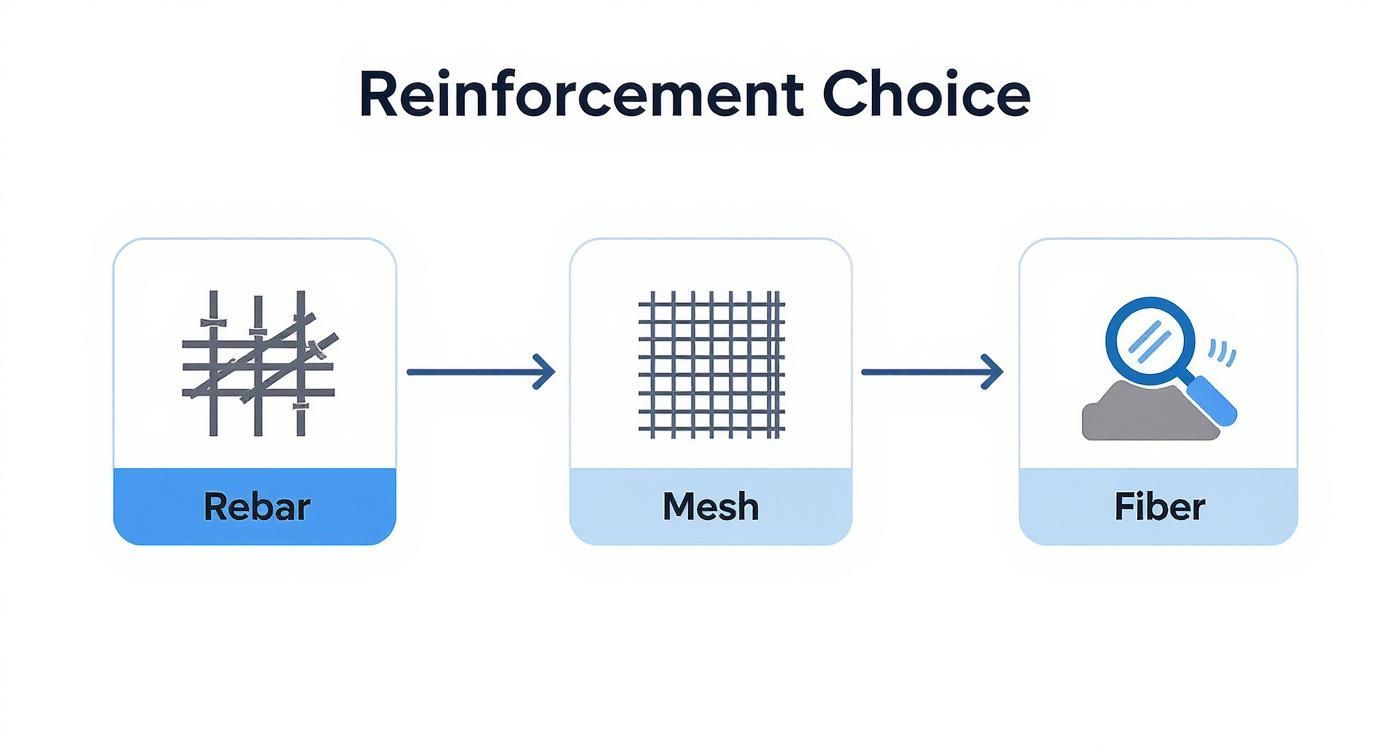
As you can see, the choice between rebar, mesh, and fiber really comes down to what the project needs to do and what kind of loads it will handle.
The Importance of Concrete Cover
One of the most critical concepts here is concrete cover. This is simply the amount of concrete between the steel reinforcement and the outside world. This layer is a shield, protecting the steel from moisture, salts, and air that lead to rust. For example, a driveway slab requires about 1.5 to 2 inches of cover to protect the rebar from water and de-icing salts.
And rust isn't just an ugly stain. It makes steel expand, sometimes with incredible force, cracking the surrounding concrete from the inside out and completely destroying its integrity. Without the right amount of cover, your reinforcement is on a countdown to failure.
The Middle Third Rule for Slabs
For slabs poured directly on the ground, like a driveway or a patio, we follow a golden rule: place the reinforcement in the upper middle third of the slab's thickness. Why there, specifically? When a heavy load—like your truck—presses down on the slab, the concrete wants to bend. The top gets squeezed together (compression) while the bottom gets stretched apart (tension).
By placing the reinforcement in that upper-middle sweet spot, you’re putting it exactly where those stretching forces are strongest. This is how it provides maximum strength and keeps cracks from spreading.
For a typical 4-inch thick driveway slab, this means the rebar or mesh should be positioned about 1.5 inches down from the surface.
This precise placement is a hallmark of any quality residential poured concrete job, making sure it stands up to years of daily use.
How to Achieve Correct Placement
I've seen it a hundred times: crews lay rebar or mesh on the ground and then try to pull it up into the wet concrete with a hook as they pour. This is a huge mistake. It’s a guessing game, and you’ll never get consistent placement.
Instead, pros use specific tools to do it right from the start.
- Chairs: These aren't for sitting. They're small plastic or metal supports that lift the rebar or mesh off the ground to the exact height needed before a single drop of concrete is poured. A common example is a "high chair" which looks like a small plastic stool that the rebar rests on.
- Ties: At every intersection in a rebar grid, you'll see workers fastening the bars together with wire ties using a special tool called a tie wire twister. This keeps the grid from shifting or collapsing as heavy concrete flows around it during the pour.
Using these simple tools is the only way to guarantee your reinforcement ends up exactly where it needs to be to do its job. No guesswork, just strength.
Putting Reinforcement to Work: Real-World Scenarios
Knowing the what and why of concrete reinforcement is great, but the real test is applying it correctly on the job site. The rebar grid that’s perfect for a foundation would be overkill for a simple patio, and the mesh you’d use for a sidewalk would fail spectacularly under the weight of an SUV.
Let's walk through the right reinforcement strategy for three of the most common concrete projects. Getting this right is what makes the difference between a project that lasts for decades and one that fails in a few years.
For a Residential Driveway
Your driveway has a tough job. It needs to handle thousands of pounds focused on four small tire patches, day in and day out. It also has to battle the ground itself, especially with the shifting clay soils we see all over the Atlanta area. This is a job that demands serious structural muscle.
For most residential driveways around here, a grid of #3 or #4 rebar is the only way to go. This steel skeleton gives the concrete the backbone it needs to resist bending under heavy loads and prevents the kind of ugly, structural cracks that soil movement can cause.
- Recommendation: A rebar grid with 18- to 24-inch spacing is standard. Make sure it's propped up on "chairs" so it sits in the upper-middle third of the slab, not on the ground.
- Why it Works: Rebar acts like a powerful internal frame, spreading the immense weight of a vehicle across the whole slab. Without it, the concrete would flex, bend, and eventually break.
For a Concrete Patio or Sidewalk
Patios and sidewalks live a much easier life. They don't have to support cars, so their main challenge is cosmetic. The biggest culprits are the tiny surface cracks that appear as the concrete shrinks while it cures or expands and contracts with the seasons. The goal here isn't brute strength—it's all about maintaining a clean, unblemished surface.
This is the perfect scenario for welded wire mesh. It's an affordable and effective way to hold the slab together. While it won't stop tiny shrinkage cracks from happening (nothing can), it will keep them tight and almost invisible, preserving the look of your finish.
- Recommendation: Use 6×6 W1.4/W1.4 welded wire mesh. Just like rebar, it must be supported on chairs to keep it in the middle of the slab when you pour the concrete.
- Why it Works: The mesh creates a tight net throughout the concrete, providing uniform control over surface cracking without the cost and labor of a full rebar installation.
For a Structural Foundation
When we talk about a building’s foundation, compromise is not an option. This is the single most important part of the entire structure, tasked with transferring the weight of the whole house safely into the ground. The reinforcement strategy isn't a suggestion; it's a non-negotiable, engineered plan.
Your foundation must have a rebar system designed by a structural engineer. The plans will dictate the precise size, grade, spacing, and placement of every single bar to meet building codes and support the unique loads of your home.
For instance, a typical foundation footing might call for two continuous runs of #4 rebar, while the foundation wall itself will require a grid of vertical and horizontal #4 bars spaced 16 inches apart.
This is where you absolutely need a pro. Here in the Atlanta region, our specific soil conditions and building codes demand expert knowledge. For a deeper dive into what's involved, check out our guide on residential foundation concrete services. Trying to cut corners with a foundation's rebar cage is a recipe for catastrophic failure.
Common Reinforcement Mistakes and How to Avoid Them

You can pick the perfect rebar or mesh for the job, but if it’s not installed right, you've basically wasted your money. I’ve seen it time and time again—small, preventable mistakes made during the pour that completely undermine the concrete’s strength, leading to massive headaches and expensive repairs later on.
The good news is that these common slip-ups are actually pretty easy to dodge once you know what to look for.
Improper Placement and Cover
Hands down, the most common mistake I see is reinforcement sitting in the wrong spot. Too often, a crew will just lay the rebar or mesh right on the ground and pour the concrete over it. This is a huge mistake.
When reinforcement sits at the bottom, it's not doing anything to resist the tensile forces that cause cracking, which mostly occur in the upper part of the slab. It also means there’s not enough concrete cover—that crucial layer of concrete that protects the steel from moisture and rust. A classic example of this failure is seeing rusty rebar patterns bleeding through a cracked and spalling bridge deck.
A lack of proper concrete cover is the number one cause of premature reinforcement corrosion, which can crack the concrete from the inside out and destroy its structural integrity.
The fix is incredibly simple: use rebar "chairs" or "dobie blocks." These little supports lift the steel off the ground, holding it at the perfect height within the slab while the concrete is poured around it. This single step ensures your reinforcement is exactly where it needs to be to work effectively.
Other Classic Blunders
Beyond placement, a few other missteps can sabotage an otherwise solid project.
-
Wrong Reinforcement Type: You can't use lightweight wire mesh in a heavy-duty driveway that's going to see truck traffic. That’s a job for structural rebar, and mixing them up is asking for trouble. An example is a driveway that looks fine for a few years but develops deep, wide cracks after a heavy moving van parks on it.
-
Incorrect Spacing: Spreading your rebar grid too far apart creates weak zones. Instead of distributing the load evenly, you end up concentrating stress in the gaps, which leads to cracks. For instance, if plans call for 18-inch spacing and the crew stretches it to 24 inches to save rebar, you create unsupported panels within the slab.
-
Inadequate Overlap: When you’re tying multiple sections of rebar or mesh together, you have to overlap them correctly. If you don't, you break the continuous tension grid you’re trying to build, leaving the slab vulnerable. A proper overlap for #4 rebar, for example, is typically around 18 inches to ensure forces can be transferred from one bar to the next.
Avoiding these basic errors is what separates a professional job from a costly failure. Get these details right, and your reinforcement will deliver the strength and longevity you expect.
Your Questions About Concrete Reinforcement Answered
Even with a good grasp of the basics, you probably still have some practical questions about how this all works in the real world. Let's tackle a few of the most common ones we hear from homeowners and project managers around Atlanta. The goal here is to clear up any lingering confusion so you can move forward with confidence.
Can I Use Both Rebar and Fiber Reinforcement Together?
Absolutely. In fact, combining them is often a fantastic strategy for getting the best of both worlds. Using rebar and fibers together creates a hybrid system that covers all your bases.
Think of it this way: the rebar grid provides the heavy-duty structural muscle, handling the big tensile loads and keeping the slab from snapping under pressure. At the same time, the fibers are busy working on a smaller scale, distributing throughout the entire concrete mix to fight off those pesky little surface cracks that pop up during curing. It’s like having defenders on both the macro (structural) and micro (cosmetic) level—perfect for projects where you need a flawless, super-durable finish, like a high-end polished concrete floor in a commercial space.
How Much Does Reinforcement Add to a Project's Cost?
The cost can swing pretty widely depending on what you're using. For a standard patio slab, adding a simple welded wire mesh or a standard dose of synthetic fibers might bump up your material cost by 15-25%. For a 10×10 foot patio, this might only be an extra $50-$75.
But if you're talking about a heavy-duty rebar grid for a load-bearing foundation, that's a much more significant slice of the budget. It could easily add 30-50% or more to the material cost alone. On a full basement foundation, this could translate to several thousand dollars in materials and labor.
Don't look at it as an extra expense—it's a critical investment. The money you'd spend to repair or completely replace a failed concrete slab is astronomically higher than the upfront cost of reinforcing it correctly the first time.
Is Reinforcement Necessary for a Small Patio?
You know, a tiny, non-structural concrete pad, like one for an AC unit, might get by without it, but reinforcement is almost always the right call. Even something as simple as a sidewalk has to fight against tree roots, ground shifting from our Georgia clay, and the relentless freeze-thaw cycles we get in the winter.
A basic sheet of welded wire mesh is an incredibly cheap insurance policy against these exact problems. It dramatically extends the life of the concrete and keeps it looking good by preventing cracks and heaving. As soon as that slab needs to support any weight—even just patio furniture and a grill—reinforcement becomes non-negotiable if you want to avoid long-term damage.
When Should I Hire a Professional?
For any project involving structural loads, you need a pro. Full stop. This includes home foundations, retaining walls, suspended slabs, or any concrete element that requires an engineer's stamp to meet local building codes and, most importantly, to be safe. For example, building a retaining wall over 4 feet tall almost always requires an engineered design and professional installation to prevent a dangerous collapse.
For other projects like driveways or large patios, hiring a professional is still a very good idea if you aren't completely comfortable with sub-base preparation, proper rebar placement, and concrete finishing. An experienced local contractor knows how to prep the ground for Atlanta's specific soil conditions—a make-or-break step that ensures your reinforced slab will be there for decades to come.
Whether your project is big or small, getting the reinforcement strategy right is the key to a long-lasting, durable result. If you want to ensure your next project is built to the highest standards, the team at Atlanta Concrete Solutions has the expertise to get it done right. We handle everything from residential driveways to commercial foundations with precision and professionalism. Contact us today for a free, no-obligation quote by visiting our website at https://atlantaconcretesolutions.com.