
If you've ever tripped on an uneven sidewalk or watched rainwater pool against your foundation because of a sunken patio, you've seen the problem mudjacking was designed to solve. It's a classic, time-tested method for lifting and leveling settled concrete slabs by pumping a special slurry mixture underneath them. For example, if one corner of your driveway has dropped two inches, mudjacking can lift just that corner back into perfect alignment with the rest of the slab and your garage floor.
Think of it as giving your concrete a solid foundation again, filling in the empty spaces left behind by soil erosion or compaction. It’s a smart repair that fixes the problem from the ground up, all without the massive headache and cost of tearing everything out and starting over.
What Is Mudjacking Concrete Explained
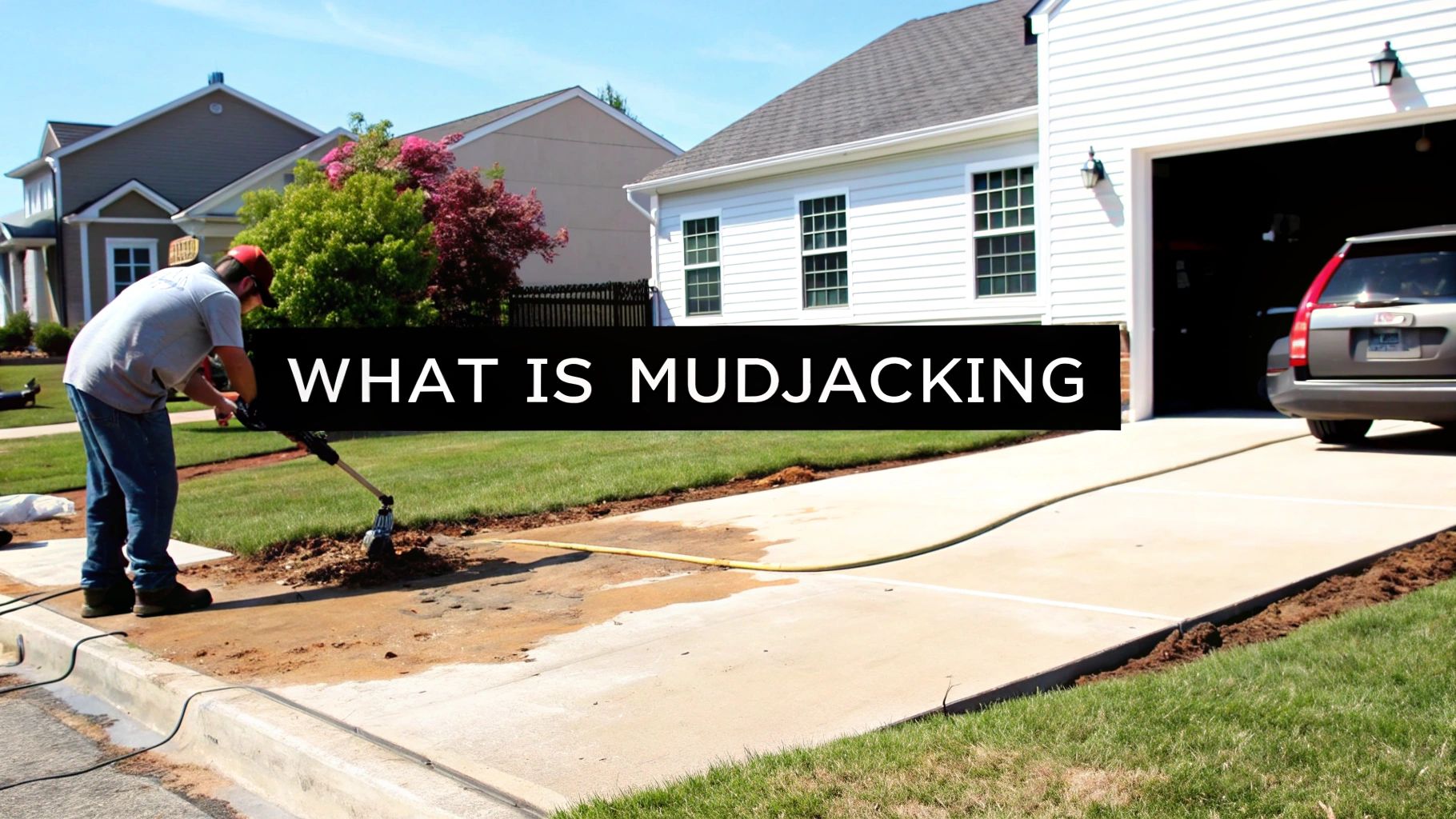
Let's use a simple analogy. Imagine the ground beneath your driveway is like a mattress that has lost some of its stuffing. The concrete slab on top will naturally sag into those hollow spots. Mudjacking is the process of carefully injecting new "stuffing"—a dense, engineered slurry—to plump it back up, pushing the concrete slab back to its original, level position.
This technique gets right to the heart of the issue: lost support. By filling those voids, mudjacking creates a stable new base for your concrete, which stops it from sinking any further and brings back the safety and curb appeal of your property. For instance, a sunken concrete step can be a serious tripping hazard; mudjacking restores it to the proper height, making your entryway safe again.
The Anatomy of The 'Mud'
The name "mudjacking" is a bit of an oversimplification. We're not just pumping mud under there. The slurry is actually a precisely blended compound engineered for incredible strength and stability.
This special mix usually contains:
- A base material: Think topsoil, sand, or crushed limestone. This provides the bulk and compressive strength needed to support heavy concrete. For example, a heavy-duty driveway slab supporting a large truck might require a slurry with a higher percentage of crushed aggregate for maximum load-bearing capacity.
- A binding agent: We mix in Portland cement, which acts like glue, ensuring the slurry hardens into a rock-solid, permanent base that resists future erosion.
- Water: Just enough is added to make the mixture flowable, so it can be pumped smoothly through small holes into the voids below. The consistency is often compared to a thick pancake batter, allowing it to spread evenly without being too watery.
An experienced crew will tweak this recipe on-site, adjusting the ratios based on the local soil conditions and the weight of the slab they need to lift. It’s part science, part art.
To give you a quick, scannable overview of what mudjacking is all about, here are its key characteristics in a nutshell.
Mudjacking At A Glance Key Characteristics
| Aspect | Description |
|---|---|
| Purpose | Lifts and levels sunken or settled concrete slabs. |
| Method | Injects a slurry of cement, soil, and water beneath the slab. |
| Material | A durable, soil-cement grout that hardens to form a new base. |
| Hole Size | Requires drilling holes 1 to 2 inches in diameter. |
| Applications | Ideal for driveways, sidewalks, patios, pool decks, and garage floors. |
| Primary Benefit | A cost-effective alternative to full concrete replacement. |
This table helps illustrate how mudjacking provides a targeted and efficient solution for common concrete problems.
At its core, mudjacking is about hydraulic pressure. The slurry is pumped with enough force to gently and precisely lift tons of concrete, leveling it with remarkable accuracy. This isn't a brute force method; it's a controlled lift.
A Foundational Fix Not A Patch Job
It’s really important to see mudjacking for what it is: a structural repair, not a cosmetic patch. While a temporary fix like a self-leveling compound might just cover a crack, mudjacking restores the actual foundation supporting your concrete slab. By stabilizing the soil underneath, it delivers a lasting solution.
In fact, the process is so effective at restoring stability that it's often a critical step in broader house leveling services.
Take a sunken driveway section, for instance. That jarring bump you hit every day isn't just annoying; it's a hazard that channels water where it shouldn't go. Mudjacking lifts that section perfectly back in line, eliminating the trip hazard and preventing water from seeping underneath, which could cause even more expensive damage down the road.
From Industrial Fix To Modern Home Solution
The technique we now call mudjacking didn't start with patios and driveways. Its story actually begins over a century ago, born from the heavy-duty needs of America's expanding infrastructure. Long before it was fixing residential properties, it was the essential solution for keeping our nation's railways and highways from sinking.
This isn't some new fad. Mudjacking is a foundational repair method with a long, proven track record. Understanding where it came from helps explain why it’s still one of the most reliable ways to fix settled concrete. Its journey from massive industrial projects to your front steps is a true story of engineering and ingenuity.
A Solution Born From Necessity
In the early days of American construction, a sinking concrete slab was a huge problem. If a railroad bed settled or a highway section dropped, the only fix was to tear it all out and start over. As you can imagine, that was an incredibly expensive, disruptive, and time-consuming ordeal. The industry desperately needed a better way.
The breakthrough came right around the turn of the 20th century. By 1900, mudjacking was becoming a standardized method for concrete repair, a pivotal moment for construction. The technique was pioneered by John W. Poulter, a sharp mechanic with the Iowa State Highway Commission. He developed a device that used hydraulic pressure to pump a simple mixture of dirt, water, and cement through holes drilled into the concrete. A classic example of its early use would be leveling a section of U.S. Route 30 that had sunk due to poor soil compaction beneath it.
This was a game-changer. For the first time, engineers could lift and realign massive concrete sections without demolishing them. It was a brilliantly practical solution that saved an enormous amount of time and money, and it quickly became the standard for maintaining public infrastructure.
From Highways To Your Home
For decades, mudjacking was strictly a big-league player, used almost exclusively in the industrial and commercial worlds. The equipment was massive, and the process was designed for huge jobs like airport runways and sprawling warehouse floors. It just wasn't practical for a homeowner with a sunken sidewalk.
But things change. As technology evolved through the mid-20th century, the tools got better. Pumping systems became more compact and precise, and the slurry mixtures were fine-tuned for all sorts of different jobs. These advancements were key to making the process more accessible.
The core principle has remained the same for over 100 years: use hydraulic pressure to lift a concrete slab from below. The evolution has been in making this powerful technique more controlled, efficient, and affordable for everyone.
By the second half of the century, contractors realized they could scale this industrial-strength solution for residential work. Homeowners could finally take advantage of the same reliable technology that kept highways level, but at a size and cost that made sense for their own homes. This history is why a service like commercial concrete and masonry repair has such deep roots. The same proven principles that fix a huge commercial lot can be applied with precision to your pool deck or garage floor.
How The Mudjacking Process Really Works
Knowing what mudjacking is in theory is one thing, but seeing it happen on your property gives you a whole new level of confidence. It’s not the messy, unpredictable job some people imagine. Instead, professional mudjacking is a surprisingly precise and controlled procedure designed to get your concrete back where it belongs with minimal fuss.
Let’s walk through what you can actually expect when a crew shows up. It’s a lot more than just pumping some mud under a slab—it’s a calculated repair from start to finish.
Assessing The Slab And Drilling Injection Holes
The first thing we do is take a good, hard look at the problem. A technician will inspect the sunken slab, figure out why it settled in the first place, and map out the best way to lift it. This involves deciding exactly where to drill the injection holes, which are typically only 1 to 2 inches in diameter.
The placement of these holes is everything. If we're lifting a sunken driveway panel, for instance, we won't just drill a hole in the middle. We'll strategically place them near the edges and corners to spread the lifting pressure evenly. For a standard 10×10 foot slab, this might mean drilling 3 to 5 holes in a specific pattern. It’s like using several car jacks to lift a heavy vehicle—you need balanced support for a smooth, controlled rise.
Mixing The Perfect Slurry Consistency
While the drilling is underway, another crew member is mixing the slurry. This isn't just a bag of concrete mix from the hardware store; it’s a custom blend. We actually adjust the consistency on-site based on the weight of your slab and the type of soil we're dealing with.
A heavy garage floor needs a thicker, denser slurry to generate enough force to lift it. On the other hand, filling a small void under a sidewalk might call for a slightly runnier mix to ensure it flows into every last gap. This tailored approach guarantees the new base under your slab is both rock-solid and completely supportive.
This infographic shows how mudjacking evolved from a heavy industrial solution into the refined process it is today.
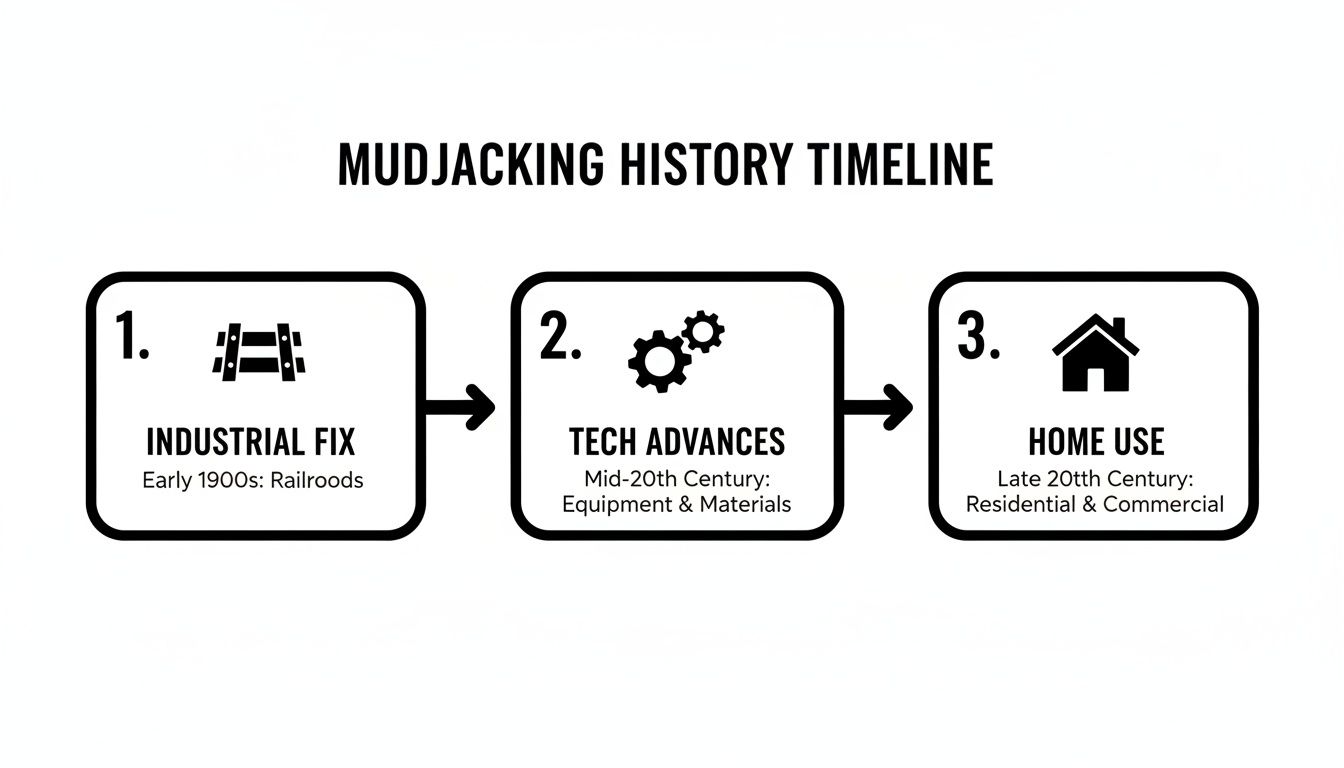
The timeline highlights the key technological shifts that made the modern, precise mudjacking process possible for residential projects.
The Careful Pumping And Lifting Phase
Now for the main event. A hydraulic pump pushes the slurry through a heavy-duty hose and into the holes we drilled. This is a slow, methodical process, not a sudden jolt. Our technicians are watching the slab’s movement like hawks, often measuring the lift in fractions of an inch.
They communicate constantly, managing the pressure and watching for the slab’s response. If one side starts rising faster than the other, they’ll pause and switch to a different injection point to even things out. For example, the technician might call out "Lifting a quarter inch on the left!" to the pump operator, who then adjusts the flow accordingly. This constant adjustment is crucial for preventing an over-lift, which would just create a new problem.
The goal is controlled elevation. We are essentially floating the concrete slab up on a bed of pressurized slurry, guiding it gently back to its original height with expert precision. It's a testament to how a simple concept can yield powerful results.
The equipment and materials used here have come a long way. As you can read in this piece on the evolution of mudjacking techniques on accountablemudjackingkc.com, the mid-20th century saw major improvements. Better pumping systems made the process faster and more reliable, while the slurry itself evolved from basic local dirt to superior materials like bentonite clay, fly ash, and cement for better performance.
Patching Holes For A Clean Finish
Once the slab is level and stable, we’re on to the finishing touches. The small injection holes are filled with a concrete patch that we smooth out to blend with the surrounding surface.
Our team takes pride in matching the color and texture as closely as possible, so the repair points are barely noticeable. We then clean up the entire work area, leaving you with nothing but a safe, level slab that’s ready to use almost immediately. You can typically walk on it within a few hours and drive on it in 24 to 48 hours.
Is Mudjacking The Right Choice For You?
So, how do you know if that sinking concrete slab is a job for mudjacking? Figuring this out early can save you a ton of time, money, and hassle down the road. There are a few tell-tale signs that the ground beneath your concrete has washed out or compacted, leaving your slab without the support it needs.
Learning to spot these common headaches will help you figure out what’s going on with your property and when it's time to call in a pro. Think of this section as your field guide for connecting everyday concrete problems to the right fix.
Identifying Ideal Scenarios For Mudjacking
Not every crack or uneven spot is a candidate for mudjacking, but certain types of settlement are a perfect match for it. The best way to know is to just look at how the concrete has moved.
Here are a few classic examples we see all the time:
- The Garage "Thump": Do you feel a jarring bump every time you pull into your garage? That’s usually a sign the garage floor slab right at the entrance has sunk, creating an annoying and potentially damaging lip. Mudjacking can lift it right back up, making it perfectly flush with your driveway again.
- The Sloping Patio: A patio that now tilts toward your house isn't just ugly; it's a major drainage problem. That slope sends rainwater straight to your foundation, which is a recipe for leaks and water damage. Mudjacking re-levels the entire patio to make sure water flows away from your home, just like it's supposed to.
- The Sidewalk Trip Hazard: We've all tripped on one—that single sidewalk panel that's dropped a half-inch lower than the one next to it. It's more than an inconvenience; it's a real safety risk. Mudjacking can lift that sunken section with precision, getting rid of the trip hazard and creating a safe, even surface.
See the common thread here? In each case, the concrete slab itself is still in good shape—it hasn't crumbled or broken into a million pieces. It has simply sunk because of issues with the soil underneath. As long as the slab is structurally sound, it can almost always be lifted back into place.
When you see a stable slab that has dropped or tilted, think of it as a patient with a strong bone structure that's just out of alignment. Mudjacking is the non-invasive procedure that gently sets it right without needing major surgery.
Democratizing Concrete Repair For Homeowners
Mudjacking used to be a massive industrial process, but key innovations brought it to the residential market. The 1980s were a big turning point, largely thanks to Grover Miller, a founder of A-1 Concrete Leveling. He was instrumental in making the technology affordable for homeowners.
Before his work, mudjacking required huge, clunky equipment that just wasn't practical for smaller jobs. Miller developed a more portable pumping system and a cleaner crushed limestone mixture that completely opened up the market. You can learn more about how these changes shaped the industry and helped Atlanta-area residents affordably fix their concrete on a1concrete.com.
That shift made it possible for everyday homeowners to get the same reliable repairs once reserved for highways and giant industrial floors. Today, specialized residential concrete and masonry repair services are a direct result of decades of refinement, turning a heavy-duty fix into a precise, accessible home improvement solution.
Mudjacking, Polyfoam, And Replacement: How Do They Stack Up?
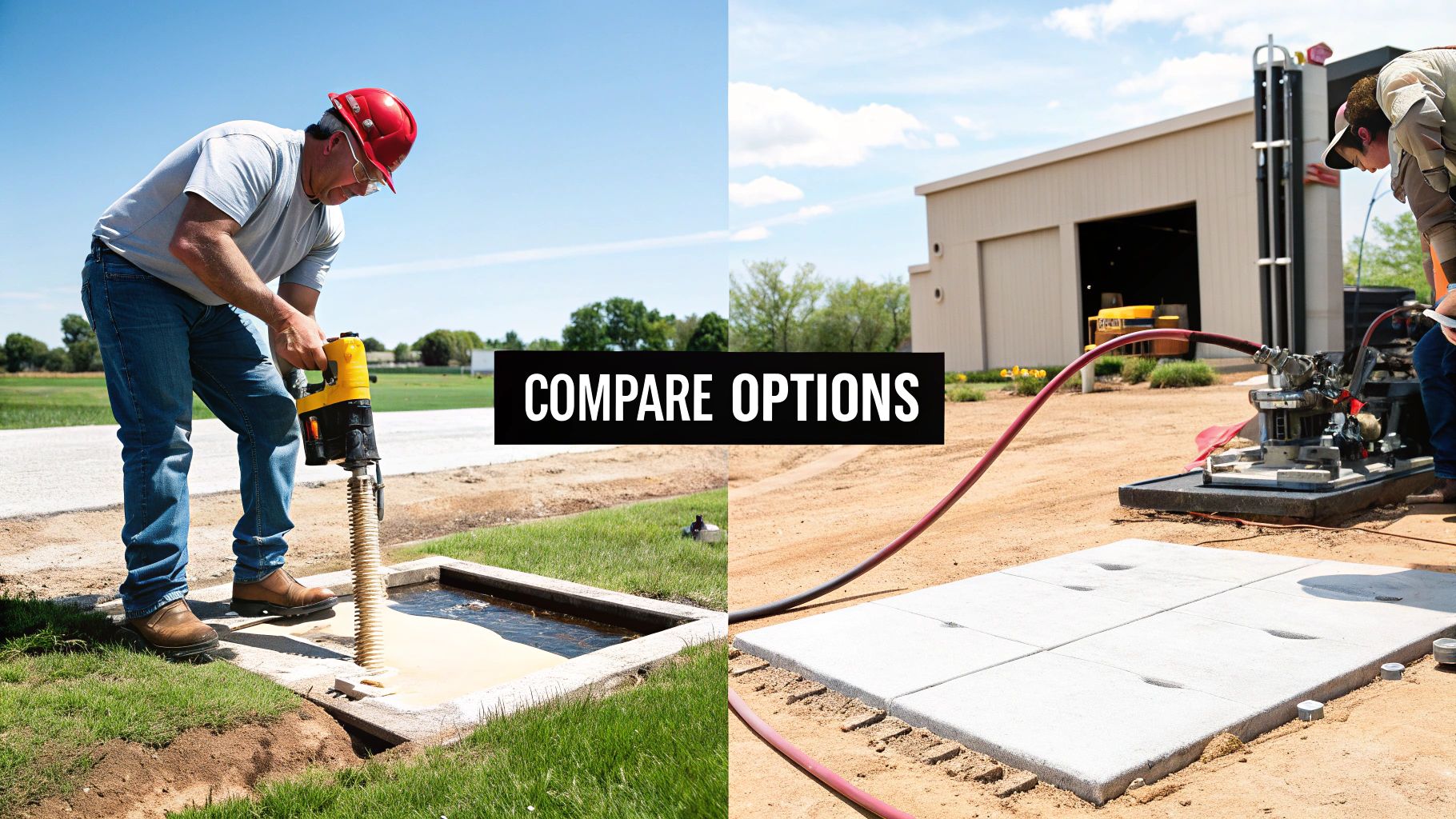
Knowing what mudjacking is gets you halfway there, but the real power comes from seeing how it compares to the other options on the table. When a slab of concrete sinks—whether it's your driveway, patio, or walkway—you're typically facing three choices: mudjacking, polyurethane foam injection (often called "poly-jacking"), or a full-blown tear-out and replacement.
Each approach has its own set of pros and cons. The right decision really hinges on your budget, how quickly you need the area back in service, and the actual condition of your concrete. Let's walk through how they compare side-by-side.
Cost-Effectiveness And Overall Value
For most homeowners, the first question is always about the bottom line. And when it comes to cost, mudjacking is almost always the winner. It's the most budget-friendly repair by a long shot.
Typically, you can expect mudjacking to cost about one-third to one-half the price of completely replacing the same concrete slab. For example, replacing a 10×10 foot section of patio might cost $1,500, whereas mudjacking the same section could be around $500 to $750. That makes it an incredible value, fixing the problem without draining your bank account.
Polyurethane foam is a fantastic technology, but it does come with a higher price tag. The chemical compounds are simply more expensive to produce than the natural cement-slurry mix used in mudjacking. While not as pricey as a full replacement, the cost is noticeably higher than mudjacking.
And then there's a full replacement. This is, without a doubt, the most expensive route. You're not just paying for new concrete; you're paying for demolition, hauling away the old material, preparing the ground, and then the labor and materials for the new pour. It’s a huge undertaking and is usually only considered a last resort.
Invasiveness And The Finished Look
How much of a mess is this going to make? This is a big deal, and the difference between the methods comes down to the size of the holes they leave behind.
- Mudjacking: We drill holes that are roughly 1 to 2 inches in diameter to pump the slurry underneath. Afterward, we patch them with concrete, but they are larger than what's needed for poly-jacking.
- Poly-jacking: This method uses much smaller injection ports, usually around 5/8 of an inch. That’s about the size of a dime. The patched holes are far less noticeable, which is a big plus for decorative or highly visible surfaces.
- Replacement: This is the definition of invasive. Think jackhammers, heavy equipment, and a whole lot of noise and dust. It completely disrupts your yard and your daily routine.
So, if you have a beautiful stamped concrete patio that has sunk, the near-invisible repair from poly-jacking might be worth the extra cost. But for a standard driveway or sidewalk, the slightly larger patches from mudjacking are a perfectly reasonable trade-off for the significant savings.
Downtime And Getting Your Space Back
How long until you can use your driveway again? Here, both mudjacking and poly-jacking are remarkably fast.
With a mudjacking repair, the job is usually done in just a few hours. You can walk on the surface almost right away, and you can drive on it within 24 to 48 hours.
Poly-jacking is even quicker. The foam cures to about 90% strength in as little as 30 minutes. In most cases, you can drive your car onto the slab the very same day.
A full replacement is a completely different story. It’s a multi-day process, and the new concrete needs a long time to cure properly—up to 28 days before it can handle the weight of a vehicle. For most people, losing their driveway for a month is a major hassle.
Durability And Making The Right Call
All three methods are durable and can last for years when done right. The hardened mudjacking slurry provides a solid, rock-like foundation. Polyurethane foam is incredibly strong, waterproof, and won't wash away, which helps prevent future erosion.
The real deciding factor is the health of your existing concrete slab.
No lifting method, whether it’s mudjacking or poly-jacking, can fix concrete that is fundamentally broken. If the slab is severely cracked, crumbling, or shattered into pieces, lifting it is just putting a band-aid on a bigger problem.
In those cases where the concrete has lost its structural integrity, a full replacement is the only sensible option. You have to start fresh.
Choosing Your Concrete Solution A Comparison
To make it even clearer, this table directly compares the three main approaches to sunken concrete, giving you a clear framework for deciding which method best fits your needs.
| Feature | Mudjacking | Polyurethane Foam (Poly-Jacking) | Full Concrete Replacement |
|---|---|---|---|
| Typical Cost | Low (often 50% less than replacement) | Medium (higher than mudjacking) | High (most expensive option) |
| Invasiveness | Low (1-2 inch holes) | Very Low (5/8 inch holes) | Very High (full demolition) |
| Repair Time | Fast (use in 24-48 hours) | Very Fast (use same day) | Slow (up to 28-day cure) |
| Best For | Budget-conscious repairs on structurally sound slabs. | Visually sensitive areas or when speed is critical. | Severely cracked, crumbling, or spalled concrete. |
By weighing these key factors, you can see where each method truly shines. For the vast majority of residential projects with structurally sound concrete, mudjacking offers an unbeatable mix of performance and affordability. It's a proven solution for restoring safety and value to your property without breaking the bank.
Choosing Your Atlanta Mudjacking Partner
Alright, you understand what mudjacking is and how it can solve your sunken concrete problems. That’s the first hurdle. But the single most important decision you'll make is choosing the right team for the job. This is where theory becomes reality, and a good choice protects your investment and brings your property back to life.
An expert crew brings more than just a pump and a hose; they bring years of on-the-ground experience with local conditions.
Selecting a partner isn't just about grabbing the cheapest quote. Here in the Atlanta area, we deal with everything from stubborn, dense red clay to looser, granular soils. A seasoned pro knows this. They know how to mix the perfect slurry for our specific ground conditions and exactly how much pressure to apply for a lift that’s not just level, but will actually last. For example, they know that lifting a slab on sandy soil requires a thicker slurry mix to prevent it from simply seeping away.
What To Look For In A Service Provider
So, how do you spot a true professional? A reputable contractor is transparent, has a proven track record right here in your community, and isn't afraid to stand by their work. Before you sign anything, do a little digging.
Here are a few non-negotiables that separate the real experts from the rest:
- A Portfolio of Local Work: Ask to see their work. They should be proud to show you examples of driveways, patios, or pool decks they’ve leveled right here in the Atlanta area.
- Clear, Detailed Quotes: Your estimate should be straightforward, breaking down every cost. No surprises, no hidden fees. You need to know exactly what you’re paying for.
- Solid Customer Reviews: Check out what past customers are saying on places like Google. You're looking for consistent feedback about their reliability, communication, and the quality of the final product.
- Guarantees and Warranties: This is a big one. A confident contractor will offer a clear warranty on their work, giving you protection in case the concrete settles again down the road.
Choosing a contractor is a lot like choosing a mechanic for a classic car. You don't want the cheapest guy; you want the specialist who knows the machine inside and out and guarantees their repairs. It's all about peace of mind.
Ultimately, the right partner makes the entire process feel effortless. They should treat your property with respect, from the initial inspection to the final cleanup, keeping you in the loop the entire time.
When you're ready to fix that sunken slab for good, our team at Atlanta Concrete Solutions is here to help. Take a look at our full range of concrete leveling and repair services to see how we can restore the safety and curb appeal of your property with professional care.
Got Questions? We've Got Answers.
Alright, so you understand the basics of mudjacking, but what does it really look like when the crew shows up at your house? It's completely normal to wonder about the practical side of things—how long it takes, how long it lasts, and whether it’ll make a huge mess.
Let's walk through some of the most common questions we hear from homeowners.
The biggest one is usually about downtime. No one wants their driveway or patio to be a "no-go" zone for weeks. The great news? Mudjacking is surprisingly quick.
For most projects like walkways or pool decks, you can walk on the repaired surface within just a few hours. Need to park your car? We typically advise waiting 24 to 48 hours for a driveway, which is a massive improvement over the days or weeks you'd wait for new concrete to cure.
How Long Does a Mudjacking Repair Actually Last?
This is the million-dollar question: Is this just a temporary patch? Absolutely not. When done right by a seasoned crew—and assuming the original cause of the sinking (like a leaky downspout) is fixed—a mudjacking repair is built to last.
The slurry we inject isn't just mud; it's a specialized grout that hardens into a rock-solid, stable base. For most situations, the repair will easily last for the remaining life of the concrete slab itself, often 5 to 10 years or more. It's a true foundational fix, not a band-aid.
Think of it like putting a new, solid foundation under a slightly wobbly table leg. Once it's propped up and secured, it's as strong and stable as the rest of the table, ready for years of use.
Will Mudjacking Make a Mess of My Yard?
We get it. The thought of concrete slurry and heavy equipment can bring up images of a messy construction site. But a professional team knows that keeping your property clean is part of the job.
Our heavy equipment, like the pump and mixer, stays on the street. We then run hoses carefully to the work area, taking care to protect your lawn, flowerbeds, and landscaping from any spillage. For example, we might lay down tarps along the path of the hose to protect your grass.
Once the slab is lifted and the small injection holes are patched, we do a full cleanup. Our goal is to leave you with nothing but perfectly level, ready-to-use concrete.
Ready to fix your sunken concrete with a proven, cost-effective solution? The team at Atlanta Concrete Solutions has the local expertise to restore your driveway, patio, or sidewalk safely and efficiently. Get your free, no-obligation quote by visiting us at https://atlantaconcretesolutions.com.