
Figuring out how many yards of concrete you need is the first real step in any project, whether it's a small weekend job like setting a new mailbox post or a major commercial pour for a building foundation. That number, the cubic yard (a cube measuring 3 feet x 3 feet x 3 feet, or 27 cubic feet), is the universal unit for ordering ready-mix concrete. Nailing this calculation from the get-go is the secret to a smooth, successful pour.
Why Getting Your Concrete Estimate Right is So Important
Getting your concrete math right is the foundation of a good project. I can't stress this enough. Whether you're a homeowner in Alpharetta planning a new patio or a contractor pouring footings in Marietta, precision is everything. It’s a common mistake to think "close enough" is good enough, but even small errors in your measurements can snowball into big problems.
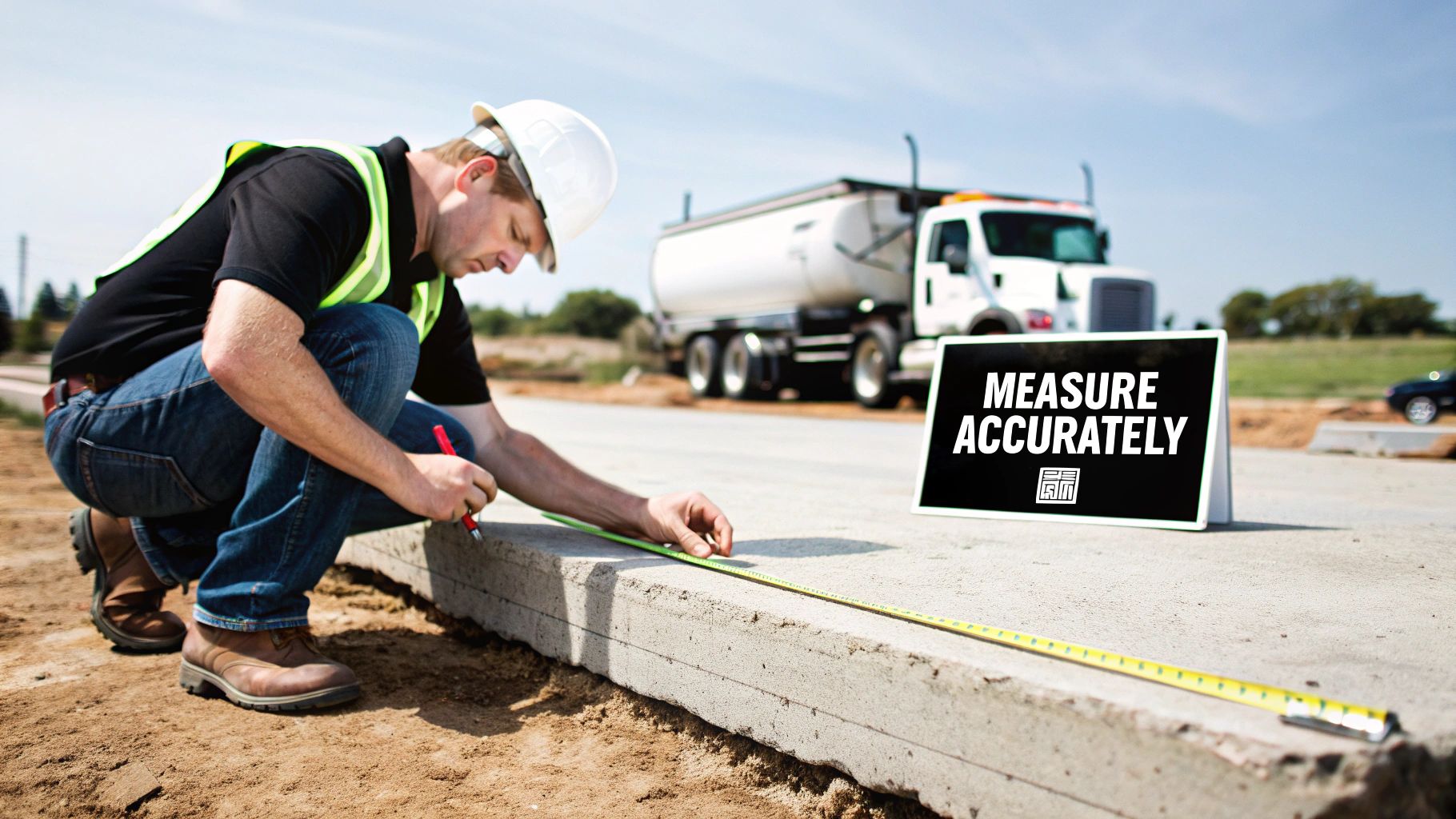
Ordering too little concrete is pretty much the worst-case scenario on pour day. A short load means a panicked, expensive call to the plant for another truck, which causes major delays. For example, if you need 5 yards but only order 4.5, you'll be scrambling to get a "short load" delivery, which often comes with a hefty fee and can take hours to arrive. Even worse, it creates a "cold joint"—a weak spot where the old, partially-cured concrete meets the new pour. This seam is a prime spot for future cracks and can seriously compromise the strength of the whole slab.
On the flip side, ordering too much is just throwing money away. You’re not just paying for concrete you can't use; you're stuck with a heavy, messy disposal problem. If you order an extra half-yard, that's over 2,000 pounds of wet concrete you need to get rid of. Most local regulations have strict rules about getting rid of excess concrete, turning that extra mud into a real logistical and financial headache.
The Real-World Cost of a Bad Guess
With over a decade of experience here in the Atlanta area, we’ve seen it all. We know firsthand how a few minutes of careful planning can save a project's budget and timeline. It's not just about plugging numbers into a formula—it's about protecting your investment from the ground up. A solid estimate means a seamless pour, a stronger final product, and a project that stays on track.
Just think about these common situations:
- The Backyard Patio: A homeowner is off by just half an inch on their thickness measurement for a 20'x20' patio. That tiny mistake means they're nearly 0.6 cubic yards short. That's more than enough to stop the job in its tracks and risk a weak, poorly finished slab.
- The Commercial Foundation: A contractor doesn't account for an uneven subgrade, which creates low spots that need more concrete to fill. Without building in a waste factor, they come up short, delaying the plumbers and framers and creating a costly domino effect.
For larger, more complex jobs, pros often turn to specialized tools like Exayard AI construction takeoff software to guarantee accuracy across all their material estimates, not just concrete.
Key Takeaway: An accurate concrete estimate isn't about pinching pennies. It’s a critical step that ensures structural integrity, avoids expensive delays, and delivers a professional result. Taking the time to measure twice and calculate carefully will always pay off.
Getting Your Concrete Math Right for Any Shape
Figuring out how many yards of concrete you need isn't rocket science, but it’s a place where precision is non-negotiable. Get this number wrong, and your project is in trouble before the first wheelbarrow is even filled. Let's walk through how to nail this calculation so you can order from the plant with total confidence.
The whole game is about finding the total volume of your project in cubic feet and then converting that number to cubic yards, which is how concrete is sold. It sounds more complex than it really is.
Length and Width: The Easy Part
First things first, grab a tape measure. For any square or rectangular project—think driveways, patios, or shed foundations—you just need two basic measurements.
- Length: Measure the longest side of the pour area.
- Width: Measure the shorter side.
Make sure you write these down in feet. If you get a measurement like 20 feet 6 inches, you need to convert those inches into a decimal. Just divide the inches by 12 (so, 6 ÷ 12 = 0.5). That 20 feet 6 inches becomes 20.5 feet. Doing this little bit of math now prevents major headaches later.
The #1 Mistake: Converting Thickness to Feet
This is where so many people trip up. We talk about slab thickness in inches—a "4-inch slab" is standard for a patio—but your main calculation needs everything to be in feet. You can't multiply feet by inches and expect the right answer.
To get it right, you have to convert your slab’s thickness from inches into feet by dividing by 12.
For a standard 4-inch patio slab, the math looks like this:
4 inches ÷ 12 = 0.333 feet
For a tougher, 6-inch slab you might use for a driveway, it's:
6 inches ÷ 12 = 0.5 feet
A Tip from the Field: Don't ever skip this conversion. I’ve seen it happen dozens of times. Forgetting to change the thickness from inches to feet is the single biggest reason people end up short on concrete, forcing a frantic, expensive call for a second truck.
This step is that important. The U.S. cement market just hit 103 million tons, which can produce around 68.7 million cubic yards of concrete. With residential driveways averaging 4 to 6 yards each, even a small miscalculation on one job contributes to a lot of waste and frustration. You can read more about the growth in the global cement industry on gabelli.com.
Recommended Concrete Thickness for Common Atlanta Projects
Choosing the right slab thickness is just as important as measuring correctly. A patio doesn't need the same beefy foundation as a driveway that will support a heavy truck. Here's a quick guide I use for projects around the Atlanta area.
| Project Type | Recommended Thickness (Inches) | Primary Use |
|---|---|---|
| Sidewalk | 4 inches | Standard foot traffic |
| Patio | 4 inches | Outdoor furniture and foot traffic |
| Residential Driveway | 4 to 5 inches | Cars, SUVs, and light trucks |
| Garage Slab | 4 to 5 inches | Vehicle parking and standard workshop use |
| Commercial Parking Lot | 5 to 6 inches | Heavier vehicle loads and frequent traffic |
| Foundation Footing | 8 to 12 inches | Structural support for buildings |
This table should give you a solid starting point. Always consider your specific needs—if you're parking a heavy-duty work truck on your driveway, you might lean toward 5 inches instead of 4.
The Final Formula: Putting It All Together
Okay, once you have your three key measurements—length in feet, width in feet, and thickness in feet—you can figure out the volume in cubic feet.
The formula is simple:
Length (ft) x Width (ft) x Thickness (ft) = Volume in Cubic Feet
But remember, the ready-mix plant sells concrete by the cubic yard. Since there are 27 cubic feet in one cubic yard (that’s a cube that is 3 feet tall, 3 feet wide, and 3 feet deep), you have one last step.
This is the complete formula you need:
(Length x Width x Thickness) / 27 = Total Cubic Yards
Let’s Run the Numbers: A Real Driveway Example
Let's put this into practice with a very common project in the Atlanta suburbs: a standard two-car driveway.
- Length: 24 feet
- Width: 20 feet
- Thickness: 4 inches (perfectly fine for most passenger cars and SUVs)
First, let's tackle that thickness conversion:
4 inches ÷ 12 = 0.333 feet
Now, plug all three numbers (in feet!) into the volume formula:
24 ft x 20 ft x 0.333 ft = 159.84 cubic feet
Finally, convert that to yards, which is what you'll actually order:
159.84 ÷ 27 = 5.92 cubic yards
So, you need 5.92 yards of concrete. Since concrete plants don't typically sell in hundredths of a yard—most work in quarter-yard increments—you’d round up and order 6.0 cubic yards. This ensures you have enough mud to finish the job without coming up short.
Putting the Numbers to Work: Examples from Our Atlanta Jobs
The formulas are the easy part. The real trick is knowing how to apply them to actual jobs, where things are rarely perfect squares. We've poured concrete all over the Atlanta area, so let's walk through a few common projects to show you how we go from a tape measure to a final order.
This chart breaks down the basic process—it's all about getting your measurements right before you do the final math.
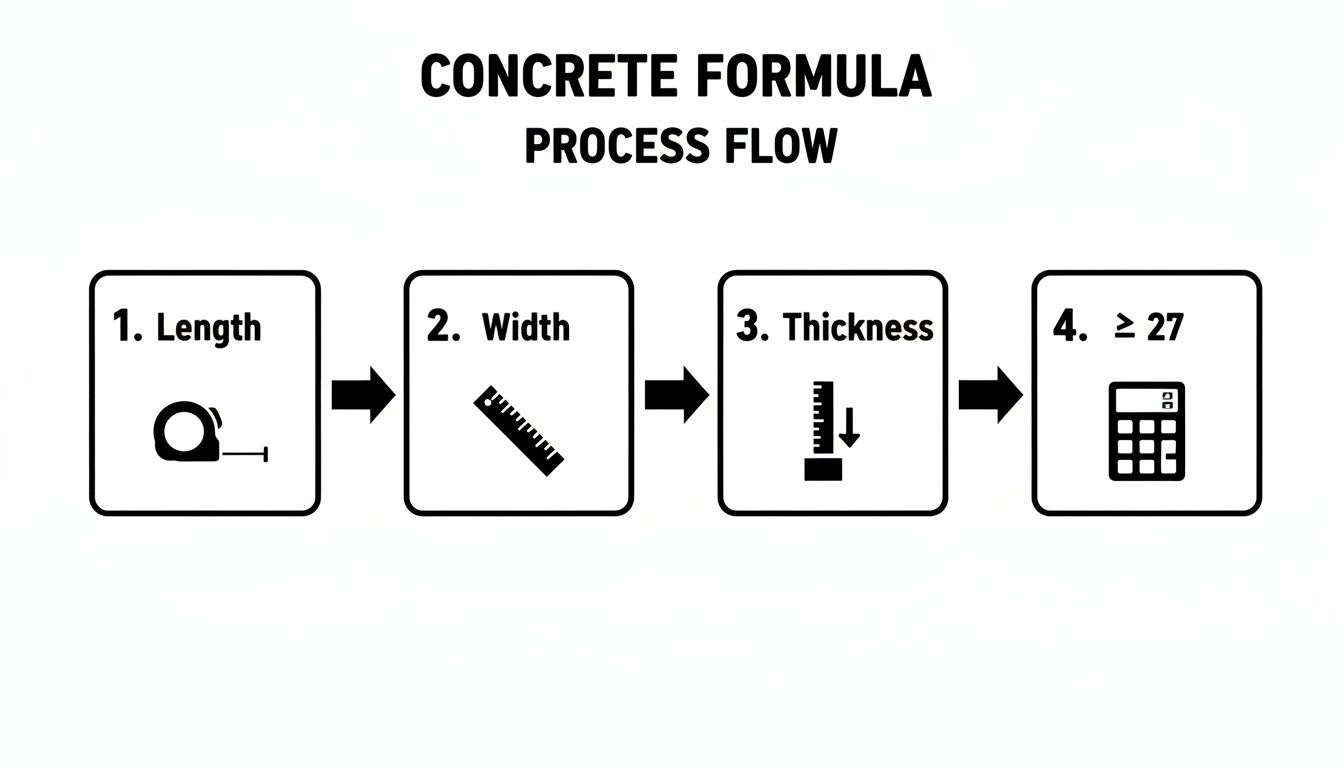
As you can see, it's a simple flow: get your length, width, and thickness, then run the calculation to find your yards of concrete.
First, Let's Talk About the Waste Factor
Before we get to the examples, we need to cover the most critical, non-negotiable part of any concrete order: the waste factor. I can't stress this enough. The ground is never perfectly flat, your forms might bow out a tiny bit, and you’ll always lose some mud in the chute or to spillage. To cover these real-world issues, you always order extra.
For most slabs, a 5-10% waste factor is the professional standard. Just multiply your final number by 1.05 (for 5%) or 1.10 (for 10%). Running short is a disaster that can ruin a job, so think of this as cheap insurance. For example, if your calculation comes out to exactly 5.0 cubic yards, ordering 5.25 or 5.5 yards provides a crucial safety net.
Ordering a bit more than your raw calculation isn't a waste of money—it's a crucial step that prevents costly delays, avoids weak cold joints, and ensures you have enough material to achieve a perfect finish, even with an uneven subgrade or minor spillage.
The Johns Creek Stamped Patio
Stamped patios are a huge part of our business. Let's say a client in Johns Creek wants a new patio that's 12 feet wide by 20 feet long. A standard 4-inch slab is plenty strong for furniture and foot traffic.
- Length: 20 feet
- Width: 12 feet
- Thickness: 4 inches
First things first, we have to get all our units the same. Let's turn that thickness into feet: 4 inches ÷ 12 = 0.333 feet.
Now we can find the total volume in cubic feet: 20 ft x 12 ft x 0.333 ft = 79.92 cubic feet.
And the final step is converting that to cubic yards: 79.92 cubic feet ÷ 27 = 2.96 cubic yards.
We're not done yet. For a job like this with stamping and potentially uneven ground, I’d add a 10% waste factor: 2.96 x 1.10 = 3.256 cubic yards. When I call the plant, I'm rounding up and ordering 3.5 cubic yards to be safe.
A Community Sidewalk in Duluth
Next up, a new sidewalk for a community in Duluth. These jobs are often long and narrow. This particular stretch is 100 feet long by 5 feet wide. Just like a patio, 4 inches is a perfectly normal thickness for a walkway.
Let's run the numbers:
- Convert Thickness: 4 inches ÷ 12 = 0.333 feet.
- Calculate Cubic Feet: 100 ft (Length) x 5 ft (Width) x 0.333 ft (Thickness) = 166.5 cubic feet.
- Convert to Cubic Yards: 166.5 cubic feet ÷ 27 = 6.17 cubic yards.
Even for a straightforward pour like a sidewalk, you still need a buffer. A 5% waste factor is smart here: 6.17 x 1.05 = 6.48 cubic yards. I’d tell the dispatcher I need 6.5 cubic yards for this job.
A Home Addition Foundation
Foundations are a different animal entirely and often involve more complex shapes. Let's say a contractor is pouring a slab for a 25-foot by 30-foot home addition. The plan calls for a 5-inch thick slab with beefier footings around the whole perimeter that are 12 inches wide and 18 inches deep.
This is a two-part calculation.
Part 1: The Main Slab
- Thickness in feet: 5 inches ÷ 12 = 0.417 feet.
- Slab volume: 25 ft x 30 ft x 0.417 ft = 312.75 cubic feet.
Part 2: The Perimeter Footings
- Total perimeter length: (25 ft + 30 ft) x 2 = 110 feet.
- Footing width in feet: 12 inches = 1 foot.
- Footing depth in feet: 18 inches = 1.5 feet.
- Footing volume: 110 ft x 1 ft x 1.5 ft = 165 cubic feet.
Part 3: Combine and Convert
- Total volume: 312.75 (slab) + 165 (footings) = 477.75 cubic feet.
- Total in yards: 477.75 ÷ 27 = 17.7 cubic yards.
Because this is a structural foundation, you don't mess around. A 10% waste factor is a must: 17.7 x 1.10 = 19.47 cubic yards. The contractor would confidently order 19.5 yards of concrete. You can see some of the foundations and other jobs we’ve completed by checking out our Atlanta concrete projects.
A Backyard Pickleball Court
Pickleball is everywhere right now, and so are requests for courts. A regulation playing area is 44 feet long by 20 feet wide. To get a durable, long-lasting surface, a 4-inch slab on a well-compacted base is the way to go.
- Length: 44 feet
- Width: 20 feet
- Thickness: 4 inches (0.333 feet)
Let’s do the math one last time.
- Volume in Cubic Feet: 44 ft x 20 ft x 0.333 ft = 293.04 cubic feet.
- Volume in Cubic Yards: 293.04 ÷ 27 = 10.85 cubic yards.
You need that court to be perfectly flat, so a 10% waste factor is a good idea to cover any low spots in the subgrade: 10.85 x 1.10 = 11.94 cubic yards. For this project, a 12 cubic yard order would be perfect.
Placing Your Concrete Order and Preparing for Delivery
You’ve crunched the numbers, double-checked your math, and factored in a little extra for waste. Now for the exciting part: getting those yards of concrete from the plant to your job site. Placing the order is more than just rattling off a number; it’s about giving the dispatcher all the details they need to make sure your delivery goes off without a hitch. A smooth pour day always starts with a good phone call.
When you call, the dispatcher is going to ask for more than just how many yards you need. You'll need to have the exact job site address, a good contact number for the day of the pour, and, most importantly, the specific type of concrete your project requires.
Choosing the Right Concrete Strength
One of the key specs you'll need to provide is the PSI (pounds per square inch). This number tells you the concrete's compressive strength once it fully cures, and getting it right is crucial for the durability of your project. Using a mix that’s too weak for the job is a recipe for cracks and early failure down the road. For example, using a 2500 PSI mix for a driveway that will hold a heavy work truck is asking for trouble.
Here’s a quick rundown of the common PSI strengths we use for jobs around Atlanta:
- 2500 PSI: This is a lighter-duty mix. It’s a good fit for non-structural jobs like small sidewalk repairs or filling in a post hole where massive strength isn't the main goal.
- 3000 PSI: Your all-around workhorse for most residential projects. This is what we typically pour for standard walkways, patios, and most driveways that will just see cars and foot traffic.
- 3500 PSI: Need something a bit tougher? This mix offers extra durability, making it a smart upgrade for garage slabs or driveways that will have heavier vehicles like work vans or big SUVs parked on them.
- 4000+ PSI: When you get into heavy-duty territory, this is the mix you need. It’s essential for things like commercial parking lots, building foundations, and any slab that has to stand up to serious weight and constant traffic.
Not sure which one fits your project? You can learn more about our different commercial and residential https://www.atlantaconcretesolutions.com/services to see what we recommend.
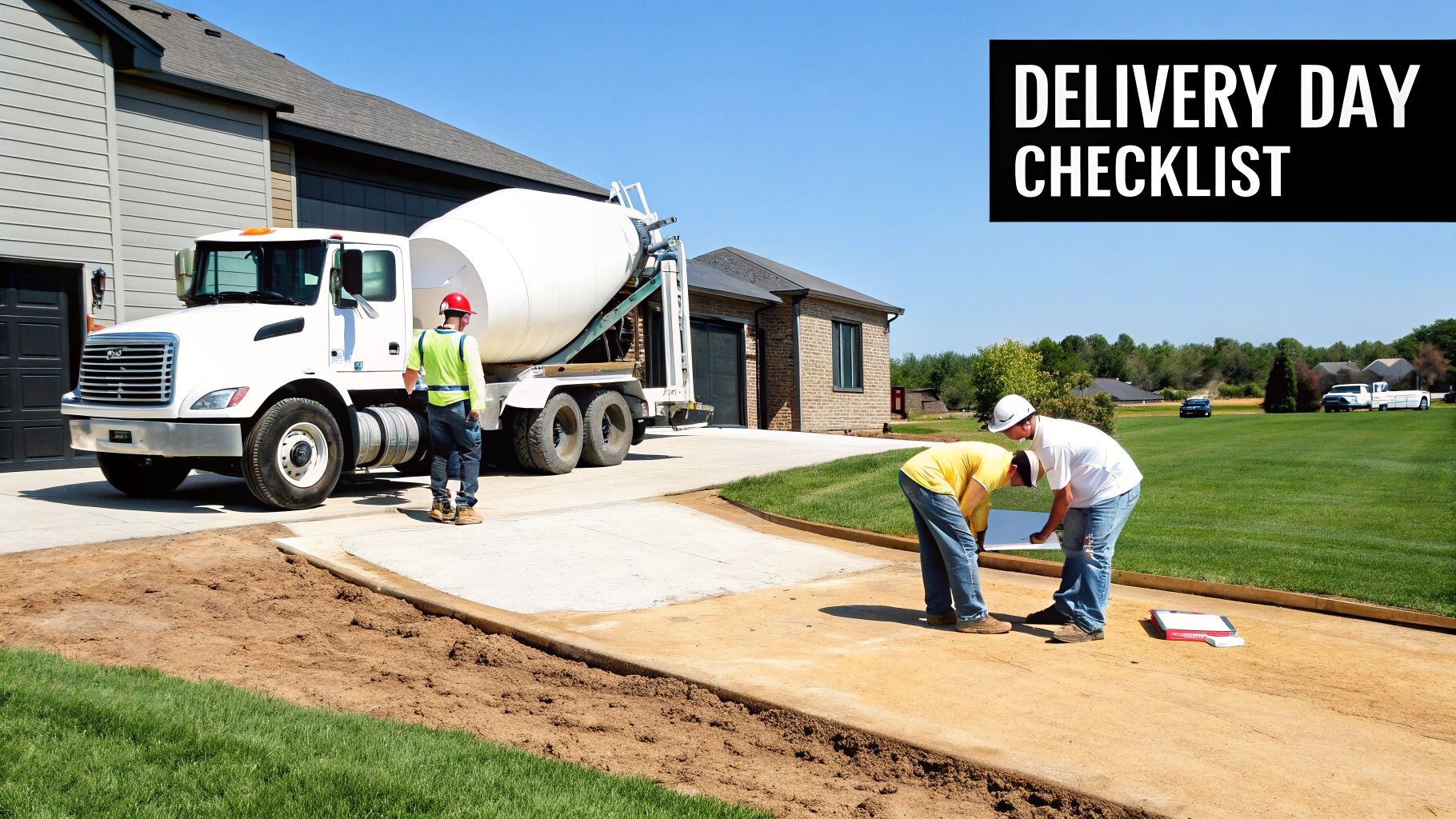
Your Delivery Day Success Checklist
The moment that concrete truck rumbles onto your site is when all your planning pays off. A bit of prep work beforehand makes the pour itself ten times easier and less stressful. Remember, once that concrete starts coming down the chute, the clock is ticking. You have a limited window to get it placed, leveled, and finished before it starts to set up.
Before the truck is even scheduled to arrive, make sure you've covered these bases:
- Clear a Path for the Truck: A fully loaded ready-mix truck is a beast, often weighing over 70,000 pounds. Make sure its path from the street to your forms is completely clear of cars, leftover building materials, and any overhead hazards like low-hanging tree branches or power lines.
- Have Your Crew and Tools Ready: All your wheelbarrows, shovels, concrete rakes, screeds, and floats should be laid out and ready to go. Your crew needs to be on-site and understand the game plan before the first yard of concrete hits the ground.
- Put Safety First: Pouring concrete is hard work. Make sure everyone on site is protected. That means gloves, eye protection, and appropriate work boots are non-negotiable.
- Confirm the Order on Arrival: When the driver hands you the delivery ticket, take a second to look it over. Does the yardage and PSI match what you ordered? This simple check can save you from a massive headache.
Having everything in place before the truck arrives is the secret to a successful pour. A well-prepared site allows your team to work efficiently, ensuring the concrete is placed correctly and finished beautifully before it has a chance to harden.
Decoding Concrete Costs in the Atlanta Market
Figuring out how many yards of concrete you need is a huge win, but it's only half the battle. The other half is understanding what you’re actually paying for when the invoice arrives. A concrete quote is more than just a single price tag; it's a breakdown of materials, logistics, and labor. Knowing how to read between the lines is the secret to a solid budget and a pour day free of nasty surprises.
The price of ready-mix concrete here in Atlanta can swing a bit depending on what's happening with material costs and local demand. You'll see a baseline price per yard, but it's the extra fees that often trip people up. A good, transparent quote will itemize everything, so you know exactly where your money is going.
The Cost Per Cubic Yard of Concrete
The biggest number on your quote will be the cost of the ready-mix concrete itself. Around Atlanta, you can expect to pay anywhere from $140 to $180 per cubic yard. The final price really depends on the PSI (pounds per square inch) strength you need. A standard 3000 PSI mix for a backyard patio will be on the lower end of that range, while a heavy-duty 4000 PSI mix for a structural foundation will naturally cost more.
This base price gets you professionally batched, high-quality concrete delivered right to your job site. It’s a number that reflects a massive global supply chain. To put it in perspective, the world produces a jaw-dropping 4.0 billion metric tons of cement—the key ingredient in concrete—every single year. While that scale keeps the supply steady for us here in Atlanta, things like rising energy costs can still nudge local prices up.
A Quick Tip from the Field: Always ask your supplier to price out a couple of different PSI strengths. Sometimes jumping from 3000 to 3500 PSI is a surprisingly small price increase, but it adds a ton of long-term durability, especially for a driveway or garage slab that's going to take a beating.
Understanding the Fees on Your Invoice
Once you get past the material cost, you'll see a few other standard fees on the invoice. These aren't hidden charges designed to trick you; they're the real costs of getting a massive, heavy, and perishable product to your location right when you need it.
- Delivery Fee: This is a flat rate that covers the driver's time and the truck's operational costs to get from the plant to your site and back. Think of it as the base fee just to get the truck rolling your way.
- Short Load Fee: Concrete plants run most efficiently when they send out full trucks, which usually hold 8 to 10 cubic yards. If you only need a small amount—say, under 5 or 6 yards—you'll likely see a "short load" fee. This just helps the plant cover the cost of sending out a truck that isn't at full capacity.
- Fuel Surcharge: With diesel prices always on the move, most suppliers add a fuel surcharge. It’s a standard industry practice that covers the cost of fuel for their fleet and might be a flat fee or a small percentage of your total.
- Weekend or After-Hours Premium: Need a pour on a Saturday or late in the evening? You should expect to pay a premium for it. This covers the overtime pay for the plant operators and the drivers who make it happen.
- Extra Unloading Time: Your delivery fee usually includes a specific amount of on-site time for unloading (often around 10 minutes per yard). If your crew isn't quite ready and the truck has to sit and wait, you'll get billed for that extra time. For a 6-yard delivery, this typically means you have about 60 minutes.
Estimated Concrete Project Costs in Atlanta
To help you get a clearer picture of your initial budget, here’s a sample breakdown of what you might expect to see on a quote for common concrete projects in our area.
| Project Component | Estimated Cost Range (Atlanta Metro) | Notes |
|---|---|---|
| Ready-Mix Concrete | $140 – $180 per cubic yard | Varies by PSI strength (e.g., 3000 vs 4000 PSI). |
| Delivery Fee | $100 – $150 per truck | A flat fee for transportation to the job site. |
| Short Load Fee | $50 – $150 per load | Applied for orders typically under 6 cubic yards. |
| Fuel Surcharge | $15 – $40 per load | This fee fluctuates with current diesel prices. |
| Weekend Delivery | Add $20 – $30 per cubic yard | Premium charge for deliveries outside of M-F business hours. |
| Unloading Overage | $3 – $5 per minute | Charged if the truck is held on-site beyond the allotted time. |
This table gives you a solid starting point. By understanding these components, you can look at any quote with confidence and budget accurately for the real cost of your project.
If you’re planning a project and want to nail down the specifics, getting a detailed quote is the next step. Being informed ahead of time makes the entire process, from ordering to finishing, run that much more smoothly. For more info, check out our guide on Atlanta concrete services to see how we can help.
Got Questions About Your Concrete Project? We've Got Answers.
Even the most carefully planned concrete job can leave you with a few questions. After helping thousands of homeowners and contractors over the years, we’ve pretty much heard them all. Here are the ones that come up most often, with straight-up answers from our team.
What If I Don't Order Enough Concrete?
Running out of concrete mid-pour is one of the biggest headaches you can have on a job site. It’s a real problem. When you stop the pour to wait for another truck, the concrete you’ve already placed starts to set.
That brief pause creates what’s called a cold joint—a weak seam right where the old and new concrete meet. This isn't just an ugly line in your finished slab; it's a structural weak point. Cold joints are notorious for cracking and letting water in, which can ruin the whole project over time. Plus, you’ll get hit with expensive emergency delivery fees. In a worst-case scenario, you might even have to tear it all out and start over.
This is precisely why we always tell people to add a 5-10% buffer to their order. It's non-negotiable.
Pro Tip: Never, ever risk a short pour. The few extra bucks for a little more concrete upfront will save you a massive amount of money and stress compared to fixing a slab compromised by a cold joint.
How Do I Figure Out Concrete for a Curve or an Odd Shape?
Life isn’t all squares and rectangles, and neither are concrete projects. Don't worry, calculating the concrete needed for a curved patio or an irregular-shaped slab just takes a little high school geometry.
- For Circular Slabs: The formula you need is π x radius² x thickness. For example, for a circular patio that is 10 feet wide (5-foot radius) and 4 inches thick (0.333 feet), the calculation would be: 3.14 x (5 x 5) x 0.333 = 26.1 cubic feet, or about 1 cubic yard. Just measure the radius (which is half the total width of the circle), square it (multiply it by itself), and then multiply that by pi (~3.14). The final step is to multiply that result by your slab's thickness in feet.
- For Irregular Shapes: The simplest approach is to break the big, weird shape into a few smaller, manageable ones, like squares and rectangles. For an L-shaped patio, for instance, you'd calculate the two rectangular sections separately and then add their volumes together. Calculate the volume for each little section on its own, then just add all those totals together. Easy.
How Many Bags of Concrete Make Up a Yard?
Bagged concrete from the hardware store has its place—it’s perfect for setting a fence post or a mailbox. For anything bigger, though, it's a completely impractical and exhausting way to go.
Just to give you an idea, you would need to mix:
- Ninety 40-lb bags
- Sixty 60-lb bags
- Forty-five 80-lb bags
…to get just one single cubic yard of concrete. Forget the back-breaking labor for a second; a ready-mix truck delivery is far cheaper and ensures you get a consistent, high-quality mix for your slab, patio, or driveway.
Does the Type of Concrete Mix Affect How Much I Need?
This is a fantastic question, and it's a common point of confusion. The actual volume you need—your total cubic yards of concrete—doesn't change at all based on the mix. A 5-yard slab is a 5-yard slab, whether you're ordering a standard 3000 PSI mix or a beefier 4000 PSI.
What does change is the price. Higher-strength concrete and mixes with special additives like fiber mesh or accelerators cost more per yard. So, while your quantity calculation won't change, you'll definitely need to adjust your project budget based on the specific mix you choose.
At Atlanta Concrete Solutions, our goal is to help you get the job done right, right from the start. If you’re still scratching your head or you're ready to get a clear, no-pressure quote for your driveway, patio, or foundation, our team is here to help.