
So, you're thinking about adding a backyard basketball court? It's a fantastic upgrade that adds a ton of fun and value to your home. In the Atlanta area, you can expect the cost for a standard half-court to fall somewhere between $3,600 and over $14,400. The final tally really depends on how you spec it out—think of it like buying a car, where the base model is affordable, but the price climbs with every added feature like leather seats or a sunroof.
Atlanta Backyard Basketball Court Costs at a Glance
Putting in a basketball court is much more than just pouring a slab of concrete. It’s a real investment in your property and your family's lifestyle, one that will pay off for years to come. Before we get into the nitty-gritty of materials and labor, let's look at the big picture on pricing.
Here in Atlanta, our local conditions definitely play a part. That famous Georgia red clay, for instance, often means more work to prepare the site properly. We also have to be smart about drainage to make sure heavy rains don't turn your court into a swimming pool and cause damage down the road. For example, a court built on a sloped yard may require a small retaining wall, adding to the site prep costs.
Typical Price Ranges in the Metro Area
The cost is going to swing pretty widely based on what you're imagining. Are you picturing a simple spot for the kids to practice their free throws, or are you dreaming of a full-blown multi-sport court with lights for night games? Your vision sets the budget.
To give you a better idea, here’s what different project scopes might look like with some examples:
- Basic Half-Court (Asphalt or Simple Concrete): This is your entry-level court. An example would be a 30'x30' concrete slab with a single in-ground hoop and painted free-throw line. It’s a solid, durable surface perfect for casual games and practice, and it's the most wallet-friendly way to get started.
- Upgraded Half-Court (Reinforced Concrete with Finishes): Stepping up a notch, this option usually includes better-quality concrete, crisp, professional-looking lines, and a high-quality adjustable hoop. For example, this could be a 45'x30' court with a full key and three-point line, plus a premium acrylic surface for better grip and color. It’s built for a better playing experience and a longer lifespan.
- Full-Court or Multi-Sport Court (Customized): This is the top tier. We're talking a larger court, premium acrylic surfaces, fencing, LED lighting, and maybe even lines for other sports like pickleball. A real-world example is a 94'x50' court with a high-end hoop system, rebounder nets, and stadium-style lighting for evening games.
Here's a key piece of advice I always give homeowners: while a professionally installed concrete court might cost more upfront, its durability and low maintenance mean you get a much better return on your investment over its 20 to 30-year lifespan.
To give you a quick reference, we've put together a table summarizing what you can expect to pay for different court sizes here in Atlanta.
Estimated Cost for a Backyard Basketball Court in Atlanta
| Court Size | Typical Price Range | Best For |
|---|---|---|
| 30' x 30' (Half-Court) | $3,600 – $14,400 | Families, practice, and casual 3-on-3 games. |
| 45' x 30' (Large Half-Court) | $5,400 – $21,600 | More room for realistic game-play and drills. |
| 94' x 50' (Full-Court) | $18,800 – $75,200+ | Serious players, training, and hosting full games. |
These numbers, which work out to about $4 to $16 per square foot installed, give you a solid baseline for budgeting. Comparing these figures to national averages for court installation can also help you understand what's included and feel more confident when reviewing local quotes. It’s a fantastic way for Atlanta homeowners to add a major recreational feature to their property.
Deconstructing Your Court's Core Costs
When you start pricing out a backyard basketball court, it's easy to just look at the final number. But that number is a sum of many crucial parts. Think of it like building a custom home—the foundation, the framing, the finishes—each element has a cost, and each one is vital to the final product.
Breaking it all down helps you see exactly where your money is going. More importantly, it shows you why cutting corners on certain steps can lead to some serious headaches and expensive repairs down the road. Let’s pull back the curtain on the core costs that make up your project.
The Groundwork: Site Prep and Excavation
Long before the first bounce of a ball, the real work begins. Site preparation is the absolute first step, and you can't afford to get it wrong—especially here in Atlanta with our notorious red clay and humid climate.
First, your crew will handle the excavation, which means clearing out the spot for your court. For example, if your chosen spot has several small trees and heavy brush, the cost of clearing and hauling debris will be higher than for a simple grass lot. After that comes grading, which is all about creating a very slight, precise slope. This is what keeps rainwater from pooling on your court, preventing the kind of water damage that leads to cracks and an uneven surface. For a court that lasts in Georgia, this step is everything.
Finally, they’ll lay down and compact a solid sub-base, usually 4-6 inches of crushed gravel. This creates a stable platform for the concrete slab, stopping it from shifting or settling over time. Trust me, skimping here is a recipe for disaster.
A poorly prepared site is the number one reason I see courts fail prematurely. Investing in professional excavation and grading protects your entire investment, ensuring your court is safe and playable for years, not just a season or two.
Your Foundation: Choosing the Base Materials
The playing surface is the heart of your court, and your choice of material is a huge factor in both the cost and how it plays. The main options are concrete and asphalt, but for a top-tier residential court, concrete is almost always the way to go. It’s more durable and gives you that crisp, true ball bounce.
Concrete courts definitely have a higher upfront cost—typically 40-50% more than asphalt—but you get what you pay for. For example, a 30'x30' asphalt court might cost $4,000, while the same size in concrete could be closer to $6,000. That initial investment translates into decades of low-maintenance use. You can get a good sense of how materials stack up by looking at national averages in a detailed breakdown of court construction costs.
This diagram shows how every decision, starting with the court type, builds on the last one to determine the final price.
As you can see, the court type sets the stage for the size, which then directly shapes the final cost.
The Cost of a Pro: Labor and Expertise
While materials are a big chunk of the budget, the skill of the team putting it all together is just as critical. Professional labor is a significant investment, and for very good reason. Pouring a massive slab of concrete for a basketball court is not a weekend DIY job.
Hiring an experienced crew means you’re paying for:
- Precision Grading: They have the specialized equipment, like a laser level, to get that perfect 1% slope for drainage.
- The Right Concrete Mix: A pro knows the exact mix (e.g., 4000 PSI concrete) and reinforcement (e.g., rebar grid) needed to handle Atlanta’s freeze-thaw cycles.
- A Flawless Finish: Getting that perfectly smooth, even playing surface using tools like a power trowel is an art form.
- Efficiency and Safety: They work quickly, safely, and haul away all the debris. That alone saves you a massive headache.
Navigating the Red Tape: Permits and Inspections
Finally, there’s the paperwork. Depending on where you live in the Atlanta metro and the size of your court, you’ll likely need to get building permits. For example, in many Fulton County jurisdictions, any impervious surface over a certain square footage requires a permit. This usually means submitting your plans to the local city or county for approval before any work can begin.
Permit costs can vary, from $100 to over $500, but a good contractor will handle this entire process for you. They know the local codes and what inspectors are looking for, making sure your court is built by the book. This step protects you from fines and ensures your project is fully compliant, giving you peace of mind from start to finish.
Choosing Your Playing Surface: Concrete vs Asphalt
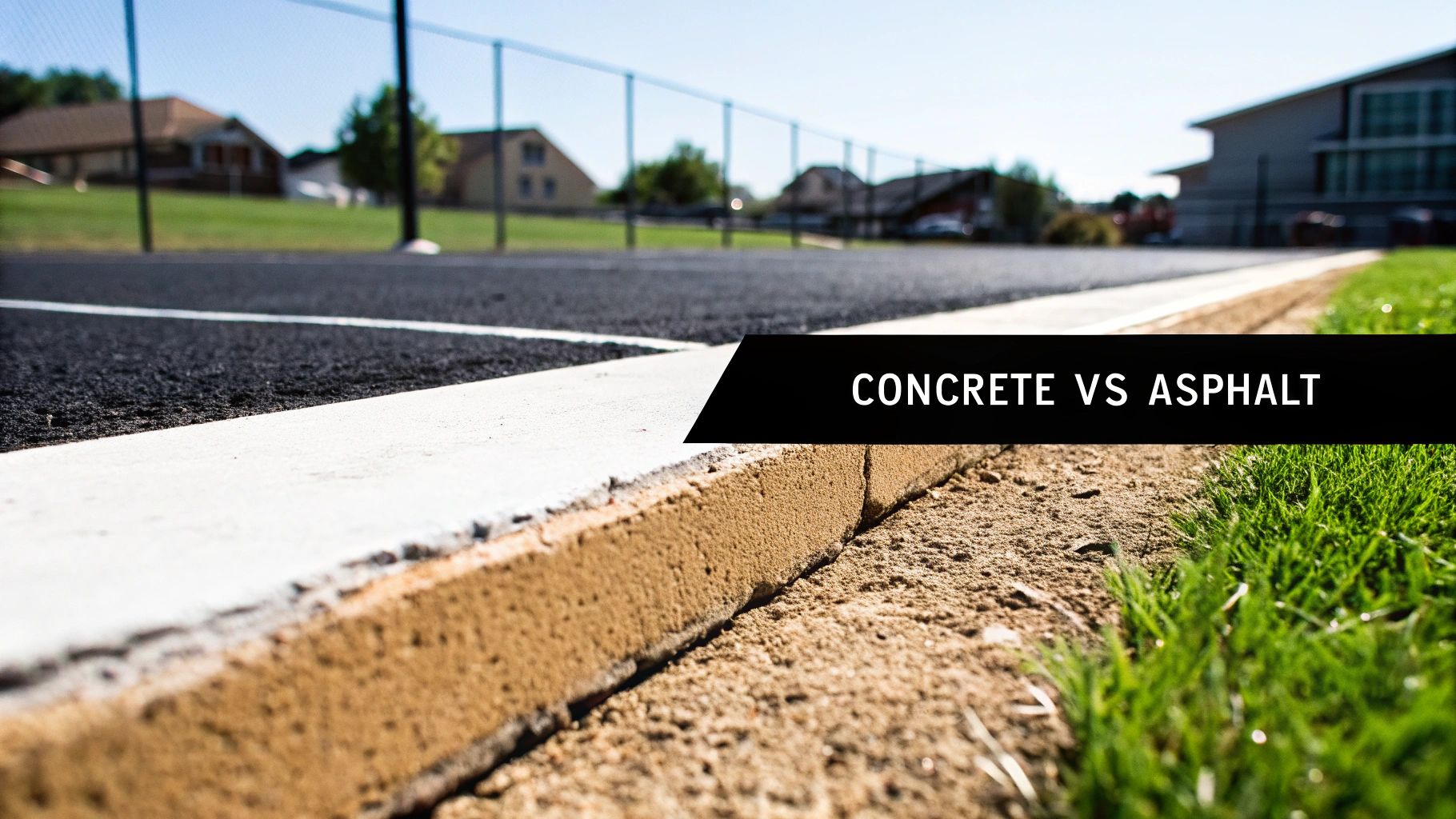
The single biggest decision you'll make—one that impacts cost, durability, and how the ball bounces for years to come—is the court surface itself. It's a classic showdown between two materials: concrete and asphalt.
Think of it like choosing the foundation for your house. You can go with a cheaper option that gets the job done for now, or you can invest in something solid and stable that will stand the test of time. Here in Atlanta, with our mix of hot summers and wet winters, this choice is even more critical.
The Case For Concrete Courts
There's a good reason concrete is considered the gold standard for backyard courts. It provides a hard, incredibly consistent surface that delivers that crisp, predictable bounce every player wants.
Yes, the upfront cost is higher, but its sheer durability makes it a far smarter long-term investment. A professionally poured concrete slab can easily last 20 to 30 years or more with very little fuss. It handles Atlanta’s weather extremes beautifully, resisting the cracks and warping that can plague softer surfaces. You can learn more about the process of using residential decorative concrete for home projects.
For most homeowners, a concrete court is the superior choice. The slightly higher initial investment pays for itself through decades of durability, lower maintenance costs, and a consistently better playing experience.
Understanding Asphalt Courts
Asphalt often gets attention as the budget-friendly alternative. It’s the same stuff used for driveways and roads, so its lower initial price tag can be pretty tempting for homeowners trying to manage costs.
The trade-off, however, comes down the road. Asphalt is a softer, more flexible material. That means it’s more vulnerable to wear and tear, especially with Atlanta's heat and heavy rains. Over time, it can develop dips and cracks, demanding regular and costly maintenance like sealcoating to keep it playable. As an example, a $500-$800 sealcoating job might be needed every 3-5 years to prevent major deterioration. To get a better feel for material pricing, a good asphalt price calculator can give you a ballpark idea of paving costs.
A Head-to-Head Comparison
To help you weigh the pros and cons, let's put these two surfaces side-by-side and see how they stack up on the key factors for a backyard basketball court.
Concrete vs Asphalt Court Surface Comparison
This table breaks down the essentials, from how much you'll spend upfront to how much work you'll be putting in over the next decade.
| Feature | Concrete Court | Asphalt Court |
|---|---|---|
| Initial Cost | Higher (typically 40-50% more than asphalt) | Lower, making it a more budget-friendly option upfront. |
| Lifespan | 20-30+ years with proper installation and care. | 10-20 years, but requires more frequent maintenance. |
| Maintenance | Very low. Occasional cleaning and crack sealing if needed. | High. Requires regular sealcoating every 3-5 years. |
| Playability | Excellent. Provides a hard, uniform surface for true ball bounce. | Good, but can soften in high heat, affecting bounce. |
| Durability | Extremely durable and resistant to weather damage. | Softer material, more prone to cracks and surface wear. |
| Customization | Easily painted for custom lines, logos, and colors. | Can be painted, but the surface is less smooth for details. |
In the end, while the lower initial cost of an asphalt court is certainly appealing, concrete almost always wins out. Its incredible lifespan, minimal maintenance, and superior playing surface make it the more cost-effective and enjoyable choice for most Atlanta homeowners over the life of the court.
Upgrading Your Court with Add-Ons and Finishes
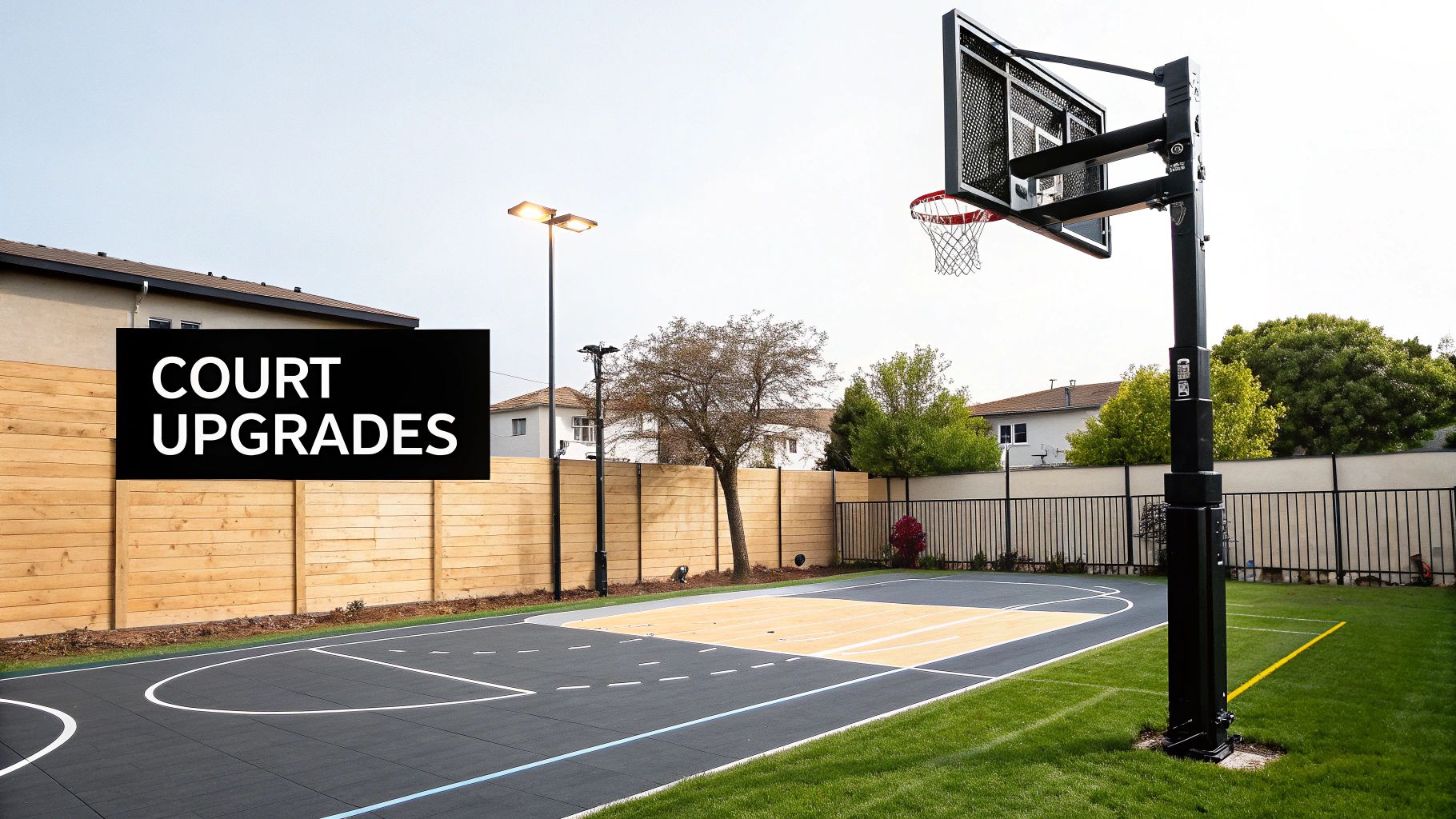
Once your concrete slab is poured and cured, you've got the foundation. But let's be honest, the real fun begins when you start adding the details that turn that slab into a legitimate playing arena. These are the upgrades that give your court personality, make it safer, and seriously improve the entire playing experience.
This is where the budget for a backyard basketball court can really start to stretch, as you shift from the must-haves to the "wow" features. I like to compare it to finishing a basement—you can have simple drywall and carpet, or you can add a wet bar, home theater, and custom lighting. Both are finished basements, but the experience is worlds apart. Let's break down the most popular add-ons that can transform a simple court into the go-to spot in the neighborhood.
Hoops, Fencing, and Containment
The hoop is obviously the heart of your court, but good fencing is the unsung hero that keeps the game moving. Both of these are crucial investments that directly affect how you play and how safe your court is.
Basketball Hoops ($400 – $3,000+): The price range here is huge for a reason. A basic portable hoop might be fine for a little casual shooting, but a permanent, in-ground system with an adjustable height (like a Goalrilla or MegaSlam hoop) is far more stable and will last for years. For the best experience, a professional-grade hoop with a tempered glass backboard gives you that authentic gym-style rebound and feel.
Containment Fencing ($1,500 – $5,000+): Nothing kills a game faster than chasing a stray ball down a hill or into the street. A 10-foot high chain-link or vinyl fence is a practical must-have. For example, fencing for a 30'x30' court (120 linear feet) will cost significantly less than for a full court (288 linear feet). The final cost will depend on the perimeter of your court and the material you choose, but it’s an investment you make for uninterrupted play and keeping your neighbors happy.
Surfaces and Custom Line Painting
A plain concrete slab works, but a specialized surface and crisp, accurate lines are what truly elevate it. This is also where you can build in the flexibility to play other sports.
An acrylic court surface, for instance, will typically add $2 to $4 per square foot to the project. This isn't just paint; it's a multi-layer coating that provides much better grip, helps keep the surface cooler, and adds a bit of cushion that’s easier on your joints. It also opens up a whole world of color possibilities for a fully custom look. We've seen homeowners get creative with all sorts of residential decorative concrete options to achieve something truly unique.
A professional paint job is about more than just looks—it’s about defining the game. Properly measured lines for the key, three-point arc, and free-throw line are what make real practice and competitive games possible.
Many families are also turning their basketball courts into multi-sport hubs. Adding lines for other games is a surprisingly affordable way to get way more use out of the space.
- Pickleball Lines: As the fastest-growing sport in the country, adding pickleball lines (court size: 44' x 20') is a very popular choice.
- Volleyball or Badminton: These are other great options that can easily share the space.
Tacking on these extra lines usually only costs between $250 to $750. It’s a small price to pay for adding entirely new ways for your family to get outside and play.
Lighting for Nighttime Play
Why should the fun stop just because the sun goes down? Adding lighting is probably one of the most impactful upgrades you can make, because it literally doubles your court's available playing time. This is a game-changer for busy families with packed schedules and a huge plus during Atlanta's hot summers when playing in the evening is just so much more comfortable.
These days, LED lighting is the way to go. It gives you bright, even light across the whole court without the crazy energy bills or long warm-up times of older metal halide systems. A professional lighting setup, including the poles and fixtures, can run from $2,500 to $10,000 or more, depending on how big your court is and how many lights you need. For example, a half-court may only need one or two light poles, while a full court could require four to six for proper coverage. While it's a notable addition to the total cost, the payoff in sheer usability is massive.
How to Find the Right Atlanta Court Builder
The single most important decision you'll make for your new court isn’t the color of the paint or the style of the hoop—it’s the builder you choose. A great contractor is the difference between a court that lasts a lifetime and a project that becomes a constant source of headaches and costly repairs.
Think of it this way: you wouldn't hire a plumber to wire your house. The same logic applies here. You need a specialist who understands the unique challenges of building courts in Atlanta, from our clay soil to our unpredictable weather. This guide will walk you through how to find that perfect pro.
Vetting Your Potential Contractors
Before you start collecting quotes, you need to do a little homework. Any reputable builder will be upfront and transparent about their credentials. Don't be shy about asking for proof.
Here are the absolute non-negotiables for your initial screening:
- Licensed and Insured: This is first on the list for a reason. Ask for their Georgia contractor's license and proof of liability insurance. For example, ask to see their Certificate of Insurance (COI) to confirm coverage. It’s your safety net against any on-site accidents or property damage.
- Court-Specific Experience: A general concrete guy isn’t enough. You want a team with a portfolio filled with basketball, pickleball, or tennis courts. Feel free to browse our gallery to see the kind of detail we put into our Atlanta-area projects.
- Local Permitting Savvy: A contractor who works in the Atlanta area regularly will know the permitting nuances of your specific city or county, whether you're in Marietta, Alpharetta, or right in town.
Proper ground prep is the literal foundation of a good court. The checklist for hiring excavation contractors has some great tips that are directly applicable here.
Essential Questions to Ask Every Builder
Once you've narrowed down your list to a few qualified builders, it’s interview time. The way they answer these questions will reveal a lot about their expertise and professionalism.
Get these questions ready for every contractor you speak with:
- Can I speak with a few of your recent clients? Talking directly to past customers is the best way to get an honest review of their experience. Ask for examples of projects similar to yours in size and scope.
- Who is my main point of contact on-site? You need to know if you'll be working with a dedicated project manager or the business owner. Consistent communication is key.
- What's your plan for site prep and drainage on my property? This is a huge deal in Georgia. Their answer should be specific and detailed, not generic. For example, they should mention the slope percentage and where water will be directed.
- How do you handle surprises, like hitting rock or a water line? A true professional will already have a contingency plan and will explain how those situations are handled contractually.
A detailed, itemized quote is the hallmark of a trustworthy contractor. Vague proposals with a single lump-sum price often hide shortcuts or leave room for surprise upcharges later on.
How to Read a Proposal and Spot Red Flags
A good proposal should be a clear, easy-to-understand roadmap for your entire project. It needs to break down the backyard basketball court cost so you know exactly where your money is going.
Look for a quote that clearly itemizes everything:
- Site Preparation: The cost for all excavation, grading, and the gravel sub-base.
- Materials: A breakdown of the concrete (e.g., 15 cubic yards of 4000 PSI concrete), rebar, vapor barriers, and any acrylic surfacing.
- Labor: Clear costs associated with each phase of the build.
- Add-Ons: Each optional feature, like the hoop system, fencing, or lighting, should be its own line item.
- Timeline: An estimated schedule from start to finish.
Be very cautious of a bid that comes in drastically lower than the others. While it might seem tempting, a lowball offer is often a major red flag. It can signal cheap materials, inexperienced labor, or a plan to cut corners where you can't see them. Investing a little more in a reputable builder is the best guarantee for a court your family will enjoy for years to come.
Got Questions? We've Got Answers
Even with all the numbers laid out, you're probably still wondering about a few things. That’s completely normal! A backyard court is a big project, and getting clear on the details is the best way to feel confident moving forward.
Let's tackle some of the most common questions we hear from homeowners around Atlanta.
How Long Will My Yard Be a Construction Zone?
Nobody wants their backyard torn up for weeks on end. The good news is, for a standard concrete half-court, the whole process is usually wrapped up in about 5 to 10 days. Of course, Atlanta's weather can always throw a curveball.
Here’s a rough play-by-play of the timeline:
- Site Prep: First, we clear and level the area, which takes about 1-2 days. This step is crucial for making sure water drains away from the court properly.
- The Pour: Setting the forms and pouring the concrete slab is another 1-2 day job.
- Curing and Finishing: The concrete needs about 7 days to cure enough for light use and 28 days to reach full strength. After the initial cure, which takes a few days, we can paint the lines, install the hoop, and you're good to go.
A good contractor will keep you in the loop the entire time, so you’ll always know what’s happening.
Will a Basketball Court Actually Increase My Property Value?
You bet. A well-built, professional basketball court is a huge plus for your home's value and curb appeal. While you might not get a perfect dollar-for-dollar return, it’s an incredible lifestyle feature that makes your property a standout, particularly in family-friendly neighborhoods.
It's a lot like adding a high-end deck or a custom stone patio. It’s not just an add-on; it transforms your yard into a complete family retreat and becomes a massive selling point if you ever decide to move. For example, a home with a well-maintained court is often more appealing to buyers with active families than a comparable home without one.
Can I Just Build It Myself and Save Some Cash?
Going the DIY route to cut down on the backyard basketball court cost is tempting, but pouring a massive concrete slab is not a weekend warrior project. It takes serious know-how and equipment to do it right.
We've seen it all—improper grading that turns the court into a giant puddle after it rains, or a bad concrete mix that starts cracking within a year. For example, forgetting to add control joints can lead to large, unsightly cracks that are expensive to repair. Fixing those mistakes often costs more than hiring a pro in the first place. For a court that’s safe, level, and built to last, you really want to bring in an experienced contractor.
Ready to turn that patch of grass into the home court you've always wanted? Atlanta Concrete Solutions knows the local soil, weather, and what it takes to build a court that will last for years of pickup games and family fun. For a free, no-pressure quote on your project, visit us online.