
If you're staring at a sunken driveway or a lopsided patio, your mind probably jumps straight to one question: "How much is this going to cost me?" The good news is that lifting that concrete is almost always a smarter financial move than tearing it all out and starting over.
On average, a typical concrete lifting job will run you between $600 and $2,000, with very small, simple fixes starting as low as $300. For example, a single sidewalk slab that has sunk an inch might fall into that lower $300-$600 range. When you compare that to the price of a full replacement, which can easily cost $3,000 to $8,000 for a new driveway, you’re often looking at a savings of 50-70%. The final bill really comes down to the size of the slab, which method we use, and just how badly it has sunk.
Your Quick Guide To Concrete Lifting Costs
Let's break down the numbers so you can get a solid idea of what to expect. Most professionals, including us, price jobs based on a few key metrics, but the square footage of the area being lifted is a big one.
For polyurethane foam injection—the modern, lightweight method—the price generally falls somewhere between $5 and $25 per square foot. That's a pretty wide range, and it’s because a small, easy-to-reach sidewalk slab is a much different job than a massive, sunken section of a basement floor. As an example, a 100-square-foot patio that requires a minimal lift might cost $700 ($7/sq ft), whereas lifting the same size patio that has sunk several inches due to a large void could cost $2,000 ($20/sq ft). For a deeper dive into these costs, the folks at Angi.com have a great breakdown of polyurethane concrete lifting costs.
Typical Project Price Ranges
To bring these numbers to life, let’s look at what some common projects typically cost homeowners around Atlanta. These are solid ballpark figures to help you start budgeting.
- Sidewalks: A single, sunken sidewalk square is one of the most common jobs. This usually lands in the $300 to $600 range.
- Patios: For an average-sized patio that's become a tripping hazard, you can expect to budget between $700 and $1,500.
- Driveways: Lifting one or two sunken slabs on a standard two-car driveway is a frequent repair, typically costing $900 to $2,500.
- Garage Floors: These can be a bit trickier due to the enclosed space, with costs generally running from $800 to $2,000.
Important Note: Think of these as a starting point. The only way to get a firm price is to have a professional come out and see what’s actually going on. Every slab, and the soil beneath it, tells a different story.
For a quick side-by-side look, here’s a table that summarizes the costs you can expect.
Concrete Lifting Costs At A Glance
This table gives you a high-level view of the cost ranges for different projects and the two primary lifting methods. It's a handy cheat sheet for comparing your options.
| Project Or Method | Average Cost Per Square Foot | Typical Project Cost Range |
|---|---|---|
| Polyurethane Foam Lifting | $5 – $25 | $900 – $4,000+ |
| Mudjacking (Slabjacking) | $3 – $10 | $600 – $2,000 |
| Small Sidewalk Section | N/A | $300 – $600 |
| Standard Driveway Slab | N/A | $900 – $2,500 |
As you can see, the method you choose plays a big role in the final cost, but both options present a significant savings over the alternative of a full replacement. For example, replacing a driveway could cost over $5,000, while lifting it might only be $1,500.
Decoding The Key Factors That Influence Your Final Price
Ever get two quotes for what looks like the exact same job, only to see one come in at $900 and the other over $4,000? That huge price gap isn't just random. When you're trying to figure out how much concrete lifting costs, you have to look at the same variables a pro does when they're putting together your estimate.
Several key factors are always in play, and each one has a direct impact on the materials, labor, and time your project will demand. From the lifting method to the actual condition of the slab, every little detail helps shape that final number.
The Method Matters Most: Polyurethane Foam Vs. Mudjacking
The single biggest driver of your final cost is the lifting method. While modern polyurethane foam (polyjacking) and traditional mudjacking (slabjacking) both work by filling the void under your slab to lift it, they use completely different materials and processes. That's where the price difference comes in.
- Polyurethane Foam Lifting: This is the high-tech approach. It uses a high-density, structural-grade polymer foam injected through small 5/8-inch holes. The material itself is incredibly light, cures in just a few minutes, and is totally waterproof. Because the foam and the specialized equipment are more advanced, polyjacking usually comes with a higher upfront cost.
- Mudjacking: This is the old-school, tried-and-true technique. A crew pumps a heavy slurry of sand, soil, cement, and water under the slab through much larger holes (1 to 2 inches). The materials are cheaper, but the slurry is extremely heavy and takes a long time to fully cure, which can sometimes lead to re-settling.
Think of it like this: polyjacking is the lightweight, high-performance running shoe, while mudjacking is the classic, heavy-duty leather work boot. Both get the job done, but the technology, materials, and price point are in different leagues entirely.
To help you see the differences side-by-side, let's break down how these two methods stack up when it comes to cost and performance.
Polyurethane Foam Lifting vs Mudjacking Cost Comparison
This table compares the essential features of each method, giving you a clearer picture of not just the initial expense but the long-term value you can expect.
| Feature | Polyurethane Foam Lifting (Polyjacking) | Mudjacking (Slabjacking) |
|---|---|---|
| Material Cost | Higher | Lower |
| Labor Time | Faster installation, less labor-intensive | Slower, more labor-intensive |
| Cure Time | 15-30 minutes (ready for use same day) | 24-72 hours (requires waiting) |
| Weight | Very lightweight (2-4 lbs/cu ft); won't overburden soil | Very heavy (100-110 lbs/cu ft); can cause re-settling |
| Injection Holes | Small (5/8 inch), easily patched | Large (1-2 inches), more noticeable patches |
| Durability | Waterproof, inert, won't erode or break down | Can erode, wash out, or shrink over time |
| Long-Term Value | Higher upfront cost but offers a permanent solution | Lower initial cost but may require future repairs |
As you can see, while mudjacking might seem cheaper at first glance, the durability and performance of polyurethane foam often make it a more cost-effective solution over the long haul. For instance, you might pay $1,200 for mudjacking today but need another fix in 5 years, whereas a $1,800 poly-lift could last for decades.
Size Of The Slab And Depth Of The Void
It's easy to assume that lifting a huge driveway will cost more than a small sidewalk square, but the surface area is only part of the equation. The real cost driver is the volume of the void that has opened up underneath the concrete.
For example, a 10×10 foot patio slab that has only sunk an inch has a pretty small void to fill. But if another 10×10 foot slab has dropped a full six inches because of major soil erosion, it's going to require a massive amount of lifting material to stabilize and raise it. Contractors have to estimate the total volume of foam or slurry needed, and that directly impacts your price.
A contractor isn't just pricing the surface area; they're pricing the empty space underneath. The deeper the problem, the more material is needed, and the higher the cost to solve it.
This is exactly why a professional needs to see the site in person to give you an accurate quote. You just can't gauge the depth of a void from a photo.
Site Accessibility And Complexity
Believe it or not, how hard it is to get to your sunken slab plays a big role in the final cost.
- Easy Access: A driveway or front sidewalk right next to the street? That's a straightforward job. The crew can pull their truck right up and get to work. For example, this type of job might have a lower labor cost component, perhaps around $400.
- Difficult Access: What about a sunken pool deck in a fenced-in backyard? Or a basement floor? Now things get tricky. The crew might need to run hundreds of feet of hose, haul equipment by hand, or take extra time to protect your home and landscaping. This could add $200-$500 to the labor cost just for the extra time and effort.
These kinds of logistical challenges add time and labor to the project, and that will be reflected in your estimate. The overall condition of the slab itself, like how many cracks it has, also adds to the job's complexity and can nudge the price up.
Ultimately, the cost of residential concrete leveling can fall anywhere between $750 and over $6,000, all depending on this combination of factors. As we always tell homeowners, the total square footage is far less important than the volume of material needed and how technically difficult the job is. To get a better handle on what to expect, you can see a more detailed breakdown of concrete leveling costs and how these elements come together.
Real-World Cost Examples for Common Concrete Lifting Jobs
Theory is one thing, but seeing real numbers for common projects is what really helps. Let's walk through three typical concrete lifting jobs we see all the time here in the Atlanta area.
These examples will give you a much clearer picture of how size, location, and complexity all play a role in the final price.
Example 1: Lifting a Sunken Two-Car Driveway
It’s a classic problem. That big concrete slab right in front of your garage has sunk, creating a jarring bump every single time you pull in. It's not just annoying; it puts a lot of wear and tear on your car's suspension.
The Scenario: You have a standard two-car driveway, about 400 square feet, and the main slab has dropped 2-3 inches. The good news is the area is easy to get to from the street, and the concrete itself is in decent shape with just a few minor cracks.
- Lifting Method: Polyurethane foam injection is the perfect fit here. It’s incredibly strong but lightweight, so it won’t add more stress to the soil that caused the problem in the first place. Plus, it cures so fast you can park on your driveway again the very same day.
- Cost Breakdown:
- Material: To fill that 2-3 inch void under a large slab, you need a good amount of high-density foam. We’d estimate the material cost at $800 – $1,200.
- Labor & Equipment: A two-person crew can usually knock this out in 2-4 hours. The labor and equipment costs would run about $600 – $900.
- Total Estimated Cost: $1,400 – $2,100
This estimate is for a pretty straightforward job without any surprises. The cost is mostly driven by how much foam is needed to fill the void and lift that heavy slab. If you want to see what this looks like, check out our gallery of Atlanta-area concrete lifting projects.
Example 2: Leveling a Cracked Patio with Tricky Access
Your patio should be a place to relax, not a place to trip. When a slab sinks and cracks, it becomes a major hazard, especially when it’s tucked away in the backyard where getting equipment in is a challenge.
The Scenario: A 200-square-foot patio in a fenced backyard has settled, and now water pools up against the house every time it rains. There are a few cracks, and to reach it, we’d have to run over 150 feet of hose from our truck on the street.
Key Insight: Access is a huge cost factor. The more time and extra equipment (like hundreds of feet of hose) it takes to reach the job site, the more you can expect the labor costs on your estimate to go up.
- Lifting Method: Again, polyurethane foam is the clear winner. The injection holes are tiny and barely noticeable on a decorative patio, and our long hoses can easily reach the spot without tearing up your lawn.
- Cost Breakdown:
- Material: The void here is smaller, but we might use a little extra foam to help stabilize the cracked pieces. Material costs would likely be $500 – $750.
- Labor & Equipment: The tough access probably adds about an hour for setup and cleanup. That puts labor and equipment costs in the $550 – $800 range.
- Total Estimated Cost: $1,050 – $1,550
Even though this patio is half the size of the driveway, the extra hassle of getting to it keeps the price from being dramatically lower. It’s a perfect example of why every job really needs its own custom quote.
Example 3: Raising a Settled Basement Floor
A sunken basement floor is more than just an uneven surface; it can lead to serious moisture issues and even put stress on your home's foundation. Working inside a home requires a completely different level of care and precision.
The Scenario: A 150-square-foot section of an unfinished basement floor has dropped, creating a low spot where water now pools. The job requires us to work carefully around utilities and structural support posts.
- Lifting Method: Polyurethane foam is really the only way to go for interior work. It’s a clean process with no messy slurry or dust, and the foam itself is waterproof, which helps create a new moisture barrier under your floor.
- Cost Breakdown:
- Material: The void is fairly small. Materials will likely run $400 – $600.
- Labor & Equipment: This is delicate work. It takes a skilled touch to inject the foam and lift the slab without overdoing it. Even on a smaller area, the need for precision keeps labor costs up, around $500 – $700.
- Total Estimated Cost: $900 – $1,300
With a basement job, you’re not just paying for foam; you’re paying for the expertise and specialized gear needed to work cleanly and safely inside your home.
Deciding When To Repair Vs. When To Replace Your Concrete
So, is lifting your sunken concrete always the right call? Not necessarily. While it’s a fantastic and budget-friendly fix for settled slabs, there's a definite tipping point where a full replacement becomes the smarter, more durable investment. Knowing how to spot that difference is the key to spending your money on a solution that will actually last.
The guiding principle is pretty straightforward: concrete lifting fixes the foundation beneath the slab, not a shattered surface.
Think of it this way. Imagine your concrete slab is a large dinner plate. If the plate is perfectly whole but has simply tilted because the table it's on is wobbly, lifting the slab (leveling the table) is the perfect solution. But if that plate is smashed into a dozen pieces, propping it up won't make it whole again.
When Concrete Lifting Is The Ideal Solution
Concrete lifting is the clear winner when the slab itself is still in good shape. You're likely a perfect candidate for this kind of repair if your concrete is showing these signs:
- Sinking or Tilting: This is the most obvious tell. One side of your driveway is lower than the garage floor, or a sidewalk section has dropped, creating a nasty trip hazard. For example, a 2-inch drop is a prime candidate for lifting.
- Minor to Moderate Cracking: A few cracks are totally normal and don't rule out a slab for lifting. As long as the concrete is broken into large, stable chunks, the lifting process can often bring them right back into alignment.
- Structurally Intact: At its core, the slab is one solid piece, or maybe broken into just two or three large, stable sections.
Opting for repair in these scenarios can save you a whopping 50-70% compared to the cost and hassle of a full tear-out and replacement. It's faster, far less disruptive to your property, and much more economical when the slab's integrity isn't the problem.
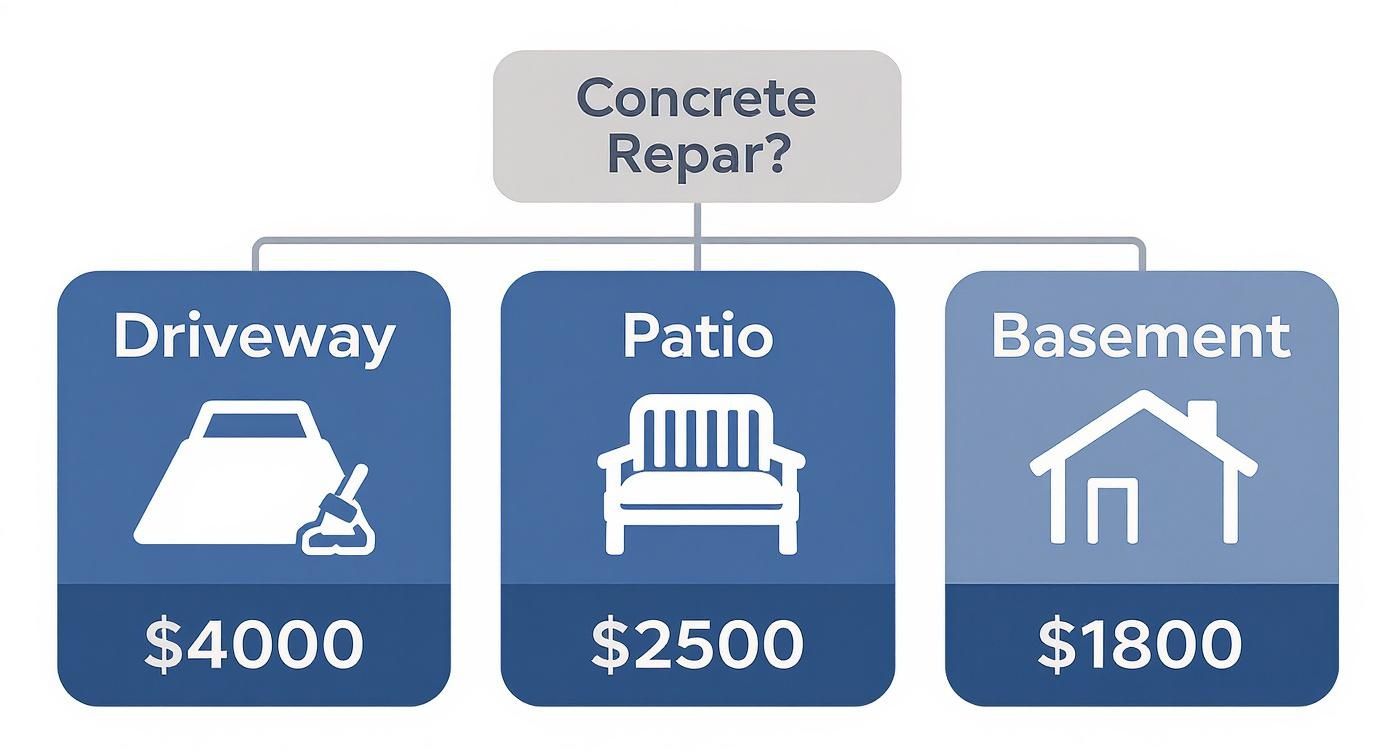
As you can see, the specific area you're fixing has a big impact on the final price. Larger, more complex jobs like a multi-slab driveway will naturally require a bigger budget than a small patio or basement floor.
Red Flags That Point To Replacement
Sometimes, a simple repair just isn't going to do the trick. Throwing money at lifting a slab that's beyond saving is a waste. If you see these major red flags, it’s time to start budgeting for a full replacement.
- Extensive Cracking: We're talking "spiderweb" or "alligator" cracking where the slab is broken into many small, shifting pieces. It has lost all its structural integrity. Trying to lift these fragments is like trying to lift a pile of loose puzzle pieces—it just won't hold together.
- Crumbling or Spalling Surfaces: When the top layer of the concrete is flaking off, crumbling, or peeling away (a problem called spalling), it's a sign of deep-seated decay. Lifting the slab won't fix the deteriorating material itself.
- Slab is Too Thin: If the original concrete was poured too thin—especially less than 3-4 inches for a driveway—it probably lacks the strength to handle the lifting process, let alone the weight of vehicles in the future.
Keep in mind that the cost of new concrete has been on the rise. Ready-mix concrete prices in the U.S. jumped by about 28% between January 2021 and January 2025, mostly due to higher fuel and transportation costs. Our team can help you navigate these factors and figure out the best approach for any residential concrete and masonry repair.
How To Hire A Pro And Get A Fair Price
Choosing the right contractor is every bit as important as picking the right repair method. After all, a rock-bottom price is worthless if the job is done poorly and you're back to square one in a year. You need a smart game plan for finding a true professional who will give you quality work at a fair price.
The first step is always to get multiple quotes. I tell every homeowner to aim for at least three detailed estimates from different local companies. This does more than just give you a feel for the average how much does concrete lifting cost in Atlanta; it helps you spot any outliers. An unusually low bid, for instance, can be a major red flag for cut corners, cheap materials, or inexperienced crews.
Key Questions To Ask Every Contractor
Once you've got a few estimates in hand, it's time to do some digging. Asking the right questions can tell you everything you need to know about a contractor's experience and the quality of their work. Don't be timid—a good contractor will welcome your questions and have clear answers ready.
Before you make any calls, have this checklist handy:
- What specific material are you planning to use? If they suggest polyurethane, ask for the specs. Is it high-density foam? What's its weight per cubic foot? They should know this off the top of their head.
- What kind of warranty do you offer on the repair? Look for a solid warranty, often 2-5 years or even longer. This shows they have confidence in their work. Always, always get the warranty terms in writing.
- Can I get a detailed breakdown of the costs? A professional quote shouldn't be a single number. It should clearly separate material costs from labor so you know exactly what you're paying for.
- Are you fully licensed and insured? This is non-negotiable. Ask to see proof of both general liability insurance and worker's compensation. This is what protects you if an accident happens on your property.
- Can you show me some local projects or provide references? There’s no better way to gauge quality than by seeing their past work and hearing from actual customers.
Pro Tip: Pay attention to how they answer. If a contractor gets vague about materials or hems and haws about their insurance, that’s a warning sign. A real pro will be transparent, confident, and ready to back up their claims.
Understanding The Estimate
A professional estimate is much more than a price tag; it's a roadmap for your project. It should spell out the exact scope of work, the specific materials they'll use, the total square footage being lifted, and even the size and number of drill holes required.
The estimate should also clearly state the payment terms and a realistic timeline for getting the job done. Never sign a contract that feels vague or incomplete. By taking the time to vet contractors and carefully review their estimates, you can hire with confidence, sidestep costly mistakes, and make a smart investment in a repair that's built to last.
When you're ready to see how a professional team approaches this, you can review our full list of concrete lifting services and see what sets a quality job apart.
Got Questions About Concrete Lifting? We've Got Answers.
Even with all the numbers and factors laid out, you probably still have a few questions rolling around in your head. That's completely normal. Let's tackle some of the most common things we hear from Atlanta homeowners to help you feel confident about your decision.
Is Concrete Lifting a Permanent Fix?
For the most part, yes. When done right, concrete lifting can easily last for the life of the slab itself. This is especially true with modern polyurethane foam, which is a fantastic material. It's basically inert—it won't break down, wash out with rain, or decompose. It’s there to stay.
The real key, though, is sorting out why the concrete sank in the first place. If you've got serious drainage issues or ongoing soil erosion, the ground around the lifted area can still shift. For example, if a downspout continues to dump water right next to the lifted slab, you could face new settling issues in the future. A good contractor won't just pump and run; they'll look at the big picture to make sure you're getting a fix that lasts.
How Long Does This Actually Take?
This is one of the best parts. Concrete lifting is incredibly fast, especially with polyurethane foam. Most residential jobs—think a driveway, sidewalk, or patio slab—are done and dusted in just a few hours.
The convenience factor is huge here. Most surfaces are ready for you to walk on within 30 minutes of us finishing up. You can even drive your car on it after just a few hours. Compare that to tearing out and replacing concrete, which puts your space out of commission for days while it cures.
It's all about getting your life back to normal with minimal fuss.
Can You Lift Any Cracked Concrete Slab?
Not always. Lifting is perfect for raising and stabilizing whole slabs, but it’s not designed to magically piece together a shattered puzzle. If your concrete is crumbled, deteriorating, or broken into a bunch of small, shifting chunks, lifting it won't give it back the strength it's lost.
The ideal candidate is a slab that's mostly in one piece but has sunk or tilted. A couple of big, stable cracks are usually no problem at all. During an estimate, any honest pro will tell you straight up if lifting is the smart move or if you’d be better off in the long run with a replacement.
Will the Crew Wreck My Yard?
Absolutely not. We take a lot of pride in how clean and non-invasive this process is. Forget the nightmares of excavators and dump trucks tearing up your lawn for a full replacement. Our equipment is much more low-key.
We drill a few small holes, about the size of a dime or a quarter, directly into the concrete. The lifting material is injected through these ports, and when we're done, we patch the holes with cement. The impact on your lawn, garden beds, and landscaping is practically zero.
Ready to get a firm, no-surprise price for your project? The team at Atlanta Concrete Solutions provides detailed, transparent estimates based on a thorough on-site evaluation. Contact us today for a free quote and see how affordable it can be to restore the safety and appearance of your concrete surfaces. Learn more at https://atlantaconcretesolutions.com.