
Figuring out how much concrete you need comes down to a simple, three-step formula. You’ll start by measuring your project's length, width, and depth in feet. Multiply those three numbers together to get the total volume in cubic feet, and then divide that total by 27 to convert it into cubic yards. That final number is what you'll give to your supplier.
For example, a 10-foot by 10-foot patio that is 4 inches thick requires 1.23 cubic yards of concrete. This is calculated by multiplying length (10 ft) by width (10 ft) by depth (0.333 ft) to get 33.3 cubic feet, then dividing by 27.
Your Quick Guide to Concrete Calculations
Getting your concrete estimate right is one of the most critical parts of the job. If you come up short, you'll have a crew standing around while you scramble to get more concrete, creating a cold joint in your new slab. Order too much, and you’re literally paying to throw material away.
The good news? The math is pretty simple once you get the hang of it. It all hinges on getting accurate measurements and making one crucial conversion.
The biggest mistake I see people make is mixing units. We typically measure a slab's thickness in inches, but the length and width are in feet. To get an accurate volume, everything needs to be in feet before you start multiplying.
Converting Inches to Feet
This is the step that trips everyone up, but it's easy. Just take your depth in inches and divide it by 12.
So, for a typical 4-inch thick patio slab, your math looks like this: 4 ÷ 12 = 0.333 feet. This is the number you’ll use for the "depth" in your main volume calculation. Getting this conversion right is absolutely essential. For another example, a heavy-duty 6-inch driveway slab would be calculated as 6 ÷ 12 = 0.5 feet.
Pro Tip: Never mix inches and feet in the same calculation. Always convert your slab's thickness from inches to feet by dividing by 12 before doing anything else. This one small step prevents the most common and costly error in concrete estimating.
Once you have all three dimensions—length, width, and depth—in feet, you’re ready for the main event. You'll calculate the total volume in cubic feet and then convert that figure into cubic yards, which is the standard unit every ready-mix supplier uses.
This quick table breaks down the entire process from start to finish.
Concrete Calculation Steps At a Glance
| Step | Action Required | Key Conversion or Formula | Example |
|---|---|---|---|
| Measure Dimensions | Use a tape measure to get the length, width, and depth of your project. | Measure length/width in feet, depth in inches. | A 10' by 12' patio, 4" thick. |
| Convert Units | Change the depth measurement from inches into feet. | Depth in Feet = Depth in Inches ÷ 12 | 4 inches ÷ 12 = 0.333 feet |
| Calculate Volume | Multiply the three dimensions (all in feet) to get the total cubic feet. | Length (ft) × Width (ft) × Depth (ft) = Cubic Feet | 10' × 12' × 0.333' = 39.96 cubic feet |
| Figure Cubic Yards | Divide the total cubic feet by 27 to get the final yardage. | Cubic Yards = Total Cubic Feet ÷ 27 | 39.96 cubic feet ÷ 27 = 1.48 cubic yards |
Following these steps ensures you're speaking the same language as the dispatcher at the concrete plant, which means you can place your order with total confidence.
Getting the Core Concrete Formula Right
Knowing the "why" behind your numbers is what separates a wild guess from a precise order. The go-to formula for calculating concrete volume is pretty straightforward: Length × Width × Depth. But here's the catch—the entire calculation falls apart if you don't use consistent units.
This is, without a doubt, the most common trip-up I see with DIYers and even new contractors. They'll measure the length and width in feet, but the slab's thickness in inches. If you plug those mixed units directly into your calculator, you'll get a number that's way off, and that's a costly mistake to make on delivery day.
The First Step: Inches to Feet
Before you multiply a single thing, you have to convert your depth measurement from inches into feet. Thankfully, it's simple math. Since there are 12 inches in a foot, just divide your depth in inches by 12.
Let's say you're pouring a standard 4-inch thick slab for a new patio.
- Your Measurement: 4 inches
- The Conversion: 4 inches ÷ 12 = 0.333 feet
That 0.333 is the number you'll use for "depth" in your main formula. If you were pouring a thicker, 6-inch slab for a driveway, it would be 6 ÷ 12 = 0.5 feet. Getting this first conversion right is the foundation for an accurate order.
The Final Step: Cubic Feet to Cubic Yards
With all three of your measurements now in feet, you can find the total volume in cubic feet. Just multiply your length, width, and your newly converted depth.
Length (ft) × Width (ft) × Depth (ft) = Total Cubic Feet
But hold on, you're not ready to call the plant just yet. Concrete is ordered and delivered by the cubic yard, not the cubic foot. This means one final, critical conversion is needed. A cubic yard is a 3-foot by 3-foot by 3-foot cube.
A single cubic yard contains 27 cubic feet (3 ft × 3 ft × 3 ft). To figure out how many yards you need to order, you must divide your total cubic feet by 27. Don't skip this step!
For instance, if your project works out to 108 cubic feet, you'd divide that by 27 and find you need exactly 4 cubic yards of concrete. For a deeper look at project-specific calculations, this guide on how much concrete to pour offers some great additional advice.
Nailing these two conversions—first inches to feet, then cubic feet to yards—is the secret to avoiding frustrating and expensive mistakes. Most common residential poured concrete jobs depend on this exact math. Once you're comfortable with it, you can approach any supplier with confidence, knowing your numbers are spot on.
Calculating Concrete for Real-World Projects
The formulas are one thing, but seeing how the math works on an actual job site is where it all clicks. Let's run the numbers for a few of the most common projects we see every day—this will give you a solid feel for how to estimate your own job.
The whole process boils down to a few simple steps: get your measurements, convert everything to the same unit (feet!), and then figure out the yards.
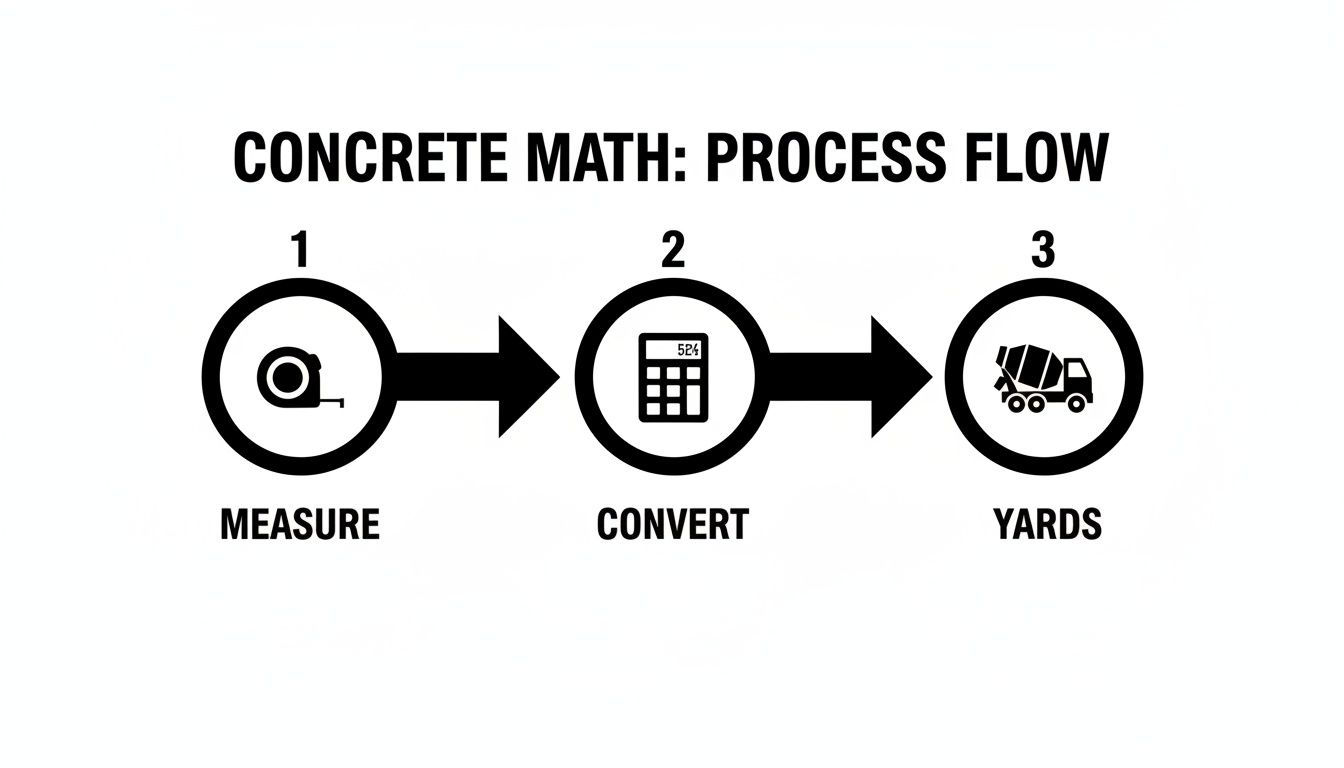
The single biggest mistake people make is forgetting to convert the slab's thickness from inches into feet before doing the final calculation. Get that right, and you're golden.
Example 1: The Two-Car Driveway
A standard two-car driveway is a pretty big pour, so getting the volume right is critical. Let's say we're looking at a slab that's 20 feet wide by 24 feet long, poured at a typical 4-inch thickness.
First things first, let's get that depth measurement into feet.
- Depth in Feet: 4 inches ÷ 12 = 0.333 feet
Now that all our numbers are in feet, we can figure out the total cubic footage.
- Cubic Feet: 20 ft (Width) x 24 ft (Length) x 0.333 ft (Depth) = 159.84 cubic feet
The last step is to convert that into the cubic yards the concrete plant uses.
- Cubic Yards: 159.84 cubic feet ÷ 27 = 5.92 cubic yards
So, the base order for this driveway is 5.92 cubic yards. We’ll talk about adding a little extra for waste later, but this is the number you start with. Getting this basic math right is the first step for all the kinds of durable driveways you see in our project galleries.
Example 2: The Backyard Patio Slab
Patios are one of the most popular DIY projects out there. For this one, let's imagine a new patio that is 12 feet wide by 16 feet long, also at a standard 4-inch thickness.
You know the drill. Convert the depth to feet.
- Depth in Feet: 4 inches ÷ 12 = 0.333 feet
With that handled, we can find our total cubic feet.
- Cubic Feet: 12 ft (Width) x 16 ft (Length) x 0.333 ft (Depth) = 63.94 cubic feet
And finally, turn that into cubic yards for your order.
- Cubic Yards: 63.94 cubic feet ÷ 27 = 2.37 cubic yards
You'll need to order 2.37 cubic yards of concrete for this patio. Once you have a handle on the material needed, you can start thinking about the bigger picture, like choosing between a concrete patio vs deck.
Pro Tip: See the pattern here? The process is exactly the same whether you're pouring a massive driveway or a small pad. Measure, convert your thickness to feet, multiply to get cubic feet, and then divide by 27. Master that sequence, and you can calculate any rectangular slab with confidence.
Example 3: The Long Sidewalk
What about something long and skinny, like a new sidewalk? The math doesn't change one bit. Let’s calculate the concrete needed for a walkway that is 3 feet wide, 50 feet long, and 4 inches deep.
Again, we have to start with that critical depth conversion.
- Depth in Feet: 4 inches ÷ 12 = 0.333 feet
Next, find the volume in cubic feet.
- Cubic Feet: 3 ft (Width) x 50 ft (Length) x 0.333 ft (Depth) = 49.95 cubic feet
Finally, let's get our yardage.
- Cubic Yards: 49.95 cubic feet ÷ 27 = 1.85 cubic yards
That new sidewalk will require 1.85 cubic yards of concrete. These examples prove that no matter the dimensions, the same reliable formula works every time for a square or rectangular pour.
Why You Should Always Order Extra Concrete
Trust me on this one: ordering the exact amount of concrete your calculator gives you is a classic rookie mistake. I’ve seen it happen time and again. On paper, the math is perfect. But on a real job site? Things are never that clean, and coming up short can bring your entire project to a grinding halt.
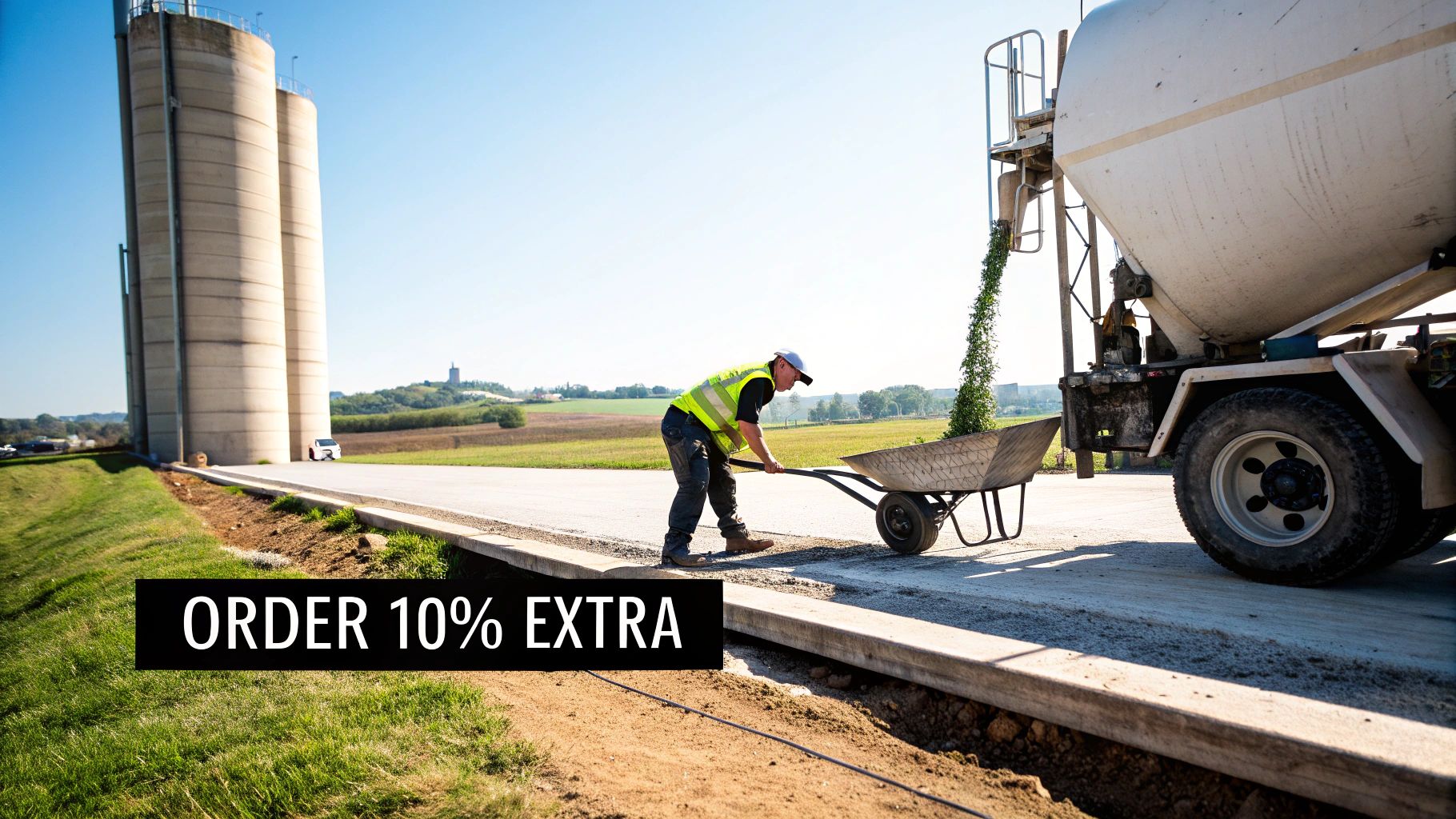
This is where the seasoned pro’s secret comes in: ordering "overage." Think of it as a waste factor. It’s not about being bad at math; it’s about smart planning for the messy reality of a construction site. A little extra concrete is your insurance policy against a costly and frustrating second delivery fee for just a tiny bit of material.
So, Where Does the Extra Concrete Go?
If your measurements are spot-on, you're probably wondering why you'd ever need more. Well, several small, sneaky factors can eat into your supply.
- Uneven Subgrade: You can grade a site to near perfection, but the ground under your forms is never perfectly flat. Small dips and low spots will fill up with concrete, making your slab slightly thicker in those areas and using up more material than you planned. For example, a low spot just 1/2 inch deeper across a 10×10 slab can consume an extra 4 cubic feet of concrete.
- Form Bowing: Wet concrete is incredibly heavy. The pressure it exerts can cause your wooden forms to bow outward, especially on larger pours. Even a quarter-inch bulge over a long run can consume a surprising amount of concrete.
- Spillage and Waste: It's just part of the job. Some concrete will inevitably spill as it comes down the chute or gets moved in a wheelbarrow. Plus, a certain amount always clings to the inside of the mixer truck and its equipment.
Coming up short isn't just an inconvenience; it can create a "cold joint." That's a weak spot where new, wet concrete is poured against concrete that has already begun to set. It compromises the strength and finished look of the whole project.
The Pro’s Rule of Thumb for Overage
To sidestep all these potential headaches, the industry standard is simple: add 10% to your final calculated yardage. It’s a small buffer that accounts for all those little real-world variables. This is the crucial final step when you figure concrete yards for an order.
Let’s say you calculated that your patio needs exactly 5.0 cubic yards. A smart order would be for 5.5 yards (5.0 x 1.10 = 5.5). That extra half-yard buys you peace of mind, guaranteeing you have enough material to fill every corner and get a perfect finish without sweating the last few wheelbarrows. For a smaller 2-yard pour, a 10% overage is just 0.2 yards, a very small price to pay for security.
Placing Your Concrete Order with Confidence
Alright, you’ve crunched the numbers and have your final yardage. Knowing how to figure concrete is a huge part of the job, but the next step—actually ordering it—is where your project really starts to take shape.
Making a confident, well-prepared call to your ready-mix supplier can be the difference between a smooth pour day and a stressful mess. Let's make sure you have everything buttoned up before you dial.
What Your Supplier Needs to Know
Before you even think about picking up the phone, get your details lined up. The dispatcher is managing a complex schedule, and when you come prepared, it makes their job easier and ensures your truck shows up on time with the right mix.
Here's what they'll ask for:
- Your Exact Yardage: Be direct. Tell them the final number, including the 10% overage we talked about. For instance, say, "I need 5.5 yards."
- Concrete Strength (PSI): This is crucial. For most patios, sidewalks, and other foot-traffic areas, 3000 PSI is the standard. If you're pouring a driveway that needs to hold cars or trucks, you’ll want to step it up to 4000 PSI. Specify this clearly. For example: "I need 5.5 yards of 4000 PSI concrete."
- Delivery Address: Give them the full street address. If there are any quirks to finding your job site, like a tricky turn or a specific gate to use, mention it now. "Come in off Elm Street, it's the gate by the big oak tree."
- Your Contact Info: They need a reliable phone number for the driver to call on pour day. Make sure it's a number you'll actually answer.
Having this information ready makes the whole process quick, professional, and mistake-free.
Logistics for a Smooth Delivery Day
Never forget that a concrete truck is a beast. Fully loaded, it can weigh up to 70,000 pounds. You absolutely have to plan its path onto your property.
Take a walk and look up. Are there low-hanging power lines or tree branches in the way? Look down. Is the ground soft, wet, or sandy? The last thing you want is a multi-ton truck sinking into your lawn. The driver needs a clear, stable route to get as close to your forms as possible. For instance, driving over a septic tank or leach field is a definite no-go.
A good rule of thumb is to have at least 10-12 feet of width and a solid 14 feet of vertical clearance. If the driver can't safely get in, they won't, and you'll be stuck wheelbarrowing concrete a lot farther than you planned.
Finally, have your crew, your wheelbarrows, and your finishing tools ready to go before the truck even pulls up. The moment that concrete is mixed, the clock starts ticking. You've got about 90 minutes to get it all placed and finished before it starts to set up on you.
Good preparation is everything. If you're feeling overwhelmed by the logistics, that's what we're here for. Feel free to contact our team at Atlanta Concrete Solutions and we can help you plan your pour.
Still Have Questions About Calculating Your Concrete?
It's one thing to understand the formulas, but when you're standing there with a tape measure, new questions always seem to pop up. Don't worry, that's completely normal. Let's tackle some of the most common ones we hear from folks right before they place an order.
Getting the math right can be a real headache, and honestly, a lot of the high-level industry info out there isn't very helpful for a real-world project. You might see reports on global cement market trends, but they won't tell you how to pour a patio. Let's stick to the practical stuff.
What About Circular Slabs or Footings?
Of course, not every project is a simple rectangle. When you're dealing with round shapes like a circular patio or sonotube footings for a deck, you just need to switch up the formula slightly. For cylinders, the volume is π × radius² × height.
Let's imagine you need to pour a footing that’s 2 feet across (diameter) and 3 feet deep.
- First, find your radius. The radius is just half the diameter, so 2 feet ÷ 2 gives you a 1-foot radius.
- Next, plug it into the formula. Using 3.14 for π, your calculation is 3.14 × (1 ft)² × 3 ft, which equals 9.42 cubic feet.
- Finally, convert to yards. Just like with a square slab, divide by 27. So, 9.42 ÷ 27 = 0.35 cubic yards for each footing.
Just be sure to multiply that number by how many footings you plan to pour. For example, if you have 10 footings, you'd need 0.35 x 10 = 3.5 cubic yards.
How Many Bags of Concrete Do I Need?
If you're just setting a fence post or doing a small patch job, ordering a full truckload of ready-mix is overkill. Bagged concrete from the hardware store is the way to go. But how many do you grab?
The yield is printed on the bag, but here’s a good rule of thumb:
- An 80-pound bag will give you about 0.60 cubic feet of wet concrete.
- A 60-pound bag yields closer to 0.45 cubic feet.
Quick Example: Let's say a small repair requires 3 cubic feet of concrete. If you're using 80-pound bags, you'd calculate 3 ÷ 0.60, which comes out to 5 bags. I always recommend grabbing one extra bag. It's cheap insurance against running short mid-pour.
Does Concrete Strength Affect My Calculation?
This is a great question, but the answer is simple: no. The PSI (Pounds per Square Inch) of the concrete has zero effect on the volume you need.
A cubic yard of 3000 PSI concrete takes up the exact same space as a cubic yard of 4000 PSI concrete. The PSI rating is all about the mix design—the specific recipe of cement, sand, and stone—which determines its final strength once it cures. It’s crucial for the integrity of your project, but it won't change your measurements. For instance, a 4000 PSI mix might contain a higher ratio of cement to sand and aggregate, making it stronger, but its volume remains the same.
Nailing down your concrete estimate is the first big step. If you’re ready to hand the project over to a professional team that gets the pour right every single time, Atlanta Concrete Solutions is here to help. You can get a free, no-obligation quote by visiting us at https://atlantaconcretesolutions.com.