
When you're weighing a raised foundation vs. slab, the decision really comes down to what you value most for your home. A concrete slab foundation, for example, is often the go-to for its lower upfront cost and quicker build time, making it a highly efficient choice, especially on level ground like you'd find in a planned subdivision. On the other hand, a raised foundation—what many of us call a crawl space—gives you fantastic access for plumbing and electrical repairs down the road and works much better on sloped land. A classic example would be a home built on a hillside lot in Sandy Springs, where a slab would require massive excavation. Though it does cost more to build, the practicality can be invaluable.
Choosing Your Home's Foundation: Raised vs. Slab
Your foundation is literally the bedrock of your home, so picking the right one is a critical first step. This choice impacts everything from your initial construction budget and long-term maintenance costs to the very look and feel of your house. For instance, a slab foundation creates a low-profile, modern look with no steps at the entrance, while a raised foundation allows for a traditional, elevated porch. Getting a handle on the fundamental differences is key to making a smart decision that fits your property and your wallet.
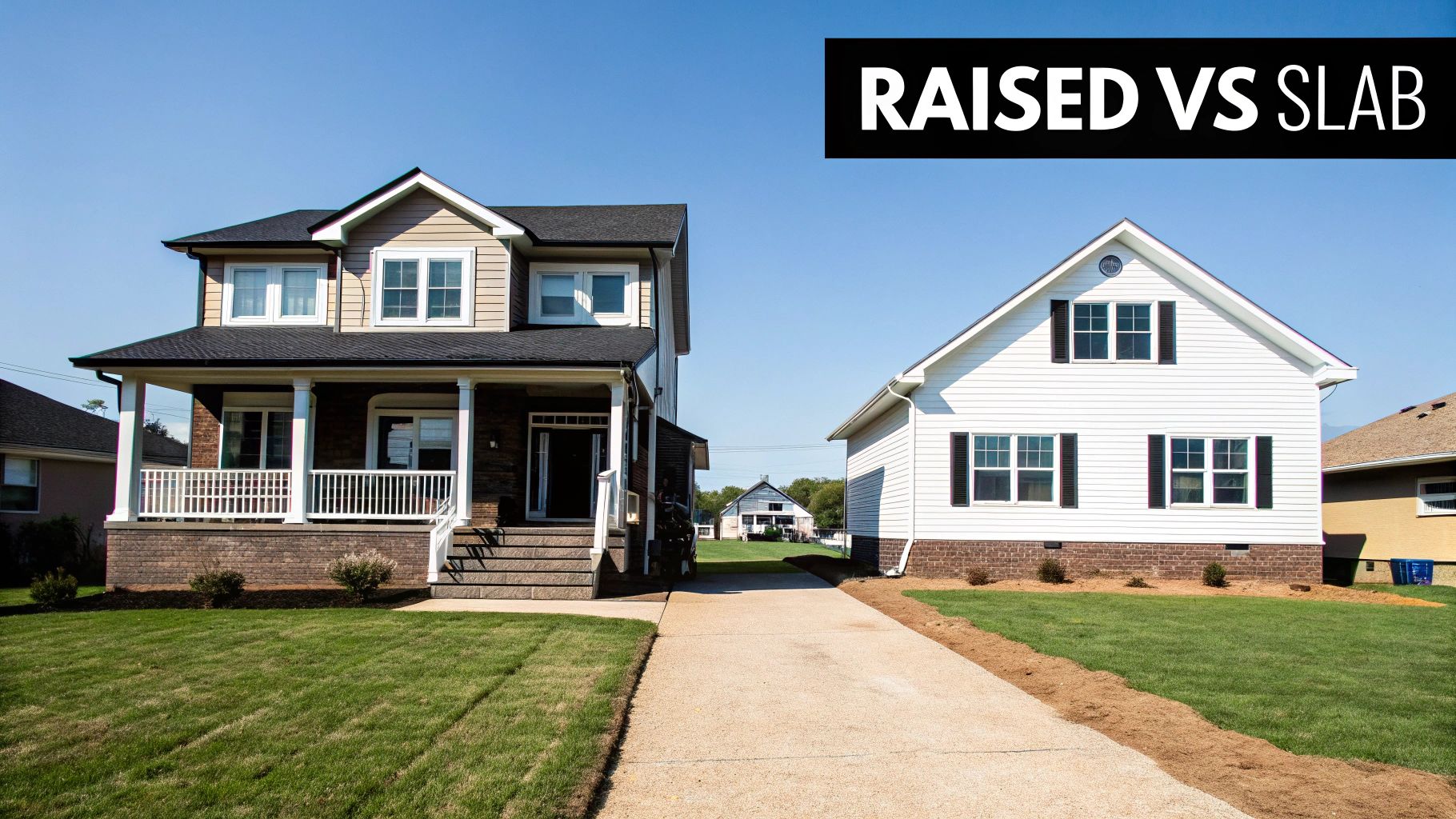
Key Structural Differences
Think of a slab-on-grade foundation as one solid sheet of concrete, typically four to six inches thick, poured directly onto a prepared patch of earth. Before the concrete is poured, all the plumbing lines and electrical conduits are laid out in trenches, becoming permanently embedded within the slab. This construction method keeps the house very close to the ground, which allows for that modern, step-free entry that is also beneficial for accessibility.
A raised foundation, however, lifts the home off the ground—typically anywhere from 18 inches to a few feet. It's built on a series of concrete piers or a continuous concrete wall (called a stem wall) that supports the entire floor system. This creates that accessible crawl space underneath, which acts as a buffer between your home and the soil, providing a space for utilities and protection from ground moisture.
To really see the trade-offs at a glance, this quick summary shows how each foundation type measures up with some concrete examples.
Quick Comparison: Slab vs. Raised Foundation
| Key Consideration | Slab Foundation | Raised Foundation (Crawl Space) |
|---|---|---|
| Initial Cost | Lower (e.g., ~$21,000 for a 2,000 sq ft home) | Higher (e.g., ~$30,000+ for a 2,000 sq ft home) |
| Construction Speed | Faster (pour and cure in days) | Slower and more complex (weeks for piers, framing) |
| Site Suitability | Best for flat, level lots | Ideal for sloped or uneven terrain |
| Utility Access | Difficult; may require breaking concrete | Easy; accessible via crawl space for repairs/upgrades |
| Durability | High resistance to pests and rot | Wood components vulnerable to moisture/pests if not maintained |
| Home Profile | Low to the ground, modern aesthetic | Elevated, traditional appearance with porch potential |
While this table gives you the high-level view, every one of these points carries a different weight depending on your specific property, especially with the diverse terrain we see here in the Atlanta area. The best choice isn't just about the initial price tag—it’s about what makes the most sense for your home's performance and practicality for years to come.
A Closer Look at Slab-On-Grade Foundations
If you've looked at newer homes, especially in the last 20-30 years, you've likely seen a slab-on-grade foundation. It's become the go-to for modern construction, and for good reason—it’s efficient and straightforward. Instead of lifting the house on piers, a slab foundation is one solid, thick sheet of concrete poured directly onto prepared ground. This single pour creates the home's base and the subfloor for the entire first level, all in one shot.
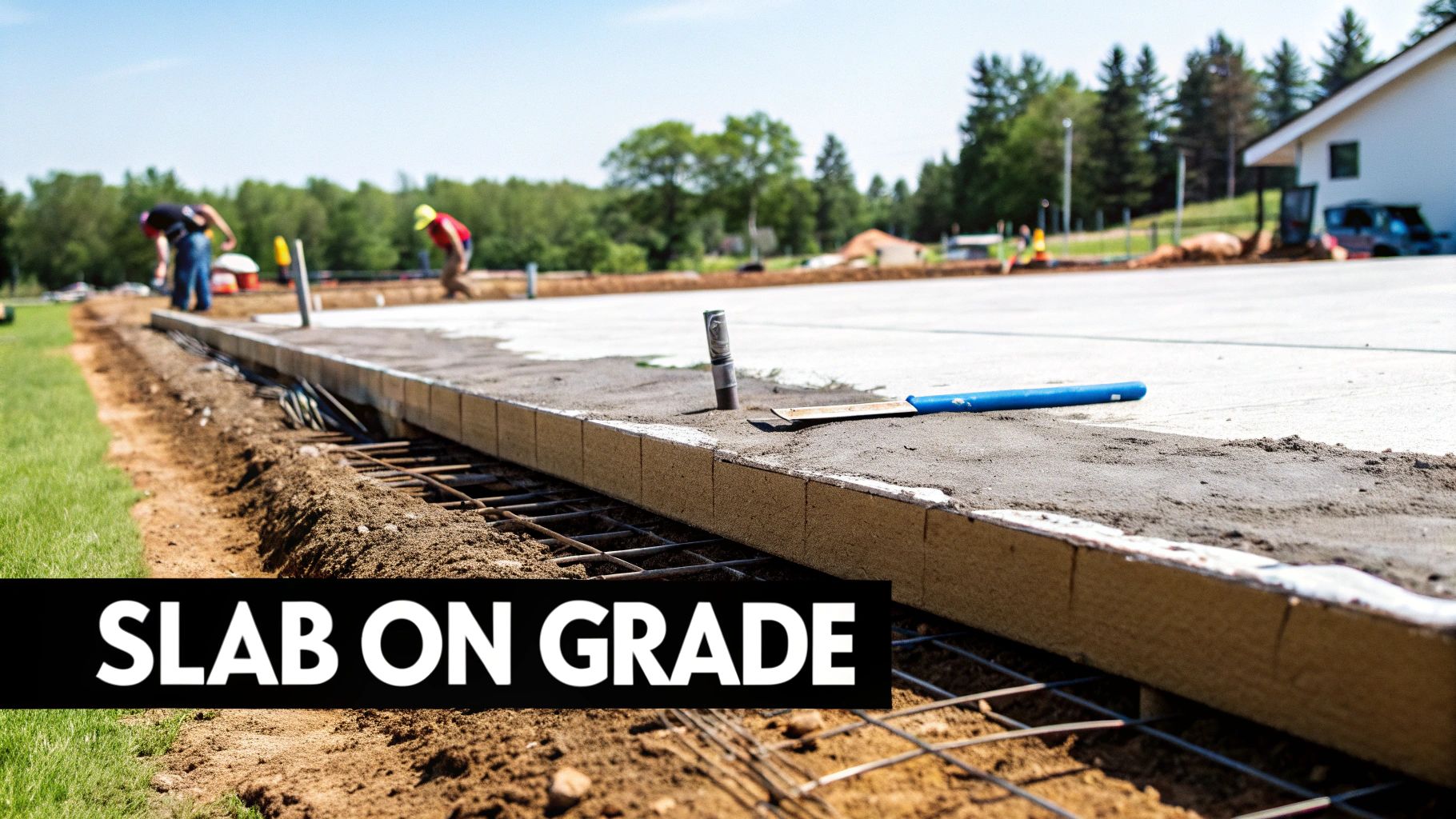
This isn't just a local trend; it's a nationwide shift. According to the National Association of Home Builders, a staggering 72.4% of new single-family homes built in 2023 used a slab foundation. That’s a huge jump from just 45.8% back in 2000, which really shows how much builders have embraced this method for its cost and time savings. For a developer building a 100-home subdivision, this efficiency translates into millions of dollars in savings and faster project completion.
How a Slab Foundation Comes Together
Putting in a slab is a precise operation that’s much more involved than just pouring concrete on the ground. To do it right, you need to create a stable, dry base that will support the home for its entire life.
The process generally unfolds in these stages:
- Site Prep: First, the ground has to be perfectly graded and leveled. We dig out any soft topsoil and bring in engineered fill (like gravel or sand), compacting it layer by layer to create a solid pad that prevents settling.
- Forms & Rough-Ins: Next, we build a wooden frame around the perimeter to hold the concrete. This is the moment of truth for plumbers and electricians, who have to lay out all the under-slab pipes and conduits in their exact final positions. A misplaced drain pipe at this stage is a huge problem later.
- Vapor Barrier: Before any concrete goes down, we lay a thick plastic sheeting (typically 6-mil polyethylene) across the entire pad. This is the vapor barrier, and its job is to block ground moisture from wicking up into the concrete and causing dampness or flooring issues.
- Steel Reinforcement: A grid of steel rebar or wire mesh is laid out inside the forms. This gives the slab tensile strength, helping it resist the pulling-apart forces that cause cracks.
- The Pour: Finally, the concrete truck arrives. The mix is poured, spread throughout the forms, and then meticulously smoothed and leveled to create the finished surface.
One of the defining features of a slab foundation is that your plumbing drains and water lines are embedded right into the concrete. It’s incredibly efficient during construction but means that any future leaks or clogs can become a major, invasive repair job. For example, fixing a cracked sewer line might involve jackhammering a trench through your kitchen tile.
This streamlined process is why you see slab foundations everywhere in large-scale residential developments around the Atlanta metro. Builders can pour them fast, keeping projects on schedule and home prices more accessible. If you're planning a project, getting familiar with the details of residential poured concrete is a smart first step.
What Makes a Slab Foundation Last?
A durable slab is more than just a big piece of concrete; it’s an engineered system. Several key components work together to ensure it can handle the weight of the house and the pressures from the ground below.
Here's what a properly built slab needs:
- Thickened Edges: The concrete along the perimeter, where the walls will sit, is poured deeper and thicker than the middle of the slab. This "footing" is what spreads the structural load out over a wider area of soil, preventing the edges from sinking or cracking.
- Vapor Barrier: In a humid place like Georgia, this is non-negotiable. It’s your primary defense against the moisture that causes mold, ruins floors, and creates that musty smell. A good example of failure is when hardwood floors start to warp or buckle years after installation due to moisture coming through the slab.
- Steel Reinforcement: Concrete has immense crushing strength, but it's relatively weak when pulled. That’s where the steel comes in. Rebar or mesh handles the tension, preventing soil shifts or heavy loads from cracking the slab apart.
These components combine to form a solid platform that's naturally resistant to termites and the wood rot that can plague raised foundations. This built-in resilience is a central point in the ongoing raised foundation vs slab debate.
A Closer Look at Raised and Crawl Space Foundations
Slab foundations are quick and simple, but they're not the only game in town. The more traditional approach—a raised foundation, often called a pier-and-beam or crawl space foundation—offers a completely different philosophy for building a home. Instead of placing the house directly on a concrete pad, this method lifts the entire structure off the ground, creating a vital buffer between your living space and the earth itself.
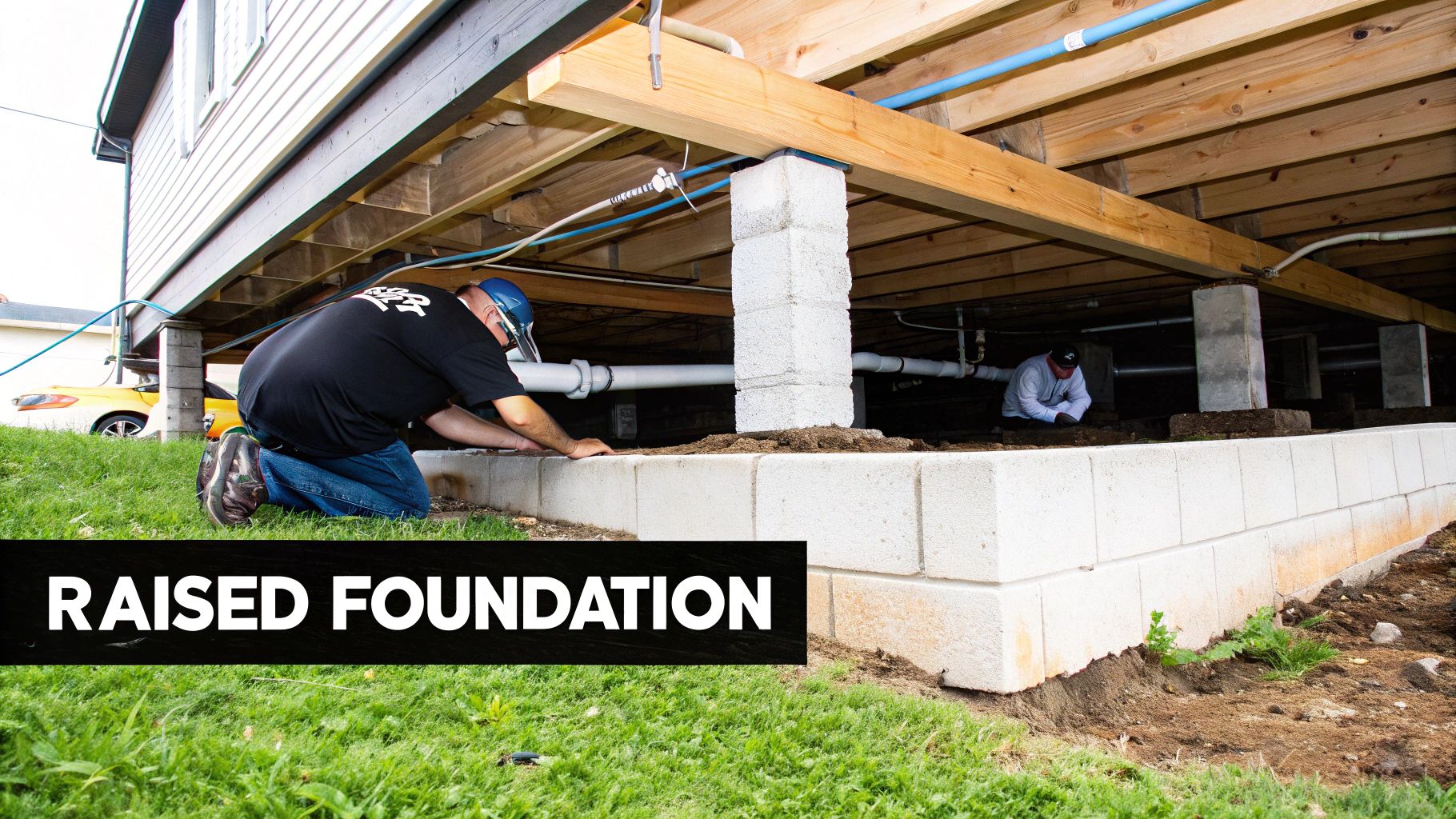
The construction starts with concrete footings poured deep into the ground. On top of these, concrete piers or continuous foundation walls (called stem walls) are strategically placed to handle the home's weight. Heavy wooden beams, or girders, are laid across these supports, forming the skeleton for the floor joists. This design elevates the home 18 inches or more off the ground, creating that signature crawl space underneath.
The Clear Winner on Sloped Lots
One of the biggest wins for a raised foundation is how effortlessly it handles uneven land. If you're building on one of Atlanta's many hilly or sloped properties, this is a total game-changer. Forget about massive, expensive excavation projects just to level out a pad for a slab. A raised foundation simply adapts to the land as it is.
The concrete piers are built to varying heights, creating a perfectly level platform for the house, no matter the slope. This can save you thousands in grading costs and, just as importantly, it preserves the lot's natural landscape and drainage. Take a drive through historic Atlanta neighborhoods like Virginia-Highland or Inman Park. You'll see countless older homes built this way, sitting gracefully on land that would be a nightmare for a modern slab.
Here's the bottom line: a raised foundation works with the land. A slab foundation forces you to reshape the land to fit it. For challenging building sites, that adaptability makes all the difference.
Unbeatable Access for Utilities and Repairs
That crawl space isn't just empty air; it's probably the most practical, long-term benefit of choosing a raised foundation. Think about it: with a slab, all your plumbing, wiring, and HVAC ductwork are buried in concrete. Forever. With a crawl space, those critical systems are neatly routed through the open area right beneath your floor.
This easy access makes a world of difference for routine maintenance and future upgrades:
- Plumbing Nightmares Averted: A leaky pipe is a straightforward fix. A plumber gets under the house, finds the problem, and repairs it. With a slab, that same leak could mean jackhammering through your living room floor. For example, a $300 pipe repair could become a $3,000 job after accounting for concrete demolition and floor restoration.
- Easy Electrical and HVAC Work: Need to add a new outlet for a home office, run ethernet cables, or reconfigure your ductwork for a new AC unit? Technicians can work freely in the crawl space without tearing up your home.
- Pest Control and Inspections: Termite inspectors can get a clear view of the entire wooden substructure, allowing them to catch infestations before they become a disaster.
This kind of accessibility is a huge plus. Over the life of your home, you'll save a ton on labor costs for repairs and renovations. While the upfront cost is higher, the long-term savings and convenience often make it a smart investment. Digging into the different types of residential foundation concrete options can show you exactly how these systems are built for both durability and easy access.
A Practical Cost Comparison of Foundation Types
When you're weighing a raised foundation against a slab, the first thing on everyone's mind is money. It’s easy to get fixated on the initial price tag, but the smartest approach looks at the whole picture—upfront construction costs and what you might be paying for maintenance and repairs down the road.
Let's be clear: slab foundations almost always win on initial affordability. The process is just simpler. You're looking at less labor, fewer materials, and a quicker build time compared to a raised foundation. For anyone trying to keep that initial budget in check, a slab is tough to argue with.
But that's just chapter one of the financial story.
Understanding Upfront Construction Costs
The price difference right out of the gate is pretty significant. A slab-on-grade foundation is consistently the more budget-friendly choice when you're just looking at the construction bill.
Recent numbers back this up. A 2022 cost analysis showed slab-on-fill foundations typically running between $103 to $211 per square meter. Compare that to a crawl space foundation, which ranged from $147 to $280 per square meter, and you can see it's a more expensive choice from day one. For a typical 2,000-square-foot home, this could mean a slab costs around $21,000 while a raised foundation could easily exceed $30,000.
So, where does that extra cost come from? A few key places:
- Labor Hours: A raised foundation is built in stages—digging footings, building piers or walls, then framing a whole floor system. It’s just more hands-on work than pouring a single slab.
- Material Needs: You're not just paying for concrete. Raised foundations need concrete for footings, block or poured concrete for stem walls, and then all the lumber for the girders and floor joists.
- Site Prep: While raised foundations are brilliant for sloped lots, a slab is much cheaper to install on flat ground that doesn't need much grading.
The Hidden Costs of Long Term Repairs
This is where the math starts to get a little more interesting. That low upfront cost of a slab comes with a big catch: your home’s plumbing and electrical lines are buried inside the concrete. This means a simple repair can turn into a massive headache.
Think about it this way: a pipe starts leaking under your floor. With a raised foundation, a plumber grabs a flashlight, scoots into the crawl space, and fixes it. With a slab, that same leak means bringing in a jackhammer to break through your concrete foundation and flooring just to reach the pipe. Then you have to patch it all back up.
The cost difference here can be staggering. A plumbing fix that might be a few hundred dollars with a crawl space can easily jump into a multi-thousand-dollar nightmare for a slab foundation. You have to account for the demolition, the repair itself, and then restoring your floor. We've seen all kinds of complex situations in our concrete construction projects across the Atlanta area.
Maintenance Costs for Raised Foundations
Of course, raised foundations aren't free of long-term costs, either. That handy crawl space provides great access, but it can also create problems if you don't look after it. Here in Georgia, with our humidity, the exposed wood structure is vulnerable to two big things: moisture and pests.
If you have a raised foundation, you’ll want to budget for some specific upkeep to protect your investment:
- Moisture Control: Keeping water away from the foundation is critical. This usually means good drainage (like French drains) and often a vapor barrier laid across the crawl space floor.
- Crawl Space Encapsulation: For the best protection, many people choose to fully encapsulate their crawl space, sealing it off from outside humidity. A typical encapsulation for a 1,500 sq ft home can cost between $5,000 and $15,000, but it’s incredibly effective at stopping mold, wood rot, and pests.
- Pest Inspections: Regular termite inspections are non-negotiable. You need to catch any issues before they compromise the wooden floor system.
While these maintenance tasks are an added expense, they're usually predictable. You can plan for them, unlike the sudden, chaotic expense of jackhammering your living room floor for an emergency repair.
So, How Do You Choose the Right Foundation for Your Property?
Picking between a raised foundation and a concrete slab isn't just a choice between two construction methods. It's about making a decision that fits your specific piece of land, the local climate, and how you want to live in and maintain your home for years to come. When you break it down, a few key factors usually point you in the right direction.
This little guide can help you see how the details of your property—the site itself, our Georgia climate, and your need for future access—make one option a better fit than the other.
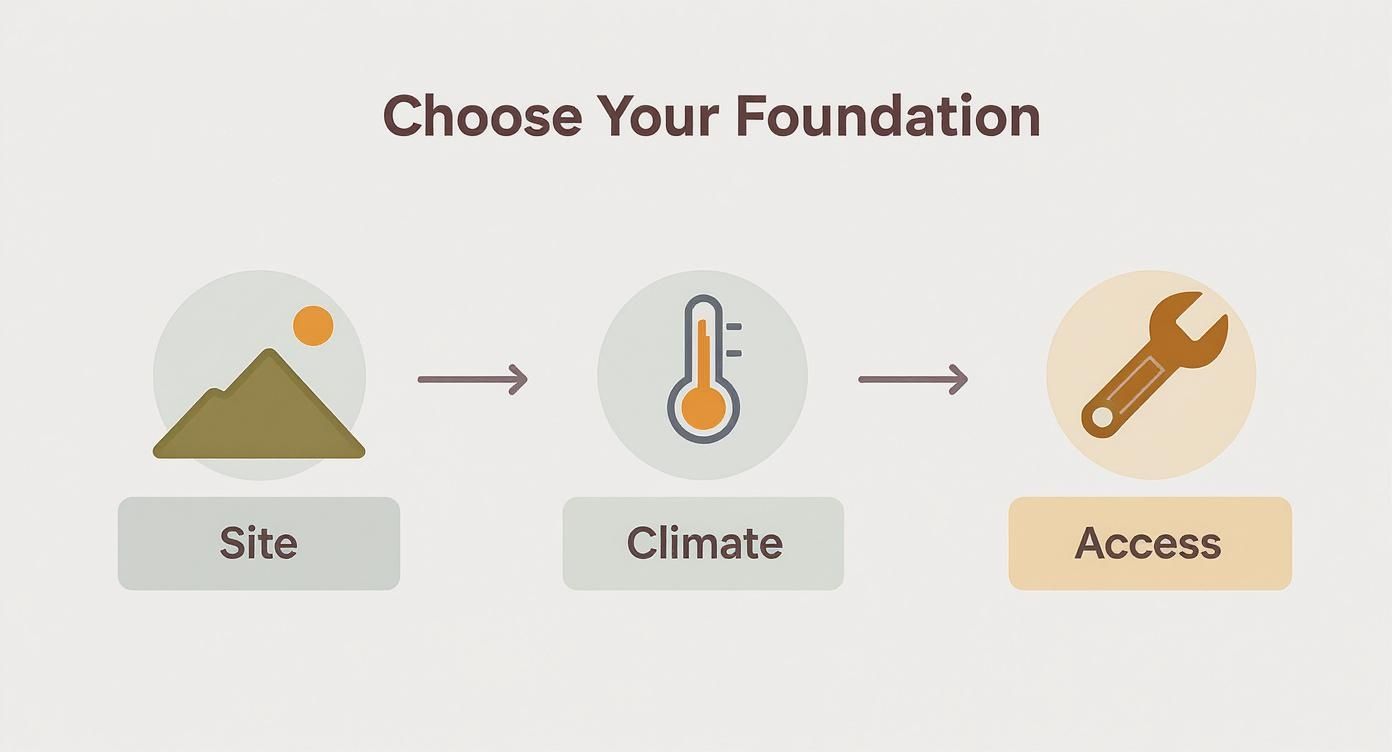
As you can see, a sloped lot almost immediately points to a raised foundation. On the flip side, if you're building on flat ground and want something that's mostly "set it and forget it," a slab is often the go-to.
Site Conditions: What’s Happening Under Your Feet?
Everything starts with the ground itself. The slope and soil on your property are probably the biggest deciding factors and can make the choice surprisingly simple.
-
Sloped Lots: If you're building on land with any real slope, a raised foundation is almost always the best answer. It’s designed to adapt to uneven terrain using piers of different heights. This approach works with the land, saving you the massive expense of excavating and grading that would be needed to create a flat pad for a slab. Think about building on a hilly lot in one of the North Atlanta suburbs—a pier-and-beam system just makes more sense.
-
Soil Type: We all know about the expansive clay soil here in the Atlanta area. It swells up when it’s wet and shrinks like crazy when it dries, which puts incredible stress on a foundation. While a good engineer can design either type for our soil, a slab foundation is much more likely to crack if the ground preparation isn't absolutely perfect. A raised foundation, however, transfers the home’s weight down through its piers to deeper soil layers that are far more stable, giving it a real advantage in these tricky conditions.
Climate Impact: Humidity and Temperature Swings
Georgia’s climate brings its own set of challenges to the table. Our hot, humid summers and generally mild winters affect each foundation very differently.
A slab foundation has what's called thermal mass, which means the big block of concrete can absorb heat all day and then release it slowly through the night. It's a small thing, but it can help keep your indoor temperatures a bit more stable and might even trim a little off your energy bills. For example, on a hot summer day, your floor stays cooler for longer.
On the other hand, the crawl space under a raised foundation can become a humidity trap, especially here in Atlanta. If it isn't properly ventilated or fully encapsulated, that damp air can lead to mold, mildew, and eventually rot in your floor joists. A slab is sealed by nature, but a raised foundation demands that you stay on top of moisture control.
Repair Access and Long-Term Headaches
Think about the future. How easy do you want it to be to fix things down the road? This is where the practical differences between the two foundation types really hit home.
A raised foundation gives you unbeatable access to all your home's guts—the plumbing, electrical wires, and HVAC ducts. If a pipe starts leaking or you decide to run new wiring, a contractor can simply get into the crawl space and handle it. It's a straightforward job.
Now, imagine that same plumbing leak under a slab foundation. The only way to get to it is by jackhammering through your concrete floor and whatever flooring is on top of it. It’s messy, destructive, and expensive. This is a huge long-term risk. In fact, construction research shows that even freshly poured slabs can have surface elevation differences averaging 0.7 to 0.75 inches, highlighting just how critical a perfectly stable base is. You can read more about the empirical guidelines for slab settlement on the NAHB blog to see why this matters so much.
At its core, the trade-off is this: A slab is lower maintenance day-to-day, but a raised foundation makes life infinitely easier—and cheaper—when something eventually breaks.
The Look and Feel of Your Home
Don't forget about aesthetics. The foundation you choose plays a big part in your home's overall architectural style and how it sits on your property.
-
Slab Foundations: These give a home a sleek, low-profile look. The house sits right on the ground, which means you can have step-free entryways. This is really popular in modern designs and is great for accessibility. For example, Ranch-style or Mid-Century Modern homes often use slab foundations to achieve their characteristic ground-hugging appearance.
-
Raised Foundations: Elevating the house creates a more traditional, commanding presence. It often feels more classic and opens the door for features like a big, welcoming front porch with steps—a true hallmark of Southern architecture. Think of the classic Craftsman bungalows in neighborhoods like Grant Park.
Ultimately, your decision comes down to balancing the upfront cost against the realities of your site and your tolerance for future repair hassles. A budget-conscious project on a flat lot might lead you to a slab, but if you're on a slope or you're thinking about long-term serviceability, a raised foundation is often the smarter investment.
Making the Final Decision for Your Atlanta Home
So, how do you pull all this information together and make the right call? The choice between a raised foundation and a slab isn't about which one is universally "better." It's about matching the foundation's strengths to your property, your budget, and your long-term plans for your Atlanta-area home.
When you get right down to it, a few key factors usually make the decision for you. Getting this part right means building a home that’s stable, comfortable, and financially sound for years to come.
A Simple Checklist for Your Foundation Choice
To cut through the noise, just ask yourself these essential questions. The answers will almost always lead you to the right foundation for your build.
-
Is my building lot sloped? If there's any significant grade to your land, a raised foundation is almost always the smarter, more economical choice. It’s designed to work with the natural landscape, saving you a small fortune in excavation and site prep.
-
Is my budget the absolute top priority? For anyone building on a flat lot and needing to keep initial costs down, the slab foundation is the hands-down winner. It goes in faster and uses fewer materials, simple as that.
-
How important is easy access for future repairs? If the idea of a plumbing leak turning into a jackhammer-and-concrete-dust nightmare keeps you up at night, you’ll want a raised foundation. That crawl space is your golden ticket to simpler, cheaper repairs and upgrades down the road.
-
Am I worried about moisture and humidity? This is a big one here in Georgia. A slab offers a solid, continuous barrier against ground moisture. A raised foundation, on the other hand, needs a solid moisture management plan—like crawl space encapsulation—to keep humidity, mold, and pests at bay.
A slab foundation is the perfect fit when budget and low maintenance are your top concerns on a level site. A raised foundation is the wiser long-term play for sloped lots or for any homeowner who values easy service access over initial cost savings.
Situational Recommendations
Let's look at how this plays out in some common Atlanta scenarios.
Choose a slab foundation if: You’re building a production home in a newer, level subdivision like those found in Gwinnett or Henry County, where sticking to a tight budget is critical. You're aiming for a modern, low-profile home aesthetic with a no-step entry and you're okay with the fact that future plumbing repairs might be more disruptive.
Choose a raised foundation if: Your lot has a noticeable hill, like many properties in areas like Marietta, Roswell, or the North Georgia foothills. You see this as your "forever home" and want the peace of mind that comes with knowing plumbing or electrical work won't require tearing up your floors and your budget.
Got Questions? We've Got Answers
Even with all the details laid out, you probably still have a few lingering questions about which foundation is right for your Atlanta-area home. That's completely normal. Making the right choice comes down to a few key scenarios, so let's tackle the questions we hear most often from homeowners just like you.
Which Foundation Is Better for High Moisture Areas Like Georgia?
Here in Georgia, humidity isn't just a part of the weather; it's a major factor in home construction. How each foundation type handles that constant moisture is a critical difference. A slab foundation, being a single pour of concrete, acts as one solid barrier against moisture seeping up from the ground.
A raised foundation, on the other hand, needs a more deliberate approach to keep that crawl space dry and healthy. You can't just leave it exposed to the damp Georgia soil. There are two main lines of defense:
- Vapor Barriers: Think of this as the first step. We lay down a heavy-duty plastic liner across the dirt floor of the crawl space. This simple barrier does a surprisingly good job of stopping moisture from evaporating up into the space.
- Crawl Space Encapsulation: This is the gold standard for our climate. We completely seal the crawl space from the outside world—sealing the vents, insulating the walls, and covering everything with a vapor barrier. Then, a dehumidifier is installed to actively manage the air, creating a dry, conditioned space that protects all that wood framing from any chance of rot or mold.
A slab is naturally sealed, but a properly encapsulated crawl space gives you total control over the environment beneath your home. It’s the most robust way to fight back against Georgia's relentless humidity.
Can I Convert a Slab Foundation to a Raised One?
We get this question every now and then, usually from someone frustrated with accessing under-slab plumbing. While it might sound like a good idea in theory, the reality is that converting a slab to a raised foundation is almost always a non-starter due to astronomical costs and complexity.
Just think about the process: it would mean lifting your entire house off its current footing, completely demolishing the concrete slab, and then building a brand-new pier-and-beam system from scratch before setting the house back down. It's a massive, high-risk, and incredibly expensive job. For example, the cost of lifting a house alone can start at $10,000-$40,000 before you even begin the foundation work. The total project could easily exceed $100,000, which is why it's not a service you'll see anyone realistically offering.
How Do I Spot Signs of Foundation Failure?
Catching foundation problems early can be the difference between a manageable repair and a five-figure nightmare. The warning signs are a little different for each foundation type, so you need to know what you’re looking for.
For Slab Foundations, Look For:
- Cracks spreading across the concrete floor or zigzagging up exterior brick walls.
- Doors that suddenly start sticking or won't latch, and windows that are tough to open.
- A noticeable slope or unevenness in your floors—you might feel it before you see it. For example, a marble placed on the floor rolls to one side of the room.
For Raised Foundations, Be Alert For:
- A bouncy or soft feeling underfoot; in worse cases, you’ll see visible sagging in the floors.
- Cracks showing up in your interior drywall, especially above doorways and window frames.
- A quick look into the crawl space reveals dampness, visible mold, or rotting wood on the posts and beams. You might also notice a musty smell inside the house.
If any of these red flags pop up, don't wait. The best thing you can do is call for a professional inspection right away. An expert can get to the root of the problem—whether it's on a raised foundation vs slab—and tell you exactly what needs to be done to fix it.
Ready to lay the groundwork for your new home or tackle an existing foundation issue? The team at Atlanta Concrete Solutions has the local expertise to ensure your project is built on a solid, reliable base. Contact us today for a free, no-obligation quote!