
When you hear someone talk about a "yard of concrete," it's easy to picture a measuring tape stretching out 3 feet. But in the world of construction and concrete work, we're actually talking about volume.
Think of it this way: a "yard" is really just industry shorthand for one cubic yard. This is the standard unit of measurement everyone—from the ready-mix plant to the contractor on-site—uses to order concrete. For example, if a contractor is pouring a standard 10×10 foot patio slab at a 4-inch thickness, they would calculate the need for approximately 1.2 cubic yards and order that specific volume from their supplier.
What a Yard of Concrete Really Means
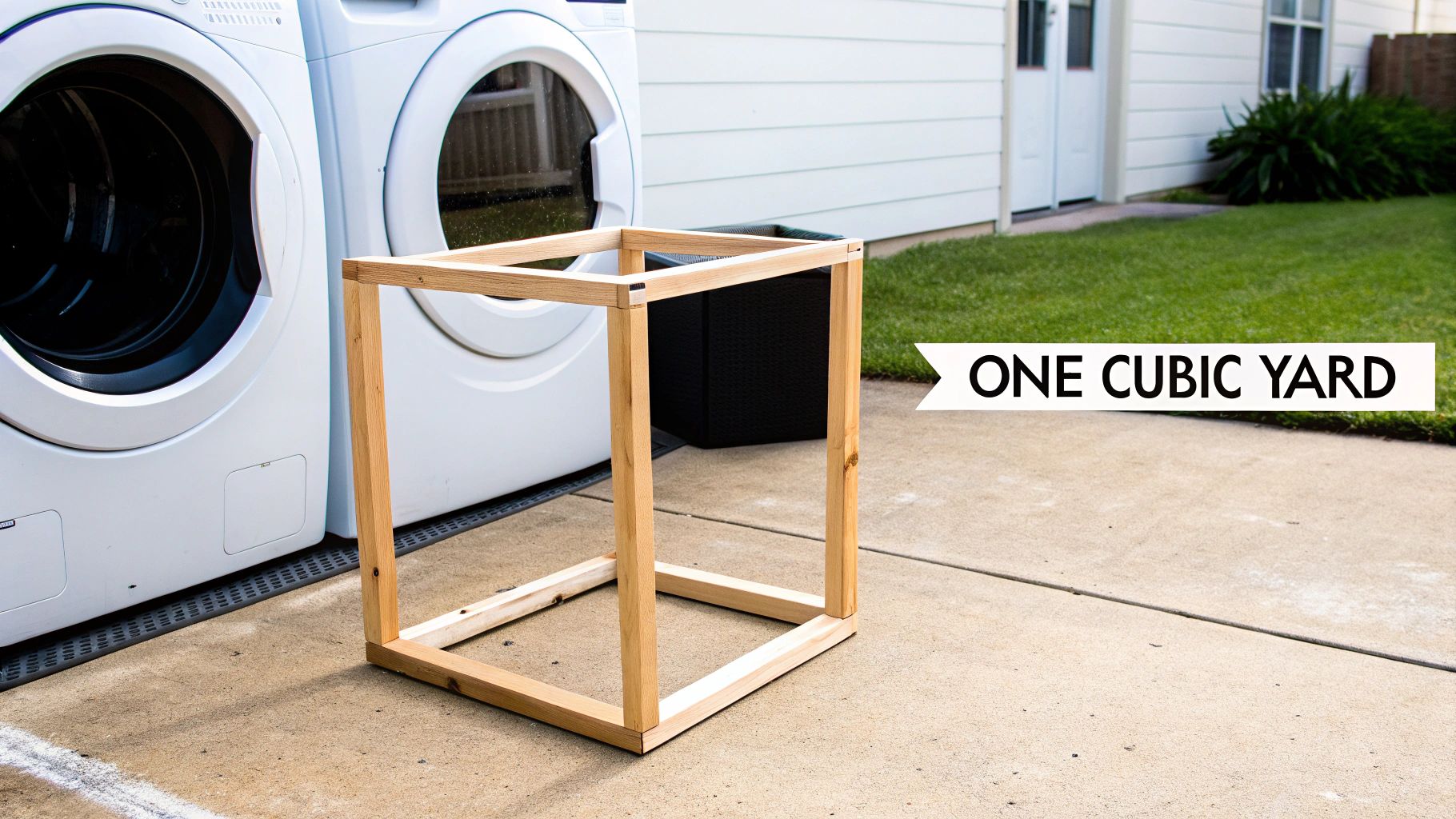
So, what does a cubic yard actually look like?
Picture a perfect cube that's 3 feet long, 3 feet wide, and 3 feet tall. The space inside that cube is exactly one cubic yard. It's this standard measurement that takes the guesswork out of ordering, whether you're pouring a small hot tub pad or a massive commercial foundation. As a real-world example, one cubic yard of concrete is roughly the volume of two standard-sized washing machines sitting side-by-side.
This single unit, which breaks down into 27 cubic feet (3 x 3 x 3), is the fundamental building block for any project estimate. It ensures everyone is speaking the same language.
A Yard of Concrete at a Glance
To put it all into perspective, here’s a quick breakdown of what makes up a single yard of concrete.
| Metric | Measurement | Example |
|---|---|---|
| Volume (Cubic Yards) | 1 | The standard ordering unit. |
| Volume (Cubic Feet) | 27 | A cube that is 3 ft x 3 ft x 3 ft. |
| Approximate Weight | 4,000 lbs (2 tons) | Equivalent to a mid-size SUV. |
| 80 lb Bags Needed | About 45 | Enough to fill the bed of a heavy-duty pickup. |
| 60 lb Bags Needed | About 60 | A full pallet's worth from a hardware store. |
These numbers give you a tangible feel for the material you're working with. It's not just about space; it's about sheer mass.
More Than Just Dimensions
Understanding that a yard of concrete fills a 3x3x3 foot space is just the starting point. For any practical application, you need to know a bit more.
- It's incredibly heavy. One yard of concrete weighs around 4,000 pounds, or two full tons. That immense density is precisely what gives it the strength and durability to support buildings, driveways, and patios for decades.
- It's a simple recipe. All that weight comes from a mix of four basic ingredients: cement, sand, gravel (also called aggregate), and water. The exact ratio of these components is what determines the concrete's final strength. For instance, a stronger mix for a driveway will have a higher proportion of cement compared to sand and gravel.
- Coverage depends on thickness. The most common question is, "How much area will a yard cover?" The answer always depends on how thick you pour the slab. A thicker slab will naturally cover less ground.
For homeowners here in the Atlanta area thinking about a new driveway, a single cubic yard—which typically runs $120-$150 locally—will cover 81 square feet at the standard 4-inch thickness. You can explore more about the industry's growth in recent concrete market reports from Allied Market Research.
Key Takeaway: A "yard" of concrete is a measure of volume (3 ft x 3 ft x 3 ft), not length. It's the universal standard for ordering concrete, ensuring clarity for both DIYers and professionals.
How Much Area One Yard of Concrete Covers
So, you know a "yard" of concrete is a measure of volume. The million-dollar question is, how much ground will it actually cover?
The answer isn't a single number. It all comes down to one critical factor: the thickness of your pour. Getting a handle on this relationship between volume, thickness, and area is the key to planning your project without a hitch.
I like to think of it like spreading frosting on a cake. That one can of frosting (your cubic yard of concrete) can give you a thin layer over a big sheet cake, or a really thick, decadent layer on a smaller cake. The amount of frosting doesn't change, just the area it covers depending on how you spread it.
It’s the exact same principle with concrete. One yard poured for a standard 4-inch residential patio will cover a lot more square footage than that same yard poured for a heavy-duty 6-inch driveway designed to handle cars and trucks. For example, a single yard would be enough for a small 9×9 foot patio but would only cover a 6×9 foot section of a driveway.
Visualizing Coverage for Common Projects
Let's put this into real-world terms to make it click. Pouring concrete at different depths completely changes the footprint you get from a single yard.
- For a Patio (4-inch thickness): One yard of concrete will give you a slab covering 81 square feet. That's a nice little 9-foot by 9-foot space, perfect for a small grill and a couple of chairs.
- For a Driveway (6-inch thickness): Take that same yard of concrete and pour it just two inches thicker for the strength a driveway needs. Now, it only covers 54 square feet. That’s a much smaller area, maybe 6 feet by 9 feet, which really shows why driveways are much bigger and more expensive jobs.
This is a make-or-break calculation for any project here in Atlanta. A simple walkway has a different formula than a shed foundation or the base for a new outdoor kitchen. Nailing the thickness from the start is what gives you a slab that lasts.
Quick Guide to Concrete Coverage
To make estimating a bit easier, here’s a handy table that breaks down how many square feet one yard of concrete covers at different thicknesses.
This is a great starting point for figuring out what you'll need.
Concrete Yard Coverage by Slab Thickness
| Slab Thickness (Inches) | Square Feet Covered Per Yard | Common Project Example |
|---|---|---|
| 3 Inches | 108 sq. ft. | Thin walkways or sub-bases for pavers |
| 4 Inches | 81 sq. ft. | Standard patios, sidewalks, and shed floors |
| 5 Inches | 65 sq. ft. | Hot tub pads or residential driveways with light traffic |
| 6 Inches | 54 sq. ft. | Heavy-duty driveways or garage floors for SUVs/trucks |
| 8 Inches | 41 sq. ft. | Commercial floors or foundations for heavy equipment |
| 12 Inches | 27 sq. ft. | Footings, piers, or thick foundation walls for buildings |
Just remember, these numbers are for perfectly level ground.
Pro Tip: Always base your calculations on the thickest part of your pour. If your ground is uneven, some spots will gobble up more concrete to stay level. For example, if a 4-inch slab has a dip that goes to 5 inches, that one spot uses 25% more concrete. Factoring this in from the beginning is the best way to avoid a costly last-minute call for more concrete.
How to Calculate Your Concrete Needs
Alright, let's get down to the practical side of things. Figuring out how much concrete you need is actually a lot simpler than most people think. With a tape measure and a quick bit of math, you can confidently figure out the right amount for your job, so you're not left with a massive surplus or, even worse, run out halfway through.
It all boils down to one simple formula. First, you need to get three measurements of your project area: the length, the width, and the thickness (or depth). The key here is to have them all in the same unit—feet. Since we usually measure slab thickness in inches, just remember to divide that number by 12 to convert it to feet. For example, a 6-inch thickness becomes 0.5 feet.
The Universal Concrete Formula
Once you have all three dimensions in feet, the math is easy:
(Length in ft x Width in ft x Thickness in ft) / 27 = Cubic Yards Needed
Let's walk through a common Atlanta project. Say you're pouring a new section of a driveway that's 10 feet by 20 feet and needs to be 4 inches thick.
- Convert Thickness to Feet: 4 inches ÷ 12 = 0.333 feet.
- Calculate Cubic Feet: 10 ft (Length) x 20 ft (Width) x 0.333 ft (Thickness) = 66.6 cubic feet.
- Convert to Cubic Yards: 66.6 cubic feet ÷ 27 = 2.47 cubic yards.
In this scenario, you'd round up and order 2.5 yards of concrete. You can see how different factors come into play by checking out our guide on professional concrete solutions for residential driveways.
This visual really brings home how much the thickness of your pour affects your coverage.
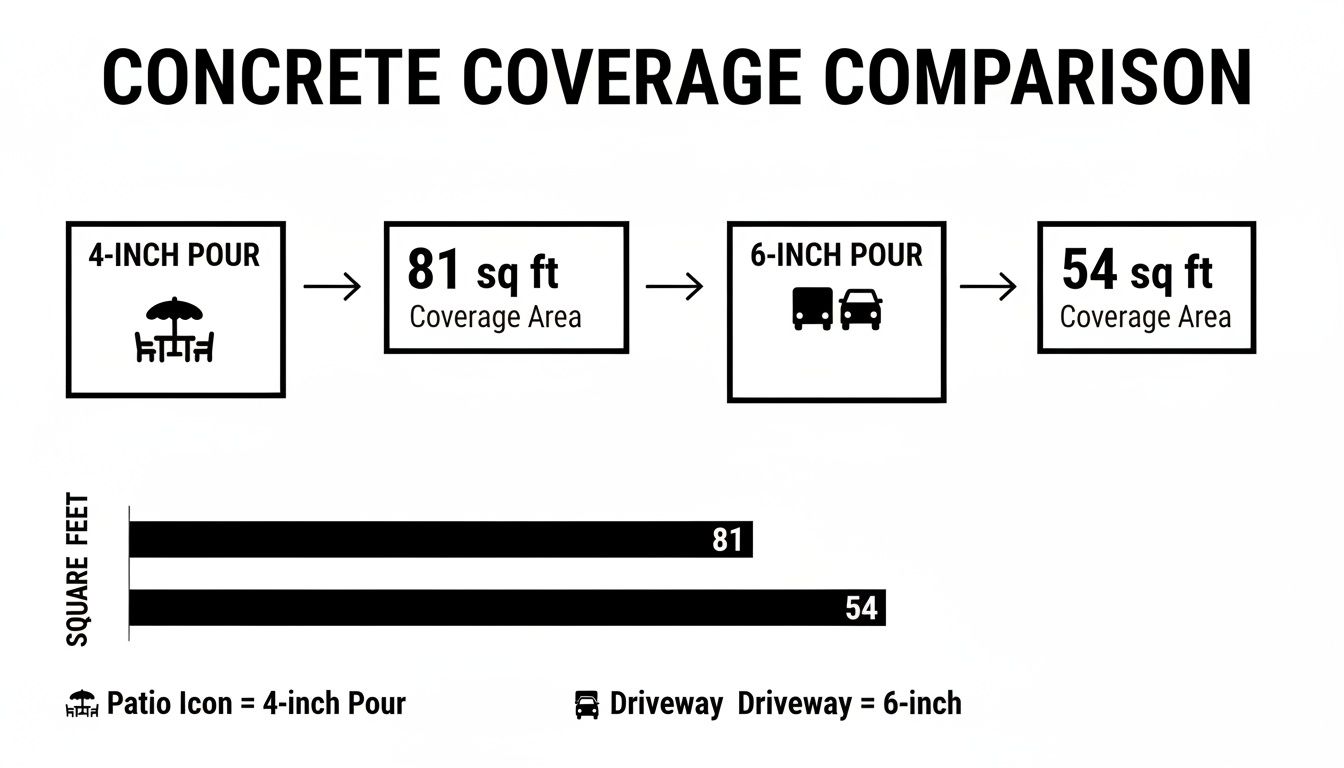
As you can see, the exact same yard of concrete covers 33% less ground when you pour it 6 inches deep instead of 4 inches. That’s why getting your thickness measurement right is so critical.
Why You Should Always Order Extra
Now for a pro tip that can save you from a world of hurt: always order about 10% extra. I know, it feels weird to intentionally buy more than you calculated, but trust me, that little buffer is your best friend on pour day. For our 2.5-yard driveway example, a 10% overage means ordering 2.75 yards.
Ordering a 10% waste allowance is non-negotiable for professionals. It accounts for uneven subgrade, spillage, and form deflection, preventing the nightmare scenario of running out mid-pour and facing costly delays or short-load fees.
Running out of concrete before the job is done is a real disaster. You end up with what's called a "cold joint"—a weak seam where the cured concrete meets the fresh pour—that can seriously compromise the strength of your entire project. Plus, trying to get a small batch delivered to finish the job almost always comes with a hefty short-load fee, which can sometimes cost more than the concrete itself.
Think of that small overage as cheap insurance. It protects you from stress, project delays, and the risk of a weak final product. It gives you the wiggle room to handle a little spillage or a low spot in the ground, ensuring you have enough to get the job done right, the first time.
What's a Yard of Concrete Really Made Of? And Why Does It Weigh So Much?
It's easy to talk about volume, but the sheer heft of concrete is where you really start to appreciate its power. A single cubic yard of concrete weighs around 4,000 pounds—that's two tons. It's this incredible density that gives concrete its legendary strength and durability.
But what actually goes into making something so heavy and so strong?
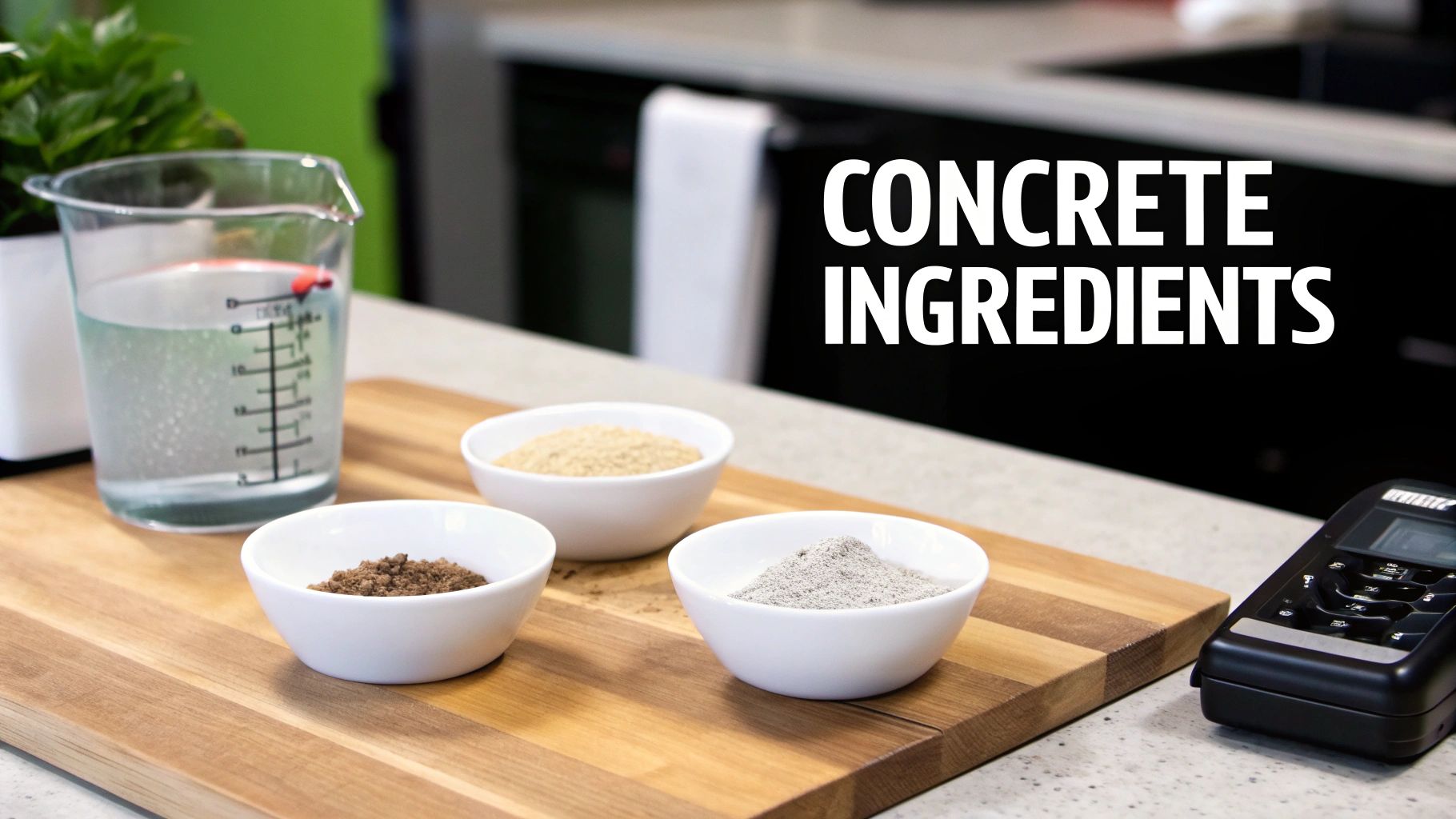
Despite its strength, concrete is a surprisingly simple recipe. It all comes down to four key ingredients that, when combined, kick off a chemical reaction and harden into a rock-solid mass. A typical recipe for one yard of standard concrete includes approximately 600 lbs of cement, 1,400 lbs of sand, 1,800 lbs of gravel, and about 30 gallons of water.
- Cement: Think of this as the "glue." It's the active ingredient that binds everything else together.
- Sand (Fine Aggregate): Sand is the filler, getting into all the tiny gaps between the larger stones.
- Gravel (Coarse Aggregate): This is the backbone. Crushed stone or gravel provides the bulk of the concrete's mass and strength.
- Water: Water is the catalyst. It activates the cement and starts the hardening process, a reaction called hydration.
The real magic happens in the proportions. By tweaking the ratio of these ingredients, we can fine-tune the concrete's performance for different jobs.
Why Concrete Strength (PSI) Is a Big Deal
We measure concrete strength in PSI, which stands for Pounds per Square Inch. This number tells you exactly how much compressive force the concrete can handle before it cracks or fails. And believe me, not all projects need the same muscle.
For a simple patio or a sidewalk that will only see foot traffic, a 3,000 PSI mix is usually perfectly fine. It's got plenty of strength for light-duty work and is a bit easier on the budget. For example, it can easily support patio furniture and regular foot traffic without any issues.
A driveway, on the other hand, is a completely different story. It has to support thousands of pounds of vehicle weight, day in and day out. That's why a stronger 4,000 PSI mix is the standard. This mix has a higher concentration of cement, making it far more durable and resistant to the stress of cars and trucks. Getting the PSI right is absolutely critical if you want your concrete to last for decades instead of just a few years.
Expert Insight: Choosing the wrong PSI is one of the most common and expensive mistakes I see homeowners make. Trying to save a few bucks with a 3,000 PSI mix on a driveway will almost certainly lead to cracks and costly repairs down the road.
A typical yard of concrete weighs in at about 4,050 pounds when mixed to 150 lbs per cubic foot. This is ideal for that 100 sq ft driveway patch many Atlanta homeowners find themselves needing, which is usually poured 4-6 inches deep to handle vehicles up to 10,000 lbs GVW. For our commercial clients, the efficiency of ordering by the yard is a game-changer, often cutting labor costs by 20-25% compared to mixing on-site. This is a huge advantage when resurfacing large industrial floors or long stretches of sidewalk. You can find more industry insights on the benefits of ready-mix concrete.
Estimating the Cost of Concrete in Atlanta
Let's talk about the bottom line. For most people, the first question about any concrete project is, "How much is this going to cost me?" While it would be nice to have a simple, one-size-fits-all price, the reality is that the cost of a yard of concrete here in Atlanta can vary quite a bit.
Getting a handle on the different factors that go into the final price is the best way to put together a solid budget and avoid any surprises down the road.
Key Factors That Influence Price
The price you're quoted for a yard of ready-mix is just the starting point. Several moving parts can affect your total cost, and each one plays a role in the final invoice.
- Concrete Strength (PSI): As we covered earlier, stronger concrete needs more cement, and more cement costs more money. A tough 4,000 PSI mix designed for a driveway will naturally have a higher price per yard (e.g., $140/yard) than a standard 3,000 PSI mix you'd use for a small patio (e.g., $125/yard).
- Delivery Distance: How far are you from the concrete plant? The further the truck has to travel, the more you'll see in delivery fees to cover the driver's time and fuel. For example, a delivery within a 10-mile radius might be included, while a 30-mile trip could add $50-$100 to the total bill.
- Short-Load Fees: Ready-mix plants are all about volume. If you only need a small amount—usually anything under 5-7 yards—they'll often add a "short-load" fee. This charge, which can be $100 or more, makes the trip profitable for them even on a smaller order.
- Special Additives: Want to get creative? Things like color pigments, accelerators to help the concrete set faster, or fiber mesh for extra reinforcement are great options, but each one will bump up the per-yard cost. For instance, adding a color pigment might increase the cost by $20-$30 per yard.
The material cost is just one piece of the puzzle. Professional installation—including site preparation, forming, pouring, and finishing—is a critical part of your total investment and ensures the long-term value and durability of your project.
Thinking about the bigger picture, the global concrete market is massive, expected to grow from $543.5 billion in 2026 to $692.3 billion by 2035. For a facilities manager in Atlanta, that translates to real-world numbers. A 20-yard sidewalk pour might run between $4,000-$6,000, which can be up to 15% cheaper than using pavers, making concrete a smart financial choice.
Don't forget to plan for the cleanup after the job is done. You might need to look into local junk removal services in Atlanta to haul away old materials or project debris.
For a closer look at how these principles apply to projects right here in our area, check out our guide to Atlanta concrete solutions.
When to Call a Professional for Your Concrete Project
Figuring out how much concrete you need is one thing. Actually managing a 4,000-pound delivery of wet concrete is a whole different ball game.
Sure, a small DIY job like setting a mailbox post is totally doable. But there are very clear signs that tell you when it’s time to hang up the hand-trowel and call in the experts.
The first big sign? Handling anything more than a single yard of concrete. Once you get into that territory, the clock is ticking. You need a team to move it, specialized tools to spread it, and the experience to finish it all before it starts to set up. A project that seems manageable on paper can quickly turn into an overwhelming mess without a trained crew. For example, a single person trying to wheelbarrow and place one yard of concrete would likely find it hardening before they are even halfway done.
Key Signs Your Project Needs a Pro
Beyond just the sheer volume, certain projects have technical demands that really require a seasoned pro. Trying to tackle these without the right know-how can lead to some seriously ugly and expensive fixes down the road.
- Proper Site Grading: Getting the ground perfectly sloped for drainage is absolutely critical. We use laser levels and grading equipment to make sure water flows away from your home’s foundation, not toward it. A professional ensures a minimum slope of 1/4 inch per foot, a detail often missed in DIY projects.
- Specialized Finishes: If you’re dreaming of a beautiful stamped patio or a perfectly smooth, uniform brushed finish, that’s not a first-timer's job. Those techniques take years of hands-on practice to get just right.
- Adherence to Building Codes: We live and breathe Atlanta's local building codes. Whether it’s the depth of footings or the required thickness for a driveway, we know the rules that ensure your project is safe, legal, and built to last. For example, some municipalities require a 6-inch thickness for the driveway apron where it meets the street.
For anything more complex than a small, simple slab, bringing in a professional is the best way to guarantee the job gets done right. Our experience, equipment, and skilled team are your insurance against costly mistakes and a final product that looks beautiful for years to come.
For more complex jobs, especially those involving repairs, it's also helpful to understand the scope of professional concrete solutions for driveways. A real expert can diagnose structural problems and apply the right fix, whether it's a repair or a full replacement.
In the end, hiring a pro is about more than just pouring concrete. We handle all the logistics, from scheduling the truck to preparing the site correctly, and deliver a polished final product that actually adds value to your property.
If your project has any of these moving parts, take a look at our professional concrete services to see how we can take the headache out of it for you.
Got Questions? We've Got Answers
Alright, let's tackle some of the most common questions that pop up when you're planning a concrete project. Getting these details straight can save you a lot of headaches down the road.
How Many Bags of Concrete Make a Yard?
This is probably the number one question for anyone thinking about a DIY project. The exact number depends on the size of the bags you're looking at, since they come in a few standard weights.
Here’s the quick math:
- 80 lb bags: You'll need to haul about 45 bags to get one cubic yard. Each 80 lb bag yields about 0.6 cubic feet of concrete.
- 60 lb bags: For these, you're looking at grabbing around 60 bags for a full yard. Each 60 lb bag yields about 0.45 cubic feet.
Honestly, mixing bags by hand is fine for tiny jobs, like setting a single fence post. But for anything bigger? Trust me, ordering a ready-mix truck is the way to go. Hauling and mixing 45 separate 80-pound bags is a back-breaking workout you don't want.
What's the Difference Between a Cubic Yard and a Cubic Meter?
It's easy to get these two mixed up. Here in the U.S., we measure everything in cubic yards. But if you ever look at plans from another country, you’ll see cubic meters, which is the standard for the metric system.
Think of it this way: a meter is a little bit longer than a yard (about 3.28 feet). So, a cubic meter—which is a cube measuring 1 meter x 1 meter x 1 meter—is naturally a bit bigger than a cubic yard.
To get specific, 1 cubic meter is equal to about 1.31 cubic yards. So if a plan calls for 10 cubic meters of concrete, you’d actually need to order just over 13 cubic yards to get the job done right. For instance, a European building plan might specify a foundation requiring 50 cubic meters, which would translate to an order of approximately 65.5 cubic yards from a U.S. supplier.
How Far in Advance Should I Schedule a Concrete Delivery?
This is a big one. You can't just call up and expect a concrete truck to be at your door in an hour, especially during the busy spring and summer months here in Atlanta.
As a rule of thumb, give your supplier at least 24 to 48 hours notice. If you have a larger or more complicated pour, giving them a week's notice is even smarter. This gives the dispatch team enough time to get you on the schedule, reserve a truck, and make sure your specific mix is ready to go. For example, if you need a pour on a Friday in May, it's best to call on Monday or Tuesday of that week to secure your spot. Trying to order last-minute is a gamble you’ll probably lose.
Ready to stop guessing and start pouring? For any project in the Atlanta area, from a new driveway to a stamped concrete patio, the pros at Atlanta Concrete Solutions are here to help. We’ll handle all the math, scheduling, and expert installation so you get a perfect finish without the stress. Get your free, no-obligation quote from Atlanta Concrete Solutions today!