
Installed concrete sidewalks typically run about $6 to $12 per square foot (VastCalc), which works out to roughly $24 to $48 per linear foot for a 4-foot-wide walk once you multiply width by rate. That band is a screening range, not a number you can hand a crew. Demolition, drainage, and permit work sit outside it, and those are the lines where low bids hide.
A cheap per-foot rate still fails when the quote stops at the slab. The Federal Highway Administration Pedestrian Facilities Users Guide priced sidewalks on both sides of a roadway at about $150,000 to $250,000 per mile, drawn from 1999 Oregon bids of roughly $12 to $20 per linear foot for a six-foot walk. Those dollars are a historical scale check rather than an Atlanta invoice, but they show why length and area both belong in the budget before anyone discusses finish.
The same gap shows up on Concrete Driveway Replacement Atlanta jobs when a walk, apron, or short connector gets priced like a long public run. Mobilization and demolition charges stay fixed whether the pour is 40 feet or 400, and they do not shrink just because the slab does.
What Concrete Sidewalks Cost to Install
LawnStarter's 2026 installed average, cited by Zarla, is $8.63 per square foot, inside a published band of $5.89 to $12. Use that midpoint to screen the slab. Atlanta totals still need separate lines for mobilization, demolition, drainage, and permits.
| Source (year) | Reported range | Typical figure | Basis |
|---|---|---|---|
| LawnStarter via Zarla (2026) | $5.89 to $12 per sq ft | $8.63 per sq ft average | Installed, US average |
| Homewyse (2026) | $12.00 to $14.71 per sq ft | $12.00 to $14.71 per sq ft | Installed, national average |
| ProjectCostPro (2026) | $10 to $19 per sq ft | 4 by 40 ft walk: $1,700 to $3,100 | Standard new sidewalk |
| VastCalc (2025) | $6 to $12 per sq ft | $6 to $12 per sq ft | New concrete sidewalk, installed |
| Thumbtack (2026) | $2,152 to $6,484 per project | Small jobs from $991 | Typical national project totals |
The rows answer different questions. Homewyse places a 2026 national installed sidewalk at $12.00 to $14.71 per square foot, above the LawnStarter midpoint. VastCalc reported $6 to $12 in 2025 for a new installed walk, overlapping LawnStarter and stopping short of Homewyse. ProjectCostPro priced a standard new 4-by-40-foot sidewalk, 160 square feet, at $1,700 to $3,100 in 2026. Divide those totals by 160 and the unit rate is about $10.63 to $19.38 per square foot, the spread they publish as $10 to $19.
Rate versus a finished job
A per-square-foot rate covers concrete and the labor to place that slab. Layout, a short crew day, mobilization, demolition, drainage, and permits sit outside it. A low unit price can still omit those lines.
Thumbtack put typical 2026 national jobs at $2,152 to $6,484, with unusually small projects near $991 and complex decorative work up to $14,257. The distance from $991 to $6,484 is access, tear-out, drainage, and how much of a crew day the site uses, not a different bag of concrete.
None of these publishers printed an Atlanta-only installed price, so the table is a baseline. Rebuild a checkable total as area times the chosen rate, then add the site lines that rate left out. If those inquiries pile up faster than your calendar, tools that turn customer inquiries into booked appointments keep the estimating queue from becoming the bottleneck.
Price Examples by Length, Width and Area
Sidewalk area is width times length. A 4-foot walk that runs 40 feet holds 160 square feet. At the LawnStarter low, average, and high rates, that small rectangle already spans more than $900.
| Project (width by length) | Area (sq ft) | Low at $5.89/sq ft | Average at $8.63/sq ft | High at $12/sq ft |
|---|---|---|---|---|
| 4 ft by 40 ft walk | 160 | $942 | $1,381 | $1,920 |
| 5 ft by 40 ft walk | 200 | $1,178 | $1,726 | $2,400 |
| 4 ft by 100 ft walk | 400 | $2,356 | $3,452 | $4,800 |
| 5 ft by 100 ft walk | 500 | $2,945 | $4,315 | $6,000 |
The conversion you can repeat is simple. Multiply the width in feet by the rate per square foot, and you get dollars per linear foot. At $8.63, a 4-foot walk is about $34.52 per linear foot. A 5-foot walk is about $43.15.
USCalculators estimated fully installed residential sidewalks in 2026 at $8 to $20 per linear foot for a standard 4-foot-wide, 4-inch-thick walk. The bottom of that band fits an open, straight pour. The top usually means tight access, extra forming, or a site the crew can't treat as production work.
One front walk, before the extras
Say the walk from the steps to the street is 4 feet wide and 60 feet long. That's 240 square feet. At $8.63, the slab math is about $2,071. Demolition, permits, and drainage aren't in that product. Add them as their own lines or the total will look dishonest next to a real bid.
A short walk with corners, a step, or a gate the buggy can't pass will cost more per square foot than a long straight run. Mobilization is a fixed day of labor and equipment. Spread across 80 square feet, it swamps the concrete. Spread across 400, it fades.
People comparing How Much Does a Concrete Driveway Cost in Atlanta? should use the same habit, not a sidewalk rate pasted onto a drive. NerdWallet places professionally installed concrete driveways at about $8 to $20 per square foot including labor, with a broad project span of $1,600 to $32,000 and an average near $6,400. A plain 500-square-foot drive implies roughly $4,000 to $10,000 before hard excavation or a rebuilt apron. Concrete Driveway vs Asphalt in Atlanta is a separate choice. Asphalt can look cheaper up front and still lose on the years you repave.
Record length and width at both ends of the walk, and price the longest reading. Our residential driveway concrete work uses that same measured area so the sidewalk number and the drive number aren't mixed into one vague allowance. Concrete Driveway Replacement Cost Atlanta 2026 budgets fail the same way when someone multiplies only the pretty middle of the slab.
How Thickness Changes the Concrete You Pay For
Thickness is the specification that changes concrete volume before finish, access, or permits enter the quote.
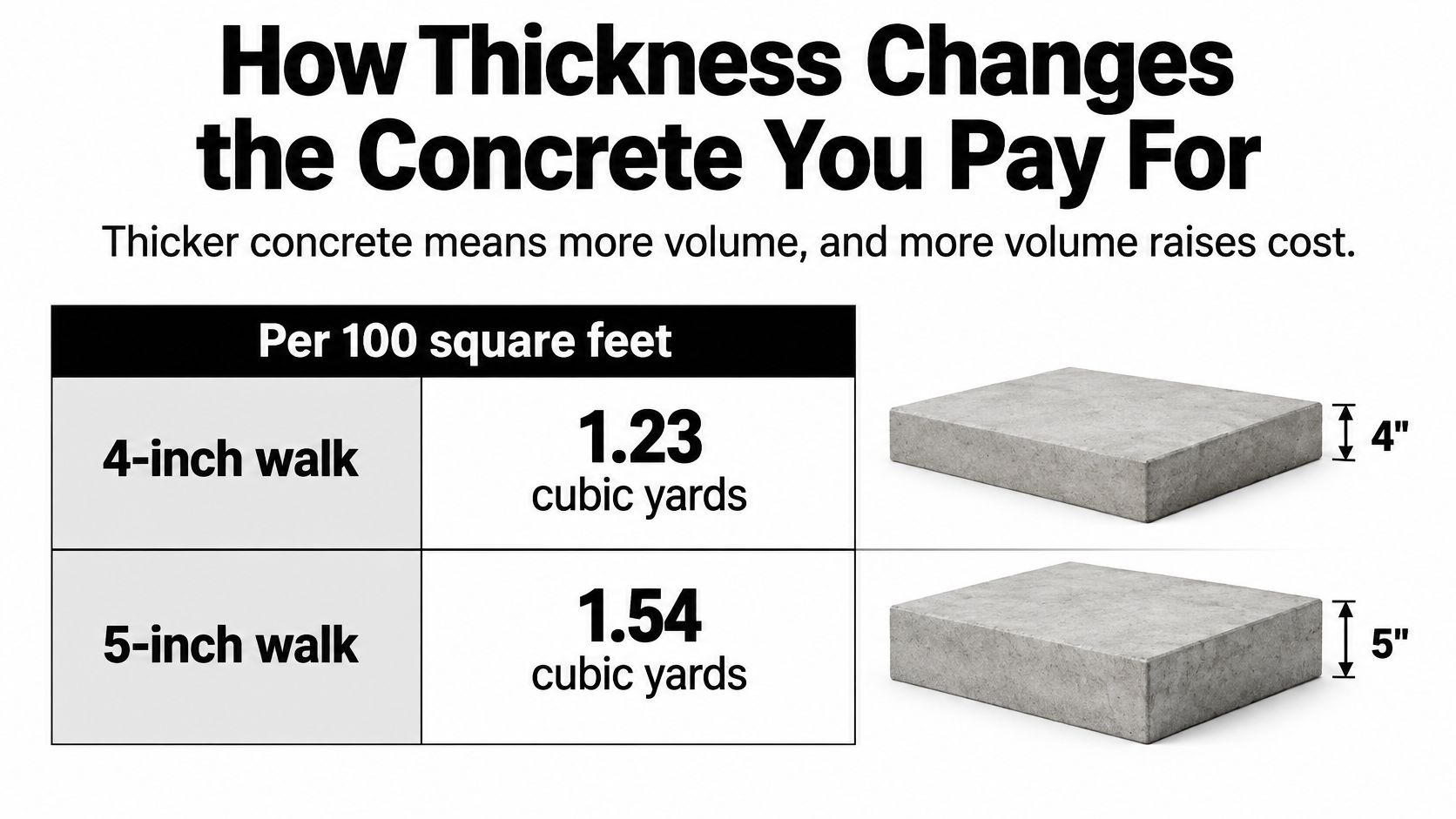
Per 100 square feet, a 4-inch walk needs about 1.23 cubic yards. A 5-inch walk needs about 1.54. A 6-inch slab needs about 1.85. An 8-inch slab needs about 2.47. Moving from 4 inches to 6 inches raises concrete volume by 50% before reinforcement or base changes, which is the ratio a 2026 municipal fixed-unit schedule implies when estimators step up the section.
| Thickness | Typical use |
|---|---|
| 4 inch | Pedestrian walks and short residential runs |
| 5 inch | Walks with occasional light vehicle crossings |
| 6 inch | Driveway aprons and service vehicle crossings |
| 8 inch | Heavy truck loads and commercial service lanes |
Match the section to the tire
Best Concrete Thickness for a Residential Driveway is not the sidewalk default. Four inches suits people and bicycles. Six inches is the common step where the walk becomes an apron or a service vehicle may cross. Eight inches is for heavy trucks and commercial lanes, not a garden path.
That schedule listed standard sidewalk at $8 per square foot for 4-inch, $9 for 6-inch, and $10 for 8-inch. A 6-inch ADA ramp was $25 per square foot, because of extra forming, detectable warnings, and tight slope tolerances. On a 200-square-foot walk, the jump from 4 inches to 6 inches is about $200 on those unit prices, before a deeper base and a deeper cut. The same upgrade adds about 1.23 cubic yards the crew still has to place, screed, and finish.
Practical rule: Ask every bidder to write thickness, base depth, and joint spacing on the quote. Two prices aren't comparable if one is a 4-inch walk and the other is a 6-inch apron.
Thickness also pulls excavation and compaction with it. A deeper section means more spoil and a base that has to be built to that depth, not just more mud in the truck. Do You Need Rebar in a Concrete Driveway? is a load question. Pedestrian walks often don't need rebar. A drive or an apron that takes a truck usually does, and that steel is its own line. Our residential poured concrete specs state the section before anyone argues about a unit price.
Site Conditions That Push the Price Up
Concrete is one line. The rest of the bill is whatever has to happen so that concrete can sit there and stay there.
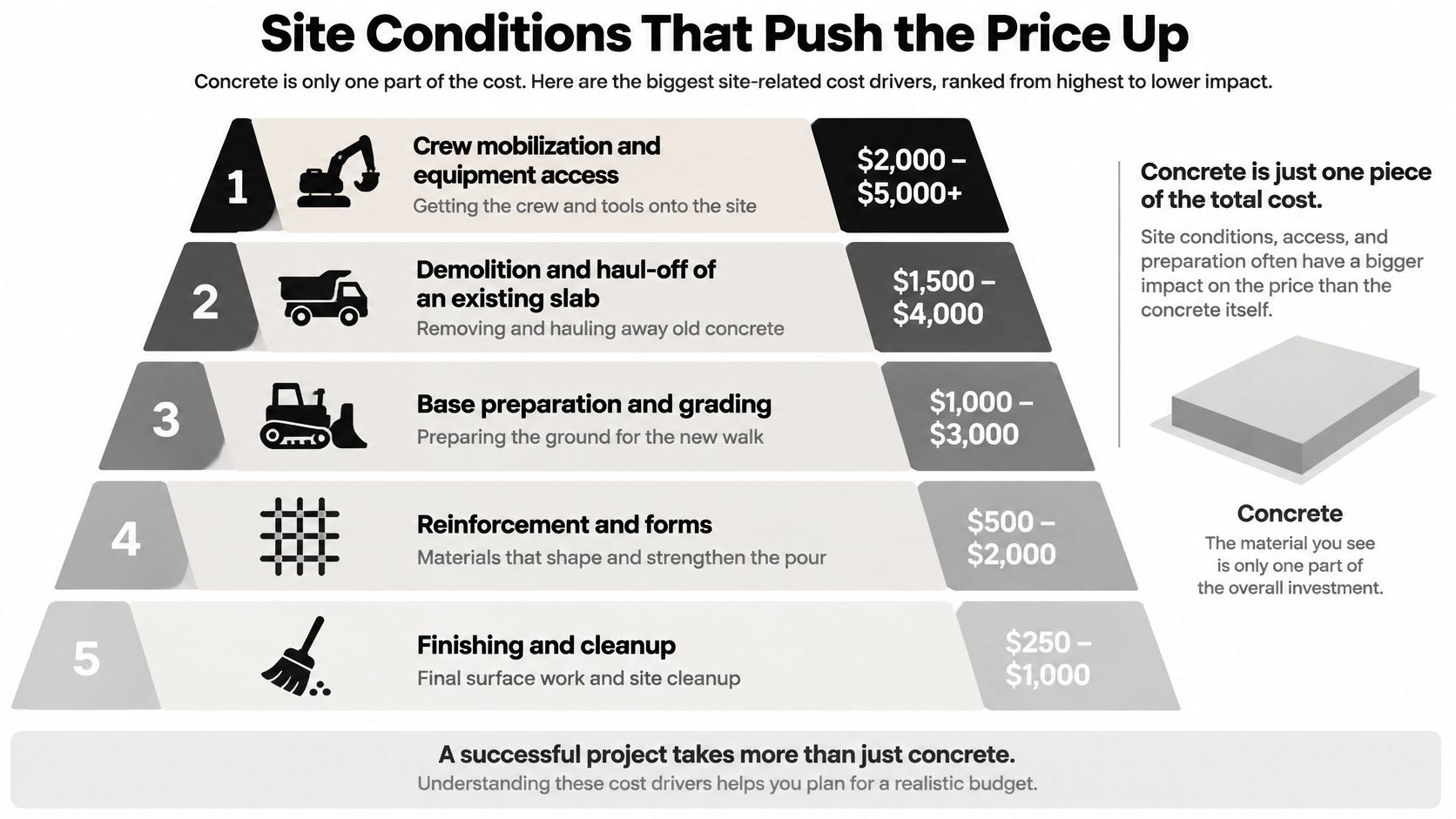
- Crew mobilization and equipment access: A pump, a buggy, or a day of wheelbarrows is a fixed charge. A locked side yard makes it larger.
- Demolition and haul-off of an existing slab: Breaking, loading, and dump fees hit replacement jobs and barely touch a pour on bare soil.
- Excavation and subgrade correction: Soft spots and buried debris get cut out or the new slab mirrors the failure.
- Grading for positive slope: Water that sits on the walk becomes a trip hazard and a callback.
- Drainage hardware: A catch basin, a longer pipe, or a shifted inlet is plumbing, not flatwork.
- Tree roots: Pruning or a root barrier protects the slab and can require an arborist.
- Utilities: Locating and working around a shallow line slows forming.
- Restoration: Seed, sod, or reset beds close the job after the forms come off.
Why the spreads get wide
A dataset of 1,233 public sidewalk contracts awarded from 2023 to 2026 across 26 metros, compiled for IEEE DataPort, showed Sun Belt metros averaging $9.40 per square foot against $11.97 in northern and coastal metros. Comparable flatwork bids ran about $4.50 in Detroit to $13.68 in New York City. Those are bid prices, not inflation-adjusted retail, and they may leave out demolition, ramps, and bad access.
A 2025 Illinois bid tab for 3,969 square feet drew unit rates of $9.90, $13, $18, and $23. Steps on that tab landed near $22.90 to $60 per square foot. Vermont's cost analysis priced a five-foot concrete sidewalk without a curb at $64 per linear foot on a basic basis and $155 once incidental work was in. The concrete didn't triple. The job around it did.
ADA ramps, cross-slope limits, detectable warnings, and level landings cost more than plain flatwork because the forms and the finish have to hit slopes, not just look level. Stamped or colored concrete is another layer on top of the structural pour.
A low unit price is not a bargain if mobilization, haul-off, and lawn repair are written as extras you discover after demolition.
For How to Fix Drainage Problems on an Atlanta Driveway, slope alone may not be enough where the drive meets a state route. Georgia DOT encroachment guidance says driveway ditches and side drains must handle the 25-year storm, curb and grated inlets the 10-year storm, and pipes tied to the highway system the 50-year storm. That design work belongs in the allowance, not in a surprise change order. Concrete Driveway Repair vs Replacement and Concrete Driveway Cracks: When Should You Replace It? turn on the same point. Patching a panel that still ponds, or that trucks keep crossing, spends the mobilization twice. Our residential concrete and masonry repair crews separate a surface crack from a section that has lost its base.
Separate the square-foot installation number from mobilization, permits, and disposal. If a bidder won't, you don't have a comparable price yet.
Atlanta Permit Rules That Can Add Cost
The Atlanta Department of Transportation states that any disturbance of the public right-of-way needs an ATLDOT permit, and it names driveway-apron installation or repair and sidewalk construction as examples. Atlanta 311 guidance says the same permits cover work on city streets or sidewalks, including driveway aprons.
A walk can look private and still hit that rule. If the new concrete ties into a curb, gutter, public apron, or the street edge, the city may need to review it before the saw starts. Assuming a backyard path and a frontage walk follow the same process is how schedules slip.
- Find the line. Confirm where your property meets the public sidewalk or curb, and mark any panel the crew will touch. You pay for a survey only if the line is unclear.
- Assign the permit. Ask the contractor whether they pull the ATLDOT permit or expect you to apply. Write that name on the quote.
- Price the paperwork. Request the permit fee, plus any survey or engineering charge, as its own dollar amount. You pay it whether it's inside their number or billed to you.
- Hold demolition. Build the review period into the schedule so the slab isn't broken before the city has signed off. A waiting crew is your cost if the date was guessed.
Applications go through ATLDOT or the city's listed permit office. Concrete Driveway Apron Atlanta work, Driveway Widening Atlanta, and Driveway Extension Atlanta all change how the private slab meets the public road, so they need the same check. A quote that leaves permits out is incomplete until someone owns the fee and the wait.
How to Lower Your Sidewalk Bill Without Cutting Corners
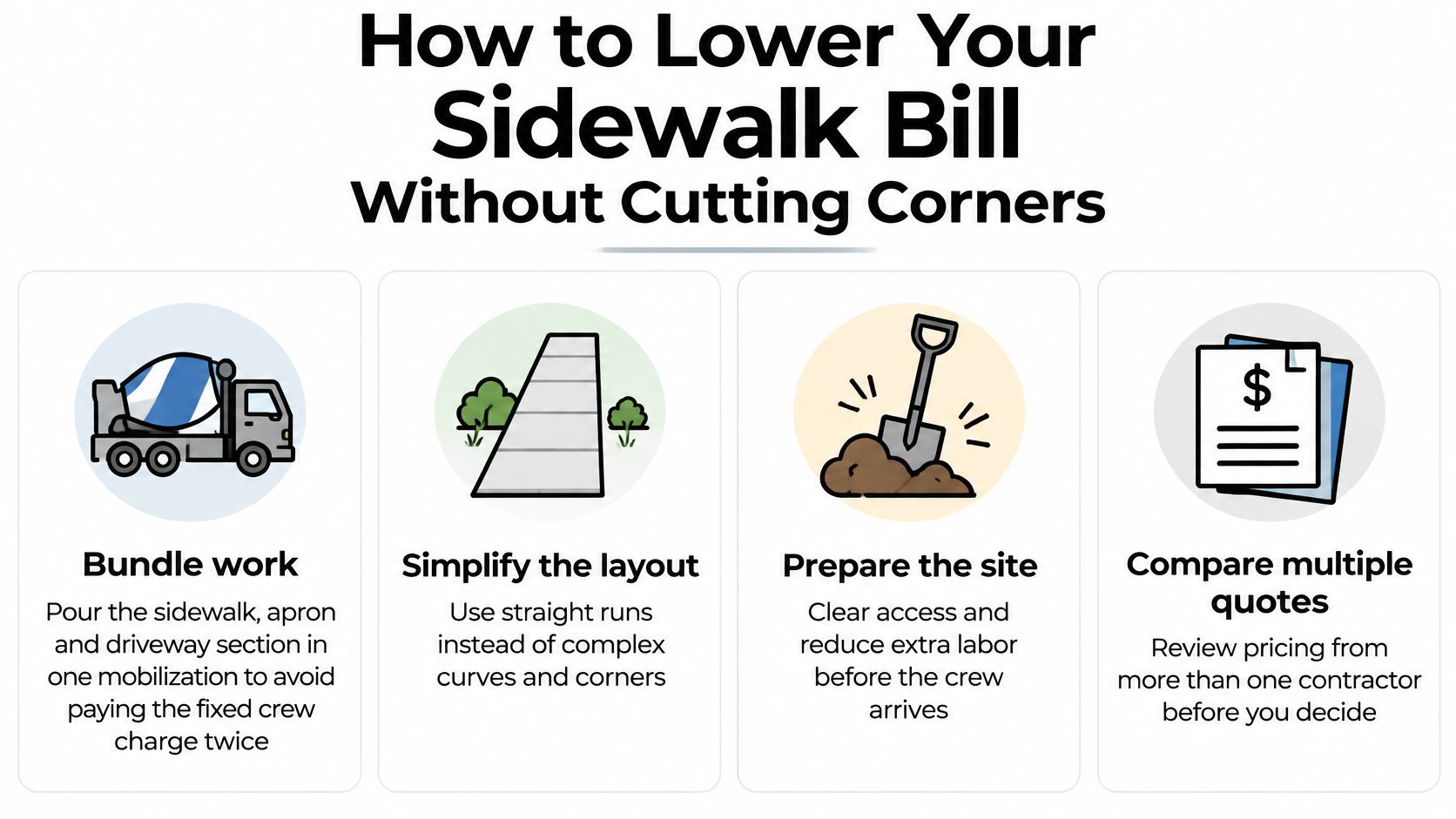
The safest savings come from cutting duplicate labor and wasted forming, not from thinning the slab that carries people, water, and the occasional tire.
Bundle the pour. A sidewalk, apron, and driveway section placed in one mobilization avoids paying the crew charge twice, but only if the specs still differ where vehicles cross. Keep the apron thicker where tires track over it, even if that means a second mix or a separate placement ticket.
Straighten the layout. Fewer curves and corners mean less form time and fewer joints to lay out. Keep a curve where it saves a tree, meets an existing step, or fixes drainage. Put Stamped Concrete Driveway Atlanta patterns on the drive face you see every day rather than every linear foot of a side path, because stamping is a second operation while the concrete is still open.
Re-grade before you build steps. Steps jump the unit price because they add forming, risers, landings, and slower finishing. A longer, gentler run can use more concrete and still cost less in specialty labor. Keep any landing the city or ADA rules require.
Right-size the thickness. Per 100 square feet, a 4-inch walk uses about a third less concrete than a 6-inch slab. Specify 6 inches only where a tire will cross. Spend the saved yardage on base depth, compaction, and slope, since those decide whether the slab stays supported.
Clear what you can. If the contractor agrees, pull plants, edging, and loose obstacles before the crew arrives so they are not billing labor to move pots. Leave the subgrade to them unless they asked for help. A DIY trench at the wrong depth becomes their repair line.
Read the total, not the unit. A low rate that excludes demolition, haul-off, lawn repair, or drainage is not the low bid. Concrete Driveway Sealing Atlanta upkeep is cheaper than replacement, and regular cleaning plus periodic sealing helps a sound slab keep its appearance with minimal maintenance. It will not restore a section that has already lost support.
Financing is available for Atlanta Concrete Solutions projects, which can spread payments across the schedule instead of pushing you to delete drainage so the invoice fits one month.
For curing, keep cars off until the contractor's stated window allows them. Foot traffic comes first, vehicles later, and heavy trucks last. Weather changes that window, so the pour-day note matters more than a generic calendar.
Compare Itemized Quotes Before You Hire
A fair comparison uses the same square footage, thickness, base depth, joint layout, and finish. Anything less is three prices for three different sidewalks.
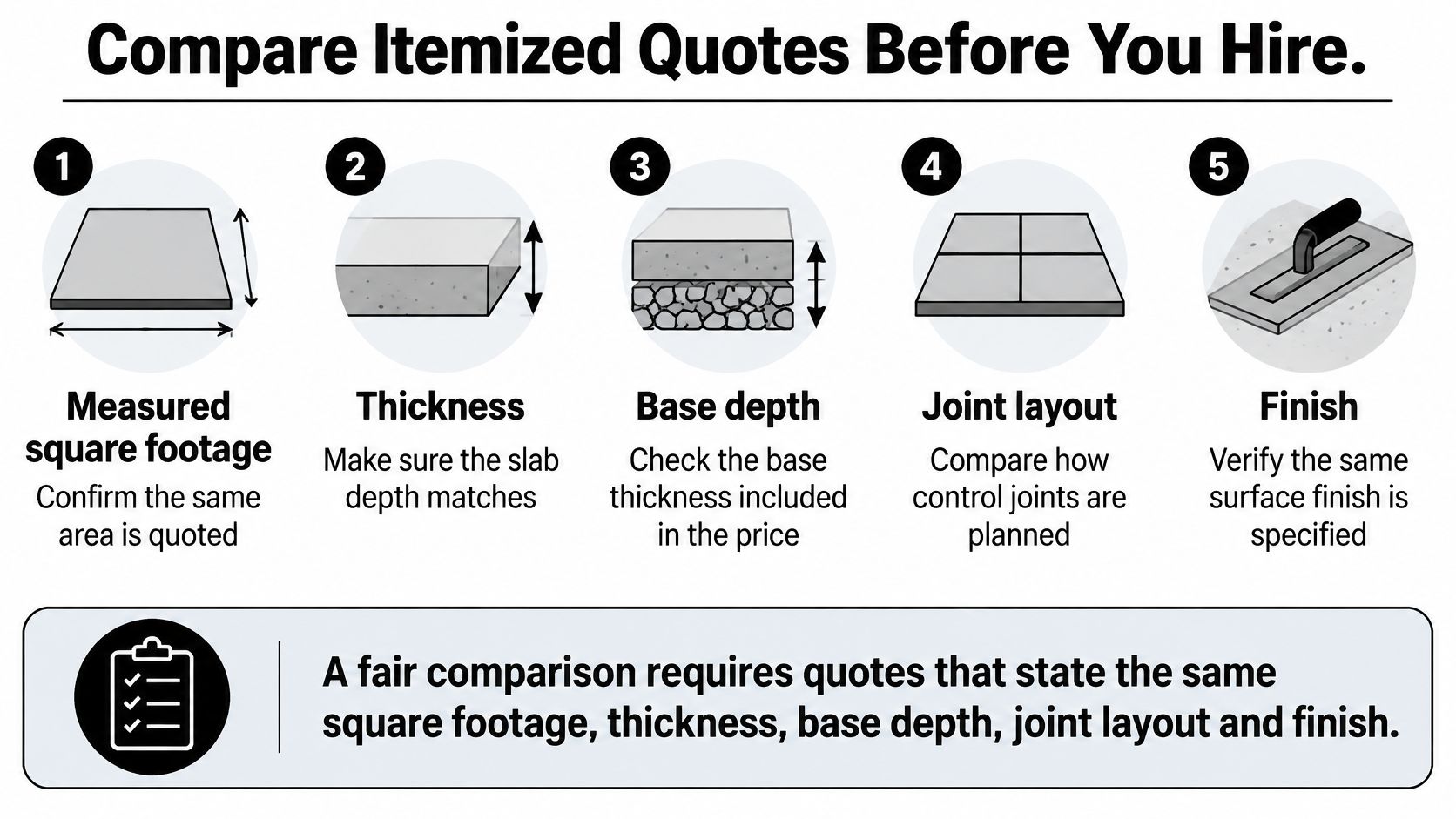
- Measured area and thickness: Both bidders should show the same square feet and the same inches.
- Demolition and haul-off: Replacement isn't a new-pour price.
- Base and compaction: Ask what material, how deep, and how it's compacted.
- Excavation and soft spots: Who pays if the ground fails once the old slab is gone?
- Drainage and grade: The quote should say where water goes.
- ADA pieces: Ramps, detectable warnings, and landings, if the walk hits the public edge.
- Permits: Name who applies and who pays.
- Mobilization and traffic control: A flagger or a lane closure isn't free.
- Restoration, warranty, payment, and timeline: Seed, the warranty period, when you pay, and how many days the walk is closed.
A missing line often becomes a change order. That's how a headline rate beats the field and loses once the forms are up.
Get at least three itemized estimates on one written specification, confirm who files the Atlanta permit, and ask how slope and drainage were set.
Atlanta Concrete Solutions provides free estimates for concrete projects, is licensed and insured, and offers a project timeframe during the initial consultation. Call (678) 554-4433 to request a free quote. Hours run Monday to Friday, 8am to 8pm, and Saturday, 10am to 3pm. The lowest headline price is useful only after the scope behind it matches the walk you're buying. This week, send each bidder the same length, width, thickness, and a note on whether the old concrete stays or goes.
Atlanta Concrete Solutions pours and replaces sidewalks, aprons, and driveways across the Atlanta area, with the thickness, drainage, and permit scope written into the estimate instead of discovered mid-job. If you're pricing a front walk or a full drive, bring the measurements and the site limits to a free estimate. Visit Atlanta Concrete Solutions and ask for a sidewalk number you can compare line by line.