
The usual advice to replace a driveway once enough of its surface looks damaged misses the most important question: what's happening underneath it? A stained, weathered driveway can still be worth repairing. A cleaner-looking slab that rocks under a tire or sinks beside the garage can be a poor place to spend repair money.
To decide whether to repair or replace a concrete driveway in Atlanta, judge support, drainage and damage type before appearance. The right solution might be crack sealing, sectional replacement or complete reconstruction, but those options solve different problems.
Repair or Replace at a Glance by Damage Type
| Condition | Likely verdict | Why |
|---|---|---|
| Hairline surface cracks, slab level | Repair or ignore | Usually cosmetic; suitable sealing helps keep water out |
| Isolated spall or chipped edge, sound surroundings | Repair | Localized damage can be removed without demolishing sound concrete |
| Single full-depth crack or failed patch, stable base | Repair | A properly designed full-depth repair can restore load transfer |
| Cracking across much of the slab | Replace | Scattered patches won't correct a systemic cause |
| Settlement, rocking or vertical displacement | Fix subgrade, then replace affected area or slab | Movement must be corrected before surface work can last |
| Recurring pooling or drainage failure | Fix drainage first, then decide | Surface repairs leave the water problem underneath |
| Surface scaling or discoloration, slab sound | Resurface or repair | Appearance alone doesn't justify demolition |
| Multiple failure types across the slab | Replace | Separate patches are unlikely to resolve widespread deterioration |
Localized damage is not the same as a failed driveway. The Federal Highway Administration's full-depth repair guidance reports that properly designed full-depth repairs can deliver 10 or more years of performance, while emphasizing overall pavement condition, construction quality and load transfer.
Load transfer means adjoining concrete sections share wheel loads instead of moving independently. A patch needs more than a clean-looking top: it needs sound boundaries, dependable support and an appropriate connection to the surrounding pavement.
Read the pattern, not just the crack
A chipped edge beside otherwise solid concrete is a different job from a driveway covered in connected cracks. Likewise, a failed patch doesn't automatically condemn the slab. It may indicate poor preparation, unsuitable material or continuing movement, and the contractor needs to distinguish among them.
Atlanta's moisture-sensitive red clay makes drainage especially important. Water collecting beside an edge can change the support beneath a slab even while most of the surface looks intact.
Cleaning can help reveal the condition, but aggressive washing can also worsen weak concrete. Water Works Power Washing's explanation of can pressure washing harm concrete is useful before cleaning an already cracked or flaking driveway.
Start with two questions: Is the damage isolated, and is the base stable?
If both answers are yes, investigate repair first. If either answer is no, a surface-only quote needs a much stronger explanation.
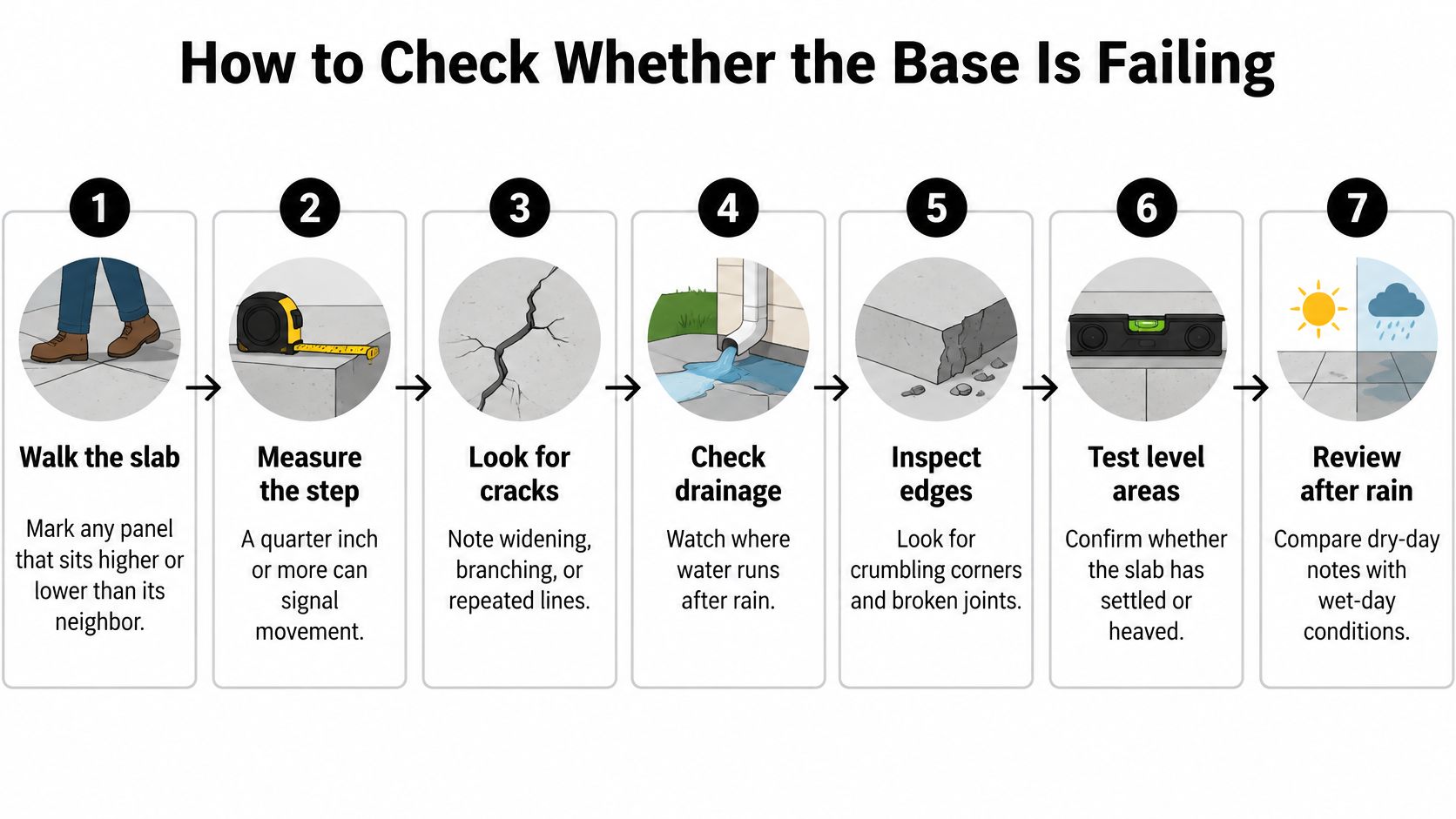
How to Check Whether the Base Is Failing
Inspect on a dry day, then return after rain. Bring a straightedge, tape measure, crack comparator, chalk and a phone so you can compare conditions rather than rely on memory.
Make a dry-day inspection
Map changes in elevation. Lay the straightedge across joints and cracks, then mark panels that sit above or below their neighbors. Don't judge settlement by eye, especially on a sloping driveway where the overall grade can disguise a displaced corner.
Check accessible corners for movement. Apply body weight carefully near an edge and watch for rocking, without putting fingers beneath the slab or testing it with a vehicle. Movement suggests lost support; a panel that feels solid in the middle can still have an unsupported corner.
Record crack width and continuity. Photograph the widest opening beside a ruler or crack comparator and note whether the crack branches, crosses panels or appears through an exposed edge. Fine, flush surface cracks are less concerning than widening cracks with displacement, but width alone doesn't establish depth or structural condition.
Inspect edges and joints. Look for crumbling concrete, open voids, washed-out soil and exposed aggregate beneath broken corners. Don't pack loose soil into a void and assume support has been restored; the contractor needs to establish why material disappeared.
Compare wet-weather conditions
Trace water after rain. Watch downspouts, garage-side low spots and runoff entering from adjacent ground, then photograph where puddles remain. A garage-side corner that settles after a rainy season deserves a drainage investigation, not just a thicker patch.
Look for root-related lifting. Compare raised panels with nearby trees, visible roots and the canopy's drip line. Don't cut major roots yourself, because protecting the driveway must also account for tree stability and health.
Check exposed steel and rust staining. Photograph reinforcement visible at broken edges and stains emerging from cracks. Rust staining warrants investigation rather than an automatic demolition verdict, but exposed, deteriorating reinforcement is more serious than surface discoloration.
The American Concrete Institute's pavement-overlay guidance emphasizes evaluating the existing pavement and selecting rehabilitation to suit its condition. An overlay is not a substitute for that assessment.
Sort your findings into cosmetic signs, such as stable discoloration and shallow wear, and structural warning signs, such as displacement, rocking and continuing movement. Partial replacement can preserve sound panels once the cause is corrected.
If movement reaches the garage slab or adjoining structure, include a residential foundation concrete assessment rather than treating the driveway edge as an isolated finish problem. A worn driveway can remain repairable; a neat-looking driveway with unstable support may not.
Repair Methods, Lifespan Gains and Reopening Times
A repair's expected life depends on the method and the condition of the concrete it must bond to. The FHWA pavement-preservation compendium gives typical service-life ranges of 3 to 5 years for joint resealing, up to 5 years for spall repair, 3 to 5 years for diamond grinding, and approximately 7 to 15 years for broader concrete-pavement restoration. Its range for full-depth repairs is 3 to 10 years; FHWA guidance on full-depth repairs reports 10 or more years for properly designed repairs.
| Method | Best for | Typical added service life |
|---|---|---|
| Joint or crack resealing | Joints and suitable narrow cracks on a sound slab | 3 to 5 years for joint resealing; crack-filler performance varies |
| Spall repair | Isolated chipped or crumbling areas | Up to 5 years |
| Diamond grinding | Surface irregularities or suitable joint faulting | 3 to 5 years |
| Full-depth concrete patch | Isolated failed area with sound surroundings | 3 to 10 years in the compendium; 10 or more years for properly designed repairs |
| Broader restoration or bonded overlay | Surface wear over a suitable, sound slab | Approximately 7 to 15 years for broader restoration; not an overlay-specific guarantee |
These are pavement-preservation estimates, not residential driveway warranties. A method's likely benefit depends on whether the surrounding concrete and support can carry the repair.
Choose the repair before choosing the finish
Spall repair means removing unsound material back to solid concrete. Mortar spread across loose edges can detach with the failing concrete beneath it.
Diamond grinding removes surface material to correct suitable irregularities. It cannot restore support beneath a settled slab, and grinding over continuing movement leaves the cause untouched.
A bonded overlay needs a suitable substrate, mechanical preparation and proper treatment of existing joints. Choose its appearance only after confirming the slab can support it. For a comparison of concrete finishes for driveways, finish options should follow, not drive, the structural decision.
For concrete and masonry repair, compare the proposed removal depth, surface preparation, bonding method and joint treatment. A product name alone does not explain how the repair will address the damaged concrete.
Reopening depends on strength
The FHWA's concrete repair materials guidance identifies patch-mix reopening windows of 4–6 hours, 12–24 hours or 24–72 hours, depending on the system. It also cites opening thresholds of approximately 2,000 psi compressive strength or 300 psi center-point flexural strength.
Ask which opening criterion applies to the selected material and how the patch will be protected until it meets that criterion. A dry-looking surface does not prove a repair is ready to carry a vehicle.
To compare repair with replacement, divide the repair price by a defensible expected service period, then account for the chance of needing more work. Treat the longest published range as a possibility, not a promise.
Repair buys useful service from concrete worth keeping. Replacement earns its cost when the work corrects the cause of failure.
What Replacement Costs and Whether It Pays Off
A replacement quote is useful only if it describes the same work as the competing quote. Compare the details that drive cost and determine whether the design addresses the cause of failure:
- Area and geometry: Include the full slab, turnouts, curves and narrow access areas.
- Thickness and loading: Match the design to passenger cars, work vehicles, trailers and expected delivery traffic.
- Demolition and disposal: Clarify what will be removed, hauled away and affected by access restrictions.
- Base preparation: Specify excavation, removal of unsuitable soil and compaction.
- Drainage: Price grading, drain installation and downspout corrections separately.
- Reinforcement: State whether mesh or rebar is included and how it will be supported during placement.
- Finish and approvals: Separate broom finishing, decorative work, sealing and applicable permits.
The U.S. Bureau of Labor Statistics ready-mixed concrete index averaged 386.967 in 2025. This is a producer-price index, not a driveway price per square foot, so it cannot establish what a particular replacement should cost.
Compare written specifications for residential poured concrete before comparing totals. A lower quote that leaves out excavation or drainage describes a different project, not necessarily a better price.
Judge value by the corrected design
The FHWA concrete preservation guide reports that concrete pavements commonly deliver 40 or more years with timely preservation. It also documents an agency example in which 38% of more than 2,300 lane-miles remained in service beyond 35 years. These are infrastructure benchmarks, not a lifespan promise for a residential driveway.
A low-cost patch can be a poor investment if the base continues to move. Repeated repairs, another disruption to access and eventual demolition may cost more than correcting the support problem during replacement. Compare repair and replacement quotes against realistic service expectations; without those details, a precise savings calculation is not possible.
Ask for a schedule that identifies approvals, demolition, base preparation, placement, finishing and vehicle restrictions. The replacement scope should state how it will address base support, drainage, thickness and joint layout.
Questions to resolve before replacement
Start with the practical decisions: What work is included in the price? Does the design suit the expected vehicle loads? Will replacement correct the drainage or base problem, and what maintenance will help preserve the finished concrete?
The answers depend on the driveway's condition and the proposed scope. A driveway with poor drainage or a moving base may need more than new concrete, while thickness and finish should reflect the loads and the homeowner's design preferences.
Atlanta Permits and Apron Rules That Affect Your Choice
| Work scope | Approval | Reference fee or limit |
|---|---|---|
| Replacement limited to the private lot | Building-permit review under zoning and building-code rules, unless exempt | Atlanta's permitting guidance lists $200 per driveway paving or resurfacing project under the cited city-planning fee schedule |
| Apron, curb or sidewalk connection | ATLDOT right-of-way approval; qualified-contractor requirements for apron work | $45 drive-apron qualified-contractor permit, listed in the manual cited below |
| Driveway placement on the lot | Setback check during design | Not closer than 7 feet from the property line |
| Apron location near road or right-of-way | Right-of-way review | No portion closer than 26 feet laterally to a local road or 15 feet to a right-of-way |
| Widening or extension reaching the curb | ATLDOT review with standard apron details | Fees and approvals depend on scope and jurisdiction |
The Atlanta right-of-way manual supplies the apron fee and placement limits above and requires concrete apron flares under City Code section 138, with conformance to the ADA GA 6050 A1-A4 replacement detail. Confirm how those requirements apply to your frontage before finalizing the design.
Settle approvals before demolition
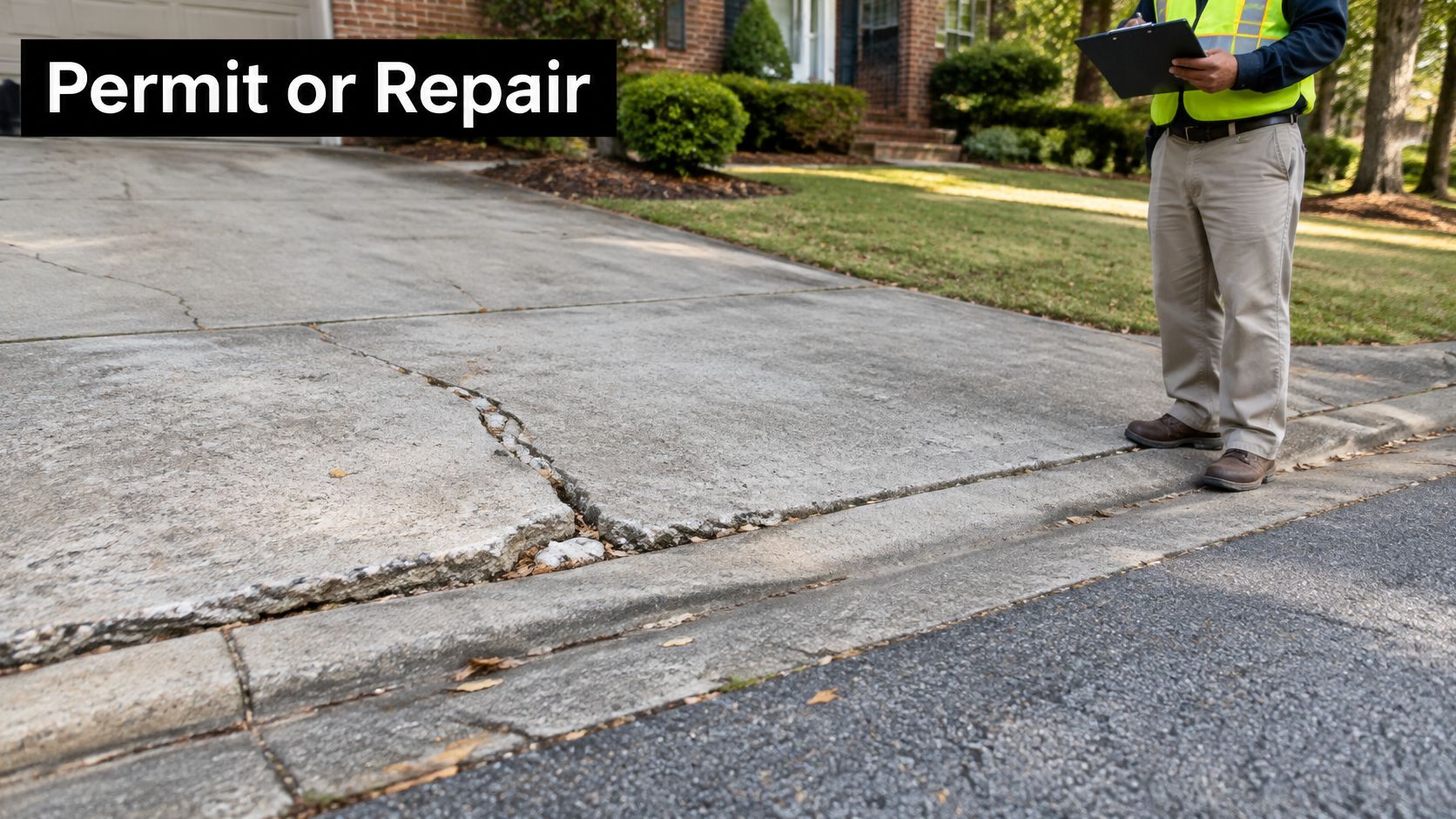
Confirm the boundary and scope. Identify whether work stays on private property or reaches the apron, curb, sidewalk or street edge. The Atlanta Department of Transportation permit page specifically identifies driveway-apron installation and repair as right-of-way work requiring approval.
Name the permit applicant. Put responsibility for applications, inspections and fees in the written agreement. Don't assume an existing apron can be rebuilt unchanged just because it's already there.
Approve the connection design. Resolve apron geometry, pedestrian access and drainage before removing the old concrete. An attractive private driveway is still a problem if its street connection fails municipal requirements.
These fees are reference values, not a complete project-permit total. Other approvals may apply, and an Atlanta mailing address doesn't necessarily place the property within City of Atlanta jurisdiction.
Include approval time in the schedule from the first consultation. Demolition shouldn't create an unusable driveway while the owner and contractor are still resolving whether the proposed connection is acceptable.
Atlanta Scenarios Where the Answer Changes
The same repair product can be sensible on one property and wasteful on another. These hypothetical cases show how use and site conditions change the recommendation.
Stable cracks and an isolated root conflict
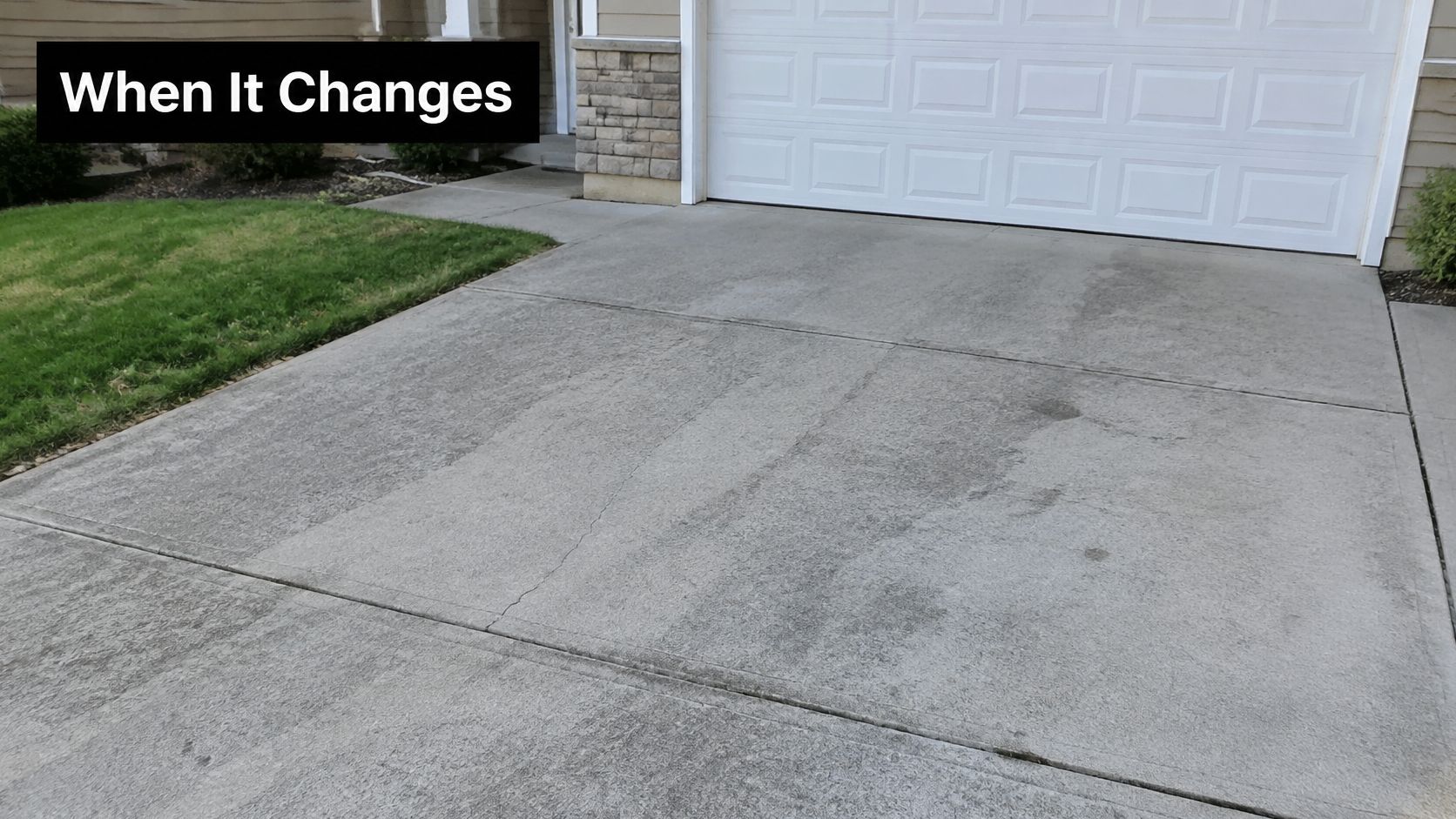
A driveway with hairline cracks beside the garage stays level. Suppose the owner finds only fine, unchanged lines, with no washout or persistent pooling. Monitor them or use a suitable sealing treatment; demolition would remove useful concrete without solving an identified structural problem.
An oak has lifted a panel and the adjoining corner has lost support. Have an arborist assess the root conflict, then establish a workable root and base solution before replacing the affected section. Preserve surrounding panels if they remain sound and the replacement can be detailed properly.
The distinction matters: removing the raised concrete alone leaves the biological cause in place. Cutting roots without assessing the tree creates a different risk.
Access deadlines and decorative surfaces
An HOA needs a failed patch repaired without a long closure. If the surrounding slab and support are sound, a rapid-setting repair may fit the access constraint. Require a material suited to the repair depth, weather and expected traffic, plus a documented reopening criterion.
The Nebraska Department of Transportation report on high-performance rapid-patching materials illustrates why rapid repair is an engineered materials decision, not merely a faster bag mix. Judge the proposed system by bond, moisture conditions, movement compatibility and capacity for passenger vehicles or delivery trucks.
A widening reaches the apron. Coordinate the private-lot design with right-of-way approval before promising a construction date. The additional parking area may be straightforward, while the public connection controls when work can begin.
A stamped driveway has scaling but remains supported. Trial a repair or compatible resurfacing treatment in an inconspicuous area before committing to the entire surface. Matching color and pattern can be difficult, and an overlay may change the original texture rather than preserve it exactly.
For decorative work, ask to see the proposed appearance as well as the technical specification. Replacement becomes more defensible when structural deterioration accompanies the finish problem, not merely because a patch might remain visible.
The best option matches the cause and the use, not the lowest price or the fastest cure.
Confirm the Base and Permits Before You Book Work
Turn the inspection into a written decision rather than a verbal promise that the driveway will look better.
Document the problem areas. Photograph each location and record crack width, elevation changes and any rocking. Include wet-weather photographs so the estimate accounts for runoff rather than just the dry surface.
Classify the damage. Separate cosmetic wear from movement and identify whether distress is isolated or distributed. Mark the panels proposed for repair or removal so competing estimates cover the same footprint.
Obtain comparable written options. Request a repair proposal with its expected service range and reopening conditions, alongside a replacement proposal identifying support, drainage and slab-design corrections. If repair isn't technically appropriate, the proposal should say why.
Confirm the approval route. Establish whether the apron, curb or sidewalk is involved and name who handles permits. For properties with earlier alterations, BatchData's explanation of how to spot red flags in permit records provides context for reviewing the documented work history.
Set the price and sequence before signing. Get line items, exclusions and a project timeframe. At Atlanta Concrete Solutions, we give a project timeframe during the initial consultation, so access arrangements can be discussed before construction starts.
Make the cause part of the contract
The scope should explain what will prevent the same failure from returning. A list that says only remove, pour and finish leaves too much unanswered when the original problem involved water or unstable ground.
Choose the work because it fits the driveway's condition, not because the surface looks old or the cheapest proposal promises a quick transformation.
Atlanta Concrete Solutions provides free estimates for concrete driveway repair and replacement, helping you compare the appropriate scope before committing to work. Visit Atlanta Concrete Solutions or call (678) 554-4433 to request a free quote and discuss your driveway's condition, access needs and project timeframe.