
You step outside after a cold Atlanta night and the driveway looks almost the same as last week. A pale flake near the garage, a tight crack beside a joint, nothing that stops the car. Then a tire kicks loose a chip, and the surface that looked fine has been breaking apart under water that sat there through the freeze.
That quiet change is how freeze thaw damage concrete owners often miss until the slab feels rough underfoot. A clean-looking surface can hide internal cracking. I would decide on repair or replacement from inspection and drainage, not from how many nights the temperature dipped below freezing.
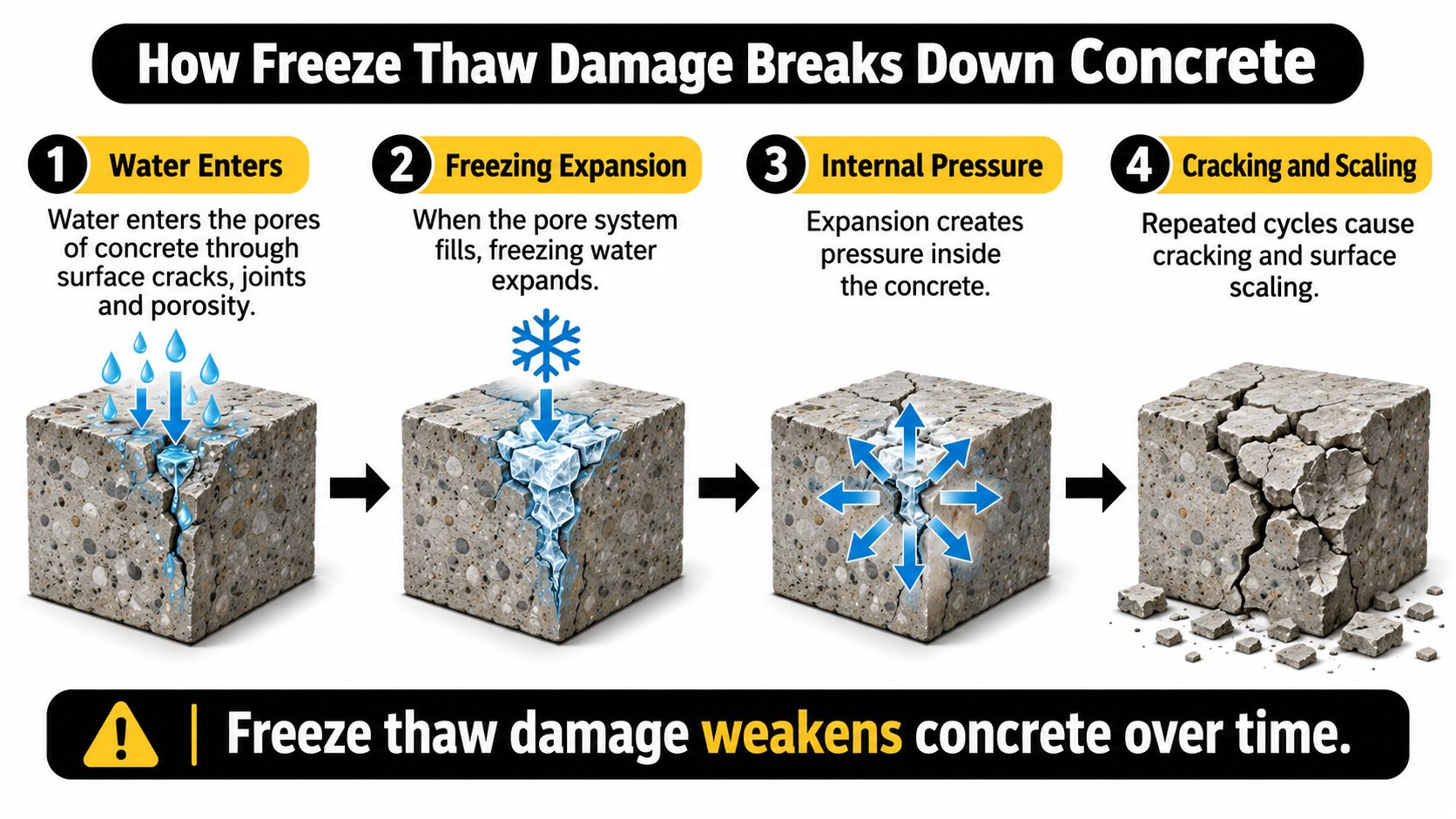
How Freeze Thaw Damage Breaks Down Concrete
Say rain fills a hairline crack by the garage. Overnight the water freezes. By afternoon it thaws, the crack takes on more water, and the next cold night pushes again.
Freeze thaw damage concrete does not need a fully soaked slab. Research from the National Institute of Standards and Technology identifies approximately 85% saturation as the critical threshold for most concrete. Once the pore system reaches that level, freezing water can generate expansive stresses that exceed the tensile strength of the cement paste.
A sealed water bottle left in a freezer splits because ice needs more room than the liquid had. Cement paste fails the same way, only the space is a network of pores. Water gets in through surface cracks, open joints, and ordinary porosity. Driveways, sidewalks, and other flat slabs stay in contact with rain, snowmelt, and deicing solution far longer than a wall does.
The stages connect. Wet concrete freezes, internal pressure opens microcracks, thaw lets more water deeper, and the next freeze works on a weaker paste.
What you see as the paste fails
NIST treats freeze-thaw deterioration as a major service-life concern for exposed concrete in cold regions. The same mechanism still matters in Atlanta. Occasional freezes hit wet horizontal slabs even when deep cold does not last for weeks. Each cycle adds pathways, so later cracking, scaling, and spalling become more likely.
The visible stages arrive in order.
- Surface scaling: Cement paste peels and the top turns sandy or flaked.
- Map cracking and joint breaks: Cracks spread into a pattern and joints open wider.
- Spalling: Chunks break free and leave aggregate exposed.
Practical rule: Flakes on top are late news. The paste can already be failing underneath a surface that still looks mostly clean.
Drainage, adequate curing, low-permeability concrete, and a designed air-void system are durability measures, not finish upgrades. Skip them and every later sealer is fighting water that already has a route in.
Warning Signs and What Each One Means for Your Slab
A surface that looks minor can still hide deep damage. Cracking, scaling, and spalling are not interchangeable labels. Deterioration moves from cement-paste peeling and microcrack growth to pore-structure failure and local breakdown. Photos of the top do not settle whether the slab can still carry cars.
Permeable-concrete specimens exposed to 120 freeze-thaw cycles showed less than 1% mass loss while compressive strength still declined by 5.5%–12.9%, according to published materials research. Low visible loss does not prove a driveway, sidewalk, or parking surface is sound. The same work found damage concentrating at the aggregate-paste interface, with microcrack widening becoming dominant after 75 cycles.
| Symptom | Likely cause | Next step |
|---|---|---|
| Hairline cracks under 1/8 inch | Early microcracking or shrinkage | Seal, photograph and monitor each season |
| Flaking or sandy surface | Surface scaling from freeze-thaw cycles | Tap test and check drainage before choosing a surface repair |
| Map-pattern crack network | Internal microcracking spreading | Measure crack widths and check for water entry |
| Popouts or loose chunks | Spalling of the surface layer | Patch loose areas and test nearby sound for delamination |
| Hollow sound when tapped | Delamination below the surface | Get a structural evaluation before any surface work |
| Edges lifting or slab settling | Base, drainage or structural failure | Assess for replacement and fix water sources first |
A self-check you can finish in one walk
Use a tape measure in the photo frame so widths stay honest later. A carpenter's hammer, tapped lightly, finds hollow zones a picture will miss. Mark those zones with chalk before the light changes.
- Map the cracks: Note length, width, and whether the edges have dropped out of plane.
- Sound the surface: A dull, hollow tap means the top has separated from the concrete below.
- Watch the water: Record pools after rain and whether joints are open enough to feed them.
- Compare seasons: The same crack wider in March than in October is active, not historic.
Isolated scaling over concrete that rings solid, with water leaving the slab, usually calls for repair. Widespread hollow zones, settlement, or deep spalling point toward replacement. Where loads or safety matter, strength or ultrasonic testing belongs before any surface product goes down. Not every isolated crack justifies a new driveway. Water entry and drainage matter more than a winter's freeze count.
Why Atlanta Driveways Face Freeze Thaw Risk
Mild winters do not give a wet slab a pass. Atlanta gets freezing nights in some years and rarely the long deep cold of a northern city, so damage builds more slowly. Repeated cycles on concrete that stays damp still open the paste.
A winter photo makes the risk easier to picture than a forecast does.
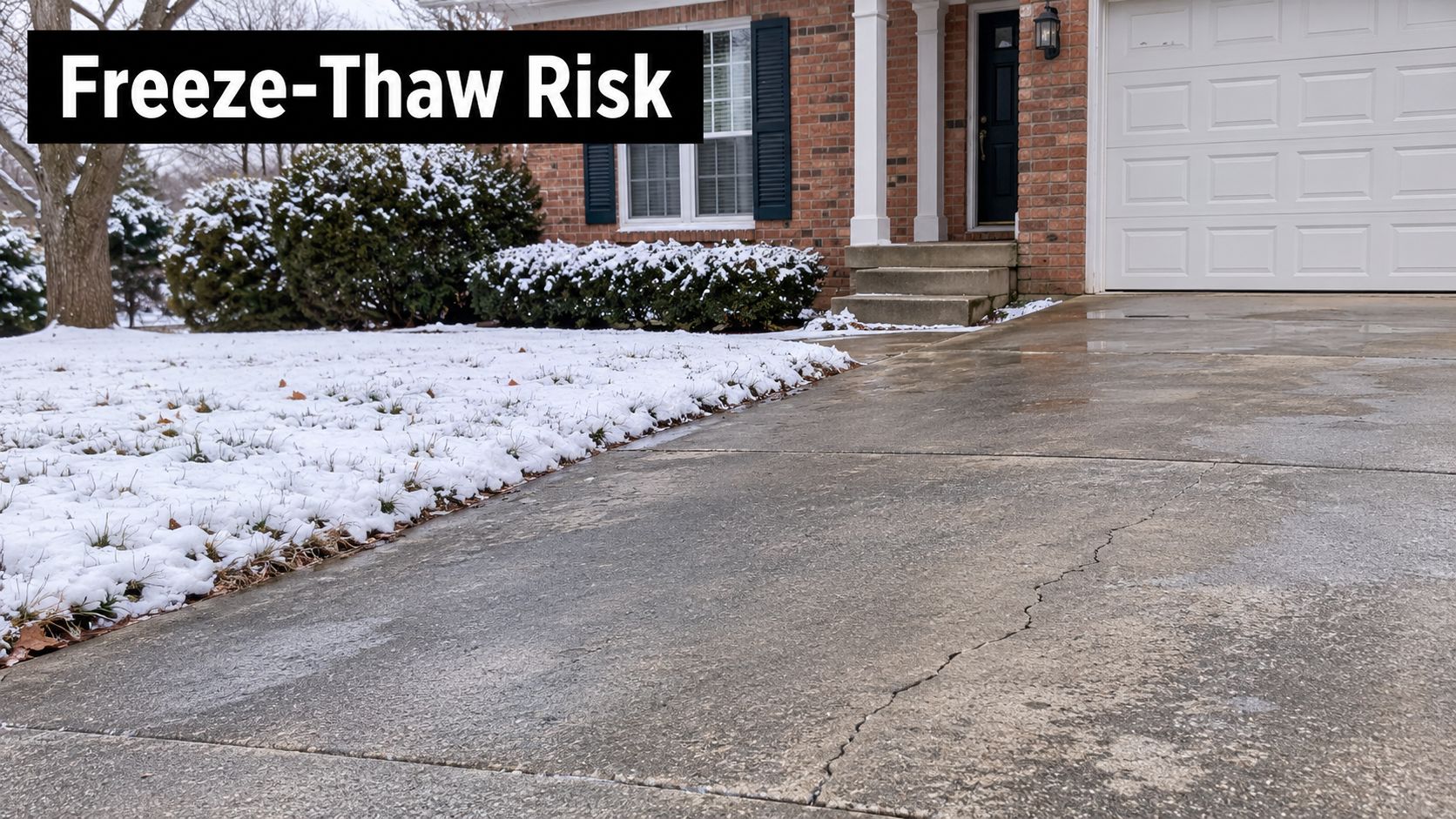
Say two driveways were poured the same spring. One slopes toward the street, joints are filled, and the downspouts discharge into the yard. The other is nearly flat, joints are open, and a downspout dumps beside the garage. The second shows scaling first, often within a few seasons, because it stays wet when the night temperature crosses freezing. The sloped, sealed slab can see the same cold and lose far less paste.
Check a local station's NOAA climate normals before you treat "we don't get real winters" as a design assumption. The risk score comes from wet hours, not from a single cold snap.
What stacks the odds
Exposure is usually a combination, not one mistake.
- Wet hours: Frequent rain and damp winter air keep pores near the saturation point for days.
- Clay soils: Much of metro Atlanta holds water and shifts, which opens joints and traps moisture under the slab.
- Low spots: A driveway in a swale ponds runoff that a sloped one sheds in minutes.
- Thin sections: A slab around four inches or less has less cover once the top starts to scale.
- Mix and joints: Concrete placed without air entrainment, plus joints left unsealed, gives freezing water nowhere safe to go.
- Shade: A north-facing drive stays wet into the evening and freezes while a sunny slope has already dried.
A short clip of surface breakdown shows why those wet edges fail first, before the middle of the slab looks bad.
Score yourself on wet hours, drainage, soil, thickness, joint condition, and sealing history. Two or more weak items means the next cold rain is a durability problem, not a cosmetic one. If the slab is already scaling, a residential concrete driveway replacement only pays off after those water sources are on the list.
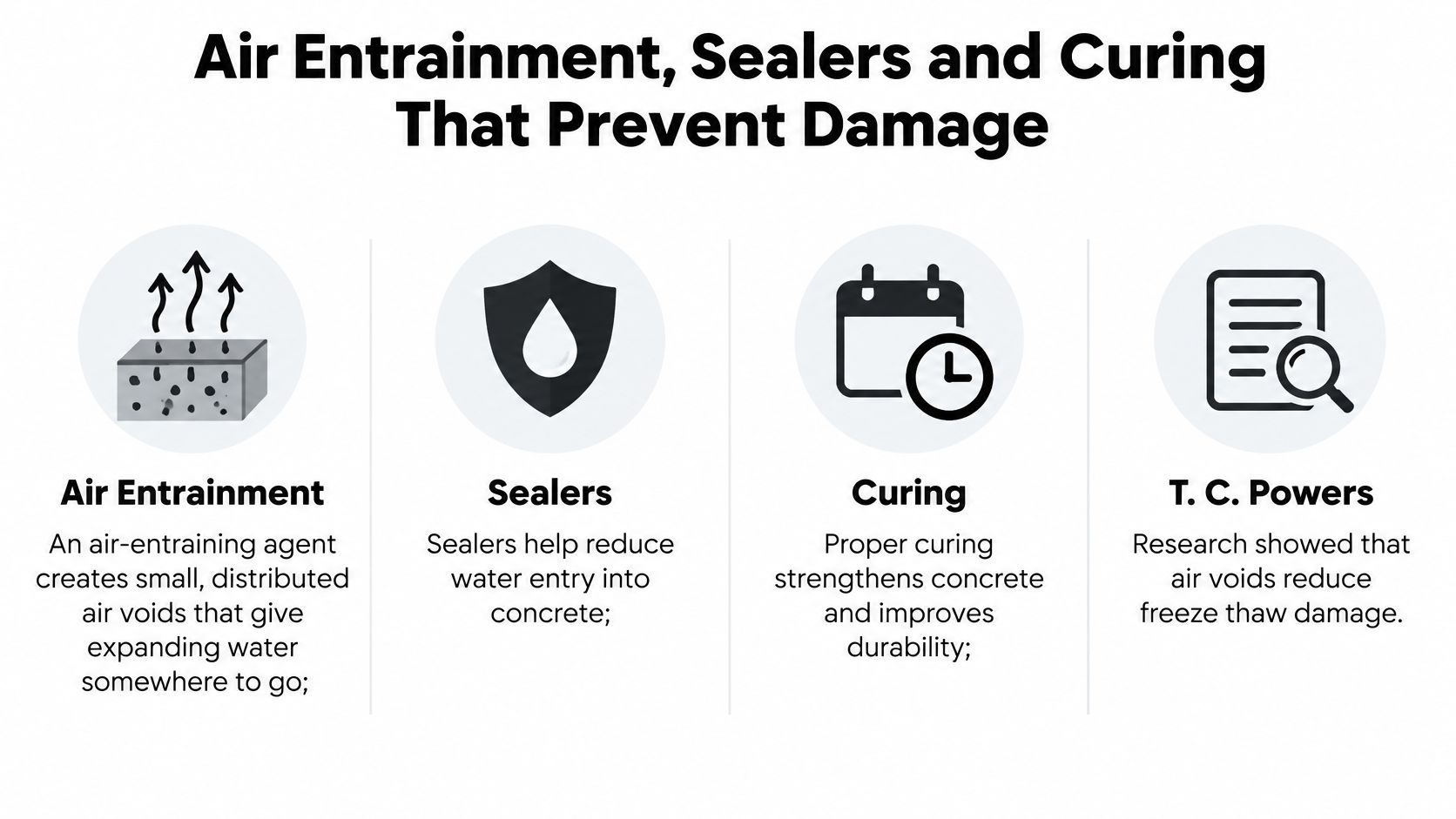
Air Entrainment, Sealers and Curing That Prevent Damage
A sealer cannot make a poorly proportioned mix freeze-thaw resistant. Air entrainment gives water in saturated concrete small voids to expand into as it freezes, reducing pressure within the cement paste. The mix, curing, and surface protection each play a different role.
Early research by T. C. Powers in 1945 attributed freeze-thaw deterioration to excessive hydraulic pressures from expanding ice in saturated cement paste. Federal Highway Administration guidance identifies air-entraining agents as a principal way to reduce this damage. Unfavorable exposure and materials can lead to early visible deterioration, though the surface may not show the full extent of internal damage.
Cracks can also let water and ionic substances reach reinforcing steel, increasing corrosion risk. Surface scaling alone does not tell you whether a slab needs a coating or more extensive repair. The decision depends on inspection of the concrete and the conditions that keep it wet.
Five specs that belong on the ticket
- Specify air entrainment in the mix. Ask to review the batch ticket before discharge. A general promise of a “durable mix” does not confirm that an air-entraining admixture is included.
- Protect the surface during curing. Curing compound, wet burlap, or plastic can help keep the paste moist while it gains strength. A surface that dries too quickly can dust or crack.
- Limit added water. Excess water makes concrete easier to finish but leaves a more porous paste that can absorb more moisture.
- Apply sealer after curing, then maintain it. Follow the product's application and drying directions. Applying a film too early can trap moisture instead of limiting water entry.
- Use sand for traction on icy concrete. Salt can keep the surface wet and contribute to scaling; sand adds grip without that effect.
Durability starts with the mix and the pour. Sealers can help protect the surface, but they do not replace air entrainment or proper curing.
For a driveway, walkway, or foundation, poured concrete services can address the installation itself. Specify concrete for its exposure, and treat sealing as one part of protection, not a fix for internal damage.
Drainage and Slab Design That Keep Water Out
After a steady rain, a driveway can look dry by noon while water remains trapped along an edge or beneath the slab. Check where puddles linger. Poor drainage keeps concrete wet through cold nights and can leave the base saturated, increasing the risk of damage.
A gentle, consistent fall toward the street or a drain moves water without creating a steep walk. Downspouts that empty onto the slab keep one area wet, while open joints can funnel water into the base.
Georgia DOT driveway guidance says a driveway's low point should generally be before its connection with a state highway, so surface water does not run across the highway. If that arrangement is impractical, the design should minimize flow entering the highway. The guidance also says driveway ditches must accommodate the 25-year storm. Where flow is too fast for grass lining, erosion protection or an alternative such as piping or paving is needed.
Translate the standard to a house lot
The same drainage principle applies on a residential lot: direct runoff to a place where it can be collected, rather than across a walkway, a neighbor's wall, or the public road.
For example, if a drive falls toward a neighbor's foundation wall, replacing the concrete at the same grade leaves the wet edge in place. Regrading toward the street or a trench drain at the low point, along with extending downspouts beyond the slab, addresses the source of the water.
- Redirect downspouts: Use elbows and solid extensions to carry roof runoff away from the concrete.
- Regrade low spots: A shallow swale in the lawn can direct water away from the slab.
- Add a trench drain: Consider one where the garage sits below street level and a slope toward the road could send water into the garage.
- Protect bare ditches: If fast-flowing water strips grass from a side ditch, piping or paving can protect the edge.
Correct the drainage and base conditions before replacing the slab. Otherwise, a new surface can face the same wet spots and settlement as the old one.
Scaling may look cosmetic, but appearance alone cannot show whether damage extends below the surface. Inspect the slab and how water moves around it before choosing a repair.
Choosing Between Crack Sealing, Patching and Replacement
Match the repair to how deep the failure goes. A sound base can take a surface treatment. A failing base will reject anything bonded to it.
| Damage level | Typical repair | Typical scope | Replace when |
|---|---|---|---|
| Hairline cracks, sound surface | Flexible crack sealant | Hours, low cost | Cracks keep widening or displace each season |
| Light scaling over a sound base | Bonded overlay or resurfacing | One day plus cure time | Scaling covers most of the slab or the base is wet |
| Localized spalling or popouts | Repair mortar patch | Hours to one day | Patches fail repeatedly or nearby concrete sounds hollow |
| Delamination across a large area | Partial removal and patch | Several days | Hollow areas are widespread or return after patching |
| Settlement, lifted edges or structural cracks | Full replacement | Days to weeks | Base or drainage failure cannot be corrected with surface work |
When a patch or overlay is the wrong tool
A bonded overlay needs concrete that is still intact underneath. Mill or shot-blast the laitance, then bond to solid paste. Lay that overlay over a delaminated or pumping base and it comes loose at the bond line, often within a season. Light scaling over a dry, solid slab is the case resurfacing is built for.
Patches have a limit. One popout filled with a polymer-modified repair mortar, edges cut square and the patch cured, can last. The same patch failing twice, with new hollow sound beside it, means the deterioration is wider than the hole you filled. At that point more surface mortar is maintenance, not a fix.
Cutting out a failed panel takes the right blade. A reciprocating saw is useful along a joint or a thickened edge where a walk-behind saw cannot start, and a guide to the best reciprocating blades for concrete keeps that cut from glazing or wandering into sound concrete you meant to keep.
Thickness you should verify, not assume
Georgia Department of Transportation specifications identify 4 inches and 6 inches as standard nominal thicknesses for miscellaneous concrete work. The specification also allows a minus thickness tolerance of 0.5 inch, so a specified 4-inch section could measure as little as 3.5 inches. Do not guess thickness from the exposed edge. Read the project specification or take a core.
Any replacement I would approve specifies an air-entrained mix and a drained, compacted base. The cost gap between repair and replacement follows drainage and base condition, not how rough the top looks. Surface-only pricing misses the work that keeps the next slab from scaling. For dollar ranges, read Concrete Driveway Repair vs Replacement and Concrete Driveway Replacement Cost Atlanta 2026. Sealing intervals belong in Concrete Driveway Sealing Atlanta, after the structure is sound.
Where the scope is patching rather than a full pour, concrete and masonry repair should still start with the hollow-zone map, not with a bag of mortar.
Book an Inspection Before You Repair or Replace
Scaling can look like a surface problem while damage continues beneath it. Base the repair decision on the condition of the slab and how water moves across and around it, not on how many freezes the area has had.
Before requesting an estimate, gather a few useful details: photograph cracks and scaling with a tape measure for scale, note any standing water or downspouts that discharge onto the slab, and record the slab's age and previous repairs. If the original specifications are available, include them. These details help clarify the problem and the work being considered.
Ask what the proposed scope covers, including whether it addresses drainage as well as the damaged concrete. A patch may improve the surface, but it will not correct a water problem that continues to affect the slab. Project duration depends on size, complexity, and weather conditions. Atlanta Concrete Solutions gives a project timeframe during the initial consultation.
Atlanta Concrete Solutions provides free estimates for concrete projects, so bring your photos and notes and request one before you commit to a patch or a new slab. Call (678) 554-4433 to request a free quote.