
You've got two quotes on the kitchen counter and a cracked driveway that turns slick every time it rains in Atlanta. One contractor priced a plain broom finish, the other priced exposed aggregate, and both sound confident theirs is the right call. The honest answer in the Exposed Aggregate vs Broom Finish decision isn't a universal winner. It's a site-specific specification based on slope, wet exposure, aggregate hardness, and sealer. Pick the name without nailing down those details and you can pay more for less grip, or save money and get exactly what you need.
Exposed Aggregate and Broom Finish Side by Side
If you need the short version first, here it is. Exposed aggregate removes the surface cement paste so the stones in the mix show and become the wearing surface. A broom finish drags stiff bristles across fresh concrete to cut fine grooves into that paste. One gets its texture from stone, the other from lines a finisher pulls by hand.
| Criterion | Exposed Aggregate | Broom Finish |
|---|---|---|
| Appearance | Stone-rich, decorative, color and aggregate visible | Plain, functional, uniform texture |
| Texture source | Exposed coarse aggregate particles | Grooves cut into plastic concrete |
| Wet slip resistance | Strong when aggregate is hard, angular and well graded | Good when grooves are coarse and run across travel |
| Durability | Strong when stone is hard and mix is sound | Good, but grooves can wear if too shallow |
| Relative cost | Higher | Lower |
| Maintenance | Periodic cleaning and sealing; occasional pop-outs | Periodic cleaning and sealing; texture can smooth under heavy traffic |
| Best-fit surface | Patios, pool decks, decorative driveways | Standard driveways, sidewalks, ramps |
The Verdict in Two Sentences
Exposed aggregate wins on looks and on long-term texture when the aggregate is hard and well graded. A coarse broom finish wins on price and simplicity for standard slabs, and I'd recommend it without hesitation where appearance isn't the driver.
That verdict comes with a catch most quotes gloss over. Both names describe families of finishes, not one standard product. Two bids labeled exposed aggregate can use different stone types, sizes, and exposure depths. Two broom finishes can differ in bristle stiffness, pressure, and groove depth enough that one grips in the rain and the other feels polished within a few years.
Don't compare labels on a quote. Compare stone type, groove depth, and exposure depth, because those are what you'll actually walk on.
Three questions decide most choices before color ever enters the conversation. How steep is the surface? How often does it stay wet? Who walks or drives on it, in dress shoes, bare feet, or on tires? Answer those and the finish usually picks itself. The sections that follow take each criterion in turn, starting with how the texture itself is made, then wet grip, wear, cost, use case, and the sample panel I'd ask for before signing anything.
How Each Finish Creates Its Texture
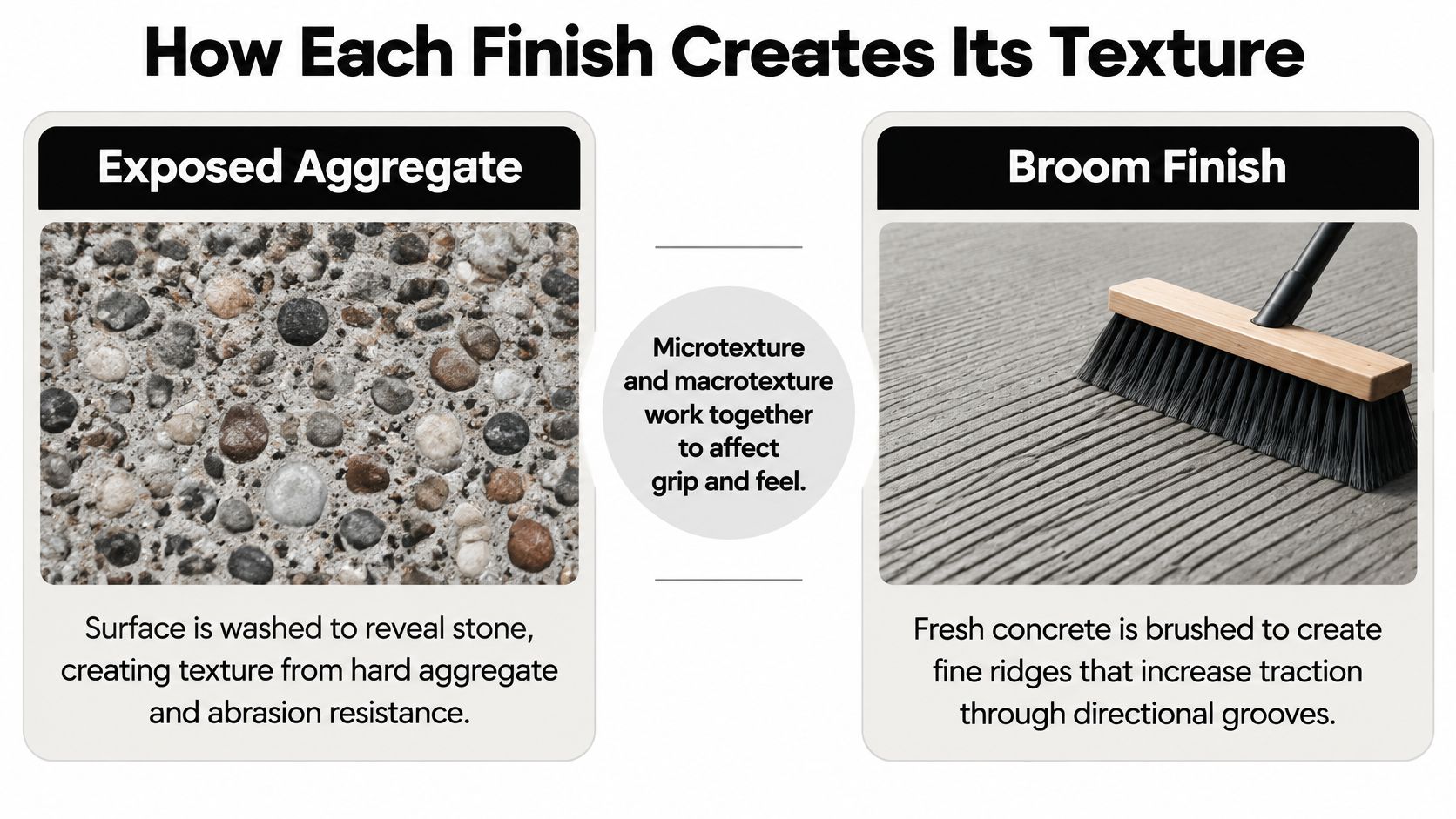
Traction on concrete works at two scales, and understanding them tells you how each finish will behave before you judge either one. Microtexture is the fine roughness from sand and mortar that helps shoes and tires grip at low speed. Macrotexture is the deeper pattern that channels water off the surface so that fine grip can do its job. The American Concrete Institute guidance on concrete texture explains that microtexture comes primarily from the fine aggregate in the cement mortar, while macrotexture consists of deeper grooves or striations formed during finishing.
ACI identifies exposed aggregate as a recognized decorative finish and separately recognizes brooming as a finishing operation used to texture concrete. That distinction matters because the two methods build macrotexture in opposite ways.
Grooves Cut In Versus Stone Revealed
A broom finish creates macrotexture directly. After screeding and floating, a finisher pulls a stiff broom across plastic concrete, leaving directional grooves in a surface that otherwise looks like flat, uniform gray with fine parallel lines. The operator controls direction and depth on the spot, which is why a well-broomed sidewalk feels predictable underfoot.
Exposed aggregate works the other way around. The crew retards the surface mortar, then washes or brushes it away so coarse stone shows, producing a pebbled, naturally irregular surface where you can see individual stones and color variation. ACI notes that its traction depends on aggregate type, particle shape, size, and spacing, so the stone you select is the texture you're buying. You can see how that looks across different projects in our residential decorative concrete options.
What the Mechanism Predicts
Three consequences follow from that difference. First, brooming gives the finisher direct control over groove direction and depth. Second, exposed aggregate performance is locked in by aggregate hardness and shape long before pour day. Third, neither finish compensates for weak fundamentals, since performance still depends on mixture design, thickness, curing, drainage, and subgrade preparation.
Try a simple field test on any sample you're shown. Run your palm across it dry, then wet it and run your palm again. If the grip comes from lines you can feel catching your skin, that's broom macrotexture. If it comes from hard points of stone, that's aggregate doing the work, and you'd better like that stone, because it's the finish.
Slip Resistance in Wet and Sloped Areas
A summer storm hits a sloped driveway while someone is still walking down it. Water sheets across the slab. Grip then depends on the grade, how hard the stone is, how long the surface stays wet, and which sealer is on it. The finish name by itself does not pick a winner.
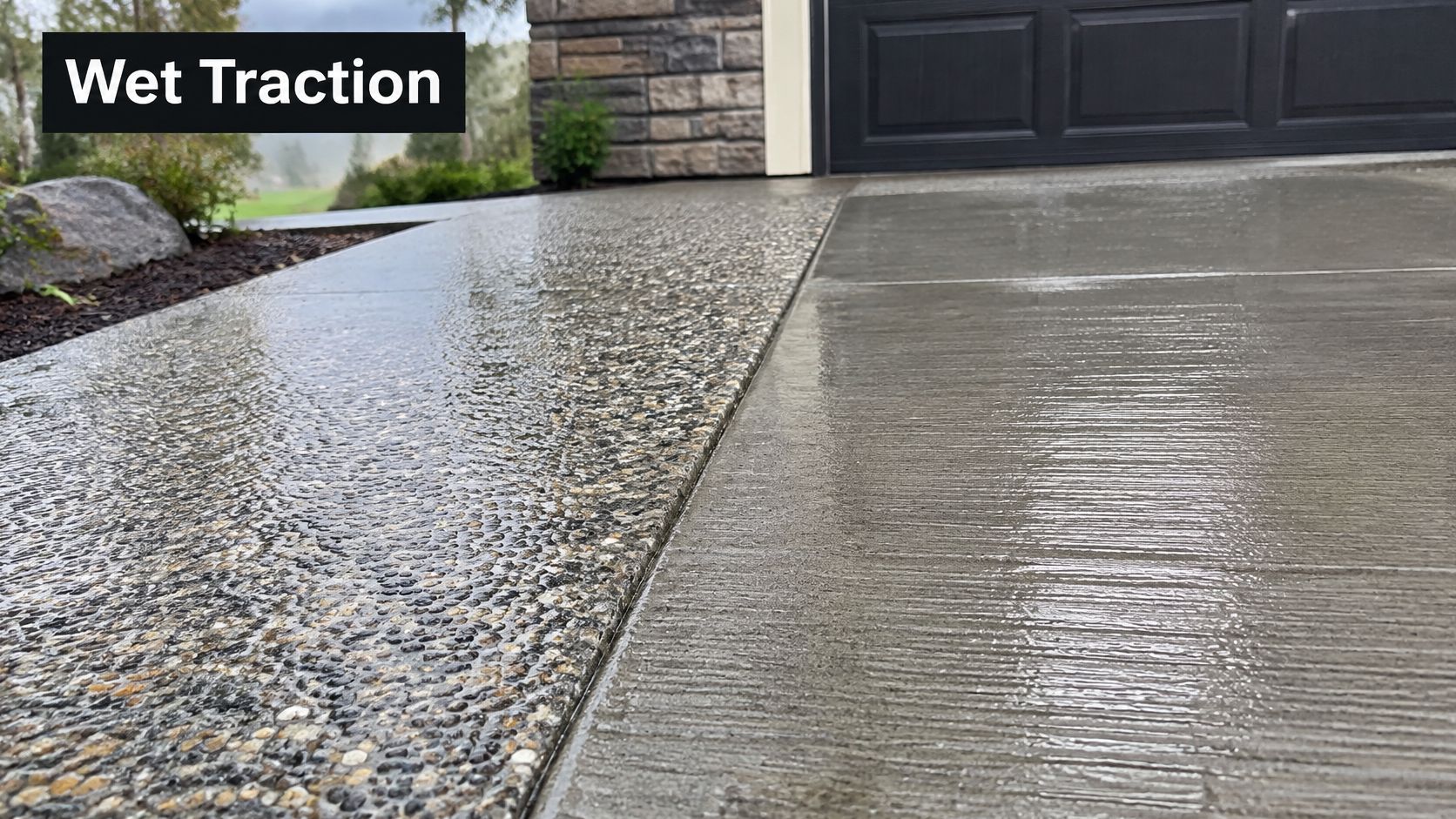
Exposed aggregate often stays safer when wet over the long term, because slip resistance comes from hard, abrasion-resistant particles rather than only shallow grooves in the paste. The Federal Highway Administration guidance on pavement texture reports that exposed-aggregate texture performance varies with aggregate size, texture depth, and aggregate durability. Durable skid resistance also depends on how well that aggregate resists wear and polishing. Soft, polishing gravel can lose bite even while the pebbles are still visible.
A broom finish can be safe when wet, with a condition. FHWA cautions that broom or artificial-turf textures may wear away unless produced with sufficiently deep grooves, heavy bristles, and adequate pressure. On a soaked grade, shallow lines fill and the slab feels smoother than it did the day it was finished. Neither surface is automatically the safe one.
A Checklist for the Contractor Call
Keep these three questions in front of you when you talk through a quote.
- Stone type: Ask whether the aggregate is angular and non-polishing, not rounded river gravel that can smooth under traffic.
- Exposure depth: Ask for the intended exposure depth and verify it with a mock-up, since specifications require controlled removal of surface mortar without dislodging the aggregate.
- Groove direction and depth: For brooming, confirm grooves run perpendicular to pedestrian or vehicle travel and are coarse enough that a fingertip catches and water has a channel off the walking line.
Slope, Bare Feet and Standing Water
On a steep or frequently wet grade, I favor a coarser broom or a more aggressive exposed texture. Water needs a path off the slab, and shoes and tires need edges to bite. On pool surrounds and barefoot areas, a finer exposed aggregate or a light broom is the better specification. Stone that grips a tire can punish bare feet.
Predictable footing matters more than decoration on residential sidewalk concrete, where the same wet-surface choice shows up at a gentler slope.
Texture cannot fix water that has nowhere to drain. If the yard holds puddles against the slab edge after every storm, find help with standing yard water before you blame the finish. A flooded surface defeats any texture.
Sealer rule: A sealer can change surface texture and must not reduce wet slip resistance, so ask for the sealer's slip rating before you approve it.
Around Atlanta, storms soak sloped driveways fast. Specify the texture, and the sealer, for that wet condition rather than for how the slab looks on a dry afternoon.
Durability and Wear Over Time
A driveway that looked sharp the week it was poured can tell a different story after summers of tires, storms, and resealing. Broom finish and exposed aggregate do not fail the same way, and neither name is the durable choice on every site. Slope, aggregate hardness, how often the slab stays wet, and the sealer on top all change how texture holds. Specify the finish for that slab.
Broom grooves flatten gradually. Tire paths and the walking line from the car door to the front door smooth first. Slab edges often keep their original lines long after the center has gone quiet underfoot. The federal pavement guidance on concrete texture and sustainability states that broom texture may not remain durable unless it is sufficiently deep, and that long-term skid resistance depends on retaining both microtexture and macrotexture.
Exposed aggregate wears on a different path. Stones can loosen through pop-outs when the aggregate is weak or the wash was timed poorly, leaving small pits where individual stones sat. Hard, well-graded stone in a suitable mix stays seated. Soft or poorly shaped particles do not, especially where water sits and repeated wetting works the bond.
Grip Versus Noise
Deeper texture costs something besides the install. That same federal guidance treats microtexture as what helps tires grip and macrotexture as what channels water away and reduces hydroplaning risk. Texture selection also affects both friction and tire-pavement noise. A vehicle driveway on a wet slope may accept some tire hum in exchange for braking edges. A flat pedestrian path should stay even underfoot. A court needs consistent traction and ball response, not decorative roughness.
I don't treat exposed aggregate as always more durable, or broom finish as always lower-maintenance. Exposed outcomes depend on specifically graded and shaped coarse particles and a suitable mixture. Broom outcomes depend on groove depth holding up under the traffic that uses the slab, and on a sealer that does not fill those grooves slick.
Warning Signs the Finish Is Spent
Walk the surface wet once a year.
- Grooves gone: Broom lines you can no longer feel with a fingertip in the tire paths.
- Stones loose or missing: Exposed aggregate you can wiggle, or pits collecting grit.
- Polished sheen: A glossy look in traffic lanes that signals the surface has smoothed.
- Sealer buildup: A slick, plasticky feel after resealing that wasn't there before.
Judge durability by whether the texture still grips when wet and the stone stays bonded, not by a promised fixed lifespan.
Installed Cost and Upkeep Compared
A 500-square-foot driveway that looks simple on paper can still split into two budgets once slope, stone hardness, wet exposure, and sealer are specified. Published prices disagree because sources use different years, regions, and assumptions about labor, base preparation, and thickness. Treat the ranges below as a bracket for budgeting, not a quote.
| Source and price basis | Broom Finish per sq ft | Exposed Aggregate per sq ft |
|---|---|---|
| SlabCalc driveway guide, 2024-2025 installed | $7-$13 | $10-$15 |
| SlabCalc finish comparison, 2026 | $4-$8 | $8-$14 |
| Concrete Calculator Max, 2024-2025 installed | $6-$12 | $12-$18 |
| Everything About Concrete, 2023 prices | $5-$10 | $6-$14 |
A 500 Square Foot Worked Example
Take the SlabCalc driveway guide row above: broom finish at $7-$13 per square foot, exposed aggregate at $10-$15 per square foot. Multiply by 500 square feet and a broom finish runs roughly $3,500 to $6,500, while exposed aggregate runs roughly $5,000 to $7,500, before permits, demolition, or base work. That spread is the finish premium you are deciding on.
The cheaper broom finish is the right call on a fairly flat site where the stone does not have to carry the look and a light sealer is enough. A steeper grade, softer aggregate, or constant wet exposure can spend that savings on earlier cleaning and resealing. Upkeep is the recurring cost either way. Regular cleaning and periodic sealing can help prolong the life and appearance of concrete installations, which generally need minimal maintenance. Exposed aggregate needs more careful cleaning so you do not dislodge stones with aggressive pressure at close range. Broom grooves tend to collect grit and leaf debris that a stiff push broom clears. Hard aggregate holds texture longer under tires. Softer stone, or a thick sealer film, can polish slick in the same wheel path. Atlanta Concrete Solutions provides free estimates for concrete projects, and I'd ask any contractor for itemized pricing that separates finish, base, and thickness.
The Atlanta Apron Line Item
On a driveway replacement, do not let the apron blur the finish comparison. The City of Atlanta right-of-way manual identifies installing or repairing a driveway apron or sidewalk as work requiring Department of Transportation authorization, possibly including a qualified-contractor permit, and the apron must follow city standard details including flared transitions. Permit rules and the building codes the city applies change with the submission year, so get the apron, the slab finish, and the permit work priced as separate lines. Then you are comparing finishes on the same base.
Choosing the Finish for Each Use
There's no universal winner here, and pretending otherwise is how people end up with sharp stone around a pool or polished grooves on a steep driveway. The Federal Highway Administration technical advisory on pavement texture notes that broom textures can lose durability when grooves are too shallow or made with insufficient pressure, and that exposed aggregate performance depends on aggregate mineralogy, particle shape, size, and texture depth. Use replaces preference as the deciding factor.
| Use case | Better fit | Why | Watch for |
|---|---|---|---|
| Vehicle driveway, steep or wet | Coarse broom, or exposed aggregate with hard angular stone | Grip and braking on wet grades | Tire noise and grooves worn by traffic |
| Patio or pool deck, used barefoot | Exposed aggregate with fine stone, or light broom | Comfort underfoot and drainage | Sharp exposed stone on bare feet; test a sample |
| Sidewalk or ramp, accessibility focus | Broom finish with grooves across travel | Even footing and predictable texture | Shallow grooves wearing smooth |
| Pickleball or basketball court | Controlled broom or a specified texture | Consistent ball response and traction | Surface flatness and regularity over decoration |
Reading the Four Cases
Say your driveway drops toward the street and stays wet under tree cover. That's the first row, and it argues for coarse texture you'd never want around a pool. Say instead you're building a patio where kids run barefoot from the water. That's the second row, where fine stone or a light broom wins and aggressive aggregate is a mistake, however good it looks in a photo.
Sidewalks and ramps reward boring consistency, which is why brooming across the direction of travel is the standard answer there. Courts are their own case, since players need controlled traction and a true bounce, and decorative roughness works against both. For the driveway itself, our residential driveway concrete work starts from slope and traffic before finish style.
You can also split the decision on one project. A decorative patio can use exposed aggregate with a fine stone while the driveway takes a coarse broom, and both get specified properly. Bring your design preferences to that conversation, because our team discusses design ideas and recommends a decorative concrete solution based on the customer's preferences and project requirements, not price alone.
If a contractor recommends a finish before asking about slope, bare feet, and traffic, that recommendation is a guess.
Confirm the Finish With a Sample Panel
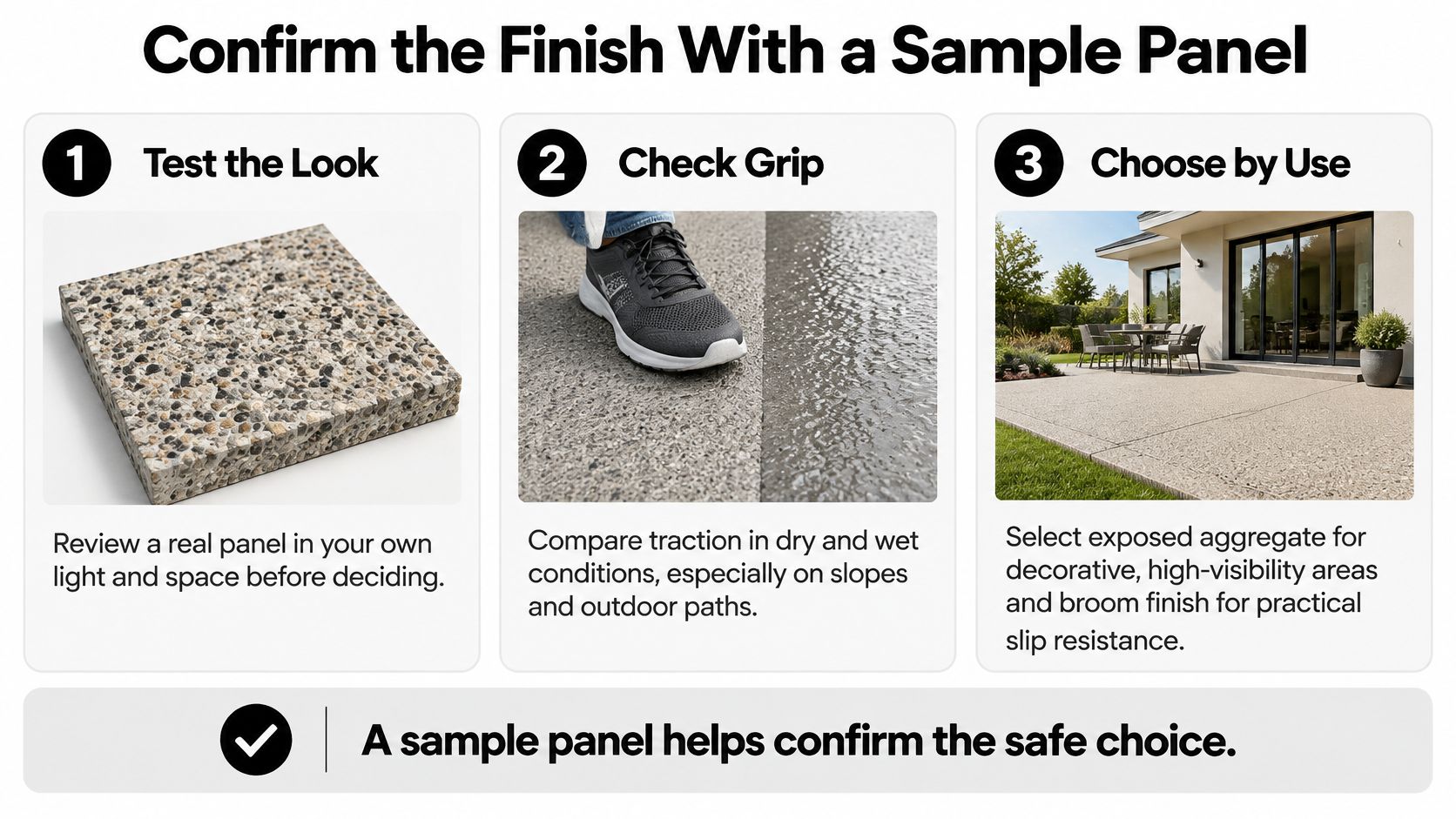
A sloped driveway that stays wet needs a different texture from a patio where people walk barefoot. Choose exposed aggregate with fine, well-graded stone for a decorative or high-visibility surface, or for a barefoot area where comfort matters. Choose a coarse broom for a standard or steep driveway, sidewalk, or ramp where cost and predictable grip matter most.
The Pre-Signing Checklist
Before choosing a finish, check how its texture feels and performs under the conditions the surface will face.
- Request a sample panel: Ask for a panel with the planned exposure or groove depth. Wet it, then walk on it in the shoes or barefoot conditions expected for the finished area.
- Confirm the stone: Specify the aggregate type and size. For barefoot comfort, avoid sharp, coarse stone; for exposed aggregate, confirm the selected stone suits the intended use.
- Check the sealer: Ask how the sealer affects traction when wet. A glossy finish can change how the texture feels underfoot.
- Review the quote: Compare the finish alongside base preparation, thickness, demolition, and any apron or permit work. This shows whether the exposed finish adds cost and helps keep the comparison fair.
Atlanta Concrete Solutions provides a project timeframe during the initial consultation. Call (678) 554-4433 to request a free quote and discuss the surface's slope, drainage, and intended use. A sample panel takes time upfront; choosing the wrong texture can affect comfort and traction for years.
Atlanta Concrete Solutions can provide an estimate for a concrete project and discuss design options based on your preferences and project requirements. A sample panel helps confirm that the chosen finish suits the site before installation.