
A few fine lines appear across your driveway after a wet Atlanta spring. One runs from the edge toward the garage; another crosses a spot where water collects after rain. It's tempting to buy concrete filler and seal both. But a crack can be a surface blemish, a sign of movement beneath the slab, or a clue that water is undermining its support. The right repair starts with figuring out which one you're looking at.
Why Atlanta Driveways Crack in the First Place
Concrete can look rigid and permanent, but it changes as it sets, dries, heats, and cools. The National Ready Mixed Concrete Association explains that concrete is weak in tension: when natural shrinkage is restrained, tensile stress can exceed the concrete's strength and create cracks (NRMCA guidance on concrete cracking). Cracking isn't automatically evidence of bad work. What matters is the cause, whether the crack is changing, and whether the slab remains supported.
Think about the hairline web that shows up after a wet spring. On one driveway, those lines may be shallow shrinkage cracks in a slab that remains level and drains well. On another, a similar-looking pattern may accompany a soft, saturated base and a section that has started to settle. The filler can hide either crack for a while, but it can't tell you which condition you have.
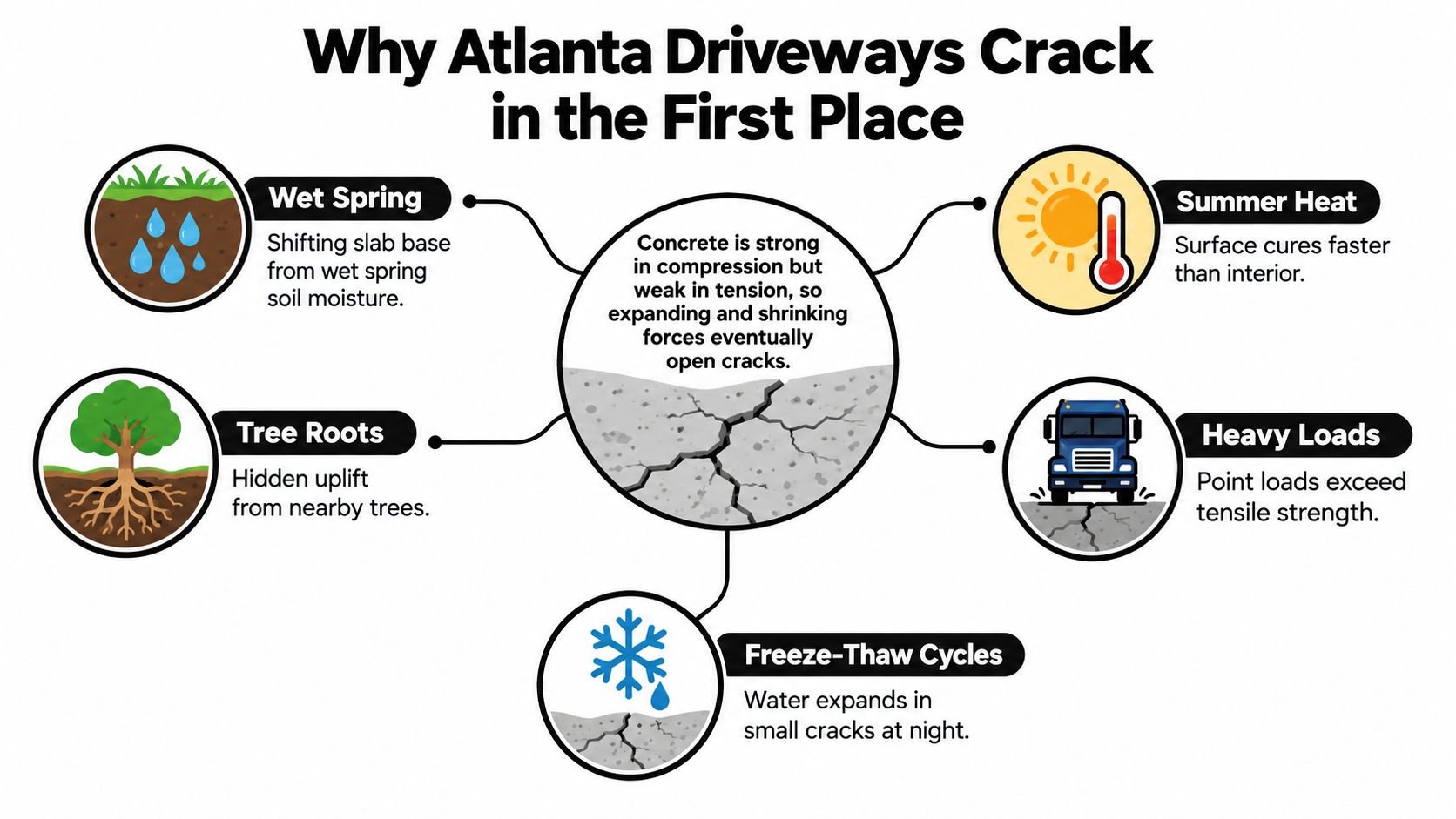
A crack is a clue, not a diagnosis. Look at its pattern, check for a change in slab height, and notice what happens to water nearby before deciding to patch it. A crack that reopens after filling often points to an unresolved source of movement or restraint.
What good installation can and can't prevent
A sound installation can manage where cracks form, but no joint layout makes concrete immune to movement. NRMCA recommends contraction joints cut to approximately one-quarter to one-third of slab thickness and spaced at 24–36 times the slab thickness. It also recommends keeping panels approximately square, with panel length no more than about 1.5 times panel width. For example, its spacing rule gives a 4-inch slab a general joint-spacing benchmark of roughly 8–12 feet, subject to site conditions and local specifications.
Those joints make controlled cracks more likely to form along planned weakened planes. They don't eliminate cracking. Poor drainage, inadequate subgrade preparation, excessive water in the mix, improper finishing, rapid moisture loss, and insufficient curing can all increase the chance of unwanted cracks.
Before comparing work options, consider the whole system: slab, joints, base, drainage, and edges. A new pour over a persistently wet or uneven base can repeat the same failure. For an overview of residential concrete driveway work, start with that system rather than choosing a filler by appearance alone.
Reading Crack Patterns Like an Inspector
The first useful question isn't “How wide is it?” It's “What does the crack do?” Record its location and shape, then check whether the slab faces sit at the same height. A narrow line with no displacement may be less concerning than a crack that's opening, branching, or leaving a raised edge.
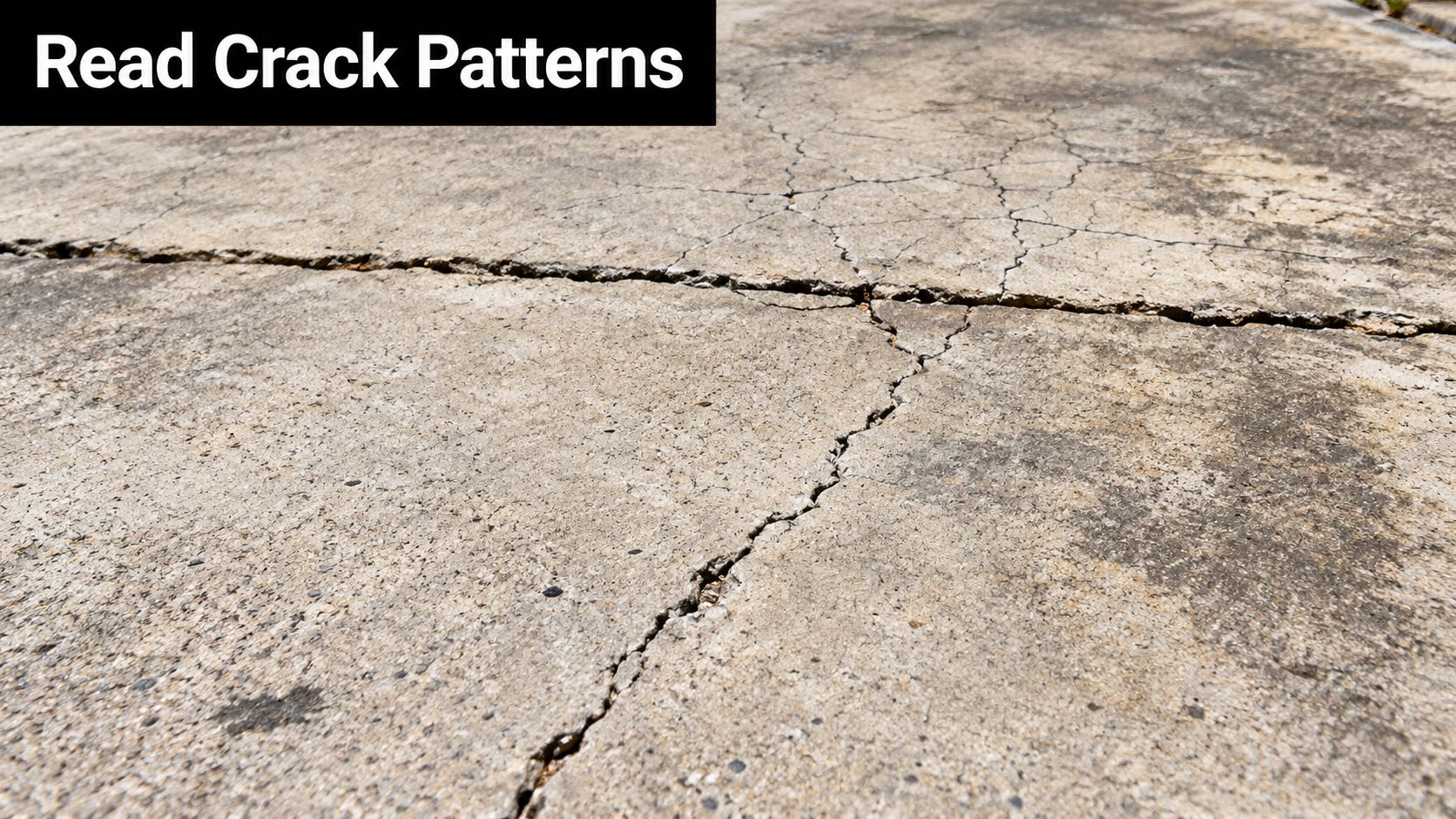
Match the pattern to the likely mechanism
- Fine, random hairlines: These can be consistent with shrinkage as concrete dries and hardens. If the lines stay fine, don't branch or widen, and the slab remains level, they may be mainly cosmetic. Track them before sealing.
- Diagonal cracks across a panel: These can point to uneven support, settlement, roots, or restraint. Look for a height difference, nearby trees, soft ground, or a section that rocks underfoot. A growing diagonal crack deserves closer assessment.
- Stepped or lengthwise cracking near an edge: Check whether one side has dropped or the slab seems unsupported. FHWA's Long-Term Pavement Performance analysis linked premature longitudinal cracking in jointed concrete pavements to voiding beneath pavement edges, associated with foundation depressurization and slab curling (FHWA pavement performance analysis). The study concerns pavement rather than residential driveways, but the support issue is relevant to driveway slabs too.
- Cracks following control joints, with chipped or scaled edges: A crack at a joint may mean the planned weak plane is doing its job. Scaling, crumbling, or small fragments around it can indicate water-related surface distress rather than a simple open seam.
- Widespread map cracking: A network of interconnected lines, especially with scaling or flaking, warrants a more careful evaluation. Don't assume a surface coating will correct a durability or moisture problem beneath it.
Document before you decide
Mark the endpoints with chalk, note the width and any vertical offset, and photograph the area in consistent light. Recheck after rain and through seasonal temperature changes. Also record whether water ponds there, a downspout discharges nearby, or vehicles regularly load the area. That record gives a contractor useful evidence and helps distinguish a stable blemish from an active crack.
The Hidden Causes Most Homeowners Miss
A crack pattern tells you where to look. The underlying cause may be at the surface, within the concrete, or below the slab. That's why a driveway with a sound-looking finish can still develop structural cracking: the base may have shifted, an edge may have lost support, or the slab may be restrained where it needs to move.
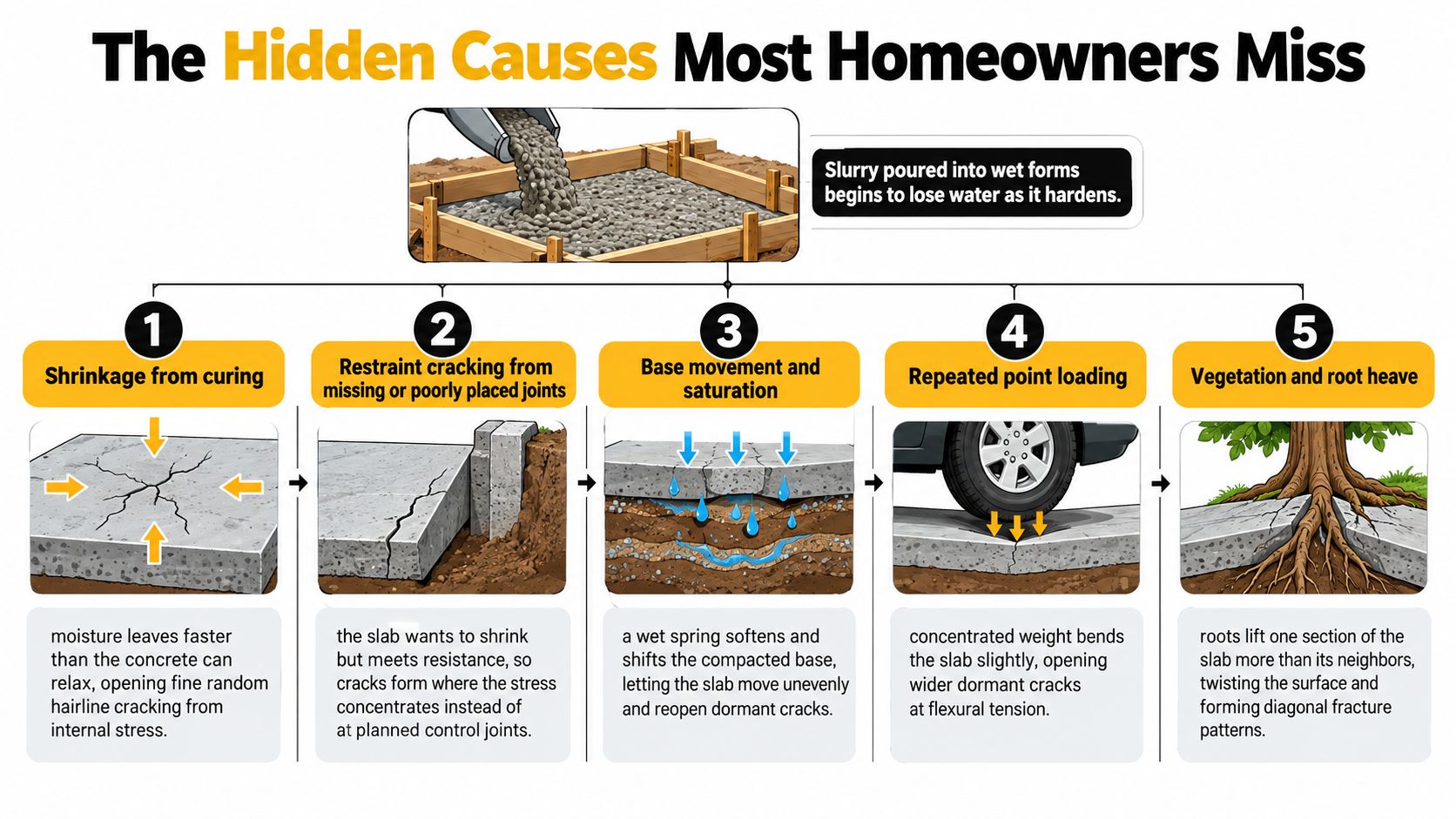
Moisture, restraint, and movement
Shrinkage happens as concrete loses moisture while hardening and drying. If it can't contract freely because of restraint or poor joint placement, stress may concentrate and produce an uncontrolled crack. A wet spring can also saturate soil below the driveway; if the base softens or moves unevenly, the slab may settle and reopen an older crack.
Drainage deserves special attention where a crack follows a low spot, recurs after sealing, or appears alongside settlement. Check where roof runoff goes, whether water runs along the driveway edge, and whether soil has eroded or softened. A root that lifts or twists a slab can also leave diagonal cracking. If a removed tree stump is part of the site history, this explanation of the root decomposition timeline after grinding can help clarify what happens below ground, though it won't diagnose the driveway's present support.
Freeze-thaw and internal distress
Atlanta's winters are milder than those in northern markets, but shaded, persistently wet areas and occasional freezing still matter. FHWA describes freeze-thaw damage as especially likely when concrete reaches roughly 87% water saturation; even one freeze-thaw cycle can then initiate cracking. Entrained air and lower permeability help protect concrete, but they don't make a slab impervious to poor drainage or every exposure (FHWA guidance on concrete durability and freeze-thaw).
Some damage can originate in susceptible aggregate, cement paste, or joints. D-cracking, for example, is associated with aggregate-related distress that commonly begins near joints. Deicing salts can retain water in concrete pores, so a mild winter or air entrainment alone doesn't rule out moisture-related damage. Filling an opening while water continues to collect or the base keeps moving may improve the appearance without stopping the failure.
Repair Options You Can Actually Do Yourself
A careful homeowner can seal some stable, isolated cracks. The key is choosing a repair material that suits the crack's behavior, not just its width. Before buying anything, make sure the slab is level, the crack isn't repeatedly reopening, and there's no persistent runoff or loose concrete around it.
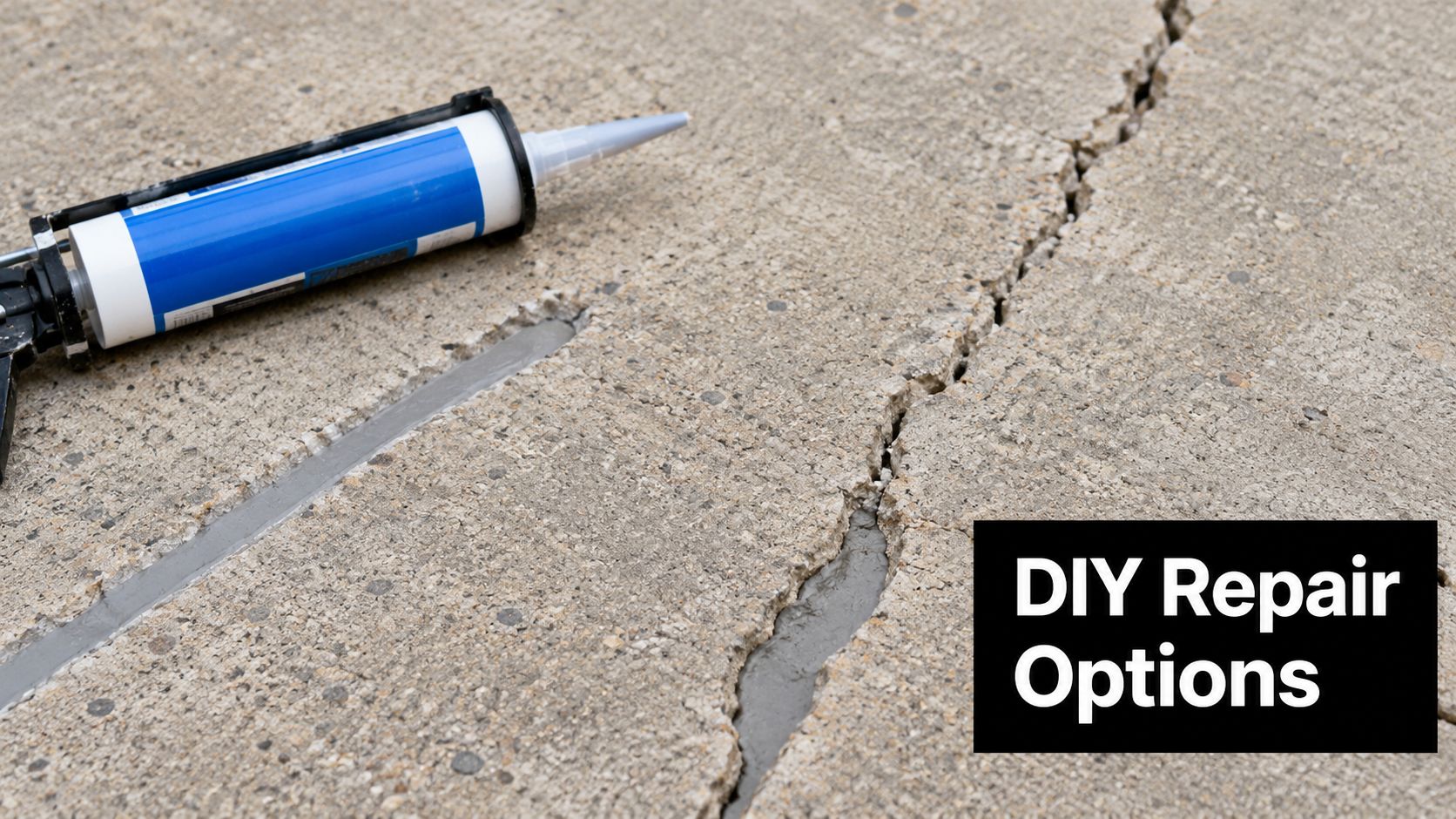
A measured DIY approach
Start by removing dust, loose concrete, leaves, and other debris. Use a stiff brush and a suitable hand tool, then let the crack dry as the product instructions require. Don't widen the crack just to make the repair look substantial. Some sealant systems need a routed reservoir, but routing should follow the repair product's requirements.
For a stable crack that may still experience small thermal or moisture movement, a compatible flexible polyurethane or self-leveling sealant is usually a more sensible choice than a rigid filler. Gravity-fill products may suit certain wider, dormant cracks. Check the label for the intended crack type and surface conditions, and keep vehicles off the repair until the manufacturer's instructions allow traffic.
ACI treats evaluation, method selection, epoxy injection, routing and sealing, gravity filling, drilling and plugging, and reinforcement or pinning as distinct repair techniques, not interchangeable products (ACI concrete repair guidance). Epoxy injection is intended for clean, dormant cracks when structural bonding is the objective. It's a poor match for a crack that keeps opening and closing. Drilling and plugging, reinforcement, or pinning are generally better left to a qualified repair contractor.
For general product categories, this overview of adhesives, sealants, and tape is useful for understanding how sealants differ from bonding products. It isn't a substitute for selecting a concrete repair system made for driveway exposure. Atlanta Concrete Solutions provides concrete and masonry repair, including work on cracked and deteriorated surfaces, when a crack's movement or cause makes a DIY patch uncertain.
The video below shows a crack-filling process. Use it as a visual reference, not a diagnosis: a neat bead won't correct settlement, poor drainage, or an unsupported slab.
Avoid sealing over an active crack with rigid epoxy, applying product over dust or loose concrete, and ignoring a downspout that pours directly onto the slab. If the crack is displaced, repeatedly reopening, or associated with settlement, stop treating it as a simple filler job.
Repair, Resurface, or Replace
Choose the smallest scope that addresses the cause, not the most visible mark. A stable crack in an otherwise sound slab may need local repair. A worn or scaled surface can sometimes be resurfaced if the concrete beneath it remains sound. A driveway with active movement, displaced sections, widespread cracking, or failed support may need reconstruction rather than another cosmetic layer.
| Condition | Recommended Scope | Typical Atlanta Cost |
|---|---|---|
| Stable, isolated crack; level slab; drainage works | Clean and seal or make a localized repair | Depends on crack and selected repair system |
| Cosmetic wear or surface scaling; sound slab and base | Evaluate and consider resurfacing | Depends on surface preparation and finish |
| Active or displaced cracks, settlement, or drainage and subgrade failure | Correct support and drainage, or replace affected slab | Published replacement estimates range from approximately $2,250–$9,000 overall |
One published Atlanta estimate reports installed concrete at $6–$12 per square foot and total driveway replacement costs of approximately $2,250–$9,000. Its example ranges include roughly $1,080–$4,950 for materials, $990–$4,050 for labor, and $90–$180 for permits (Atlanta driveway replacement cost estimate). Treat those figures as planning ranges, not a quote. Demolition, excavation, access, poor subgrade, drainage structures, and decorative finishes can change the final scope and price.
What a resurfacing quote should answer
Ask whether the contractor believes the existing slab and its base are stable. A new surface layer may refresh appearance, but it won't correct a slab that rocks, settles, or carries water toward the house. If the assessment points to structural replacement, compare estimates that specify demolition, base preparation, grading, drainage, joints, and finish rather than comparing a single per-square-foot figure.
For a poured slab project, confirm what the proposed scope includes and whether it addresses the support conditions behind the cracking. Atlanta homeowners can review residential poured concrete services as a starting point for understanding replacement options. When comparing contractors, ask each to explain why the crack pattern supports their recommendation and what would make the repair fail again.
Permits and Prevention for Atlanta Homes
A driveway project can involve more than the slab on private property. The apron, curb cut, sidewalk, gutter, and other public-right-of-way features may be governed by a different authority. The City of Atlanta, Marietta, Roswell, Alpharetta, Sandy Springs, and Fulton, Cobb, Gwinnett, and DeKalb counties can have different procedures, so confirm the jurisdiction before demolition or construction.
A local permitting guide says new driveways, widening, and extensions commonly trigger permitting and reports driveway-related fees of approximately $75–$500, with possible additional grading or drainage review fees of $100–$400 (Atlanta driveway permitting guidance). Work that changes the driveway footprint or affects an apron, sidewalk, curb cut, or drainage route may require review. Ask the relevant city, county, public-works, transportation, or Georgia Department of Transportation office what applies to your address and scope.
Keep water and early loading in check
Prevention starts at the roofline. Make sure downspouts discharge away from the slab, clear channels and drains, and watch where runoff travels during heavy rain. If water repeatedly ponds by a crack or washes soil from the driveway edge, correct the drainage or support problem before resealing.
Keep deicing salts off new concrete, especially where water can linger, and follow the contractor's written release schedule before driving on a new pour. The waiting time depends on the mix, weather, slab, and specified strength; surface appearance alone doesn't show whether the concrete is ready for traffic.
A practical maintenance rhythm is simple:
- After major storms: Check for new ponding, runoff against the slab, or erosion along the edges.
- During routine upkeep: Keep joints and drains clear, and use a suitable sealer when the surface and product instructions call for it.
- When cleaning: Use driveway-appropriate methods that don't damage the surface; these driveway pressure washing tips offer general cleaning context.
- When cracks change: Photograph and measure them again, especially if the slab is displaced or water collects nearby.
The most durable repair is the one that addresses the cause, whether that means managing runoff, restoring support, or replacing a slab that has moved beyond a local patch.
Atlanta Concrete Solutions handles driveway inspections, repairs, and replacements, with project scopes that can address concrete condition, drainage, and site preparation. If your driveway keeps cracking or you're weighing repair against replacement, contact Atlanta Concrete Solutions to discuss the site and request a quote.