
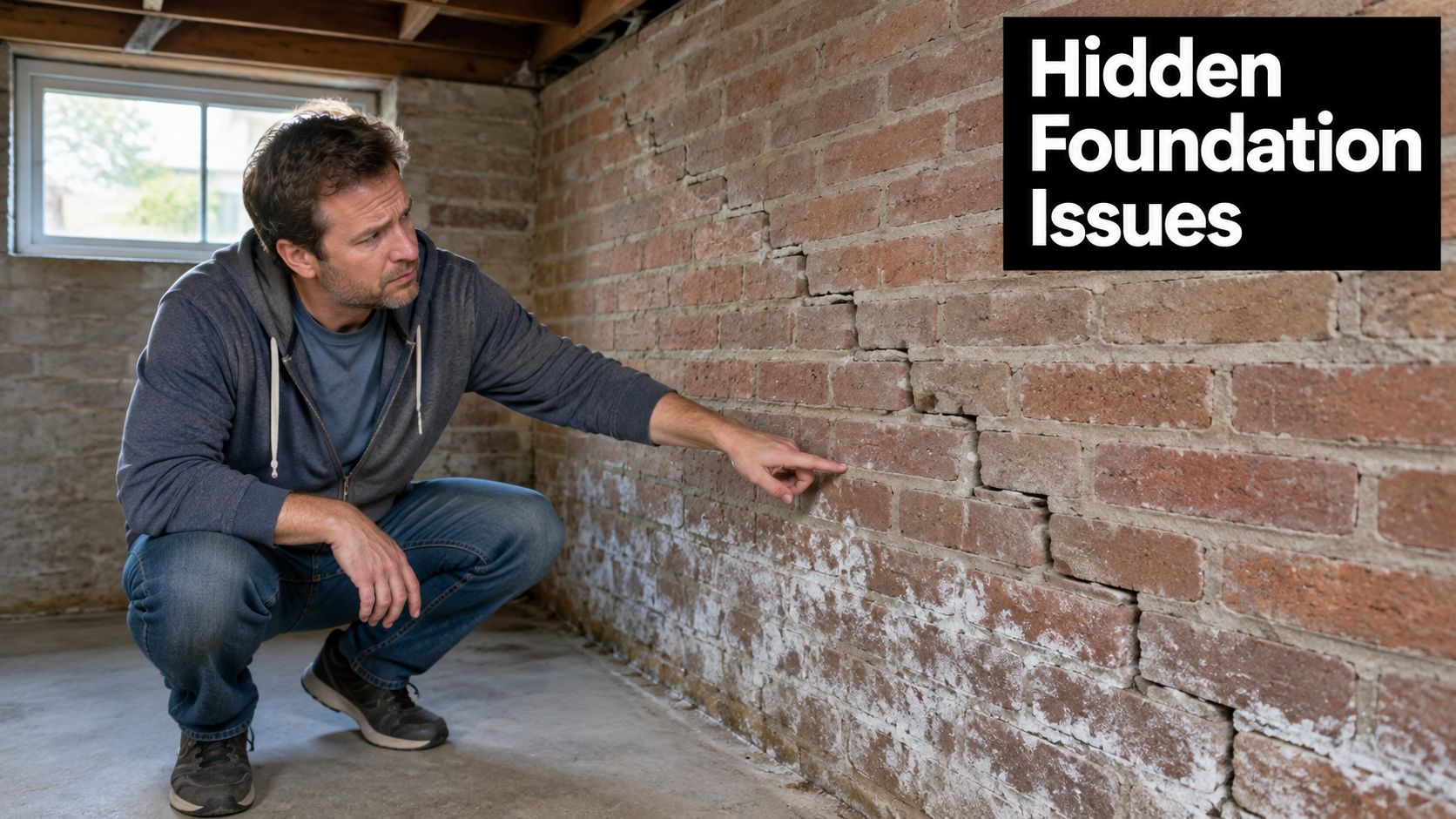
A homeowner in Marietta spots a stair-step crack in the basement wall, a dusting of white powder nearby, and a door that has started sticking. It's natural to assume the wall is failing and reach for a repair quote. But those clues can point to different problems: deteriorated mortar, water entering through the wall, soil movement, or a combination.
That distinction matters. A crack is evidence to investigate, not a diagnosis. Good masonry foundation repair starts by recording what's happening, checking water conditions, and determining whether the wall is moving before anyone chooses a repair method. The same concrete and foundation considerations matter when a home needs new work, including projects such as residential poured concrete.
Why Masonry Foundation Problems Are Not Always What They Look Like
After a heavy rain, a homeowner may find white residue on a basement wall and a new crack in the mortar. Those signs deserve inspection, but neither proves the foundation is failing. Mineral deposits often point to moisture moving through masonry; a crack may come from worn mortar, water pressure, or structural movement. Find the cause before approving a repair.
Brick, stone, and concrete-block foundations rely on mortar joints to hold the masonry together. Mortar can deteriorate before the units themselves, while water, soil pressure, or shifting ground can damage joints or move a section of wall. More than one problem can be present at once, so sealing the visible crack may leave the cause untouched.
A crack tells you where to look. It doesn't tell you which repair to buy.
A sound inspection checks the crack's pattern and width, wall displacement or bulging, mortar and unit condition, and likely water sources. FEMA's earthquake-resistant construction guidance identifies diagonal cracking, visible settlement, and deteriorated masonry or mortar as conditions warranting structural evaluation (FEMA guidance on earthquake-resistant construction). In Atlanta, moisture, settlement, freeze-thaw cycles, and poor drainage can also weaken masonry. Homes with new foundation work may involve different materials and construction considerations, including residential poured concrete.
A durable repair follows the evidence: cause first, method second.
How Masonry Foundations Actually Work
A masonry foundation isn't a solid, uniform wall like poured concrete. It's an assembly of individual units and mortar joints, built to carry the structure's weight downward into a footing and then into the soil. The units and the mortar behave differently, and that difference governs how repairs should be designed.
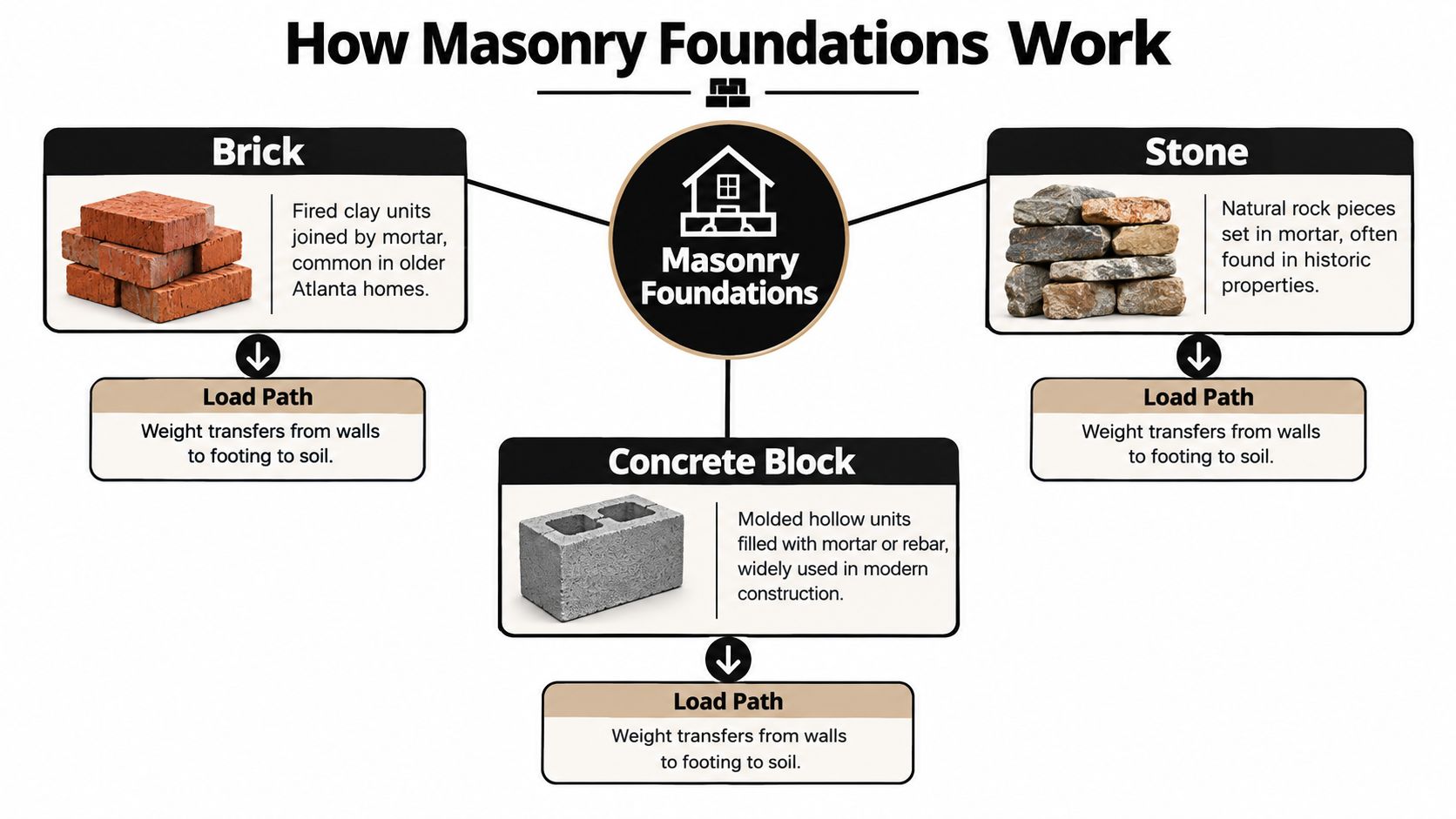
Three common masonry systems
- Brick: Fired-clay units are stacked in courses and joined by mortar. A crack following the joints can reveal distress without necessarily meaning the bricks themselves have broken.
- Stone: Irregular pieces are bedded in mortar. Older stone walls can have uneven joints and varied materials, so a repairer must assess the wall as a system rather than assume every joint is alike.
- Concrete block: Hollow molded units are laid in courses. Mortar joints connect the blocks, and reinforcement or grouting may be part of the wall's construction.
In each type, the load moves from the walls to the foundation, then through the footing into supporting soil. If that soil settles, a portion of the foundation can move. If lateral soil pressure pushes against a basement wall, the wall may bow or displace. If mortar deteriorates, the bond between units weakens.
Mortar is meant to be more sacrificial than the masonry units. It can accommodate small movement and moisture-related stress, so deterioration may show first in the joints. Historic mortar often differs from modern Portland-cement mixes in strength and porosity. Replacing softer historic mortar with an overly hard mix can transfer stress to the brick or stone instead of allowing the joint to do its job.
Water belongs in the diagnosis
Gutters, downspouts, surface grading, and drainage conditions affect how much water reaches the foundation. Preservation guidance recommends directing ground slope away from foundation walls and monitoring site drainage. It also warns that impermeable coatings can trap moisture in historic masonry. When repointing is necessary, replacement mortar should be compatible with the original and generally weaker than the masonry unit, not harder (Town of Kennebunk foundation preservation guidance).
A homeowner considering new foundation work should also know the difference between a masonry wall and a poured-concrete foundation system. The materials and construction details affect both diagnosis and scope; Atlanta Concrete Solutions describes its residential foundation concrete work separately from masonry repair.
Reading the Warning Signs Before You Pick a Repair
Walk the perimeter with a notepad before you call anyone. Record four things: the crack, any displacement, the wall's shape, and the moisture evidence. A contractor who skips that inspection and pitches a product on the first visit has skipped the diagnosis and gone straight to the sale.
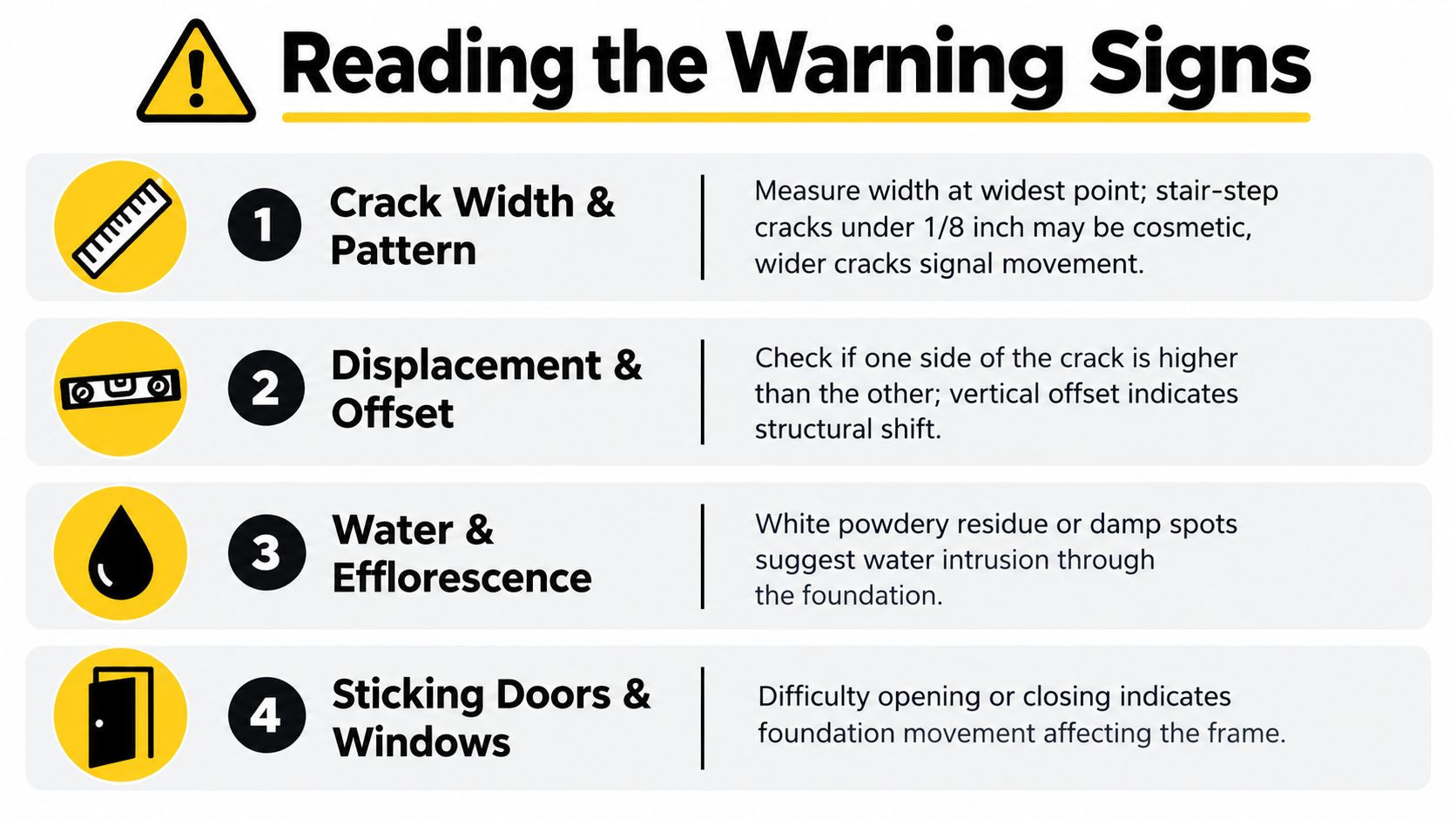
Start with the crack, then look at the wall
ICC inspection guidance categorizes cracks as hairline when barely discernible, fine when under 1 mm, medium at 1–2 mm, and wide when over 2 mm (ICC inspection guidance). Those labels help you describe what you see. Width alone doesn't establish structural severity. Write down the crack's location, orientation, width at its widest point, and whether one side sits higher or farther forward than the other.
Pattern tells you more than size. Vertical cracks often trace shrinkage or localized movement. Stair-step cracks through mortar joints point toward settlement. A wall that bulges, bows, or sits horizontally displaced suggests lateral pressure or footing movement, and that changes the conversation entirely. Visible displacement or bowing warrants evaluation by a qualified structural professional before cosmetic repointing. Don't let anyone repoint a bowed wall and call it fixed.
Then check the moisture evidence: damp spots, musty odors, efflorescence, mortar loss, staining after rain. If the problem shows up after storms, trace the water before you trace the crack. Look at downspouts, grading, and spots where water ponds against the foundation. Hydrostatic pressure can force water through mortar joints, construction imperfections, and existing cracks, and sealing the opening without correcting the water source only masks the leak (Building Science guidance on bulk water control).
That water check matters in Atlanta, where heavy rain keeps drainage pressure on foundation walls. If a recent storm hit the roof or siding too, bundle the inspections. A crew like SuperiorPRO that handles storm damage repair Atlanta can flag related exterior damage while a foundation specialist assesses the wall.
Take dated photos and measure the crack again over weeks. A stable crack and a growing crack need different plans, and the timeline tells you which one you have.
If you prefer a walkthrough of these four checks, this short video shows each warning sign on real foundation walls, giving you a visual baseline before you call for quotes:
The Four Repair Methods Homeowners Should Know
The right method depends on whether the foundation is moving now, has already moved and stabilized, or has surface deterioration without meaningful movement. These repair families aren't interchangeable, and a contractor should be able to explain why the proposed method fits the diagnosis.
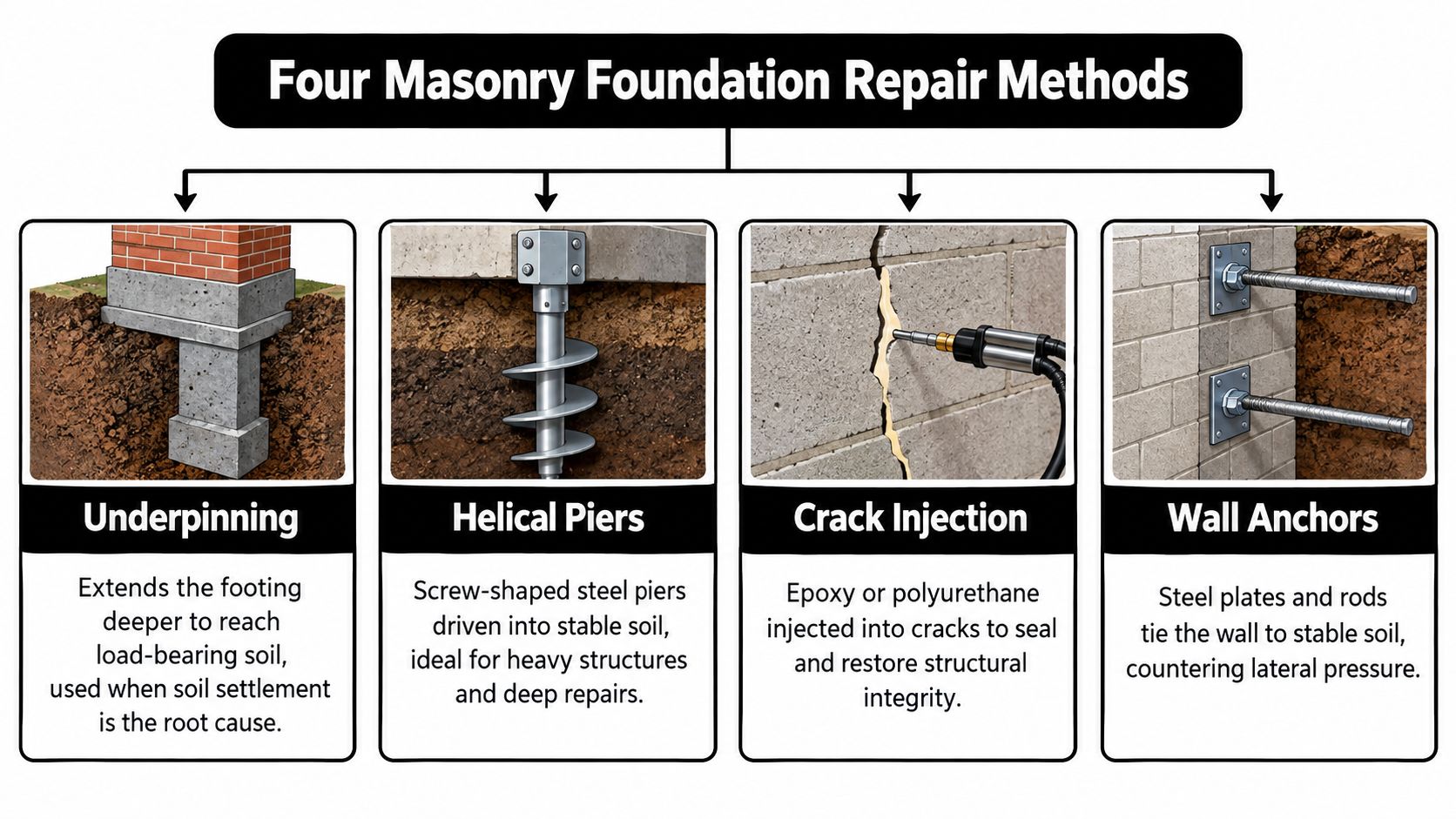
Support and stabilization
Underpinning extends or supports a footing at a deeper level when settlement has affected the foundation. It addresses inadequate support below the footing, but it's not a default answer to every crack.
Piering uses steel supports, such as push piers or helical piers, to stabilize a settled section by transferring load to more competent soil or another engineered bearing level. The contractor and engineer must establish where the supports should go and what the design is intended to accomplish.
Both approaches involve structural work. Ask what movement or settlement evidence justifies the system, how the crew will access the foundation, and whether the goal is stabilization, lifting, or both.
Repair the masonry or reconnect a section
Repointing removes deteriorated mortar from joints and replaces it with a compatible mortar. It's appropriate when the joints have failed but the wall doesn't need structural stabilization. Matching mortar strength, porosity, texture, and hardness matters, especially on older brick and stone.
Crack stitching uses steel bars or helical ties embedded across a crack, often within mortar joints, to reconnect a fractured section. It can suit a stable crack that needs reinforcement, but it won't solve active movement or water pressure by itself.
Other options include crack injection, sealing, and partial wall rebuilding. Injection may help address a suitable crack, while rebuilding may be needed where units are badly displaced or the masonry has lost integrity. A proper scope names the material and method, explains the intended result, and accounts for drainage where water is part of the failure.
Matching the Repair to Your Situation
Match the work to the cause, not just the visible symptom. This table can help you spot a mismatch between the problem and the proposed repair, but an inspection must confirm the diagnosis.
| Method | Problem It Solves | Structural or Cosmetic | Typical Disruption |
|---|---|---|---|
| Underpinning | Settlement requiring deeper footing support | Structural | Excavation and work at the footing |
| Piering | A settled section needing support from a more competent bearing level | Structural | Access and installation near the foundation |
| Repointing | Deteriorated mortar joints with no need for stabilization | Maintenance or limited repair | Mortar removal and replacement at affected wall areas |
| Crack stitching | A stable fracture that needs reinforcement across the crack | Structural repair to masonry | Localized work at the cracked section |
A 1920s brick foundation in Midtown has stair-step cracks and doors that stick. Those signs call for a structural evaluation, not an automatic order for piers. If the inspection confirms settlement that affects support, underpinning or piering may fit. If movement has stopped, a different repair may be appropriate.
A Marietta ranch has mortar loss in its concrete-block walls, with no signs of movement. Repointing with compatible mortar may address the damage, but check grading and runoff too. Repointed joints won't stay dry if water keeps collecting beside the wall.
For a Johns Creek basement with a stable vertical crack that leaks after storms, identify the water source before choosing a crack repair. Injection or stitching may suit the crack, while the drainage work needs to address the runoff or groundwater conditions feeding the leak.
As noted earlier, water can enter through more than one pathway. That affects the quote: compare whether each bid includes grading, downspout extensions, and a footing drain where site conditions call for one. A bid that prices only crack repair may leave the recurring water problem untouched.
What Masonry Foundation Repair Actually Costs in 2026
There isn't a reliable one-price answer for masonry foundation repair. Access, excavation depth, soil, wall condition, interior finishes, drainage, and engineering all affect the scope. A contractor who gives you a firm price before inspecting those conditions is guessing.
The available Atlanta pricing data is for driveway replacement, not masonry foundation repair, so it shouldn't be presented as a foundation quote. It does show why local site work and scope matter: one Atlanta estimate puts a 520-square-foot concrete driveway replacement at about $5,300–$7,200, including demolition, while another gives an installed range of roughly $3,120–$8,010, with an average near $5,565 (Atlanta concrete driveway cost estimate). These figures are context for local concrete and site-preparation work, not prices for piers, repointing, or foundation stabilization.
Get a scoped price, not a guessed range
For underpinning or piering, ask the estimator to state the support system, locations, installation scope, engineering basis, access assumptions, and whether any lifting is included. For repointing, the quote should identify the affected wall area, mortar removal and replacement, and how the new mortar will match the existing masonry. Crack stitching should specify where the reinforcement goes and how the crack's stability was assessed.
Don't accept “drainage included” without a description. Ask what work is planned for grading, gutters, downspouts, exterior drainage, or water discharge. If interior finishes need removal or replacement, make sure the scope says who handles them. Permit and engineering costs should also be listed rather than appearing as a surprise.
Timelines depend on the repair and access
A crew may complete a straightforward repointing or crack repair much faster than excavation and structural support, but the schedule depends on conditions at your property. Ask the contractor to separate mobilization, demolition or excavation, installation, inspection, drainage work, and restoration in the written schedule. Don't use an unsourced “typical” duration as a promise. Get the expected start and finish dates, weather assumptions, and any inspection hold points in writing.
Picking the Right Contractor and Getting the Right Permits
A contractor recommends sealing a crack before asking when it appeared, whether it has changed, or where water enters. That is a diagnosis problem. Hire someone who investigates the cause before naming the repair.
Check these points before signing:
- Confirm credentials: Ask which Georgia and local licensing or registration requirements apply, then verify them with the relevant authority.
- Assign permit responsibility: The contract should state whether the contractor will obtain required permits or expects you to handle them.
- Specify the work: The written scope should identify the method, materials, repair area, drainage work, exclusions, and restoration.
- Clarify engineering: Ask who is responsible for structural design and whether a signed engineer's letter is required.
- Read the warranty: Get its duration, coverage, exclusions, and maintenance conditions in writing.
Be wary of door-to-door pressure, cash-only discounts, and claims that every crack needs the same repair. Work that changes load paths, footing depth, or wall stability may require a permit. Rules vary among Atlanta, Marietta, Roswell, Alpharetta, Sandy Springs, and surrounding counties. Historic districts may require extra review, so confirm requirements with the authority that serves your property before work starts.
A contractor who handles masonry, concrete, drainage, and site preparation can reduce coordination between crews. Still, compare qualifications and written scopes before choosing. Atlanta Concrete Solutions describes its residential and commercial concrete and masonry services.
Your Masonry Foundation Repair Action Plan
Start with dated photos and simple crack measurements. Check whether gutters discharge near the wall, whether downspouts carry water away, and whether the ground slopes toward the foundation.
If you see displacement, bulging, visible settlement, or changing cracks, arrange a structural evaluation before cosmetic work. Then request two or three written bids that identify the method, materials, repair area, drainage plan, warranty, and schedule.
Not every crack needs underpinning, and not every leak means the wall is failing. But water belongs in every masonry foundation diagnosis. Watch and measure when the evidence supports a stable condition, and don't let anyone sell you a patch before explaining the cause.
Atlanta Concrete Solutions provides Atlanta-area concrete and masonry services, including foundation-related work, and can discuss how your repair connects with drainage and site conditions. Visit Atlanta Concrete Solutions to request a quote and talk through the work your property needs.