
A sidewalk replacement contractor handles more than the concrete pour itself. They manage permits, ADA slope control, sub-base preparation, and adjacent curb or apron upgrades, and skipping any of those is where projects fail.
You may be standing outside right now, measuring a raised panel with your shoe because a family member nearly tripped over it. Maybe Atlanta sent a notice, a tree root has pushed the slab upward, or a delivery driver pointed out that water collects beside the walkway after every storm. The visible problem looks small. The responsibility behind it often isn't.
North America has more than 1.6 million kilometers of sidewalk, and life-cycle research estimates that approximately 15% to 20% require replacement, representing roughly $9,375 to $18,750 per kilometer of renewal exposure. Actual bids vary sharply with access, demolition, drainage, roots, reinforcement, and accessibility work, as documented in the sidewalk life-cycle cost research.
For an Atlanta homeowner, the central hiring question isn't “Who pours concrete?” It's “Who can diagnose the failure, control the finished grade, coordinate the right-of-way, and leave me with a compliant pedestrian route?” The cheapest answer to that question is rarely the cheapest invoice.
The Moment You Realize You Need a Sidewalk Contractor
The moment usually arrives in an ordinary way. A city notice appears in the mailbox. A guest catches a toe where two panels meet. You see a slab lifted near a tree and assume replacing that one rectangle will solve everything.
Then the contractor arrives, measures the panel, and says the work may involve the curb ramp, drainage, driveway apron, or public right-of-way. That conversation is where a routine-looking repair becomes an infrastructure decision.
Atlanta Department of Transportation rules matter whenever work disturbs the public right-of-way. A sidewalk between the property and curb may sit inside that area, and a driveway apron can connect private concrete directly to city-controlled space. ATLDOT specifically lists installing or repairing a driveway apron as work requiring a permit, with additional closure requirements when a sidewalk or lane is blocked. A contractor who ignores that connection isn't simplifying the job. They're moving risk onto you.
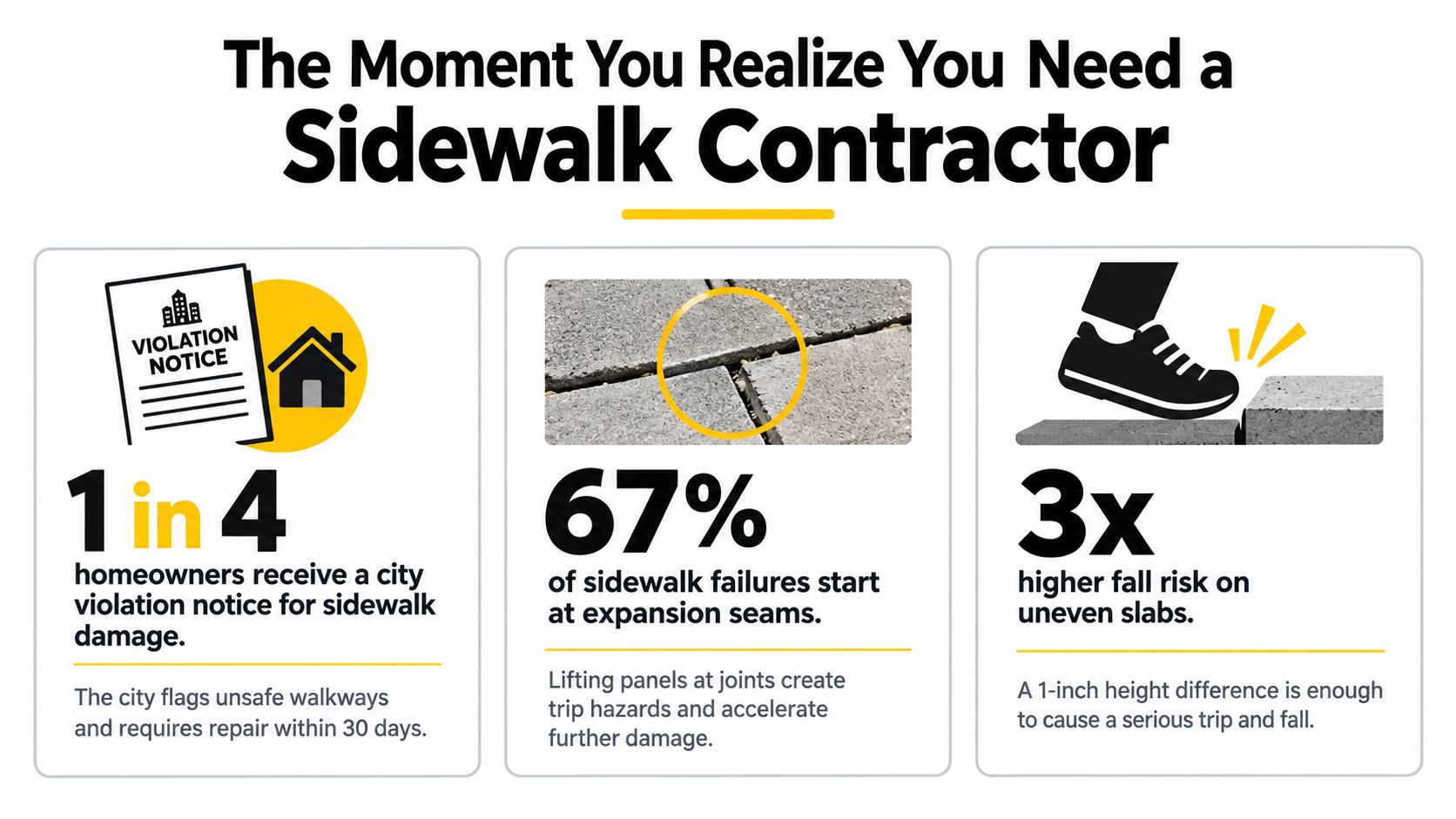
The four risks hidden beneath a damaged panel
The first is ADA exposure. A new panel can still fail if its running slope or cross slope is wrong. The second is surprise permitting, especially when the replacement reaches a curb, apron, ramp, or sidewalk closure area.
The third is the cheap bid that prices demolition and concrete but omits base correction, drainage, jointing, inspection, or restoration. The fourth is a driveway contractor treating pedestrian work like a driveway. Driveways tolerate different loading patterns and don't automatically demonstrate competence with accessible routes.
Practical rule: The finished slab is the last visible step. The hiring decision controls everything underneath it, including grade, drainage, public access, and inspection risk.
Ask the contractor to identify the work boundary before discussing price. If they can't tell you whether the panel is private property or right-of-way work, whether an apron is involved, or how they'll verify the finished slope, you haven't received a usable proposal.
What a Sidewalk Replacement Contractor Actually Does
Sidewalk replacement is a sequence, not a single pour. A competent contractor should be able to explain each phase and identify what can go wrong if that phase is rushed.
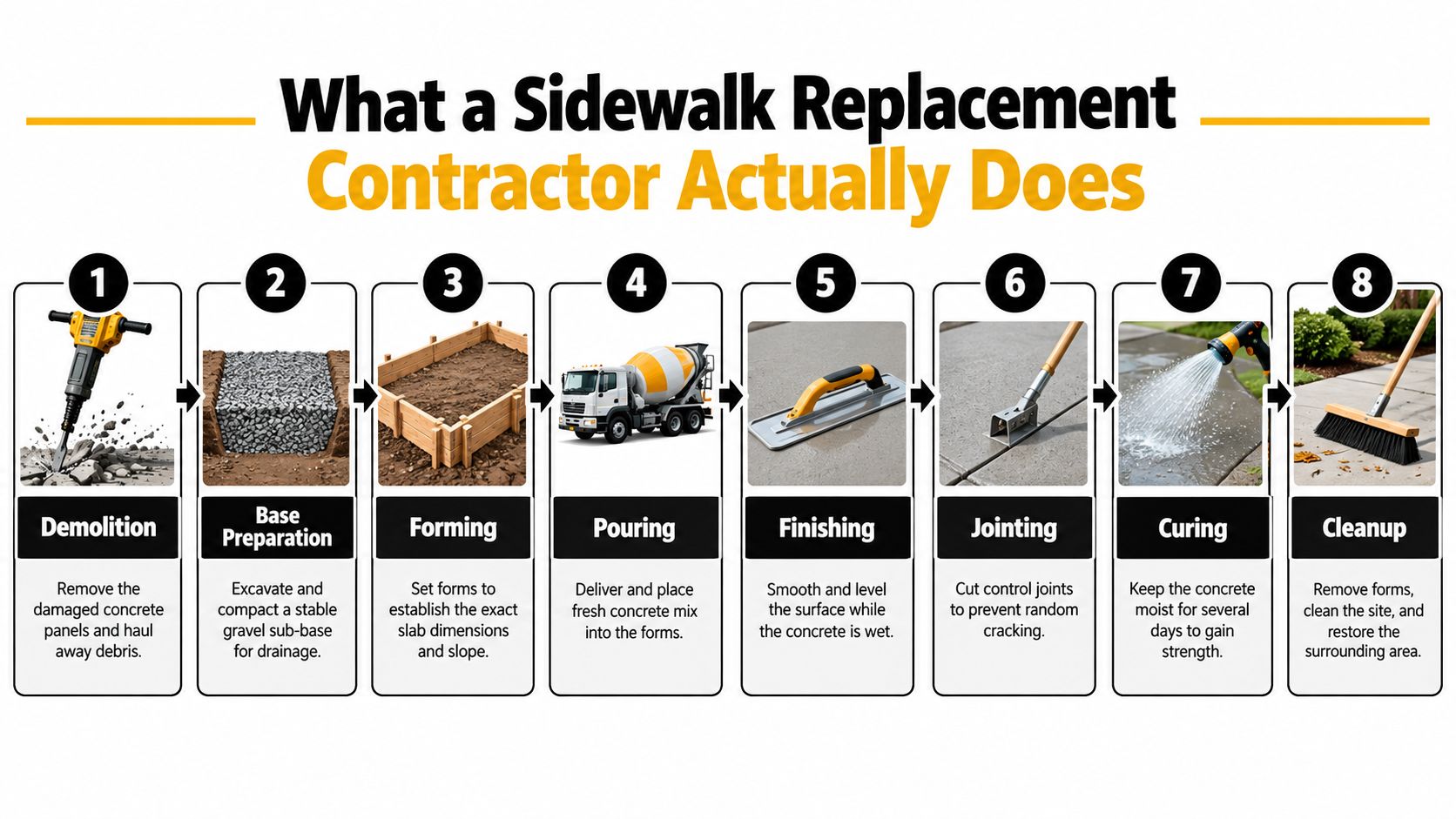
From demolition to a stable base
Demolition removes the damaged panels, isolates adjoining concrete, and hauls away the debris. The crew should protect nearby landscaping, utilities, curbs, and surfaces that aren't part of the replacement.
Excavation and base preparation determine whether the new slab stays supported. Soft soil, organic material, voids, and washout must be removed or corrected. A contractor who pours over a weak base may deliver a smooth surface that settles or cracks after the first serious drainage event.
Forming establishes the slab's width, edge alignment, elevation, and transitions. During this stage, the contractor should tie the new work into existing panels, driveway crossings, curb ramps, and entrances instead of setting forms by eye.
Concrete placement and finishing must produce a firm, stable, slip-resistant walking surface. A broom finish is a practical choice for pedestrian traction. Overworking the surface or adding water at the wrong time can weaken the surface layer and increase scaling or abrasion.
Joints and curing control the result
Jointing gives shrinkage and temperature movement a planned location. Public specifications commonly use weakened-plane joints at planned intervals and expansion material where new sidewalk meets existing pavement, structures, or obstructions. The contractor should document joint depth, alignment, and connection to adjacent slabs.
Curing starts immediately after finishing, when the surface won't be damaged. Federal highway specifications require curing for at least 72 hours, and pedestrian use is typically restricted during that period, according to the municipal concrete specification. Early foot traffic can damage immature edges and surfaces.
Expect the written scope to address:
- Subgrade preparation: State how unstable material will be removed and how the base will be compacted.
- Elevation control: Identify the laser, digital level, or survey process used at tie-ins.
- Joint layout: Show where contraction and expansion joints will go.
- Finish: Specify a broom-textured surface suitable for pedestrian use.
- Curing and reopening: State the curing method and the minimum time before pedestrian access.
- Restoration: Include soil, sod, edging, planting, and debris removal where relevant.
For work that affects pedestrians or traffic, contractors should understand temporary access and work-zone control. A resource covering RIIRIS402E course details can help property owners recognize whether a proposed traffic-management approach is being handled seriously. For residential project context, compare the contractor's scope against residential sidewalk concrete services.
Diagnosing the Cause Before You Replace Anything
A quote is only as good as the diagnosis behind it. Replacing a panel without identifying why it failed is how homeowners pay twice for the same movement.
Start with the tree. If one edge rises in a curved or localized pattern near a trunk, expose the relationship between the roots and slab before approving demolition. Oregon City's 2026 sidewalk assistance policy limits eligible reimbursement to panels damaged by street-tree roots and requires work to address tripping hazards or accessibility slopes. That policy illustrates the larger point: tree responsibility, root treatment, drainage, and panel replacement can fall under separate rules, as described in the sidewalk assistance policy record.
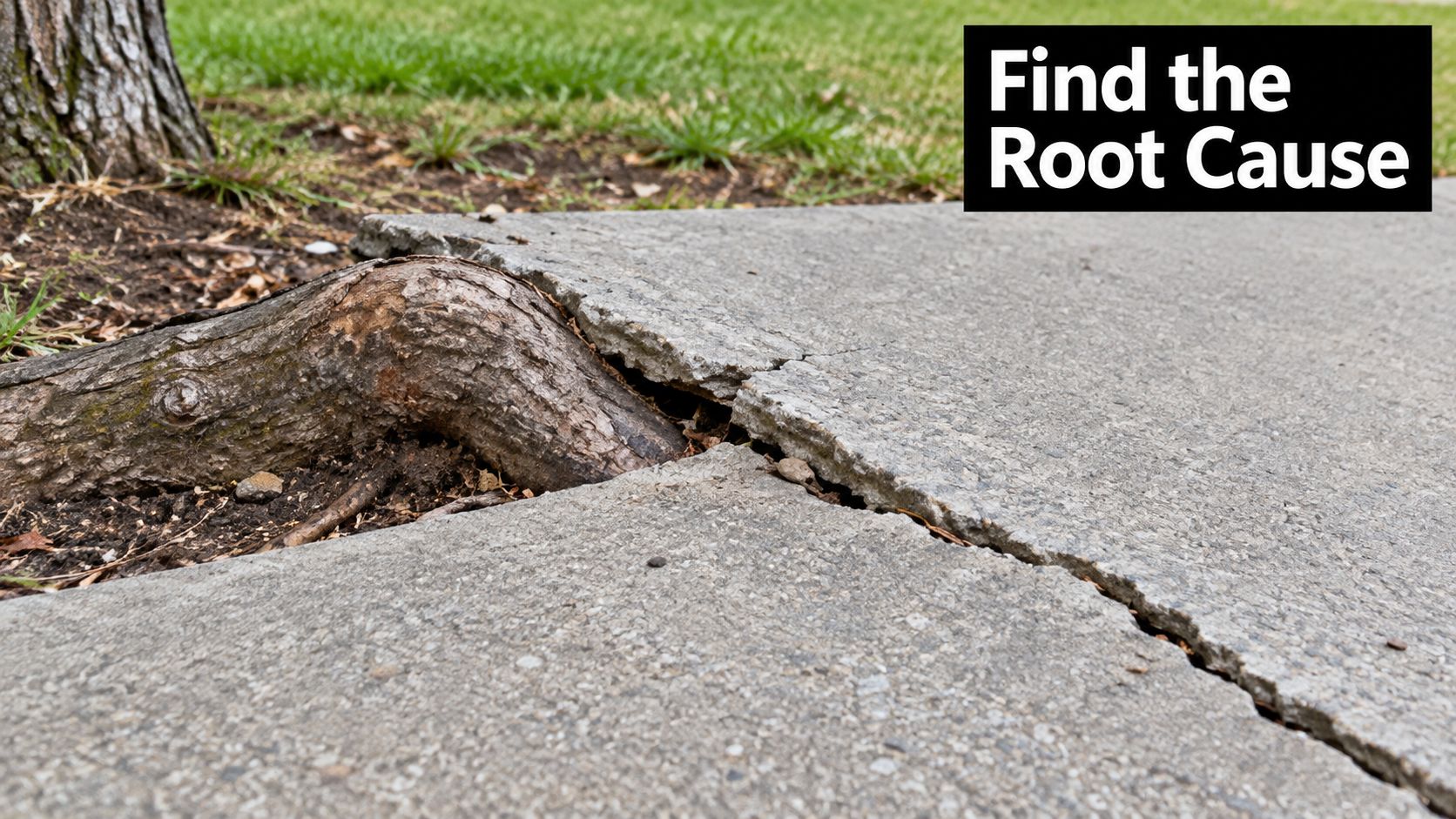
Four questions to ask on site
Is a root lifting the panel? Ask what happens to the root, who controls that work, and whether a replacement panel will recreate the same conflict. Refusing to discuss the root is a warning sign.
Did the base settle? Look for a low panel, an open edge, or a visible depression beside the slab. The contractor should explain excavation, aggregate placement, compaction, and the finished transition. Pouring over settled material preserves the failure.
Is water undermining the route? Check downspouts, driveway flow, curb lines, and areas where soil has washed away. A low replacement panel can become a ponding point and create a slope problem even if the concrete itself is sound.
Is the damage only at the surface? Isolated scaling, shallow spalling, or limited nonstructural cracking may support repair. Widespread cracking, movement, exposed reinforcement, or a failed grade points toward full-depth replacement.
Walk the site with the contractor and mark the high point, low point, adjacent obstruction, drainage path, and route users need to follow during construction. Refuse a bid that lists “replace concrete” without naming the failure cause, base treatment, and drainage response.
Repair or Replace and How to Decide
Repair makes sense when the panel remains stable and the defect is mostly cosmetic. Replacement makes sense when the slab has lost support, has moved out of grade, or cannot provide a compliant route after surface work.
The right decision depends on damage extent, root cause, and remaining service life. A narrow surface crack in a level, supported panel is a different problem from a panel that has heaved repeatedly beside a mature tree.
| Criterion | Repair Usually Works | Replacement Usually Required |
|---|---|---|
| Surface condition | Limited cracking, isolated scaling, or small joint spalling | Widespread cracking, crumbling, or deep deterioration |
| Movement | Panel remains level and supported | Settlement, heaving, rocking, or repeated displacement |
| Cause | Cosmetic surface defect with no active underlying failure | Roots, drainage, failed base, or unstable soil |
| Accessibility | Existing running and cross slopes remain acceptable | Grade or cross slope cannot be corrected with a surface treatment |
| Long-term value | Sound slab with useful remaining service life | Recurring failure makes another patch temporary |
A contractor recommending replacement should point to the specific failure, not call the slab old. Conversely, a contractor recommending a patch should explain why the base, drainage, roots, and slopes are stable enough to justify it.
U.S. ADA criteria generally limit a walking surface to a running slope no steeper than 1:20, or 5%, and a cross slope no steeper than 1:48, approximately 2.08%, according to the U.S. Access Board requirements. If the running slope exceeds 5%, the segment is treated as a ramp and stricter provisions apply. A patch won't solve a grade failure.
For practical comparison, review the contractor's recommendation alongside residential concrete and masonry repair services. The useful question isn't whether repair costs less today. It's whether the repair preserves support, drainage, safety, and compliance.
How to Choose a Qualified Sidewalk Replacement Contractor
Don't hire from a driveway photograph alone. Sidewalk replacement contractors need to understand pedestrian grades, public interfaces, curing restrictions, and inspection exposure.
Verify the credential behind the promise
Ask for the contractor's license information, insurance certificate, and references for comparable sidewalk work. The certificate should identify general liability and workers' compensation coverage, and you should ask whether you can be named as an additional insured where appropriate. That step reduces your exposure if a worker is injured or the crew damages adjoining property.
A contractor with an attractive stamped-driveway portfolio may still set sidewalk forms incorrectly. Ask for references involving curb ramps, public frontage, driveway crossings, sloped routes, or city inspections. Call the references and ask whether the crew protected access, handled cleanup, returned for punch-list work, and delivered what the written scope promised.
Demand a scope that can survive inspection
The written estimate should identify:
- Demolition and disposal: What gets removed, and where does the debris go?
- Base work: What happens if the contractor finds soft soil, roots, voids, or washout?
- Concrete details: What mix, thickness, reinforcement, finish, and joint layout are included?
- Grade verification: How will running slope, cross slope, driveway transitions, and curb connections be checked?
- Permits: Who applies, pays, schedules inspections, and handles corrections?
- Access and protection: How will pedestrians, landscaping, utilities, and neighboring surfaces be protected?
- Warranty: What defects are covered, for how long, and what exclusions apply?
- Schedule: When will demolition, placement, curing, reopening, and restoration occur?
Pittsburgh's public guidance shows why this level of detail matters. The city requires permits for replacing, widening, changing materials, or installing sidewalks, and noncompliant curb ramps in the work area must be upgraded to ADA standards. Contractors may also need registration, bonding, and insurance, as stated in the Pittsburgh sidewalk repair permit information.
For broader contractor-marketing and hiring perspective, these UK construction company tips offer useful questions about written scopes, proof of work, and communication, even though Atlanta's permit requirements remain local.
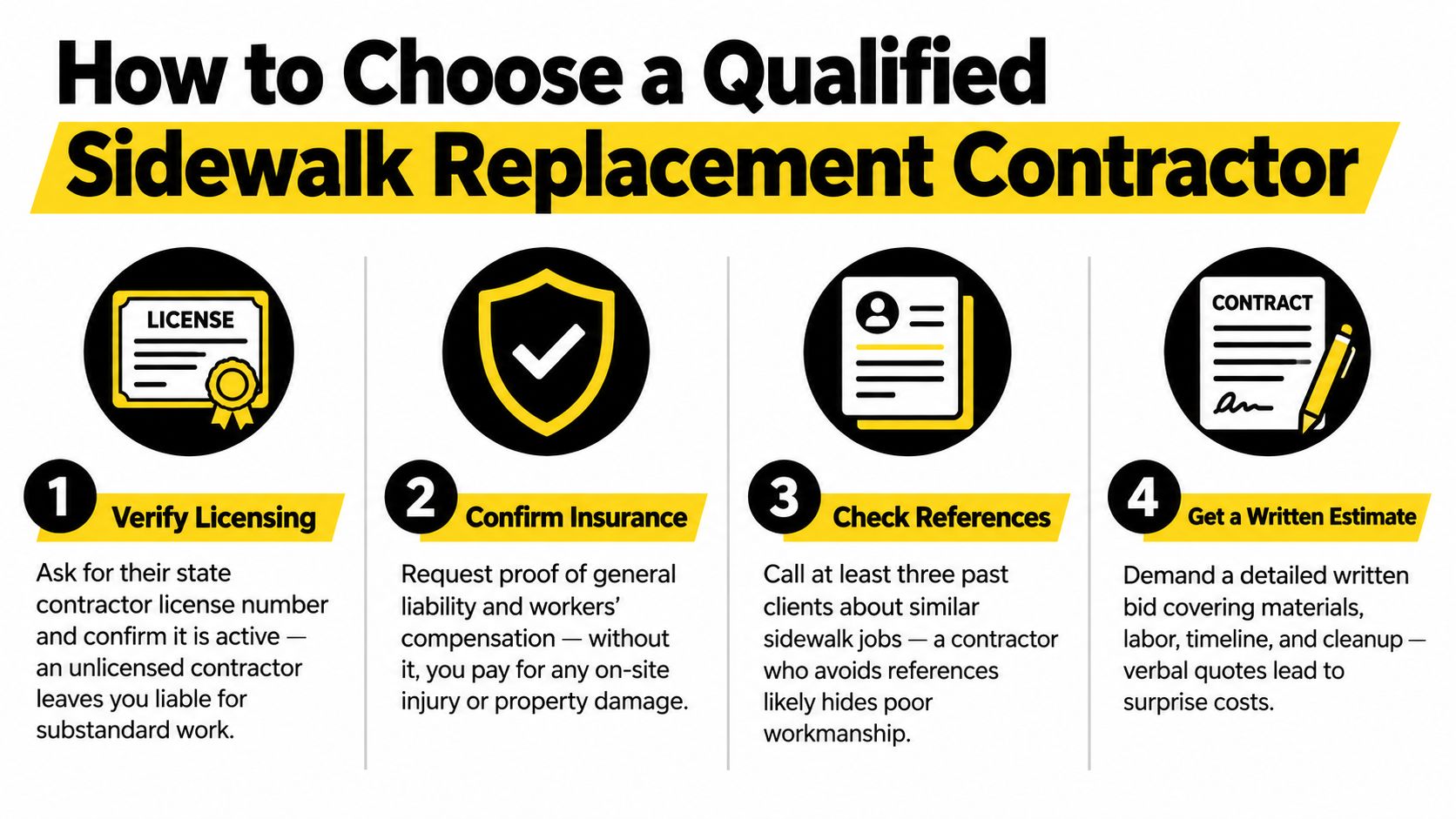
Bring this short checklist to every estimate:
- Confirm the contractor understands whether the work is private property or right-of-way.
- Request proof of insurance and comparable sidewalk references.
- Require slopes, base preparation, joints, curing, restoration, and permits in writing.
- Reject a bid that cannot explain what happens if the contractor finds roots, drainage failure, or unstable soil.
Atlanta Permits, Aprons, and Right-of-Way Details
Atlanta's permit issue is simple in principle and easy to mishandle in practice. ATLDOT states that any disturbance in the public right-of-way requires an ATLDOT permit, and it specifically includes installing or repairing a driveway apron among the examples. Work that blocks a sidewalk or lane can require an additional closure permit, while digging within the right-of-way requires a Qualified Contractor permit. Confirm the current requirements through ATLDOT permit information before construction begins.
The apron is where many homeowners get surprised. They think they're replacing a private driveway, but the concrete strip between the driveway and street can sit in the city's controlled area. A sidewalk panel that ties into a curb ramp creates the same problem. The contractor must coordinate the physical transition, the permit boundary, pedestrian access, and the finished grade as one job.
What to ask before signing
Ask who will apply for the permit, whose name appears on it, who schedules inspections, and who pays for corrections if the work fails. Ask whether the contractor is registered for the right-of-way work involved and whether a sidewalk or lane closure plan is needed.
ADA control and permitting are connected. The city may care not only that the replacement looks clean, but that the new transition doesn't create a slope, cross-slope, ponding, or detectable-warning problem at the adjoining route. A contractor who raises permits during the first visit understands the job boundary. One who says “it's just a small panel” is telling you they haven't assessed the whole interface.
Put the permit responsibility in the contract. “Owner to handle permits” is not a harmless line if the contractor designed the grade and controls the work.
What Sidewalk Replacement Should Cost in Atlanta
There is no honest single price for Atlanta sidewalk replacement. The invoice depends on panel dimensions, access for demolition equipment, disposal, subgrade condition, roots, drainage, ADA corrections, and whether the driveway apron or curb interface is included.
Municipal data from Seattle illustrates the material and scope issue. The city auditor reported estimated average repair costs of $79.60 per square foot for concrete compared with $48.90 for asphalt, as documented in this sidewalk condition and funding report. Those figures aren't an Atlanta quote, but they show why material choice, existing conditions, and accessibility work matter more than a simple square-foot multiplication.
A panel-only bid priced below a few thousand dollars may be legitimate for a very small, accessible, uncomplicated repair. It may also exclude the work that protects you. Read the exclusions before celebrating the number.
The line items a serious bid should show
- Site access and protection
- Demolition, loading, hauling, and disposal
- Excavation and sub-base correction
- Concrete, reinforcement, forms, finish, and joints
- Slope and elevation verification
- Permit, inspection, and right-of-way coordination
- Curb, ramp, apron, or drainage adjustments
- Curing, barricades, reopening, cleanup, and restoration
- Warranty terms and exclusions
If a bid comes in dramatically lower than the others, ask which of those lines are absent. Compare the proposals through documented Atlanta concrete projects, but judge every contractor by scope, not gallery quality. A polished portfolio can't tell you whether the crew compacted the base or verified the cross slope.
Why the Cheapest Bid Is Almost Never the Best Job
A low panel-only bid often excludes the exact work that determines whether the sidewalk lasts. ADA slope correction, base preparation, joint layout, drainage, permit handling, curing, and restoration don't disappear because the concrete quantity is small.
Under U.S. ADA criteria, a walking surface generally must keep its running slope no steeper than 1:20 and cross slope no steeper than 1:48, so inaccurate elevation control can create a noncompliant route on brand-new concrete, as explained by the U.S. Access Board. The homeowner then pays through rework, failed inspection, or another failure at the same location.
The bid worth comparing is the one that names subgrade preparation, joint layout, reinforcement, drainage corrections, curing method, warranty, and permit responsibility. Request three written, line-item bids, then compare what each contractor will do, not just the total at the bottom.
Atlanta Concrete Solutions can inspect a damaged walkway, determine whether repair or replacement is appropriate, and provide a written scope covering the concrete work and site requirements. Visit Atlanta Concrete Solutions to request an Atlanta sidewalk evaluation and discuss the right next step for your property.