
Most Atlanta concrete removal jobs run $2 to $6 per square foot, with a typical 500-square-foot driveway totaling $1,000 to $3,000 for basic removal. That range can balloon when reinforcement requires extra cutting, machinery can't reach the slab, or disposal involves more hauling than the quote allows.
You're probably looking at a cracked driveway and trying to work out whether the contractor's number is reasonable. The problem is that “concrete removal” can mean breaking the slab to one bidder and leaving a cleared, graded site to another. My recommendation is straightforward: buy a defined scope, not a square-foot promise.
What a Concrete Removal Quote Actually Covers
A proper removal quote starts with what stays and what goes. The contractor should identify the demolition boundary, adjoining concrete that needs protection, the equipment route, and the condition you expect when the crew leaves.
That sounds basic until you compare a removal-only proposal with one that includes preparing the area for a replacement driveway. Those aren't interchangeable products, even if both contractors write “complete removal” across the top.
Follow the work from arrival to cleanup
Think of the project as a sequence of separately priced operations:
- Mobilization: Bringing the crew, breaker, skid-steer, excavator, or slab saw to your property.
- Isolation and demolition: Saw-cutting boundaries and breaking the concrete without unnecessarily disturbing adjacent work.
- Debris handling: Moving broken material, loading trucks, transporting it, and paying the receiving facility.
- Site completion: Removing remaining debris and completing whatever grading, base correction, or restoration the contract specifies.
The distinction between demolition and debris handling isn't just estimator preference. RSMeans estimating guidance separates cutting, cutout demolition, concrete demolition, and rubbish handling, and warns that selective-demolition prices generally exclude loading, hauling, storage, and disposal.
That's why I wouldn't accept “demolition included” as proof that trucking is covered. Ask the contractor to name the work instead of relying on a broad label.
Define the finished condition
“Clean site” needs a practical definition. Does the crew leave exposed soil, a roughly leveled excavation, or a prepared base ready for the next contractor? Does restoration include the lawn along the equipment route?
For a driveway connected to a front walk, discuss the transition before demolition. Reviewing the scope of residential sidewalk concrete work can help you identify adjoining sections that should be protected or priced separately.
Practical rule: If you can't tell what the property will look like when the contractor leaves, the quote isn't finished.
A low headline price isn't automatically dishonest. It may cover less work. Your job is to make those omissions visible before you compare totals.
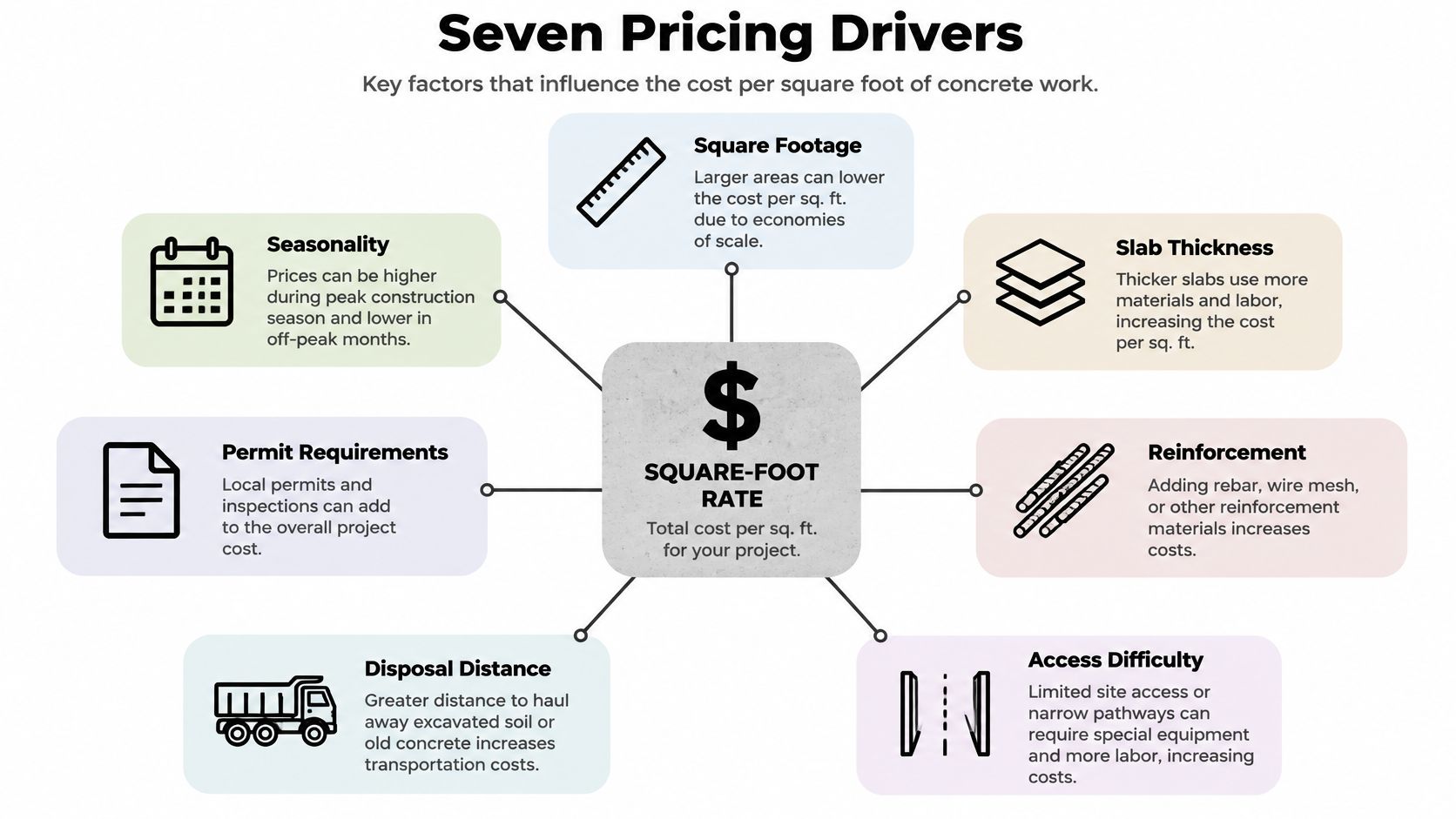
The Seven Pricing Drivers Behind Every Quote
A square-foot rate summarizes the contractor's assumptions. To judge it, you need to know which conditions the estimator checked and which ones they guessed.
Use this diagram to identify the site conditions worth discussing, then require the bidder to explain their labor and equipment assumptions.
Labor and equipment
Labor becomes more expensive when workers must carry pieces by hand, protect nearby structures, or repeatedly stop to separate steel. Ask whether the proposal assumes machine handling throughout the job. A backyard patio reached through a narrow gate shouldn't be estimated like an open driveway.
Equipment should match the work. A skid-steer can help move debris, while a breaker attachment handles demolition and a slab saw establishes controlled boundaries. Ask what machinery the contractor intends to use and where it will operate. Don't pay for an equipment plan that can't physically reach the slab.
Material and site conditions
- Disposal: Require a stated destination and an explanation of whether the material will qualify as clean concrete. Don't assume every receiving facility accepts the same load.
- Access: Walk the route from slab to truck. Gates, slopes, landscaping, and pavement that must remain intact all belong in the estimator's assessment.
- Thickness: Ask how it was established. An exposed edge is useful, but the contractor should also address possible thickened sections rather than treating the entire slab as uniform.
- Reinforcement: Have the bidder distinguish confirmed steel from assumed steel. If reinforcement is concealed, require a written method for pricing additional cutting.
- Permits: Identify who determines the applicable requirements, who obtains approvals, and whether fees are included. “Owner responsible” should never appear as a surprise after acceptance.
These variables interact. Restricted access can change equipment selection, which changes labor requirements, which changes loading time. Don't accept separate surcharges without asking whether they charge for the same difficulty twice.
A higher price with a workable demolition plan can be better value than a lower price built on an impossible access assumption.
My strongest recommendation is to attend the site visit. Show the estimator the actual gate, parking area, and concrete you want preserved. Don't rely on photographs alone when the route to the work is the main complication.
Typical Atlanta Removal Scenarios at a Glance
Use national benchmarks to establish a budget, not to manufacture an Atlanta-specific price. There isn't a defensible reason to add an unexplained local surcharge before anyone has inspected your property.
The basic $2 to $6 per square foot, $1,000 to $3,000 for a 500-square-foot slab, and difficult-condition pricing reaching roughly $14 per square foot come from Angi's concrete demolition cost guide; the table applies those benchmarks without inventing separate local totals.
Typical Atlanta Concrete Removal Scenarios
| Project | Size | Low Range | Typical Range | High Range |
|---|---|---|---|---|
| Single-car driveway tear-out | Measure the actual slab | Basic-rate end if open and uncomplicated | Written quote based on measured area and conditions | Difficult-condition pricing when justified |
| Standard two-car driveway example | 500 square feet, illustrative rather than a dimensional standard | About $1,000 under basic assumptions | About $1,000–$3,000 for basic removal | Site-specific quote if outside basic assumptions |
| Small patio or walkway | Measure each section | Clean, machine-accessible work | Quote must account for mobilization and hauling | Restricted-access or reinforced work requires separate assessment |
Match the scenario to the property
A single-car driveway isn't automatically the cheapest job. A contractor may have to protect a retaining wall, maintain a pedestrian route, or move debris through a constrained frontage. Measure it rather than assuming its parking capacity tells you the removal cost.
The two-car example is useful because it gives you a recognizable budgeting reference. It's not a promise that every driveway of that area belongs within the basic range. Ask the bidder to identify exactly what pushes your project outside it.
Small patios and walkways deserve particular attention to fixed charges. The contractor still has to deliver equipment and arrange transport, even when there isn't much surface area to remove.
- Open driveway: Focus your questions on slab construction and the proposed finished condition.
- Side-yard walkway: Focus on handling methods and protection of surrounding improvements.
- Replacement project: Review the residential driveway concrete scope alongside removal so neither contractor leaves a gap between demolition and installation.
When you ask how much does concrete removal cost, specify which of those jobs you mean. Otherwise, you're comparing unlike work.
Reading a Real Estimate Line by Line
Suppose you're replacing the same driveway and receive several proposals. The examples below are illustrative quote formats, not actual customer bids or completed-project results.
The first contractor writes “remove existing driveway” beside a blended price. The second describes the demolition and haul-off operations. The third identifies concealed-condition allowances and separates optional base work. The meaningful difference isn't presentation, it's how much uncertainty you're being asked to accept.
Compare the wording before the total
| Estimate format | What the proposal says | What you should challenge |
|---|---|---|
| Blended bid | Removal at an inclusive square-foot rate | Whether “inclusive” actually covers loading, transport, and facility charges |
| Itemized bid | Mobilization, boundary cutting, breaking, loading, hauling, disposal, and grading | Whether quantities and completion standards are defined |
| Conditional bid | Itemized work plus reinforcement allowances, permit responsibility, and optional aggregate | How allowances become charges and who authorizes changes |
With the blended bid, ask the contractor to confirm exclusions in writing. If disposal appears elsewhere as “additional,” the headline total isn't the project total. Don't fill that gap with your own assumption.
With the itemized bid, check that each line describes a deliverable. “Hauling” should identify the basis of the charge, while “grading” should explain whether the contractor is merely smoothing the excavation or preparing it for construction.
The conditional bid may look more expensive because it exposes work that competitors haven't acknowledged. That doesn't automatically make it better, but it gives you something concrete to negotiate.
Put a boundary around changes
Require written approval before additional work begins. For concealed thickness, buried footings, or unexpected steel, the contract should state how the contractor documents the condition and calculates the adjustment.
- Allowance: Ask what the quoted amount covers and how unused allowance is treated.
- Unit charge: Ask what gets measured and how you can verify the quantity.
- Optional work: Keep it visibly separate from the accepted base scope.
- Completion payment: Tie it to the contracted work, not merely to the arrival of equipment.
A useful comparison is the U.S. Army Corps of Engineers facility-cost benchmark, which lists concrete wall demolition at $4.70 per square foot for a specified 10,000-square-foot building, 10-foot ceiling height, and 25-mile haul. That isn't a residential driveway rate; it demonstrates why the scope and haul assumptions must travel with the number.
Don't negotiate an undefined price downward. Get the work defined first, then negotiate the price of that work.
Disposal, Hauling, and the Recycling Question
The debris bill deserves more scrutiny than most homeowners give it. You're paying to move mass, not just clear a surface, and the truck leaves with material that must meet a receiving facility's requirements.
The disposal sequence helps explain what the estimator needs to establish before promising an all-inclusive haul-off price.
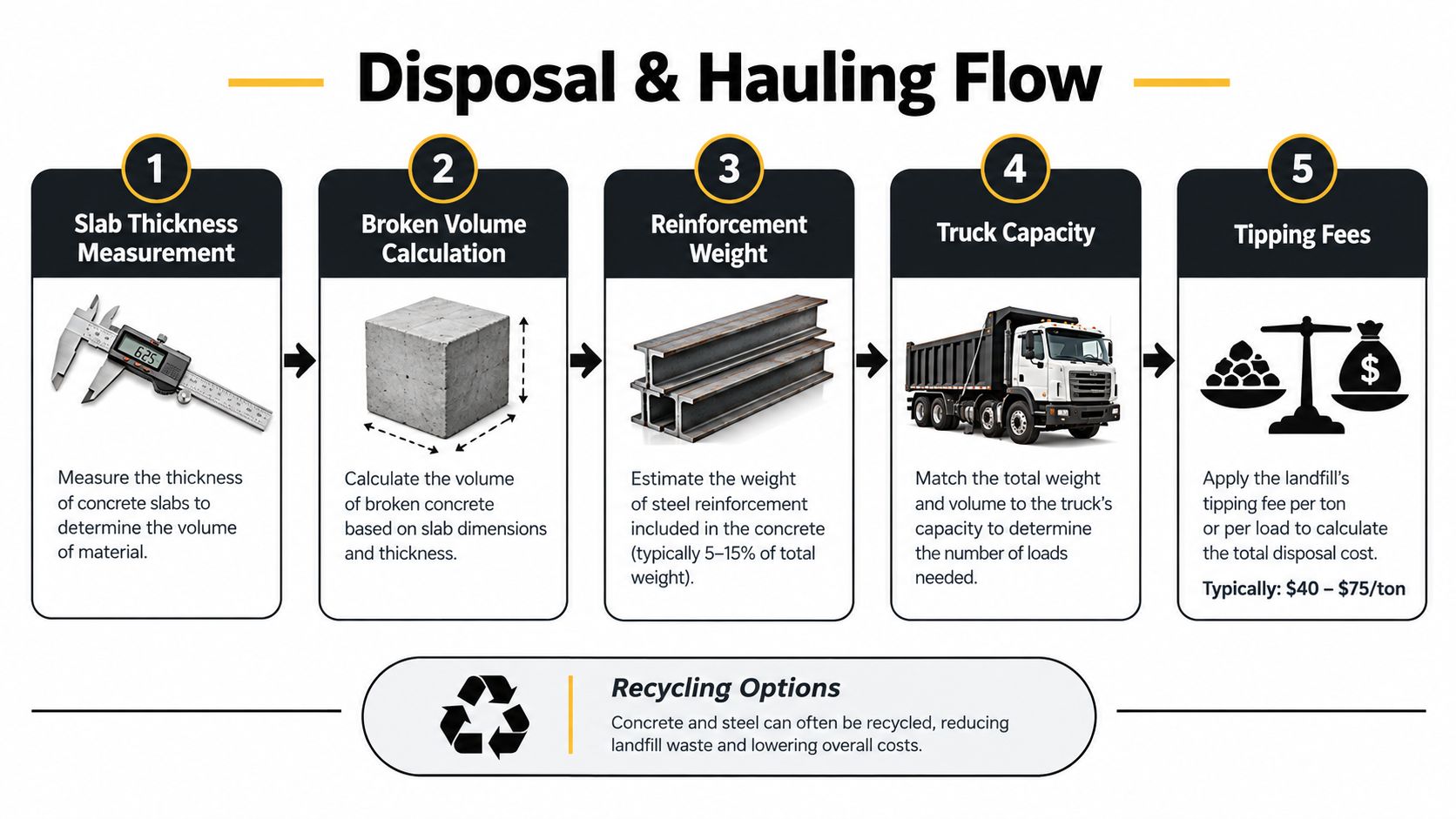
Weight changes the conversation
A six-inch-thick, 100-square-foot slab contains about 1.85 cubic yards and weighs roughly 3.7 tons, while a 10-by-10-foot slab typically costs about $300–$800 to demolish and haul away; HomeGuide's removal cost breakdown also lists reinforced-concrete additions of $1–$3 per square foot and some landfill charges of $90–$160 per ton.
Those figures explain why a modest patio can still generate a substantial invoice. They don't establish what an Atlanta receiving facility will charge your contractor. Require the estimate to state its disposal assumptions instead of substituting a national tipping rate for a local arrangement.
Broken pieces also occupy truck space differently from an intact slab. Ask whether the contractor's loading plan is constrained by weight, available volume, or both, and how an additional load would be authorized.
Request alternative disposal plans
| Disposal plan | What to ask the contractor |
|---|---|
| Clean-concrete recycling | What material restrictions apply, and does the quoted price reflect the recycling route? |
| Mixed-debris disposal | Why is this necessary, and which contaminants prevent clean-concrete handling? |
| Claimed recycling credit | Is there an actual credit, who receives it, and where does it appear in the proposal? |
Recycling is an option to price, not a discount to assume. Concrete can be crushed, screened, and separated from reinforcing steel for aggregate recovery, but that doesn't prove your particular load will receive favorable terms.
For scale, the EPA estimates that the United States generated about 600 million tons of construction and demolition debris in 2018, with more than 455 million tons directed to a next-use market and nearly 145 million tons to landfills, according to its construction and demolition materials overview.
Ask for the destination and retain available disposal documentation. “We recycle” is less useful than a clear explanation of where your concrete is going and how that decision affects your bill.
How to Lower Your Atlanta Removal Bill Without Cutting Corners
Start with decisions that remove unnecessary work, not protections that prevent damage. A useful contractor conversation should produce a revised scope you can inspect, rather than a verbal promise to “work with your budget.”
Bring the actual proposal to that conversation.

Ask for savings you can verify
- Coordinate removal and replacement: Ask whether the contractor can reduce duplicated mobilization or handling. Require any saving to appear in the revised proposal.
- Clear agreed obstacles: Move vehicles, planters, and portable items before arrival. Don't remove fences or alter access without confirming that the change helps the equipment plan.
- Offer scheduling flexibility: Ask whether a flexible start date changes the price. Don't budget around an assumed seasonal discount.
- Price selective work: If only part of the surface needs intervention, compare a defined repair scope with full removal through a concrete and masonry repair assessment.
Keep demolition separate from replacement costs even when you award them together. Published 2026 Atlanta estimates place full driveway replacement broadly around $2,250–$9,000, with a 520-square-foot replacement including demolition estimated at approximately $5,300–$7,200, according to Cost to Renovate's Atlanta replacement guide. Those are replacement budgets, not removal-only comparisons.
Don't delete necessary protection
I wouldn't remove boundary saw-cutting from a quote merely to lower the total. Ask the contractor to explain which cuts protect retained concrete and which are unnecessary for your scope.
Likewise, don't trade insurance verification, lawful disposal, or written change authorization for a cheaper verbal arrangement. Those aren't decorative contract details.
Use the same written questions when discussing the project after watching this video.
The right saving leaves you with the same agreed outcome for less money. Deleting cleanup or base preparation gives you less work for less money, which may be acceptable, but it isn't a discount.
The Pre-Hire Checklist Atlanta Owners Should Run
Before signing, review the proposal with the person who can authorize changes. A salesperson's explanation is useful only if the contract reflects it.
Use this checklist as a final verification tool.

- Verify credentials: Confirm applicable licensing requirements and request current insurance documentation.
- Confirm measurements: Record the removal boundaries and the bidder's thickness and reinforcement assumptions.
- Review logistics: Check equipment access, haul assumptions, and the disposal destination.
- Control changes: Require documented conditions, an agreed pricing method, and written authorization.
- Define handover: State the cleanup, grading, and restoration you're purchasing.
- Check references: Ask about comparable access constraints and how the contractor handled changes.
Connect removal to the driveway plan
For Concrete Driveway Replacement Atlanta, keep the removal estimate alongside the decisions that determine what follows. These supporting topics make a practical planning checklist, with each tied to a specific question rather than a vague upgrade discussion:
| Supporting articles | Information and examples to resolve |
|---|---|
| How Much Does a Concrete Driveway Cost in Atlanta?; Concrete Driveway Replacement Cost Atlanta 2026 | Separate removal from the complete replacement budget |
| How Long Does a Concrete Driveway Last in Atlanta?; Concrete Driveway vs Asphalt in Atlanta | Compare material choice and ownership expectations |
| Best Concrete Thickness for a Residential Driveway; Do You Need Rebar in a Concrete Driveway? | Specify the intended vehicles and structural design |
| Concrete Driveway Cracks: When Should You Replace It?; Concrete Driveway Repair vs Replacement | Compare targeted intervention with complete demolition |
| How to Fix Drainage Problems on an Atlanta Driveway; Concrete Driveway Apron Atlanta | Define runoff corrections and the street connection |
| Driveway Widening Atlanta; Driveway Extension Atlanta | Mark additional pavement separately from replacement |
| Stamped Concrete Driveway Atlanta; Concrete Driveway Sealing Atlanta | Distinguish finish choices from protective treatments |
| How Long Before You Can Drive on New Concrete?; Concrete Driveway Maintenance Guide | Get written access and care instructions |
A trustworthy bidder explains assumptions and accepts written boundaries. An incomplete proposal relies on verbal reassurance, undefined extras, or pressure to sign before the scope is settled.
Atlanta Concrete Solutions offers driveway replacement, concrete installation, and masonry repair for Atlanta-area properties. Visit Atlanta Concrete Solutions to request a free estimate, and ask for removal, loading, hauling, disposal, and site preparation to be identified separately so you can compare the proposal against the same scope from other contractors.