
“Just seal the cracks” is popular driveway advice, but it can waste money when the concrete has settled or water has washed out its support. A clean-looking repair won't stabilize a moving slab, and a decorative finish won't stop runoff from undermining the apron.
The best driveway repair is the least invasive method that fixes the actual failure. For Atlanta property owners, that means checking the concrete, the base beneath it, drainage, and responsibility for any work near the street before choosing between filling, patching, resurfacing, and replacement.
Which Driveway Repair Fits Your Damage
Driveway repair options at a glance
| Repair option | Best for | Expected lifespan | Disruption |
|---|---|---|---|
| Crack filling | Hairline and narrow cracks in a slab that hasn't moved | A maintenance treatment, with renewal based on adhesion and crack movement | Brief application; reopen after the product cures |
| Partial-depth patch | Spalls or scaling confined to the top layer of a sound slab | Long-term potential when preparation, material compatibility, and joint maintenance are right | Localized removal and placement, followed by strength development |
| Resurfacing overlay | Worn surface over a sound, level base | Governed by bond quality, exposure, and the remaining condition of the slab | Surface preparation, application, and curing |
| Decorative overlay | Visual upgrade over a sound, level slab | Governed by substrate stability and maintenance of the finish | Preparation, pattern work, and curing of the complete system |
| Full replacement | Full-depth cracks, settlement, or a failed base | A new service cycle when support, drainage, and construction are properly specified | Demolition, base work, placement, and restricted access during curing |
Crack filling makes sense when keeping water out is the main task. It doesn't reconnect a broken slab or remove a height difference.
Partial-depth patching replaces unsound surface concrete without discarding a serviceable slab. It's a targeted repair, not a thin smear over crumbling material.
Resurfacing suits widespread surface wear where the underlying concrete remains stable. Decorative overlays serve the same sound-substrate requirement but add texture, color, or a pattern.
Replacement becomes the practical choice when the work must reach below the concrete. It also gives the contractor access to correct support and grading rather than preserving those defects beneath another finish.
Treat service life as a condition, not a promise
These options fall into distinct groups: surface treatments for a sound slab and reconstruction for structural failure. Their prices aren't interchangeable because they solve different problems.
Ask for a quote that separates preparation, repair material, drainage work, finish, and access restrictions. Generic lifespan promises aren't useful unless the contractor has inspected the base and identified where water goes. Confirm those conditions before choosing a method.
Diagnose the Damage Before You Choose a Method
Start with depth, movement, and water. Those checks tell an estimator more than the driveway's age or color.
For depth, examine an exposed damaged edge and gently probe loose material with a screwdriver or rod. You're checking whether deterioration stops in the surface layer or continues into broken concrete below. Don't assume a probe can establish the depth of a closed crack; that may require professional investigation.
For movement, lay a straightedge across the crack and look for a raised edge or depressed panel. A slab that rocks underfoot, pumps water when loaded, or has lost support needs more than a cosmetic repair. Avoid testing visibly unstable concrete by driving over it.
For water, walk the driveway after rain. Mark puddles, sediment trails, washed-out edges, and staining near the street connection. Also note joints with missing sealant and water moving toward the garage.
Match the pattern to the likely failure
Damage pattern, likely cause and repair method
| Damage pattern | Likely cause | Repair method |
|---|---|---|
| Hairline cracks with no movement | Shrinkage and normal aging | Crack filling |
| Flaking or pitting in the upper concrete layer | Freeze-thaw or deicing-salt scaling | Partial-depth patch with durable repair material, or overlay if widespread |
| Full-depth crack with one side higher | Settlement or base washout | Base repair, then replacement of the affected slab |
| Ponding and edge breakdown near the apron | Poor grade or drainage | Drainage correction first, then patch or replacement |
| Spalling along joints | Failed joint sealant and water intrusion | Joint reseal and partial-depth patch |
| Crazed surface over a level, solid slab | Surface wear or a finishing-related surface defect | Evaluate surface integrity before resurfacing or overlay |
These are diagnostic leads, not proof of cause. Fine surface crazing doesn't automatically require an overlay, and a narrow crack can still sit above a support problem. Likewise, early freeze-thaw deterioration can look like harmless flaking until removal exposes deeper unsound concrete.
Before requesting quotes: Photograph each defect close up and from far enough away to show its location. Include the straightedge, nearby joints, and rainwater paths.
Give every bidder the same photographs and damage map. Otherwise, you may receive competing prices for entirely different scopes of work.
How Patching and Crack Filling Hold Up
Crack filling and partial-depth patching work best on localized damage in stable concrete. A concrete-compatible, cold-applied flexible filler suits narrow, nonmoving cracks; a bonded patch replaces deteriorated material rather than covering it.
A caulking gun gives the installer control over placement and avoids spreading unnecessary material across the driveway.
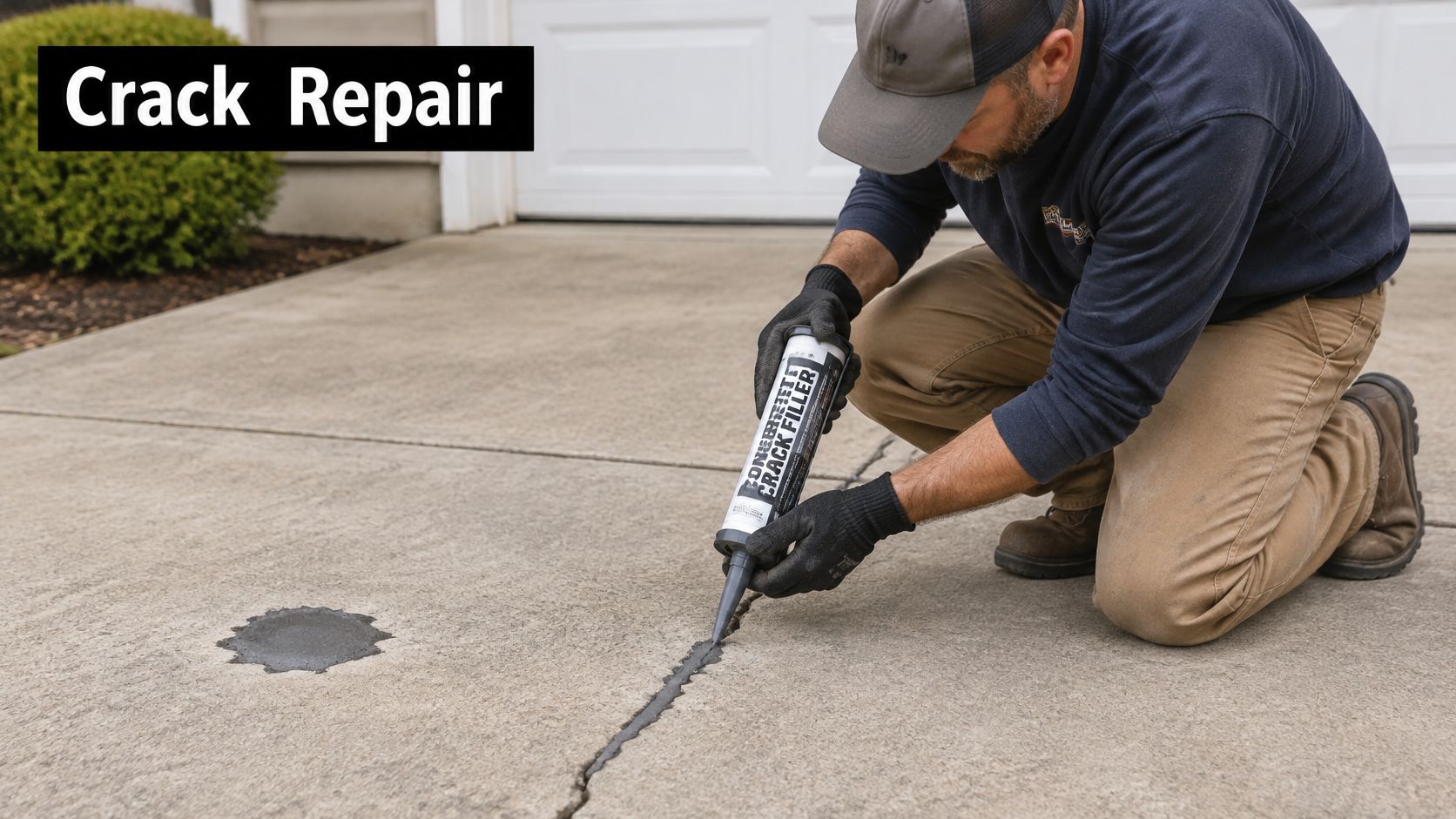
The Federal Highway Administration's partial-depth repair guidance reports that properly installed repairs performed well in approximately 80% to 100% of cases after 3 to 10 years, with suitable durable materials and construction quality control. That evidence concerns pavement repairs, not a warranty for every residential patch.
Preparation determines whether a patch stays bonded
- Remove deteriorated concrete. Stop only when the remaining material is sound, not when the hole looks tidy.
- Clean and inspect. Remove dust, debris, oil contamination, and loose particles so the repair bonds to concrete rather than residue.
- Define the boundaries. Form clear edges suited to the repair system instead of feathering material into a fragile margin.
- Match the material. Select a concrete repair product with compatible mechanical properties, exposure resistance, and installation depth.
- Consolidate carefully. Work the material against the prepared surfaces without leaving voids.
- Protect early curing. Control moisture loss, temperature exposure, rain, and traffic while the repair develops strength.
Reopening is a strength decision, not just a clock decision. The specification should require adequate strength relative to the surrounding pavement and anticipated loading before vehicles return. Use a concrete repair system, not asphalt cold patch, for a permanent bonded concrete repair.
This demonstration provides additional context for assessing the application process.
Say a scaled parking area looks smooth after patching but flakes again after wet winter exposure. If the installer selected an incompatible material or allowed traffic before adequate curing, the appearance at handover proves little.
Our residential concrete and masonry repair services include repair work appropriate to residential concrete conditions. Stop patching when recurring failures show that the remaining slab or its support can't carry the repair.
Resurfacing and Decorative Overlays Compared
An overlay needs a sound substrate. If the existing slab moves, a new surface can crack with it, regardless of how attractive the finished driveway looks.
A bonded cementitious resurfacer restores a worn surface. A thinner acrylic resurfacer provides lighter coverage and a more uniform finish, while a stamped overlay adds a decorative wearing surface. A sealer belongs in a different category: it protects an appropriate surface but doesn't rebuild missing concrete.
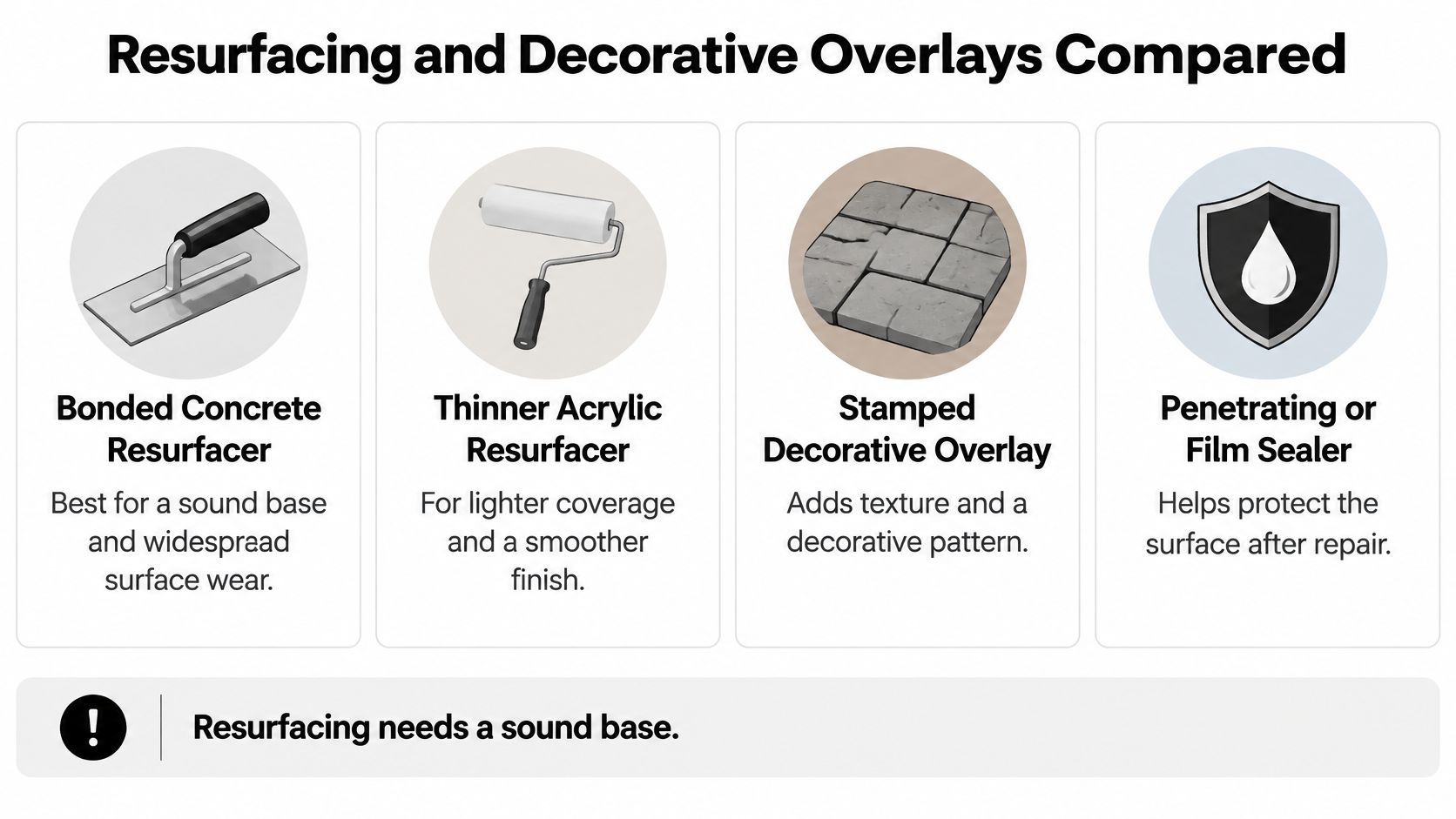
Overlay and sealer options compared
| Option | Expected lifespan | Main risk |
|---|---|---|
| Acrylic resurfacer | Use the selected system's documented service expectations for vehicle exposure | Peeling if the base cracks beneath it |
| Bonded concrete resurfacer | Assess from substrate condition, preparation, and the specified repair system | Debonding if the surface isn't prepared |
| Stamped decorative overlay | Assess with the specified sealing and maintenance schedule | Conceals existing cracks without correcting movement |
| Penetrating or film sealer | Plan renewal around product type, wear, and exposure | Doesn't repair cracks; some water-repellent treatments may impair freeze-thaw performance |
Compare the complete installed system
For bonded resurfacing, mechanical preparation may include grinding or shot blasting to remove weak surface concrete and create the required profile. A bonding agent is appropriate only when the chosen system calls for it. Applying a coating over dusty, contaminated, or unsound concrete invites separation.
Decorative concrete can imprint flagstones, brick, slate, or other patterns on driveways or decks. Our residential decorative concrete options suit owners choosing an aesthetic treatment, but pattern selection should follow substrate evaluation.
For finish selection, Hayes Painting and Decorating's resource on protective finishes for concrete surfaces offers useful context. Compare vehicle suitability, wet traction, appearance, and maintenance rather than treating every coating as an equivalent product.
Specify for wet winter exposure
NIST's freeze-thaw guidance identifies about 85% saturation as a critical moisture level for many concretes and reports that water-repellent sealers didn't reliably improve freeze-thaw durability and sometimes reduced it. Where wet freezing is credible, specify compatible air-entrained cementitious repair material, suitable aggregate, proper placement, and protected curing.
A sealer supplements a durable repair system. It isn't a substitute for one.
Compare cost per service year by dividing the complete quoted price by a defensible service-life estimate. Include preparation, joint treatment, finish renewal, and eventual removal. Enter current quote amounts rather than relying on a generic price chart that excludes the difficult work.
When Full Replacement Is the Better Investment
Full-depth cracks with a raised edge, visible settlement, washed-out support, and deterioration across broad areas justify a replacement assessment. The important distinction is whether removing the slab gives access to a problem that surface work can't reach.
A transportation life-cycle analysis indexed by TRID found that initial pavement cost represented 72% to 91% of net present value under the roadway conditions studied. That isn't a residential price forecast or a universal argument for concrete over asphalt. It does reinforce the importance of comparing complete alternatives rather than a patch price against a replacement price with different work included.
Compare ownership scenarios
For a hypothetical five-year ownership period, price the immediate patch, likely follow-up repairs, maintenance, and unresolved drainage work. For a hypothetical ten-year period, add the possibility that you'll pay for both repeated repairs and eventual replacement. Compare those totals with a replacement scope that corrects the cause from the outset.
For Concrete Driveway Replacement Atlanta, the estimate should address:
- Support and slab design: Sound subgrade, appropriate base preparation, slab thickness suited to vehicles, and reinforcement where the design requires it.
- Apron loading: Turning wheels, trailers, delivery vehicles, and transitions at the street.
- Layout: Joint placement, garage access, widening, and any custom residential driveway design.
- Access and curing: Separate expectations for walking, passenger vehicles, and heavier loads.
Our residential poured concrete services include concrete work for residential projects, and we offer custom-designed driveways. Atlanta Concrete Solutions gives a project timeframe during the initial consultation.
Don't confuse a scheduling allowance with permission to drive. Concrete continues developing strength after it becomes firm enough to walk on, and weather, mix design, curing, and vehicle weight affect release decisions.
Replace when the credible cost of repairs over your planned ownership period exceeds a properly scoped replacement, or when repair can't provide the required safety and performance. A cheaper treatment isn't a bargain if it leaves the structural failure untouched.
Match Your Driveway Situation to One Repair
Selling soon with a sound but worn slab: Resurfacing or a decorative overlay can improve presentation without unnecessary demolition. Document the work and disclose the repair history appropriately; Cultivate House Detailing's guidance on how to boost curb appeal with driveway care also helps distinguish cleaning and sealing from actual repair. Check that the surface is sound before paying for appearance.
An older driveway with stable hairline cracks: Choose concrete-compatible crack filling and joint maintenance rather than covering the entire driveway. Photograph the cracks and reassess after seasonal weather changes. Check for new elevation differences before repeating the treatment.
A patch that looks right on installation day can still be the wrong repair if the base is failing.
Widening or extending: Treat the addition and existing driveway as a connected grading and access project. Coordinate joints and transitions without blindly copying an existing slope that already ponds. Check where runoff will go after the paved area increases.
Trailers or heavier vehicles: Replacement may be appropriate when the existing slab isn't suited to the intended load. Design thickness, support, apron details, and reinforcement together. Confirm actual vehicle use before accepting a passenger-car driveway specification.
A shaded driveway exposed to deicing salt: Choose a repair specification appropriate to wet winter exposure rather than selecting on compressive strength alone. Check drainage, material compatibility, and curing protection before authorizing work.
Questions worth resolving before signing
For pricing, distinguish How Much Does a Concrete Driveway Cost in Atlanta? from Concrete Driveway Replacement Cost Atlanta 2026 by demanding a dated, site-specific scope. For design, resolve Concrete Driveway vs Asphalt in Atlanta, Best Concrete Thickness for a Residential Driveway, and Do You Need Rebar in a Concrete Driveway? against the actual loads.
For repair planning, pair Concrete Driveway Cracks: When Should You Replace It? with Concrete Driveway Repair vs Replacement. For layout and finishes, consider Driveway Widening Atlanta, Driveway Extension Atlanta, and Stamped Concrete Driveway Atlanta as separate design decisions, not automatic upgrades.
Check Drainage and Rights-of-Way Before You Hire
A repaired driveway can still flood because the contractor restored the surface without correcting runoff direction, inlet capacity, or a damaged culvert. Responsibility for the apron also can't be determined from appearance alone: public-right-of-way authorization and responsibility for arranging or paying for work are separate questions.
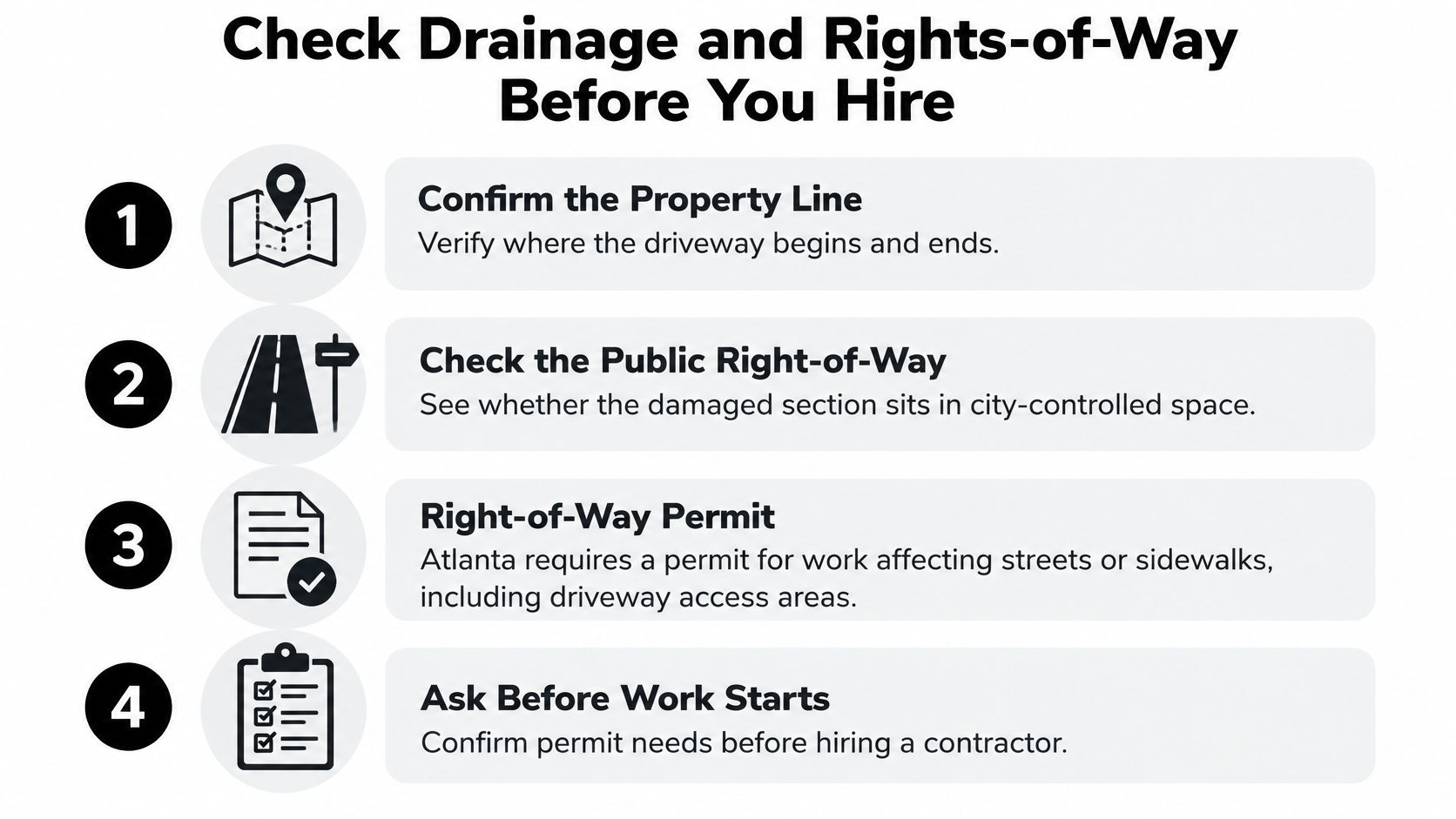
Resolve site responsibility before construction
Locate the property boundary and right-of-way. Check the survey and confirm which authority controls the street connection. Atlanta's right-of-way requirements require a permit for work affecting public streets or sidewalks, including driveway-apron repairs, and identify an apron slope generally about 2% to 5% away from the travel lane. Confirm the applicable detail rather than assuming the entire driveway follows that slope.
Record runoff during rain. Photograph water approaching the garage, crossing neighboring land, collecting behind the apron, or reaching a storm drain. Ask for proposed elevations and a clear discharge route. This is the practical starting point for How to Fix Drainage Problems on an Atlanta Driveway and Concrete Driveway Apron Atlanta, not choosing a drain from a catalog.
Check state-highway requirements where applicable. Georgia DOT's drainage requirements generally call for driveway and side-drain pipes designed for the 25-year storm, curb and grated inlets for the 10-year storm, and low-point inlets for the 50-year storm. They also require a low point before the highway connection to keep runoff from crossing the road and calculations accounting for pre- and post-development conditions. A widening project therefore needs more than a matching concrete finish.
Include the culvert and ditch transition. Georgia DOT's driveway requirements address approved pipe materials and safety treatment of exposed pipe ends in the clear zone. Price the apron, pipe condition, end treatment, and erosion protection together where applicable. Leaving an inadequate crossing beneath new concrete can preserve the original drainage failure.
Turn the diagnosis into a written scope
Request an estimate for the documented damage. We provide free estimates for concrete projects. Ask why the proposed method fits the findings and what conditions would change the recommendation after demolition.
Confirm qualifications and responsibilities. Atlanta Concrete Solutions is licensed and insured and holds the necessary licenses to operate in its service area. The written scope should identify base preparation, drainage corrections, apron and culvert work, concrete specification, joints, finish, and who obtains permits.
Get access and aftercare instructions in writing. Resolve How Long Before You Can Drive on New Concrete? through the project's curing and loading requirements. Address How Long Does a Concrete Driveway Last in Atlanta?, Concrete Driveway Sealing Atlanta, and a Concrete Driveway Maintenance Guide through explicit maintenance expectations, not an unsupported lifespan promise.
Call (678) 554-4433 to request a free quote. Before choosing a repair, obtain a written estimate that explains both what will be corrected and what will remain.
Atlanta Concrete Solutions offers driveway repair, ready-mixed concrete replacement, and custom residential driveway designs. Visit Atlanta Concrete Solutions to request a free estimate, and bring photographs of cracks, uneven panels, and rainwater flow so the proposed work addresses more than the surface.