
Atlanta homeowners often call after the same frustrating sequence: the driveway looked fine from the street, then scaling, stains, hairline cracks, and rough patches began spreading across the surface. A pressure washer improves the color, but it can't restore worn concrete, and another patch rarely makes the driveway look consistent.
Concrete overlay repair can solve that surface problem when the existing slab is stable. It can't correct a settled base, major heaving, or a driveway that has lost its structural support. In Atlanta, moisture deserves special attention because heavy rain, poor grading, runoff from sloped lots, irrigation, and groundwater can undermine an otherwise attractive resurfacing project.
Is Concrete Overlay Repair Right for Your Driveway
A driveway with surface wear isn't automatically a candidate for demolition. Scaling, shallow spalling, weathering, discoloration, and map cracking often affect the top layer while the concrete beneath remains sound. An overlay can give that worn surface a new finish, provided the slab doesn't move and the repair team can establish a reliable bond.
The mistake is treating every ugly driveway as a cosmetic problem. A long crack that follows a settled section, a slab that rocks under vehicle weight, or a section pushed upward by tree roots points to movement below the surface. Placing new material over that movement only hides the evidence temporarily. The old failure will eventually transfer through the overlay.
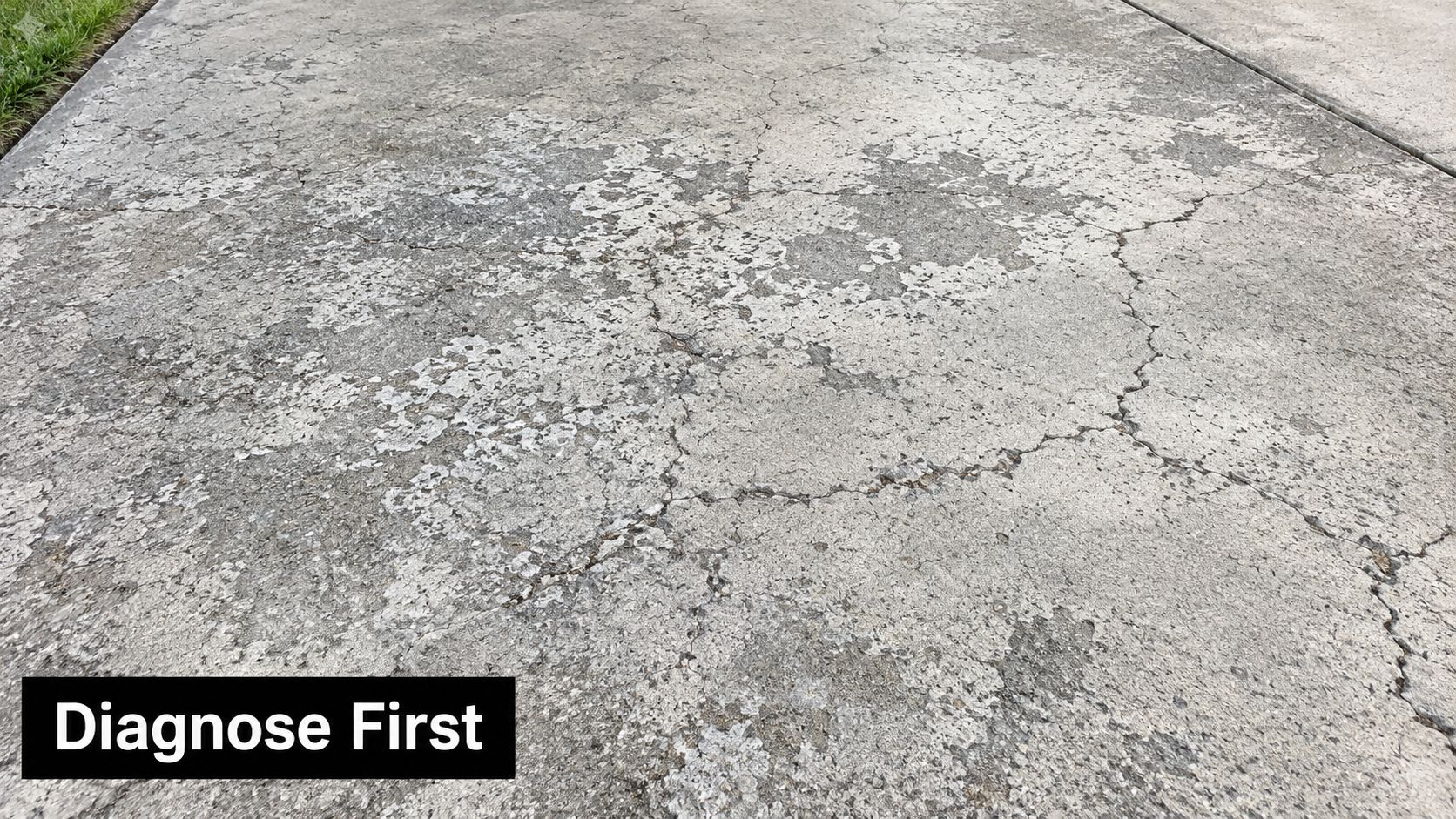
Separate surface distress from structural failure
I start with the simplest question: does the slab still behave like a stable slab? Walk the driveway after rain and look for ponding, soft edges, exposed aggregate, and areas where water appears to travel beneath the concrete. Check whether cracks are narrow and inactive or whether they have displaced edges, widened over time, or created a change in elevation.
A viable overlay candidate generally has:
- Surface-level deterioration: Scaling, light pitting, fading, and shallow roughness can often be addressed after soundness testing and preparation.
- Limited cracking: Hairline or dormant cracks may be treated with an appropriate repair system, though no overlay guarantees that every existing crack will stay hidden.
- Stable elevation: The slab shouldn't show obvious settlement, rocking, or heaving.
- Manageable drainage: Water must have a route away from the driveway and away from the overlay interface.
Practical rule: An overlay is a finish placed on a foundation. It isn't a substitute for a foundation repair.
Concrete overlays aren't experimental products. Concrete has resurfaced pavements since 1901, rehabilitated existing concrete pavements since 1913, and rehabilitated asphalt pavements since 1918. From 1980 through 2010, concrete overlay projects constructed per decade were about five times more numerous than those built across the previous six decades combined, according to the documented history in the National Concrete Overlay Explorer background. That history supports overlay repair as a mature rehabilitation method, but it doesn't eliminate the need to inspect the specific driveway.
For homeowners researching Concrete Driveway Replacement Atlanta, the useful next step is a condition assessment, not a product selection. A contractor providing residential driveway concrete services should identify whether the problem is the surface, the slab, the base, or the drainage around it.
Critical Diagnostics and Moisture Testing
Moisture is the failure risk most often ignored before resurfacing. A driveway can look dry on a sunny morning while water is still moving through the slab or collecting below it. If the source remains active, the overlay may blister, discolor, debond, or fail after installation.
Start with water movement
Inspect the driveway during or soon after rainfall. Look for water flowing toward the garage, collecting beside the slab, spilling from a downspout, or remaining along an edge because the surrounding soil has settled. In Atlanta, irrigation lines, heavy clay soil, sloped lots, and intense rain events can all create moisture conditions that aren't obvious during a dry inspection.
A basic plastic sheet check can provide an early warning:
- Choose a representative area of the slab, not just the driest section near the street.
- Clean the surface and allow loose water to disappear.
- Seal clear plastic tightly against the concrete with tape around every edge.
- Leave it undisturbed, then inspect for condensation or a noticeably darkened slab beneath the plastic.
- Treat visible moisture as a reason to investigate further, not as permission to proceed.
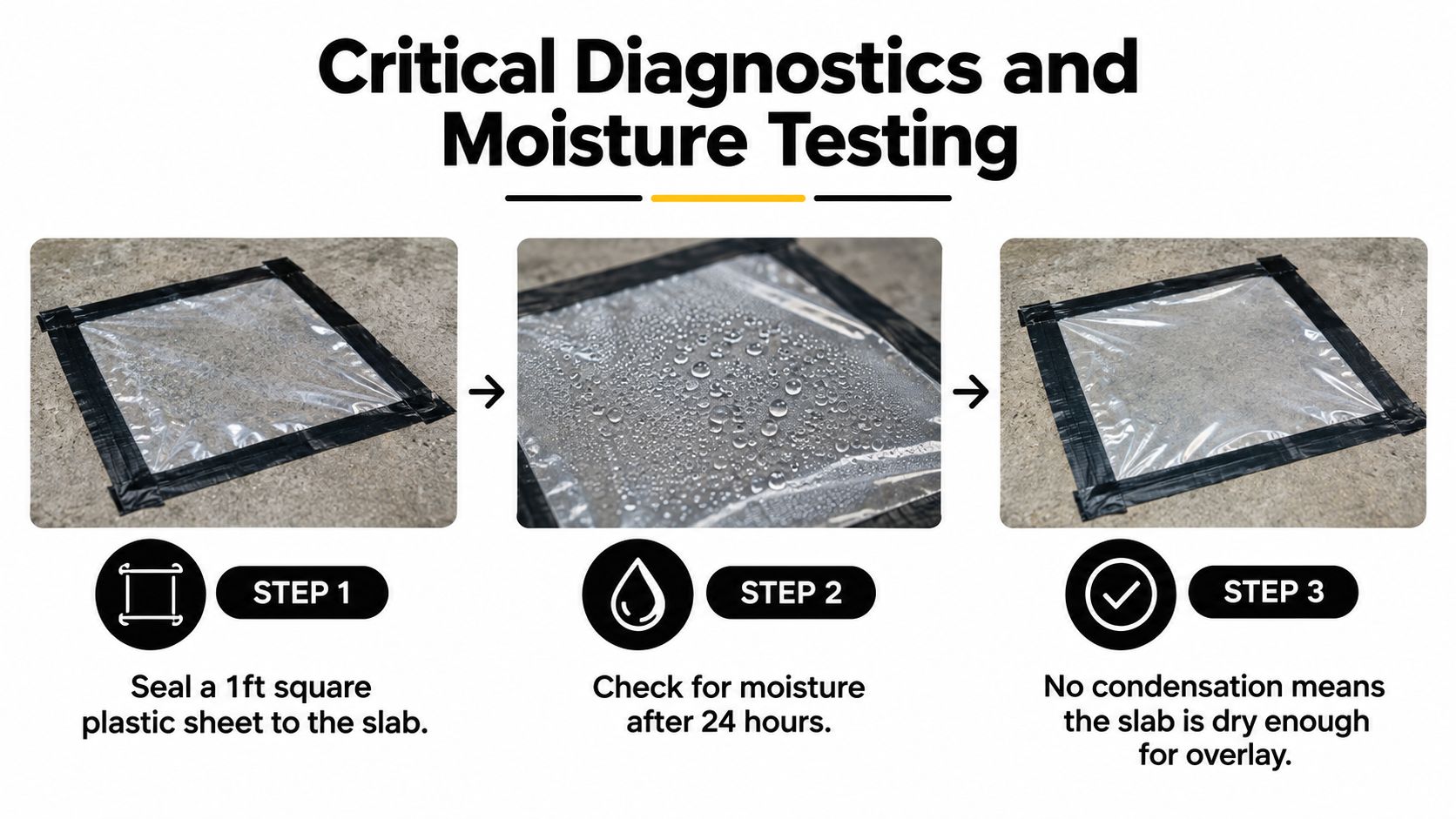
The test doesn't identify the source by itself. Moisture may come from drainage, groundwater, irrigation, vapor transmission, or water trapped within the existing slab. Technical guidance from the IRMCA discussion of concrete overlay mistakes emphasizes that installers should diagnose and correct those conditions before overlaying.
Verify the slab can carry the bond
A sound-looking surface may still have weak concrete beneath the paste. A professional crew may remove a small area, sound the slab, inspect exposed aggregate, and perform tensile pull-off testing on prepared representative locations. The test measures whether the substrate can resist the force required to separate the repair from the existing concrete.
One referenced repair specification calls for at least 3,000 psi of in-place substrate compressive strength, with minimum tensile targets of 200 psi for bonded overlays and 150 psi for partial-depth patch substrates, as described in this concrete repair and restoration specification overview. Those figures aren't a substitute for engineering judgment, but they show why visual inspection alone isn't enough for a demanding bonded repair.
If moisture testing shows a problem, fix the water path before discussing colors, textures, or sealers. That may mean extending a downspout, correcting the grade, repairing irrigation, improving edge drainage, or reconsidering overlay altogether. Homeowners who need broader assessment can review residential concrete and masonry repair services, but the principle remains the same: no bonding agent can compensate for a persistently wet or moving substrate.
Surface Preparation and Profiling
Surface preparation determines whether the overlay becomes part of the driveway or merely sits on top of it. Power washing removes dirt, but it doesn't necessarily remove weak cement paste, embedded oil, laitance, or contaminated concrete. A slab can look clean and still provide a poor bonding surface.
Remove what the overlay can't bond to
The crew should first identify unsound areas and remove them. Laitance, dust, loose aggregate, curing compounds, oil, paint, tire residue, and other debris must be removed before any bonding material is applied. Cracks and damaged edges need their own treatment rather than being casually filled and covered.
Mechanical profiling is usually more dependable than acid etching for a driveway overlay. Diamond grinding can remove weak material and expose a consistent texture. Shot blasting can clean and profile larger areas efficiently when the equipment and containment are suitable. The right method depends on the slab, contamination, access, and chosen overlay system.
Bonding depends on contact, not appearance. A smooth gray slab isn't necessarily a prepared slab.
The prepared concrete must have a texture that allows the new material to grip mechanically. After profiling, the surface needs thorough vacuuming and cleaning. Dust left in the pores acts like a release layer, while standing water can dilute a bonding agent or interfere with the interface.
Independent repair guidance identifies surface preparation as the dominant determinant of bond performance and calls for the removal of laitance, dust, and debris. The ACI concrete repair guide also highlights moisture control and substrate condition as part of a successful repair sequence.
A proper inspection should continue after preparation. If grinding reveals widespread weak concrete, voids, or deep contamination, the original overlay decision may no longer be valid. It is better to stop before placement than to cover a newly exposed failure with expensive material.
Mixing and Application Techniques
A good overlay can fail through poor timing just as easily as through poor preparation. The crew needs a stable substrate, compatible materials, controlled water content, workable weather, and enough labor to place and finish the material without cold joints or hurried edges.
Use a readiness checklist
Before mixing, confirm the following:
- Substrate: The slab is profiled, clean, sound, and free of standing water.
- Moisture: The crew has investigated damp areas and corrected active drainage or vapor problems.
- Weather: Air and surface conditions fit the overlay manufacturer's requirements.
- Materials: The cementitious mix, polymer, bonding agent, pigments, and sealer are compatible.
- Labor: Enough people are available to mix, spread, edge, texture, and protect the surface continuously.
- Finish plan: The homeowner has selected a broom, smooth, stamped, or decorative texture before placement begins.
Bonding agents should be applied according to the product system and placed while they remain in the required tacky condition. If the agent dries beyond that window, it may no longer perform as intended. If the crew applies new material over a puddled or contaminated agent, the interface can fail even when the top looks uniform.
Mixing requires discipline. Follow the manufacturer's measured ratio rather than adding water until the material “feels right.” Excess water can weaken the finished repair, increase shrinkage, and change the color or texture from one batch to the next. Small changes in water content become visible across a broad driveway.
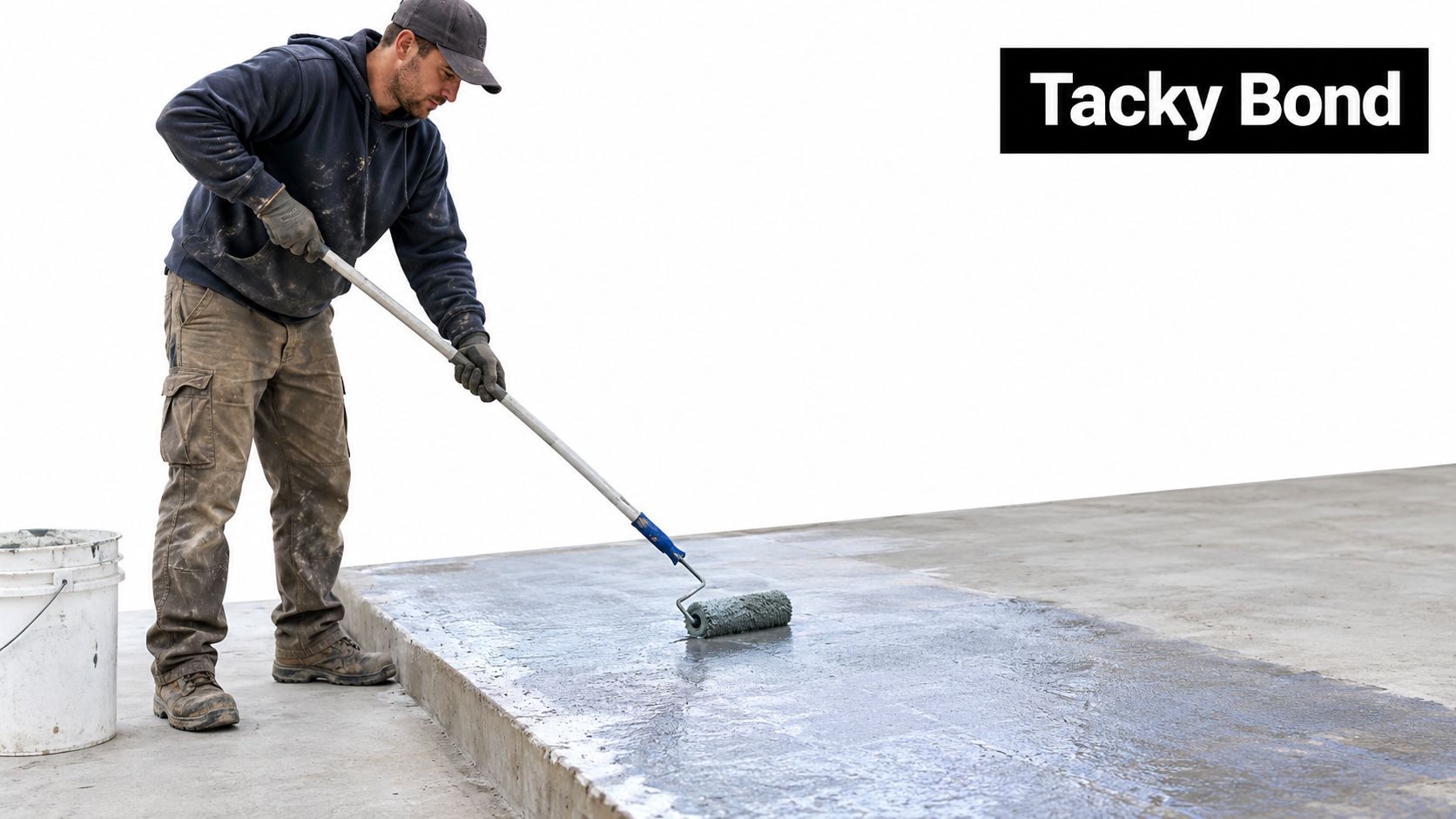
Match the application to Atlanta weather
Overlay placement generally works best when air and surface temperatures are roughly 50°F to 90°F, according to concrete overlay weather guidance. Hot, dry weather pulls moisture from a thin overlay quickly and can promote shrinkage cracking. Direct sun on one section can also make it set before the crew finishes the adjacent area.
The practical response isn't to add water. Schedule around the weather, shade the work where possible, dampen the substrate only as the system allows, and protect the fresh overlay from wind and rapid evaporation. In humid conditions, the surface may remain workable longer while the slab still holds hidden moisture, so the team must manage both drying and moisture movement.
Spread the material consistently, maintain planned thickness, and use the selected finishing tool at the correct time. A broom finish can improve traction, while decorative textures require coordinated timing across the whole placement. The final appearance matters, but uniform bond and controlled curing matter more.
Curing and Maintenance Protocols
The first week after placement has a major effect on the repair's future performance. Concrete needs protection from rapid drying, excessive heat, traffic, and premature sealing. A surface that feels hard enough to walk on may not yet be ready for vehicles or heavy loads.
Concrete should have at least 7 consecutive days above 50°F for proper curing, and one driveway timing guide lists at least 7 days before passenger-car traffic and 28 days for full use by all vehicles, as explained in this Atlanta driveway timing and cost guide. Follow the overlay manufacturer's instructions when they require a longer protected period.
Overlay cost and service life are different questions
A new residential concrete driveway in Atlanta is commonly priced around $6.50 to $10.50 per square foot, while a 600-square-foot driveway poured 4 inches thick requires about 7.4 cubic yards of concrete, according to Atlanta concrete installation cost information. That comparison helps establish the scale of a replacement, but it doesn't create a universal overlay price. Preparation, repairs, access, finish, drainage corrections, and the selected system change the estimate substantially.
Expected overlay service life also depends on whether the system is bonded or unbonded and whether it sits on concrete, asphalt, or composite pavement. A national concrete overlay compilation lists typical expectations of 15 to 25 years for bonded overlays on concrete, 20 to 30 years for unbonded overlays on concrete, 5 to 15 years for bonded overlays on asphalt or composite, and 20 to 30 years for unbonded overlays on asphalt or composite. The same concrete overlay performance compilation records more than 8 million square yards of thin concrete overlays constructed by 2009 to 2010.
Those figures are planning ranges, not promises for a particular Atlanta driveway. A wet, moving, poorly prepared slab can fail far earlier than a stable, properly prepared one.
Protect the finished surface
Once the manufacturer's curing period allows it, a compatible sealer can help limit staining and water penetration. Keep leaves, mulch, and soil from holding moisture against the edges, and trim vegetation that lifts or crowds the slab. Clean oil and chemicals promptly rather than allowing them to sit in the surface.
For homeowners comparing decorative finishes, residential polished concrete services illustrate an important distinction. A polished interior surface, a polymer coating, and a vehicular driveway overlay may use different materials and protection systems, so the product must match the exposure and traffic.
Overlay vs Replacement Decision Matrix
A driveway can look worn while its base remains sound, or appear repairable while moisture and movement are already undermining it. In Atlanta, humid conditions, heavy rain, runoff from sloped lots, and poorly directed downspouts can keep water at the slab edge or beneath the driveway. That is why the decision starts with moisture and movement, not color, texture, or decorative finish.
| Driveway condition | Overlay repair | Full replacement |
|---|---|---|
| Scaling, weathering, or shallow surface wear | Often appropriate after preparation and moisture testing | Usually unnecessary if the slab is stable |
| Minor cosmetic cracking | May work with crack treatment and realistic expectations | Consider it if cracks are active, widening, or spreading |
| Rocking sections or settlement | Not a durable solution | Preferred because the base or slab needs correction |
| Heaving from roots or expansive movement | Overlay will follow the movement | Remove the cause and rebuild the affected area |
| Widespread deep failure | Surface treatment only conceals the problem | Safer long-term option |
| Persistent moisture beneath the slab | Correct drainage first, then reassess | May be required if the base remains compromised |
Replacement becomes more reasonable as failure spreads through the slab or its support. Repair-versus-replace guidance identifies replacement when more than about one-third of the slab has failed or the base has settled, while another recommendation favors replacement when damage exceeds 50% of the surface or the driveway is over 25 years old. These figures are screening points, not automatic rules. The repair or replacement comparison explains why the underlying cause matters more than a visual percentage alone.
Make the decision in the right order
- Map the failure. Mark cracks, settled areas, ponding, exposed aggregate, hollow-sounding sections, and places that move under load.
- Trace the water. Check downspouts, roof runoff, driveway edges, low spots, and nearby soil. If water remains at the interface, postpone resurfacing until the drainage problem is corrected.
- Assess movement. Settlement, rocking, root heave, and recurring separation indicate a base or structural problem that an overlay cannot stabilize.
- Test the substrate. Confirm that the remaining concrete is sound enough to support the selected bonded system. Weak, contaminated, or persistently damp concrete needs correction before installation.
- Price both scopes. Compare a properly prepared overlay with full tear-out, base correction, and repour. A cosmetic patch is not a fair substitute for either option.
- Choose by risk. Use an overlay when the slab is stable, moisture is controlled, and the remaining uncertainty is manageable. Choose replacement when movement or base failure is likely to return.
A qualified contractor should review the findings with you, including where water travels, how much of the slab has failed, and whether the supporting base can be corrected. Resolve moisture and structural problems before selecting an overlay color, pattern, or finish.
Atlanta Concrete Solutions evaluates existing driveways for moisture problems, surface deterioration, drainage concerns, overlay suitability, and full replacement needs. Visit Atlanta Concrete Solutions to request a project assessment and discuss whether resurfacing or replacement is the safer investment for your Atlanta property.