
A typical concrete driveway costs roughly $5,565 to install, with a broad common range of $3,120 to $8,010. In Atlanta, thickness, finish, reinforcement, access, demolition, and drainage can move the final price well beyond that baseline.
A homeowner replacing a cracked driveway usually starts with one simple question: “What should I budget?” Then the first contractor quote arrives with separate line items for removal, grading, steel, concrete thickness, finishing, and sealing. The total may look very different from an online average, even when both prices are reasonable.
The cost to install a concrete driveway depends less on one universal Atlanta rate than on the specifications behind the quote. A plain, four-inch driveway on a stable site is a different project from a six-inch stamped driveway poured over weak soil. The sections below explain where the money goes, which upgrades earn their place, and which choices often drain a budget without improving the finished driveway.
Understanding Your Concrete Driveway Budget
A homeowner in the Atlanta metro area may start with a cracked slab, uneven expansion joints, or standing water after a storm. The first contractor estimate can raise more questions than it answers. Is demolition included? Who corrects the base? Does the price cover rebar, or will reinforcement appear as an upgrade after the quote?
A national benchmark provides context. A concrete driveway is commonly estimated at about $5,565 total, with a typical range of $3,120 to $8,010, or roughly $9.50 per square foot on average. The overall per-square-foot range is about $4.50 to $14.50, depending on size, labor, site conditions, and finish, according to The Spruce's concrete driveway cost guide.
That benchmark is not an Atlanta proposal. It does help identify estimates that need a closer look. A low quote may leave out demolition, weak-subgrade correction, drainage, or reinforcement. A higher quote may include a thicker slab, rebar where vehicle loads require it, decorative finishing, difficult access, or concrete delivery costs that another contractor has not listed.
Short driveways can also carry surprising delivery costs. A ready-mix supplier may apply a short-load surcharge when the order does not fill a truck efficiently. That charge, along with forming, setup, and crew time, can make a small project cost more per square foot than a larger, uncomplicated pour.
Read the quote as a specification
A dependable estimate describes what the crew will build, not only the final price. Check the measured area, slab thickness, concrete finish, reinforcement method, demolition scope, base preparation, control joints, cleanup, sealing, delivery charges, and any allowance for drainage work.
Practical rule: Compare contractor proposals line by line. The lowest total is not a bargain if it omits work that protects the slab.
Thickness and reinforcement deserve particular attention. A four-inch slab may suit ordinary passenger vehicles, while heavier or frequent loads can justify additional thickness and steel. Rebar is not automatically needed on every residential driveway, but removing it from a specification without considering soil, drainage, and vehicle use can shift repair costs into the future.
Budgeting discipline works across exterior projects. If a front porch is also on your list, this guide to compare front porch prices 2026 shows how line-item planning applies there too. For driveway-specific scope, review the residential concrete driveway services from Atlanta Concrete Solutions and confirm that preparation is included with the pour.
Start with a site visit and written scope. Measure the area, identify the vehicles that will use it, inspect drainage, and ask the contractor to explain every allowance before approval.
Key Factors That Influence Installation Costs
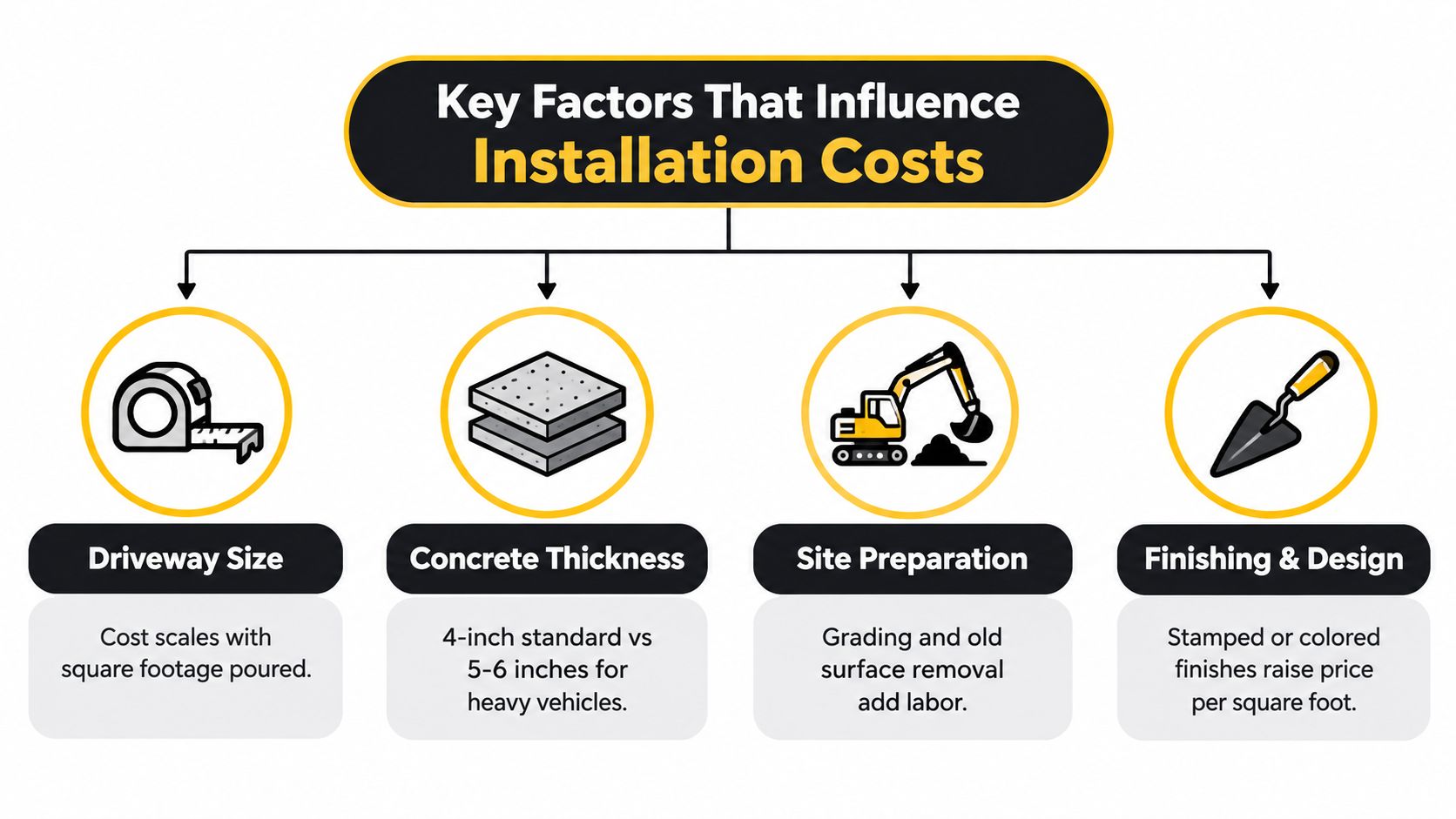
Atlanta driveway estimates move most when area, thickness, site preparation, and finish change. Reinforcement, truck access, delivery conditions, and removal work can then add costs that a simple square-foot average does not show.
Thickness and vehicle loads
In our Atlanta-area residential installs, we typically spec 4 inches thick for ordinary passenger-vehicle use. A driveway that regularly carries a truck, boat, or RV may need 5 or 6 inches. That upgrade increases concrete volume and placement labor, but gives the slab more capacity. The Atlanta driveway cost and thickness guide offers supplementary local context.
Thickness is a poor place to cut the budget when vehicle use clearly requires more support. The decision must be made before the pour. Repairing an undersized slab can mean demolition, disposal, and complete replacement.
Reinforcement and subgrade
Steel mesh and rebar help control cracking and distribute loads. Reinforcement commonly adds $1 to $3 per square foot, while rebar averages about $1.40 per linear foot before labor, according to HomeGuide's concrete driveway cost information. Rebar is not automatically necessary on every residential driveway. Soil conditions, drainage, vehicle loads, and the slab layout determine whether the added cost is justified.
The base beneath the concrete can create a larger surprise than the steel. Soft soil, poorly compacted fill, roots, standing water, or a failed existing base may require deeper excavation, imported aggregate, compaction, or slope correction. Those steps protect the slab from settling. A low bid that skips them can leave the new concrete supported by the same unstable ground.
Concrete guidance commonly specifies wire mesh for 4- to 5-inch slabs and #4 rebar for slabs 5 inches or thicker, with rebar arranged in a grid about 12 inches apart, as outlined in Concrete Network's driveway basics guide. Local requirements and the actual site still control the final specification.
Labor, access, and removal
Labor changes with crew availability, project complexity, travel, forming, and handwork. A straight driveway with direct truck access takes less effort than a narrow, sloped entry where workers must move concrete farther from the truck. Delivery can also affect the invoice. If the order does not meet a supplier's minimum load, a short-load surcharge may apply.
Removing an existing driveway adds about $2.50 per square foot on average, while labor alone averages about $5 per square foot, based on The Spruce's cost breakdown. Confirm whether disposal and haul-off are included. Old concrete remains part of the project until someone breaks it up, loads it, and pays to remove it.
Plain versus Decorative Concrete Options
A front-facing Atlanta driveway can shape a home's first impression, but appearance should not take priority over the slab's performance. Plain gray concrete remains the practical choice when the driveway's main job is parking and access. The crew can place, screed, broom-finish, and joint it without pattern layout, color matching, or additional sealing work.
A clear pricing comparison helps: expect roughly $6 to $8 per square foot for a plain broom finish, $8 to $12 for textured or exposed aggregate, and $14 to $25 for stamped work, with sealing adding about $1 to $3.50 per square foot, according to HomeAdvisor's concrete driveway pricing guide. The final invoice can still move higher when the pour is small, access is difficult, or the design requires extra setup and handwork.
When decorative concrete earns its premium
Stamped or colored concrete fits a driveway that is prominent from the street, complements a carefully designed façade, or forms part of a larger outdoor renovation. A stamped pattern can echo brick, slate, or stone without installing those materials individually. That continuity can strengthen curb appeal and resale presentation, but no finish guarantees a particular return.
Decorative work earns its cost when the driveway is a major visual feature and the design supports the rest of the property. It drains the budget when the home needs drainage corrections, structural repairs, or better site preparation first. A pattern cannot compensate for poor support, incorrect slope, or a slab that is too thin.
The finish also affects maintenance. Sealer helps protect colored and stamped surfaces, but it becomes another item to maintain. Without proper sealing, color can fade and the surface may show wear more clearly than plain concrete.
Select upgrades with a purpose
A broom finish provides traction and keeps the surface understated. Exposed aggregate adds stone character and texture, though repairs may be harder to blend. Stamping creates the strongest visual effect and requires accurate mat placement, consistent coloring, careful timing, and disciplined sealing.
Review Atlanta Concrete Solutions' residential decorative concrete service information to compare patterns and finishes. Then request a written price difference between plain, textured, colored, and stamped options. If the upgrade does not improve the property's appearance or use, keep the money in the slab and the work that supports it.
The Installation Process and Timeline
A driveway replacement should follow a controlled sequence. Rushing site preparation or opening the slab too early creates more risk than a short scheduling delay.
Prepare the site before concrete arrives
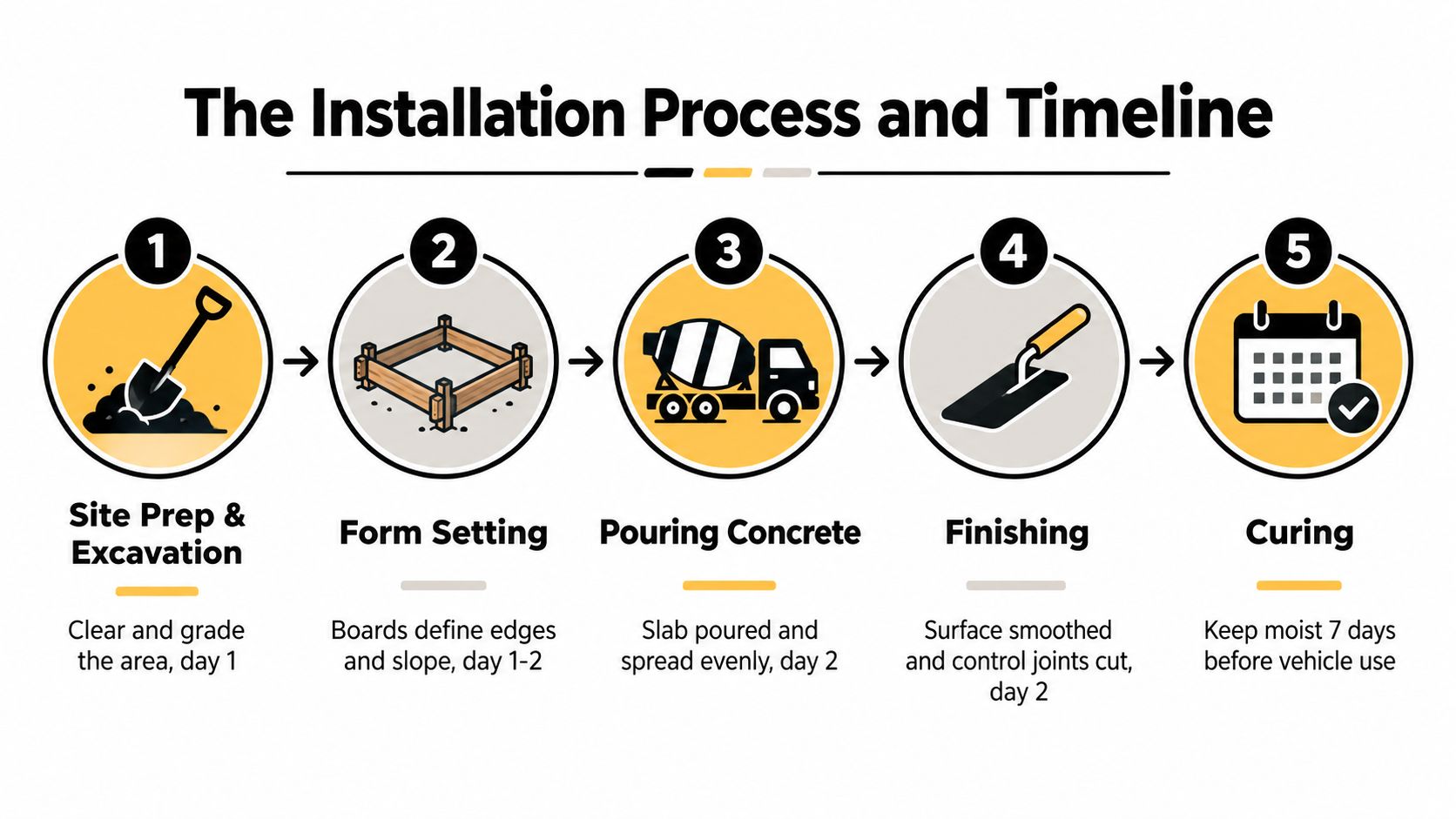
The crew first removes the existing driveway, vegetation, loose material, and unsuitable soil where necessary. They then establish the driveway grade, shape the subgrade, compact the base, and confirm that water will move away from the garage and toward an appropriate drainage path.
Forms define the edges and establish the intended slope. Reinforcement is placed before the pour, not dropped onto the ground after concrete delivery. If a permit, inspection, HOA approval, or right-of-way review applies to your property, those requirements should be resolved before demolition and scheduling.
Place and finish the slab
During the pour, workers spread and consolidate the concrete, strike it to the forms, and finish the surface according to the selected specification. They cut or form control joints at planned locations so the slab has a controlled place to accommodate shrinkage.
The crew's timing matters. A broom finish, exposed aggregate, and stamped surface each require different finishing decisions while the concrete is workable. Decorative work can't be treated as an afterthought once the surface has begun to set.
Site rule: A driveway that drains poorly will continue to have a drainage problem after replacement. Fix the water path before the concrete covers the ground.
Respect the curing period
Light foot traffic can usually begin after 24 to 48 hours, but vehicles should remain off the slab for at least 7 days. Heavy vehicles are often delayed for about 30 days, and concrete generally reaches full compressive strength at 28 days, according to FixUpFirst's concrete driveway guidance.
Weather can affect the working schedule and finishing conditions. The contractor should explain when forms will come out, when the driveway can accept ordinary vehicles, and what curing measures will be used. Keep the area closed with the agreed barriers, even if the surface looks hard enough to drive on.
Real-World Cost Scenarios for Atlanta Homes
Atlanta driveway budgets become easier to judge when the estimate is tied to a specific job. The examples below use national pricing as planning references, not fixed local bids. Access, soil, demolition, slab thickness, reinforcement, delivery, scheduling, and the contractor's scope can move the final proposal substantially.
A straightforward residential replacement
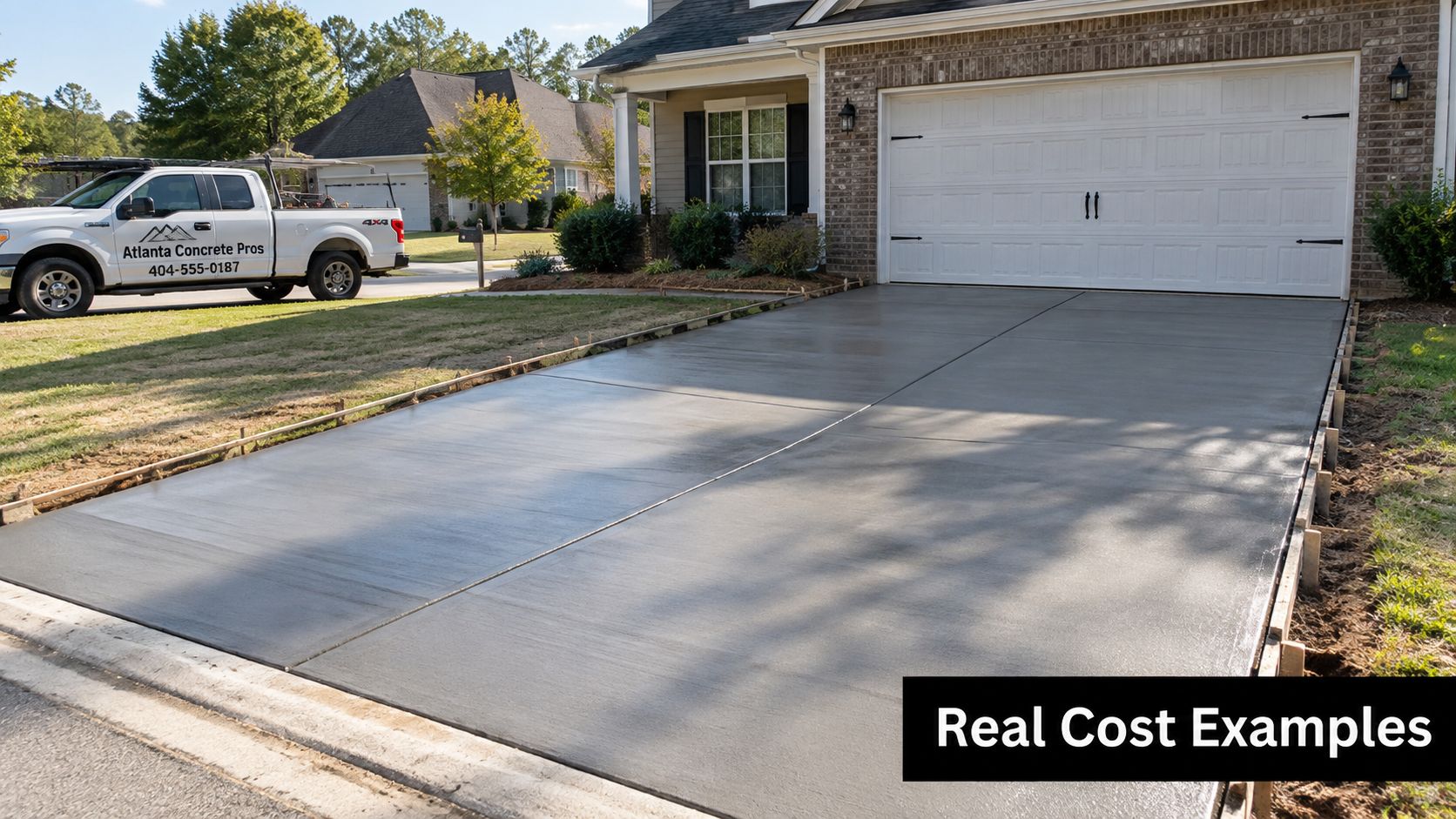
A plain, four-inch driveway for ordinary passenger vehicles is the baseline project. The estimate should identify excavation, base preparation, forms, concrete placement, finishing, control joints, and cleanup. If the old driveway must come out, demolition and disposal should have their own line items instead of being buried under a vague “site work” allowance.
A national estimate places average concrete driveway installation around $6,400 total in 2026, with a common range of $2,700 to $14,500, depending on size and finish, according to HomeAdvisor's installation cost guide. That wider published range reflects national variance. The Atlanta projects we price typically land inside the narrower band described earlier because soil and access conditions are relatively consistent.
The spread still matters. A small, plain entry and a large decorative replacement involve very different amounts of forming, concrete, labor, and finishing.
Quote check: Ask what physical work would move the project from the low end of the proposal to the high end. The answer should identify specific changes, not simply say that prices vary.
A smaller driveway with delivery inefficiency
A compact driveway uses less concrete, but mobilization, forming, labor, and delivery do not shrink in the same proportion. Ready-mix concrete is only one part of the invoice. Current pricing references place ready-mix around $160 to $180 per cubic yard, while short-load surcharges can add about $40 to $150 when the order is small, according to Concrete Network's driveway cost information.
Ask whether the proposal includes a short-load charge, delivery distance, pumping, and disposal. A small order can carry a disproportionate delivery cost, especially when the truck cannot reach the forms directly.
A wide, reinforced decorative entry
A wide multi-bay driveway requires more concrete, forming, finishing, and often more reinforcement. If it regularly supports a truck, boat, or RV, the design may call for a 5- to 6-inch slab instead of standard residential thickness. Rebar may also be necessary where vehicle loads, soil movement, edges, or slab geometry require better load distribution.
Decorative work adds another decision. Stamping and color can improve a prominent entry when the finish supports the property's design, but those upgrades do not solve drainage, weak base preparation, or an undersized slab. Pay for thickness and reinforcement when site conditions and vehicles justify them. Choose appearance upgrades when the driveway is highly visible and the added cost fits the rest of the project. For a utility-focused home, a plain reinforced slab may be the better use of funds.
The quote should show measured area, thickness, reinforcement, finish, removal, base work, drainage changes, delivery allowances, and permit responsibility. Without those details, two totals cannot be compared fairly.
Use the video as a visual reference for the work sequence. Judge an Atlanta proposal by its written specifications and site conditions, not by a low square-foot figure alone. A contractor who explains each line item gives you a clearer basis for comparing bids.
Smart Ways to Reduce Driveway Expenses
Lowering the price doesn't mean removing the work that keeps concrete stable. The safest savings come from simplifying the design, improving the quote comparison process, and making decisions before the crew arrives.
Protect the structural scope
Keep the driveway shape efficient when curves, extra borders, or multiple decorative bands don't serve a functional purpose. A plain or broom finish usually costs less than stamped concrete, and it can still provide a clean, durable appearance when the forms and joints are laid out carefully.
Don't remove reinforcement solely to reach a target price. Instead, ask the contractor to explain whether mesh, rebar, or another method suits the slab thickness, soil movement, vehicle load, and edge conditions. Cutting steel from a driveway that needs load distribution can turn a short-term saving into a repair problem.
Compare complete proposals
Request detailed written quotes from several qualified contractors. Compare the same scope, including demolition, disposal, grading, base preparation, thickness, reinforcement, finish, control joints, curing instructions, sealing, and cleanup.
- Check the exclusions: Confirm whether old concrete removal, haul-off, drainage corrections, and delivery charges are included.
- Ask about access: Identify whether the truck can reach the pour directly or whether the crew must use extra handling or pumping.
- Review the finish: Make sure “concrete driveway” means the same surface treatment in every proposal.
- Confirm scheduling: Ask how weather delays, curing, and vehicle access will affect the project.
- Request payment terms: Financing or staged payments may help manage the investment, but review interest, fees, and repayment obligations before signing.
For broader planning ideas, these Recepta.ai tips on cost savings can help you think through prioritization and trade-offs. Apply the same discipline to driveway bids. A low number with missing scope isn't a saving until the project is complete.
Spend first on failure prevention
Drainage, compaction, correct thickness, and appropriate reinforcement protect the slab. Decorative borders, unusual patterns, and extra color should come later in the decision order.
If your budget is tight, install a well-prepared plain driveway now rather than funding an elaborate finish over a questionable base. A simple surface can be maintained and enhanced with landscaping, lighting, or entry improvements later. Ask about financing options directly, and get the total repayment cost in writing rather than focusing only on the monthly amount.
Protecting Your Investment Long-Term
A new driveway holds up better when water drains away and surface care starts early. Keep soil and mulch clear of drainage paths, clean spills promptly, and follow the contractor's sealing guidance. Sealing can reduce water intrusion and surface wear, but its value depends on the product, preparation, and condition of the concrete.
Inspect after heavy rain and periods of repeated vehicle loading. Small, isolated cracks may be repairable. Widespread movement, severe settlement, drainage-related failure, or structural cracking can justify replacement. For localized damage, discuss residential concrete and masonry repair options with a qualified local contractor before removing the entire driveway.
Cosmetic upgrades can improve curb appeal, but they will not correct movement or settlement. Put repair and water control ahead of decorative work when funds are limited.
Related Atlanta driveway questions
- How long does a concrete driveway last in Atlanta? Service life depends on weather, traffic, installation quality, and maintenance.
- Do you need rebar in a concrete driveway? Soil, slope, and expected loads determine whether reinforcement is appropriate.
- When should cracked concrete be replaced? Replacement becomes more likely when cracks accompany movement, settlement, or recurring water problems.
- How do you fix drainage problems? Correct pooling at its source before repairing the slab, or the failure may return.
- How should you maintain a driveway? Keep drainage routes clear, address small damage early, and reseal when the surface and product require it.
Atlanta Concrete Solutions provides driveway replacement, decorative and stamped concrete, excavation, installation, resurfacing, and masonry repair across the Atlanta metro area. Visit Atlanta Concrete Solutions for a consultation and quote covering thickness, reinforcement, site preparation, finish, delivery, short-load charges, and other hidden costs.