
You're carrying groceries in from the driveway, you know exactly where that raised panel is, and your toe still catches it. A guest, a delivery driver, or a neighbor using a wheelchair won't get that warning. That's why you don't repair a sidewalk trip hazard by eyeballing a crack and picking the cheapest patch. You measure the offset, find what moved the slab, and rank the fix by who uses the route. A small lip on a busy front walk can matter more than an ugly crack on a side path nobody uses.
Measure the Hazard Before Choosing a Fix
A shoe catches, a stroller wheel stops dead, and the lip that looked harmless in daylight suddenly isn't. Start with a tape measure and a 4-foot straightedge, not a guess.
Lay the straightedge across the joint and measure the highest vertical offset between the two panels. Record the length of the raised edge and the width of any crack or gap. Then check both adjoining slabs for rocking under your weight, cracking, pooled water, tree roots lifting one side, and soil settlement dropping the other. One raised edge often signals a larger problem underneath.
Compare Your Measurement to the Thresholds
Under Section 303 of the 2010 ADA Standards, a vertical change up to and including 1/4 inch may remain vertical, a change over 1/4 inch but no more than 1/2 inch must be beveled no steeper than 1:2, and changes over 1/2 inch must meet ramp requirements, as summarized in the ADA trip hazard height guide.
| Vertical offset | ADA treatment | Practical action |
|---|---|---|
| Up to 1/4 inch | May remain vertical without beveling | Monitor and record; grind if it grows |
| Over 1/4 to 1/2 inch | Bevel no steeper than 1:2 | Grind or bevel the edge this season |
| Over 1/2 inch | Treat as a ramped change, no steeper than 1:12 | Build a compliant ramp or replace the panel |
That 1/4-inch line is a screening benchmark, not a universal legal verdict for every walk. Route classification, facility type, local codes, and surface condition also matter. A small offset on a primary route, near a curb ramp, or on a wheelchair path deserves faster action than the same offset on a little-used spur.
Build a Record While You Measure
Photograph each defect with a coin or tape measure for scale. Add the date, location, offset, and your best read on the cause. That file supports an HOA request, a municipal report, or an insurance conversation later, and it tells a contractor whether you're looking at grinding, lifting, or replacement.
Field verdict: Under a quarter inch, monitor it. Between a quarter and a half inch, grind or bevel soon. Over a half inch, or moving underfoot, plan a ramp or a new panel.
Who Is Responsible for Sidewalk Hazards in Atlanta
Say a lip sits on a school drop-off route where kids, parents, and a crossing guard pass twice a day. That defect outranks a deeper crack behind a gate, even if the crack looks worse in a photo. Exposure drives priority, and it is also how you should think about liability: the more feet cross a hazard, the faster it needs an answer.
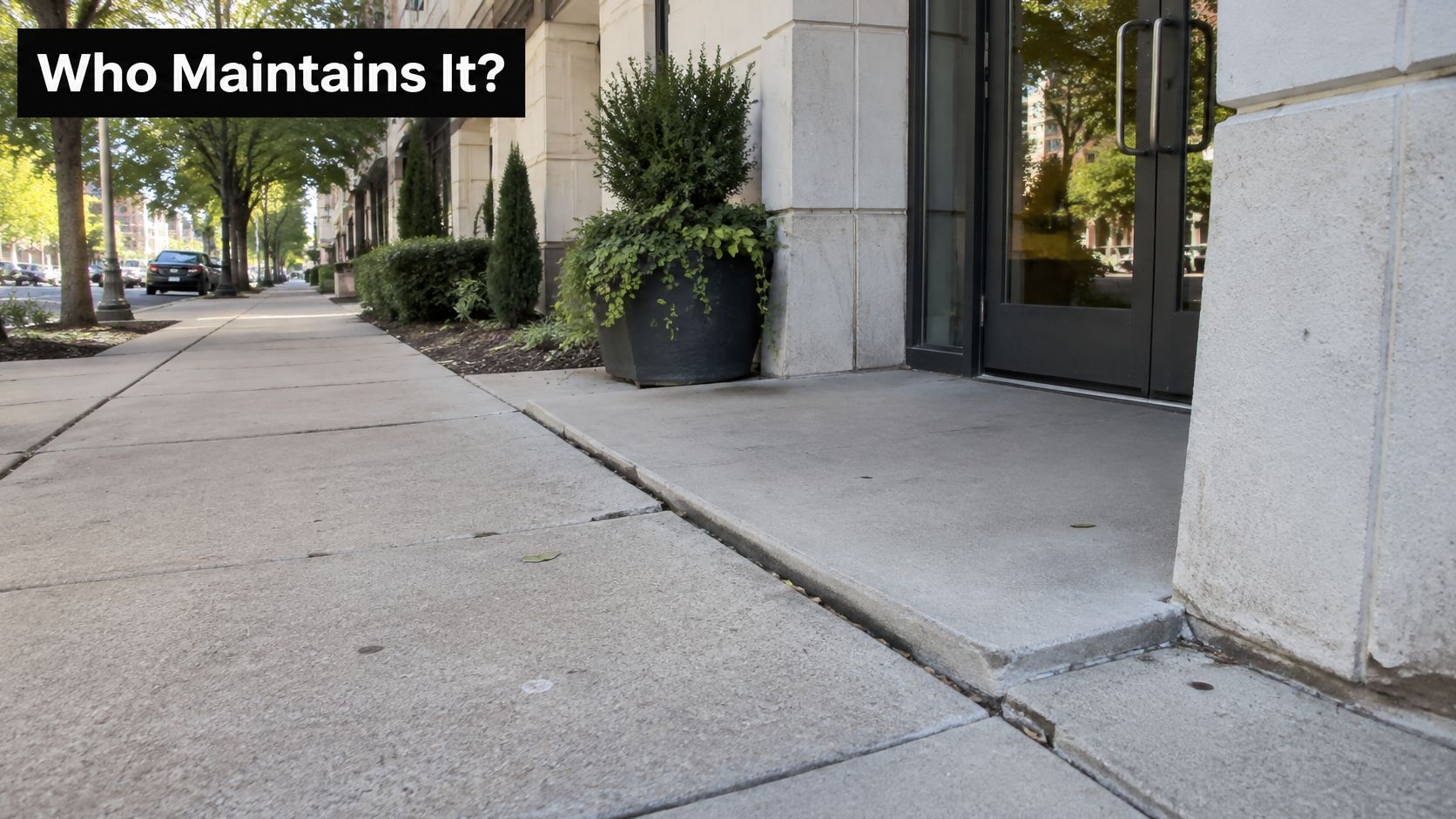
Responsibility depends on the parcel, the sidewalk's classification, and any lease or HOA covenant, so confirm who maintains the walk in front of the property before you pay for work. In Atlanta, that answer often splits two ways: an adjacent owner may carry the maintenance duty, while the city still controls how the work inside its right of way gets done.
The gap between a public walk and a building entrance is where ownership questions usually start.
Protect People While the Repair Waits
- Mark it visibly: Set cones or a barricade and paint the lip with high-visibility marking paint.
- Bridge it temporarily: A cold-patch wedge can soften the transition, but keep its slope gentle and check it after rain.
- Document everything: Keep measurements, dated photos, quotes, notices sent, and replies in one file for ADA, insurance, or lease questions.
Atlanta adds a permit layer. The City of Atlanta right-of-way office states that any disturbance within the public right of way requires a permit, with driveway-apron installation or repair listed as an example, and its manual requires a qualified contractor and an inspection request 24 hours before work. If your repair touches the apron, Atlanta's Streets Atlanta guidance sets apron slope between 1:10 and 1:12 and requires the pedestrian clear zone to keep a passage at least 30 inches wide. Check both before you choose a fix that reshapes that crossing, because a smooth patch poured over an out-of-spec apron trades one violation for another.
Match the Repair to the Defect
Say a maple root has lifted a 5-foot panel by 3/8 inch while its neighbors stay flat. Grinding gives you a compliant edge today. The root keeps growing, though, so the durable plan is panel replacement with root pruning handled by a certified arborist. Same lip height, completely different answer, because the cause is different.
An on-site inspection is where that cause gets identified, before anyone quotes a method.
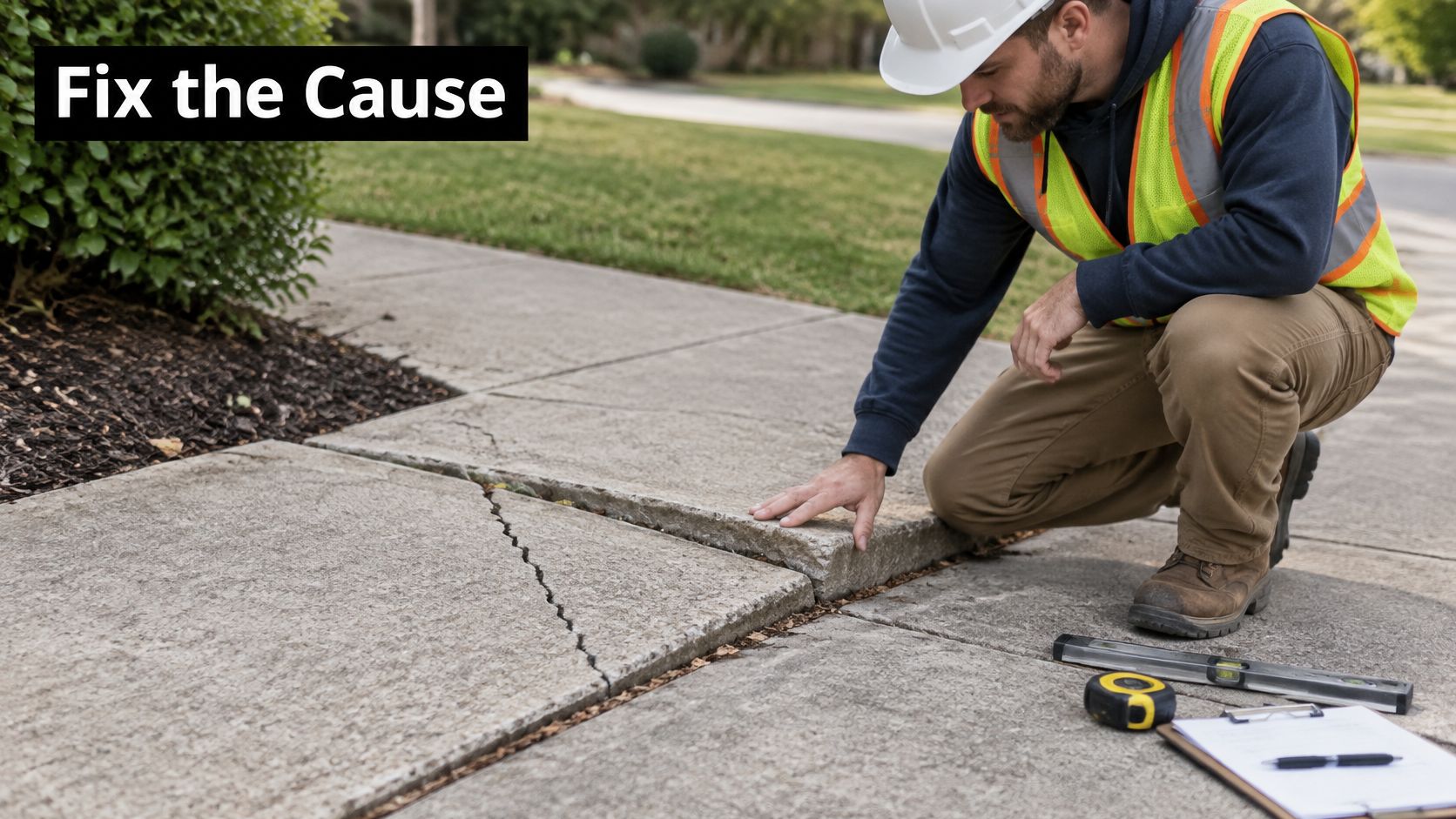
Ask what moved the slab before you ask what the repair costs. A chipped corner needs patching. A sound panel with one raised edge suits grinding. A settled panel over a solid base may suit slab lifting. A panel heaved by roots or cracked through under load needs replacement. I would start with the cheapest fix that addresses the cause, and skip anything cheaper than that.
| Repair method | Use when | Avoid when | Typical service life |
|---|---|---|---|
| Diamond grinding | Sound concrete with one edge raised under 1/2 inch | Cracked, loose or repeatedly moving panels | Often 1 to 5 years |
| Patching spalls and broken corners | Localized chipped or crumbled edges | Active settlement or damp, contaminated surfaces | Often 1 to 5 years |
| Mudjacking or slab lifting | Settled panel with a solid base beneath | Root uplift or a washed-out base | Set by base and drainage condition |
| Partial panel replacement | Cracked or displaced panels with sound neighbors | Widespread slab failure across the run | Decades if base and drainage are sound |
| Full walk replacement | Several failed panels or more than half the run needs work | A single isolated defect | Decades if base and drainage are sound |
The reverse case matters too. A one-inch broken corner on a stable slab rarely justifies tearing out the panel. Square the edges, undercut, patch, and finish flush. Homeowners weighing that kind of spot fix can review what's involved in residential concrete and masonry repair before committing to a larger scope.
This short walkthrough shows how a raised edge gets assessed and cut down in practice.
Rank your candidate repairs by pedestrian exposure and accessibility impact, not by how visible the crack is. Schedule the front entrance, the curb ramp approach, and the mail route first. The quiet side path can wait for the next round.
How to Grind a Raised Sidewalk Edge
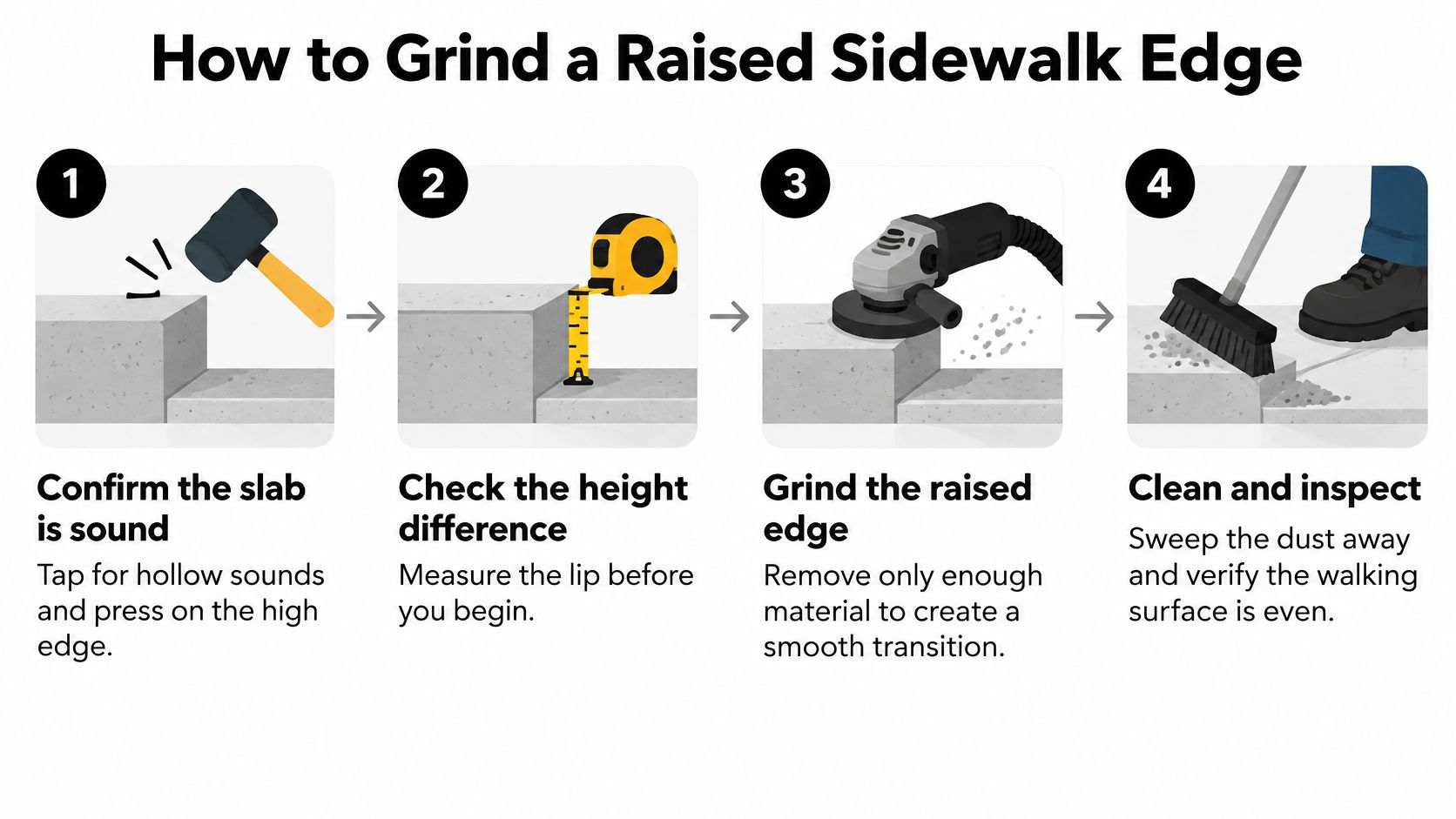
Grinding works when the concrete is sound and the rise is localized. It fails when people skip the soundness check and shave a panel that's already rocking on a void. Work the steps in order.
The infographic below condenses the sequence into four checkpoints.
The Seven Steps
- Confirm the slab is sound: Tap around the panel with a hammer and listen for hollow spots. Press your weight onto the high side. Rocking or a drum-like sound means grinding is the wrong tool.
- Mark a generous grind zone: Chalk a zone that extends well beyond the lip on the high panel. A wider zone blends the transition instead of carving a new cliff a few inches back.
- Set up wet grinding and protection: Use a walk-behind or handheld diamond grinder with water feed or a vacuum shroud for dust control. Wear eye and ear protection and a fit-tested respirator, because dry concrete dust carries silica.
- Grind in light passes: Sweep across the high edge in overlapping passes and check with the straightedge after each one. Light passes keep you from gouging a dip that ponds water.
- Clean before you judge: Rinse and vacuum all slurry and dust. Dried residue fills low spots and can hide a remaining lip, so you can't measure accurately until the surface is clean.
- Verify slope, not appearance: Check the finished transition with a digital level. For offsets exceeding 1/2 inch, the transition should generally be designed as a ramp with a maximum slope of 1:12, or 8.3 percent, and cross-slope should stay at no more than 2 percent, per the FHWA guide to maintaining pedestrian facilities.
- Reinspect dry and log it: Walk it again after drying, drag the straightedge once more, photograph the result, and record final measurements next to your originals.
Where Grinds Go Wrong
The FHWA guidance cautions that grinding can remove the abrupt lip while leaving a warped transition if one panel has settled, so check the entire pedestrian path rather than only the highest point. That warning is in the same FHWA guidance linked in step 6, and it's the mistake behind most callbacks. People fix the peak and leave a rolling hump.
Stop when the edge is within the limit, not when it looks perfectly level. Chasing dead flat thins the panel edge until it chips within months.
Grinding is best suited to sound concrete with a localized rise, not severely cracked, unstable, or repeatedly moving panels. If the lip comes back within a season or two, the slab is telling you the cause is still active. Repeated cosmetic grinding on a moving panel just buys a thinner panel.
When Mudjacking or Panel Replacement Is Needed
Two errors drain sidewalk budgets in opposite directions: tearing out a panel that only needed lifting, and grinding a root-heaved slab three times while calling it maintenance. The cause of the defect picks the repair, not the size of the lip or how visible the crack looks from the street.
Settlement Points to Lifting
A panel sitting low over a voided base is a candidate for mudjacking or slab lifting, provided the base below can be stabilized and drainage corrected. The crew drills small holes, pumps grout or foam underneath, and raises the slab back to grade. If water keeps washing fines out from under that panel, the lift won't hold, so fix the downspout or grading problem first.
Root uplift is a different issue. Grinding removes today's lip, the root adds another, and you're back next year with less slab thickness. The practical sequence is root pruning or a root barrier, then panel replacement formed around the corrected grade.
Where the hazard sits should also set the schedule. A lifted panel on the route to a building entrance, mailbox bank, or transit stop carries more liability than an identical lip on a lightly used side path, so queue the work by pedestrian exposure rather than by which crack looks worst on a walkthrough.
The Half-Run Rule of Thumb
The PennDOT sidewalk technical sheet states that small repairs under 100 linear feet and 500 square feet may generally be repaired in kind, while repairing more than 50% of a sidewalk run should prompt upgrading the entire length to current standards.
Run the math on a hypothetical 60-foot walk with three failed panels spread across 35 feet. You've crossed the half-run threshold, so budget for the full run, its transitions, and its slopes rather than three disconnected patches. Those thresholds come from a Pennsylvania technical sheet, so use them as planning benchmarks rather than local law. Atlanta work answers to the city's right-of-way rules and the ADA Standards.
Clay-heavy soil across the Atlanta area swells when wet and shrinks when dry, which works panels up and down over the seasons. Check downspout discharge and surface grading before you choose any repair here. A grinding or mudjacking job will fail again if water keeps softening the base, and property managers facing that pattern across multiple walks can scope it under commercial concrete and masonry repair rather than panel by panel.
What Sidewalk Trip Hazard Repair Costs in Atlanta
Grinding a single raised edge is usually the cheapest durable-looking option, and it carries a trap. Most contractors set a minimum charge to cover mobilization, dust control, and cleanup, so one short edge can cost more per foot than grinding six edges on the same visit. If you've measured several small lips, batch them into one call.
Treat every number a contractor gives you over the phone as a planning estimate, not a quote. Site access, base condition, panel thickness, and total length all move the price, and none of those show up in a photo. A bidder who prices replacement without asking about roots or drainage is guessing with your money.
| Repair type | Quoted per | Main cost drivers |
|---|---|---|
| Diamond grinding one raised edge | Location | Minimum charge, edge length, dust control |
| Patching cracks or spalls | Repair area | Prep depth, undercutting, number of patches |
| Mudjacking or slab lifting | Slab | Number of injection points, grout volume |
| Single panel replacement | Panel | Demolition, forming, base prep, curing |
| Full walk replacement | Square foot | Removal, forms, permits, transitions |
How to Compare Bids Line by Line
- Separate the scope: Ask each bidder to price demolition, base preparation, permit fees, and root pruning as distinct lines.
- Name the method: A quote should state grinding, lifting, patching, or replacement, not just a lump sum to fix the sidewalk.
- Flag right-of-way work: Sidewalk sections and driveway aprons inside the public right of way typically need a city permit and inspection, which adds time and fees.
- Ask about the cause: The cheapest bid that ignores drainage or roots usually becomes the second repair you pay for.
A low patch price on a moving slab isn't savings. It's a deposit on doing the job twice.
Panel replacement carries demolition, hauling, forming, concrete, and curing time, and full walk replacement is normally quoted per square foot with transitions included. Those bigger numbers buy you decades when the base and drainage are right, which is the comparison that matters.
Call a Contractor or Schedule Your Repair
Handle a small, sound, localized edge yourself only if you can complete every grinding step, including the digital-level check and the clean reinspection after drying. Renting the grinder is the easy part. Verifying slope and offsets is what keeps the repair defensible.
Call a licensed contractor when the lip is over 1/2 inch, two or more panels are moving, roots or drainage look like the cause, the work sits in the public right of way, or the hazard lies on a primary route or near a curb ramp. Atlanta Concrete Solutions is licensed and insured, holds the necessary licenses for its service area, and provides free estimates. Call (678) 554-4433 for a free quote; its concrete services cover sidewalks along with driveways and foundations.
Before you call anyone, do three things. Measure the maximum offset and raised-edge length. Photograph each defect with a reference object and date. Rank the spot by pedestrian exposure and accessibility impact, especially if it serves an accessible route. If a contractor is mid-pour, responsiveness still counts; some trade shops use round-the-clock reception for plumbing businesses style coverage, so send your log and photos in the first message. Ask for a written scope naming the repair method, your measurements, the ADA treatment category, permit and inspection steps, and a timeline.
If the measurements point past a simple grind, Atlanta Concrete Solutions can evaluate the cause, scope the sidewalk repair, and document a compliant walk. Visit Atlanta Concrete Solutions to request a free estimate and schedule the raised panel before someone finds it with a toe.