
A driveway demolition invoice is shaped by more than breaking concrete. The breaker starts the job; loading, hauling and disposal can determine much of the final bill.
Before comparing quotes, check what each contractor will remove, how far debris must travel, and whether hauling and disposal fees are included. These details can make a low demolition price a poor guide to the total cost.
Atlanta Concrete Demolition Cost at a Glance
The Kaamcam Atlanta driveway cost estimate puts a 2026 driveway replacement at $3,629 to $13,478, with an average of about $7,258. It also lists residential permits at $150 to $2,500 and an estimated 10 to 20 business days for residential plan review. These figures describe a replacement project, not demolition by itself.
A replacement budget may cover removal, excavation, base preparation, forming, new concrete, finishing, and cleanup. Subtracting an assumed installation cost from a replacement average won't produce a dependable demolition quote: removal costs depend on the concrete, access, and what happens to the debris afterward.
Atlanta Planning Figures for Demolition Inside a Driveway Job
| Budget item | Planning figure | How to use it |
|---|---|---|
| Full Atlanta driveway replacement | $3,629 to $13,478 | Whole-project benchmark, not demolition alone |
| Reported average replacement | About $7,258 | Reported average, not the mathematical midpoint of the range |
| Residential permit | $150 to $2,500 | Permit benchmark for a replacement project |
| Demolition and removal, Phoenix AZ 2024, 4-inch slab | $1.50 to $3.00 per sq ft, according to ProMatcher's Phoenix-area figures | Out-of-market benchmark for sawing, demolition, and removal, not an Atlanta rate |
| Demolition and removal, Bedford TX 2024, 4-inch slab | $2.00 to $3.00 per sq ft, according to ProMatcher's Bedford-area figures | Out-of-market benchmark, not an Atlanta rate |
The per-square-foot figures are useful comparisons, but they are from other markets. In Atlanta, the bill can shift with the distance to the receiving facility, whether the concrete is accepted for recycling, and how much handling the job requires. Those costs can matter more than the rate for breaking the slab.
Use the Range Without Mistaking It for a Quote
A flat slab with truck access near the work area is generally simpler to price than concrete behind a narrow gate or connected to a garage. Slope, reinforcement, thickened edges, and unstable soil may also change the scope.
Owners weighing a decorative finish can use Concrete Resurfacing Products, Inc.’s resource on driveway upgrade budgeting for Atlanta homeowners to consider the finish separately. Keeping removal and finish budgets distinct makes it easier to spot a quote that leaves out hauling or disposal.
Budget rule: Compare breaking, hauling, receiving fees, and permits as separate parts of the total.
How a Demolition Bid Is Built
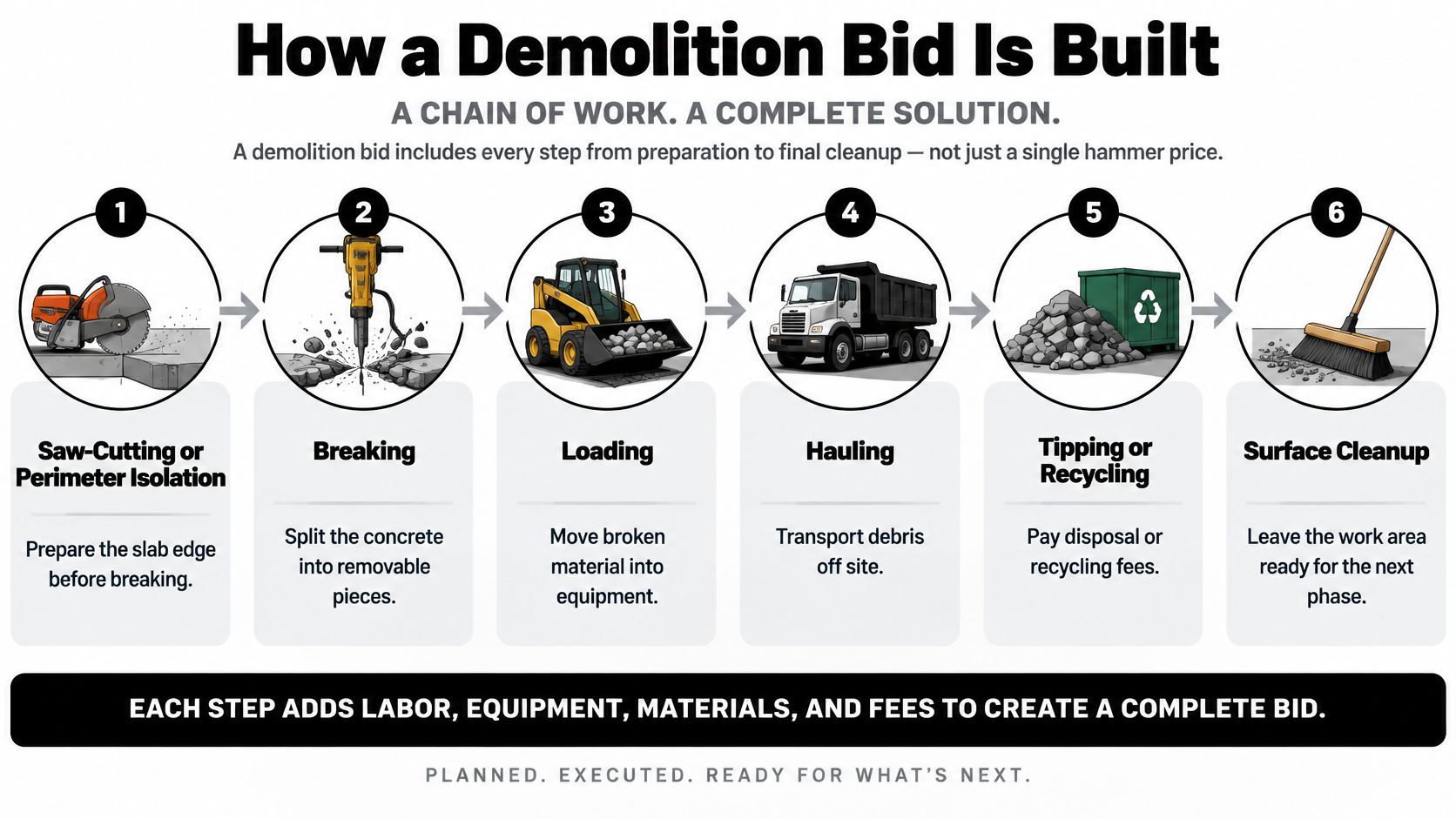
A demolition estimate should follow the crew's work, not stop at the breaker attachment. RSMeans estimating guidance distinguishes concrete cutting, cutout demolition, concrete demolition, and rubbish handling, and warns that selective-demolition prices may exclude handling, loading, storage, hauling, and disposal.
The sequence below makes those boundaries visible.
Follow the Work From Edge Protection to Cleanup
The crew first isolates concrete that must remain. Saw-cutting at a garage entrance or adjoining sidewalk helps establish a controlled removal boundary. Breaking follows, using equipment suited to the slab and available access.
Loading is its own operation. The machine breaking concrete may also need to load it, so production pauses while the operator changes tasks. Hauling then introduces truck availability, payload limits, travel time, and receiving-facility hours.
Finally, someone must leave the site ready for the next phase. Sweeping loose debris isn't the same as excavating unsuitable soil, compacting a replacement base, or restoring damaged landscaping.
Line Items That Make Up a Demolition Bid
| Line item | Pricing basis | Planning figure |
|---|---|---|
| Saw-cutting or perimeter isolation | Per linear foot | Measure the isolation cuts and request a quoted unit price |
| Breaking, loading, and removal | Per square foot | $1.50 to $3.00 combined, out-of-market 2024 benchmark |
| Labor crew | Crew-hours | Request crew composition, hours, and rate; no local benchmark established |
| Equipment rental | Machine-days | Request machine type, duration, delivery, and pickup |
| Hauling and truck minimum | Per load or mileage | Name payload, estimated loads, haul distance, and minimum charge |
| Tipping or recycling | Per ton | $44.87 to $80.67 regional 2024 benchmarks, not local receiving quotes |
| Subgrade and final grading | Allowance | State excavation limits, replacement material, and finished condition |
| Permit | Per project | $150 to $2,500 residential planning band |
Don't add overlapping lines twice. If a removal unit price includes loading and hauling, those tasks shouldn't also appear as separate additions unless the contractor explains the distinction.
On commercial work, check mechanical and electrical drawings for equipment pads as well as structural sheets. A pad supporting equipment still belongs in the concrete quantity, even if it isn't drawn on the main demolition plan.
AmbitionCFO's explanation of job costing and seeing beyond company-wide profit averages provides useful context for why contractors track labor, machinery, and disposal by project. For the buyer, the practical test is simpler: align included tasks side by side before deciding which bid is cheaper.
Disposal Hauling and Recycling Costs
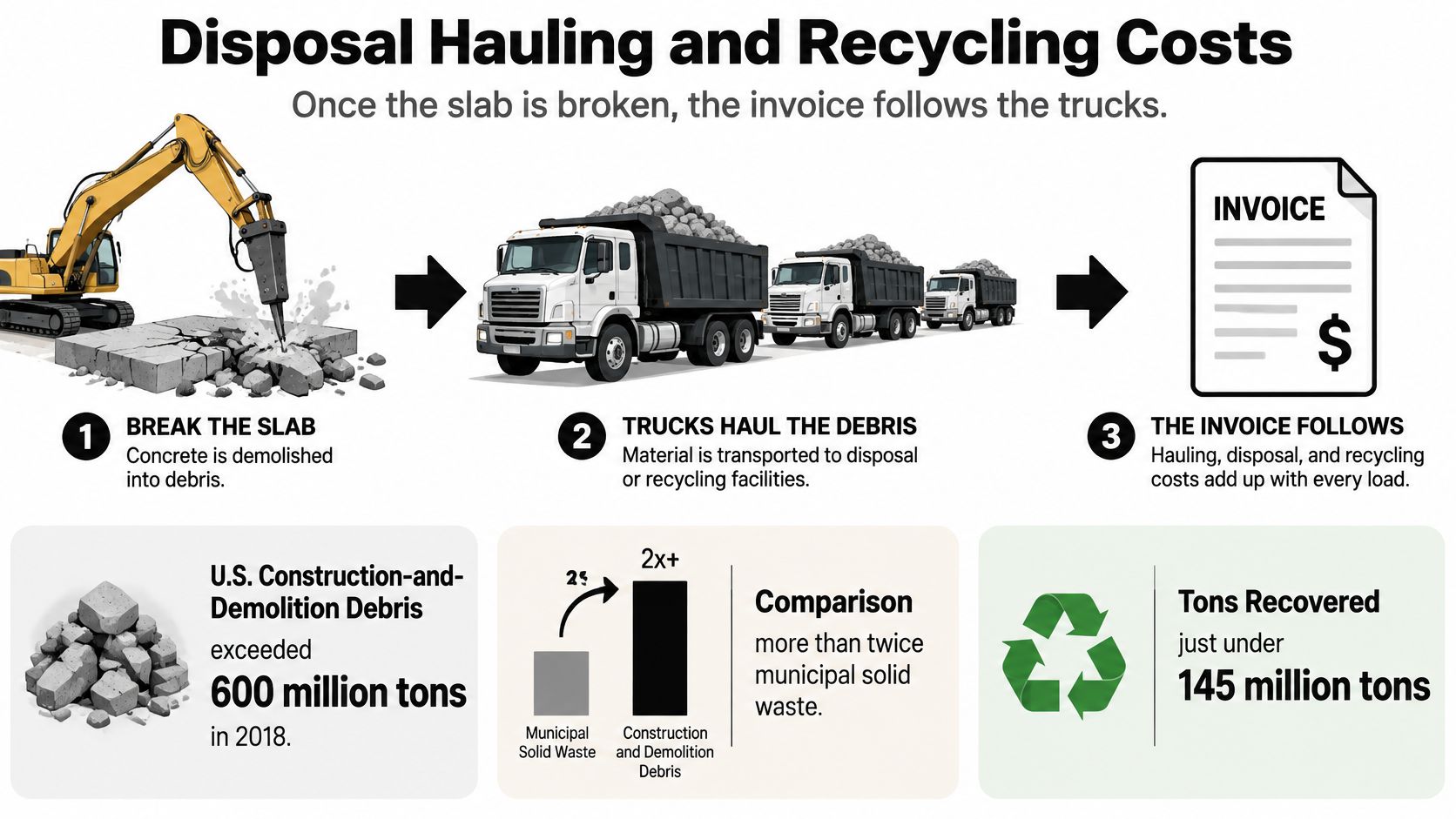
Breaking the slab is only part of the bill. Each load must be sorted, hauled, and accepted by a receiving facility, so distance and disposal rules can matter more than the breaking rate.
The EPA's construction-and-demolition debris summary estimates that U.S. C&D debris exceeded 600 million tons in 2018, more than twice municipal solid waste. Just under 145 million tons went to landfills, while more than 455 million tons were directed to a next use.
Recycling does not automatically cost less, and landfill fees are not uniform. C&D tipping fees vary by region, facility, and whether the load is clean concrete or mixed debris. Ask which facility will receive the material and get its actual rate.
The route from slab to destination helps explain why disposal assumptions belong in the bid.
Where Broken Concrete Goes and What That Does to Price
| Material path | When it fits | Cost effect |
|---|---|---|
| Landfill as a mixed load | Concrete mixed with soil, trash, or asphalt | May mean higher processing or tipping fees than clean concrete |
| Recycling as clean concrete | Slab kept separate from other debris | May reduce landfill fees, while sorting and hauling still cost money |
| On-site crushing reused as base | Larger projects with enough material and room to work | Crusher mobilization may not pay on a small driveway |
| Haul of the concrete layer only | Base rock, edges, and drains excluded from the quote | Lowers the initial price, but excluded work may become an extra |
For example, one contractor may separate concrete for delivery to a nearby recycler, while another prices a longer haul with mixed debris. The second contractor could have the lower breaking rate and still charge more overall.
Small loads may also face a truck minimum. Overloading is not a sound way to reduce costs. The estimate should allow for a realistic payload and the trips needed to move the material safely and legally.
Ask whether separating the concrete lowers the total delivered disposal cost, including sorting and transportation.
For larger commercial slabs, compare on-site crushing as a separate option. Include crusher delivery and operation, steel separation, stockpiling space, and whether the recycled aggregate suits the planned base. A useful pile of crushed material still has production and handling costs.
The video provides a visual reference for the removal work.
Ask the proposal to identify expected tonnage, haul distance, receiving facility, material acceptance rules, and how disposal is charged. Without those assumptions, it is difficult to compare bids or understand why the final invoice changed.
Site Conditions and Driveway Scopes That Change the Bid
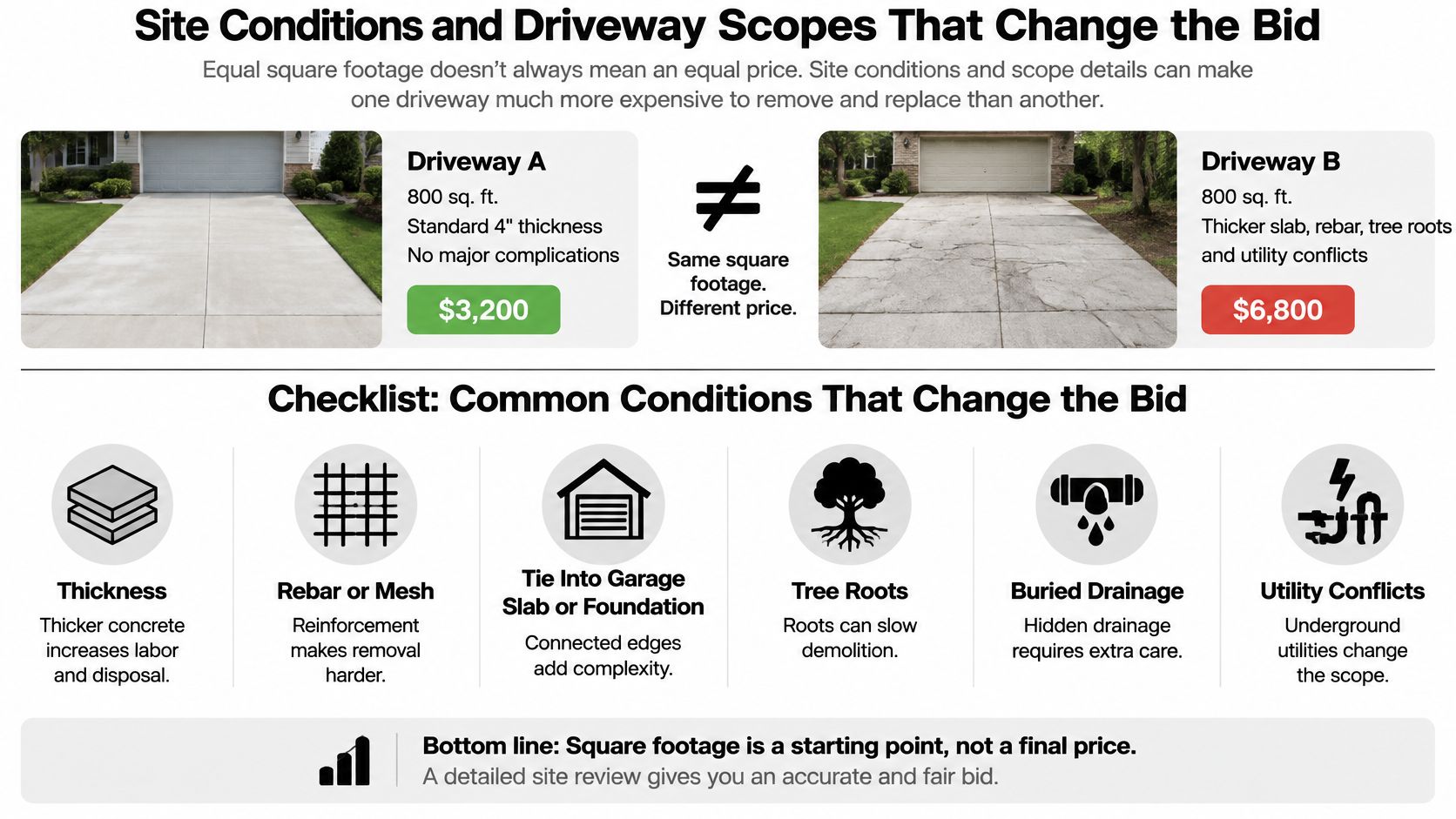
Equal square footage doesn't mean equal work. Reinforcement, connected foundations, roots, buried drains, and restricted access can require different tools and slower removal. The EPA's sustainable C&D materials guidance also identifies concrete and asphalt concrete as materials that can enter aggregate and other reuse streams, making material separation part of scope planning.
Verify Conditions Before Choosing the Removal Scope
- Slab and steel: Record thickness at exposed edges and identify known rebar, mesh, thickened sections, and connections.
- Utilities: Arrange utility locating and identify private irrigation, lighting cables, and drainage lines separately.
- Equipment access: Measure the actual route from the street to the slab, including gates, overhead clearance, and turning space.
- Water movement: Photograph ponding after rain and note whether water travels toward the garage or foundation.
Cracking needs a diagnosis before it becomes a demolition quantity. The WHEDA concrete maintenance specification recommends section replacement where multiple cracks exceed 1/4 inch, or where a longitudinal crack runs in the direction of travel, and calls for correcting settlement that creates hazardous ponding.
Narrow, stable cracks may be candidates for cleaning and flexible sealing. Displaced panels, recurring settlement, or broken edges require a closer look at the supporting base rather than a cosmetic patch.
These site features should be documented during the estimate visit.
Three Atlanta Demolition Scopes and What the Bid Must State
| Job | Concrete scope | Extra cost drivers | Bid must state |
|---|---|---|---|
| Straight two-car tear-out | Standard residential slab with truck access | Saw-cuts at the garage and edges | Thickness, haul distance, and whether the base stays |
| Reinforced sloped drive | Thicker sections with mesh or rebar and a grade change | Slower production and steel sorting | Reinforcement, tonnage, and a subgrade allowance |
| Apron or widened approach | Private slab plus curb, sidewalk, or right of way | Separate approval and approach restoration | Who pulls the permit and what public surface is rebuilt |
A connected garage slab requires particular care. The crew should not pull against an attached edge and hope the retained concrete stays intact. Establish the separation method and identify any structural question before demolition.
Replacement specifications matter too. An Atlanta-area driveway construction guide identifies 4 inches as a common residential driveway thickness while emphasizing that the approved application determines the specification. Reinforcement doesn't compensate for weak soil or poor drainage.
We specialize in ready-mixed concrete driveway replacements. Our residential driveway concrete services allow the removal boundary and replacement requirements to be considered together, rather than treating the exposed base as somebody else's problem.
Ask whether demolition and base inspection can precede the final concrete order. That creates an opportunity to resolve unsuitable soil before committing to the replacement pour.
Permits Aprons and Public Right of Way
Start by drawing a boundary between the private driveway slab and the street-facing approach. A project can be mostly on private property and still require separate approval where it crosses a sidewalk, changes a curb cut, or affects public drainage.
The PermitMint Atlanta concrete-slab guide says sidewalks, curb cuts, and driveway approaches generally require review by the relevant Public Works or Transportation department; it also describes possible IRC R105.2 exemptions for at-grade sidewalks and driveways, a structural review distinction for slabs more than 30 inches above adjacent grade, and typical guide fees of $75 to $600.
Confirm the Approval Path Before Cutting
- Identify the authority: Establish whether the property falls under the City of Atlanta, Fulton County, Cobb County, Gwinnett County, or another municipality.
- Describe the change: Distinguish replacement within the existing footprint from widening, extension, relocation, and a new street connection.
- Mark public features: Show the sidewalk, curb, apron, drainage route, and any work beyond the property boundary.
- Assign responsibility: Put permit applications, fees, inspections, and correction work under a named party in the contract.
Don't treat an at-grade exemption as permission to alter public property. Building-code exemptions and right-of-way approvals address different questions. The reviewing office may also examine drainage and impervious-surface limits.
A raised slab can require footings, guardrails, and engineering review rather than an ordinary flatwork detail. If that description fits the property, resolve the design classification before scheduling removal.
Scheduling safeguard: Get the approved footprint clear before committing to the replacement concrete delivery.
Account for the Sidewalk as Its Own Surface
A driveway approach that crosses a public sidewalk must work for pedestrians as well as vehicles. The estimate should identify whether the sidewalk remains, receives isolated repairs, or must be rebuilt as part of the approach.
Our residential sidewalk concrete services address sidewalk restoration beside homes and businesses. Where driveway and sidewalk work meet, define their shared boundary so neither scope leaves an unfinished strip or an unpriced restoration obligation.
Permit review, inspections, and concrete installation are separate scheduling activities. Obtain the reviewing authority's current requirements rather than assuming a published planning window guarantees a start date.
Worked Budget for a 520 Square Foot Driveway
Consider a hypothetical 520-square-foot driveway with a 4-inch slab, direct truck access, and a clean-concrete haul. The purpose is to show the arithmetic, not establish an Atlanta removal rate.
Applying the published out-of-market removal reference produces $780 to $1,560, calculated as the example area multiplied by $1.50 to $3.00 per square foot. The Phoenix reference includes sawing, demolition, and removal; the Bedford reference starts higher. Neither substitutes for a measured local proposal.
Build an Example Without Double Counting
| Example line | Calculation or treatment | What to verify |
|---|---|---|
| Slab volume | 520 × 4 ÷ 12 = approximately 173 cubic feet | Actual thickness and thickened edges |
| Removal reference | 520 × $1.50 to $3.00 = $780 to $1,560 | Which removal operations the unit rate includes |
| Assumed debris weight | Approximately 13 tons for illustration only | Replace with the estimator's documented quantity |
| National tipping comparison | 13 × $65.84 = approximately $856 | Actual receiving charge and material classification |
| Lower regional comparison | 13 × $44.87 = approximately $583 | Comparison only, not an Atlanta quote |
| Higher regional comparison | 13 × $80.67 = approximately $1,049 | Comparison only, not an Atlanta quote |
The weight is an explicit scenario assumption, not a measured quantity. The volume calculation establishes how much solid concrete the example contains, but truck payloads and billed weight need the contractor's quantity assessment and receiving records.
If the removal reference already includes disposal, adding the tipping comparison would overstate the budget. If it excludes receiving fees, combining the removal reference with the national tipping comparison gives an illustrative $1,636 to $2,416 before separately excluded work and permits.
Replace Assumptions Before Signing
Request a local quote that identifies whether the receiving charge is included, what permit path applies, and how unsuitable base material will be priced. Don't automatically add both published permit bands.
This example excludes new concrete, reinforcement for the replacement, drainage reconstruction, and decorative finishing. A thicker slab or changed approach requires revised quantities and scope, not an unexplained flat surcharge.
Ways to Lower the Bill and Compare Bids
Spend effort on the items a contractor can control: material separation, access, coordinated scheduling, and a complete scope. If damage is localized, our residential concrete and masonry repair services provide a relevant alternative to discuss before choosing full removal.
Keep Replacement Decisions Connected
Concrete Driveway Replacement Atlanta involves more than demolition. Useful supporting topics, each tied to a practical decision, include:
| Supporting article | Information and example to consider |
|---|---|
| How Much Does a Concrete Driveway Cost in Atlanta? | Separate removal from installation and finishing |
| Concrete Driveway Replacement Cost Atlanta 2026 | Compare a complete replacement with an incomplete tear-out bid |
| How Long Does a Concrete Driveway Last in Atlanta? | Evaluate drainage and base condition, not age alone |
| Concrete Driveway vs Asphalt in Atlanta | Compare replacement materials for the intended vehicle use |
| Best Concrete Thickness for a Residential Driveway | Match the design to passenger vehicles or heavier loads |
| Do You Need Rebar in a Concrete Driveway? | Discuss reinforcement without overlooking base preparation |
| Concrete Driveway Cracks: When Should You Replace It? | Distinguish stable cracks from displaced panels |
| Concrete Driveway Repair vs Replacement | Compare isolated section repair with complete removal |
| How to Fix Drainage Problems on an Atlanta Driveway | Trace garage-side ponding to its cause |
| Concrete Driveway Apron Atlanta | Separate the street approach from private flatwork |
| Driveway Widening Atlanta | Check the proposed footprint before demolition |
| Driveway Extension Atlanta | Account for new base preparation beyond the existing slab |
| Stamped Concrete Driveway Atlanta | Keep decorative finishing separate from removal costs |
| Concrete Driveway Sealing Atlanta | Plan maintenance after installation |
| How Long Before You Can Drive on New Concrete? | Obtain project-specific opening instructions |
| Concrete Driveway Maintenance Guide | Plan cleaning, inspection, and periodic sealing |
Savings and Bid-Comparison Checklist
- Keep loads clean: Confirm recycler acceptance before mixing rubble with soil.
- Avoid unnecessary crushing: Request delivered recycling pricing for a residential tear-out.
- Coordinate mobilization: Compare combined removal and replacement with separately scheduled work.
- Resolve the cause: Include needed base and drainage corrections.
- Limit approach changes: Alter the curb connection only when the project needs it.
- Standardize bids: Give bidders the same thickness, access, disposal, and restoration scope.
- Bring useful photos: Include cracks, ponding, gates, slopes, and the street approach.
Financing is available for our projects. For a free estimate, we schedule a site visit to assess requirements, then provide a detailed and accurate estimate outlining the scope and associated costs.
Atlanta Concrete Solutions offers driveway replacement, concrete installation, repair, and maintenance, with free estimates that help you understand demolition within the full project scope. Call (678) 554-4433 to request a free quote, or visit Atlanta Concrete Solutions to arrange an assessment of your driveway, access, and replacement requirements.