
You're standing beside a new driveway, lawn renovation, or low area near a sidewalk, and the supplier asks how many yards of soil you need. The temptation is to answer with the area alone. That's where many Atlanta projects go wrong. A “yard” describes volume, not a guaranteed weight, finished depth, or suitable construction base.
One cubic yard can be useful for a garden bed, lawn repair, or final grading layer. It can also arrive far heavier than expected after rain, settle below the planned elevation, or create a weak foundation if it's placed beneath concrete. The right order depends on depth, soil quality, moisture, access, and the job's structural purpose.
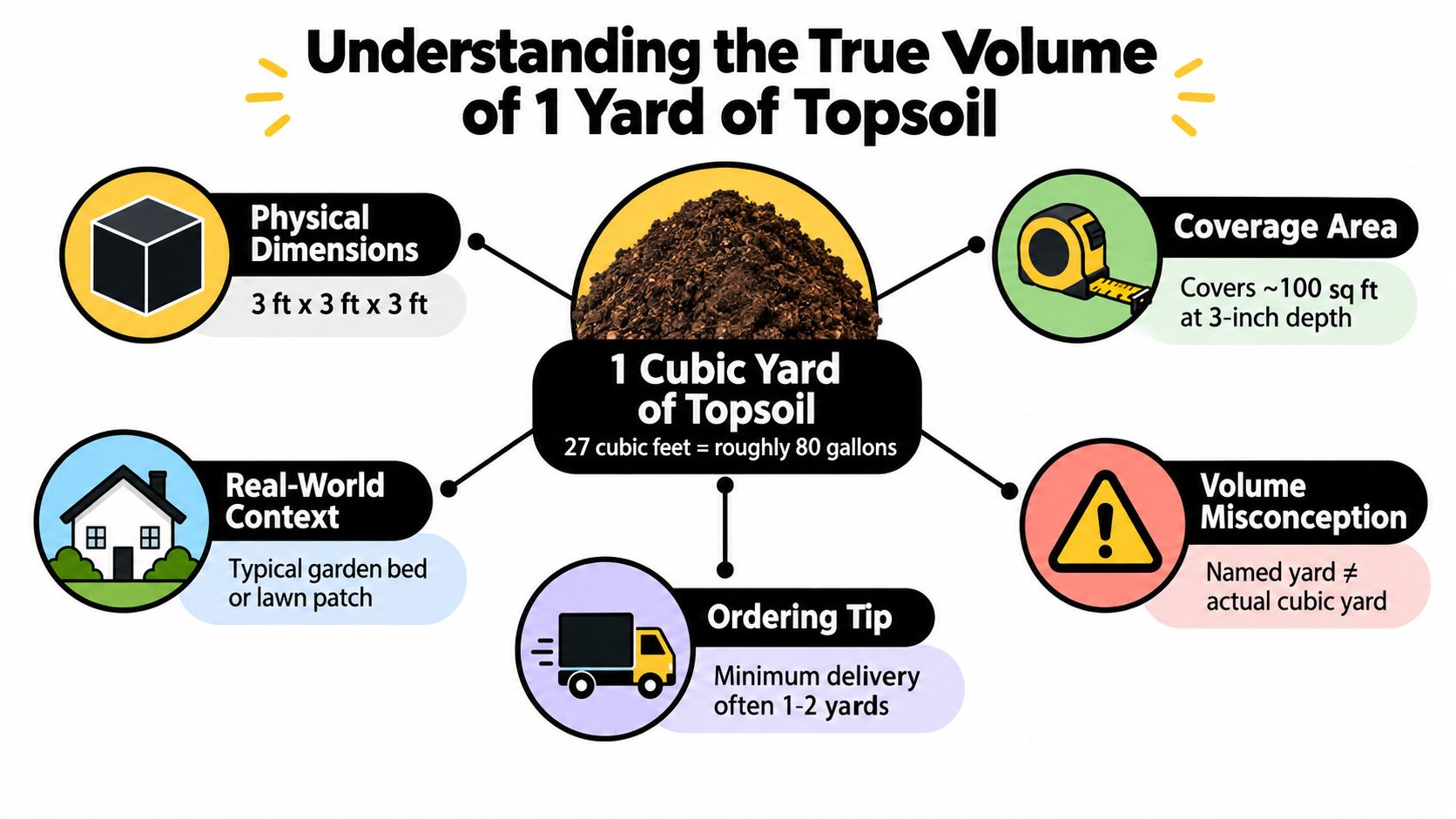
Understanding the True Volume of 1 Yard of Topsoil
A cubic yard is a volume measurement equal to 27 cubic feet, or 46,656 cubic inches. In simple physical terms, it occupies the volume of a cube measuring 3 feet by 3 feet by 3 feet. That description establishes the space the material takes up, but it doesn't tell you how well the soil will perform once it reaches the property.
Volume is only the starting point
In soil science, topsoil generally corresponds to the surface A horizon, the mineral layer containing sand, silt, clay, organic matter, nutrients, and active soil organisms. The USDA Natural Resources Conservation Service explanation of soil horizons describes this layer as commonly called topsoil and notes that it's typically darker, more fertile, loose, and crumbly than the subsoil beneath it.
Commercial topsoil isn't always a naturally excavated slice of that horizon. A supplier may sell a screened or blended product made from mineral soil, compost, sand, or other amendments. That can be a good choice, but you should ask what the blend contains rather than assuming every “topsoil” product has the same texture or fertility.
Screening affects how evenly the material spreads. Organic matter affects water retention and plant growth. Texture affects drainage and how readily roots move through the layer. For a lawn or planting bed, those properties may matter more than the name printed on the delivery ticket.
Practical rule: Order by cubic yards, but choose the material by its intended use, texture, organic content, and drainage behavior.
Near an existing driveway, sidewalk, or foundation, quality also includes how the material affects grade. A rich planting blend may be excellent around shrubs, while a coarse mineral topsoil may be easier to shape along a lawn edge. Neither should be treated as a substitute for engineered base material beneath concrete.
Calculating Coverage and Accounting for Settling
A quick measurement can look sufficient on paper, then fall short after the soil is spread and consolidated. Start with the standard coverage formula:
Area in square feet × depth in inches ÷ 324 = cubic yards required.
The divisor comes from 27 cubic feet per cubic yard multiplied by 12 inches per foot. At a fixed depth, coverage changes directly with the amount of material delivered.
Topsoil Coverage by Depth
| Target Depth | Coverage Area | Best Use Case |
|---|---|---|
| 1 inch | Approximately 324 square feet | Light topdressing or minor surface correction |
| 2 inches | Approximately 162 square feet | Lawn renovation or shallow planting preparation |
| 3 inches | Approximately 108 square feet | Deeper lawn repair or general grading layer |
| 4 inches | Approximately 81 square feet | New lawn preparation or substantial soil replacement |
For example, a 1,000-square-foot lawn at 4 inches requires approximately 12.35 cubic yards before allowing for settling, grading losses, or uneven ground. The same yard spread at 2 inches covers approximately 162 square feet, while a 3-inch layer covers approximately 108 square feet. These figures describe even placement on a level area, not the extra material consumed by slopes, depressions, or rough existing fill.
The theoretical result is only the starting point. Delivered soil is loose, and the installed layer can finish thinner after spreading, watering, rainfall, grading, foot traffic, and compaction. Some consumer calculators model 15% settling, as discussed in this settling and coverage calculator. Treat that figure as a planning reference, because the appropriate allowance depends on the soil blend, ground condition, and how aggressively the material is worked.
Finished depth versus loose depth
Set three elevations before ordering:
- Finished depth, the thickness you want after settlement.
- Loose placement depth, the thickness immediately after spreading.
- Final settled depth, the thickness after water and consolidation affect the soil.
This distinction matters beside Atlanta driveways, sidewalks, drainage swales, and slabs. Too little material leaves thin coverage and exposed low spots. Too much can raise the grade against concrete, redirect runoff, or trap water beside a structure. Topsoil also belongs above the planting area, not beneath a concrete or driveway base, where its organic content and settling can undermine the surface.
Measure separate lawn areas independently, add the results, and discuss rounding with the supplier. A smooth rectangular lawn is easier to estimate than a sloped yard with roots, old fill, ruts, and drainage channels. Those conditions consume material before the visible surface reaches the target elevation, so verify finished elevations at edges and low points before the truck arrives.
Weight Variations and Driveway Protection
The phrase “one yard of soil” doesn't identify a fixed load weight. Published estimates place dry, loose loam at roughly 1,900 to 2,200 pounds, while wet material may reach roughly 2,800 to 3,200 pounds, according to this topsoil weight range reference. That means moisture can change the load by more than 1,000 pounds even when the ordered volume remains the same.
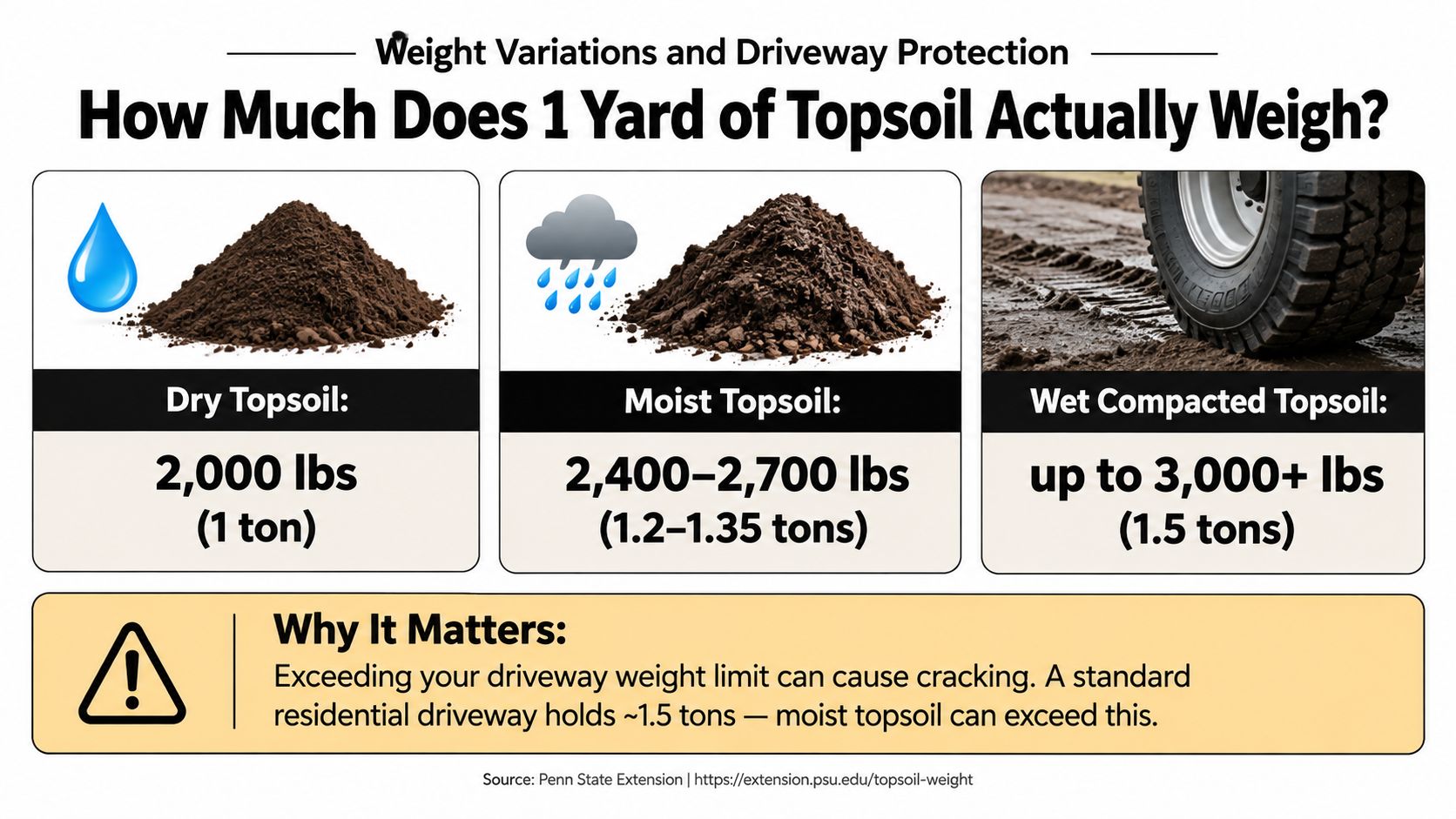
After heavy Atlanta rain, the issue isn't just whether the truck can reach the property. Wet ground can rut, soft shoulders can collapse, and a heavy vehicle may damage pavers, driveway edges, buried irrigation, or recently placed concrete. A truck that can access a compacted gravel drive during dry weather may be a poor choice when the subgrade is saturated.
Call the supplier before delivery and ask:
- What material is being delivered?
- Is the quoted quantity loose delivered volume?
- What moisture condition should you expect?
- What truck and axle configuration will arrive?
- Can the driver unload on the street or only on the driveway?
- Where can the truck safely turn or stop?
For unusual access conditions, equipment and load movement deserve the same attention as the soil itself. A practical ANTS Trailers guide can help readers understand how material-handling equipment is designed for bulk loads, although a residential delivery still requires a site-specific access decision.
The safest drop zone is usually firm, level, and away from finished edges. Don't assume plywood makes every surface safe. It distributes some pressure, but it won't eliminate the risk created by a saturated lawn, weak subgrade, or a heavy truck turning in place.
For driveway work, material logistics should be planned before the truck is scheduled. A contractor evaluating a new or existing slab can also review residential driveway concrete as part of the broader access and surface-protection plan.
Topsoil Versus Structural Fill for Concrete Bases
Topsoil belongs in the biological zone of a property. Concrete belongs on a stable, compacted structural base. Those purposes conflict when a homeowner uses topsoil to raise a driveway, patio, slab, or walkway before pouring concrete.
Topsoil contains organic matter and active organisms that help plants grow. That same organic content can decompose, compress, hold variable amounts of water, and create an inconsistent supporting layer. A slab poured over it may settle unevenly, lose support, and crack even if the concrete mix and finish work were acceptable.
What belongs below a slab
Structural fill is selected for stability and compaction rather than plant growth. Depending on the design and site conditions, a contractor may use suitable mineral fill, crushed stone, gravel, or a graded aggregate layer. The material must be placed and compacted in a way that creates consistent support beneath the planned slab.
A typical decision looks like this:
| Material | Primary purpose | Main concern |
|---|---|---|
| Topsoil | Lawns, planting beds, final landscape grading | Organic matter and settlement |
| Structural fill | Raising grade and building stable subgrade | Must be suitable for compaction and drainage |
| Aggregate base | Supporting concrete or pavement systems | Requires correct thickness, grading, and compaction |
The first construction step may be stripping away the existing A horizon entirely. If a driveway area contains dark organic soil, roots, mulch, loose landscaping material, or soft fill, placing stone directly over it may still leave a weak layer below. Excavation depth depends on the design, existing grade, soil condition, drainage, and required finished elevation.
Topsoil can return above or beside the finished concrete as fill material. It shouldn't form the load-bearing layer beneath the slab merely because it's convenient to spread.
A planting material can be excellent for roots and still be unacceptable under a vehicle load.
The same distinction applies to specialty planting. If you're selecting a free-draining medium for containers or succulents, this guide to the best soil for succulent plants offers useful context on why plant requirements differ from concrete-base requirements.
Before ordering soil for a new pad or driveway extension, identify whether the delivery is for finish grading or subgrade construction. For foundation-related concrete, the material decision should be coordinated with the full residential foundation concrete scope, including excavation, drainage, reinforcement, and placement conditions.
Navigating Atlanta Permits and Drainage Rules
A soil delivery can become a permitting issue when it changes a driveway connection, sidewalk, curb area, or public drainage path. In the City of Atlanta, the Department of Transportation states that work disturbing the public right-of-way requires a permit. Its examples include installing or repairing a driveway apron, constructing work that requires an apron, and related sidewalk work, as explained on the city's right-of-way permit information page.
The boundary matters because a private driveway slab may connect to a publicly controlled apron or sidewalk. A homeowner may own the property beyond the right-of-way but still need approval for work at the street connection. Adding soil or fill can change the elevation at that boundary, so the material order should follow the approved layout rather than establish a new grade by guesswork.
State highway connections require extra care
Georgia Department of Transportation rules require a permit before construction or non-routine maintenance in a state-highway right-of-way. The listed work includes grading, drainage work, and development access. For driveways connecting to the state highway system, drainage must function consistently with the highway drainage system and follow the current Georgia DOT Drainage Manual, as detailed in the Georgia DOT driveway encroachment guidance.
Pipe requirements can also affect the order of work. Commercial driveway pipes in the right-of-way must be concrete, while residential driveway pipes may be corrugated metal, concrete, or approved HDPE under the applicable rules. That decision shouldn't be made after soil is already dumped across the access route.
Drainage deserves a site inspection before grading. Ask where water comes from, where it currently flows, whether an uphill property sends runoff toward the driveway, and whether a culvert or swale is blocked or undersized. Resources covering landscape drainage solutions can help homeowners understand the range of approaches, but public right-of-way work still needs the applicable Atlanta or Georgia approval.
FHWA guidance likewise treats drainage investigation as part of pavement assessment. Its pavement preservation and repair guidance identifies moisture-related distress, cross slopes, ditches, and edge-drain conditions as items to evaluate. Raising grade with topsoil without correcting the water path can leave the driveway problem in place or move runoff toward a neighbor.
Executing a Smooth Delivery and Placement
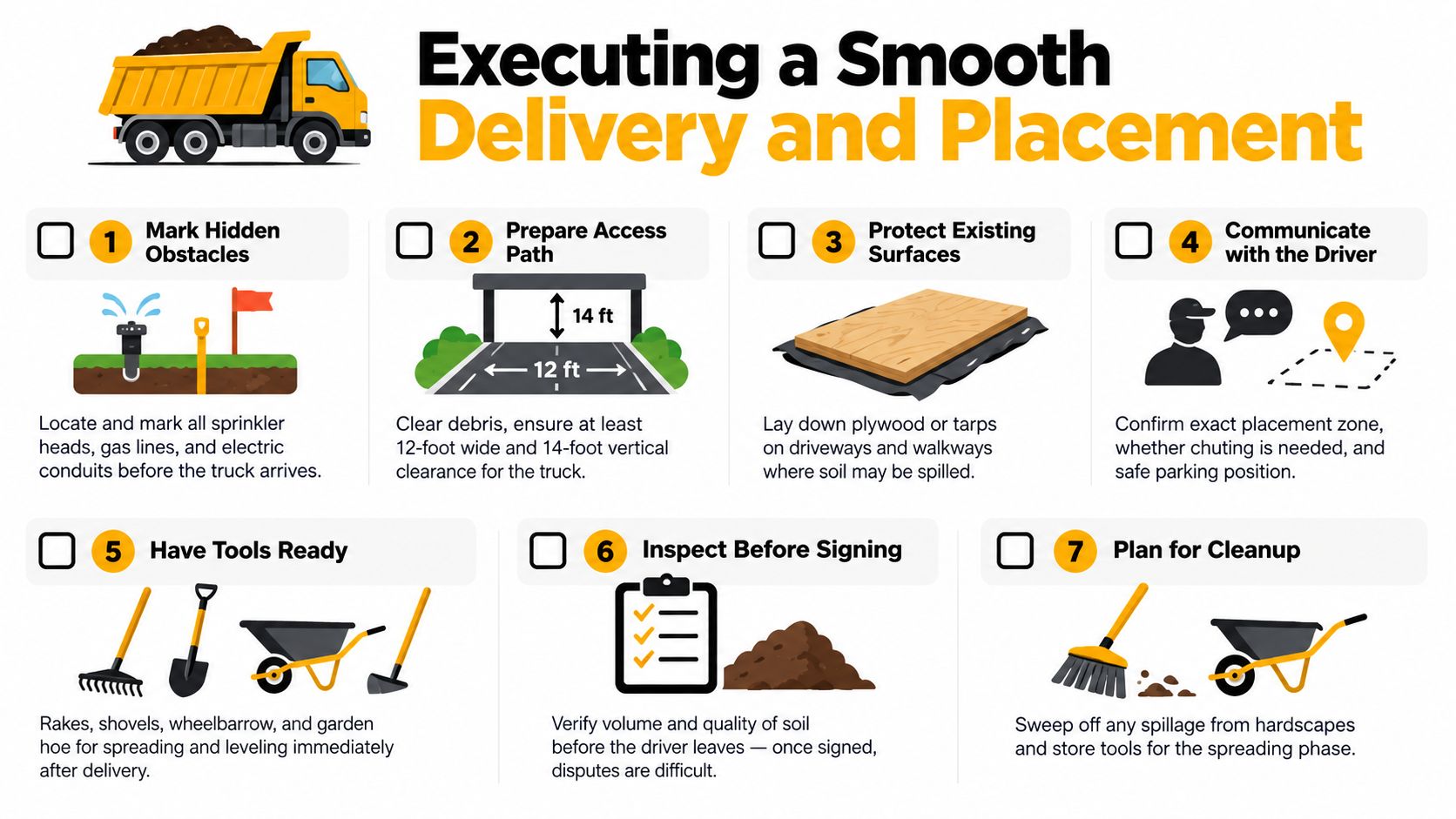
A successful delivery starts before the truck leaves the supplier. Mark sprinkler heads, clean the access route, identify low wires and tree limbs, and choose the exact drop zone. If the ground is soft, decide whether the load should be placed on a firm surface and moved with a wheelbarrow rather than risking ruts across the lawn.
Delivery-day checklist
- Mark hidden obstacles: Flag irrigation heads, utility locations, cleanouts, and buried conduits before arrival.
- Prepare the route: Remove debris and confirm the truck's clearance from branches, wires, gates, and structures.
- Protect finished surfaces: Use plywood or tarps where appropriate, while remembering that protection doesn't replace a firm base.
- Confirm placement: Speak with the driver before unloading so the pile lands where it can be spread efficiently.
- Stage the tools: Have rakes, shovels, a wheelbarrow, and a garden hoe ready before the load arrives.
- Inspect the material: Check the apparent volume, texture, debris, and moisture condition before signing.
- Plan cleanup: Sweep soil from concrete and pavers promptly, then cover or spread the pile before weather changes its handling properties.
For a small lawn repair, spread the material while it's workable and use a rake to feather the edges into the existing grade. For a driveway-adjacent project, keep soil below the intended concrete elevation and preserve the drainage path rather than pushing material against the slab. More information about concrete, masonry, and related site services is available through the Atlanta Concrete Solutions service team.
Atlanta Concrete Solutions can help homeowners separate soil needs for the grounds from the excavation, base preparation, drainage, and concrete work required for a durable driveway or slab. Visit Atlanta Concrete Solutions to request a project evaluation and discuss the right material and placement plan for your Atlanta property.